




Abstract
Jammu and Kashmir, famous for its picturesque beauty, is one of the most attractive and welcoming tourist hubs in India. The tourism industry contributes significantly to Jammu and Kashmir’s GDP. In addition to its scenic beauty, this union territory is rebranding itself with adventure, horticulture, cultural, eco, film, rural, spiritual and golf tourism. Following an uncertain business environment, new policies are being framed which may enhance investments. The government has taken several initiatives to develop an ambience and new favourable infrastructure simultaneously. Now the challenge is to determine if an individual (here Mrs Fatima Wani, a Canada-based entrepreneur) should invest in the hotel industry of this union territory. Since she inherited an ancestral property recently, can she now consider taking up this venture as the laws and environment are favourable to her?
Introduction
Fatima Wani, an experienced hotelier from Canada, is thinking of returning to the native soil. She foresees several opportunities in the tourism industry of Jammu and Kashmir (J&K). She is planning to make a financial investment in a phased manner starting from Q1 of FY 2023–2024 and expects to complete it in the next two years. Her research team has been dogged by the supportive culture, government initiatives and policies, which promote investments in tourism. Additionally, she is determined that the union territory is rebranding itself.
With changes in land and administrative policies from FY 2019–2020, the process of acquiring land and investment has been made a lot less cumbersome. The government has also rolled over a range of incentives in the form of tax sops and subsidies. In order to leverage such attractive investment enablers, Wani is exploring the possibility of investing in this picturesque region.
Having seen several new developments in the tourism sector, she finds herself in a bind. Should she construct another hotel when there are already huge in numbers? What is going to be the USP of the services her hotel is intending to provide? How would the new business entity deal with an uncertain business environment? What about the trained and professional workforce, which is not readily available? and so on.
She has completed a master’s degree in hotel management and has worked for several leading hotel chains. Given Fatima’s current expertise in budget hotels, she is interested in exploring the prevailing market gap in the union territory. Based on this, she will decide whether the investment will be routed towards making a luxury hotel or a budget hotel.
She resolves these queries with the help of her research team to decide what should be done.
J&K Tourism
Located in the northern part of India, J&K is one of the most attractive, appealing and heartwarming destinations. J&K is now divided into three sub-regions (Jammu, Kashmir and Ladakh). Administratively, the erstwhile state was bifurcated into two union territories (J&K and Ladakh).
J&K is a host of beautiful locations with a pleasant climate, delicious cuisine, natural waterfalls, apples and saffron fields, murmuring streams, lush greenery, local art and handicrafts that have always attracted travellers. It is an ideal vacation spot for poets, scholars, artists and travellers in general (UKEssays, 2018). The tourism sector of J&K contributes 7% of J&K’s GDP (Majid, 2021). Being the most reliant industry, it is a primary factor in generating employment and bringing foreign exchange to the country. FDI inflow in J&K stands at (USD 0.21 million) in October 2019–March 2021 (Brand India, 2021).
Government Initiatives
The number of initiatives has spurred up recently that affect the tourism industry. The majority of the population of J&K is directly or indirectly reliant on tourism for earning their bread and butter.
Since the government started to expand evening flights from cities like Mumbai, Hyderabad and Ahmedabad to Srinagar, tourist footfall has increased. The month of July–August 2021 recorded 0.1 million tourists visiting the union territory. The Department of Tourism has been able to vaccinate almost 90% of the stakeholders (shikarawalas, pony owners, caterers, etc.), a main reason for more tourists walking around (Ashiq, 2021).
In the contribution towards Azadi Ka Amrit Mahotsav, the Department of Tourism organized a dedicated celebration week in October 2021. The supreme event embraced performances on local arts, calligraphy and Sufism. The lesser-explored destinations include Gurez, Bangus Valley, Lolab, Daksum, Warwan Valley and Tosa Maidan. J&K has received I7,860 million (USD 104.73 million) for the development of the tourism industry. To attract tourists to such potential destinations, a three-month festival from November 2021 to January 2022 took place to gain familiarity and promote these new places. The celebrations include trekking and camping experiences, mountain bike adventures, New Year festivals, winter carnival, houseboat festivals, saffron-picking festivals and appreciably more (Shiraz, 2021).
J&K owns the highest altitude golf course in the whole country. Golf enthusiasts from every corner of the world visit the union territory and stay back for at least two to three days. As a result, the number of golfers has seen a growth right from 100 to 1,000 (Wani, 2021a).
When all COVID-19 related restrictions are removed, there is a huge possibility that arrival of foreign tourist would rise. To grab this opportunity, the government of India is expected to provide the first 0.5 million visas free of cost to revive the hospitality sector. This strategy is expected to have a financial outlook of I1 billion (USD 13.32 million) (Kashmir Reader, 2021).
Finally, an initiative is taken up by the administration by transfiguring 75 villages to create employment opportunities among the youth. Under the umbrella of Mission Youth, the rural areas are upgraded. The government is committed to empowering women and helping people convert their ideas to launch a business (Financial Express, 2021).
The government has issued certificates for forest rights to owners. On 26th September, SKICC hosted an air show which featured aircraft and helicopters (Wani, 2021b).
Recently, to bring back the charm of water transport, the Department of Tourism initiated a trial-and-error process of a luxury boat bus in Jhelum River. The boat is well-equipped with an air conditioner, LCD TV, rescue team and driver. It is launched by a company called Sukhnag Enterprises (Outlook, 2021).
The Department of Tourism has started with FAM tours (familiarization) accompanied by the presence of travel agencies, tour companies and journalists. They will give a shootout to a strong promotional campaign (Greater Kashmir, 2019).
Connecting Kashmir to the rest of the world by train is given special priority and shall be active in 2024. Currently, work has started on the 111 km of the Katra to Banihal segment. This section will come up with several iconic bridges and tunnels. The Chenab Bridge, which is the tallest railway bridge in Asia, will soon be functional.
The government is encouraging investments as they have endorsed 456 MOUs with different organizations recently. An MOU with Flipkart has been signed to promote local artisans (IBEF, 2021).
The Department of Tourism estimates that 7 million tourists will visit the union territory by the end of 2035, which is 28,000 visitors per day (Free Press Kashmir, 2021). To entertain the tourist influx estimation, a Master Plan has been initiated to mitigate the burden on existing infrastructure such as airports, railways, hotels and motels.
Business Environment
The tourism sector has seen some of the worst phases since the 1990s because of political instability, floods of September 2014 and more recently the coronavirus pandemic. The economy has dwindled due to these factors time and again. It has been a roller-coaster ride for tourism to survive in the valley. As a result, there has been an abrupt reduction in the tourist inflow from 1.17 million in 2013 to 0.4 million in 2016 (Irfan, 2017). In the last 10 years, the consecutive government and tourism stakeholders worked towards the revival of the tourism industry. While the industry was yet to stabilize, the government announced demonetization in November 2016 to get rid of black money. As a result, I 1,000 and I500 notes were demonetized.
The valley slipped into a slumber in August 2019 with a communication blackout and shut down for over a year. The tourism industry faced an unprecedented crisis with a major decline in tourist footfall. Domestic tourists were reduced by 87% and international tourists by 82% (Pandit, 2019). Nevertheless, this crisis was mitigated to a greater extent led to an increase in tourist influx since December 2020.
Recently, the COVID-19 pandemic has pushed the tourism industry into another dark phase where the losses sum up to I15 billion (USD 199.86 million) (Hussain, 2021). When COVID-19 was at its peak, people were left hopeless. They could hardly make money for survival because of the lockdown imposed in the country.
The union territory can become a global destination if peace prevails in it. It has complete potential to rule the market in the hospitality sector.
In terms of the prevailing business environment, there is a slight revival in progress. The government policies in terms of facilitating new investment in the tourism and hotel industry are very encouraging. With the fading away of the pandemic, the tourist influx from mainland India and the rest of the world has substantially grown. The introduction of high-speed internet (5G) and improvements in electricity availability along with improved air and road connectivity has made the region an attractive investment option. The government is also identifying and developing dozens of new tourist spots with diversified profiles in health tourism, business tourism, adventure tourism, village tourism, eco-tourism, etc.
In terms of competition, there is a wide range of budget hotels with a handful of luxury ones. Despite being a tourist attraction destination for eternity, there is still a huge market gap that can accommodate a lot of new hoteliers in all economic segments.
Financial Budget and Government Aid
The gross state domestic product for the year 2020–2021 accounts for I1.76 trillion (USD 24.28 billion). The national state domestic product for the year 2021–2021 has reached I1.49 trillion (USD 20.49 billion) (Rawat, 2021). After the second wave of COVID-19, the government declared a relief fund of I29.4 million (USD 0.39 million) to the tourism sector. An amount of I2,000 will be given to shikarawalas, tourist guides and people who help a tourist enjoy a sledge and horse riding (Hindustan Times, 2021). But this amount is sufficient for nothing, keeping into consideration the daily expenses a normal bread earner needs.
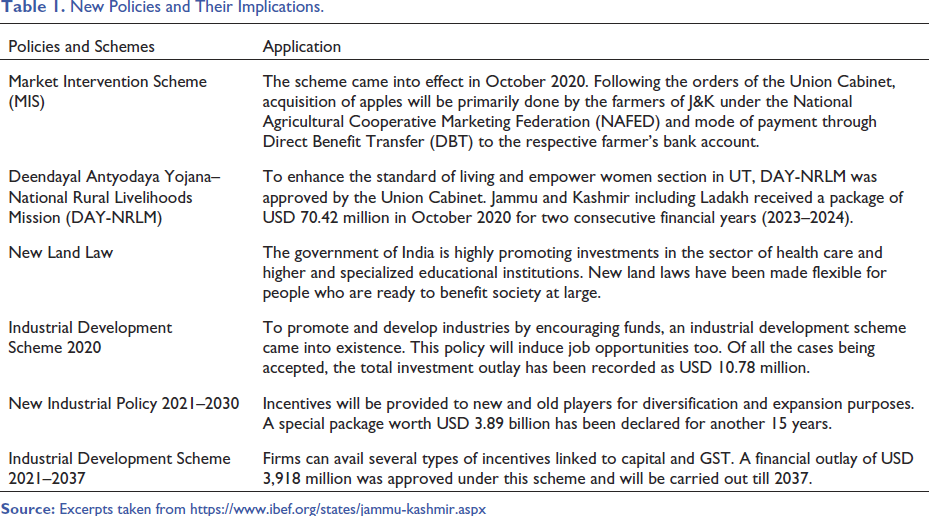
The financial outlay of the new industrial scheme approved by the Cabinet Committee of Economic Affairs for J&K is I284 billion (USD 3.78 billion). The term of the scheme is 1 April 2021–31 March 2037 (IBEF, 2021). A new budget is framed for the fiscal year of I1,086.21 billion (USD 14.47 billion). The decision to approve a budget lies in the hands of the Centre. But before it is put into practice, it should be discussed for input and suggestions. This budget framework did not include required consultation from stakeholders (Ganai, 2021).
Policies (for new policies refer Table 1)
Tourism Policy
The policy came into effect in 2020. Its purpose is to achieve the following objectives:
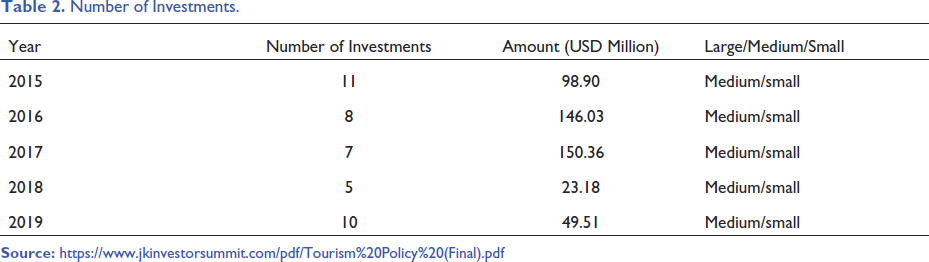
By 2025, J&K is expected to be an all-year-round tourist destination. To provide a minimum of 50,000 jobs every year and 4,000 service providers are expected to be trained in the next 10 years. To develop all forms of tourism in J&K. To set up a schedule of festivals performed every year that promotes the same at national and international levels. To increase investments in tourism (refer Table 2 to review previous investments).
New Policies and Their Implications.
Number of Investments.
Houseboat Policy
In 2005, a law was passed which banned repairs and reconstruction of houseboats and hotels. The owners of houseboats and hotels urged the government to provide ease with the same (Kumar, 2021), but the possessors were not able to find a way for emergency repairs. Unfortunately, many of the houseboats sank.
To protect Dal Lake and its surroundings, the Kashmir High Court directed a complete ban on constructions near 200 m of the periphery of the Dal Lake in 2009. The order supported that there will be no further renewal of licences and the total number of houseboats active should be decreased. Finally, the wait was over and happy news was on the air.
In April 2021, the government decided to lift the ban on the reconstruction and repairs of houseboats and hotels. They have a procedure to follow for acquiring such benefits. They need to pay off all the bills that are due to them and get a No Objection Certificate.
Film Policy
An administrative strategy in the form of a film policy was launched in J&K on 5 August 2021. It ensures single-window stress-free permissions for shooting purposes and is granted with no fee (Film Policy, 2021). This benefits the tourism sector as well as the local film units. Further, there will be a re-opening of old cinema halls, and drama schools will be exposed to train youth in film-making. J&K can be the most preferable film location. The J&K Film Development Council aims to achieve the targets and objectives of film policy. Film houses are exposed to several subsidies depending on the days of shooting, award engagement, accommodation, tax purposes and much more.
Findings from the Research Team
Challenges and Opportunities
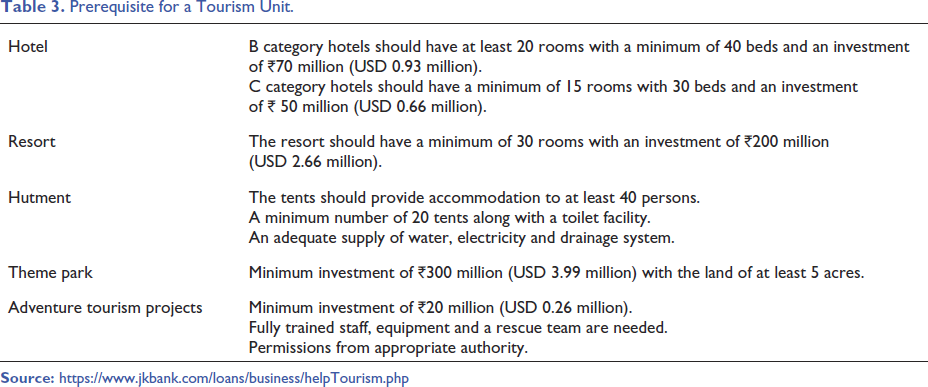
Hotel investment is a capital-intensive project (refer Table 3) which needs funds with a long tenure and feasible interest rates. Given the frequency of political unrest, the players in the tourism and hotel industry have often suffered volatile cash flows, resulting in unhealthy management of bank loans. The absence of an equity-based platform for funds results in a low-risk appetite for the respective hotelier’s balance sheets. In addition, there is a dearth of professional human resources which can cater to this industry. The dearth of skill-based professional institutes which could have provided staffing requirements for this industry is another big hurdle in the entire scheme of things.
Prerequisite for a Tourism Unit.
Moreover, the TRP-hungry mainstream media often portray the region in a very bad light, which keeps the inflow of tourists very limited. In the absence of proper and effective narrative management, the Kashmir tourism brand is losing its equity unnecessarily.
The president of the Travel Agent Association of Kashmir, Mr Farooq Kuthoo, talked about the putrid properties of hotels that need a necessary lookout whenever required. To strengthen tourism and boost it further, some untapped areas need to be considered right away.
The government should permit the owners to do the repairs and restoration on time. Few hotels are operating on lease. The owners are requesting the local authority to extend and renew the term of the contract. To promote tourism, tour operators and hoteliers visit different states and arrange road shows. Due to COVID-19, the whole economy suffered losses. It is difficult for stakeholders to manage these promotional campaigns as there is an adequate requirement for financial support.
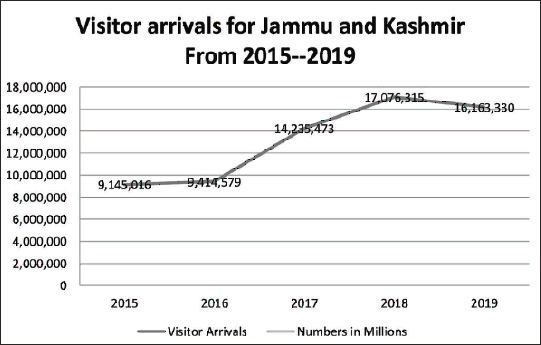
Everything comes with a price. More tourists are visiting the union territory (refer Figure 1), and it is affecting the environment badly. The residents and visitors are consciously contaminating different lakes, Mughal gardens, temples, waterways and shrines such as Dal Lake, Gulmarg, Pahalgam, Shri Amarnath Ji Shrine and Vaishno Devi. It is imperative to manage such activities before they adversely affect those whose livelihood depends entirely on tourism (UKEssays, 2018). It is important to satisfy all the customers varying from low-level income–high-level income. The low-budget tourists can afford a comfortable stay, food and sightseeing, but the problem is an air ticket, the cost of which is not affordable.
The government may take a step ahead and inquire the authorities to put a cap on airfares. The weather conditions get worse in winter which hamper NH road connectivity due to snow. It must be looked upon (Rising Kashmir, 2021). Upgradation of airport technical infrastructure which enables the landing and departure of airplanes during bad weather and low visibility scenarios can substantially solve the problem of connectivity. Therefore, an approach of ILS CAT3 (instrument landing system for improving operability under bad weather and low visibility) will do needful for people to travel even in bad weather conditions.
Strategies
Before promoting tourism products, it is necessary to reconsider the strategies. Kashmir has always been compared to Europe and Switzerland (Ashiq, 2021). Tourists who can not afford to visit Europe would prefer to go to Kashmir. People view J&K as an option rather than a priority. There is a lot more to explore in J&K than scenic beauty and icy mountains with snow. The new strategy is to rebrand the imagery of J&K. The need of the hour is to break the stereotyped description (Zahoor, 2021).
Developing adventure tourism (adventure sports, water sports, camping areas, trekking expeditions, hiking areas, rafting experiences and ski destinations) to its full potential can be an advantage. The strategy to gain familiarity with the history and politics of union territory can make an effort to attract visitors who are interested in historical tours.
Tourists across the world visit the union territory for inner peace and such visitors promote devout tourism (UKEssays, 2018). They prefer to visit sacred places for blessings such as Amaranth Yatra, Vaishno Devi, Kheer Bhawani, Shankaracharya and Mata Zeashta Devi. Many countries practise Sufism and welcome visitors who like to meditate. Some of these countries are Egypt, Tunisia, Algeria, Morocco, Senegal, Uzbekistan and Turkey. For example, Turkey has beautifully promoted their shrines and that is how religious tourism may also be promoted in Kashmir.
There is a huge sweep of developing real estate in the union territory. Meetings, incentives, conferences and events are an upcoming segment that is highly in favour of rising corporate culture in the union territory. Such meetings require adequate infrastructure such as luxury hotels with conference halls, auditoriums, etc. (Zahoor, 2021).
Loan Scheme by Banks
Banks provide loans to promote tourism wherein one can convert a residential house into a guest house, fulfilling all the conditions prior. The age of the house should not exceed 15 years. The maximum amount of loan that can be approved is 1 million for a guest house.
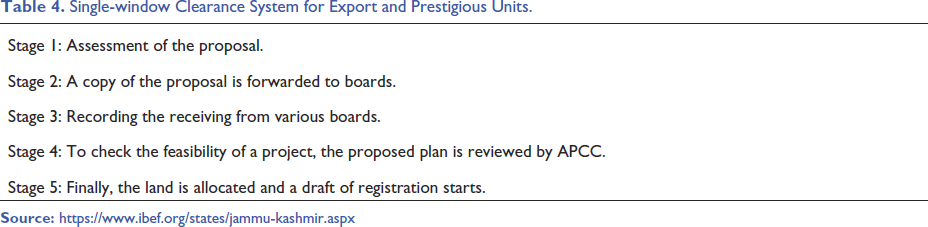
The authorities have successfully launched a web portal under the ‘New Central Scheme’. It is a single window for registration purposes of business units across the globe. A single-window clearance mechanism has been formulated to give a green signal to all those projects that are feasible and come under the umbrella of export and prominent units. The process has five distinct stages (refer Table 4)
Single-window Clearance System for Export and Prestigious Units.
Wani in Dilemma
After analysing the above report, Wani started to check the feasibility of investing in various opportunities aforementioned. Now, she has to decide whether she should return to her homeland by investing in the tourism industry of J&K or not. This has put her to profound thought.
A personal interview was conducted with Mr Farooq Kuthoo, President Travel Agent Association of Kashmir (TAAK) (Kuthoo, 2021). Presently, tourism is picking up well. The government is promoting investments. All the opportunities are good to go with. For example, if he thinks of constructing a luxury hotel, the capital requirement will not be less than I500 million (USD 6.66 million). The market segment can include film producers, the corporate sector, bureaucrats, etc. If he ideally chooses a budget hotel as an investment option, crew members of the film line and low–medium-income groups will be considered. The purpose of film policy is wholesome exposure to promote tourism. The destination is exclusively promoted. The government is promoting tranquillity, as tourism is a peaceful activity. So, we are expecting a certain favourable environment. It is necessary to fill the gap in professional competency and retain employees by offering appropriate salaries, supportive culture, training, perks and appreciation of ethical practices in the workplace. The tourism mantra has changed.
Discussion Questions
What approaches should Wani follow to understand the favourability of the internal environment of the tourism industry in J&K?
Help her to determine the impact of macro-environmental factors on the tourism industry of J&K.
How would Wani know about opportunities she can take advantage of?
What financial and regulatory elements of the new film policy are going to affect the tourism-related traffic in the region?
Keeping into consideration the kind of market gap, competition, financial resources, entrepreneurial expertise, future outlook and return on investment, would she be better off building a budget or a luxury hotel?
How can she manage to recruit and engage a professional workforce?
Footnotes
Declaration of Conflicting Interests
The authors declared no potential conflicts of interest with respect to the research, authorship and/or publication of this article.
Funding
The authors received no financial support for the research, authorship and/or publication of this article.
