




Abstract
Since the dawn of the first industrial revolution, the global community has borne witness to the manifold advantages of industrialization. Encouraged by the resounding success of this transformative journey, nations worldwide have ardently aspired to expedite their own industrialization endeavours. The region of Jammu and Kashmir (J&K) embarked on a parallel trajectory in the early 1950s, sharing India’s zealous commitment to industrial advancement. However, this shared vision was beset by a complex interplay of political, social, and economic factors that thwarted the realization of their set objectives. A significant policy reform in 2019 marked a turning point, setting the stage for a new chapter in J&K’s industrialization narrative. The present study serves as a retrospective analysis of the industrialization process in J&K up to 2018. It serves to corroborate findings derived from firm-level data, illuminating the intricacies of existing loopholes and challenges that have hindered the sustainable growth of industrialization in the region. The primary aim of this study is to inform and enable pertinent, evidence-based policy interventions, fostering the establishment of a resilient industrialization process in post-2018 J&K. This endeavour seeks to realize an unwavering commitment to sustainable development, where progress knows no bounds.
Introduction
The steady shift of the economies from the primary agrarian structure towards production and manufacturing is broadly referred to as the process of industrialization. Though there are various channels of industrialization, the main and sustainable channel identified is the steady mechanization of the production processes (Berlanstein, 2003). This leads to a steady tilt towards mass production and in a longer-run perspective ushers in structural changes across the economies impacting individuals at the minute levels. While the process of industrialization is characterized as both positive and simultaneously negative, the cost-benefit prospective on indoctrination is one of the longest ongoing debates in the analysis of developmental economics. Though the empirical evidence predominantly supports the positive aspects of industrialization there is some good evidence pertaining to its negative impacts (like; Cobb, 2014; Robinson, 2012; Walton, 1987). On the positive side, the process of industrialization is known to usher in sustainable economic growth, specialization in the production processes, mass production of output, division of labour, efficiency in the production processes and efficient resource use, and innovation and technological growth among many other dynamics.
The initial waves of industrialization were steady and self-driven. There is an evolutionary path associated with these processes of industrialization. There were inventions and innovations that unfolded in a step-by-step manner making the process all-inclusive and sustainable. The structural change associated with these waves are the most authentic and self-driven ones (Deane & Deane, 1979). However, over the course of next two centuries as people, organizations and countries realized the positive outcomes of this holistic process, the world steadily tilted towards attaining planned and the accelerated processes of industrialization. The end of colonialism also came as a positive exogenous shock. As more and more countries attained freedom from colonialism, increasing number of nation states were being formed throughout the 20th century (Dirlik, 2005). These nation states, taking lessons from the industrial revolutions of the developed world, sought out to adopt either a planned model of economic development or a mixed one. While in the former case a part of the economy was planned by the public sector with a focus on industrialization, in the latter case the freehand mechanism was adopted with the hope of ushering in a dynamic industrialization process. As a result, from the 20th century onwards, industrialization has been the priority of every nation state from micro to macro levels (Lenchuk, 2016).
In a bid to end colonialism across the Indian subcontinent, it took a lot of effort, resource, and costs. Finally, in 1947 the colonialism did end but it came at a cost. The unified region got divided into two independent nations of India and Pakistan (Chandra, 2008). The integration and creation of these two nations was a difficult process. Despite being a huge unified subcontinent the pre-1947 India was a mosaic of British colonies and Princely states. The partition between India and Pakistan was done predominantly on religious lines. While the former became a Hindu dominated region, the latter was a Muslim majority state (Mehrotra, 2012). After 1947 both the nations began their independent journeys towards development. India specifically took the planned channel to development focusing predominantly on industrialization. It was with the making of the first five-year plan that scope was created for a simultaneous growth of public and private sectors led mutual industrialization process to derive the benefits of industrialization in a timely and speedy manner. The growth trajectory was planned in a bifurcated manner with; (a) the central planning and implementation and (b) the state planning and implementation. While the central government focused on the overall developmental processes of the country, the state governments were given the task of ushering in state/regional level development progressions.
The region of Jammu and Kashmir (J&K, henceforth) is located uniquely. While it is remotely located it falls at a geographic juncture where the international borders of a number of nations meet. Given the importance that the countries associate with sovereignty and the simultaneous preference of the governments to extend their frontiers, the region of J&K has seen volatility and fragility throughout the centuries (Majeed & Kataria, 2023). In the modern times, on the eve of the colonial independence of India, the Indian subcontinent got divided into the two nation-states of India and Pakistan. This imposed indirect yet grave consequences for the princely state of J&K. While the majority of the region was Muslim it was ruled by a Hindu monarch. The latter wanted to remain independent while the former expected to join the dominion of Pakistan. However, the indecisiveness of the Maharaja led to delay, speculations, and unthought-of outcomes all resulting in panic and uncertainty (Majeed & Rashid, 2023). The outcomes in the form of the fragmentation of the princely state. A major part of the then-princely state joined the union of India which is known as the region of J&K (Majeed, 2022; Majeed & Mushtaq, 2022a). Of all the states of the union of India, the region of J&K has been identified as less developing and rather stagnation, especially in terms of industrialization.
The present study is an attempt to assess the position of the industrialization process across J&K over the past seven decades. The study is set in 2018. Given the major policy shifts that were brought in J&K in 2019, it is plausible to make an assessment of the pre-2019 industrialization process across J&K. Based on this evaluation, the present study has a complete policy focus. Analysing the nature and characteristics of the units across J&K, the enquiry breaks down the variables into distinct categories. The findings of the study identify the major issues and challenges that the J&K industrialization process has been facing. Based on this empirical evaluation, the study jots down the major policy recommendations that the government needs to pursue in the post-2019 period in order to set in place a steady and sustainable industrialization process across J&K. The policy recommendations are precisely being made with a people-centric welfare orientation. The outcomes of this perusal are expected to usher in development and sustainable peace across J&K.
To maintain the precession of the study and stay focused on the policy perspectives, the study has been synthesized into five sections. In the second section of this study, the context of J&K has been discussed. The third section gives a brief exposure to data and methodology. This is followed by a detailed analysis of data in the fourth section. The study concludes in the fifth section by making informed policy recommendations based on the outcomes of the fourth section.
The Contextualization of Jammu and Kashmir
The end of colonialism and the creation of India and Pakistan came at a challenging cost to the Princely State of J&K. While the Princely State was an “A” category state under the Colonial rule, it started losing grounds with the end of colonialism (Hardgrave, 1993). The region was ruled by a Hindu Maharaja and the subjects were predominantly Muslim (Rai, 2004). While the Maharaja was envisioning an independent state for himself in the post-1947 scenario, the Muslim majority population saw every reason and logic to join the Pakistan dominion. The indecisiveness on the part of Maharaja was creating issues for every concerned party (Menon, 1955). A number of unexpected and uncertain events took place and the Maharaja found himself in a position where the only refuge from the crisis that he could see was the signalling of the historic “Instrument of Accession” in the year 1947 (on 26th October) with the dominion of India. The unexpected events led to fragmentation of the hitherto princely state. A part of the region came under Pakistan administration and is known as the Pakistan administered Kashmir region. China took control of the Gilgit Baltistan region. While the consolidated region of J&K inclusive of Ladakh joined the Indian union (Jha, 2003).
The focus of the present study is on the region of J&K. Soon after the signing of the Instrument of Accession on 26 October 1947, Sheikh Mohammad Abdullah the popular people’s leader was made the Prime Minister of J&K (Hussain, 1995). Soon after attaining power in 1948 and the charge of official affairs Sheikh sought to implement his dream vision for Kashmir, The Naya Kashmir Manifesto that was drafted in 1944 (Abdullah, 1944). The vision was put to practice by bringing in the land-reforms (Aslam, 1977). This was followed by the setting up of the socialistic state-led industrialization. Public sector units were being set in place focusing on employment generation, output creation and setting up of an exports oriented dynamic industry.
With the coming of Sheikh to power, people of J&K could finally see some home and welfare coming their way. The state was actively supporting free and sponsored education for one and all (Kanjwal, 2017). The change was being set in motion and people could directly see the implications coming in their direction. Having faith in Sheikh, people relied heavily on the public sector industrialization. No person from the region thought it important or necessary to set in place private sector/individuals led industrialization process. However, this anticipated prosperity and stability did not last long. Sheikh was removed from the office and jailed. He was replaced by Bakhshi Ghulam Mohammad (Lockwood, 1969).
This was the first knell of political instability in the region. Following this event, the focus of the state shifted from developmental tasks to peace restoration and peacekeeping. One of the main casualties of the political instability was the state-led industrialization process (Snedden, 2021). The socialistic industrialization which was set on a wide scale got a back seat. The state lost its focus on industrialization-based development. The economic development got a backlash. Since then, there has been economic regression in the region. Over the following decades, out of necessity people started venturing into individual-led and entrepreneurial industrialization processes (Majeed et al., 2021b). In an environment where the fragility shocks have often been witnessed and adequate public sector policy is rather absent an expectation pertaining to steady growth of the industrialization process is rather unrealistic.
The theoretic construct of the New Economic Geography, pioneered by Paul Krugman (1998), validates the role of geography in the economic outcomes of a region. It has been empirically validated for a number of regions that an easy geography in-terms of plains and access to waterways contributes positively and significantly towards the industrialization and economic development of the region (Gaspar, 2018; Lall & Chakravorty, 2005; McCann & Sheppard, 2003). Simultaneously, it has also been validated that poor geography in terms of hilly terrains, land-boundedness and remote location contributes negatively towards the economic development of the region concerned (Chen & Peng, 2020; Mukim, 2015). Based on the theoretical underpinnings in the understanding of the New Economic Geography, it can be hypothesized that the region of J&K already falls in the latter category states. Given the realization that the primary geography of the region by itself is unfavourable for J&K, a major role gets assigned to the policy and the informed intervention that it needs to make. As such, the administrative reforms in J&K have always been of importance and significance.
Following a series of administrative reforms, there was a major policy shift that took place in the region of J&K in 2019 in the form of the abrogation of Article 370. One of the main agendas that have been proposed by the central government in the region of J&K has been the proposal to put in place a sustainable industrialization process in the region of J&K. However, a note of caution needs to be put in place in terms of the a priori evaluation of the industrialization in the region of J&K. Right from 1948, both the central and the state governments have been extending plans, policies and developmental funds to the region of J&K. One of the main channels of this development has been through the attempts of setting in place the process of industrialization. However, evaluations from time to time have highlighted the failure in terms of unattained agendas of sustainable industrial outcomes. Now, in the contemporary times when there is an opportunity and there are funds, lessons need to be drawn from the cumulative shortcomings and failures to correct upon them and arrive at policies that are targeted towards effective, feasible and sustainable industrialization process for the region of J&K. The present manuscript is an attempt in the same direction.
Data and Methodology
The study is based on the Annual Surveys of Industries Data (ASI, henceforth). The ASI data are nationwide reliable data-set on the industrial performance and outcomes of the registered firms located across India. The data are collected and disseminated by the Ministry of Statistics and Plan Implementation (MoSPI, 2018). The ASI frame questionnaire is scientifically designed and samples firms methodically. Since the survey is conducted annually, each year different firms are sampled. This makes the data-set universal and gives the best possible results and outcomes.
Given the policy focus of the present manuscript, the methodology of descriptive statistics is applied and put to use. The appropriate firm-specific variables are tabulated. It is followed by an in-depth analysis of these variables in light of an a priori and existing information and empirical studies. Descriptive statistics help in the evaluation of variables in light of averages and comparisons. As such this methodology has been deemed as most fitting for meeting the research objectives of the present analysis.
Results and Discussions
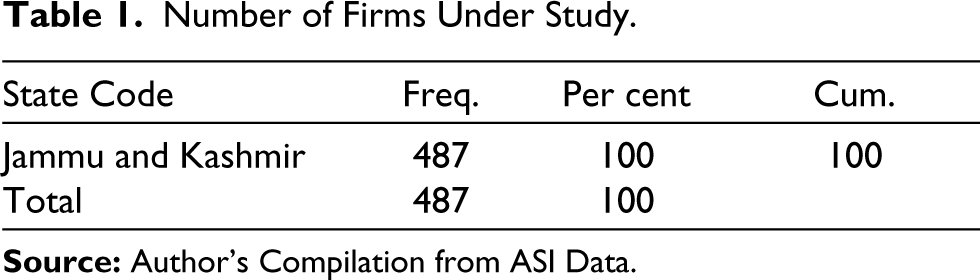
Given the latest data availability the time period of the present analysis is 2018. Given the exogenous shocks that took place after 2018 like the abrogation of Article 370 and subsequent pandemic waves of Covid-19, 2018 can be considered a stable year to analyse the long-run scenario and position of the industrialization process in J&K. Under the ASI frame, for the year under study, 487 firms have been surveyed across the region of J&K, as presented in Table 1.
Number of Firms Under Study.
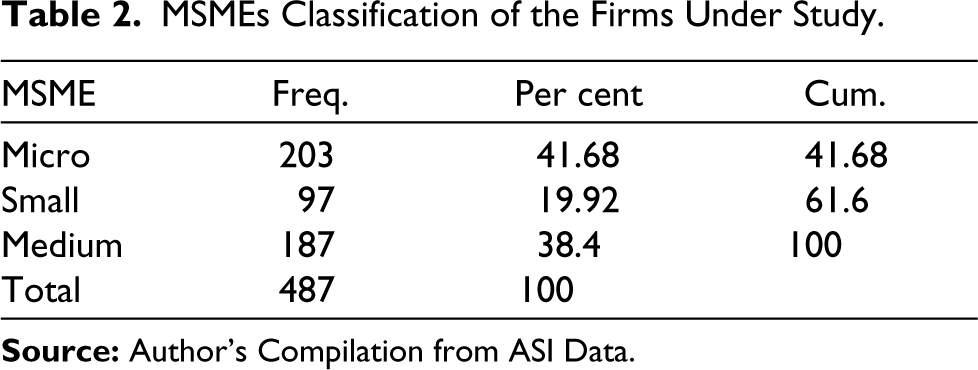
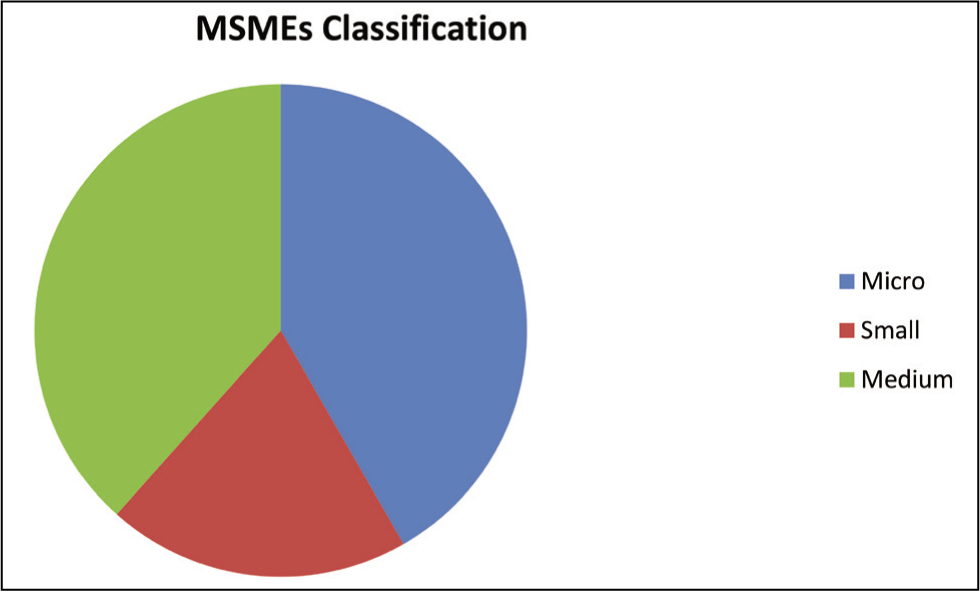
Studies like Majeed et al. (2021a) have already validated the fact that the industrialization process in the region of J&K is dominated by the Micro, Small and Medium Enterprises (MSMEs, henceforth). Neither the ASI data under study nor any other source validates the existence and presence of large units or multinational corporations in the region. The industrialization process in the region of J&K has not only begun late but at the same time has been state-induced and state-led to begin with. The age of this process is not even a century old 1 with spells of instability and fragility distorting the process from time to time. Table 2 using the definition of the MSMEs from The 2016 MSMEs Development Act of 2016, classifies the firms in J&K under the three heads of MSMEs. The classification is made on the basis of investments in “Plant and Machinery” by the unit under consideration. It can be seen from Table 2 and Figure 1 that the regional industrialization is dominated by the micro units. Given the transition from state-led to individual-led industrialization, the growth of the process has been steady. People have had their sceptic and pessimistic beliefs pertaining to the business environment of the region. As such, to minimize the risk the entrepreneurs have started small to test the waters. Even in the present times, the trend across J&K is to set a micro unit, monitor its performance and growth, and then subsequently take a decision of expanding, shrinking or shutting down the said unit. From a long-run perspective, therefore, the industrialization process across J&K is classified as MSMEs led.
MSMEs Classification of the Firms Under Study.
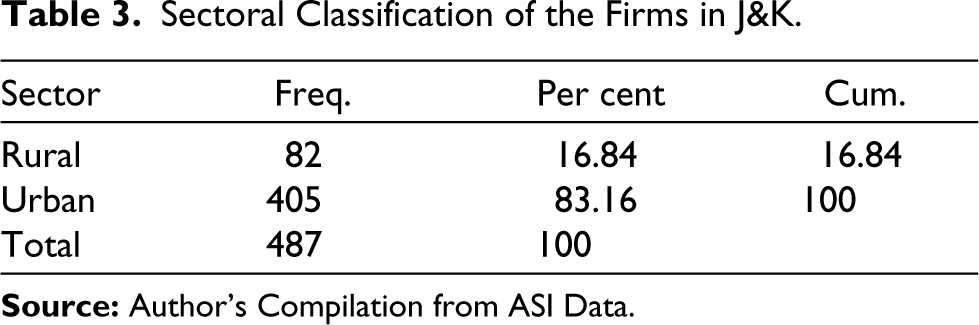
Like the rest of the country, J&K also lives predominantly in its rural areas (Majeed & Mushtaq, 2022b). As such it might be expected that a considerable fraction of economic activity should be concentrated in the rural areas itself. However, the data reveals something else. Only 17% of the firms under study are located across the rural pockets of the region, as presented in Table 3. The rest of the firms have reflected an establishment preference of urban areas. As validated by Majeed et al. (2022a), India as a whole shows a trend of geographic peculiarity in industrialization. Northern India lags behind in the overall Indian industrialization process. There is a tendency that urbanization pulls in industrialization as a centripetal force. The same can axiomatically be established for the J&K industrialization process. The unit holders/entrepreneurs look for the industrial prerequisites and then take a locational decision of establishment. Given the pre-existence of facilities like roads, electricity, communication, baking, etc., people from both rural and urban areas of J&K reflect a preference of setting the units and production activities in and around the urban areas.
Sectoral Classification of the Firms in J&K.
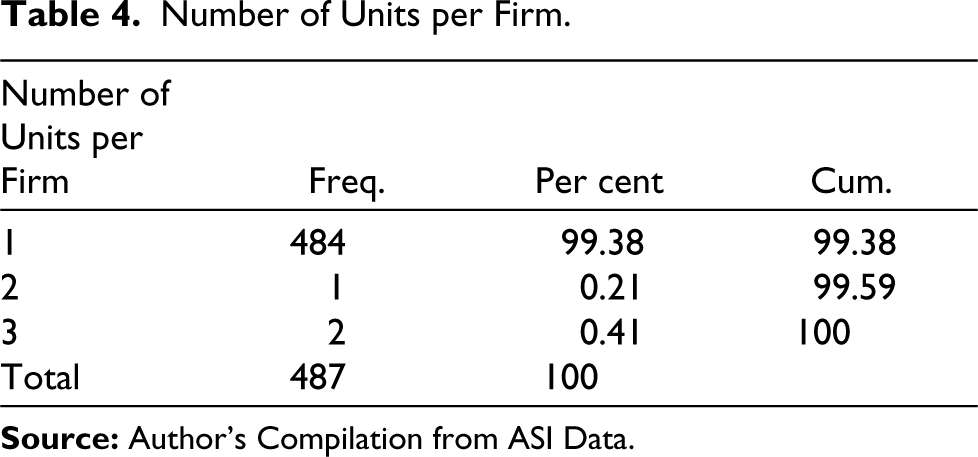
One of the main parameters of firm growth and diversification is the increase in the number of units per firm. Expanding and successful firm have universally shown a trend of the increase in the number of units under the same firm head (Riccaboni et al., 2008). As such, it is an established fact in industrial economics that firm growth is measured by this sort of diversification. However, Table 4 presents evidence against this phenomenon for the firms of J&K. Not only are the firms predominantly micro units in existence but at the same time, almost all the firms under consideration are a single unit firms. The diversification parameter is absent. These findings establish the timid nature of J&K industrialization. Both the business expectations and the vision of entrepreneurs are limited and rather pessimistic. The focus is on the survival of the existing units rather than expansion and attainment of multiple firm objectives like sales maximization, market influence or employment provision. Khan et al. (2021) analysing the efficiency of the units in J&K validate the fact that micro units are the most efficient ones. Studies like these validate the glass-ceiling and iron-floor the firms are caught up in.
Number of Units per Firm.
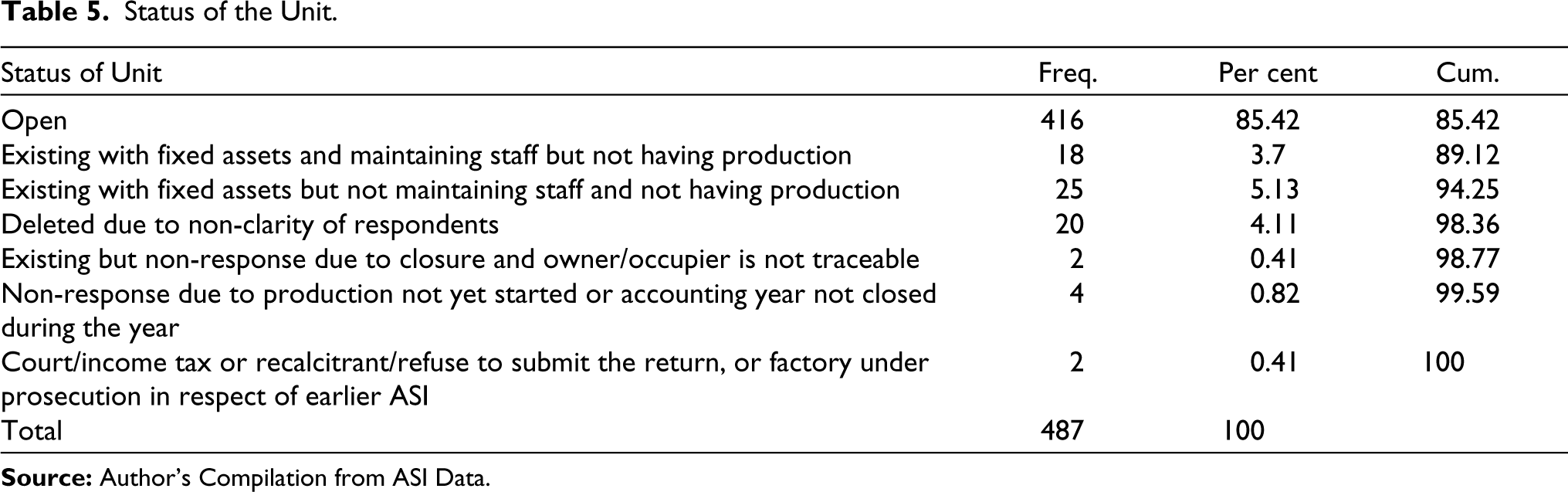
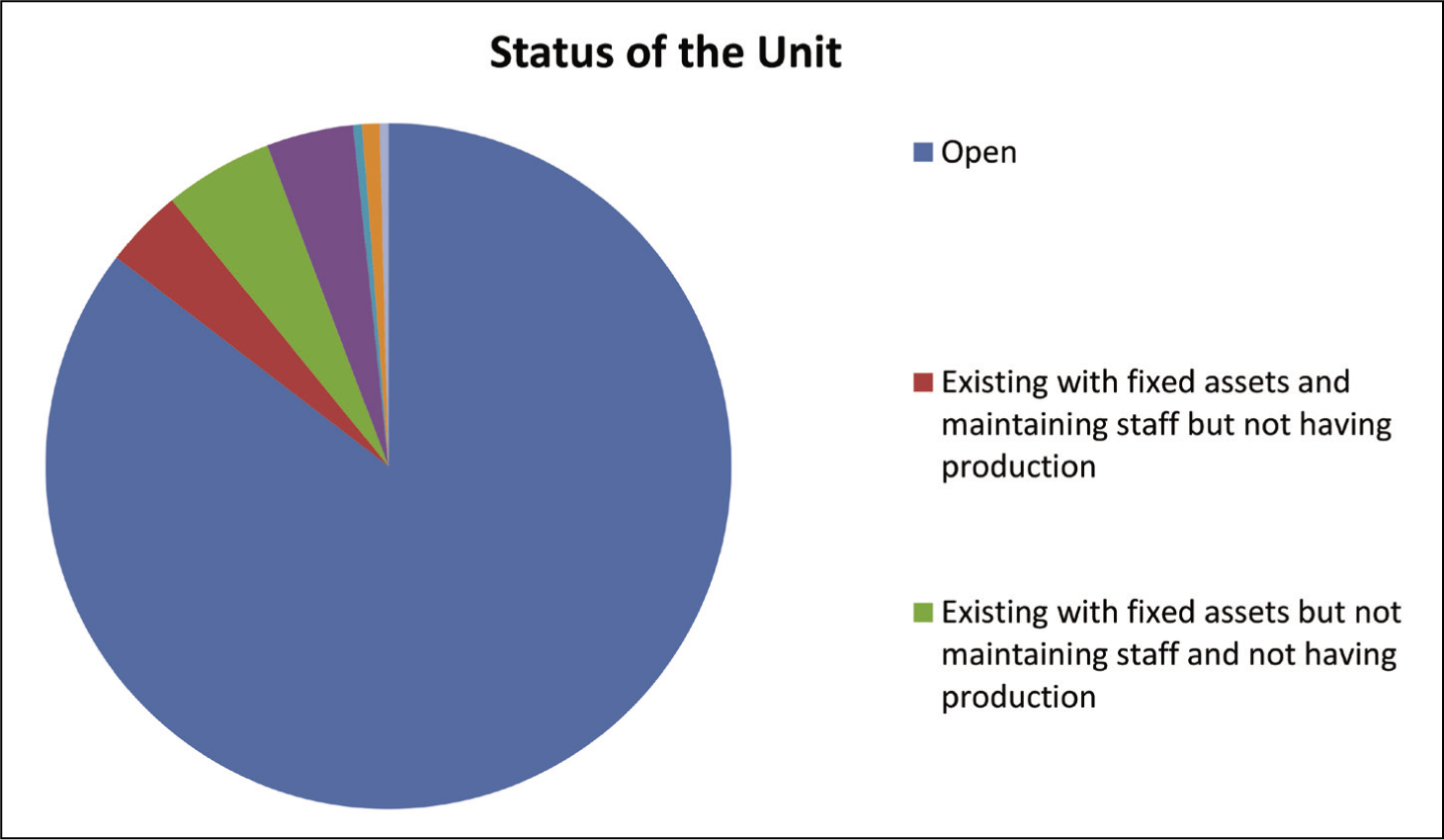
The operational status of the units is summed up in Table 5 and presented in Figure 2. Since ASI surveys all the firms that are duly registered with the competent authorities of the government under The Factories Act (1948), it surveys the units irrespective of the fact whether or not they are functional. This variable becomes very detrimental in determining the characteristics of industrialization in any particular area. The regions with a maximum/complete number of open units signify a robust and busting industrialization while the regions where the number of closed units is considerable indicate the presence of some issues and troubles. It can be deciphered from the table that in J&K though 85% of the units surveyed are open there is a 15% proportion of units that are not functional at the moment. In a situation where maximum units are micro in operation and at the same time are the most efficient in the category, this is an alarming proportion of units. The indication of this parameter is towards loopholes, inefficiencies, and inadequate policy interventions. It is a non-desirable parameter for a(ny) region to have units other than open. Its long-run negative implications are directly on the sustainability of the industrialization process. As such, this variable needs a deeper firm level industry wise identified analysis in order to prevent the closure of more and more units across the region. There must be a trend indigenous and common to these J&K firms that is leading to the closure of the units; it needs identification and appropriate policy intervention.
Status of the Unit.
Out of 365 days of a year, the firms in J&K on an average work for 251 days, as reflected in Table 6. A loss of more than 100 working days is not justifiable for any sort of business, especially the production units. The number of total working days is equally concerning. These numbers are quite high compared to the all India average. A priori studies on J&K firms have identified factors like extreme climate, road-blockade, pushing geography, and persistent fragility as the causal factors behind the same. However, in a post-2018 scenario a number of parameters have shifted and altered. A number of exogenous and endogenous causal factors can be influenced and rehabilitated to lead to better outcomes especially in-terms of increasing the number of working days for the firms in J&K. There is a significant chance of attaining Pareto improvement in firm outcomes once these negative causal factors are addressed scientifically through the creation of a rigorous policy implication.
Working and Non-working Days of the Firms.

Type of Organization of the Firms Under Study.
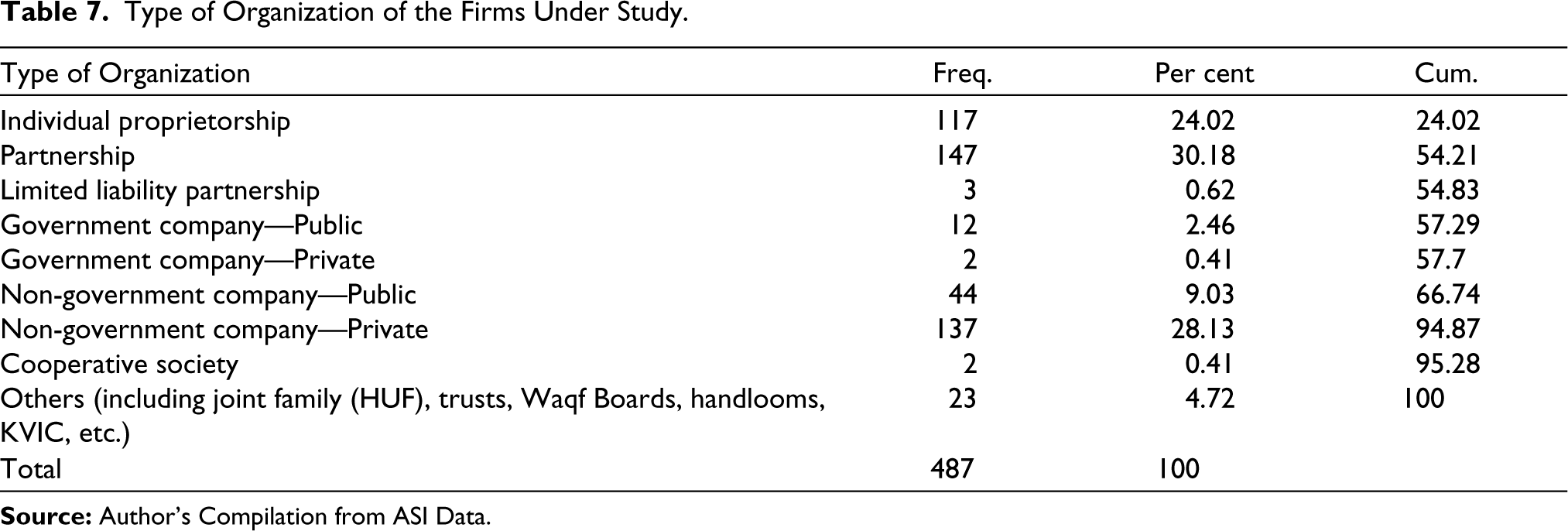
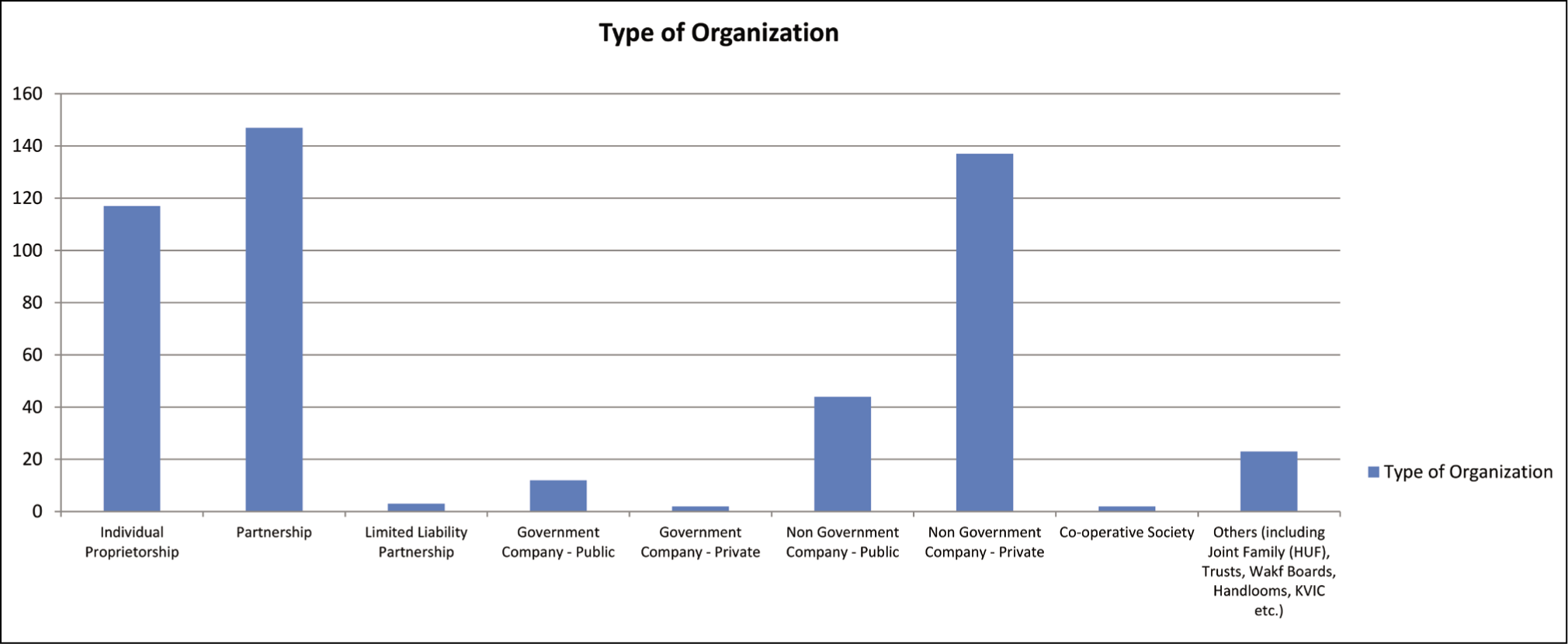
The organizational type of a firm is a detrimental factor in determining the firm outcomes. Empirical studies from across the world have validated different outcomes from different types of organizations (see e.g., Collins & Reutzel, 2017; Elbanna, 2009; Ghosh, 2011). The ASI data provides data on the organizational type of the firms across India. From the outcomes of Table 7 and Figure 3, different types of firm organizations from J&K can be seen. In total, 30% of the units under study have a partnership type of organization. These units as such are run by more than one individual in the capacity of owner-entrepreneurs. It is an established fact in the entrepreneur literature that individual proprietorship is the most efficient type of business organization (Broughman, 2011). Though it is followed by partnership, the top slot has always been conquered by the former. In the MSMEs context, the success of the unit depends on the decisions taken by the owner/entrepreneur. Each entrepreneur is different in thought, action, and process.
As such, a MSMEs industry is expected to be predominantly individual proprietorship in the organization. The lack of this factor in the context of J&K points to some fundamental and structural issues. One of the main reasons behind this as hinted by the variables analysed till now in the study can be identified as a lack of capital to start a unit. When a potential entrepreneur is not able to find enough capital to start a unit, (s)he essentially looks for people with the same ideas and intentions. This brings two or more people together to venture into mutual-industrialization endeavours. The main takeaway from the findings of Table 7 is that the entrepreneurship process in J&K needs some strong and considerable policy interventions and push to make sure a timely transformation of potential entrepreneurs into actual/practising ones.
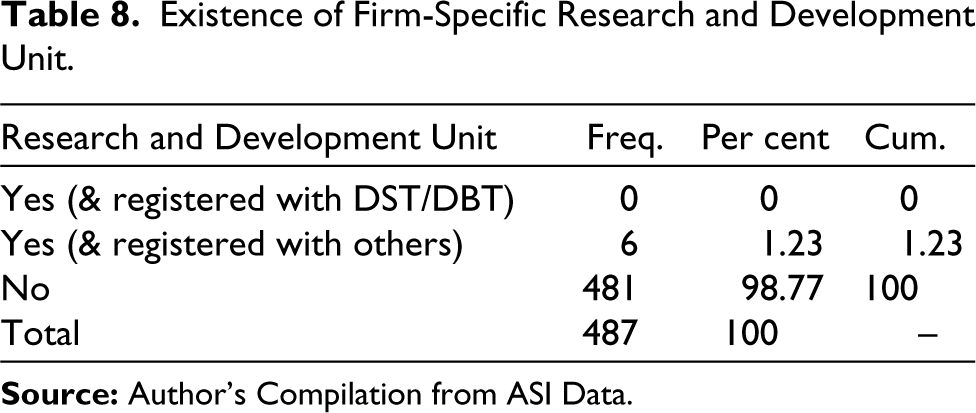
It is a historically established and validated fact that the birth, growth, and sustainability of the industrialization process is initiated and upheld by a steady Research and Development (R&D, henceforth) process (Dodgson & Rothwell, 1991; Oakey, 2013). Until there is a constant and continual R&D process going on simultaneously along the production processes, the industrialization has no scope to sustain in efficiency. Quiet contrary to this fundamental prerequisite studies like Majeed et al. (2021a) and Mushtaq et al. (2021) using ASI data for various time-periods validate the absence of this culture across India. From the outcomes of Table 8, a similar trend can be established for the firms in J&K. On average there is a blanket absence of firm-specific R&D in all the units located across the region of J&K. This factor is taken as a long-run negative implication challenging the sustainability of the industrialization process. It needs a timely policy address to make the production processes across all units efficient and more productive moving the whole industrialization process towards Pareto optimality.
Existence of Firm-Specific Research and Development Unit.
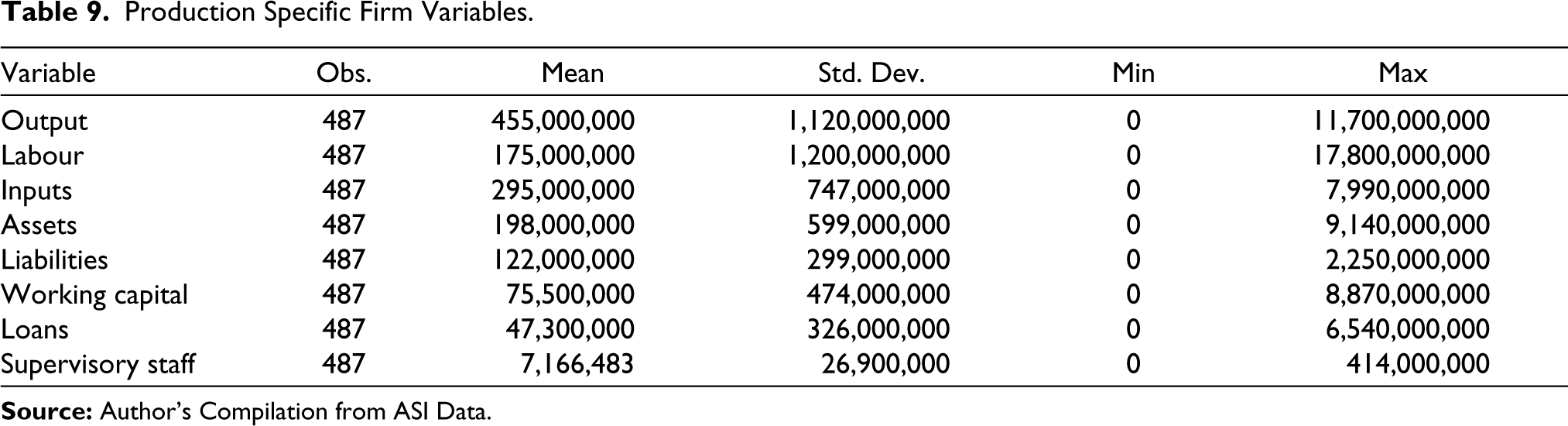
The primary variables concerning the formulation of the production function, that is, the input and the output variables are summed-up in Table 9. The mean valuation of different types of inputs like labour and raw-materials reflect the small size of the production processes across J&K. This number is very small compared to the all India averages presented in recent studies like Majeed et al. (2022b). The statistics again drift back to the small and rather constrained size of the J&K industry. The nature and pattern of the industrialization and the subsequent development from the same demands a steady growth of the process. Stagnation in industrial growth has the tendency to keep the welfare and economic position of people unchanged. The poverty levels in J&K as estimated by studies like Mushtaq et al. (2022) can be further shrunken down by a holistic industrialization process that essentially is dynamic and vibrant in nature.
Two important variables of interest from Table 9 are the loans and supervisory staff. The mean value of loans accruing to the firms is considerably high as compared to the rest of the country. At the same time, given the MSMEs nature of the units in general and the dominance of micro units in particular across J&K, this is a very high amount. As such one of the detrimental factors in constraining the industrial growth of J&K is the bad loan problem. The causal factors behind the same can be many like lack of adequate banking facilities, misappropriation of the loans, non-feasible rates of interest, etc. Identification and proper redressal of this major constraint is essential and important to tune it right in light of long-run industrial sustainability. The supervisory staff is taken as a (proxy) variable for the management of the processes in the firm. Industrial theory ascribes a special importance to the presence of supervisory staff within a unit especially in the context of efficiency and productivity. However, the data from Table 9 reveal that the trend of having supervisory staff in the firms across J&K is highly limited. This factor also demands a change. Hiring of the supervisory staff is a long-run win-win situation for the firm as it enhances firm productivity and efficiency in the long run and makes the firm position steady in the industry preventing stagnations and shutdowns.
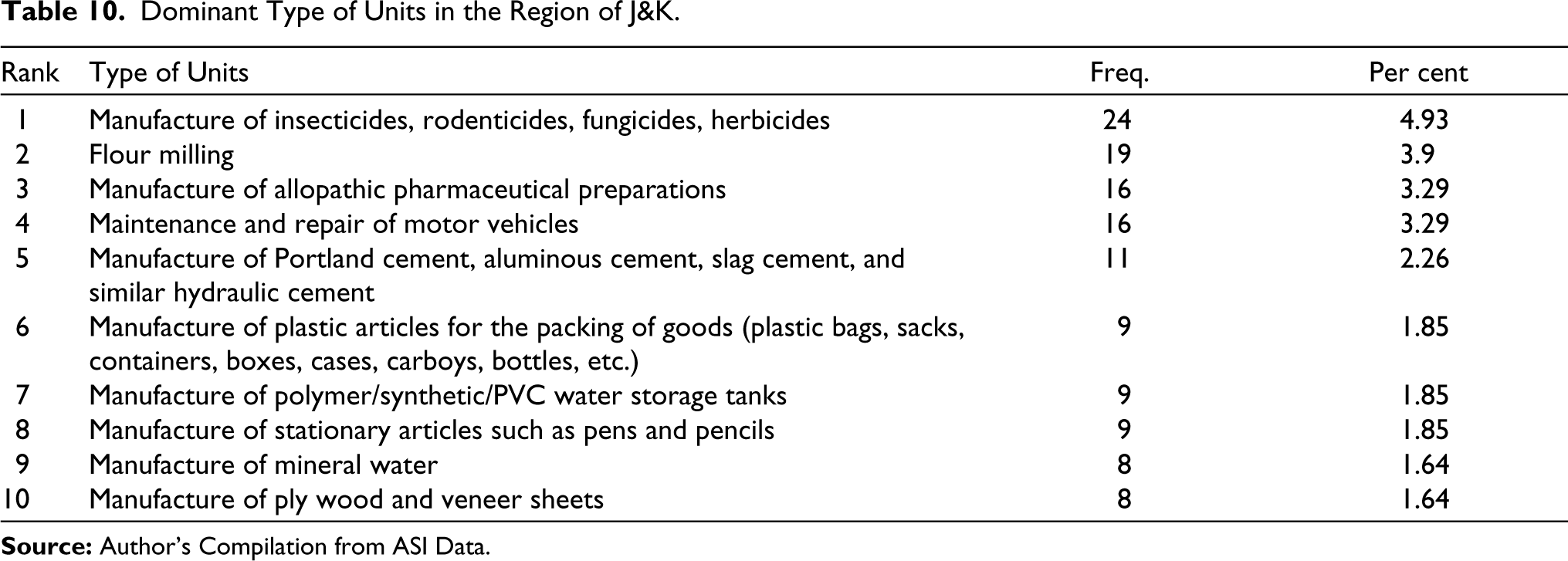
Given the transition of the industrialization process across J&K from state led to individuals led over the last half a century, the outcomes have been evolutionary. One such characterization is presented in Table 10 of the present analysis. This table ranks the units across the region in terms of dominance. It can be observed from this table that the maximum number of units that have come to grow over time across the region belong to the agricultural chemical industry. Clear linkages can be established between the growth of horticulture in the region and the creation of a derived demand for insecticides, etc. The creation of both backward and forward linkages itself is a win-win situation in the establishment of sustainable industrialization. All the units that are summed up in Table 10 present a success story of survival through the ups and downs that the J&K economy has been through over the past half a century. These units have been able to find a local demand and cater to the local market. For long-run industrialization to set in motion, it is essential that these industries are boosted to begin with. Only after setting them in tune, research is to be carried out pertaining to close forward and backward linkages to these units. In this manner a spiral process of industrialization firmly grounded in the surviving and existing industry types can be set in place steadily over time.
Production Specific Firm Variables.
Dominant Type of Units in the Region of J&K.
Conclusion and Policy Recommendations
The present study is an analysis of the industrialization process of J&K. The study is contextualized in the late-industrialization processes. Given the fact that there was a major policy shift in J&K post-2018, the study has a special significance. Being contextualized in 2018 itself, it gives a view into the long-existing trends that have evolved over time in J&K. An evaluation of the firm-specific variables is made with a critically-constructive perspective to identify the setbacks and lacunas that the industrialization process in J&K has been witnessing over time. However, the present study has been limited in its approach and outcomes by the limited data-availability. The data for the post-reform period has not yet been publicly made available and as such the present study is not able to precisely capture the outcomes from these changes. At the same time, the outcomes of this study along with this limitation open-up the floor for further primary and secondary analysis of the industrialization-centric industrial outcomes in the region of J&K. Based on the contextualization, data, analysis, and findings of the study, some important policy recommendations follow.
The very basis of the industrialization process in J&K lies in the state intervention. It was the Naya Kashmir Manifesto and its implementation that introduced the concept of industrialization across J&K. Not only was the concept introduced but at the same time a message was disseminated among the state-subjects that the benefits of this process will be shared equitably by one and all. These historic events have led to the building of an expectation among the masses of J&K despite the ups and downs that the state is an agency of upholding and stimulating the industrialization process. The evidences from a review of public sector policies coming from both state and central governments over the past decades reveal the attempts and intentions at both the levels to stimulate the industrialization process in J&K. However, the outcomes have not been as expected or anticipated. Instead, there has been a persistent policy failure on account of industrializing the J&K economy.
One of the main reasons behind the same is the appropriation of the policies that are either un-informed or under-informed. It is in light of this realization a priori that the present manuscript intends to recommend some policy implications that are derived from the data generated from the ground by the government authorities themselves. The main takeaways for immediate intervention and implementation can be summed-up as follows:
First of all, the present study establishes the fact that the firms located in J&K are predominantly MSMEs. It means that most of them are entrepreneurial in nature. Even in the MSMEs category, there is a strong bent towards the micro units. For industrialization to be sustainable a growth trajectory is a must. A unit established as a micro unit must spiral outwards towards becoming a small followed by medium and then large over time. Quite contrary to this, J&K firms instead reflect a survivalist nature. A micro unit remains micro unit. Even when it is inherited by the next generation it continues being a micro unit. The most important and basic policy recommendation that follows from the review of the literature and the data is that the government needs to create a “boost to grow.” Feasible conditions need to be created in the post-2018 circumstance to create a growth trajectory for the units and for the units to break the glass ceiling. It can be in the form of re-registration, eligibility for a larger loan at a lower rate of interest after meeting some parameters and various other facilitations. The second important observation from the present study is the identification of the urban bias in the industrialization process across J&K. Though people predominantly live in rural areas, industrialization is growing across urban areas. A biased industrialization contributes towards the perpetuation of poverty and underdevelopment. As a policy takeaway from this observation a ruralization of the industry is highly recommended. The creation of industrial clusters, the establishment of industrial estates and the common provision of basic industrial infrastructure at the district level around rural areas is yet another immediate need of the hour. Sustainable industrialization is always free of rural–urban bias. As such the ruralization of industry is a pre-requisite in this direction which can be attained in a speedy manner only by relevant public sector and public policy intervention. An analysis of the firm status reveals that around 15% of the firms under study were closed and as such at the time of survey were not actively producing for the past 12 months on a stretch. A 15% firm closure rate is a serious alarm bell pointing towards considerable distortions in the overall industrial process. From this double-digit number of firm closure a trend towards firm stagnation and closure can be validated. A serious note of closed units needs to be made at the policy level. This is to be followed by a detailed survey of these units. From a collective survey of the closed units, the common factors contributing towards these closures can be identified. It will be only after this preliminary investigation that actual policy interventions can be made to rectify these identified variables of interest. It is expected that factors like pending loans, high rates of interest, information asymmetry, industry type, availability of raw-materials, broken supply chains, etc., can be some of the factors. However, the actual factors need to be validated empirically and rectified thereupon. Another variable of concern identified by the findings of the present study is the number of working days. The data reveals that around a hundred days are lost in J&K on an average as non-working days. For a production unit losing three-digit number of days is a sure way to declining efficiency and an eventual end in stagnation and firm closure. Theoretical axioms of industrial economics ascribe a day’s loss to work to long-run damage to the firm productivity. In the context of J&K, identified factors by the a priori research are climatic extremities, geographic remoteness, fragility, and information asymmetry among others. However, in the post-2018 context, where a number of exogenous factors and dynamics are already in alteration handling of other factors must be taken care of by informed policy intervention. While the factor of fragility has already subsided, immediate policy intervention can come in the form of dedicated electricity supply to the industries. It can solve a number of problems, especially the climatic extremities. Infrastructure building can be another policy intervention to enhance the number of working days for each firm. Industrial rehabilitation and in-depth surveys are also immediately needed to increase the number of working days across the firms in J&K. While evaluating the types of organizations common across the firms in J&K, the study validates the dominance of partnership over individual proprietorship. The MSMEs are units with small sizes of operation. Their nature is predominantly entrepreneurial and the units are mostly own-account enterprises. All these characteristics point forth towards single person decision making. Such a feature has the capability of making the enterprise efficient. As such the MSMEs sector is expected to be predominantly individual proprietorship in the organizational structure. J&K firms show a higher proportion of partnerships mostly because of a lack of adequate amount of investments and capital available to the potential entrepreneur. In a situation like this, the potential entrepreneur looks for people with the same interests and tries to forge a partnership. In such a situation the decisions and profits both are shared. Sometimes rather quite often the partners are not on the same page pertaining to the perusal of firm objectives. As such at the MSMEs level individual proprietorship is better than partnership. The policy takeaway from this crucial finding is the provision of adequate help in terms of subsidies, soft loans, etc., to the potential entrepreneurs in setting up industrial units that are predominantly individual proprietorships in the organization. The study finds out that the firm specific R&D culture across the firms in J&K is totally absent. Without constant improvisation and innovation firm growth is impossible. The sustainability of any industrial process is related directly to R&D. In an indirect situation an industry-academia nexus takes care of R&D, innovation, and industry. However, in the case of J&K all of these channels are completely absent. As a policy intervention, first of all, an academia-industry nexus needs to be set in place. Research and inputs from the academia can be directly put to practice in the firms and positive outcomes attained. This needs to be followed by setting up of publicly and adequately funded research institutions. In a longer-run gestation/outcomes perspective, a boost in terms of subsidies, know-how and awareness needs to be forwarded to the firms encouraging them to set and invest firm-specific R&D units to improvise the processes at the firm level over time. An analysis of the basic production and firm-specific variables reveals the bad loan problem. Most of the units from across J&K have high amounts of pending loans ascribed to their units. In a situation where a hundred days of production on average are lost, firms face stagnation and ceiling and a considerable number of units are already closed, financial problem is a clear visibility. The policy takeaway from this major finding is the correction of the financial atmosphere in J&K. The firms are in dire need of dedicated financial institutions, soft loans, and the lowest rates of interest on the loans. In a situation where this specific policy intervention is kept away from implementation, no other intervention can prevent an industrial stagnation. The size of the J&K industry has not seen any considerable growth or bulge in all these decades. As such the J&K industry can be identified with the presence of a glass ceiling and iron floor. There are factors that are not allowing for the growth of this specific regional industry.
A dynamic growth is indeed needed but it is essential to maintain that the growth is indigenous and not exogenous. An industrial growth of the latter nature might come up with the setting up of units from the multinational corporations across J&K. However, such an industrial growth will only create a leakage-centric employment creation. On the other hand, an indigenous industrialization process will lead to the transformation of potential entrepreneurs into actual ones belonging to the soil and targeting the local markets and consumers. It will act as an injection instead of a leakage to the J&K economy. As a consequential result, there will be an ushering in of a sustainable industrialization process across the region of J&K, taking the developmental trajectory to new heights.
Footnotes
Declaration of Conflicting Interests
The author declared no potential conflicts of interest with respect to the research, authorship and/or publication of this article.
Funding
The author received no financial support for the research, authorship and/or publication of this article.