




Abstract
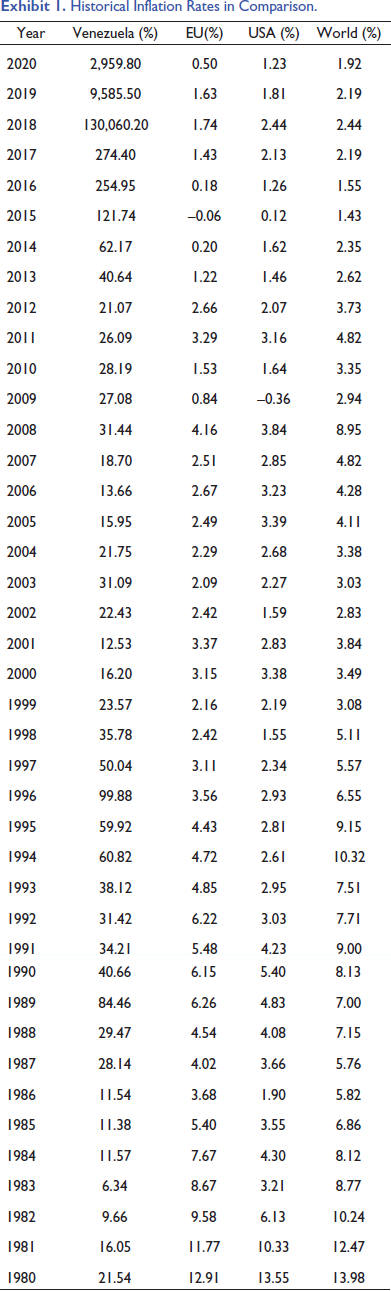
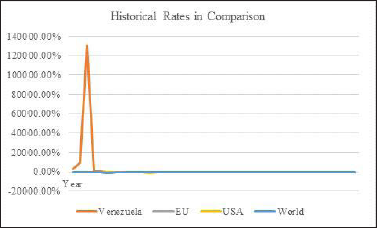
As Juan Guaido inherited a debt and poverty-stricken economy characterized by hyperinflation as an ‘interim President’, the fear of his removal and dissolution of the Government engulfed him. He was worried about rising inflation, mismanagement of natural assets, rising fiscal debt, unemployment and poverty. He knew that the socialist policies adopted under the leadership of Chavez and Maduro had benefitted the citizens only for a brief period but had been the primary reason for the economy’s slowdown in the last decade. The economy underwent long periods of hyperinflation amounting to 130,060%, which has rarely been observed in any country worldwide (Exhibit 1, Exhibit 3). Venezuela is a classic case of a ‘petrostate’ exhibiting the characteristics of a ‘resource curse’. The expansionary fiscal policies, a large share of the government sector, subsidies, price controls, a ban on the private sector and erratic monetary policies contributed to the economic and political crisis. Juan knew the economy was bleeding, and almost seven million Venezuelans still fell into extreme poverty. He thought adopting a contractionary fiscal policy would increase unemployment, and many more would fall under the poverty line. On the other hand, expansionary monetary policy will further increase inflationary pressure. While sitting in his office, Juan thought, ‘Shall I go for a stringent tax policy to increase the government revenue or adopt the dollar as an official currency for curbing inflation?’
History: Economic Crisis and Management of Petrostate
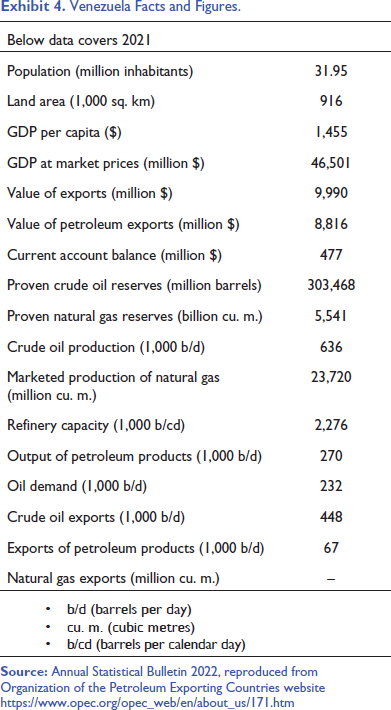
Venezuela was one of the highest oil producing countries in the South African region, with an average of three million barrels per day. However, with a decline in production since the past decade, oil production has drastically reduced to 800,000 barrels per month in 2019 (Sanchez, 2019, Exhibit 4). In 2022, Venezuela ranked fourth in the region, preceded by Brazil and Colombia. The decline in oil production is around 70% compared with the previous decade (OPEC, 2021). The country has faced a decrease in crude oil production due to a scarcity of the chemicals required for extraction and processing activities. Weak economic and political conditions have also contributed to the decline in output. Due to the decrease in crude oil extraction, the refining plants need to be more utilized, with a capacity utilization of around 15%. This has hit the export sector and the domestic consumption of petroleum/gasoline. Fuel shortage is one of the problems that Venezuela’s citizens rarely encounter. The lack of availability of subsidized petroleum has significantly hit the citizens’ confidence in the present Government.
The country’s economy relied heavily on oil exports, and the sudden increase in oil prices led to a significant inflow of foreign currency. This caused the value of the Venezuelan Bolivar to appreciate, making the country’s other exports, such as agricultural goods, less competitive on the international market. The decline in competitiveness of different sectors of the economy, coupled with mismanagement and corruption, contributed to the economic crisis that Venezuela is currently experiencing.
During the early 1900s, Latin American countries were open to free trade and capital flows. However, in the 1960s, most countries in Latin America adopted the policies of self-sufficiency and import substitution and increased the barriers to trade and capital flows. The Government owned most of the natural resources, including the coal and oil mines. It also owned the infrastructure and other business activities. Venezuela’s reliance on oil exports and the revenues derived from oil supported the economy. Socialist President Carlos Perez nationalized Venezuela’s oil industry in 1975 (BBC, 2019). The economy of Venezuela was highly dependent on oil exports. The oil prices fell drastically in the 1980s, leading to a decrease in the revenue from Oil for Venezuela. The debt started to rise and reached $35 billion in 1989. As a result, the currency of Venezuela began to face downward pressure. Finally, the economy of Venezuela was opened up due to a decline in oil prices and currency depreciation. Assistance from international organizations such as IMF mandated Venezuela to liberalize its economy. The aid from IMF also mandated Venezuela to decrease its budget deficit and public funding of subsidies. By 1989, oil prices, once highly subsidized, started to soar. It resulted in massive public protests against the Government in the capital city of Caracas. A large number of citizens died during the clash.
Rise of Hugo Chavez and ‘Bolivarian Revolution’: A Move Towards a Socialist State
After the political upheavals, Lieutenant Colonel Hugo Chavez led the leftist movement with the support of the army, led a failed coup against the President in 1992, and was imprisoned subsequently. However, Chavez rose to fame because of his charisma and was elected President in 1998 with 56% of the votes (BBC, 2019). At the same time, oil prices fell, putting upward pressure on inflation, which rose to around 30%. After rising to power, Chavez reformulated the National Assembly and consolidated it into a single-chamber legislative body. All the reformulations were done under nationalism and left-wing economic policies (Ellner, 2010). The era is also known as the ‘Bolivarian Revolution’. During this time, Chavez seized PDVSA (Petróleos de Venezuela, S.A.), the state-controlled oil company, intending to make it the Government’s economic engine (Rodríguez, 2021).
Chavez’s popularity with the public started to increase, with an approval rating of 80%, after he promised to fight corruption and increase spending on redistribution of wealth and social security. However, an increased restriction on the free press and antagonization by the United States led to mass protests by PDVSA employees in 2002 (Rodríguez, 2021). This resulted in a decrease in the approval ratings to 30% and a depreciation of the Bolivar (the currency) by 30%. This is followed by the imposition of strict capital controls by a newly appointed foreign exchange regulator CADIVI (Comisión de Administración de Divisas). The foreign exchange regulator was also responsible for setting up the official exchange rate. This led to a black market/parallel market economy where billions of dollars were embezzled by declaring fake import bills to buy dollars. By 2003, the import prices for necessities like food started to rise. Hence, Chavez introduced price caps on essential goods to make them affordable for the citizens. Although the policy seemed very lucrative at the face of it, it led to vast shortages of the products. The privately owned grocery stores were not allowed to increase the prices as per market forces. Instead, they were threatened to shut in case they were found to sell the goods above the Government mandated prices. The Government simultaneously opened up stores to sell grocery items to the underprivileged. The side effects of government-controlled prices were observed in the declining production of agricultural produce. However, the oil prices started increasing in 2001, benefitting the Venezuelan economy and favouring a second term for Chavez (2001–2007). With increased revenue from Oil, the Government started funnelling millions of funds from PVDSA to social security benefits and subsidies (Trojbicz, 2021). This resulted in a decrease in poverty (a fall from 53.1% in 2004 to 27.5% in 2007) and unemployment. With improvements in the standard of life for the common public, the popularity of Chavez rose further, gaining him a third term with a landslide victory in 2006. The wave of nationalization of most of the sectors of the economy started with telecom, broadcasting companies and electricity. Also, the foreign-owned oil-producing firms were forcefully removed from Venezuela. Lack of innovation and investments from the private sector choked the production of oil. Also, Venezuela lends oil to its neighbouring countries at much cheaper rates, which increases the financial burden. The external debt increased due to enormous loans from China from 2004 to 2014.
Expansionary Fiscal Policies, Fiscal Debt and Inflation
The expansionary fiscal policies of Chavez, combined with substantial external debt, resulted in an increase in inflationary pressure by the end of 2008. Chavez removed three zeros from Bolivar to curb inflationary pressure and introduced a new Bolivar Fuerte or ‘Strong Bolivar’ (Pons & Buitrago, 2018; Viswanathan, 2021). This move was supposed to have a positive psychological effect on the people of Venezuela. By 2008, Venezuela had lost its connection with multilateral organizations such as IMF and World Bank. Press lost its freedom, and the country’s democracy was in question. With the abolition of the presidential term in 2009, Chavez resumed his fourth term of office in 2012. However, Chavez’s health continuously deteriorated, leading to his death in 2013 from cancer (BBC, 2019). He was succeeded by his vice president, the former foreign minister Nicolas Maduro. Maduro acquired an economy with very high fiscal debt, external debt and soaring inflation (Exhibit 1) (Rodríguez, 2021).
Deepening Economic Crisis
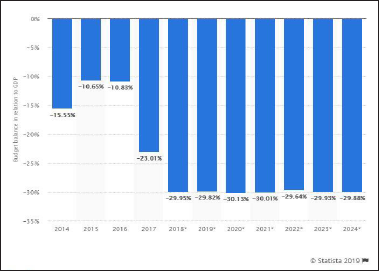
With declining oil prices in 2014, the economic problems were exacerbated (Cheatham et al., 2021). An increasing budget deficit of 23.01% of the GDP in 2017 (Exhibit 2) forced the Maduro government to print money. The Government also increased its control over the prices of goods and exchange rates. Expanding control over costs intensified inflation, which reached 181% in 2015. After that, the Government stopped publishing official statistics about inflation. The situation is aggravated due to a need for more investment in goods and services. The inflation translated into very high inflation expectations, as citizens of Venezuela rushed to stores to buy things or convert them to dollars (Carmody, 2019). The Government introduced a new digital currency, ‘Petro’, tied to Oil. Although it was the Government’s first digital currency, it never worked. Finally, the money was devalued by 95% and renamed ‘Bolivar Soberano’. Devaluation of the currency also did not work, as inflation soared to 350,000% in 2019. Inflation was tracked to the money supply, and both followed the same trend.
The political crisis supplemented the economic crisis (Cheatham et al., 2021). The opposition leader, Juan Guaido, took over the charge of presidentship by alleging that Maduro’s re-election was fraudulent. Economic sanctions were imposed on Venezuela by the US president. After several rounds of political tensions, the opposition gave up against Maduro. In 2019, Maduro reopened many sectors of the economy, including oil, to foreign investors (BBC, 2019). On the monetary front, due to hyperinflation, the Bolivar was rendered useless by the majority of the residents (Rodríguez, 2021). The public widely accepted the dollar as the official currency. The economic and political situation resulted in high poverty rates (65% of the population lived below the poverty line in 2019). The economic crisis was supplemented by the migration crisis. Over five million Venezuelan residents fled and found refuge in neighbouring nations (Sanchez, 2019). The situation was recognized as one of the worst migration crises in Latin America. Some famous economists commented on the situation as one of the worst economic crises after the US Great Depression and the migration crisis in Syria. Chavez’s vision of a socialist economy funded by revenue generated from the export of oil was considered the prime cause of the crisis.
Way Ahead
Given the state of the economy, which is debt-burdened with millions of people living in poverty, Juan is on the verge of deciding to enhance the economic conditions. Fiscal consolidation can further increase unemployment, driving people into poverty. Can he go for dollarization? Can he go for diversifying the economic base?
Exhibits
Historical Inflation Rates in Comparison.
Budget Balance in Relation to GDP.
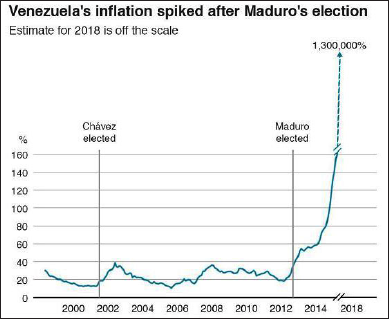
Venezuela Facts and Figures.
Footnotes
Declaration of Conflicting Interests
The authors declared no potential conflicts of interest with respect to the research, authorship and/or publication of this article.
Funding
The authors received no financial support for the research, authorship and/or publication of this article.
