



Abstract
ALBAIK is one of the leading fast-food brands that has been known for its high-quality food offered at affordable prices in a courtesy and inviting environment. The story of ALBAIK restaurant started in 1974 in the city of Jeddah in Saudi Arabia, and recently, it has been able to achieve international expansion in other countries, including the United Arab Emirates (UAE) and Bahrain. This case study presents about the success story of ALBAIK restaurant in relation to its expansion in the UAE. Specifically, it focuses on the entry mode used by ALBAIK as well as the benefits from expansion to UAE market. Also, comprehensive analysis about the political, economic, cultural, technological and legal environment of UAE, which would have significant implications on doing business in the country are presented. Finally, the case study aims to enrich our understanding about the fast-food industry in UAE as well as the contributions of ALBAIK to CSR, which have enabled it to position itself as a market leader in the industry.
Introduction
ALBAIK was founded in 1974 by the late Shakour AbuGhazalah in the city of Jeddah in Saudi Arabia in response to a demand for reasonably priced, freshly prepared meals delivered quickly by friendly staff in a pleasant setting. Shakour invested all of his hard-earned savings in this business venture, and signed an exclusive agency agreement with a company located outside of Saudi Arabia for the usage of their proprietary deep-fried chicken spice blends and equipment. As a result, Shakour was the first in the market to introduce the ‘broast’ chicken concept throughout Saudi Arabia.
Shakour discovered a great spot in the newly constructed Al Dakheel Building at the intersection of Al Madinah Road and Palestine Street in Jeddah, as the city was spreading northward from the ancient city. He begun the construction on his first restaurant but later decided to suspend his project when discovered that electricity had not been extended to the site. In September of 1974, Shakour AbuGhazalah founded the first Broast restaurant in the Kingdom of Saudi Arabia in a converted warehouse he had rented on Airport Road in the Sharafiyah District. In March of 1976, the second Broast Restaurant eventually opened its doors in the Al Dakheel Building, which had been chosen as the location to inaugurate the business in the first place.
The objective that Shakour AbuGhazalah had set for himself was almost within reach when just five months later, his life was cut short. On 14 August, 1976, at the age of 48, he lost his fight against cancer. The son of Shakour (Ihsan), who had recently graduated from college, had to leave his brother Rami to finish his degree so that he could return to Jeddah and prevent the collapse of the startup after Shakour’s sudden death. Ihsan said:
With the demise of our father, we lost the agency rights and had to start from scratch. We had to liquidate assets, pay off debts, streamline the business and reduce costs. By the time I took over the business, there were over 400 copycat restaurants serving ‘broast’ chicken in Jeddah alone. We had to find something that would set us apart from the competition and we knew that it had to come down to quality and value.
In 1982, once Rami completed his studies, he joined Ihsan in Jeddah. The result was a unique achievement for the two brothers. The company was completely redesigned by the group of young engineers. Rami said:
We didn’t know about food when we started. We weren’t restaurateurs, we were engineers. We had to learn the food business from the ground up. I followed the example of our father and got behind the counter, cooked the food, served our customers, cleaned up the premises, everything, while Ihsan went to Paris to study Food Technology. Once we learned the basics, we began to deploy systems that ensure quality and increase efficiency.
Upon the return of Ihsan, he came up with the now-famous recipe for 18 different secret herbs and spices. His brother has then put in a lot of effort with him over the next three years, working late into the night every day to prepare the recipe for further cooking at an undisclosed location and then transporting it to the main kitchen for additional cooking. In the meantime, the workforce was trained and the restaurant’s image was revamped through changes to packaging, operations and production. The two brothers were well aware that in order to differentiate themselves from the other businesses in their industry, they need a new brand name as well as a new company logo. Ihsan together with his late spouse Laila (Monique) were responsible for designing the new logo, and after that, the family got together and decided on the ALBAIK brand name. In 1986, ALBAIK brand was introduced to the market. Komo Paravati former Regional Operations Coach (1976–2010) said:
Almost immediately customers began flocking to our newly branded & refurbished outlets; ALBAIK became iconic—a restaurant with a difference serving highest quality food, fast and courteous service, sparkling clean restaurants at best value for customers.
It wasn’t until 1990 that Mecca welcomed the first ALBAIK restaurant. In 1998, ALBAIK began its growth by opening three temporary locations in Mina to serve Hajj visitors. In 2001, ALBAIK opened a new store in Medina. After that, in 2002, Diyafa Mall in Mecca developed a limited menu food court concept called ALBAIK Express. They opened what is now known as the world’s largest quick-service restaurant kitchen in Mina in 2006 as a seasonal restaurant to serve travellers during the Hajj. Another branch was established in Yanbu City during the same year. On the main route connecting Medina and Jeddah, they also launched their first express restaurant inside a Sasco Petrol station in 2013. In 2015, they opened their first restaurant outside of Hejaz, in the city of Buraydah, Qaseem. After that, in 2016 and 2018, they opened their first stores in Jizan and Riyadh. 2019 marked the opening of three new stores in Dammam and Eastern Province. To establish itself as an international brand, ALBAIK has opened its first branch in the Kingdom of Bahrain in 2018. On June 2021, ALBAIK has further expanded its business to UAE and opened in the Dubai Mall, bringing its unique menu to outside Saudi Arabia. Since then, they have expanded in the United Arab Emirates with the opening of three additional locations, with a fourth under construction.
However, it is important to note that ALBAIK is one of the businesses that makes it a priority to hire the skilled labour by providing them with a stimulating workplace environment and implementing supportive training programmes to ensure their satisfaction and better job performance. Despite the challenges faced in fast-food industry, ALBAIK has been able ensure the retention of its staff through providing them with a pleasant work environment, better compensation package and useful training programmes. Furthermore, it has been a leader in community service in the industry, devoting resources to various programmes that benefit the society. In particular, it has developed its own policy for applying CSR principles, mainly in the areas of education and the environment. As a result of its success in Saudi Arabia, ALBAIK has opened more than 120 locations across the GCC region (Arabian Business, 2023). The brand has grown by opening a number of new locations in UAE and other GCC countries, and it is anticipated to expand further in the region.
Entry into the UAE Market
After ALBAIK has successfully opened three stores in Bahrain in 2020, the company was prompted to open a fourth store in Dubai (Joseph, 2021). The UAE’s ALBAIK restaurant opened in Dubai Mall’s food court in June 2021. After opening a branch in the Kingdom of Bahrain, ALBAIK’s restaurants now have a total of two new international markets outside of Saudi Arabia. Initially, it grew by creating a temporary store at Expo 2020 Dubai, which proved to be so popular with large queue reaching outside the building on the opening day. Upon the end of Expo 2020, the fast-food franchise intimated in an Instagram post that it will be announcing the establishment of a new store in the United Arab Emirates (Khan, 2022).
ALBAIK has entered the UAE market through franchising mode. Franchising is one of the business models in which one company (the franchisor) grants another company (the franchisee) access to its trademarks, trade secrets and other valuable assets in exchange for financial compensation (Alon et al., 2020). International franchising has been considered as an important mode of entry that enables businesses to expand into new markets with a comparatively low level of risk. There are a number of advantages for the franchisee in the franchise agreement. For instance, the franchiser will provide the necessary resources for the franchisee to run a successful business. A franchisor will further provide services such as training, supplies, management assistance and/or technical support. Partnering with a well-known company also improves the chances of being successful in the international market.
However, the franchise/license for operation and expansion in UAE was given to ServQuest (Joseph, 2021; VFS, 2021), a firm that was developed and formed by National Holding, Abu Dhabi. ServQuest is committed to operating and expanding ALBAIK across the seven emirates under the direction of an experienced team responsible for the management of several successful restaurant brands in the UAE. It is believed that ALBAIK group was so cautious about protecting its brand and centralizing operations, to avoid any errors that might damage the reputation, or simply to cut costs, as the UAE is considered to be smaller in size in comparison with Saudi Arabia.
According to Yazan Malhis, general manager of ALBAIK Food Systems—UAE, ALBAIK has earned its place as Saudi Arabia’s most popular restaurant, thanks to the hard work and dedication of its well-trained team members, who strive to deliver food of exceptional quality and 100% Customer Love at all times. He added: ‘Our recent launch in Bahrain proved extraordinarily successful despite the current challenges, and we are delighted to further extend our reach with ALBAIK’s first branch in the UAE. We look forward to a fruitful relationship with ServQuest and will continue to seek out fresh opportunities to serve our loyal customers, wherever they need us to be’. Moreover, Karim Hajjali, the CEO of ServQuest stated that:
Many visitors to Saudi Arabia return with fond memories of ALBAIK. Likewise, Saudis and former residents in the Kingdom living overseas will often find themselves craving for ALBAIK dishes. We are proud to partner with this much-loved brand on its long-awaited arrival to the UAE and are delighted to introduce diners in Dubai to the unmistakable taste of one of the Kingdom’s unmissable culinary treats.
ALBAIK now has a presence in five different areas of the United Arab Emirates as a result of the opening of two new branches in Dubai, a branch that was only recently inaugurated in City Center Ajman, and two new branches in Sharjah (Khan, 2022). After achieving great success with its launches in Dubai, Ajman and Sharjah, ALBAIK decided to open a new store in the market by extending its operations to another emirate: Abu Dhabi. The first Abu Dhabi restaurant which was officially opened in December 2022 is located in the iconic landmark and super-regional shopping destination in Al Wahda Mall (Khaleej Times, 2022). In response to the news, the general manager of al Wahda Mall, Mr. Navaneeth Sudhakaran, stated that ‘this will be the largest branch of ALBAIK in the UAE, with 9,500 square feet of space dedicated to the capital fast food joint’. The restaurant’s layout is meant to be able to handle lengthy waits in an organized and efficient manner. When asked about the quality of the service provided to customers, he continued by saying, ‘We are constantly ready to deliver a unique experience to our precious shoppers and serve our guests in Abu Dhabi in a better way’. As a result, we put in long hours every day and night in order to fulfil our customers’ needs, which is our top priority.
Benefits from Expansion to UAE
The economic climate in UAE is characterized by high potential for success. The UAE has a competitive advantage over other countries as a result of its high-quality infrastructure facilities, competent workforce and individualized customer care. According to the World Bank’s Ease of Doing Business Report 2020, the United Arab Emirates ranked in at number sixteen worldwide. Here are its positions in the various aspects: First in the world for accessing electricity, third for obtaining building licenses, ninth for enforcing contracts and tenth for registering property. The flexibility in conducting business wherever you like within the country is another advantage. Investors can establish their businesses in free zones, commercial structures and industrial areas. Over 40 special economic zones (SEZs) allow for full foreign ownership of businesses. The Minister of Economy, Abdulla bin Touq Al Marri explained that ‘the changes to the Commercial Companies Law were made to improve the country’s competitive advantage and is part of UAE government efforts to facilitate doing business’. Bin Touq noted that the changes will reinforce the UAE’s reputation as an international economic centre and encourage an investment flow to important economic sectors, making it a more appealing destination for foreign investors, entrepreneurs and talent. The decision by the government covers a wide range of industries, from the hospitality and food services sector to the internet and communications sector and even the professional, scientific and technical services sector.
However, ALBAIK decided to operate through franchising mode/partnership with ServQuest to simplify the expansion process and minimize the risk. Also, the expansion to new country has been considered to be very costly and time consuming. While ALBAIK reaps the benefits of an additional location, it avoids the financial and legal responsibilities associated with launching a franchise unit. Moreover, one of the major sources of challenges in expansion comes from the process of hiring and managing personnel. Training and general business knowledge are the main forms of support that ALBAIK, as the franchisor is obligated to provide to its franchisee. Because of the low level of staff oversight required, ALBAIK will be able to direct its attention towards the expansion of the company rather than the day-to-day operations. Instead of being concerned about whether or not an employee will show up for their shift, ALBAIK is currently concentrating on the more important aspects of running a successful business. Finally, UAE has enforced a corporate tax law that mandates a 9% tax rate for companies reporting revenues of more thanDh 375,000.
United Arab Emirates as a Business Destination
Political
The UAE is considered to be among the safest countries in the world, along with the remaining GCC countries. It has been politically stable for a long time and has an open diplomatic policy around the world. The UAE is a part of the Gulf Cooperation Council (GCC), the Arab League, the United Nations (UN) and the UN’s agencies. According to the Global Peace Index 2021 made by the Institute for Economics and Peace in New York, it is the third most peaceful country in the area. The UAE governance takes shape in Federal and governmental ways, as the UAE has one Federal government concerns with main issues like security, for example. On the other hand, each emirate has its own government, by which differences can be found in governing. It is important to mention that UAE has close and healthy ties with most of the world’s countries, including so many treaties that ease movement of means of production, which affect all economic, cultural and social perspectives nicely. The country emphasizes on the principles of tolerance and respect for cultural diversity. According to the World Happiness Report 2020, the UAE holds the top rank in the general index for the Arab region. The country has passed effective anti-discrimination and anti-hatred laws and hosted the Human Fraternity Meeting to improve dialogue about how humans can live together. The country has also passed effective laws to help vulnerable community groups.
Economic
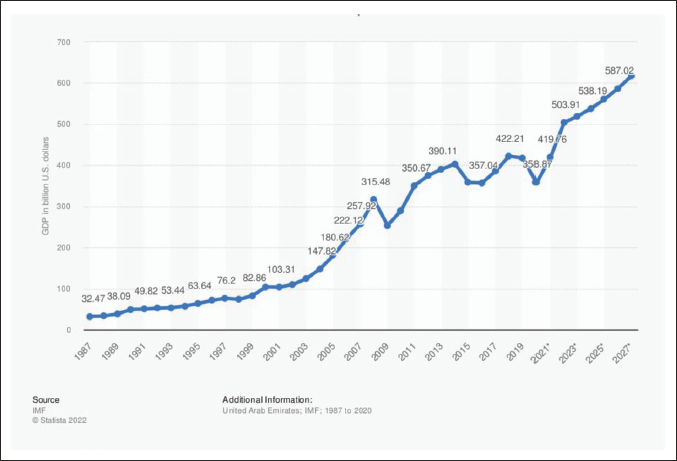
The UAE’s economy is one of the strongest in the world, especially that its main pillar is oil, which is a main necessity, backed up with diversified portfolio of income resources, including Foreign Direct Investment (FDI). The country has eased a lot for outsiders, not to mention the low unemployment rate, and the high GDP per capita, that elevates the purchasing power level in the country to a great extent, leading to more consumption, and more profitability for businesses. UAE’s economy is considered as the fourth largest in the Middle Eastern region, with a GDP of $414 billion in the year of 2018 (Samour et al., 2022). The GDP in the UAE exceeded $415 billion in 2021. It was anticipated that between the years 2022 and 2027, it would constantly rise by a total of $113.6 billion (+22.54%). In the year of 2027, it is anticipated that the GDP will amount to $617.48 billion (see Figure 1). The economy of the UAE made a healthy recovery from the pandemic that occurred the previous year, and this year’s economic momentum has increased up. Following growth in the first quarter, it is anticipated that the economy would expand at the fastest rate in 11 years. The Minister of Industry and Advanced Technology declared in June 2022 that the country’s goal to further strengthen its industrial sector to increase economic resilience in the face of global difficulties had helped it recover from the pandemic.
Gross Domestic Product (GDP) Growth from 1987 to 2027 (in Billion US Dollars) in United Arabs Emirates.
UAE currently occupies the top spot in the Middle East and North Africa (MENA) region and is actively working to consolidate its position through economic diversification. It has a thriving economy that is featured through multiple factors, such as its advantageous location, its large and stable financial reserves, positive international relations, consistent spending on infrastructure, commitment to digital transformation and innovation, progressive policy of economic diversification, multi-specialty free zones and the increased amounts of FDIs. A portion of the high value spent on food by Emiratis can be explained by their high net income, in addition to the fact that going to the mall and eating out are the primary sources of entertainment for many people living in the region. Spending money on food away from home (i.e., at restaurants) mirrors the growth of the economy and population.
Social/Cultural Environment
The UAE is one of the countries embracing globalization nicely, which resulted in a highly diversified population, creating more needs and wants to be met in the country. According to the UAE Government Portal, approximately 200 nationalities worked and resided with their families in the UAE in 2021. The largest ethnic group of foreign residents in the country is represented by Indian expatriates. Also, UAE is a collectivist country where people live together and have convenient lifestyles due to the high salary jobs. Moreover, the official religion in the country is Islam and it is a core pillar of The UAE’s society, giving orientation to many actions in people’s lives including purchasing behaviours. Furthermore, UAE residents are among the most talented and skilled workers in the world. The diversity of its people boosts both performance and creativity in the workplace. Although Arabic is the official language of the country, English and other major languages are also widely spoken. The government has introduced a new visa system in an effort to recruit skilled workers in the fields of medicine, science, technology and the arts that support the residents in many ways. The country also aspires to lead the world in producing talented human capital and highly competent individuals in fast-growing industries.
Women are getting more involved in workforce in the country. This is because many Emirati women purse higher education. In 2018, women accounted for 71% of all alumni graduates at higher education institutions. Also, many foreign women relocate to the country in search of employment or entrepreneurial opportunities. The government of the UAE encourages women to participate in the workforce by providing options, such as part-time and flexible work schedules, in addition to paid maternity leave. Additionally, the government is working to promote equality in the workplace. In 2018, a law mandating equal pay was enacted in order to initiate the process of reducing the gender pay gap. Despite this, women hold only 5% of leadership positions in the business sector of the UAE.
Technological Environment
Technology has never been an issue for the UAE, due to the country’s wealth, high young population, high purchasing power and high investments in technology sector. The UAE is considered to be a hub and an incubator for many technological breakthroughs. Furthermore, the country is working towards becoming a major hub for data centres in the Middle East. Extra investments of up to a billion dollars are expected to be made by 2026. The implementation of Internet of Things (IoT) solutions to improve public infrastructure has also made the country a frontrunner in this arena, with a particular focus on Dubai and its ambitions to become a world-class smart city. In Dubai and the rest of the UAE, there is a strong foundation of collaboration in a variety of fields, including information and communications technology (ICT), power, transportation, infrastructure, healthcare and government. In addition, the nation has made substantial investments into programmes for smart cities, with the objectives of building smart cities from the ground up and improving infrastructure in existing cities. Public Wi-Fi, charging stations for electric vehicles, real-time traffic monitoring and an electronic wallet for the Roads and Transport Authority are just a few examples of these kinds of projects.
Legal Environment
UAE is a federation whose constitution sets out the rules governing its relationship between Abu Dhabi, its federal capital and the individual emirates (its constituent states). The Constitution of the country establishes federal law as superior to the laws of the various emirates. Each emirate may, however, pass its own laws in areas not reserved by the federation. In areas where the federation has not passed a law, individual emirates may do so. Civil and commercial matters are mostly governed by federal law, with the exception of property law. UAE generally supports free market principles, including the promotion of competition and the elimination of monopolies. It has solid relationships with major regional and global trade organizations. The UAE’s competition rules and regulations were enacted to foster an environment free from anticompetitive behaviours and to protect consumers by preventing unfair pricing and other market distortions (Murray et al., 2021).
In general, UAE has clear legal regulations related to who opens a business, how to sell, where to sell, at what quality to sell and how to advertise for products. For example, no one is allowed to sell anything on Instagram without getting a license first for online trading. Also, many products have to take ISO verification in order to be sold for people. Moreover, The UAE pays much effort on consumer safety and pricing strategies by prohibiting unreasonable pricing, especially for main commodities such as rice, grain, sugar and cooking oil. However, the UAE is an investor-friendly environment that gives incentives and facilities to promote FDIs, especially after allowing investors to have 100% ownership without the need for a sponsor as in the past. ALBAIK Marketing activities are well sticking to UAE laws and regulations, as they are posted on Instagram based on the license they have in UAE, and mainly talking about the products they have, to remind people of getting a new taste of ALBAIK.
Fast-food Industry in UAE
The UAE is home to an impressively large number of fast-food restaurants. There is a wide range of food service establishments, menu options and individual preferences for dining out. There are about 3,100 restaurants in the UAE, but only 94 of them serve fast food. Despite this, the fast-food businesses are generating a significant amount of revenue. A large part of this expansion may be attributed to the fact that fast-food restaurants now deliver to customers’ homes for free and offer a wide range of tasty options at costs that are reasonable for any family. In general, the country’s Foodservice Market is divided into two categories: Type (Quick Service restaurants, 100% Home Delivery, Full-service restaurants, Cafés/bars and Street Stalls/Kiosks) and Structure (Chained Consumer Foodservice and Independent Consumer Foodservice). The expansion of the country’s foodservice industry has been driven by factors such as rising per capita income, an increase in the number of people living in metropolitan areas and shifting customer tastes. Additionally, the country is at the forefront of the Middle Eastern foodservice business due to the abundance of tourists and the presence of internationally recognized food and beverage brands.
Generally, the foodservice industry is extremely competitive due to the presence of numerous local, national and even worldwide firms, including Yum Brands and Starbucks. The major US-fast-food players, including McDonald’s, Burger King, Pizza Hut, KFC, Domino’s and Hardee’s, continue to have a disproportionate amount of influence over the fast-food industry in the country. In addition, there is intense competition among the providers of foodservice based on cost, the quality of the foodservice, the average number of calories consumed in a meal and the availability of healthier menu options. Subway, McDonald’s and Starbucks are just a few examples of the many global chains that have opened franchises or formed partnerships with domestic eatery operators in order to rapidly extend their global footprint. It was found that the market leaders utilized strategies such as product innovation, mergers/acquisitions, geographic expansion and strategic collaborations. Although there are a lot of fast-food restaurants that provide fried chicken, the quality and taste of the food served at ALBAIK is undeniably distinct, and its prices are lower than the average (Khaleej Times, 2022). To further respond to the competition, ALBAIK chain of stores has maintained its success by holding a secret recipe that is not easy to copy or imitate. The chicken and accompanying garlic in this dish are what really set it apart from the classic Midwestern American dish. The sauce contains no less than 18 different spices. However, the most significant challenge that fast-food stores encounter in the hospitality sector in Dubai is the high cost of renting space. To overcome this challenge, ALBAIK has decided to operate through franchising mode to avoid the costs associated with rent, permission, obtaining licenses for operation. ALBAIK also does a lot of research before choosing a location for its restaurants to make sure that the location will have enough customers to keep the business profitable. Therefore, ALBAIK conducts proper analysis about population distribution and number of visitors at selected areas.
In addition, the percentage of employees who leave their jobs is particularly high in the Middle Eastern restaurant industry. The primary reason for this is the intense level of competitiveness. (Mahmoud et al., 2022). The employees have the impression that they can switch to a different service provider at any time, and that better chances are available for them. Even if there is not a severe shortage of workers, the rising demand for professionals and the fiercer competition in the UAE’s market have prompted a significant increase in employee turnover. In addition, employees in food service sector may have sufficient reason to leave due to the overall industry’s poor compensation and the absence of job security. As a result, the rate of employee turnover has a significant impact on business expenses. To minimize employee turnover, ALBAIK is dedicated to the growth and development of its teams by providing chances for training at all levels, from entry to management. As part of its efforts to maintain its workforce, ALBAIK provides its employees with access to training programmes in a positive and supportive environment, with the goal of equipping young people with the knowledge and skills they need to succeed in their careers. Over the course of their careers, ALBAIK team members have access to more than 150 training courses aimed to help them grow into effective leaders and future managers. ALBAIK also adopts careful selection process by hiring the right people who are considered the best fit for the job. In addition to that, ALBAIK provides an attractive package of salary to its staff and collects feedback from them regularly. To show appreciation for employees’ hard work and dedication, ALBAIK has further instituted a rewarding incentive and recognition programme.
Marketing Strategies in the UAE
Whether launching new products or updating existing ones, businesses might benefit from a sharper focus on the marketing mix/four Ps (price, product, place and promotion). The marketing mix requires a firm to decide on the selling price of its product or service, as well as its availability and distribution channels. In the face of intense rivalry, it is essential to monitor the pricing and quality of rivals and adjust business practices accordingly. In the case of ALBAIK restaurant, it has implanted various strategies maintain and strengthen its position in the target market.
Price
Price is he monetary value at which a good or service is sold or made available for purchase. Common pricing strategies that can be used by firms to sell their products or service include cost-plus pricing, penetration pricing, competitive pricing and value-based pricing. However, when ALBAIK opened its first branch in Dubai mall, it started with the same standard pricing used in Saudi Arabia; however, later on, it increased prices with 2 to 3 dirhams in its UAE outlets, and the prices are even more on Talabat 1 application. This increase in pricing can be due to high costs in the UAE when it comes to purchasing and shipping. It has been widely claimed that ALBAIK is a living proof of a strategy combining both differentiation and price leadership. Customer value is key to every successful differentiation strategy. Despite the myriad of restaurants that serve fried chicken, the taste and quality of ALBAIK fast foods are definitely unique, while prices are always below average. ALBAIK brand sends strong messages of high quality, prices below average, fast service, convenience and corporate social responsibility (CSR).
Product
Product includes anything offered for sale. A competitive product is one that provides value for customer through a blend of benefits that cannot be imitated or copied by competitors. Furthermore, successful brands regularly conduct extensive research about customers in target markets in order to learn about their needs and then design a product/service to fulfil them. ALBAIK, much like KFC, uses a ‘secret blend’ of herbs and spices to flavour their chicken. This gives the goods a distinct flavour that has not been effectively imitated, despite the fact that many competitors have attempted to do so. Before the first franchise branch opened in the Saudi city of Riyadh, several stores with red and yellow signage like ‘Albaak’ or ‘Albaiq’ served the public. There were others that tried to compete with ALBAIK, including one with a duck wearing a top hat and another with a chicken that looked quite similar to ALBAIK. Visitors to Al-Madinah and Makkah frequently stop at ALBAIK because of the happy memories it evokes of their pilgrimages.
ALBAIK serves several dishes in UAE. Chicken nuggets, burgers, chicken and sandwiches made with chicken fillets are all popular options at ALBAIK. There are also the renowned shrimp dinners, falafel sandwiches and shawarma sandwiches. The products sold in the UAE can be considered different somehow than the ones sold in KSA. For example, the UAE menu lacks Tawook sandwiches, Saj De lite sandwiches, the more diversity in falafel meal options and the seven chicken nuggets meals found in KSAs menus, as in the UAE, only 10 chicken nuggets meal is there. Moreover, since the UAE’s population tastes are more westernized, other international fast-food chain restaurants like KFC and McDonald’s pose a threat to ALBAIK. ALBAIK is attentive to the feedback provided by its customers, which has enabled it to develop a number of well-liked dishes over the course of its history, including Spicy Chicken, Shrimp and Chicken Fillet Nuggets, all of which are still available on the menu today. Thus, ALBAIK group added the BBQ thighs sandwich in UAE menus, in additional to the baikeez, which include boneless breast and thigh chicken pieces for more diversity, and fillet nugget snacks, to give the children meal concept.
Distribution (Place)
The term ‘distribution’ refers to the steps taken by a firm to make it convenient for customers to get its products or services. This process involves packaging, delivery and transportation. Sales success relies heavily on a company’s distribution network. Due to the growth of internet usage among customers worldwide, firms have took the advantage of direct selling. ALBAIK group started with the biggest mall in Dubai, as its first branch in The UAE, due to the ability take more space, and the high visits rate, from all nationalities, especially that Dubai is the leisure city in the UAE, and is connected easily with other emirates, such as Sharjah and Ajman (Khan, 2022). Then, ALBAIK took the chance to introduce itself to the globe, by opening its second branch in Expo 2020 in Dubai temporarily, then in Mall of the emirates, city centre Ajman, al Majaz waterfront in Sharjah and city centre Sharjah, and to open soon in Abu-Dhabi, based on an article shared in the national news website. Overall, ALBAIK marketers have always been concerned towards the selection of their restaurants’ locations. No ALBAIK outlet has ever been reported as lacking in numbers of customers. Despite the huge expansions in Jeddah, which were at first seen as too optimistic based on competitor power, customers quickly proved loyal to ALBAIK. For this reason, the higher management decided that wherever people live in Jeddah, there should be ALBAIK outlet within easy reach of all the residents. This followed the same strategy in UAE market in order to reach larger number of customers and make it convenient for them for dining.
Promotion
Promotion refers to all marketing activities that focus on communicating a firm’s products and services in order to create awareness and influence consumer behaviour. As ALBAIK focuses on providing superior quality to its customers, the management is always keen to emphasize these attributes into the brand employing various methods of advertisements, publicity and public relations, as well as spreading brand stories. The high reputation of ALBAIK group perceived from all people living in KSA and visiting it, made people in the UAE could not wait for the restaurant opening in the UAE. Not to mention the restaurant’s legacy on giving two Saudi riyals as a donation for each meal sold, made people in UAE value the brand more, and feel connected morally to it, as it represents the noble Arabic spirit in the products themselves with their authentic Arabic spices, and in the operations. Moreover, until now, ALBAIK restaurant branches in UAE have run few promotions or discounts to attract customers, as the brand’s position is too strong. ALBAIK provides sponsorship to support various social activities and launches different campaign programmes from time to time that cater to various needs of people in the society in order to build brand image and increase the awareness among customers in target markets. It is one of the prominent sponsors of a wide variety of educational, social and recreational activities that are intended to cultivate the creative potential of young people in communities where it serves. During the holy month of Ramadan, ALBAIK further provides fantastic bundle deals on a wide variety of products. It also focuses on social media channels and runs advertisements in different forms for promoting its offering. For instance, it utilizes Facebook, Instagram and YouTube to reach larger mass of audiences and collects feedback from them regularly.
Corporate Social Responsibility
Corporate social responsibility is a broad term in the business domain. It typically refers to a company’s promise to act ethically when conducting business. This involves running a business in a manner that takes into account social, economic and environmental concerns. By the 1990s, ALBAIK had established itself as a well-known local brand that held a special position in the community’s collective consciousness. Ihsan and Rami’s has a strong desire to make a positive contribution to their homeland and its inhabitants. Rami stated: ‘We owe everything to our customers; they have made ALBAIK the brand it is today. Our giving back to the community and corporate social responsibility is our thank you to the communities, neighbors and customers we serve—a thank you in the ALBAIK way’. In an effort to promote science education, ALBAIK launched The Young Scientist program and sponsored the Mad Science Shows at the Jeddah Science and Technology Censer. This was the first CSR programme of its kind in the region, and it successfully united the public and private sectors within a framework of educational application within a light-hearted concept that also included an emphasis on environmental awareness. Moreover, ALBAIK would use the Young Scientist Competition as the starting point for a number of unique programmes and activities that would help the community.
Corporate social responsibility for ALBAIK also included coordinating the ‘100 parks in 100 weeks’ campaign with the Friends of Jeddah Parks Organization and the Jeddah municipality. Rami said: ‘This park along with its basketball court is the outcome of efforts between the public and private sectors, and I encourage and urge more cooperation from the private sector in all such community-related activities’. This effort is to provide public facilities that are built to world standards in order to serve as a source of entertainment, relaxation and sporting activities for the younger generation. ALBAIK has also been a sponsor of the ‘Madrasati’ programme, which was started by Her Majesty Queen Rania of Jordan with the goals of providing children with access to a high-quality education, giving them the opportunity to find employment, evading poverty and living a healthy and self-assured life.
In 2009, ALBAIK collaborated with the Ministry of Education and Khawater to implement a programme called Feena Khair, ‘My School, My Responsibility’, which teaches primary school children the value of taking pride in their school and keeping it clean by having them spend the last 15 minutes of each school day for cleaning their study classrooms. Participating schools were the Al Noor Educational Complex and the Dar Al Fikr institutions. As a result of the programme’s overwhelming success, it was expanded to an additional 52 schools in 2011. A set of standards and rules were created to aid in the evaluation of schools and classes taking part in the initiative; each month, a subset of schools is audited, and the top performing classrooms are given special recognition. The Ministry and its partners honoured the top three schools of the year at its annual awards ceremony. On whole, more than a million students and 30,000 educators from over 1,280 schools across Saudi Arabia took part in the initiative during the 2013–2014 academic year.
Looking Ahead
ALBAIK is an example for all Arabic brands on how high quality and moral respectful working activities can contribute to a legacy that makes an essential competitive advantage. Through its dedication to offer premium quality and a wide variety of menus at affordable prices, ALBAIK was able to get a strong position in the market and grows in smooth and budget-friendly way when entering UAE. This is especially when it comes to less advertising, promoting and even lessening the need to adapt the new market with new different products, as the people in the host country would favour more trying the authentic home country’s taste than trying similar local tastes. ALBAIK is committed to developing its business throughout the UAE’s seven Emirates to build brand identity and reach larger number of customers.
Footnotes
Declaration of Conflicting Interests
The authors declared no potential conflicts of interest with respect to the research, authorship and/or publication of this article.
Funding
The authors received no financial support for the research, authorship and/or publication of this article.
