




Abstract
The case study provides insights into the nuances of manpower planning in the construction industry in a post-pandemic context. This case study was developed by collecting data from employee interviews, web pages of SMMA Enterprises Ltd and research articles in the field of manpower planning. The case deals with SMMA Enterprises Ltd which is one of the leading infrastructure development companies in India. SMMA Enterprises Ltd were at crossroads in terms of manpower planning and were trying to restructure the manpower to optimize the cost. The sudden lockdown and the subsequent project delay due to COVID-19 further exacerbated the challenges faced by the company. The protagonist, in this case, is the human resources manager at SMMA Enterprises Ltd. She has a problem in terms of how to deal with manpower planning going forward especially in the challenging times because of the pandemic. Additionally, she also has a manpower planning problem because of the extension of the project. This case study can be used by academicians for classroom teaching and also can be used by practitioners as a reference case.
It was a hectic day at the office for Soumya, as she walked out of the project director’s office after a long deliberation on manpower planning. Two project sites of Bangalore Metro Rail Corporation Limited (BMRCL) where SMMA Enterprises Ltd was the engineering, procurement & construction (EPC) contractor were behind the schedule for completion. Both projects were delayed because of the COVID-19 lockdown and the subsequent labour migration.
Soumya has been heading the manpower planning and human resources activities at SMMA Enterprises Ltd sites for the past 5 years. Although recruitments and retrenchments are common in projects, the current situation at the SMMA metro project was very different. The construction work at the main metro stations was almost complete and SMMA Enterprises Ltd were in the last phase to finish the project when the COVID-19 pandemic struck. They had restructured the workforce just before the COVID-19 pandemic and were anticipating project cost optimization. The lockdown due to COVID-19 caused significant disruption in the labour market. The labour migration further exacerbated the situation and resulted in a shortage of skilled labour. SMMA Enterprises Ltd could hardly afford any delay in the project completion because of the mounting costs. On the other hand, BMRCL wanted SMMA to extend the existing railway network by 1 km which was an addition to the existing work. Soumya had to decide how she would plan for the manpower requirement in these challenging times because of the lockdown and the extension of the project.
Industry Outlook
The construction industry in India has been growing steadily at around 5.6% between 2016 and 2021, up from 2.95% from 2010 to 2015. In the year 2019, the industry recorded an all-time high in terms of its contribution to the Indian economy with a contribution of over 2.7 trillion INR. The construction industry was projected to grow by a CAGR of 15.7% by 2022 to reach an estimated amount of $738.5 billion. By 2025, the Indian construction market is expected to be the third-largest market globally. Being a mature market, it has signs of sustained growth in the next few years.
The construction industry in India can be classified as: (a) real estate; and (b) urban development projects. The real estate segment includes residential buildings, offices, hotels, retail and leisure parks, whereas the urban development projects include infrastructure projects owned by governmental or semi-governmental organizations. The construction industry in India has been going through a difficult phase in the past few years because of challenges in land acquisition, delays in the completion of projects, liquidity issues, unsold inventory, and labour problems. However, the urban infrastructure segment is growing at a good rate. This can be attributed to rapid urbanization in and around tier 1 cities because of which the development of urban infrastructure has become an absolute requirement.
The urban infrastructure sector is a fragmented market and is dominated by players like NCC limited, JMC Projects, AFCONS Infrastructure Limited, TATA Projects, L&T constructions, SOMA Enterprises Ltd and other smaller players. The high initial investment in machinery, land, and infrastructure is a barrier for new entrants. Governmental influences and lobbying are common in this industry.
The construction industry is labour intensive and requires a large skilled/semi-skilled labour force. In the urban infrastructure sector, the labour requirement varies according to the project and its completion status. Generally, the demand for labour requirements in infrastructure projects will be low at the beginning of the project and spikes up once the project takes off. It reaches the maximum during the middle periods of the project and stabilizes for some time before climbing down. Normally companies plan and restructure the manpower based on the project structure and requirements at various periods.
Construction companies hire the labour force through labour contractors who hire the labourers on their payrolls and allocate them to various projects. These contractors hire a large number of labourers from North Indian states like Uttar Pradesh, Bihar, Orissa, West Bengal, Assam, because of the availability of cheap labour. The staff, officers and engineers for the projects are recruited by the companies through direct recruitment, referrals, campus recruitments, and so on, and they will be on the companies’ payroll.
Company Profile
SMMA Enterprises Ltd was one of the leading government-partnered construction and infrastructure development companies in India for over two decades. It had its headquarters in Hyderabad, India. SMMA Enterprises Ltd started its operations in the year 1997 and was a medium-sized infrastructure solutions company with a net worth of around $556 million. SMMA Enterprises Ltd have been instrumental in executing key infrastructure projects pan India and abroad. The company had around 1,000 employees and was managing booked orders of around $3 billion.
The company was involved in the construction of roads, highways, urban infrastructure, energy and irrigation projects across India. SMMA Enterprises Ltd had operated with a variety of projects as a Buy–Operate–Transfer (BOT) contractor and/or EPC contractor. SMMA had prior experience in building urban transportation systems with Delhi Metro (underground), Mumbai Metro (underground), and so on. SMMA had many ongoing projects apart from the BMRCL metro rail project and competed with companies like L&T, Tata projects, JMC projects, AFCONS infrastructure, and so on. Many of these competing companies had better financial standing, a stable workforce and technological prowess in handling infrastructure projects.
Bangalore Metro
BMRCL was a collaborative venture between the Government of India and the State Government of Karnataka with an agenda to implement the Bangalore Metro Rail project. Bangalore Metro is also called ‘Namma Metro’ which not only aims to provide comfort in travel but also to reduce traffic congestion and thus contributing to the reduction in carbon footprints. Namma Metro is also the second-longest metro network in India after the Delhi metro (source: BMRCL website).
Namma Metro had phase 1 and phase 2 constructions, with phase 1 fully complete and operational and phase 2 in its completion stage. There were four rail networks in phase 1 and phase 2 of the metro project including the Green line (40.1 km), Purple line (34.3 km), Yellow line (18.8 km) and Red line (21.2 km). Many reach lines are subsidiary to the main lines to facilitate maximum reach.
As part of the Purple line, SMMA Enterprises Ltd were given the tender to construct the subsidiary metro rail from Kageri–Milapura (BMRCL R2B) and the stations at these two locations. The project handled by SMMA included the casting yard site and Kageri–Milapura viaduct site which had the railway lines and the metro stations.
Manpower Planning
The allocation of the right talent at the right time for the right task in adequate quantity can add significant value in enhancing productivity and outcomes in organizations. This comprehensive process is generally referred to as Manpower Planning. Manpower planning facilitates business enterprises to estimate the realistic requirement of employees—in quantity and quality of talent pool or skill sets to achieve the business goals by optimizing talent deployment at the workplace. It decreases the uncertainties about current human resource demands and removes the inaccuracies associated with staff deployment and upgrading the use of its human asset. Therefore, organizations need to be proactive in the timely recruitment of employees on one hand, while ensuring retention of the talented workforce on the other, which shall improve their utilization of human resources.
Retrenchment which is also part of manpower planning is a set of organizational activities undertaken to achieve the objectives of cost-and-asset reduction and disinvestments, in times of challenges and uncertainties in business operations. When an organization adopts retrenchment as one of the cost-optimization measures, it reduces the expenditure and increases the financial viability/profitability of the organization. Simply stated, retrenchment is a systematic and scientific process of re-deployment of an organization’s human resource or hierarchical structure with layoffs of a section of the organization’s employees. Also, it is understood as the termination of employees on the grounds of surplus labour due to an economic downturn.
Manpower Planning in the Troubled Times
Manpower planning in troubled times like the COVID-19 pandemic or any similar exigency poses significant operational challenges for companies. It is very difficult to hold on to the manpower intact and get the project completed in these troubled times. Any manpower requirement in these crisis times needs mobilization from external sources and labour contractors. The cost of manpower acquisition may go up manifolds resulting in extra financial burden on the firms. Under these circumstances, firms exhibit the dynamic capabilities to adapt to the new normal posed by the external environment.
Antecedents of M1anpower Planning for SMMA
Manpower planning at SMMA was impacted by many factors. The challenges like bureaucratic delays, lack of coordinated effort to finish the project and less skilled workers were persistent with construction projects in India. SMMA was influenced by these challenges for their metro project. Apart from that, land acquisition and clearances from governmental bodies were major barriers that caused project completion delays resulting in the escalation of the overall cost of construction of the projects. SMMA had similar challenges with their metro project because of which there was a significant financial impact. Therefore, SMMA had to optimize its manpower and make it more efficient so that the project gets completed without any further delay. Since the metro project was nearing closure, redundancy was a major issue that SMMA had to address. Therefore, they had to consider retrenchment as an option for manpower planning.
Manpower Planning at SMMA
Manpower planning aims to attain appropriate fitment of the number of employees and their skill set with the organization’s requirements. The purpose of manpower planning is to attain the organization’s objective to optimize the cost of manpower. At SMMA Enterprises Ltd, manpower planning was a cyclical process and was done in five steps:
Step 1: Analysis of the existing inventory of manpower/employees Step 2: Prediction and forecasting of manpower requirements for the future Step 3: Restructuring the workforce Step 4: Designing, developing, and delivering the various training programmes Step 5: Capacity building and development of retained employee competencies
The use of quantitative manpower planning methods is common in construction industry and the most commonly used techniques are as follows.
Expert judgement: This technique involves estimating manpower requirements based on the experience of project managers. The minimum and optimum number of employees along with the required skills and qualifications is provided by the managers based on their previous experience. Trend analysis: This is a statistical technique for forecasting manpower requirements based on trends calculated from historical data. This technique assesses changes in the internal and external labour market. However, this technique is relevant for stable conditions. Examining and standardizing work or workload method: Manpower planning is estimated by identifying the nature and number of tasks, and people required to complete these tasks in a particular time frame. The total workload is estimated and based on that manpower is calculated. Work process modelling: This method involves developing models using statistical data with the help of operations research, statistics and simulation. Indicator method: Another method used for manpower planning is to estimate requirements with the help of indicators such as size or structure of employment.
SMMA’s Estimation Methods for Manpower Planning
The manpower planning at SMMA Enterprises Ltd was based on a combination of workload and expert judgement methods. The managers of various departments in the metro project at SMMA were responsible to provide manpower estimates based on the number of critical tasks, timelines, and competency requirements for the completion of the tasks. They make these estimates based on their experience with previous projects. First, the total workload was calculated for delivering the project and based on this, SMMA estimated the workforce requirement.

The capacity required for each department was estimated by using the formula mentioned above. Based on the survey to identify redundancy, the extra workforce was identified and listed for retrenchment.
SMMA Enterprises Ltd project sites for the Namma Metro project had six departments which included: The Safety, Health and Environment (SHE) department, Quality Control (QC) department, Technical department, Design department, Construction department and Commercial department. The SHE department managed safety, environmental issues and employee health with a focus on the prevention of accidents and risks at work. The QC department focused on checking and adhering to the quality standards as specified by the project owners. The Technical department took care of equipment management and maintenance. The design department worked with designs, sketches and plans for various structures, while the Construction department was responsible for building, plastering and painting. The Commercial department managed the procurement and billing associated with the project. SMMA Enterprises Ltd, as part of the BMRCL project, were working on two metro stations (Kageri–Milapura) and elevated railway lines connecting these metro stations. The pre-casted structures required for these sites were supplied by a casting yard that was located close to these construction sites.
SMMA Enterprises Ltd recruited the managers, engineers and staff for various departments through referrals, direct recruitments from college campuses and newspaper advertisements. The human resource department of SMMA engaged with these recruitments directly. However, for the labour class workers the company depended on labour contractors and had contracts for the supply of skilled labour for their project sites.
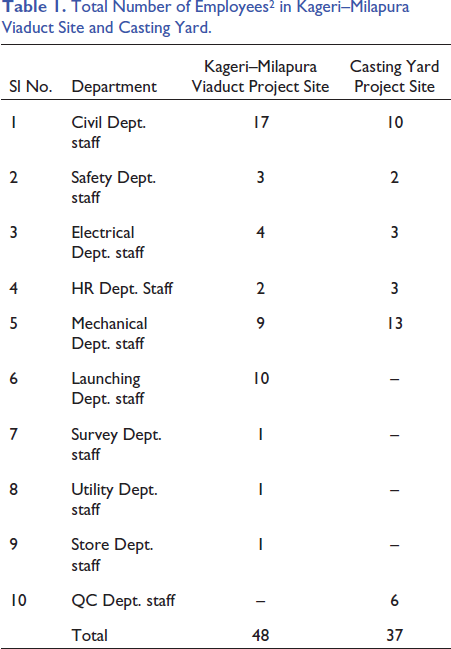
The maximum number of employees required for various departments, considering the construction sites and the casting yard was 100 employees. However, over a while, some of the employees moved out because of better opportunities or for other reasons because of which the number of employees working in the project sites and the casting yard got reduced to 85 (Table 1).
Total Number of Employees 2 in Kageri–Milapura Viaduct Site and Casting Yard.
Retrenchment Process
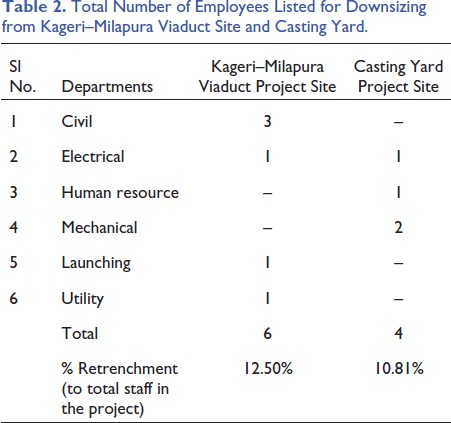
At SMMA, the excess labour was estimated based on the ‘Redundancy’ in each of the departments in the project sites and the casting yard. SMMA forecasted the job required based on the project status for completion. Once the project was about 80% complete, that is, when most of the civil work and electrical work was finished and only when the finishing work and the testing of equipment were pending, manpower restructuring was planned. An existing inventory of the manpower was taken and forecasting was done based on the man-hours required to complete the work. After taking the inventory of the existing manpower, a redundancy of 12.5% of the workforce at the metro station construction site and 10.8% of the workforce in the casting yard (Table 2) was identified.
Total Number of Employees Listed for Downsizing from Kageri–Milapura Viaduct Site and Casting Yard.
After identifying the redundancy, the management decided to retrench the redundant employees in the project sites and casting yard. Project completion and redundancy were the main reason for the retrenchment. An initial checklist required for the retrenchment process was prepared. The procedure for retrenchment involved the identification of the employees and intimating them in this regard. As a company policy, all the employees who were identified for retrenchment were served 2 months prior notice. They were motivated to look for positions with similar work in other organizations. Once the notification period ended, the employees were relieved of their duties and all the work-related documents, tools, and equipment that were issued to them previously were taken back. All the accounts related to the retrenched employees were closed. The salary statements were processed and they were paid 2 months’ salary as compensation. Finally, clearance certificates and service certificates were issued to them.
Six employees from the viaduct site and four employees from the casting yard were identified for retrenchment. According to the company policy, their salaries were settled, clearance certificates and service certificates were provided and were subsequently laid-off.
Post-retrenchment Challenges
The retrenched employees had a personal rapport with other employees who were retained in the project. Because of this, the retained employees felt pained about their peers being retrenched. The retrenchment process created a lot of unease and a lack of motivation among the other employees who were still with the company. They felt less secured about their jobs and were under tremendous stress that, they will also be retrenched and will have to look for an alternative job soon. The retained employees started distrusting the management decisions regarding job security and employee wellbeing. Some employees even started looking for better opportunities outside the organization, although they were not listed for retrenchment. This affected the overall morale and performance of the workforce.
Since employees who were retained were under ‘Survivor syndrome’, 1 they felt uncomfortable of being retained and were de-motivated and stressed. Motivational sessions and workshops were introduced to engage and motivate the retained employees every week. A reward system was instituted to recognize the good work towards project completion and incentives were given to motivate the workforce.
COVID-19 Pandemic and Labour Market Issues
The construction industry employed around 7 million people which included 300,000 white collared jobs. According to the Confederation of Real estate Developers’ Association of India, there were 20,000 active construction projects and 18,000 construction sites across India, which employed local workers and migrant workers from various states and geographies. A large part of the workforce in the construction industry comprised migrant workers and these workers stayed in temporary housing near the project sites.
By the end of February 2020, there were reports that a new strain of coronavirus—SARS-Cov-2 was infecting people across the globe. This infection was called Corona Virus Disease 19 or simply COVID-19. To control the disease, a lockdown was declared to slow down the spread of disease. The lockdown created significant uncertainty for workers and employees in all sectors.
Because of the COVID-19 lockdown, the migrant workers started moving back to their home towns. The construction industry was badly hit because of labour migration. An estimated 2 million workers either returned to their homes or stayed in the temporary relief camps during the pandemic. More than 30% of the construction workers did not return to the project sites after the lockdown was lifted. The labour migration resulted in a significant shortage of skilled labour in the market and increased the demand for skilled workers. The lockdown and labour migration resulted in many construction projects getting halted abruptly.
SMMA was in the final stages of the metro project completion and the impact of lockdown and labour migration impacted the company significantly. The company was already under financial stress and the additional distress caused by the lockdown and labour migration had a debilitating effect on the company’s performance. During the lockdown period, the metro project was under hold. The company had to facilitate the labourers who wanted to head back to their homes in another state.
After the lockdown was lifted, the company had a huge task in managing the workforce with all the necessary restrictions related to COVID-19. Since the company was shedding its extra manpower just before the lockdown, they were in for a shock because it could not find adequate number of skilled employees post-lockdown.
Construction companies normally engaged labour contractors for the supply of skilled labour for their projects. The labour contractors acted as agents between the companies and the skilled workers and facilitated the manpower requirements of the construction projects by mobilizing workers from various parts of the country.
To complete the project, which was already delayed, SMMA had to engage the labour contractors and had to negotiate with them to get the labourers. One of the challenges with labour contractors was that they were quoting higher rates (almost double as compared to pre-COVID times) for the supply of labour. The labour contractors mostly looked into their profits rather than the overall benefit and well-being of the labourers.
Project Extension and New Challenges
In the meantime, BMRCL decided that the metro rail should have maximum reach with the existing network and directed SMMA Enterprises Ltd to work on an additional railway line of a 1 km stretch. Given the delay in the existing work and the labour market situation post-COVID-19, SMMA was staring at a new set of challenges.
Soumya was sitting in her office contemplating the strategies to manage the workforce to finish the existing project and the extension work. She was browsing through the files of the existing employees and the list of labourers working on the metro project. One thought lurking in her mind was how to retain the existing workforce and how to deal with manpower planning because of the dynamic changes in the project. She browsed through the files and looked at the financial implications on the company because of the higher rates charged by the labour contractors for supplying the manpower. She was somewhat convinced that resilience and dynamic manpower capability in the company to deal with unexpected events need to be built in the future.
Footnotes
Declaration of Conflicting Interests
The authors declared no potential conflicts of interest with respect to the research, authorship and/or publication of this article.
Funding
The authors received no financial support for the research, authorship and/or publication of this article.
