



Abstract
This case study explores the subscription-based video-on-demand (hereafter SVOD) business strategy of Netflix from multiple dimensions such as company value chain, customers’ experience and marketing strategy. From initiation to now this brand has evolved itself to appropriately benefit the consumers. A company that was initiated in a developed country is now successfully running its business across the world. In a developing country such as Bangladesh, Netflix has effectively utilized its quintessential strategies and is successfully entertaining the subscribers. This case study is dedicated to understanding the situation of Netflix in Bangladesh. It highlights some strengths of Netflix such as (a) customization of its contents and (b) seamless user experience as well as some weaknesses such as (a) pricing strategy and (b) selecting the right target market.
The Entertainment Industry in Bangladesh
The entertainment industry is composed of various elements such as theatres, films, series, short films, documentaries, dance, music and so on. The industry patterns are continuously changing with greater creativity with the dint of technological advancements to better serve the consumers. The dwellers of Bangladesh today witness the distinctive transformations in the industry of entertainment. From the rural side to the urban side, noticing these transformations is quite fascinating. One of the key reasons for this transformation is due to the change in demographics of Bangladeshi residents. The once extended families are gradually turning into nuclear families. Individuals are shifting to the urban part of the country to enjoy improved quality of life. This, of course, is resulting in a change in the lifestyle of individuals. An individual’s lifestyle is an accumulation of an individual’s regular activities, interests and opinions (Kotler & Armstrong, 2017). These characteristics of Bangladeshi nationals are altering as the experience differences in their quality of life and better living standards. People who are living in urban areas are more exposed to the culture of the sub-continent as well as the culture of western countries. These result in the change of consumers’ tastes and preferences for entertainment.
In Bangladesh, urban people today prefer more customized sources for entertainment. During the 1980s and 1990s, one of the main sources of entertainment for the inhabitants was television that had a fixed airing time. For enjoying music, people used to carry a device named Walkman. Users could carry that device anywhere they go without sacrificing their mobility (The Daily Star, 2019). Today the urban people, with a variety of devices available for them can watch any movie or listen to any music of their choice quite easily. Once the only means to watch any content was through television using local cable operators but not any longer. Today consumers can use Direct to Home (DTH) services which use encrypted transmission through satellites. For DTH service Akash DTH is a strong player in Bangladesh. The country also has a myriad of options because of the internet. According to Bangladesh Telecommunication Regulatory Commission (BTRC), in March 2023 there were 126.12 million internet users in Bangladesh where almost 90.45% are mobile internet users (114.07 million).
The online streaming platform is dominated by various subscription-based video-on-demand (SVOD) channels such as YouTube, Netflix, Amazon Prime, Disney Plus, HBO Max and Hoichoi. The entertainment or televisual industry has been through various structural changes within the past decade (Lobato, 2017). One of the changes can be noticed in the promotional activities of different brands. Companies are now changing their user interfaces keeping in mind the consumers’ preferences. SVOD channels are customizing the user interfaces based on users’ choices to promote its’ service.
It is indeed exemplary how the industry has evolved to better serve the needs of the consumers. From mass marketing to seamless customized marketing the industry strived to successfully tackle the challenges. Nonetheless from 2020 onwards, the pandemic of COVID-19 has made the world face some unconceivable challenges. Normal life on earth has been termed as ‘new normal’. People were required to stay at home to avoid social gathering implying that they needed to work from home, socialize staying at home and entertainment sources were also limited to indoors. Among all the impediments for many businesses, the practice of staying at home has promoted the indoor entertainment services such as, DTH and video-on-demand channels.
The Case: Netflix
In 1997 Netflix started its business in Scotts Valley, California. Founded by two entrepreneurs—Marc Randolph and Reed Hastings the name is now renowned in the industry. Back in that time of inception it functioned as a service provider that rented digital video discs (DVDs) by mail using a payment method of pay-per rent (McFadden, 2020). When first began, Netflix was purely a movie rental service. Users ordered movies on Netflix website, and received DVDs in the post. When they were finished watching the show, they would simply post them back to Netflix in the envelopes provided without taking the hassle to go to brick-and-mortar stores for buying or renting DVDs. At the time, this was seen as a boon to those who did not have a video rental store nearby as they could easily order DVDs. Demonstrating that since its beginning, Netflix wanted to provide distribution solutions for the customers. Consecutively, a company that started as a distributor of films through mail in the USA is now known as a global video streaming service (as shown in Figure 1) dedicated to entertaining its subscribers (Lobato & Lotz, 2020). Netflix now works as a content platform and production firm.
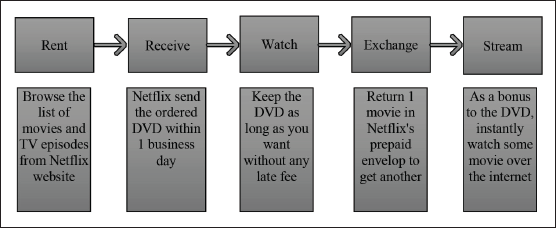
Despite its in the USA origin, Netflix is eminently embraced in many countries around the globe. It has set a remarkable paradigm of how investing in data analytics results in substantial accomplishments for any business (Pancholi, 2018). Nearing 200 million paid subscribers the video-on-demand media platform Netflix is successfully managing its business model (Rodriguez, 2020). Netflix till date has been successfully leading the SVOD channels.
Initiation in Bangladesh
Netflix has been successfully running its business activities in Asian countries since 2015. It needs to be noted that the growth rate in Asia Pacific region has been highest among all the markets of Netflix and the USA giant has been successfully running its business by customizing the strategies based on the country, content, pricing and payment methods (Yu, 2020).
In the year 2016 Netflix officially started its services in Bangladesh. According to some estimations by 2019 Netflix had 200,000 Bangladeshi subscribers (Chowdhury, 2019). The number of users was increasing and resulted in a significant turnover for the company. The COVID-19 pandemic resulted in loss for numerous businesses in 2020 and onwards. In order to stay safe from contamination people had to stay at home ignoring public gatherings and governments of different countries had to accustom social distancing measures and announce nationwide lockdown. Bangladesh was under no different circumstances and the entertainment industry faced loss that is still difficult to overcome. Despite these challenges the participants of the entertainment industry tried their level best to keep the spirits high. In his interviews with Bangladeshi entertainment industry directors and actors, Ratul (2020) noted how even in these trying times, this industry worked selflessly to motivate the viewers. Poignantly, for the same reason the business horizon of Netflix grew grander. The company has seen a record number of new subscriptions in 2020 worldwide indicating the same case for Bangladesh (Bangkok Post, 2020). In 2021, with another wave of COVID-19 Delta variant the country was under lockdown again and the despondent history was repeating itself. This however is not a negative indication for the streaming company. As a matter of fact, Netflix decided to double its investment in 2021 to secure a stronghold in Asian market (Zhao, 2020). At present consumers of Bangladesh are exposed to a good number of SVOD companies. Among all of them the noticeable success of Netflix in Bangladesh is hugely dependent on its strategy that focuses on customization.
The Industry Structure
Major contending forces determine the state of competition in an industry (Porter, 1980). Porter theorized that understanding both the competitive forces at play and the overall industry structure are crucial for effective, strategic decision-making and developing a compelling competitive strategy for the future (Martin, 2021). In order to understand the structure of industry the following are illustrated thoroughly—threat from new entrants, threat from competitors, threat of substitutes, bargaining power of buyers and lastly bargaining power of suppliers.
The Competitors and Their Roles
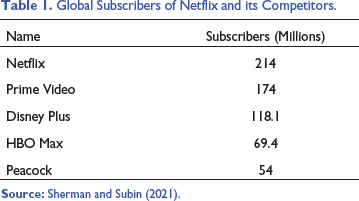
The number of competitors for Netflix is increasing day by day. Various competitors such as Disney Plus, HBO Max and Peacock are acting as strong contenders, and Netflix is also preparing itself to hold its position (Rodriguez, 2020). These on demand video streaming services are partaking in various methodologies to give their subscribers supreme value. The services being provided by the competitors are somewhat similar to that of Netflix and hence the switching costs for the consumers are lowers as they can easily avail other options for similar costs. Moreover, as the barrier to exit is also high, the competitors compete among each other to stay within the industry.
Rivalry Among Existing and Potential Competitors
Netflix in Bangladesh is not the only source for online streaming service. Customers can access other international brands such as Prime Video, Hulu, HBO Max, Disney Plus and Hoichoi. Though among all of them only Netflix and Prime Video are officially available in Bangladesh. However, as shown in Table 1 focuses on the number of subscribers globally, all of the brands have significant number of subscribers.
Global Subscribers of Netflix and its Competitors.
Also, the entertainment industry in Bangladesh has some local streaming service providers such as Grameenphone’s Bioscope, Robi TV+ and Banglalink’s Banglaflix. There are some local independent platforms such as Bongo BD and Cinematic which hold the potential to compete with Netflix.
Substitutes of Products/Services
The prevalence of local TV cable network providers and DTH services such as Akash and Bengal Digital may act as indirect or substitute products for Netflix (as shown in Figure 2).
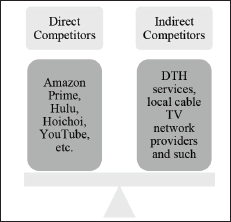
Each of these services has its own advantages and disadvantages. For example, local cable network providers and DTH services cost much less compared to Netflix. A local cable network provider may charge approximately BDT400-500 monthly (Bumblebee Ltd, n.d.) whereas Netflix charges lowest BDT 678 and Netflix now offers a new plan for just mobile phones that costs BDT 338 monthly (Netflix, n.d.-a,b). To justify the pricing of Netflix, it can be said that the value proposition that Netflix offers is combined with multiple factors such as seamless streaming, variety of series, movies and documentaries which cater individual demands of its subscribers.
Netflix has varieties of Bangladeshi as well as international content. However, to enjoy the contents of Netflix an individual has to subscribe and these subscription plans can be changed or cancelled anytime without any cancellation fees (Netflix, n.d.-a). This is different from other international brands such as Amazon Prime where the companies are giving a scope of free trial in Bangladesh (Prime Video, n.d.). In case of Bangladeshi platforms, parts of their contents are free of charge. However, the quality of content is also said to be better in the platforms where they ask for paid subscriptions (Nikita & Nusaiba, 2020). This trial period is unavailable for local cable operators; hence, customers have to incur the costs of cable and the fixed monthly payments.
The industry has offered variety of options for the consumers of Bangladesh making the power of competitors comparatively high. With virtual private network (VPN) consumers can easily access the other global competitors and of course the local platforms act as a substitute of Netflix for many. Realizing this, Netflix is relentlessly burgeoning to strongly compete. Due to the influence of global culture, the young subscribers of Netflix Bangladesh are heavily involved with its contents. The top shows in Bangladesh such as The Fame Game, Vikings: Valhalla, The Pirates: The Last Royal Treasure and the likes are all due to widespread connectivity through internet in global market (Monamee, 2022).
Dynamics Impacting Consumers’ Television Consumption
So far to succeed in the everchanging entertainment industry organizations and individuals focused on the technological advancements, structure of the industry and system as a whole. However, audiences’ television consumption behaviour has been overlooked (Turner, 2021). Especially, after considering the impact of pandemic it is vital to understand how audiences prefer television consumption. Some may prefer a big screen with high definition (HD), some may prefer their mobile/laptop screens. Depending on the culture, individualistic societies may have audiences who like to watch content alone and collectivistic societies may have audiences who like to watch content with their families and/or friends. Netflix with its variety of packages available serves the needs of different types of consumption preferences.
Post COVID-19 pandemic it can be presumed that the number of Netflix subscribers in Bangladesh has increased as people are inclining towards indoor entertainment sources. With the increasing number of consumers who are subscribing to the SVOD channels, several dynamics such as screen time, screen size and type of device are also coming to the attention of the businesses.
In Bangladesh, viewers prefer to watch the contents together on a big screen as the culture is majorly reflected in collectivist nature. However, the millennials and Generation Z 1 are demonstrating different consumption behaviour in the entertainment industry in Bangladesh. Their preferences towards various SVOD channels are rising and a significant group of subscribers are aged between 24 and 34. Also, they prefer contents of thriller and drama genres (Joya, 2021).
In Figure 3 the value chain of Netflix and other companies in the entertainment industry is portrayed. It can be said that with its evolution Netflix is now successfully serving the end users with multiple options for user interface.
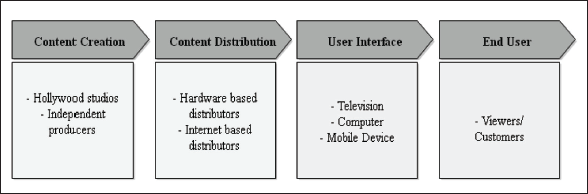
The end users of Netflix are tailored with options that matches their personal choice. This customization is possible by Netflix because it uses data from consumer’s streaming history. The Netflix recommendation system attempts to match the right content with the right end user by analysing a user’s viewing history, user’s ratings, other users with similar tastes and preferences and information about the content, such as the genre, actors, categories and release year. Moreover, to better understand consumer behaviour while streaming Netflix, the recommendation system also notices items such as, time of day end users watch more, the devices they use, duration of viewing. All of these data are used as inputs in the process of algorithms by Netflix. To maintain safety and security of end users Netflix does not include any form of demographic data (Netflix, n.d.-b). With the use of data analytics, the recommendation system of Netflix strives to match the right content with the right consumer.
Suppliers of Netflix
For content production Netflix partners with content providers through licensing, produces in-house or acquires exclusive rights to stream. Some contents are available globally and some are exclusive to particular countries (Netflix, n.d.-c). Since the industry globally is growing at a heavy pace, the content providers are becoming competitors. For instance, Walt Disney Co. is channelling contents to Disney+, AT&T Warner Media is channelling contents into HBO Max. On the other hand, in April 2021, Sony Pictures who could have also become a strong competitor for Netflix decided to become a top supplier for Netflix (James, 2021).
The challenge here for Netflix is to ensure the availability of some popular shows, like the famous 1990s sitcom Friends, which is unavailable in the USA. However, the particular shows are available to the users of Bangladesh (Moore, 2021). Moreover, the supplier’s, HBO Max’s, bargaining power is also as it now operates in the industry as one of Netflix’s competitors. Netflix is now following the vertical integration strategy where it produces in-house or gives exclusive rights to tackle the high bargaining power of suppliers.
Strategic Implications
The business strategy of Netflix objects to ensure the satisfaction of individual customers. Due to the advances in algorithms, it tries to offer a customized set of value propositions to each of its subscribers, which requires massive analysis of big data and algorithmic know-hows. As a result, to improve the algorithm, Netflix arranged competition back in 2006–2009 (Burroughs, 2019). The strategic input of big data, algorithmic culture and alike have supported the growth and success of Netflix. Another important factor would understandably be the content Netflix will show to its subscribers. It must be something convincing enough for a subscriber to be interested in watching the Netflix Originals. In that endeavour, Netflix devotes to personalizing the homepage of each subscriber with titles made with visually compelling artwork (Chandrashekar et al., 2017). The core of differentiation strategy in marketing requires fulfilling the different versions of demands of different customers and Netflix is maintaining that quite profitably. A subscriber in Brazil may not prefer the same content as a subscriber in Bangladesh.
Moreover, the virtual world allows the viewers to get various options. They get to choose what, when and where to watch. Netflix realizes this and strategically incorporates a recommender system that assists Netflix in finding the perfect combination of viewer and content (Gomez-Uribe & Hunt, 2015). Netflix’s recommender system is made up of different algorithms such as, a personalized video-ranker where the homepage is customized based on customer’s previous watched list, similar videos, trending now and many other factors (Gomez-Uribe & Hunt, 2015). Netflix is applying these strategic methodologies in Bangladesh as well. Subscribers here are enjoying international as well as Bangladeshi contents, namely ‘Doob: No Bed of Roses’, ‘Komola Rocket’ and ‘Sincerely Yours, Dhaka’ (Flixable, n.d.). Netflix released two Bangladeshi films—‘Television’ and ‘Pipra Bidya’ by Mostofa Sarwar Farooki, starting the successful journey in Bangladesh (Ferdous, 2017). However, the streaming giant is yet to explore the market with its in-house production.
Netflix applies the common ‘disruptive’ strategy as a competitive advantage. It offers the products at a fairly affordable price with high perceived customer value (Dias & Navarro, 2018).
Netflix arranges options for Bangladeshi consumers based on their preferences to compete successfully in the industry. As Netflix runs on subscription-based methods, a viewer in Bangladesh is required to subscribe using an international credit card as Netflix payment is unavailable in local currency (Durdana & Chowdhury, 2018). Hence, it is a drawback for the business as owning an international credit card is sort of a prerequisite for the customers. As shown in Table 2, Netflix has four different plans and customers can select one based on their preference.
Netflix Plans and Payment.
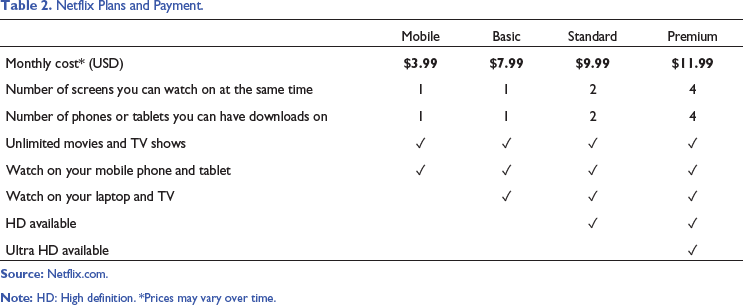
Netflix gives Bangladeshi subscribers the freedom to change or cancel subscriptions and it does not take any yearly subscription fees keeping the system aligned with the global market. Though in some countries subscribers may be charged with taxes; however, it is not the same in Bangladesh.
For a developing country such as Bangladesh, this pricing strategy may not be as affordable as it appears in other countries. Realizing this, Netflix offered the new ‘Mobile’ plan which consumers can subscribe to at a more affordable rate. Competitors such as DTH services, local streaming service providers are now giving services at lower prices with fairly good contents. Moreover, the launch of other SVODs such as Amazon’s Prime is acting as a strong competitor for the company. One negative result of the pricing strategy for Netflix in Bangladesh is that the consumers of Netflix here are indirectly subscribing to Netflix where an individual is getting a Netflix subscription from different unauthorized websites. One authorized subscriber is sharing his/her password which is not allowed according to the terms and conditions of Netflix. According to Lerman (2021), a user must be living in the same household otherwise they should have their own subscribed account which may not be happening in every household in Bangladesh.
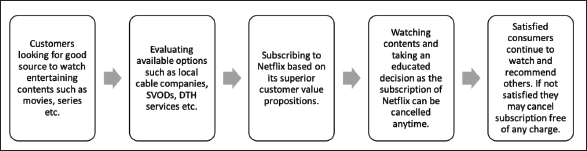
The customer journey of Netflix is portrayed in Figure 4. Customers can select any plan from the six offered plans by Netflix. The plans are: mobile, basic, standard and premium and the pricing varies accordingly (Tech Hindustan Times, 2023).
The marketing strategy of Netflix is heavily relying on digital marketing. It runs on a wide variety of social media campaigns, freedom for viewers to watch contents anytime, anywhere or on any screen acts as a strong value proposition (Taş, 2020). Netflix also has Netflix gift cards which are currently unavailable in Bangladesh. This card is used to pay for membership of a gift to someone (Netflix, n.d.-d).
Despite the comparatively higher prices Netflix is practicing its business in Bangladesh successfully. The BTRC and PI Strategy (a private management consulting firm) estimated that Netflix earns around USD 21.60 million annually from Bangladesh (Chowdhury, 2019). Netflix could forecast positive results from its business in Bangladesh and act on establishing a mutually beneficial arrangement with the government. BTRC allowing Netflix to set up cache servers in Bangladesh acts as an optimistic indicator for the business to flourish further in this country. Already many Bangladeshi contents are available for Netflix subscribers (Chowdhury, 2019). This is working as a good opportunity for the local entertainment sector to broadcast their shows to the right target market. After allowing cache servers, the country can allow Netflix to open an office for the growth of Bangladesh’s national revenue and growth of the entertainment industry.
Setbacks and Challenges
Netflix as a company has acted as a proactive company while coming up with out of the box solutions. It may have been successful in developed countries as the customers there are very well informed and positive to accept technological developments (Turner, 2019). However, Netflix is facing challenges with its premium pricing and increasing competition in Asian countries. All of these indicate the underlying opportunities as well as challenges for the streaming giant in Asia. How successful Netflix will be in a country where the majority of the people are not well educated or informed about the entertainment industry is still difficult to fathom. In a world that is accustomed to terms such as audience or global audience, we now have an internet audience and specifically Netflix audience (Jenner, 2018).
A country that has almost 2.11% of total world population (Worldometer, 2021) may appear as a very lucrative market but looking at the demographic and economic background of the citizens it can be said that Netflix will not be the ideal entertainment solution for the masses. Moreover, from cultural perspectives the shows broadcasted in Bangladesh should be culture appropriate. Local TV channels which are available through DTH, cable operators are introducing culture appropriate shows that a family can watch together or individually. The contents in Netflix however do not allow for this every time, indicating a challenge that the brand is facing in Bangladesh. Despite comparatively high prices consumers are willing to take Netflix subscription but the only option for payment is international credit or debit cards. Competing company Hoichoi incorporated debit and credit cards, local mobile wallets such as bKash and some offline subscription cards which can be bought in local stores such as Meena Bazar and Gadget & Gear in Dhaka (The Daily Star, 2019). Lastly, another challenge for Netflix would be to bring the revolutionary change of viewing devices which used to be the traditional remote-controlled television. The Netflix audience are more comfortable with devices such as smart TV, laptop and mobile phones.
Future Perspectives
Regardless of the encounters portrayed, Netflix has a promising scope for revenue in Bangladesh considering the market size and its popularity especially after pandemic. Today the world is more digital than ever not only because of technological advancements but also because of the impacts of pandemic. The working from home generation under multiple lockdowns in the cities and regions is looking for growth and relaxation inside their homes. The online video-on-demand services such as Netflix and alike are consequently enjoying encouraging influx of revenue streams. In context of Bangladesh, it will be beneficial for Netflix to focus more on promotional activities, generate culture appropriate contents that families would enjoy watching together, and also develop solutions for payments so that consumers do not have to go through any hassle with the Netflix subscription.
Regardless of the positive prospects that Netflix is expected to incur, there is still a significant portion of market that it needs to tap into in order to survive in the industry. Even so, the challenges such as the lack of education and economic conditions in certain geographic areas are proving to be a serious drawback for Netflix as these are the externalities that can improve and cater to. Nevertheless, there are still vast opportunities presented in front of the company which it can exploit and provide services to the different segments accordingly. As Netflix has established itself as a proactive company bringing disruptive business models to earn maximum revenue it will be apparent to expect more consumer-focused entertainment solutions from them in future.
Footnotes
Declaration of Conflicting Interests
The authors declared no potential conflicts of interest with respect to the research, authorship and/or publication of this article.
Funding
The authors received financial support for the research, authorship and/or publication of this article from InterResearch, Dhaka, Bangladesh.
