




Abstract
The world of the COVID-19 pandemic is an anomalous biosphere with nothing to be forecasted. The main concern of every individual is focused on keeping themselves safe from infection. This need of keeping oneself safe has raised an alarming situation and resulted into quasi self-quarantines and self-imposed seclusion. The pandemic has increasingly put pressure on the healthcare system of different countries, wherein the countries with the limited number of doctors and health staff are finding it increasingly difficult for all intent and purposes to treat the patients. To lay off the load of medical staff all around the world, different countries have adopted their own unique technique of handling the calamity. One of the creations is applications on smartphones. This has resulted in increasing awareness, self-detection of coronavirus symptoms among the population. These applications were designed to increase awareness among individuals of any risk in their surroundings. It has been developed by corporates, governments and NGOs. The Indian government also launched its own indigenous app named Aarogya Setu (Bridge of Health) to capacitate people to handle and self-detect coronavirus symptoms. The present case is an effort to understand the adoption of Aarogya Setu app from the eye of diffusion of innovation.
Case Objective
Objectives of the case are to make readers aware about the coronavirus-related applications launched during pandemic, criteria for diffusion of innovation and the concepts of adoption.
Novel Corona Virus (COVID-19)
During testing times of the pandemic due to the spread of the COVID-19 virus, the main fear of individuals is to keep themselves and their loved ones safe from any kind of infection. Such levels of anxiety have raised an alarming situation resulting in quasi-quarantines. The fear of the unknown with respect to the novel coronavirus, its spreading at an alarming rate has created pressure and stress on healthcare systems across nations. Countries considered to have the best healthcare systems too were struggling as the number of active patients was rising exponentially daily. One of the major reasons for the widespread panic was that there were no data to refer to. As there was no historical information available, related to how to treat patients suffering from this virus, it created a nightmarish situation for every stakeholder, be it the governing authorities, paramedics, healthcare workers or the citizens themselves. Even the best of the health infrastructure crumpled, with the developing and underdeveloped countries getting badly hit with very high death tolls.
India, the second most populated nation in the world, has always had a major scarcity of healthcare resources; the doctor-to-population ratio is as low as 1:1,456 against WHO standard 1:1,000. Only 8 physicians and 8.5 beds are available per 10,000 population (Ghosh et al., 2021). A daunting task in front of the Indian authorities was how to treat patients and save lives with limited resources. As the healthcare system was under duress, the efforts of the healthcare and frontline workers cannot be undermined. With the desire to help the sick patients, the healthcare staff were devoting five times more time than their normal working hours on duty which is resulting in their burnout, that is, physical, emotional and mental exhaustion. At the start of the pandemic, policymakers were aware that India’s healthcare system which in normal circumstances runs at full capacity, will not be able to cope up with the additional burden to accommodate COVID-19 patients (Rajagopalan & Choutagunta, 2020). To control the spread of the virus, initially the Indian government adopted the route of lockdown. However, it has its own repercussions as all the economic activities were put on hold (Choutagunta et al., 2021). If it comes to a situation where people must choose between life and livelihood, the government had no option but to start opening all kinds of economic activities. It was becoming politically difficult for the government to continue with the lockdown indefinitely. Creating containment zones of smaller locations was a possible solution, but the difficulty faced by the local authorities was by the time they realized that large populations were infected, the virus had spread to a much larger area.
Lockdown could not be a permanent solution to the existing crisis. It was imperative to find a solution that could not only help in reducing cases but educate people to ensure controlling the spread. Reaching out to people at these mass levels is not difficult but can be very expensive and time consuming. They were looking for ideas that could help spread the message, educate the citizens on control measures and above all how they could identify geographical clusters with higher concentration of infected patients.
At the time of trouble, the mobile applications came as a ray of hope, with 451 million monthly active internet users, India is now second only to China in terms of internet users, according to a report by the McKinsey Global (Kaka et al., 2019). India is home to one of the largest and most rapidly growing bases of digital consumers. The low cost and availability of smartphones propelled the growth of digitally active consumers. India also has the second-largest mobile subscription base, with nearly 1.2 billion subscribers, and the second-largest internet subscription base, with 560 million subscribers. This seemed to be the best option as it could achieve all the objectives of; economical to create, capacity to reach large populations in both urban and rural India at a fast pace and short duration of time. Technology seems to have come to the rescue again. If the plan to provide information about the pandemic, its control measures and the ability to trace infected patients is executed, it could reduce the excessive load on the healthcare infrastructure and many more lives could be saved.
The app was launched with the hope to lay off some load of the medical staff all around the country. The intent of the app was to increase awareness and self-detection of coronavirus symptoms among the population.
The use of mobile health apps improves patient’s experience, by accessing health information, making communication more convenient and contributing to positive health outcomes (Lu et al., 2018).
The same approach was followed by many countries, and they all have launched their own versions of such an app (Chabbra, 2020) with customized features as per their needs (Table 1).
Mobile Applications Launched in Different Countries.
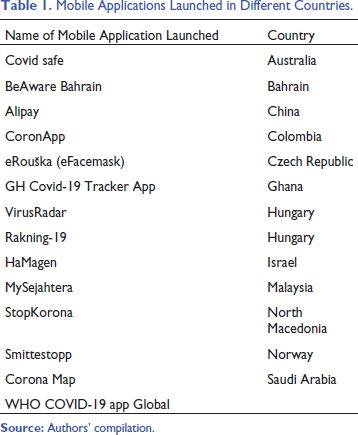
A similar agnate of mobile health application has been launched by the Government of India to make people aware of different symptoms, risks in their surroundings associated with COVID-19. The application with the name of Aarogya Setu has its origin in Sanskrit to ‘A Bridge of Health’, launched on 2nd April 2020.
Digital literacy in India is much higher than in its global counterparts; hence, while making the population aware of the COVID-19 risks, policymakers also piggybacked on technology and introduced/launched Arogya Setu mobile application.
Mobile Applications: An Overview
Mobile applications are also referred to as a mobile apps or simply ‘App’. It is a computer programme or software application designed to run on a mobile device such as a phone, tablet or a smartwatch and runs specific tasks for users (Islam et al., 2010). Further, Chang (2015) defined mobile applications as ‘software or applications for the purpose of performing specific tasks for the user and are suited to run on mobile devices such as phones, smartphones, and electronic devices’.
With the convenience to work on all smartphones and on both android and IOS operating systems, the adoption rate of mobile applications is quite high compared to other technological innovations. The advantage leads innovators and companies to develop apps in a variety of fields which includes productivity apps, social apps, games, business, entertainment, health and fitness apps, communication and even tracking apps. Mobile phones are an important tool to enhance the quality of life (Plaza et al., 2011).
Not only the penetration of mobile phones and the internet is high in India compared to other counterparts but also a maximum number of individuals downloaded different apps on their mobile phones. It has been evident that due to the availability of affordable smartphones and economical internet data access the growth of app downloads has significantly been boosted in India.
Popular Mobile Applications in India
The mobile application downloads saw 165% growth on both android and iOS devices in two years, a report revealed in 2019. Popular mobile application includes Facebook, Messenger, UC browser, WhatsApp, ShareIt, TikTok, Vigo video, Hotstar, Truecaller and MX player being the chart toppers (Exhibit 1).
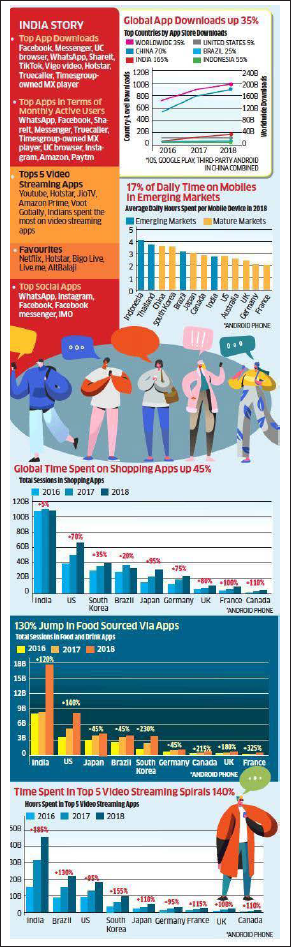
The wider adoption of different mobile applications has opened doors for policymakers to spread necessary information. As the reach of apps is quite high compared to traditional communication channels and developer/organization can easily track users, the governments too have started to launch applications for different categories. Many such apps launched by the Government of India include: Bharat Interface for Money, Swach Bharat Abhiyan and GST finder to name of few. These apps have been launched by the government under the Digital India initiative. The very objective of such an initiative is to reduce red tape or bureaucratic interface and improve the service interface for the end user.
Aarogya Setu App
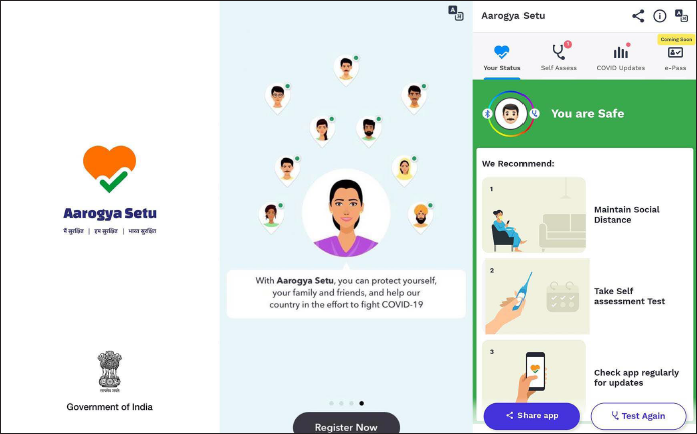
The Aarogya Setu mobile application is one of the perfect examples of how the Government of India is pushing for their initiative called Digital India. The app and the technology combined have been developed to benefit of society. It helps users to self-diagnose and identify whether they are at risk of coronavirus infections. It connects each individual user with their unique identification code (Aadhar Card) ensuring the validity of data. Further, it asks a few questions to determine your level of risk. Further, clubbed with GPS, it can pinpoint your location within a 100 metres range. This way others around within the same geographical vicinity can get information of active cases near them and take appropriate precautions. The app showed great success and created awareness too. It provides information related to coronavirus infection and its symptoms. The Aarogya Setu app is owned by the Indian government and developed by a government agency (NITI Aayog) and tech industry volunteers.
Every part of technology has some human interface, limiting its capabilities. Similarly, the Aarogya Setu app is dependent upon the self-diagnostic tool for the users. The users may provide incorrect information resulting in inaccurate projections. However, to minimize the same, all individuals who are tested positive during an RT-PCR lab test are automatically marked as active by the testing lab. The app is seamlessly interconnected between the user, testing labs and vaccination centres.
Linkage with Vaccination
The new year (2021) brought in positive hopes for the world community as the vaccine administration for emergency use was starting to get approvals from governments. On 16th January 2021, the Government of India launched its inoculation drive for all healthcare and frontline workers. Further, in March the vaccine was made available to the senior and more vulnerable section of populations.
The biggest worry was how to monitor the vaccination drive in a country with 1.5 billion people. Again, all eyes were to find an answer using technology. The Indian government was quick in creating the Co-WIN portal to register for vaccination. Initially, penetration seemed slow, and yet again the Arogya Setu app resonated as a solution which can be used for fast, efficient tracking and controlling of vaccine administration. Information on how to register and hyperlinking to the Co-WIN portal has been integrated within the Arogya Setu app.
Barriers to Adoption
Strategies to Deal with the Challenges
The Aarogya Setu application is holistically created with many features and multiple language options ensuring higher user engagement and to cater to different segments and sections of the population. Segmentation of content-enabled applications has been designed to deliver relevant and effective communication in a selected form. Content available on the mobile application is as follows:
With a variety of audio–videos content available on the application, it provided a great tool for user engagement, as well as it tried to cater to segments with different needs. The app also has a chatbot feature to help the user with coronavirus symptoms, updates and helpline numbers of every state.
India is a country of diverse languages differing in various zones, areas and states. It is one of the biggest challenges for application developers. In the past, the penetration of different private consumer products related applications was concentrated in different metro cities, as applications were available only in English. Addressing this challenge and ensuring adoption by the diverse population, Aarogya Setu has been launched in 11 different Indian languages.
Adoption Rate of Innovations:
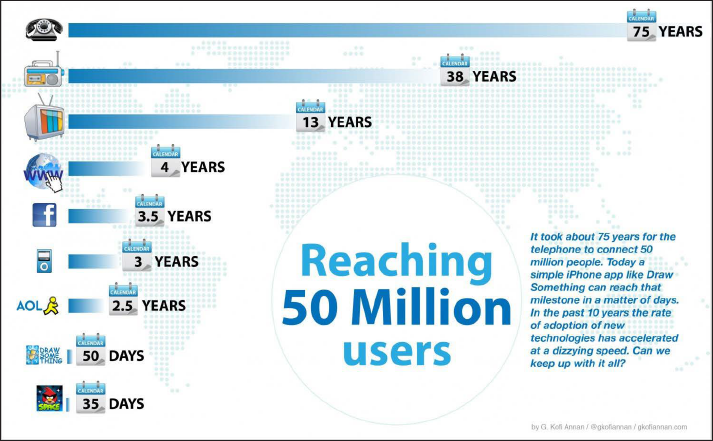
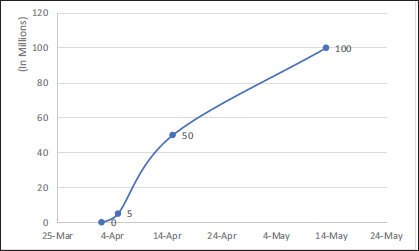
While the telephone has taken 75 years to reach 50 million people, radio 38 years and television 13 years (Exhibit 2), the Aarogya Setu app has only taken 13 days to reach 50 million and 40 days to touch the 100 million people mark (Figure 1, Exhibit 3) (Annan Kofi, 2020). Not only a specific research related to app development rather its promotion strategy also plays an important role in its adoption.
The Prime Minister of India himself has given a briefing of this application to the public during one of his address to the nation. He has been using his social media accounts to reach out to millions of citizens following him, with the sole purpose of promoting and educating people the importance of the app and its various uses and benefits. When the information was given by the Prime Minister himself, the confusion and apprehensions in the minds of prospects were diluted to a large extent as the credibility of this source hold a very high regard and pedestal in the eyes of the citizens.
As there were no authentic and corroborated sources of the COVID-19 active cases in one’s surroundings, the relative advantage of this app became quite high which was a big factor in influencing its adoption among the population. Application has been developed and launched for android, KaiOS and iOS users ensuring coverage to a wider spectrum of device users and enhancing the compatibility of the application. This further helped in easier adoption as prospects could easily use the application on their existing mobile phones.
Poor data connectivity and frequent electricity outrages are one of the biggest issues in some areas of India, specifically in rural areas and remote regions, hence once downloaded after the application worked with the help of Bluetooth. Connectivity at times is slow and unreliable on a mobile device in certain parts of the country, which too pose a challenge to acceptance (Harrison et al., 2013). To cater to non-smartphone users, the government has launched Aarogya Setu Voice Interactive Response System and helplines.
Adoption of any innovation depends upon its relative advantage, compatibility, complexity and trialability, which have been carefully taken care of while launching the app.
The government requested all social media platforms present in India to create awareness about Aarogya Setu (Ananth, 2020). It is also mandatory for those who are living in containment zones or designated risk areas to download and register on the app (Mehrotra, 2020). Further, the government made it mandatory for all government and private sector employees to download app on their phones. It was seen that most private offices and works too made it mandatory for its employees to register on the app before they could come to the office. The retail industry took it upon itself to check the status of the individual on the app (risky/safe) before allowing them to enter malls and markets.
Conclusion
The Government of India made great efforts trying to sensitize its population about the pandemic and its consequences to the citizens. They adopted various media platforms to spread awareness which played a major role in the adoption of the Aarogya Setu app in crossing the 100 million users mark in a very short time span. The Indian government had tactfully used the Aarogya Setu app and was largely successful in restricting outdoor movements and confining the population to their homes. The registration of people on the app helped in tracking the hotspots and infection clusters to implement stricter lockdowns in such isolated regions of a city. At public places and social gatherings too, the app played an important role by providing the event organizers with information if the individual had been living near any hot spots or is from a safe zone. The Aarogya Setu app has given a landscape to practitioners for understanding the efficient adoption of new technology with constrained resources. This creates a huge opportunity for managers to see how they could implement similar strategies of adoption in different consumer segments for faster penetration in their respective target markets.
Footnotes
Declaration of Conflicting Interests
The authors declared no potential conflicts of interest with respect to the research, authorship and/or publication of this article.
Funding
The authors received no financial support for the research, authorship and/or publication of this article.
