



Abstract
Though in a relatively infant stage, the soft drink industry of Bangladesh has been thriving. Coupled with high-tech machinery, a stable production process (i.e., aseptic plant) and maintaining international standards have led some companies to export soft drinks to approximately 110 countries. However, despite these achievements, the companies still deal with wavering consumer perception, cultural differences and barriers to enter foreign markets (i.e., the Middle East). Focusing on Akij Food and Beverage Ltd., this case mainly sheds light on how local companies are adapting their strategies to tackle these hurdles: dealing with the fast and fickle consumers, scepticism about quality, changing production lines and even the brand name of products to enter the Middle East markets. The case revisits classical international business topics, such as expansion strategies, culture, communications, global strategic rivalry theory, global supply chain management and distribution networks.
Keywords
Learning Outcomes
On the completion of the case, students will be able to:
Discuss the importance of distribution channels in the soft drinks industry; Explain the physical flow of goods through the supply chain and channel strategy; Describe the supply chain and distribution network of the Bangladeshi soft drink industry; Discuss the various entry modes and their application in the Middle East market; Argue the importance of changing the brand name in the host countries.
Introduction
Manufacturers of soft drinks are primarily engaged in formulating, bottling and producing both non-alcoholic and carbonated beverages. The products range from bottled water, juice, nectar, squash/syrup, sports drinks and energy drinks. The classifications of soft drinks are primordially based on their sugar composition, level of carbonation, ingredients and functionality it serves (e.g., energy drinks and sports drinks) (Muhammad & Dickinson, 2019). In Bangladesh, the estimated annual consumption of soft drinks (per capita) is 17 (250 ml) bottles, and this number is lower than that of India and Sri Lanka (i.e., 25 and 40 bottles, respectively) (Shoyeb, 2018). Due to the high variety of soft drinks available in the market, the potential profit margin in this industry is high. Moreover, as of 2019, the value of soft drinks exports reached 17.4 million USD by Bangladeshi manufacturers (Workman, 2020).
As of 2020, a total of 19 companies gained permission (by the government of Bangladesh) to manufacture soft drinks for both the domestic and international markets (i.e., exporting) (Noyon, 2020). These companies include foreign companies, such as Coca-Cola and Pepsi, along with local companies including Akij Food & Beverage Ltd. (AFBL), Danish Foods Ltd., Globe Soft Drinks Ltd., PRAN Foods Ltd., ACI Foods Ltd., etc.
Most of these companies are equipped with advanced facilities to meet the production demand of both local and foreign markets. For local companies, this means the difference between survival and extinction. All efforts from production to marketing need to be significant not only for survival in local markets but also to enter foreign markets; as competitive pressure (aside from established companies such as Coca-Cola) looms from manufacturers from India and China. In the case of Bangladesh, beverage-producing powerhouses such as Coca-Cola have shown interest to invest an additional $74 million for the infrastructure (i.e., plant, transportation network and warehouse) shortly (Alam, 2019).
Historically, several Bangladeshi companies started embracing the uneven competition in the global arena and eventually stepped into the ‘low-quality trap’ as the products were considered cheap alternatives by Middle Eastern consumers. These happened due to several concrete reasons: firstly, being an exporter of several soft drink brands, the companies were not given the opportunities to focus on advertisements for foreign products, that is, Bangladeshi products as it would conflict with the cultural elements (e.g., language) of a host country related to product names, messages or other elements; secondly, at the initial level, the products, which were exported to several Middle Eastern countries, were not valued by the local people other than the expatriates.
To avoid these traps, one of the local companies named AFBL has invested in machines that preserve fruit pulp and has set up its self-proclaimed ‘a kind of aseptic plant’-based production plant to produce non-carbonated soft drinks. The company invested a hefty Tk. 3.0 billion USD to restructure their factory with the aseptic system; meaning the drinks are free from microbiological germs and have a longer shelf life without the need for refrigeration (for a long time) (Financial Express, 2020). With three variants (i.e., mango, orange and grape), Frutika, which is regarded as one of the most popular fruit-based drink brands of AFB, is also exported to several countries in Asia, Africa regions and a few countries in Europe and the Middle East (Naznin, 2017). Located in Dhamrai, Dhaka, 1.29 million 250 ml bottles of Frutika and Aafi can be produced each day (Financial Express, 2020; Noyon, 2020), which are considered flagship brands of AFBL specially formulated for both the domestic and the Middle Eastern markets; for its mango fruit drink, the company uses 16% fruit pulp in formulating the drink in which the raw mango pulp is mainly sourced from the company’s mango orchards in Chapainababganj, along with several local farmers and also sourced from India. In the domestic market, the company also maintains a competitive price (relatively) and heavily emphasizes both advertisement and distribution efforts. For example, AFBL employs approximately 900 distributors across the country. But, in the Middle Eastern markets, due to the nature of its business (e.g., export-oriented), the company failed to communicate its capabilities and competencies of producing quality products following the benchmark.
The soft drink market in The Middle East and Africa region seems quite fascinating. The market size is equal to 7.85 billion USD with a growth rate of about 3.37% per year. The market is forecasted to reach 18.01 billion USD by 2026, and it is forecasted to be growing at a CAGR of 4% (Williams & Marshall, 2020).
To meet the growing demand arising in the Middle Eastern part, AFBL took a small initiative to send its first consignments, including a few products to Qatar and Dubai in hopes of feeding the expatriates followed by another initiative to export Speed, a brand of AFBL, to the United Arab Emirates, Malaysia and Bahrain. The brands started attracting local consumers as well since it was opted by local consumers as an alternative to Chinese and Thai products only available in those markets.
Afterward, AFBL started exporting its products to 17 countries in the Middle East, where they faced their biggest dilemma. As an exporter, AFBL could not perform marketing activities (in all forms). The only alternative to reach a mainstream audience was by attending trade shows and trade fairs, held a few times a year and in selected locations. Understandably, this method was not effective in reaching consumers or creating an impact in host countries. The company eventually started focusing on advancing internal competencies in all aspects. While exporting to the Middle Eastern zone, AFBL had to face huge pitfalls, including changing the name from ‘Frutika’ to ‘Aafi’. AFBL has a multi-brand strategy with over 11 different brands, including Frutika and Aafi.
The Company at a Glance
Akij Group is mainly a privately owned venture headquartered in Dhaka, Bangladesh, which was launched in 1950 by an eminent philanthropist Late Mr Sheikh Akij Uddin, began with a single production line of tobacco products locally known as Akij Biri. As of late, the company employed a total of 32,000 skilled and semi-skilled employees in various categories with an annual turnover of over 3,907,047 USD (approx.).
To become the market leader in quality food and beverage as a part of community engagement, AFBL started its journey in 2006 with only three products. To be the market leader in the quality food and beverage sector; likewise, considering the emerging preferences of the growing community, the company has ranged its wide variety of products in such a way to meet the demand both at home and abroad.
Unlike other ventures of the Akij Group, the AFBL gained much popularity among the youth and eventually turned into a profitable business within a short period. The company now has dedicated research and development with the ability to introduce new types of variants. The company has devoted its resources to offer high-quality products with zero preservatives.
What Changes Were Incorporated in AFBL’s Supply Chain and Distribution Model?
The comprehensive supply chain and distribution network for AFBL (Figure 1) was developed to understand the current tier and production capacity of manufacturers in Bangladesh.
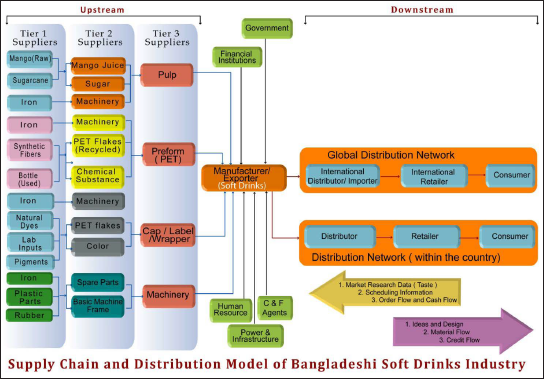
The entire supply chain model comprises two streams, that is, upstream and downstream. The upstream segment is classified into three tiers, while the downstream part is comprised of multiple distribution networks. The three tiers of the upstream portion of the value chain consist of nominated suppliers supplying the raw ingredients and other essential items, such as fruit pulp, preform, cap, label and wrapper, while the tier 3 suppliers are supported by tier 2 suppliers, who primarily outsource raw materials from farmers and local suppliers. Tier 1 on the other hand consists of basic suppliers of raw polyethylene terephthalate (PET) and PET bottle manufacturers as well as machine suppliers, which can supply to various industries.
In the case of AFBL, this comprehensive supply chain and distribution network is adopted by the company at both upstream and downstream levels. AFBL maintains the upstream components of the model through sourcing pulp from their orchards or sourcing from India. AFBL plants are well equipped with several advanced types of machinery from renowned companies, such as Krones, Tetra Pak, Alfa Laval and Sipa, which were primarily purchased to maintain quality and hygiene along with the aseptic treatment of PET bottles. They also own several plants that produce ‘preform’ (i.e., recycle plant) of PET bottles as well as manufacturing labels, wrappers and so on (aside from PET Flakes). Moreover, the aseptic processing and packaging functions allow the company to extend the shelf life of their products up to nine months without extensively using preservatives (Bhuiyan, 2020).
The downstream component is maintained by having multiple distribution networks including one for Frutika (local) and the other for Aafi (international). The various distribution networks (global versus domestic) differ in terms of production through a separate line of production. Though each of the brands is produced in the same factory (i.e., Dhamrai), bottling procedures are separated between two distinct lines of production to produce the same type of soft drinks but for separate brand names (Muntasir, 2020).
Strategies Related to Standardization, Adaption and Quality
Initially, Frutika was not widely accepted by consumers in the Middle East (especially in Saudi Arabia). The poor sales volume was a direct result of the name ‘Frutika’, which did not resonate with the consumers in the country. As a result, AFBL renamed the product to ‘Aafi’, which loosely translates to ‘who forgives’ in Arabic. This is somewhat synchronized with the tagline of Frutika, that is, ‘Ektu beshi pure’, which loosely translates to a higher degree of purity. However, the language barrier was not an issue for their other carbonated energy drink ‘SPEED energy drink’. Thus, the name and ingredients of SPEED remained unchanged. Another hurdle AFBL had to face was the doubt of consumers about the quality of their products. This was primarily due to the perception of the product’s country of origin. As Aafi originated from Bangladesh, there was scepticism among consumers about the quality of the product and the brand eventually fell into the ‘low-quality trap’. AFBL (and similar companies in Bangladesh) is restricted to export their products in bulk to different importers through Cost and Freight agents. The companies are also restricted from carrying out any promotional campaigns in the Middle East. The agents, who negotiate with the manufacturers in Bangladesh, are not usually nominated by the exporter or importer (international distributors); therefore, the prime focus has always been on maintaining profit rather than creating brand awareness. In the case of AFBL, the nominees (agents) working with AFBL distribute various products from many countries to over 110 countries, and most marketing activities are dealt with by the agents/distributors (importers) themselves.
The only way to communicate with the consumers was at the trade shows which the companies such as AFBL have no control over, nor can they customize their campaigns while attending the trade shows in host countries. However, attending these trade shows (or trade fairs) hosted by foreign countries was the only way to reveal competencies and secure orders from buyers as promotional campaigns were somewhat restricted or limited.
AFBL’s main drive is to have two separate and distinct production channels to tackle a few issues. By differentiating and maintaining two different marketing channels for Aafi and Frutika (i.e., one on the foreign market and another on the local market), AFBL would be able to offer several sizes, quality or other variants as required by international buyers.
Conclusion
Despite producing quality products, the ‘quality trap’ perception is still an issue for Bangladeshi soft drink manufacturers. Along with the restriction of using Integrated Marketing Communication in Middle Eastern countries, companies such as AFBL are forced to limit their operations to merely export their products to several destination countries. Though having two distinct production lines for a soft drink may serve as a good point of difference, the question remains will it change the minds of the buyers? And more importantly, can it make up for the lack of connection to consumers? Despite enormous challenges encountered in almost all spectrums of business, the company, which is AFBL, had successfully captured the Middle Eastern market and eventually started expanding its market share. Now, the brands are competing head-to-head with international brands, such as Red Bull.
Questions
What are the key issues faced by AFBL while entering the Middle Eastern countries with its flagship product ‘Aafi’?
Develop alternate strategies to market AFBL’s products within the Middle East. You can consider short-term and long-term marketing programmes or other alternatives such as different target market(s), price(s) and distribution.
What are the pros and cons of maintaining two separate downstream channels? Should AFBL switch to a more standardized and ‘traditional’ manufacturing process (i.e., warehouse to distributors to retailers to consumers)? Would that help to capture markets across the border (i.e., by lowing costs)? Justify your argument.
Further Readings
Amin, M., & Zaman, M. H., (2020). Which comes first in the apparels industry: Process or compliance? In SAGE Business Cases. 2020.
Amin, M. K. (2014). Expanding apparel and textile market through effective marketing strategies: A case study of Bangladesh. International Journal of Business & Management (Toronto), 1(1).
Chopra, S., & Meindl, P. (2007). Supply chain management. Strategy, planning & operation. In Das summa summarum des management (pp. 265–275).
Chopra, S., & Meindl, P. (2007). Supply chain management. Strategy, planning & operation. In Das summa summarum des management (pp. 265–275).
Keegan, W. J., & Schlegelmilch, B. B. (2001). Global marketing management: A European perspective. Pearson Education.
Kuppusamy, J., & Anantharaman, R. N. (2014). A critical review of barriers to export business. SMART Journal of Business Management Studies, 10(1), 9–18.
Hill, C. W. L., & Hult, G. T. M. (2017). International business: Competing in the global marketplace, 11e.
Footnotes
Declaration of Conflicting Interests
The authors declared no potential conflicts of interest concerning the research, authorship and/or publication of this article.
Funding
The authors received no financial support for the research, authorship and/or publication of this article.
