




Abstract
The world of art has both fake and original works competing for the attention of art collectors. Chances of accepting a forged work of art as authentic is very high because of the advanced techniques available to forgers who do as much research as those appointed to certify it. Counterfeits flourish because of economic and psychological reasons. Scarcity, status symbols and social cues become vital factors in driving up the prices. India has not given enough attention to regulations in art market and this has led to wide spread scams and monetary loss to the government and society. What can be done to correct the market for art and how can application of Bayesian theorem and artificial intelligence assist the ordinary buyers and experts to make better judgments before accepting a piece of work as original?
Introduction
This case was compiled from published sources. It is intended to be used for discussion on market for art and counterfeits among MBA and executive professionals. It also attempts to introduce the issues of noise and bias in decision making and explores the benefits of Bayesian Theorem and AI.
On the night of 26 September 2021, Monson Mavunkal was arrested from the engagement ceremony of his daughter. At the time of arrest Monson was wearing an Apple smart-watch, a smart ring and had on him three iPhones.
Monson Mavunkal, henceforth referred to in this case as Monson, was a self-proclaimed billionaire who postured as a dealer of unique antique pieces. He claimed to have a keen understanding of antique items and therefore an authority on what was rare and unique. The introduction he gave of himself was quite a potpourri in itself. He’d say he was a MBBS doctor, cosmetologist (with eight postdoctoral honours), archaeologist, a passionate traveller; vblogger (he owned a YouTube channel), ‘peace promoter’ (said he was on the panel for world peace), philanthropist, educationist and motivational speaker, had a degree in Ayurveda and MD in Dermatology.
In his bail application, Monson stated that he was a doctor. In reality, Monson did not even have a college degree.
Monson’s rise as an art dealer points to the many lacunas in the Indian art industry. A value chain for the visual art industry (paintings, photography, sculptures, murals, graffiti, antiques, miniatures and installations) has three major stages: production, promotion and sales, and art resale. Art sales in India has organized and unorganized players. Sales data from organized players is available to track the work of art but there is a large unorganized section of art sellers made up of small establishments and sole traders whose sales are neither reported nor taxed. For small establishments, mostly a one person shop, regulations and disclosure of sale is not mandatory.
The Indian art market was estimated at around ₹ 14.6 billion in 2017, having witnessed a decline of 6%. If not for demonetization and introduction of Goods and Services Tax (GST), growth was expected to continue. Before demonetization, purchases in art were often done in cash to get a better deal and sale happened through art galleries that sold affordable art. Demonetization and GST brought down the value in the Indian visual art market from 1,560 crore in 2016 to 1,460 crores in 2017. The effect of demonetization was mostly felt on the art galleries and of GST on the auction houses. The implementation challenges around GST impacted the sales of auction houses, with many auction houses holding at least one less sale in the year (KPMG in India—FICCI report, 2018). With GST, prices of artwork has gone up. Art work in the range of ₹ 1 lakh–₹ 5 lakh attracts 12% tax—this hikes the price to a point which discourages buyers from picking from the organized market. It also adversely affects talented artists who have to bear the cost of raw materials, framing, shipping, insurance, promotions, gallery spaces, etc. Activities such as framing the art work attracts an additional tax of 28%—another major reason for buyers to patronize counterfeits.
The lack of an enabling ecosystem to make art is also a challenge. Artists are not allowed to make art at home as it is a commercial activity; in the absence of any government run art centres, the obstacle adds to the cost of making and selling art.
Natural Pull in Art
People are drawn to art—there are experts who call it a ‘pleasure technology’ equivalent to drugs, erotica and cuisine. Cognitive psychologists consider art to be part of an ‘evolutionary adaptation’ like other emotions. According to Steven Pinker, art is pursued for status, aesthetic pleasure and the need to achieve desired end by designing artefacts (Pinker, 2019, p. 405). In the primitive era, ornamentation became a way to attract a mate because it was an indicator of the quality of the brain which in turn comes from the artistic virtuosity of ones forefathers (Miller, 2001). Between the idea of winning a mate and social status—the art world has found a niche.
Every culture across the globe has offered art forms that have captured human imagination. Philosopher Dennis Dutton, based on his cross-sectional investigation, compiled Universal Features of Art (Dutton, 2002).
Expertise or Virtuosity: while everyone might be able to sing and paint there are only few who possess special talent Non-utilitarian pleasure: art is in itself a source of pleasure and is not expected to be a practical tool or source of knowledge; it offers ‘aesthetic pleasure’ when experienced. Style: There are rules of forms and composition and enjoys variations; it can be influenced by culture, family or the individual’s own invention. Criticism: There exists a language for criticism, judgment or appreciation of art. These are echoed in discourses by art critics, art-gallery owners, audiences on their evaluation of the art. Imitation: art imitates the real in either naturalistic, stylized representations or nominative symbolisms which are understood by the artist and its audience. Special Focus: the art makes departure from the ordinary and focuses on dramatic experience—an element of intense emotion and sense of community Imaginative Experience: art happens in the theatre of imagination; it is lifted from the ordinary with the imagination of the artist and becomes more than the real.
These exclusionary features of art make it challenging for aspiring collectors and investors. Compounding this short coming is the absence of several measures that the Indian market must have in place to reduce the prevalence of counterfeits. Legal agreement for art transfer or insurance coverage or hiring experts to verify artwork and papers is not common—often not available or prevalent. Many legal documents such as certificates from experts and artists are also often forged. There is no regulatory agency supervising the transactions. There are no clear guidelines on what proofs of the art work has to be produced or on how to verify if the pricing is honest and transparent or how to arrive at the true worth of the art.
For Monson, in Kerala, the absence of high end technology and expertise was a perfect opportunity. He merely had to maintain appearances. He even told his visitors that he had in possession a multi-crore chemical used for launching rockets. Artefacts in Monson’s house in Kochi were allegedly fake products designed by local carpenters. Paintings made in Kochi were shown as done by Pablo Picasso. Monson even claimed to have Raja Ravi Varma’s and Da Vinci’s original paintings. He had no documents to prove their authenticity or ownership.
Monson’s art collection was both incredible and unbelievable. Among the antique materials housed by Monson in his museum cum mansion, there are:
The staff of Moses Two of the thirty pieces of silver coins that Judas Iscariot received for betraying Jesus A piece of garment that Jesus had worn A stone jug used by Jesus to convert water into wine The throne of Tipu Sultan The oil lamp of Prophet Mohammad The original deed of the Mysore Palace Personal Bhagavad Gita of Chhatrapati Shivaji A coronation ring of Emperor Aurangzeb A 4,500 year old sculpture Social reformer, Sree Narayana Guru’s walking stick A sculpture of Nandi (sacred bull of Lord Shiva) Fingernail of St Antony and others Lord Krishna’s favourite Dahi Handi
Monson never tried to sell from his collection—they worked best to create the illusion of assets. It’s almost fantastic that Monson’s victims believed the lies. Santosh, a vintage collector from Thiruvananthapuram district, a former affiliate of Monson, and an accused in six dishonest circumstances, claimed to have taught Monson the trade secrets. Monson received early funding money and artefacts from Santosh.
‘I used to laugh when he used to present local stuff as priceless items. But since I was getting money, I used to keep quiet. But finally, he also cheated me of ₹ 3 crore’, said Santosh. Santosh claimed that he had supplied around 60% of the items that Monson said were antiques. ‘I gave him a 60-year-old old walking stick which I procured from Alappuzha for ₹ 5,000 two years ago. Later, Monson made some changes, and it became the staff of Moses’ said Santosh (Livemint, 2021). Monson used local artisans to manufacture his vintage art collection. Earthen pots made in Cherthala, a small city in Kerala, was sold as Lord Krishna’s favourite Dahi Handi. Monson’s collection also included elephant tusks, one of which turned out to be made from wood and the other was still to be verified—Monson claimed that it was crafted using camel bone.
The art world attracts gifted forgery artists who capture every master stroke, reproduce age old paints, remake canvas, tools and materials from any century till the work meets all the parameters that experts search for in assessing art-work. The remake (itself a work of diligent research) then comes into galleries as work that was lost to the world and now found, or with fake papers on past ownership by a well-known collector. The fine replication makes it difficult even for the most experienced art collector to tell with conviction whether the work is a fake or an original.
Sellers offer irresistible price deals to buyers willing to trade in cash. Such tempting offers make buyers close the transaction quickly without hiring specialists who will charge more money and take more time. Moreover, to some art collectors if the art is faked to perfection, such that even the most trained eye cannot tell the difference from the original, then it may as well be worth buying it for whatever price it comes at.
There are very few art connoisseurs left in the world who can tell an original from the fake and the payout to hire them is prohibitive. Jamie Martin, head of Sotheby’s scientific research department, is one such expert who has perfected the process to tell the difference between real and fake art work. Martin’s process involves reducing the work of art to its very particles and determining the material used, chemical nature of the composition and the time period when it could have been made. With attention and effort Martin puts the work of art to meticulous examinations and believes only in what is revealed.
There is grave risk in assessing work of art because if an original work is tagged fake when in fact it was an original—because of which it is lost or destroyed—then the art expert will incur severe penalty in terms of litigation charges, isolation and ruined reputation. When a piece of work is declared ‘forged’ it often becomes a source of shame for all who initially endorsed its authenticity.
Museums are known to house fake work for decades before finding out that the millions worth of work they housed was actually counterfeit. Palace of Versailles had purchased furniture (including two Louis XV chairs) worth more than US$3 million. Later they realized that the authenticity of their prized treasures was suspect and the men behind the crime were not ordinary aspiring artists but art historian Bill Pallot and gallery director Laurent Kraemer (Art of Faking Art, 2019). Suppliers of imitation art stand to gain because private deals in auctions have reached nine figure price tags (Subramanian, 2018).
The desire to accept the work as a ‘discovery’ lowers the standard of proof sought to verify its authenticity or blunts the instinct almost like it did for Wilhelm von Osten, a retired school teacher, who genuinely believed that his horse, Clever Hans, could answer questions on current affairs and even solve math problems. For example, when Osten asked Clever Hans to subtract six from ten, the horse would tap four times and stop. Even when Osten wrote the problem on a piece of paper and showed it to the horse, the horse seemed to read and respond. This incredible feat of the horse and his master drew publicity and crowd. Oskar Pfungst, a student from the Berlin Psychological Institute, was sent to observe and report the development. He was a keen observer and noticed that the horse was unable to give the right answer if Osten was standing at the back of the horse or when the answer to the question was not known to Osten. The student was able to determine and demonstrate that the horse would start tapping when Osten would bend forward slightly and stop when Osten straightened up or made other facial expressions such as raised eyebrows or tilting of head. Osten had seriously believed that he had trained the horse and that his claim was verifiable. Osten’s belief that he had managed to do the impossible appears to come from the need to generate positive views based on favourable facts that we imagine are available to anyone who cares to check its veracity (Gilbert, 2007, pp. 189–192).
Experts come under attack when they come up with uncomfortable judgments about the authenticity of art pieces. Martin’s report that the Jackson Pollock painting sold by Knoedler, for US$17 million was a fake led to the closing of the gallery in 2011. Knoedler, once New York’s oldest art gallery, had purchased more than 40 paintings of popular modern artists over a period of 15 years. Total sales of these purchases brought an earning of roughly US$80 million to the gallery. Martin’s report on the forged Jackson Pollock painting set out alarm bells which led to more buyers becoming suspicious. They hired Martin to check the authenticity of their purchases. Martin found a ground layer of white paint in 16 of the paintings housed in Knoedler. This was unusual unless all the artists shared the same space, time and paints. It was found that the paintings were clever forgeries done by a Chinese immigrant and was placed in the Knoedler gallery by an art dealer (Subramanian, 2018). Many forgers are artists who were hired to restore a work of art—through their intimate interaction with the work, they pick the artist’s style elements along with other details about the material, paint and frame used in that century or period. The work is then overlaid with other elements such as the damage from moth, smoke and termite when the work may have lain undiscovered in basements and attics of owners unaware of its worth.
Martin was served six subpoenas by Knoedler’s attorneys and was forced to defend his method and character. Martin was able to endure the crisis because of his deep conviction in his process and stood by what was revealed during his thorough examinations of the art piece. When FBI raided the Queens Garage where the forgery was done, they found the tubs of white paint that was used in the paintings.
Sotheby’s follows a system of triage where the art-piece is sorted by the name of the artist that is, if the artist has been copied a lot in the past then that’s a reason to study the work that’s turned up under that name. If there is a scientific analysis report with the work that looks suspiciously long then that, too, is an alert signal. As rightly said by the astronomer Carl Sagan (1934–1996) in the slogan: ‘Extraordinary claims require extraordinary evidence’—the trouble is that the art world also manufactures evidence.
To Believe Is to See and to See Is to Believe Are Two Sides of a Coin
The thief or swindler who has gained great wealth by his delinquency has a better chance than the small thief of escaping the rigorous penalty of the law and some good repute accrues to him from his increased wealth and from his spending the irregularly acquired possessions in a seemly manner. A well-bred expenditure of his booty especially appeals with great effect to persons of a cultivated sense of the proprieties, and goes far to mitigate the sense of moral turpitude with which his dereliction is viewed by them (Veblen, 1899, p. 118).
Monson rented a large house and designed it like a museum where he entertained art lovers. He was always among the first to felicitate police chiefs each time they took post and the photographs taken with the bigwigs at the ceremony was shared frivolously. Photographs of Monson hobnobbing with VIPs, such as Kerala DGP, Lokanath Behera; ADGP, Manoj Abraham; DIG, Surendran; actor, Mohanlal; Kerala Pradesh Congress Committee (KPCC) president, K Sudhakaran; ministers, Roshi Augustine, Ahammed Devarkovil; IG, Lakshman Gugulloth and former chief secretary, Jiji Thomson established Monson’s credibility and led many people to invest in his business model for antiques.
Several other photographs showing Monson with VIPs came up on social media after his arrest. One of the pictures doing the rounds was of former DGP Behera and ADGP Abraham, where Behera is seen sitting on a throne from Monson’s collection, claimed to be of antique value. Behera is flanked by the ADGP holding a sword.
Monson gimmicked a grandiose lifestyle which prevented people from asking uncomfortable questions. In the absence of understanding about the work of art and overwhelmed by appearances, a person often seeks cognitive ease from other available cues. Daniel and Amos’ research shows people still make judgment without the knowledge of probability and assume that they had applied principle of probability to arrive at the solution. According to them, we substitute a difficult question with a simpler one and the answer to the simple one then becomes the answer to the complex one, too. The target question (the one you need an answer for) is substituted with a heuristic question (a simpler question which answers the target question) and the decisions so made can be sometime useful but often erroneous. Example, if the target question is, ‘How much would you spend to own a piece of art from a known artist from the nineteenth century?’ one will have to undertake an arduous task of seeking more information on which piece of art, the amount of money that may be needed to purchase it and the value in its property. The question is thus substituted with a heuristic question, ‘How, after possessing such a valuable piece of art, I will feel about the attached status, prestige and popularity?’ The heuristic question is easy because we can think of how we will feel about the rise in status. The intensity of feeling thus evoked becomes the basis for how much we will be willing to contribute. This shot-gun approach brings quick answers to the target question—which may even be ignored or left unanswered (Kahneman, 2012, pp. 97–103).
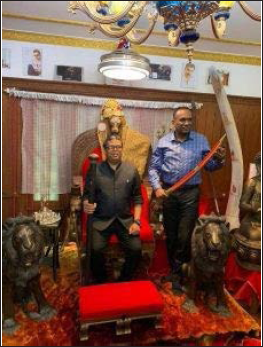
Question on whether Monson was selling original artefacts would have required a complex evaluation process—one that was automatically replaced with a heuristic question: ‘Is it possible for high ranking public officials, bureaucrats and celebrities to openly socialize with a fraudster?’ If the answer is an emphatic: ‘most likely not’ then Monson had offered the relevant cognitive ease.
The use of heuristics among those unfamiliar with art and artists from different regions of the world lead to some very funny episodes. Pandit Ravi Shankar, during his 1971 George Harrison’s Concert for Bangladesh, received applause for merely tuning his sitar. There could be two interpretations for that applause: one could be that the western audience, accustomed and therefore conditioned to artists tuning their instruments before appearing on the stage did not realize that Indian artists tune their instruments while on stage and that ‘tuning’ can go on for a long time, too. This ignorance could have led to the untimely clapping to which Pandit Ravi Shankar remarked good humouredly—‘Thank You! If you appreciate the tuning so much, I hope you will enjoy the playing more’. Or, it could be that the audience did understand that Pandit Ravi Shankar was tuning the sitar but applauded in anticipation to the concert that was about to begin. Either way, it just goes to show that one can be lost in the art world.
Those who did not believe Monson’s claims would have believed after visiting his large rented house. He utilized the halo effect to its full measure. When people learned of Monson through his many websites, images and associations, they formed favourable first impression which was difficult to shake off even when they were faced with unsettling evidence that negated Monson’s claims.
Monson created an impressive identity by naming himself as the Chairman of Kosmos Group and the Kalinga Kalyan Foundation; member of the World Peace Council apart from being a patron of the Pravasi Malayali Federation. He was also running an archaeological centre in Kochi. Monson gave television interviews about his interest in antique automobiles and of his collection of limited edition vehicles. There was suspicion that Monson purchased cars damaged during the 2019 Kerala flood at very low rates. Thirty automobiles, together with high-end Dodge, Porsche and Bentley were among the automobiles seized from his house in Kaloor. Out of the collection, many were not in working condition while seven of them were not documented.
The people who invested in Monson’s business were also influenced by the security the art world provides to investors. India’s art market was valued at ₹ 200 crore in 2000 and it was valued at ₹ 1,700 crore by 2020. According to experts, if it follows the trend the value of the India’s art market is expected to be ₹ 16,000 crore a year by 2040 (Lall, 2021).
Reasons for Growth in Indian Art Industry
Increasing number of high net worth individuals
Emergence of new generation of art buyers such as entrepreneurs, company executives and professionals—doctors and lawyers
Increasing online sales
Increasing private/corporate patronage
Increasing number of art galleries (KPMG in India—FICCI report, 2018)
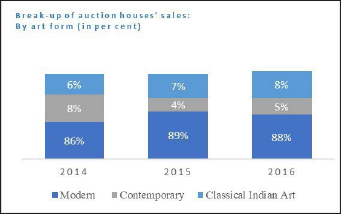
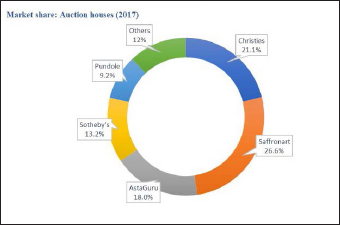
Demand has come from investors and collectors alike. Auction houses buy and resell previously owned art pieces; they are responsible for fetching the highest possible price once the work enters the private marketplace. Auction houses verify the quality and authenticity of the art and serve to reduce purchase risk.
Art Categories Popular with Indian Buyers
World Bank report had estimated that by 2020, COVID-19 would push between 119 and 124 million more people to extreme poverty; their revised update brought the number to 97 million in 2020—which was still much higher than the pre-pandemic days. Contrast this with the wealth added to the already rich—according to the Oxfam Davos report of 2022—in India, 40 billionaires were added to the existing 142 and together they held US$720 billion (2022). Dinesh Vazirani, CEO, Saffronart, said in an interview (2022):
During the lockdown, disposable incomes of the high-end groups and businessmen had grown because they weren’t travelling, partying or attending weddings. The building up of the collector’s culture had begun from 2009 after the economic meltdown in 2008. Speculators disappeared, and serious collectors gained ground. That’s been crystallising for quite a while over the last over a decade… Collectors buy artworks to live with them and soak in the ambience that they exude in their homes. If one were to quantify, today, 80 percent of those participating in auctions are unshakable collectors, while the rest could be dealers and speculators….
Art is increasingly gaining credibility as a value-preserving asset class, almost akin to gold, and is often positioned as a capital asset. Art and collectibles related wealth among Ultra High Net Worth Individuals (UHNWIs) was an estimated US$1,481 billion in 2020 and it is projected to reach an estimated US$1,882 billion by 2025. There is agreement among nearly 80% of wealth managers that art should be offered as one of the wealth management services (Deloitte, 2021).
In the backdrop of rising wealth and rising interest in art, the arrival of Non Fungible Tokens (NFTs) has drawn much attention from young aspiring artists and collectors. The technology allows for anything you can imagine to be turned into digital assets. It has gained in popularity because it smoothens transactions in digital artwork with its unique identification codes. Mike Winklemann, a well-known digital artist, created a composition with 5,000 daily drawings titled, ‘Everydays: The First 5000 Days’. Christie’s sold it for US$69.3 million (2022).
With NFT, artwork is ‘tokenised’—it means that a digital certificate of ownership is created that allows for the buying and selling of the work. ‘Tokens’ also help the artist to receive royalties every time it is sold. A 12-year-old boy from London sold his artwork for £290,000. The art titled ‘pixelated whales’ was created during his summer holidays. The money is stored in Ethereum (Kleinman, 2021). Programming such as Bitcoin and Ethereum, which is used to create cryptocurrencies is also used for NFTs. It exists on the blockchain; NFTs are held on the Ethereum blockchain.
The programming similarity of NFTs with cryptocurrencies ends where the question of ‘fungible and non-fungible’ arises. Unlike the cryptos, NFTs with its fungible characteristic enables seamless transactions on blockchain. NFTs are non-fungible because it accords unique signature to every work of art that is, it does not allow the same artist’s work or different artists work to be exchanged (non-fungible). Music, art, GIFs, videos, virtual avatars even tweets—any tangible or intangible item can be sold as a digital file.
Even though these digital files can be viewed, downloaded, shared and its screen-shots taken—the desire to own an original is what is driving the demand. Because there can be only be one owner at a time it is possible for the owner or creator to personalize the work by storing information or signature in the NFTs metadata. This digital receipt of ownership however does not include copyrights. Artists can even program their digital assets with the percentage of royalty which they wish to receive every time their work is sold. This opportunity to make money from future transactions of their work coupled with the option to bypass galleries and auction houses ensures heightened interest among new age artists to make the most of the global reach that the technology offers (Conti & Schmidt, 2022).
India had its first NFT auction in January 2022, held by Mumbai based auction house Prinseps, The sale included 35 rare works of art on paper by Indian artist Gobardhan Ash. Buyers still preferred physical work over NFTs (Auction Daily, 18 January 18, 2022).
NFT works on the value someone attaches to the piece of work—the ability to sell the art work for a profit in the future will depend on the demand for the work. To start an NFT collection one needs to create a digital wallet and shop from any NFT site. One of the well-known marketplaces for NFTs is OpenSea.io. There is no standard verification process and platforms host thousands of NFT creators and collectors.
The tech savvy young generation is going to drive the market for art collectibles. In a study to understand the difference in motivation for collecting art, it was found that 85% of younger collectors (under 35 years) cited ‘social impact and purpose led investment’ along with ‘emotional value’ as their key motivations for collecting art as against 32% of the older aficionados. The key difference is the technology (Deloitte, 2021).
The Pandemic shifted the focus of investors on making meaningful investments that has a clear sense of purpose and impact; therefore investment in an emerging space like art and culture which guarantees social impact is estimated to grow.
Owing to the social and economic value of investments in the art and culture sector, governments of many countries are supporting the trend. Countries offered multibillion relief packages to the cultural sector and increased budget allocations for Art and Culture to support those affected by the pandemic. For instance: China’s Ministry of Culture and Tourism offered around £11.3 billion in financing credit, UK offered 1.75-billion-pound rescue package, Singapore introduced rental waiver for arts organizations and Australia gave US$800 million support (Sahapedia.org, 2021).
In India however, there was a midyear revision during the 2020 lockdown where allocation for art and culture was slashed by 21%; this further worsened the already resource deprived sector. Government of India’s (GoI) Ministry of Culture (MoC) has over many years received only an average of 0.11% of the overall budget and this has declined to 0.07% in FY 2022. Low allocation, delayed fund release and underutilization of funds has led to further cuts in budget allocation. In the first two quarters of 2018–2019, MoC spent only 51% and in 2019–2020 this came down to 40%. This downtrend further lowered the allocation by 16% in the revised estimates in FY 2019–2020. Based on the instruction from Finance Ministry to restrict expenditures in the first three quarters of FY 2020–2021 to 15%, the MoC spent one-fourth of the revised allocation in the last quarter of the FY (Sahapedia.org, 2021).
The likelihood of taxation of NFTs and cryptocurrencies will possibly alter the present interest. Finance Minister, Nirmala Sitharaman in her Budget 2022–2023 announced 1% tax deduction at source (TDS) and a capital gains tax of 30% on income earned from transacting in digital assets. The taxation might discourage investments in digital assets because a 1% TDS in high value transactions with high frequency of trade will impose a high tax burden. With the increase in the cost of transacting in digital currencies and the non-legal status of cryptocurrencies—art investors will need to be careful. Even gifting in virtual assets will be taxed (Bhupta, 2022).
The same HOMER, who pleased at ATHENS and ROME two thousand years ago, is still admired at PARIS and at LONDON. All the changes of climate, government, religion, and language, have not been able to obscure his glory. Authority or prejudice may give a temporary vogue to a bad poet or orator, but his reputation will never be durable or general. When his compositions are examined by posterity or by foreigners, the enchantment is dissipated, and his faults appear in their true colours. On the contrary, a real genius, the longer his works endure, and the more wide they are spread, the more sincere is the admiration which he meets with. Envy and jealousy have too much place in a narrow circle; and even familiar acquaintance with his person may diminish the applause due to his performances. But when these obstructions are removed, the beauties, which are naturally fitted to excite agreeable sentiments, immediately display their energy and while the world endures, they maintain their authority over the minds of men (Hume, 1957).
Forgers make people feel lucky for having found a masterpiece and it fulfils their fantasy of becoming rich. Many owners of fake art do not bring the art for authentication from fear of losing the value in its property if it’s assessed fake. Among the fakes commonly sold in India are works of M. F. Hussain, S. H. Raza and Manjit Bawa. Fake art makes up nearly 80–100 crores of the Indian art market which is worth ₹ 1,000–₹ 1,200 crores (Mulye, 2018).
2009: Dhoomimal Gallery had to withdraw 12 canvases after they were declared fake. 2011: Twenty fake paintings of Rabindranath Tagore were exhibited in Kolkata. 2014: Works of M. F. Husain and Manjit Bawa at Mumbai’s India Art festival were reported to be fake (Mulye, 2018).
Scarcity and Art
The world of art is now accessible to common man because of mass production and deep distribution. Since more people can easily patronize art, the idea of owning exclusive art, scarce art or classic art or art with a catchy storyline has become all the more desirable.
A curious case of Banksy, a graffiti artist from Bristol, England, has caught the imagination of art collectors. Banksy’s street art is known for its wry humour which is considered anti-establishment because of its satirical themes. He is also a mystery figure because he does not appear in public, does not share his image nor seeks public attention. One reason could be that if he is caught, he will serve a prison term of nearly 10 years for damaging public property.
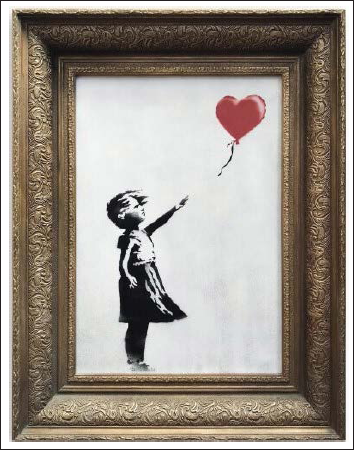
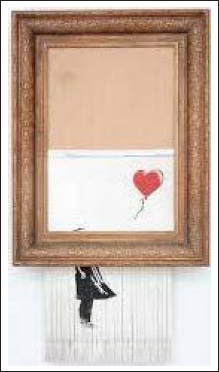
‘Girl with Balloon’—a spray painted image of a young girl reaching up to a heart shaped red balloon rose to popularity when it shredded itself soon after it was sold to the highest bidder for £1,042,000 at Sotheby’s auction house in London in October 2018. Even after the painting shredded itself, which left half of it hanging outside the ornate frame in strips, it was still paid in full by its European buyer who said she felt it was her, ‘own piece of art history’. The shredding incident was attributed to the artist’s yet another subversive approach to art establishments and its excesses. The buyer’s decision to retain the painting proved to be lucrative because, 3 years later, on 14 October 2021, it was sold for £18.5 million—a record high for the artist’s work.
With the increase in fake products, new solutions using artificial intelligence and barcode technologies have emerged. Overt technologies include hologram, barcode and QR code while covert method uses special devices to determine the authenticity of the piece.
Stories, Stories and More Stories: If You Believe, You Will See
One of the stories Monson cited to extract money was about his sale of ₹ 262,000 crores worth of antique to royal Arab families. Monson would say he needed money to clear legal hurdles that included compliance with Foreign Exchange Management Act (FEMA), norms of the Reserve Bank and to get the clearance to transfer the money from his HSBC account. In return for contribution, Monson would promise interest free loans to start their own business. In order to reassure his victims, Monson would share forged documents of HSBC bank. Investigators found that Monson did not have a HSBC account.
The complaint that Monson robbed people to the tune of ₹ 10 crore cannot be ascertained because his account balance was only around ₹ 200 at the time when the investigation began. Monson had no foreign account either (Kerala: Monson Mavunkal, 2021). He left no paper trail of his transactions because most of it was done in cash and the accounts used were of his employees or former colleagues or employers. For instance, Ajith, Monson’s driver, could not believe that transactions of over 2 crore had been made through his account with a private bank which he had not used for want of minimum balance. Even the mobile number linked to the account, ATM card and cheque book of the account were with Monson. Where did Monson hide all the money he stole? There is speculation that he was spending all the money on his lavish life style and to maintain the pretension.
Monson reminds one of a story of a man who once offended the Sultan and was sentenced to be hanged. The man thinks of a clever scheme and offers to teach the Sultan’s horse to sing within 1 year. The Sultan takes the deal and releases the man so that the horse can be taught to sing. The man’s prison mates chide him for making such a foolish move saying that the man was merely asking for more trouble. To this the man replies that anything can happen over the course of a year. It’s quite possible that the Sultan will die and the new Sultan might pardon him, or he himself will die, or the horse will die or perhaps he will even manage to teach the horse to sing (Pinker, 2021, p. 49).
Evidence Ignored
If any of Monson’s victims had checked his background before investing they would have found some strange anomalies. Monson moved to Rajakumari in Idukki district in the early 90’s because of his wife’s posting there as a school teacher. He worked as an electrician. Monson was first arrested in 1998 for selling a stolen car. He convinced the police of his innocence by weaving the story of carjackers and returned the ₹ 50,000 to the buyer. He then worked with a jeweller in Idukki, Kerala and was forced to leave because of dishonest dealings. He later moved to Kochi where he started to network with influential people. One thing favoured him—he had a knack to impress and was reasonably good looking to appear suave and urbane. To those Monson wanted to impress, he would gift expensive items such as Corum Admiral wrist watches that could cost anything upward of ₹ 55 lakh. He was often seen near film units and used to network with film stars. He duped car dealers by taking their cars and threatening to expose them using his connections with the police.
Six people complained which finally led to the investigation. Four out of the six that is, Yakub Purayil, Anoop V Ahammad, Shameer M T and Shanimon (Kerala: Monson Mavunkal, 2021) requested police protection for themselves and their families as they were cyberbullied and threatened. Whenever the six had requested Monson for their money or expressed apprehensions of ever getting it back, Monson would send pictures of him with various politicians and top police officials and this worked to prime their mind about Monson’s authenticity (Who Is Monson Mavunkal?, 2021). If they persisted, Monson would say he’d sell the antique pieces to return their money.
On the night when Monson was arrested, policemen in plain clothes had to fight Monson’s bouncers who tried to forestall the arrest thinking the men were agitated investors. The bouncers fled soon after they realized that the plain clothed men were from the police department. The weapons toted by the bouncers turned out to be China-made toys.
Fourteen FIRs were registered against Monson in various police stations across the state. The sections ranged from 450 (cheating), 506 (criminal intimidation), 34 (impersonation) and 420 (cheating and dishonestly inducing delivery of property) to 471 (using forged documents) of the Indian Penal Code (Monson Mavunkal, 2021).
It is easy to fool inexperienced buyers. Art students and art dealers in need of quick money, sneak in fakes every now and then. Bayesian Theorem and rationality principles can be used by inexperienced buyers before making expensive investments in doomed art acquisitions and projects.
Scholars, Connoisseurs and Thomas Bayes
Martin Kemp, an emeritus professor of art history at Oxford University and a leading scholar of Leonardo was intrigued by an email submission—a digital image of a picture that showed the profile of a girl with outline drawn with a left hand using pen and coloured chalks—an evidence that Martin’s instincts told could only be the work of Leonardo Da Vinci. The appearance of the painting made it an exception—because for more than a century not one painting of Da Vinci has turned up and the drawing seemed to have come out of the blue. It was difficult to believe that the drawing had escaped the most trained eyes and ended in an art gallery. A prominent dealer had purchased the drawing forUS$22,000 at an auction at Christie’s and the previous owner was a lady whose identity was not disclosed—it is common to hide the details of past owners in the art industry. The speculation was that the painting could have been made by someone from a German school of artists. The new owner submitted the drawing for authentication. An analysis of the pigments used in the drawing showed that they were discontinued after Leonardo’s time period. Radio carbon dating of a sample of the parchment dated it between 1440 and 1650; Leonardo was born in 1452 and died in 1519—all the evidence added up to indicate the work was an original Leonardo Da Vinci.
Old forgeries can be difficult to expose using radiocarbon dating and pigment analysis. Leonardo Da Vinci was popular in his lifetime and someone else around that time period could have forged the work. Martin Kemp made the trip to Zurich to check the painting and he was convinced that all that he had read and understood about Leonardo was visible in the painting and he named the portrait ‘La Bella Principessa’ meaning ‘The Beautiful Princess’. After the declaration by Kemp, many other scholars and connoisseurs were convinced that the work was an authentic Leonardo da Vinci.
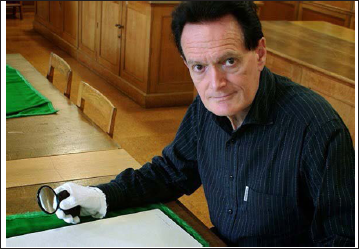
Amidst this rising excitement, many critics did voice their doubts; Thomas Hoving said that ‘La Bella Principessa’ was too ‘sweet’ to be a Leonardo. Connoisseurs rarely repudiate a piece of art publicly from fear of being sued for ‘product disparagement’, or for defamation. The authentication industry does not clearly communicate the value and judgement of the work in writing and are often subject to confidential agreements—this keeps valuable information from buyers. A connoisseur is superior to a scholar in their understanding of the work of an artist or of a certain medium or time. Bambach was one such connoisseur who after examining the drawing said, ‘It does not look like a Leonardo’.
Peter Paul Biro was contacted to determine if the work was truly a Da Vinci. Biro was known to have brought science into establishing the authenticity of a work of art—he looked for the artist’s fingerprints or other evidence that could be connected to the artist, categorically. Biro claimed his approach was rigorous and of forensic standards. According to Biro ‘La Bella Principessa’, was an original because there was a smudge in the corner which looked like a fingerprint and it was comparable to the finger print on ‘St. Jerome painting’. Although it was difficult to read the fingerprint and no expert could have used the vague smudge mark to authenticate—Biro established without any doubt that it was an original Da Vinci. However, few connoisseurs and experts on Da Vinci remained unconvinced because the style and effect outcome on ‘La Bella Principessa’ lacked Da Vinci’s signature effect. Forensic experts were also sceptical about the perfect match that Biro claimed to have because each finger leaves a distinct impression and because of elasticity of skin it is not possible to get the same fingerprint impression with the same pattern and pressure, twice. The evidence shown by Biro to prove the work was an original seemed to match as exact overlay in size, shape and pressure. Biro was also planning to use DNA analysis of a hair or nail embedded in the piece of art with what they got from a relative (Grann, 2010).
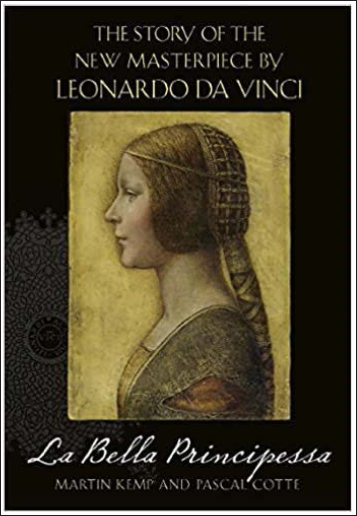
Martin Kemp, the scholar who first endorsed the work as an original Da Vinci, co-wrote a book titled after the name he had given the painting.
A brief overview of the book on Amazon reads as follows:
The 500 year-old portrait is one of the most extraordinary discoveries of our time. This is the story of how a team of experts - led by Professor Martin Kemp -pieced together the evidence, detailed historical research and technical analysis to follow a trail that leads back to the 15th Century…Martin Kemp takes us on a journey of discovery recounting the steps he and Pascal Cotte took in authenticating the painting including the use of forensic methods usually reserved for criminal investigation. He recounts how experts matched a fingerprint found on La Bella Principessa to the great Renaissance master. This discovery throws new light on Leonardo da Vinci and his world. We learn the story of the girl who inspired the painting. The sitter, a beautiful young girl, displays a sense of melancholy and strength, a tender and fragile beauty. But who is she? By far the most likely candidate is the illegitimate daughter of Duke Ludovico Sforza. Martin Kemp tells, too, the tragic story of this princess who was to die when she was just fourteen years old….

A convicted art forger Shaun Greenhalgh claims that he faked this ‘Leonardo’ and that the model in the ‘La Bella Principessa’ is Sally from the Co-op, a girl he knew in Bolton in 1975. Greenhalgh has a history of selling forgeries to international museums. In his memoir, ‘A Forger’s Tale’ published in 2015, Greenhalgh claimed he had painted the picture in 1978 using a large piece of vellum dating from 1587 for the canvas. After Shaun Greenhalgh disclosure, there have been countless opinions from experts and others on why the work could never have been of Leonardo Da Vinci. A French laboratory stated that the pigment used in the art was at least 250 years old. The sheer magnitude of discussion around the painting, its connection to Leonardo D Vinci, the argument and counterargument that has gone on for more than a decade is sufficient to establish the slippery nature of art evaluation.
Evidence used for scientific study can be forged and the expertise of a connoisseur is limited to the individual and sometime can be completely wrong—the assessment of a work of art cannot be truly democratic. Yet one needs to keep aside the aspiration and excitement and this is where Bayes theorem will be invaluable.
Bayes’ rule is the law of probability that shows us the strength of evidence. It says by how much one should change one’s mind when confronted with new fact or observation or evidence. Decisions that have a high cost, either emotional or monetary, require an assessment of the odds. Bayes’ simple rule is to quantify a belief with a probability. The likelihood of an idea should depend on the evidence which is called posterior probability after examining the evidence. Bayesian theorem is based on personal perspective. For example, people might differ in their estimate on whether a given art work is authentic or not. The difference will be largely due to the difference in the availability of information. One should be sceptical of stumbling on rare classic art given how unlikely it is to find it or how unlikely that it should have escaped the experts who look for art not just for its beauty but also for its value. Daniel Kahneman and Amos Tversky found that most people depend on stereotypes than on Bayesian rule. The brain employs the availability and representativeness heuristic when faced with a fact rather than engage itself with math. Blindness to base rate makes people believe the impossible. Remembering the base rate—the sheer shortage of classic art—can help people reject such claims. One must calibrate ones hope against the degree to which such artistic work could reasonably be expected outside the great museums and auction houses of the world.
In 2011, National Gallery, London, declined to include the ‘La Bella Principessa’ in their retrospective on Leonardo’s masterpieces.
An algorithm prepared by the Rutgers Art and Artificial Intelligence Lab can identify the artist and genre with 60% accuracy using a database of 80,000 works across six centuries.
The Archaeological Survey of India (ASI) has assessed the value of artefacts found in Monson’s possession and in its report it stated that the two silver coins which Monson claimed were coins given to Judas Iscariot to betray Jesus were of antique value but were not connected to Judas. A wooden spear also was attributed as having antique value. Other than the two artefacts, the rest was junk (The New Indian Express, 2022).
The world of art is clearly exclusionary and non-democratic with several ways to game the system. The intuition of connoisseurs and experts is restricted to one artist or time period or art technique or any number of domains in the art world that a person can occupy to build expertise. Artificial intelligence will grow in strength and might to help with the speed and accuracy of the assessment. Bayesian thinking will help to control the desire to believe in the impossible.
