




Abstract
SunPower Corporation is an American organization working in the solar energy sector specialized in power generation and solar energy storage. This case highlights the strategic growth path of SunPower corporation, which originated as an outcome of effective solar cells production. This case also discussed how the energy sector considers solar energy the vital energy source, and solar energy organizations grow to capture the energy demand. The case also highlights the various consolidations of SunPower in terms of different mergers and acquisitions as essential strategies to succeed. The case also discusses the competitors’ strategy of the top five solar power generation and storage firms, which give a clear view of how different solar firms are building their space in the solar energy sector. With competitors’ discussion, this helps to understand the challenge faced by SunPower to beat the competition among the other solar firms. In the end, the case focused on the ongoing and future strategic choices of SunPower as SunPower Corporation.
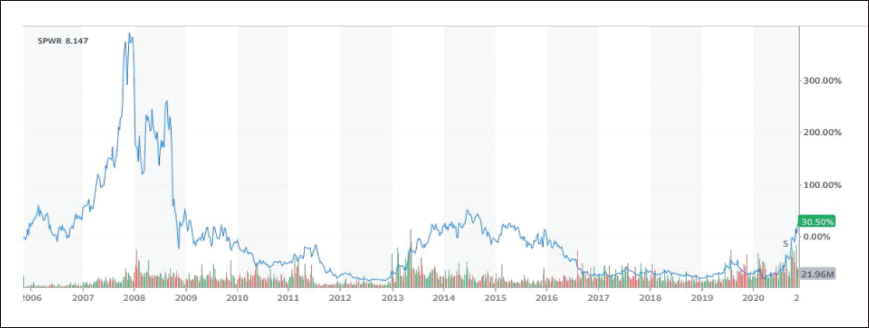
For the SunPower Corporation, 28 January 2021 is the decisive day, as it accounted election of Suzanne Leta, heading of policy and strategy of the firm, to the executive committee of the Solar Energy Industries Association (SEIA) Board of Directors. According to the forecast of new governmental change, Leta is supposed to work over coalitions which may lead to new policies that accelerate solar storage, diversity, customers, and firms’ insertion within SEIA. The President and CEO of SEIA, Abigail Ross Hopper, announced 2021 as a shaping year for solar energy. However, Suzanne’s expertise in energy and her dedication helps to meet SEIA’s goals in SunPower. With 17 years of experience, strong industrial leadership, and board expertise Leta directs the market policy and strategy team at SunPower, responsible for government relations, strategic business initiatives and new market entry. Her experience in renewable business and current role in policy councils to the American Council on Renewable Energy (ACORE), Advanced Energy Economy (AEE) makes her an ideal candidate to be nominated for the executive committee of the SEIA Board of Directors. By acquiring this position, SunPower can hold a firm place in SEIA, a national trade association for solar. With Leta selection, SunPower has become a part of SEIA`s solar vision agenda, which will help promote SunPower’s solar services. SunPower plans to implement a solar app and other service integration to becomes the best low-cost provider within her term. This decision helps SunPower to fix its strategy and fluctuating market position and to achieve a strong competitive position in the solar industry (Figure 1). It may allow SunPower to gain a strong position in the solar industry which it tries to achieve by shifting its strategies for decades.
About SunPower
Solar energy was first introduced in the form of solar collector water heating systems in 1909. The Sunlight to electricity converting technology emerged from Bell Labs in the 1950s was mainly used for radio transmission. In space, satellites had become breakthrough research to solve the energy crisis. The solar energy innovation from a solar heating system to space radio transmission acts as a highly impacting action to awaken the oil firms in 1973, dealing with the oil crisis. To overcome this crisis, Dr Richard Swanson had co-founded a firm Known as SunPower. Hence, SunPower originated as an energy solution by developing cost-effective solar photovoltaic panels and was later known as the world’s best solar solution provider. SunPower’s dynamic development can be closely linked with the evolution of solar energy, which acts as a breakthrough technology by providing renewable energy solutions (SunPower, 2020).
Rise of Solar Solution
Solar energy was introduced by a breakthrough invention of silicon solar battery by Russell Ohl’s while working on diodes which were patented as a ‘Light sensitive device’. The solar to energy converting experiments started the ‘P–N junction’ invention to find a source of energy for power for transistors (ISES, 2021). The successful investigation of silicon strips to capture free electrons from Sunlight generated the first solar energy apprehend solar cell. This breakthrough experiment became public by a New York Times article in 1954. The commercialization of solar photovoltaic (PV) cells started in the late 1940s for satellites. The small entrepreneurs started manufacturing small tube radios, which were shifted to TV manufacturing technology (The Economist, 2021). The solar photovoltaic cells were later on used as small power generating cell arrays for satellite radios. With time the efficiency of these solar photovoltaic cells was improved remarkably.
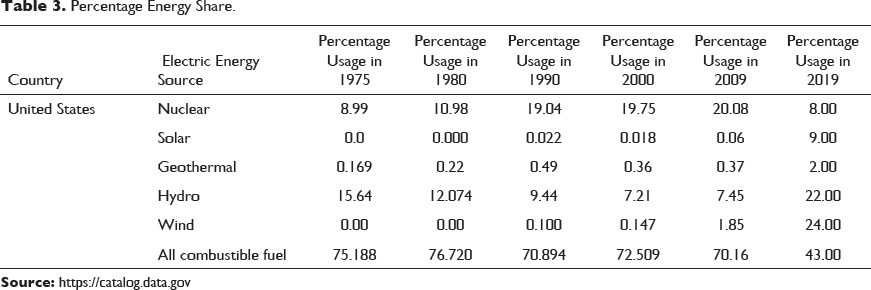
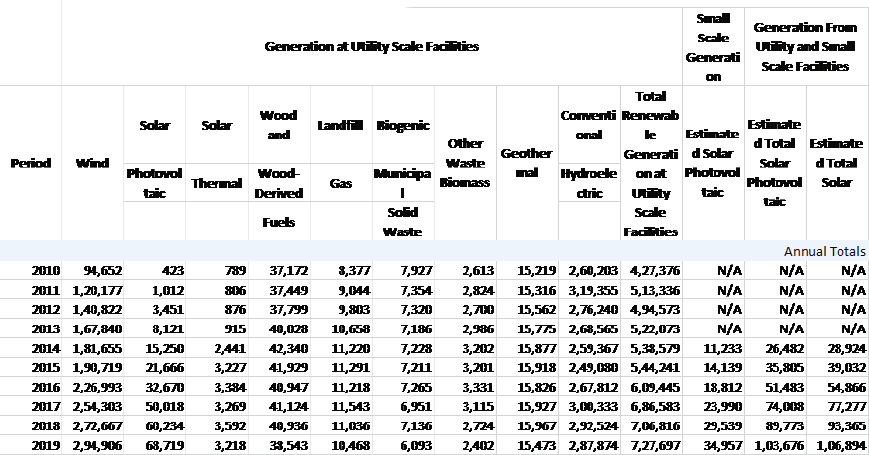
SunPower Corp. started its initial solar technology as spacecraft solar photovoltaic has been continuously worked on improving its solar technology efficiency through innovation. However, in the late 1990s, there was a record fluctuation in oil prices, and the security of oil became a significant concern to the government. Because of raised oil prices, the government faces considerable changes in policies from various countries. Countries like France and Sweden were using nuclear energy for solving energy problems. The solar energy potential for commercial use was first discussed at Stockholm Conference in 1972. Later on, solar energy has been considered clean energy, which acts as an alternative energy source. Instead of the availability of atom energy, solar energy acts as a renewable alternative to oil as shown in Table 1. With the increased popularity of solar energy, there is visibly increased investment in the solar sector by the Federal and state government of the United States. Such a situation leads to the development of small solar energy entrepreneurs to established firms. The oil firm started investing in solar projects in the United States to solve the power problem in offshore platforms.
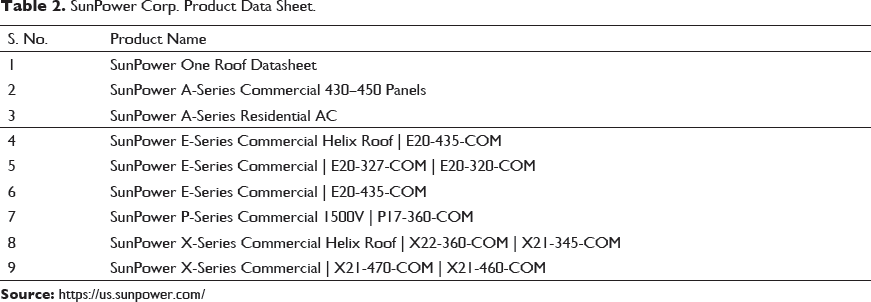
In the year 1970, SunPower Corp. emerged as a record-breaking solar technology provider for spacecraft. SunPower Corp. presents itself as a creative and innovative solar technology developer. SunPower Corp. came into existence when its co-founder Dr Richard Swanson started developing effective, low-cost solar cells, and he was able to incorporate it officially in April 1985. SunPower Corp. achieved its position as a utility and commercial solar energy developer when Dr Swanson explores his solar power research in a specific venture. Later on, SunPower Corp. reached a new level with CEO Tom Werner; it became a known brand in solar cell production under him. The rising importance of solar energy because of raised oil prices helps increase funding for solar energy in the United States. Because of this funding and some major acquisition deals, SunPower Corp. became a committed and reliable solar solution provider instead of only solar PV producers, various products of SunPower are shown in Table 2. SunPower, a cost-effective solar cell producer, became a quality solar solution maker by considering and adapting to the industry change. SunPower Corp.’s core values have been changed from low cost to quality, making it a strong competitor in the solar energy industry. SunPower Corp. marked its strong position by strategically choosing strong partners that help to enhance brand image and market position (SunPower, 2021a).
Oil and Solar Energy Scenario in the USA
After 1968, Berman started developing organic cells as energy alternatives in the oil company Exxon. In 1973, the firm ‘Solar Power Corporation’ was launched, Exxon’s wholly owned subsidiary. This firm started manufacturing terrestrial PV cells for the first time in the United States, which affects Mobil’s strategy and functioning, a known oil company, had also invested in solar power. Later in 1974, Mobil started working with Tyco as a joint venture. Tyco had been identified as a light-weighted solar cells producer. The Mobil-Tyco Joint venture worked long for developing cost-effective fabrication of crystalline silicon solar cells. However, other oil companies like Arco, a U.S. oil firm, started developing efficient photovoltaic cells for Communications Satellite Corporation (COMSAT). The acquisition of solar firms by oil companies has resulted in another entrepreneurial start-up. The entry of the oil companies into the solar industry had several downsides, as oil giants have well-developed reputations, and it is now difficult for entrepreneurs to grow their firms. Thus the U.S. market starts developing the Solar industry as the new energy industry, which can help the space industry and become an alternative to oil and nuclear energy as shown in Table 3 (ISES, 2021; O’Connor et al., 2021).
SunPower Corp. Deals
SunPower emerged as the creative solar energy-producer firm which has acted as a stable solution to the oil crisis in the U.S.A. SunPower Corp. gets financial support from the Electric Power Research Institute and the U.S. Department of Energy to continue its reach in solar energy, making it a leader in residential, commercial and utility-scale solar power production. SunPower Corp. has faced significant milestones in the decade 2000–2009. After joining CEO Werner in 2004, it first started with the mergers and acquisitions deals (Electric Energy Online, 2018; SunPower, 2021a, 2021b; WNA, 2021). This acquisition of Korean Power Light Corporation by SunPower in January 2007 helps show SunPower Corp. footprint in a solar electric power plant. The firm received good returns from this deal by sealing energy. SunPower Corp. has also benefited from the excellent reputation of PowerLight as a subcontractor. This acquisition of PowerLight by SunPower Corp. helps in the business expansion of SunPower Corp. from efficient solar cells to a portfolio of solar technology systems. SunPower Corp. acquired SunRay, a Renewable Energy firm, in February 2010, for $277 million, providing an excellent opportunity for SunPower Corp. to expand in small-scale solar rooftop photovoltaic cell installation in Europe. This deal helps SunPower Corp. to grow in the area of small rooftop PV installations (Renewables Now, 2018). One of the significant acquisitions took place in December 2011, including Tenesol SA–SunPower acquisition, where Tenesol SA is a vertically integrated solar firm situated in France by SunPower Corp. This deal has been happened by the firm nomination of SunPower Corp. by total (branch of Total SA), which purchased 18.6 million common shares of SunPower Corp. and 50% premium shares. Because of this deal, SunPower Corp. gets access to Tenesol’s strong business presence in Europe, Africa, the Middle East, and South America (SunPower, 2013). With the expansion of SunPower Corp. business in various regions, now SunPower Corp. wants to become a technology-intensive firm through inorganic development. SunPower Corp. found this can be easily achieved by acquiring a new solar technology-intensive firm. Hence SunPower Corp. intends to develop new robotic solar panel cleaning technologies, and such cleaning technologies make SunPower Corp. more efficient in after-sale services. Thus SunPower Corp. acquired Greenbotics, Inc.; Greenbiotics is known for its cost-effective solar cleaning robots, performing at different surface conditions. The Greenbotics Inc. acquisition provides SunPower Corp. with comprehensive robotic technology services at global portfolios and makes SunPower Corp. a robust solar solution globally (Gheorghiu, 2018; SunPower, 2021a, 2021b).
Oil firms Investors in Solar.

SunPower Corp. Product Data Sheet.
Percentage Energy Share.
Strategies of Competitors.
2.
In 2018, SunPower Corp. announced an American unit of German Oregon based solar panels manufacturer Solar World AG. This deal was somewhat opposite to Section 201 of the Trade Act of 1974. The International Trade Commission investigates any petitions filed by domestic industry or workers for injury or threat of damage because of imports. This deal makes SunPower Corp. a robust solar panel manufacturer in the world. SunPower Corp. started its work on the sun concept by doing a joint venture with its SunPower Corp. Equinox (SunPower, 2013). This bottle the sun concept makes SunPower Corp. a complete energy solution from solar PV manufacturing to solar energy storage batteries installation at the commercial and residential levels. SunPower Corp. manufactures P-Series solar panels, producing more than 400-watt energy and selling it as a complete energy package at the residential solar program (Solar Power Investor, 2021). To provide customized residential solar solutions, SunPower Corp. launches a designed studio. In the pandemic year 2020, SunPower Corp. worked in joint partnership with Technology Credit Union and Bank of the West to secure more than $1 billion in funds. This complete solar solution provided by SunPower Corp. through different expansion strategies makes it the number one organization in three consecutive years (EIA, 2021; SunPower, 2020).
Competitor Analysis of SunPower Corp.
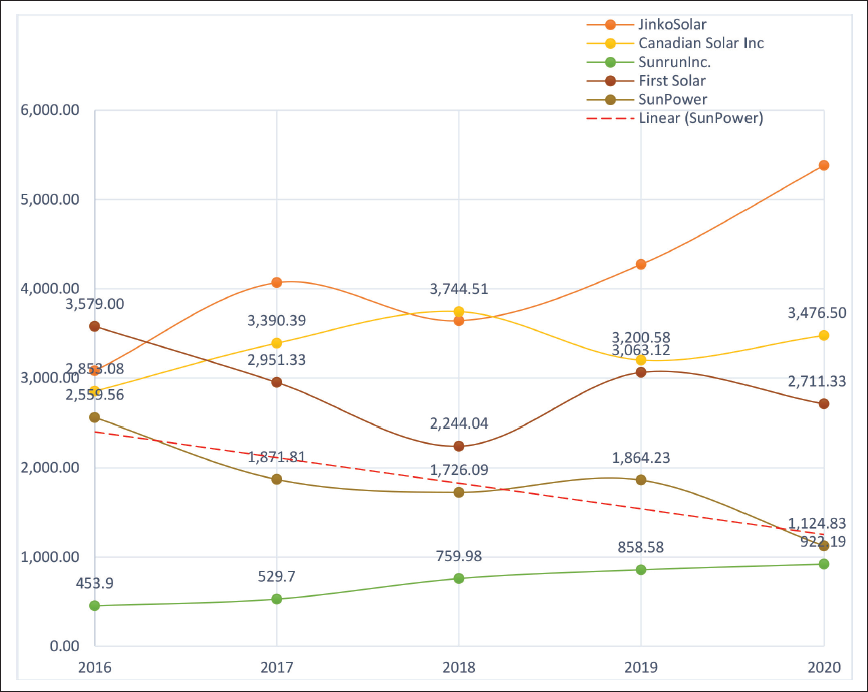
SunPower is under the top 10 companies in the energy sector based on revenue raised. The average income raised by the top ten solar firms is approximately $11 billion, with estimated employees are 633.6 thousand. In 2020, SunPower faced an 89.3% decline in revenue, that is, from $274.8 million in Q3 of 2020 to $47.9 million in Q1 of 2021. SunPower is facing intense competition in the energy sector by the top ten companies. SunPower is a public company working in the energy and utility sector, specifically in cleantech and renewable solar. The other top five competitors listed as public companies, come under the energy & utility sector, and work in cleantech and renewable solar are C1: JinkoSolar; C2: Canadian Solar; C3: Sunrun Inc.; and C4: First Solar. SunPower Corp. maintains its top-five position by developing the highest efficiency (24%) large area solar wafers and continuously improving its solar panel manufacturing process.
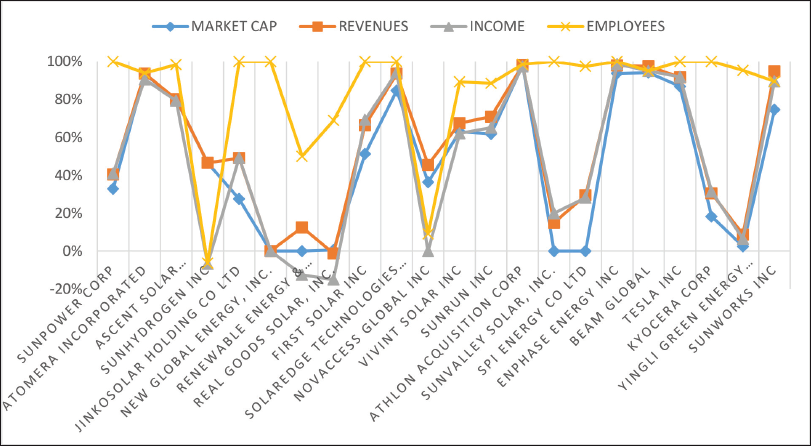
The revenue analysis has been performed on the top five public firms working in cleantech and renewable solar energy in the energy & utility domain as shown in Figure 2 (Reiff, 2020). SunPower Corp. is facing competition by continuously improving its solar technologies and services. To overcome competition with the reseller, developers, and other products and services, SunPower Corp. has a robust strategic relationship with different solar system providers. SunPower Corp. tries to extract funding from the government for solar product development and promotes its work in other renewable energy programs to pull more tax rebates and attract customers with other energy source providers. SunPower Corp. also collaborates with the university’s research centres for developing alternative technologies for PV cells. Instead of working with solar technology, SunPower Corp.’s key for managing competition is working with solar energy management solutions to provide everything related to solar energy. Other parts of competitive strategy are speedy installation through the Helix system, engagement with the end customer community, bankability, Strong brand image, warranty protection, and strong after services, including customer services (SunPower, 2020). The competitive strategies of other top five competitors listed as public companies in the energy & utility sector are described below.
C1: JinkoSolar Strategy
JinkoSolar is a solar firm that manufactures solar modules and provides solar solutions and services for commercial and residential purposes worldwide. JinkoSolar is known as JinkoSolar Holding Co., Ltd. Their principal executive office is in Jiangxi Province, People’s Republic of China. Jinko was started in 2006 which manufacture only silicon wafers, and it went public in 2010 on New York Stock Exchange. JinkoSolar is a vertically integrated firm that produced mono wafers, solar cells, and solar modules. It also supplies all vertically integrated products through its value chain. JinkoSolar depends upon government initiatives to develop its technology and other products, and hence governmental regulations affect the JinkoSolar business. JinkoSolar has its manufacturing units in Jiangxi, Xinjiang, and Zhejiang, making silicon wafers and solar modules respectively in huge capacity and transporting their solar products in various locations. They supply their product to multiple suppliers by using prepayment arrangements which also affect the firm’s financial conditions. JinkoSolar may face restrictions in abroad business because of the risk associated with marketing, distribution, and manufacturing process. Jinko increases its production capacity of solar cells and solar modules to fight increased competition. As Jink solar has its solar cells manufacturing, they mainly compete with specialized and integrated manufacturers like Longi Green Energy Technology Co., Ltd., Trina Solar Ltd., Canadian Solar Inc., and JA Solar Holdings Co., Ltd. They also started their downstream manufacturing by making polysilicon, expanding their solar cells, silicon wafers, and ingots manufacturing. JinkoSolar competes with the help of the existing brand image competitor business model by providing a high quality product at low price products, timely delivery, reputation for supplying large orders, and reputation for reliable customer support services. JinkoSolar strategically selects its manufacturing unit in China, the United States, and Malaysia, where critical resources are available to enhance its proprietary process technologies. JinkoSolar adopts new technology where the solar product is made of thin-film materials and CSPV, which are cheaper than monocrystalline and multi-crystalline technologies without compromising the efficiency of solar products (JinkoSolar, 2018).
C2: Canadian Solar Strategy
Canadian Solar was started in 2001 as a producer of photovoltaic modules and solar solutions publicly listed in 2006 on NASDAQ. It is headquartered in Ontario, Canada but its manufacturing units lie in Indonesia, Vietnam, and Brazil, producing solar cells, silicon wafers, and other solar utility products. Canadian Solar was started as a producer of solar battery chargers for Audi, Volkswagen. Canadian Solar Inc.’s stock price in NASDAQ raised over $100 million in 2006. Canadian Solar has started its solar cell production in 2007 and delivered 1 GW modules commutatively in 2010. They began the mass production of PERC (Passivated Emitter and Rear Cell) technology with efficiency greater than 20% in 2017, and till 2020 Canadian Solar developed a world record of setting up large area N-type multi-crystalline solar cells with the highest efficiency, that is, 23.81%. The N-type large region multi-crystalline silicon solar cell of Canadian Solar produces modules up to 590 Watt, and it was also working in utility level solar projects. Canadian Solar had its solar modules for 150 countries and come under the largest solar power companies. It is a leading manufacturer of solar photovoltaic modules and a provider of solar energy solutions.
Canadian solar business is split into two segments, MSS and energy segment which deals with solar products and sailing of electricity, sailing of solar power projects respectively. The Canadian solar supply its product to customers in credit terms. The firm provides a flexible credit system depending upon the type of customer, they offered short-term and medium-term credits based on the financial position. They sell their considerable amount of solar products to specific customers, and their top five customers collectively account for nearly 31.9% of total revenue. Canadian solar continuously worked to develop cost-effective solar cells, silicon wafers, and ingots to meet the competition. Canadian Solar increased its production capacity from 6.3GW to 1.65GW from 2016 to 2018, and the higher production capacity helps to meet the great demand of specific customers. Canadian solar avoids replacing alternative solar technologies like copper, indium, gallium, and selenide in their PV materials manufacturing, making the project cost-effective, profitable and competitive. Canadian Solar used silicon for solar technology whose cost change is less susceptible to market dynamics. Instead of vertical integration from polysilicon manufacturing to solar system integration, Canadian solar focuses on the solar power market where its significant competitors use other renewable energy sources as alternative power generation. The competitive strategy includes the timely delivery of solar products with associated services, a good customer relationship and distribution channel, and a strong brand image which helps in retaining the bank’s finances (Canadian Solar, 2019).
C3: Sunrun Inc. Strategy
Sunrun Inc. was started by Lynn Jurich, Ed Fenster, and Nat Kreamer in 2007. The firm mainly used PPA (Power Purchase Agreement) for selling their power, where the customers do not buy any products but pay for electricity usage from their solar products. Thus, Sunrun Inc. provides energy to their household customers while installing and service the equipment based on customer agreement. Therefore, Sunrun Inc. offers clean and affordable energy solutions to small households. Hence their core strategy is differentiation, where Sunrun provides differentiated customer experience based on customized energy solutions according to customers pricing configurations. Sunrun’s business starts growing in 2007, and till 2019 they became the second largest fleet of residential solar energy systems in the United States. Sunrun has a chain of solar subcontractors who acts as a solar pattern of Sunrun Inc. these patterns work in an integrated manner to run Sunrun business. Also, these patterns include solar integrators, sales partners, and installation partners who help in identifying the customers, sale of products and installing solar products. Sunrun’s primary competitors are traditional utility providers, which supply power from conventional power sources to their customers, whereas, Sunrun is competitive based on cents per kilowatt-hour power delivered. Other competitors are unregulated power suppliers working on consumer choice and other similar business model firms. Sunrun competed with identical business models and traditional power supply firms based on their unique multi-channel approach and differentiated customer experience (Sunrun, 2019).
C4: First Solar Strategy
The First Solar was started in 1990 by Harold McMaster as Solar Cells, Inc. It was named First Solar, Inc. in 1993. True North Partners, LLC, purchased the firm in 1999 where it was rebranded as First Solar. In 2006 First Solar was traded on NASDAQ and went public. In 2010, First Solar became the second largest PV modules maker worldwide and got the sixth position in the fast company’s top 50 list of innovative companies worldwide. The First Solar achieved the highest rank in Forbes’s list of top 25 American most rapid technology growth companies in 2011. From 2012 to 2013, it was the leading solar contractor in solar power world magazine. The First Solar is competing based on cost per watt power supply and the low-cost solar modules manufacturing. Its competitive strategy lies in cost leadership that has been achieved by low-cost solar modules and solar products technology. That helps in cost-cutting by a 2% reduction in semiconductor usage during the solar modules manufacturing process. The First Solar makes a profit on a life cycle basis. They produce lower carbon footprint thin-film modules, minimum water usage during the production process, and minimum payback period of energy replacement. First Solar is continuously researching to improve its module wattage, which significantly reduces the cost-per-watt of energy generated (First Solar, 2019).
Competitive Strategic Challenges for SunPower
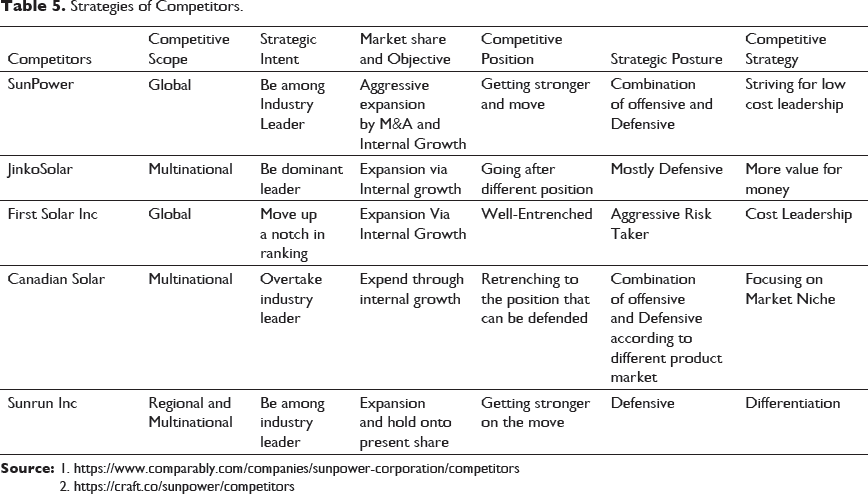
The competitors strategic analysis (Figure 2) shows the struggling improvement in SunPower position. SunPower and working in enhancing its competitive position by introducing new suppliers, organic and inorganic activities as shown in Tables 4 and 5 and Figure 3. Initially, in 2006 the SunPower tried to give massive competition to other solar firms by acquiring various firms in solar technologies as shown in Figure 2. Still, as time proceeds, Canadian Solar, First Solar and JinkoSolar are getting more market share than SunPower. The low-cost manufacturing lifecycle, competitors’ effective making of solar batteries and specific niche market consumption have introduced a vast challenge to SunPower Corporation. SunPower try to adopt low cost and consolidation strategies to beat the competition but still fighting to market share, which makes it vulnerable. Thus SunPower starts working on differentiation strategy. The experimental change in SunPower strategy by introducing third party suppliers will improve the competitive position of SunPower in 2018 (Osborne, 2019). In 2020 SunPower splits into SunPower and Maxeon Solar induced by Tianjin Zhonghuan Semiconductor Co. (TZS), a leading silicon wafers supplier. This split makes the organization structure simple and helps in increasing the speedy manufacturing of silicon wafers. With this split, SunPower can make differentiated low-cost solar cells. By disventure, SunPower became a nimbul firm that can work faster in low-cost solar cells production with effective service providers compared to existing competitors in the solar energy sector (Shumkov, 2020; ISES, 2021).
SunPower Corp. as a Solar Solutions
SunPower Corp. provides P-Series (Performance-Series) solar panels with more than 400-watt power supply for homes and other commercial purposes. SunPower Corp. strategically chose its partner like Sierra Club, to provide a residential solar program. SunPower Corp. provides customized designs according to customer needs. There is designed solar storage under the name of Sun Vault. SunPower Corp. is also committed to consolidating its business with rarer suppliers for achieving long-term advantage (SunPower, 2020; EIA, 2021). These specific partners received new opportunities and preferable business allocation. There is the SunPower Corp. Supplier Engagement Program (SSEP), which gives inherited benefits to SunPower Corp. like flexibility, sustainability, good product cost management, innovation in technology, and service quality. This strategic move has been specified to certified suppliers, strategic suppliers, and partners. With this program, SunPower Corp. managed the incurred cost of production, developed innovative technologies for achieving a sustainable competitive position. SunPower Corp. adapts flexibility in business velocity where SunPower Corp. understands the change in market condition and dynamic demand. They rapidly adjust the difference to meet dynamic demand cycles. SunPower Corp. vision ‘Zero Defect’ helps to achieve a competitive edge among the competitors. To maintain the continuous innovation and strong position in the market, SunPower Corp. runs its certifier supplier, continuous improvement, sustain quality and innovation awards which help in seamless management of the simple, innovative solar solution (SunPower, 2021).
Footnotes
Declaration of Conflicting Interests
Funding
The author disclosed receipt of the following financial support for the research, authorship and/or publication of this article: The infrastructural support provided by the FORE School of Management, New Delhi in completing this study is gratefully acknowledged.
