




Abstract
Digital transformation in the energy sector not only changes how power is generated, delivered, and consumed but also urges firms to change their business model. Renewable energy is an emerging sector responding to the increasing demand for sustainable energy. There is limited understanding about digital business models in this sector. Therefore, this case study shows the digital business model innovation opportunities of NextGridVolt, a renewable-energy provider that designs, installs, and maintains renewable energy systems. Furthermore, this case study introduces a new toolkit focusing on data-driven business model innovation. It provides a structured way to identify a firm’s existing business model and the data it has, inspiring ideas on new business models leveraging existing data sources. Using the toolkit, managers from the case company identified that they have data about clients from previous contracts and solar panel usage data from real-time sensor readings. A data analysis platform that integrates all data sources can enable various business model innovation opportunities, including increasing internal process efficiency and service quality, and providing the platform to external users as a new service.
Keywords
Introduction
The digital transformation in the energy sector has gained increasing attention in the past decade, especially in power generation, delivery (transmission, distribution), and consumption areas (Maroufkhani et al., 2022). One frequently discussed concept is the smart grid, which uses digital and other advanced technologies to monitor and manage the electricity system, covering the generation from various resources, transportation and distribution to meet varying end-users’ consumption needs (Fang et al., 2011). Smart energy and zero energy buildings concepts also discuss using digital technologies to combine and coordinate electricity, thermal, gas, and energy storage systems to improve energy efficiency and sustainability (Lund et al., 2017).
The use of digital technologies in the energy sector also attracts attention from business model (BM) researchers, covering BMs for energy products like EVs (electric vehicle) and smart home devices, smart grid infrastructure, energy data, and energy services like energy trading and marketplaces (Paukstadt and Becker, 2021). The smart grid encourages electricity firms to change their BMs from selling power to selling combinations of renewable energy and high-quality service that help consumers save energy while keeping their equipment operating as usual (Chasin, Paukstadt, Gollhardt, et al., 2020a). Examples of BM changes include presenting customers with visualised consumption details, saving energy use, installing self-produced energy sources such as solar PV (photovoltaic) systems with maintenance services and selling authorised customers’ data to a third party (Chasin, Paukstadt, Ullmeyer, et al., 2020b).
Research in electricity retailers’ business model innovation (BMI) identified the opportunities to provide customers with digital and sustainable energy solutions. For example, the combination of smart meters and energy management software, with solar panels and storage systems, helps customers to manage their energy activities (Karami and Madlener, 2021). Porter and Heppelmann (2014) suggested that firms can provide Artificial Intelligence (AI) based energy management systems that increase clients’ energy efficiency by predicting solar energy generation based on weather forecasts.
NextGridVolt is a provider of renewable energy solutions in the UK, offering a variety of sustainable energy technologies and services to commercial clients that minimise carbon emissions and maximise energy efficiency. It is interested in changing its BM to better benefit from the advanced digital technologies and the data derived. It used the data-driven BMI toolkit developed by Digit Lab (a UK Government-funded research project) to identify its opportunities and challenges.
In this case study, we use the fictitious name ‘NextGridVolt’ to protect the identity of the firm studied.
Current business model of NextGridVolt
Founded in 2007, NextGridVolt is a renewable energy solutions provider in the United Kingdom, specialising in helping businesses achieve their energy and carbon reduction targets. With less than 50 employees, the company reported an annual turnover of £24.3 million for the financial year ending in March 2024 (Endole, 2024). The firm provides renewable energy system design, installation, operation, and maintenance services for commercial clients, including solar PV systems, battery storage, EV charging infrastructure, smart grids, and HV (high-voltage)/LV (low-voltage) equipment. The following subsections describe NextGridVolt’s business models with its value proposition, creation, and capture mechanisms.
Value proposition
NextGridVolt provides the services mainly for larger businesses, helping them reduce carbon emissions or energy costs. The firm aims to provide high-quality services, such as high energy productivity, reliable energy systems that last longer and tidy installation sites. It keeps up with the latest industry changes, such as solar panel designs with increased energy efficiency using new materials. Additionally, it proactively works with customers to address industry challenges, like roof suitability, shading, and electrical system upgrades, which do not have mature solution templates. The firm wants to demonstrate a level of expertise that is uncommon in this young industry.
Specifically speaking, NextGridVolt provides end-to-end installation service packages, which means the package begins with consultancy, system design, installation service, post-installation maintenance, and system optimisation service. NextGridVolt’s installation revolves around solar PV system installation, with additional offerings that improve system productivity, such as battery storage systems to optimise energy usage by storing excess solar energy. The services included in an end-to-end package can also be provided separately. For example, on some occasions, the firm provides consulting services on new energy system designs that can improve energy efficiency. The clients can then take the installation design to other contractors for delivery.
Value creation
Value creation describes how a firm organises its resources and processes to create and deliver its proposed benefit to clients (Teece, 2010). This part introduces NextGridVolt’s process of delivering its value proposition – improving energy efficiency and carbon reduction for clients.
The value creation mechanism for the end-to-end service package of a renewable energy system, which is introduced in the value proposition, starts with design and ends with post-installation maintenance service. The renewable energy system encompasses various technologies as a complete set-up to lower the client’s carbon emissions, including solar PV systems, battery storage, and EV charging infrastructure. To elaborate, the solar PV system includes solar panels, inverters, monitoring structures like meters, batteries, switches, and controllers (Franklin, 2018).
When potential clients send their initial queries, NextGridVolt creates an initial quote with solar PV system designs and prices based on Google impressions-such as satellite images from Google Maps of clients’ roof space. When the clients decide to purchase the service from NextGridVolt, the engineer begins with the installation competence assessment and renewable energy design. A competent assessment ensures the proposed energy system installation design is suitable, efficient, and safe for the client’s specific sites. It often includes energy consumption analysis, roof/surface inspection (e.g. received solar radiation, space occupancy, shading, and inter-row spacing assessment) (Ghaleb and Asif, 2022), electrical infrastructure evaluation, local legislation and compliance.
At this stage, NextGridVolt prioritises human oversight from engineers in addition to installation designs generated by computational intelligence to ensure the quality of installation. For example, engineers must conduct on-site evaluations and roof surveys to understand potential obstacles in installation.
After that, the data analysis for component design assessment is done manually, using simple algorithms in Excel tables to generate designs tailored for each client. Specifically, NextGridVolt’s engineer conducts a competent assessment for installation and a renewable energy system design to maximise clients’ financial returns in investing in a renewable energy system and minimise their carbon emissions. The firm analyses the clients’ data for the daily energy usage pattern and future projections, then matches it with what can be installed to best satisfy their needs.
The following step is service delivery, where the firm works with supply chain partners to install renewable energy systems, including procurement, logistics, installation, commissioning, etc. After that, NextGridVolt provides a post-installation routine and emergency maintenance service to ensure system longevity and efficiency, which can be combined with optimisation services like upgrading the solar PV system and installing other technology components.
Value capture
About 70% of revenue comes from the sale and installation of energy systems, with a steady income from operation and maintenance contracts. Consultation services account for around 30% of revenue, enhancing client relationships and lifetime value through customised advice. As part of the profit model, the firm provides financial support for clients to cover the initial installation cost by collaborating with funders to provide clients with a Power Purchase Agreement (PPA). In such an agreement, the funders and NextGridVolt fund the installation on clients’ property (e.g. rooftops) and own and maintain the systems, while clients pay for the generated electricity at a lower rate than the standard grid price.
Finding the suitable business innovation path for NextGridVolt
Participants information.

A data-driven toolkit for digital business model innovation
We developed a data-driven BMI toolkit that contains four activities in sequence (Figure 1): pre-workshop preparation to set objectives and scopes for the workshop, where are we now, what data do we have, and what data do we need. Digital BMI toolkit – the workshop process.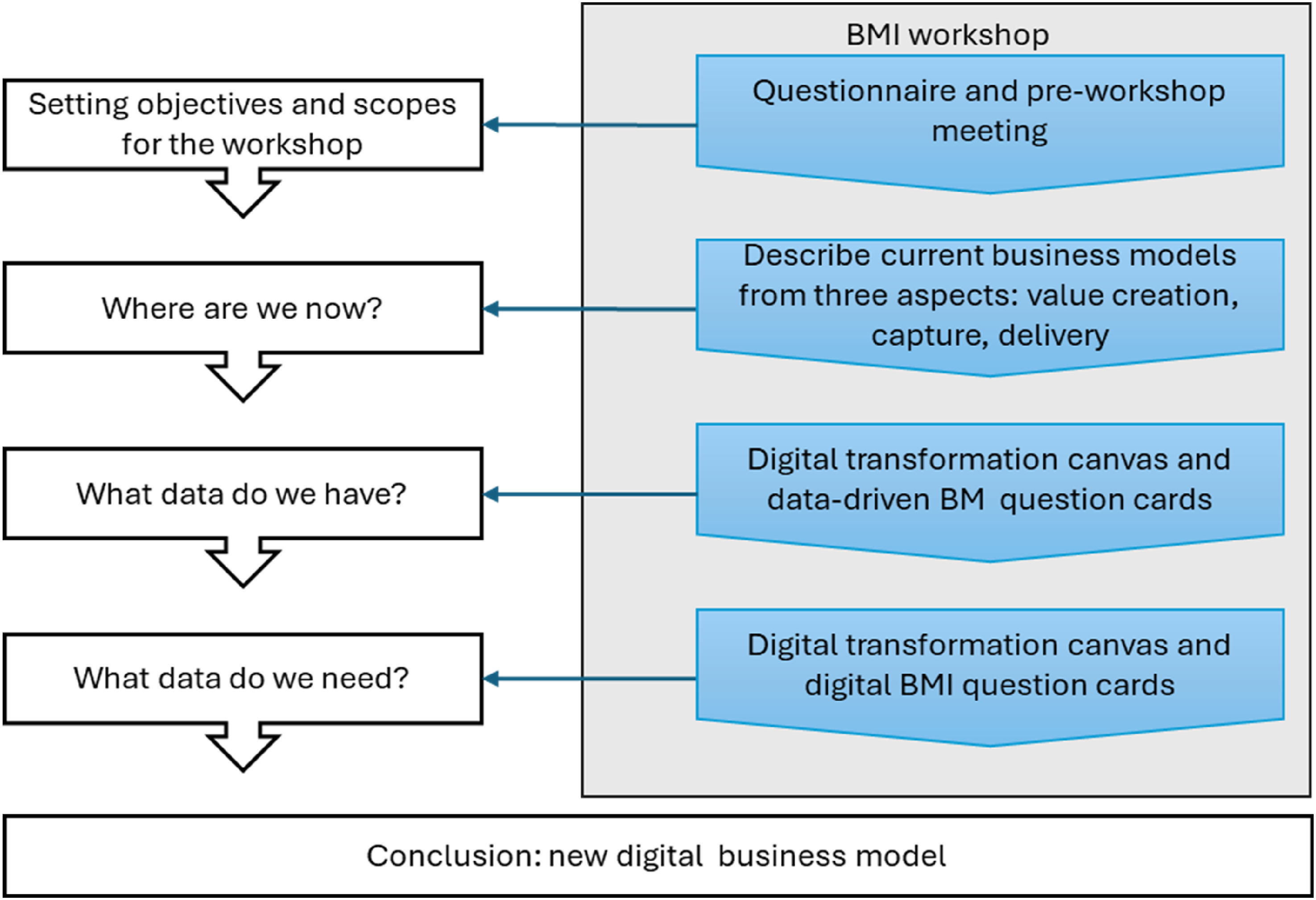
Step one: Setting objectives and scopes for the workshop – Pre-workshop preparation
The first step is the pre-workshop preparation, where we used questionnaires and interviews to narrow down the scope of the workshop. Specifically, we asked the participants, especially the chief manager, to answer three questions by filling out a questionnaire: (1) What current challenges do you want to solve with digital transformation? (2) Who drives your motivation to change, for example, suppliers, customers, competitors, or internal needs? (3) What barriers stop you from innovating? Additionally, we arranged a pre-workshop meeting with key participants to discuss more details about their current BM and what to expect from the workshop.
Step two: Where are we now? – Clarify current BM
The second to fourth steps are conducted in the workshop. In the second step, we asked the participants to describe their current BM from value proposition, creation, and capture perspectives. Before discussing the innovation of BMs, a clear understanding of current BMs helps the participants to understand the strengths and challenges of the existing BMs. It sets the ground for the following discussion in steps three and four.
The third step is to identify firms’ current data as resources. Participants from different departments in a firm might have different views about what data the firm has access to. This step helps them share their knowledge to build a comprehensive list of the data they have. The fourth step is to interrogate the participants about what data they need for BMI. At this step, the participants discuss the new BM and what digital technologies can provide the necessary data.
Intermediary step two: Introduce the digital transformation canvas
Before starting the next step, the participants must be introduced to elements on the Digital Transformation Canvas (Figure 2) from Elia et al. (2024), which is adapted in our data-driven BMI toolkit to guide the activities in the third and fourth steps, that is, identifying existing data and exploring BM changes. Moreover, the workshop facilitator should specify the canvas elements on which participants should focus their discussion in each step. It is because the canvas covers some less relevant elements to an exploratory conversation about future BM opportunities, such as data security and privacy issues. The choice may vary depending on the firm’s BMs and BMI needs. We suggested five elements for step three and six for step four based on NextGridVolt’s situation, as shown in Figure 3.
The canvas, as in Figure 2, captures the complexity of digital transformation with 11 pillars to help firms design their digital transformation strategies. These pillars are grouped into four building blocks: Digital Transformation (DT) strategy, DT operation, DT value, and DT pitfalls. DT strategy contains the Purpose pillar. The Purpose represents the motivation and goals for digital transformation, which should be aligned with the firm’s organisational and business strategy. The DT operation building block includes five pillars: Process, People, Partner, Platform, and Projects. The first four pillars represent the areas related to the firm’s DT initiatives, including activities, internal and external individuals, digital technologies, and external suppliers. The last pillar, Project, details the DT initiative’s management. The DT value building block contains the Product, Performance, and Planet pillars, representing the value in new products and services, economic and financial growth, and social and environmental impact. Lastly, DT pitfalls relate to system security and information privacy issues, described as the Protection and Privacy pillars (Elia et al., 2024). Digital transformation canvas from Elia et al. (2024).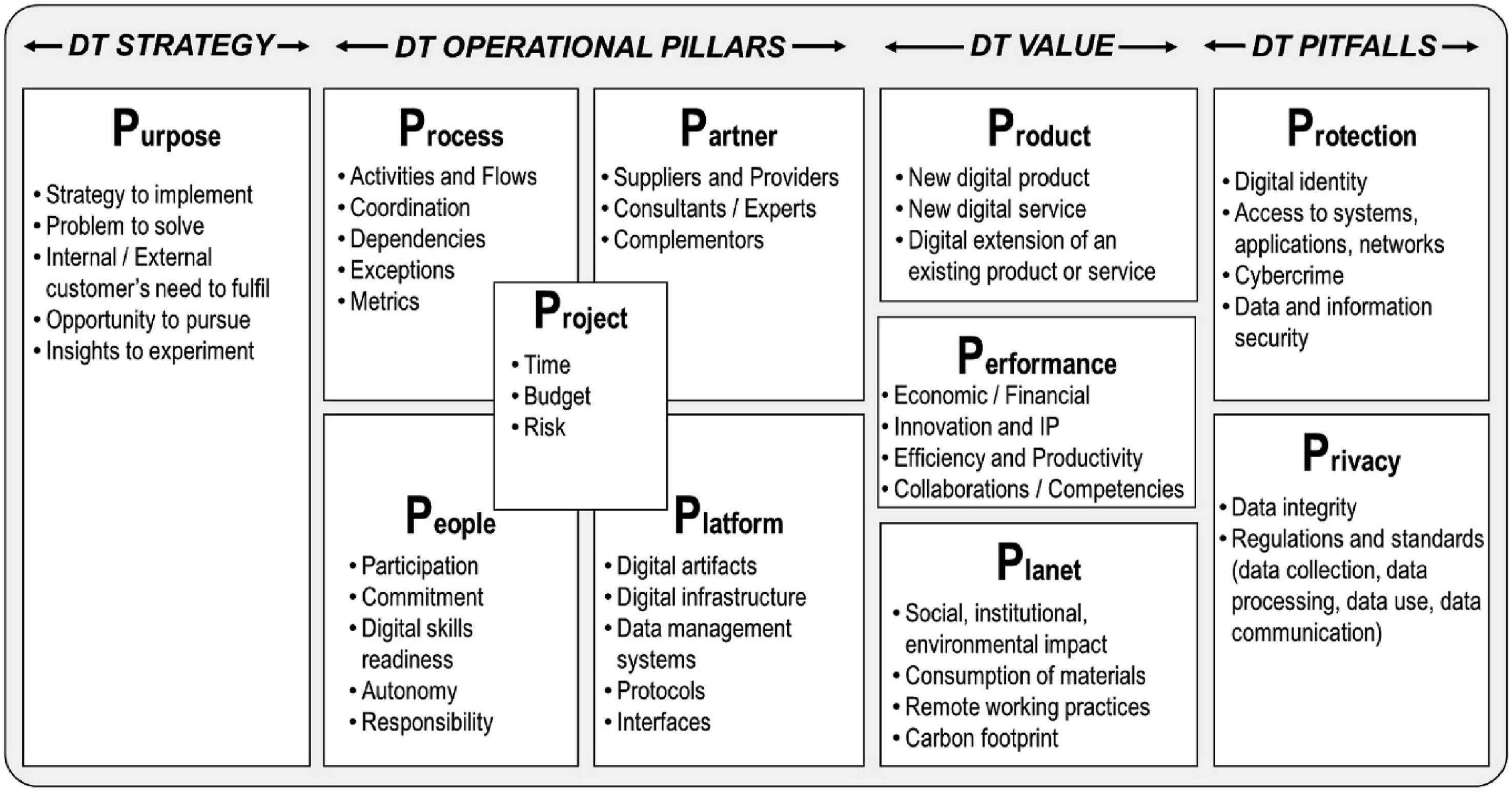
Step three: What data do we have? – Identify existing data source
The third step is a breakout session that divides participants into two to four people per group for discussion. They are given a set of data-related questions to answer, which help them explore the possibilities in internal and external data sources: (1) What clients’ data do we have? (2) What supply chain ‘touchpoint’ (e.g. data and contracts)? do we have? (3) What internal data do we have across the organisation? (4) What external/third-party data do we have?
As explained in the subsection above, the participants should focus on the chosen elements of Digital Transformation Canvas. We specified the purpose, process, project, people, and platform for NextGridVolt (Figure 3). The purpose data relates to the firm’s long-term position and strategies in the market (Seddon and Lewis, 2003), such as the challenges, opportunities, and customer needs (Elia et al., 2024). Process, People, and Platform data are generated from internal business activities that create and deliver products or services to the target customer. These include business process data, internal and external individuals’ information, and implemented digital technologies and systems (Elia et al., 2024). Elements chosen in steps three and four for our workshop, adapted from Elia et al. (2024).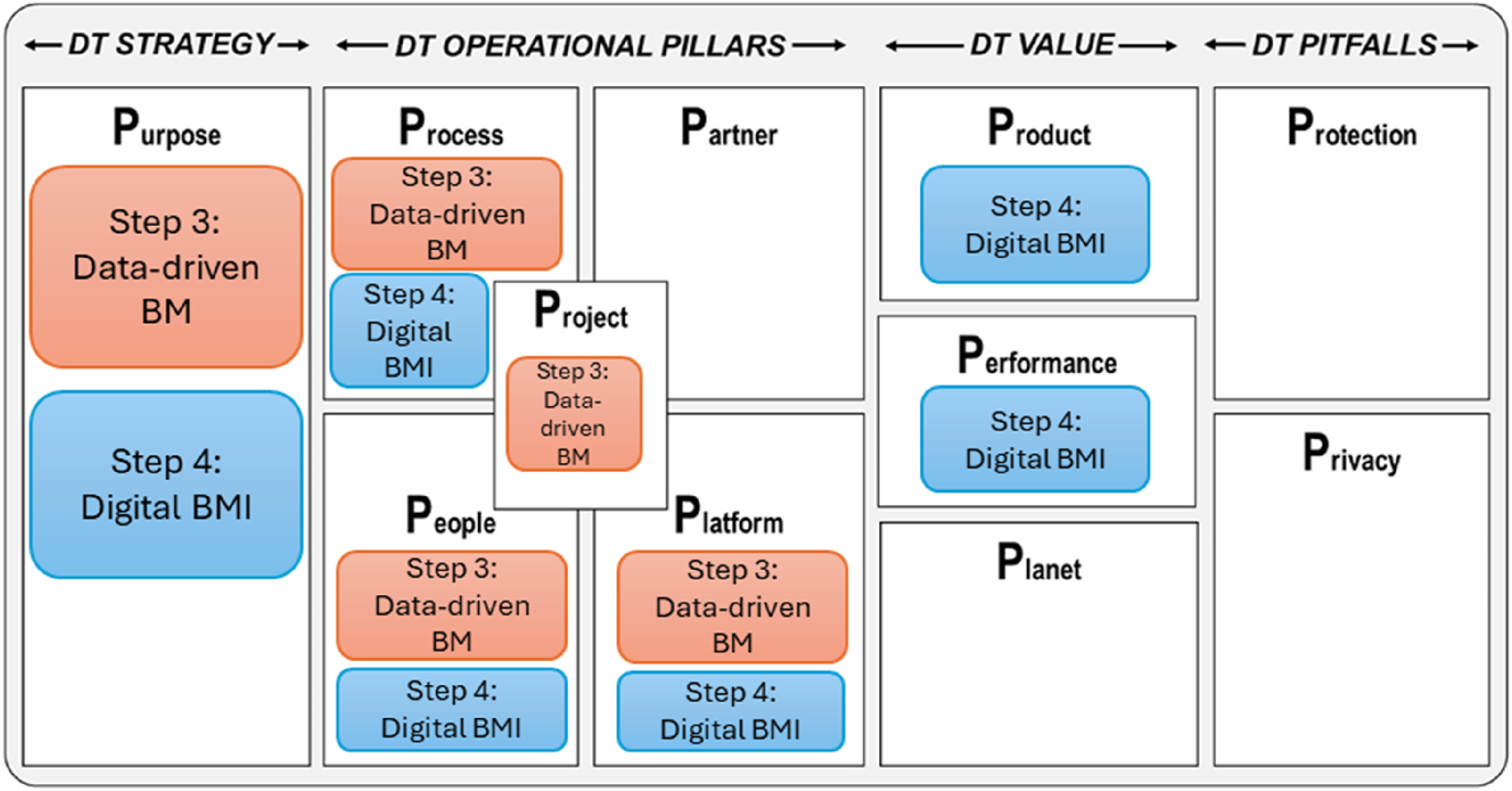
After the breakout session, all participants should gather to share their findings and conclude on what data is available for NextGridVolt. It is to exchange different role holders’ understanding of the data sources. For example, executive leadership may see from the larger scope, such as strategies, while department heads can provide a detailed list of the existing data in their area, such as human resource data, process data, and IT infrastructure. At the end of this session, all the participants should have an overview of existing internal and external data for NextGridVolt, hence ready to explore how to create value from these data.
Step four: What data do we need – Explore future business models
Similar to step three, the fourth step is a breakout session to discuss data-driven BMI questions on particular elements of Digital Transformation Canvas. After identifying the available data sources, participants use our toolkit to explore business opportunities that can turn these data into value-generating resources and develop the ideas into new BMs. Additionally, they can identify new data sources required to implement new BMs.
At this step, our toolkit provides a wider range of questions to facilitate the discussion (Appendix 1). The workshop facilitator should choose three or four questions that better align with their goal of the workshop (defined in step one, pre-workshop preparation), and with the current situation (discussed in step two about BMs and three about existing data). As an example, we chose the first four questions for NextGridVolt because they want to provide better and more services to customers.
Question for NextGridVolt. • What new digital services(s) can your firm offer clients? • How can you customise your product/services using data in order to ensure clients pay more for your service(s) • How can digital transparency allow your business to leverage products/processes/services positivity associated with your brand? • Describe what tasks or workflows in your firm could be automated with digital technologies.
As for the Digital Transformation Canvas elements, the participants focused on purpose, process, people, platform, product, and performance, as in Figure 3. The purpose identifies the target opportunity, key challenge, and customer needs (Elia et al., 2020). The process, people, and platform elements help firms explore their opportunities in using data to change value proposition, creation, and delivery BMI. In addition, product and performance describe the new value proposition. For example, firms can analyse customers’ needs to improve their offerings based on individual preferences (Sorescu, 2017).
Data-driven BMI workshop results
The challenges and motivations for BMI
NextGridVolt sees challenges in reaching new clients. First, the PPA model faces tight margins and funding constraints, as falling energy prices reduce the profitability of long-term investments in PPAs. Second, large property owners have become competitors as they recognise opportunities to monetize energy infrastructure by generating and selling power within their estates. Third, clients can easily switch to competitors offering similar solutions. Lastly, NextGridVolt aims to enhance its client acquisition process by leveraging digital technologies to filter out unsuitable prospects and focus on high-potential opportunities efficiently.
Data available now
NextGridVolt collects meter readings from multiple sources in various formats (Excel, email, PDF) and at different intervals (live or historical). Some installations, such as modern batteries and electrical charging systems, have automated data collection via sensors, while some solar panels use smart meters for monitoring. However, older installations do not transmit live data and require either manual readings or rely on client-provided Excel spreadsheets, for example, an email attachment containing meter readings recorded every 30 minutes over a year.
The firm’s digital transformation is still in its early stages. Last year, it implemented a project platform to collect maintenance, installation, and project management data, replacing previous manual processes. This digital platform aims to integrate multiple data sources, including clients’ metre readings, public procurement databases, and online repositories. Streamlining data processing, analysis, and visualisation enables consultants to efficiently generate insights and automate tasks, such as creating tender documents and sales proposals.
NextGridVolt also collects data from past cases, including rare scenarios. For example, at one installation site, seagulls dive-bomb the area, requiring the firm to clean up dead seagulls and guano once a year. However, this has no impact on energy productivity. It keeps historical customer data but only uses it to justify its new design offerings. Another example, the modelling output for a PV system uses EV generation data with solar panels, routing efficiency with batteries that store energy, and the system’s contribution to carbon offset. The consultant also calculates the project productivity using metrics like panels per day or peak per person, delivered margins versus sold margins, and the variation recovery rate.
Data comes from customers (mostly static, i.e. pre-entered and provides baseline clients’ characteristics). • Consumption data, energy import data, energy generation data, and billing and energy costs. • Plans for future demand, such as those resulting from EV procurement. • Changes of the plant on site, for example, the decommissioning of a Combined Heat and Power (CHP) unit (an efficient process that captures and utilises the heat that is a by-product of the electricity generation process). • Financial standing, boilerplate contracts, and available cash. • Project information provided by clients, including electrical schematics, electricity import data, maximum meter readings, and transformer data. • The accepted electricity.
Consultant gathers information (for clients). • Electricity price suggestion • Buildings and structural information, and potential hazards
Potential business model changes based on currently available data and additional data sources
Platform-based BM
We propose that, by using platformization, NextGridVolt can integrate its data collected from customers and from internal business processes identified through the use of the toolkit. The platform supports both internal operations and the firm’s clients. It can be offered to other companies that are not NextGridVolt’s business partners, who can license the platform capabilities while agreeing to provide NextGridVolt access to their data, which in return gives NextGridVolt access to more external data.
New technologies can also be added to the platform, such as an AI-powered camera system that can automatically capture site progress and convert it into data. This data could then be integrated into the central repository, allowing NextGridVolt to analyse efficiency metrics by correlating factors such as weather conditions, site performance, and workforce presence.
First BM innovation possibility is that the platform can scale up intelligent operation and maintenance services by integrating an open-source database. For example, the database can improve the algorithm for identifying faulty solar panels on clients’ roofs and suggest maintenance services to the owner. The database includes a large-scale solar panel consumer database, LiDAR (Light Detection and Ranging) data, which is laser and infrared mapping data for solar panels, an Environmental, Social, and Governance (ESG) carbon database, and a corporation report on their solar data generation.
Second, the platform can provide NextGridVolt with new ways to profit from valuable data collected through its operations. One direction is to provide clients with reporting services through the platform, including asset management and performance evaluation, rather than simply supplying raw data. Since clients use various metering systems, NextGridVolt can use its platform to aggregate data from multiple sources to generate comprehensive performance reports and offer proactive maintenance advice, which could potentially lead to new contracts.
Another possibility is linked to dynamic energy pricing in the UK. The platform can leverage predictive modelling to match client energy output with pricing changes. As a result, NextGridVolt can provide a service that accurately forecasts supply and demand, allowing customers to manage energy variance better and flexibly match supply with demand.
Lastly, an integrated platform can improve service delivery. NextGridVolt recognises the need to capture delivery data better to improve efficiency measurement. While a project management system is in place, it still relies on manual data entry. A lot of that information has been isolated or not returned to other areas of the business because of the way that it's set up. A sophisticated platform can gather and analyse data from multiple sources to support consultants in generating the required information quickly and efficiently, reducing the time required for tasks from hours to minutes.
Broaden offering
One possible change is adding new value propositions. NextGridVolt can use its experience and accumulated data to enter new industries that the current client groups underrepresent. This may include enhancing automated client interaction tools to capture opportunities and new clients’ information.
Additionally, NextGridVolt can provide consultancy services as its value proposition because the combined expertise in energy systems and digital transformation is valuable in a new market like solar PV systems that lacks sufficient experts. NextGridVolt emphasises training its engineers into experts to combine its expertise in digital transformation with energy system services to increase its consultancy service on installation design, carbon reduction planning, and smart grid design.
At the moment, NextGridVolt believes that there is no market yet for AI-based robots to replace human labour in installation and maintenance roles, as installation experts play a crucial role in on-site supervision and decision-making. Human experts are more flexible and accurate in identifying required changes in energy system installation design for specific on-site conditions. Additionally, experts can identify opportunities for upgrades or system transformations during installation or maintenance services, as well as effectively communicate these improvements to customers, potentially driving additional sales.
Identify the challenges during business model innovation processes
NextGridVolt needs to tackle the challenges from various aspects. For instance, despite its expertise in cutting-edge technology, it needs to assess the client’s digital readiness before implementing apps, software, and automated processes. The lack of digital skills also hinders operational data collection, such as the on-site workers who may struggle with digital tools, making alternative solutions like wearable cameras necessary.
Data collection also presents challenges. Variability in installation conditions, such as health and safety regulations, scaffolding, and site setup, makes standardising data collection difficult. Additionally, the shift toward pre-assembled solar systems and modular construction necessitates adaptable data strategies. Manufacturers now require digital tracking of individual components, adding complexity to data capture during installation. Furthermore, increasing demands for carbon footprint reporting require firms to track materials and environmental impact, ensuring compliance with sustainability regulations.
Assignment/case discussion questions
Q1 Describe the current business model of NextGridVolt using the Business Model Canvas given by (Osterwalder and Pigneur, 2010) Q2 Elaborate on the differences between incremental and radical business model innovation strategies. Q3 What is your evaluation of NextGridVolt’s new business model? Discuss the benefits and challenges for the company. Q4 What should be done to implement the new business model? What are the challenges for NextGridVolt and other stakeholders during the implementation? Q5 Suggest other business model innovation ideas for NextGridVolt and compare them with the case study. Q6 Are NextGridVolt’s business model innovation ideas in the case study suitable for other industries? Q7 Choose another company and design new digital business models for it. You can use the digital business model innovation toolkit or other suitable tools to assist your analysis.
Footnotes
Ethical Consideration
Ethical approval for this study was obtained from the Cross-Faculty Research Ethics Sub-Committee at Oxford Brookes University (No: 231761).
Informed Consent
Written informed consent was obtained for anonymised patient information to be published in this article.
Funding
The authors disclosed receipt of the following financial support for the research, authorship, and/or publication of this article: This work was supported by the Engineering and Physical Sciences Research Council (grant number EP/T022566/1). DIGIT Lab is a Next Stage Digital Economy Centre.
Declaration of conflicting interests
The authors declared no potential conflicts of interest with respect to the research, authorship, and/or publication of this article.
Author biographies
 ). He has held 28 UKRI research awards (20 EPSRC, 4 ESRC and 4 through Innovate UK) which have a total value over £40m. This is one of the largest portfolios of any UK social science researcher. His current research is funded through the DIGIT EPSRC project and the Defence Data Research Centre (DDRC.uk), where he takes an active role in developing international links. He is also a CI on the INCLUDE N+, led by Professor Helen Thornham at the University of Leeds.