




Abstract
This case illustrates Intello Labs, a leading agri-tech company, operating out of Gurgaon. As an agri-tech company, Intello Labs is trying to create an artificial intelligence (AI)-based solution model for its clients. The case dives deep into the issues of degrading farm productivity being faced by Kerala Cardamom Processing and Marketing Company (KCPMC), a client of Intello Labs. The case stands out as a means for understanding the application of the AI-based solutions being offered by Intello Labs to solve the degrading farm productivity issue of KCPMC. It addresses the concerns of the current agricultural-based businesses which mostly depend on manual commodity grading.
Keywords
Introduction
In July 2018, Mr Milan Sharma, the Chief Executive Officer of Intello Labs in Gurgaon, India, faced a complicated situation. Being founded in 2016, Intello Labs in its early stages provided artificial intelligence (AI)-based agricultural solutions to business-to-business (B2B) clients, which included farmers, commodity buyers and enterprise clients. Clients started relying on the technology-based solutions provided by Intello Labs to increase their farm productivity, thereby aiming for larger returns. Mr Jojo George, Managing Director of Kerala Cardamom Processing and Marketing Company (KCPMC), approached Mr Sharma in July 2019 with a problem experienced by KCPMC for the past several years. KCPMC was one of the leading agricultural companies that engaged in auctioning and trading Indian green cardamom, a premium spice both in India and other markets around the world. The price variation between different grades was based largely on capsule size, colour (greenness) and bulk density. The variation being substantial, the visual assessment of a lot would determine whether a purchased lot would be profitable or not.
The first major issue faced by Mr Sharma was that the existing system depended on the subjective ‘skill’ of the buyer for the visual assessment of a lot, which restricted the traders from participating in the purchase process unless they were physically present to assess the cardamoms offered for sale.
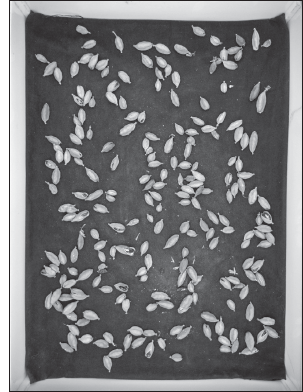
The second issue was related to the primary driving force behind determining the price of cardamom, that is, the percentage of pods needed to be 8 mm (or larger) in size. The size of the pods being assessed through human eyes, there remained a tendency of error in estimating the percentage of pods concerning their size (refer to Exhibit 1 for analysis of the input pods). Hence, traders allocated an estimated price depending on their guesstimate and eventually, the actual size of 8-mm pods could be ‘off’ by several percentage points. Further, KCPMC did not have any data about the variation between expected vs. actual 8-mm pods because it was never appropriately captured, which severely affected the revenue for KCPMC as a trader and also for buyers who procured cardamom from the auctions. Consequently, Intello Labs was approached to devise an AI-based solution for addressing the issue through the categorization of its product portfolio according to the problem faced by the industry.
Machine Learning in Agriculture
Machine learning (a subset of AI) is an essential aid in the present agri-tech businesses. Right from field conditions management to crop management, machine learning incorporates all (Sciforce, 2021). In the case of field conditions management, machine learning assists with the following:
In the case of crop management, machine learning assists with the following:
Deep Learning and Its Algorithms
Deep learning is a subset of machine learning. 1 It provides training or instructions to a computer system to make decisions based on certain prior conditions. Machine learning offered instructions to a computer by learning from previous examples while making decisions with the help of a given set of conditions. In deep learning, a computer model was designed to perform classification tasks derived from image, text or sound data. The deep learning computer models were made competent by using large chunks of structured data. 2
Deep learning is an important component of data science, it helped data scientists to collect, analyse and interpret the data chunks swiftly and smoothly. To understand deep learning, we could take into consideration the first word learned by a two-year-old toddler; the first word learned could be a cat. The toddler primarily learned about a cat by pointing to different objects in front and repeating the word cat. If the toddler could rightly identify, the parents showed confirmation stating, ‘Yes’, else they stated ‘No’. Slowly, with time, the toddler developed an understanding of all the features possessed by a cat, which were probably absent in other animals. The toddler clarified to himself or herself the concept of a cat by adding new knowledge about the features of a cat to the existing information, which was gained by him or her in the previous interaction. This iteration continued till the toddler developed clear identification about a cat.
Deep learning algorithms generally followed the same process stated above for the identification of an object. Iterations continued until the output reached an optimal accuracy. The number of iterations that the algorithm underwent to reach its desired output inspired the term ‘deep’. Unlike the toddler who took months to understand the concept of a cat, a deep learning algorithm could be run through a training set consisting of terabytes of image data, which resulted in accurate identification of images by matching the pictures of the cat in them within seconds (Burns & Brush, n.d.). The following could be considered as the most popular deep learning algorithms (Brownlee, 2019a):
Deep learning excelled on domains associated with the problems of similar output and input, which meant that the output and input were not in a tabular format; rather, these were images consisting of pixel data bits, text data documents or audio data files. The deep learning techniques were representation-learning techniques with multiple representational levels acquired after formulating the non-linear and simple modules, which transformed the representation at level one (consisting of the raw input) into a higher representation and a slightly more abstract level. The main facet of deep learning was probably related to the fact that these layers of attributes were not designed manually; instead, they were learned from the data by using a general-purpose learning operation (Brownlee, 2019b).
Computer Vision and Deep Learning in Agriculture
Computer vision had been gradually adopted along with deep learning in agriculture to increase the transparency and productivity of farming techniques. Nowadays, machine vision or computer vision was applied to agriculture in effective ways for transition to better means of irrigation and cultivation techniques. The better means of cultivation and irrigation techniques helped to raise fine crops, thereby bringing more nutritious yields. The main barrier behind the implementation of computer vision was the development of appropriate hardware and compatible software for the sensor systems. But with the advancement of smartphone technologies, computer vision had a great future ahead. Several benefits of using computer vision in agricultural practices (Vision Online Marketing Team, 2016) were:
Deep learning was a modern technique for image processing and data analysis, which had a greater potential for better results. Deep learning was successfully applied to various fields, had recently been introduced to the field of agriculture (Kamilaris, & Prenafeta-Boldu, 2018). It had been used for crop disease detection, crop classification, weed threat level identification, land classification and yield prediction, and its application would open up various opportunities in smart agriculture (Zhu, et al., 2018):
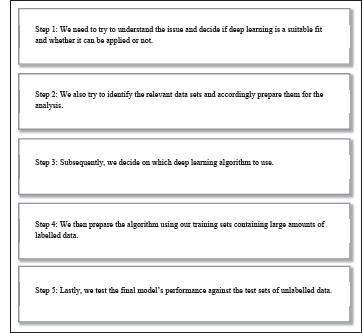
The recent advances made in the agricultural domains by researchers were connected to crop production for improving the agricultural output and reducing crop diseases by boosting the utilization of agri-tech equipment. Computer vision and deep learning (refer Exhibit 2) were usually used in agricultural practices for data classification and image recognition, which could further be encapsulated in the following four steps: Data collection and data pre-processing, neural network training, model testing and final result analysis.
About Intello Labs
Intello Labs Product Line
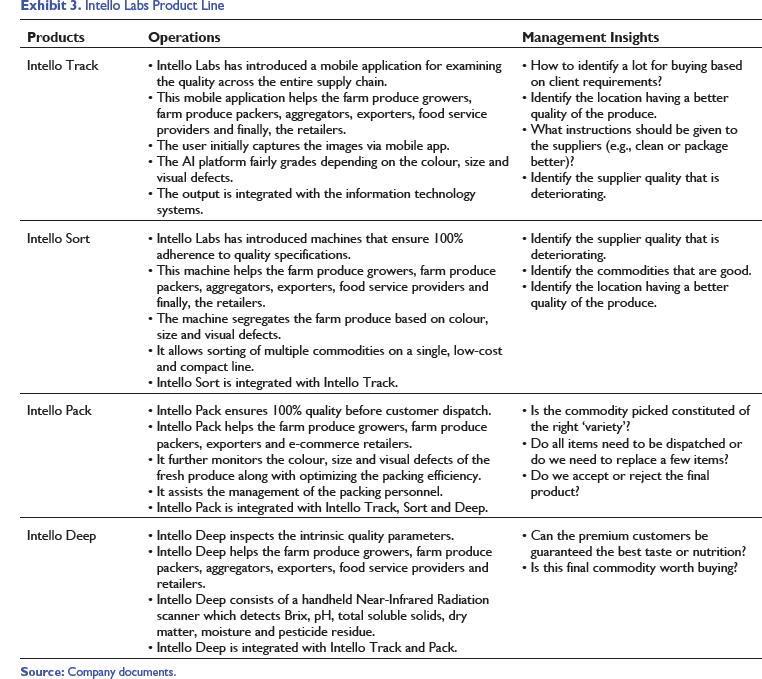
Every commodity buyer wanted a good quality of fruits and vegetables, which were neither over-ripe nor damaged. The process of product testing was conducted manually by food inspectors who physically checked a random sample from every available lot of farm produce (Kashyap, 2019). But Intello Labs provided an image-based solution using a smartphone mobile application, which improved the standardization and transparency for the quality assessment of agricultural products, thereby reducing wastage during the supply chain. Based on the images captured using just a cell phone, the grades of the farms’ produce could be determined, which imparted complete transparency in the system. Therefore, farmers could demand a fair price for their farm produce in the markets.
The AI-based solution provided by Intello labs worked on the cloud-based architecture. The images of agricultural produce were clicked through a smartphone camera using a mobile application and uploaded to the cloud. The computer vision and deep learning algorithm present in the backend of the mobile application developed by Intello Labs subsequently identified each image and classified each produce based on girth, colour and health type. The results were then aggregated and displayed on the mobile application. The entire process took less than a minute and required no manual intervention; therefore, the results were standardized. The earlier manual process took around half an hour and provided a 70% accuracy rate, but with the algorithm of Intello Labs, the accuracy level had improved to 90%. With a simple photo taken even from a low-cost smartphone, Intello Lab’s algorithms could produce instant quality grading metrics (BW Online Bureau, 2019).
Currently, Intello Labs targeted two types of consumers: Farmers and commodity buyers. Intello Labs encouraged farmers to participate more in the growth of the digital economy for enhancing their farm productivity along with improving efficiency by aiming for higher returns. Farmers were mostly reluctant to involve in technology adoption owing to their lack of digital awareness. With Intello Labs, the farmers gradually became part of the technological supply chain concerning their agricultural products. Commodity buyers always had a suspicion of the positive words of farmers related to their products and never trusted the manual product grading process. They never understood the process of grading the agricultural products at the time of procurement. Intello Labs solutions helped the commodity buyers to understand the entire grading process, which reduced their subsequent losses.
Intello Labs aimed to become the most effective platform over all the agribusiness value chains from trading, procuring, grading to pricing, marketing and traceability. Intello Labs had previously tied up with multiple multinational food companies and had built the ready-to-use algorithmic grading solutions for vegetables, fruits and spices. The company not only focused on large business enterprises as their clients but they also increased their product line to software-as-a-service (SaaS) products for small agricultural businesses, traders and farmers (Soni, 2019).
The Problem Statement
KCPMC could be considered as an Indian agri-business company and the largest auctioneer and trader of cardamom in India, so the group had the largest portfolio of growers/sellers of cardamom. Other than cardamom, it dealt with the supply of agricultural inputs, provided extension services, trades in other agriculturally based commodities like natural rubber, and further produced superior cardamom from its plantations.
The primary marketing focus of KCPMC was to ensure the steady outflow of the farm produces to its commodity buyers. To instil demand for the KCPMC products amongst its commodity buyers, KCPMC’s management team focused on enhancing the farm inputs, their productivity and the outputs’ quality and quantity. The superior quality and the high volume of the KCPMC products, integrated farming solutions and trusted functioning over the past 50 years had made it the leading auctioneer and agriculturally based solutions provider in India.
To handle such a large volume of products, especially cardamom, the KCPMC management team had to ensure proper and instantaneous assessment of the quality of the cardamom for conducting the trade in a timely and punctual manner, which in turn would confirm faster and fairer profits for the farmers. However, this entire process of assessing the incoming cardamom relied on the experience and knowledge of the traders, which made the entire manual assessment process subjective and erroneous.
The commodity buyers needed to be present physically at the auction site to ensure the quality parameters (size and colour) of the cardamom. With the physical presence of the commodity buyers being mandatory for checking the quality of the products, KCPMC could presently accommodate only a limited number of potential bidders at the auction site. One of the senior executives at Intello Labs highlighted the auction site problem by stating:
During an auction, a person takes a large bowl of cardamom from a lot… and about 50–100 people are sitting in the auction room… and about 20 people sitting in one row…. There will be one guy who would walk across the row and then throw a handful of cardamom for inspection…. People take 30 seconds to one minute to manually looking at the cardamom… and then they conclude on the percentage of high grade and low-grade cardamom in the bowl… and subsequently decide the price based on that one-minute manual assessment, which is governed by guestimate… and so on.
Considering the complexity of grading and assessing the cardamom sample through manual inspection, it was evident that this grading process would slowly decrease the reliability of the cardamom quality. The grading of cardamom depended on 3–4 parameters in order of priority: Size or girth (diameter) of the pod, 4 colour, health (scars, splitting and insect damage) and bulk density of the pods. The classification of the cardamom sample into groups was done based on the girth of the pods in different buckets. The size buckets used for the grading were of six types: Lesser than 6 mm, 6–6.5 mm, 6.5–7 mm, 7–7.5 mm, 7.5–8 mm and greater than 8 mm. The variance of cardamom prices based on the size is high, it was necessary to accurately grade the sample into the correct size bucket.
The management team of KCPMC had approached Intello Labs because of its growing concern regarding the complexity and discrepancies of the current manual grading process of the cardamom samples. The concerns of the management team were as follows: (a) How to resolve the discrepancies and errors present in the manual grading process? (b) With the increase in digitization, it became important to keep a record of previous grading reports, which could be accessed as and when required to make the future grading process more robust. Would it be possible to build a fast, objective and scalable solution that could help with the grading process and also assist in the digitization of the records?
One of the senior executives of Intello Labs said: ‘Our client is a progressive and forward-looking enterprise’. According to his interaction with the client, the client said, ‘This is not the way we do business… we need more scientific and verifiable approach toward cardamom grading; and hence, we should invest in this technology’.
The above issues outlined by George directed to one single broad issue, which would probably be related to having full control over the entire grading process. Mr Sharma was sure that this issue could be resolved by the application of deep learning. However, it was a challenging task for Mr Sharma in deciding on the application of a specific deep learning algorithm to solve KCPMC’s issues, as each algorithm had a unique functionality. Hence, Intello Labs needed to convert its resources into a feasible solution for KCPMC, which led Mr Sharma to think about the required algorithm as well as whether it could be deputed with minimal complications and, if so, how.
