



Abstract
Abstract
The case narrates the story of Asian Paints, an Indian organization operating in the paint industry. Although best practices were an integral part of Asian Paints from its inception, a shared language for all people decisions and processes was felt necessitated. The objective of this case is to highlight Asian Paints management’s need to professionalize the human resource (HR) processes and practices and strategize towards building the leadership pipeline.
The case describes Asian Paints’ leadership competency framework (LCF) and examines its purpose of becoming a common language across all HR processes in the organization. This LCF not only addressed the existing business exigencies but also imbibed the culture on which Asian Paints was fabricated, thus, providing shared principles for all employee-related processes. Key people practices at Asian Paints are encapsulated in the competency framework which not only guides its own leaders but also serves as a benchmark for other organizations.
Asian Paints: Towards a Lustrous HR Future
A splash of pink on the blue background, a patch of yellow and some green. ‘Aaarghhh!’ screamed Amit Jain, vice-president of Asian Paints’ human resource division, Asian Paints. After a busy day at work, Amit returned home to discover that his 5-year-old nephew had liberally applied his watercolours on the freshly painted walls. Amit and his sister were about to take the little monster to task when he gave a mischievous and naughty grin. His mother was unmoved but for Amit that smile seemed to come from the remote past. During Amit’s childhood years, Gattu, the mischievous little boy with a paintbrush, was an omnipresent mascot of Asian Paints.
Asian Paints made humble beginnings as a partnership firm. With the turmoil post-India’s independence in 1947, the founders realized the need to innovate in order to stay ahead of other foreign, national and local players. They approached the legendary cartoonist, R. K. Laxman in 1954, to take the paint industry closer to the masses and to capture the public imagination. Gattu was that first little step that went on to symbolize the transformational and innovative spirit of Asian Paints. The company never looked back. Through its strong customer focus, robust in-house technology and harmonious employee practices, it sailed smoothly through various times of crisis and uncertainty. In 2009, Asian Paints transformed from a family-run business to a professionally managed one. While most processes were streamlined, people-related matters were not well standardized. Amit felt that it was necessary to establish a common understanding of employee processes and practices in order to synchronize Asian Paints’ rich decorative past with its lustrous future.
The Issue
Being a start-up with a handful of employees in the 1940s–1950s, it was easy to communicate the philosophy of the business and enable day-to-day operations. Like-mindedness of the workforce facilitated quick consensus and smooth operational activities. People practices were simple and lucid and there existed an environment of trust and mutual understanding. As Asian Paints expanded (within the country and globally) and the workforce increased thereof, there was a need to empower middle and junior-level managers and sharpen their managerial judgments.
Asian Paints considers its people as its key strength. Since its inception, leaders employed their judgment and conviction to recruit, develop and groom the right talent. With increasing business footprint, market competition, workforce complexities and dynamism in the industry environment, there was a need to safeguard and build the human asset by having a ‘common language for all people decisions and processes’. While Asian Paints migrated from a family-run business to a professionally managed organization, the problems before Amit were: How to professionalize the HR processes and practices? How to build the leadership pipeline in a growing organization?
Asian Paints
Since its modest beginning in 1942, Asian Oil and Paint Company has come a long way. The founders dreamt of leaving behind some of the world’s leading firms dominating the then Indian market. Headquartered in the financial capital of India, Mumbai, the company catered to the industrial and decorative paints segments. Within a decade, they shook the market reporting an annual turnover of Rs. 230 million. Propelled by its strong customer focus, in-house technology, deeply penetrated distribution network and innovative spirit, by 1967, the company became the market leader and changed its name to Asian Paints.
A few years later, the company was converted into public limited and listed on the Bombay Stock Exchange. Key modernization programmes were undertaken and collaboration with global players began. Asian Paints currently serves customers in 65 countries through 25 plants located in 16 countries. Asian Paints was ranked 9th among the top paint companies in the world with a turnover of $2.59 billion (Coatings World, 2018). The company enjoys an enviable status in the Indian corporate sector for high levels of professionalism coupled with a consistent growth rate (Figure 1).
Tracing the Past
As Asian Paints changed from a small family owned to a large public limited global company, its workforce changed and consequently its talent need and practices. During the initial years, the HR system was less formalized. Active involvement of the founders in all aspects of the business made employees and other key stakeholders feel that they were part of a familial relationship. Trust, fair and care formed the guiding principles, and the focus was on hiring and training young inexperienced individuals. It was not uncommon to hire individuals with high school qualification and provide on-the-job training. Owing to this, a homogenous company-focused culture emerged. Leadership was very effective since there was a focus on values and appreciation of heritage.
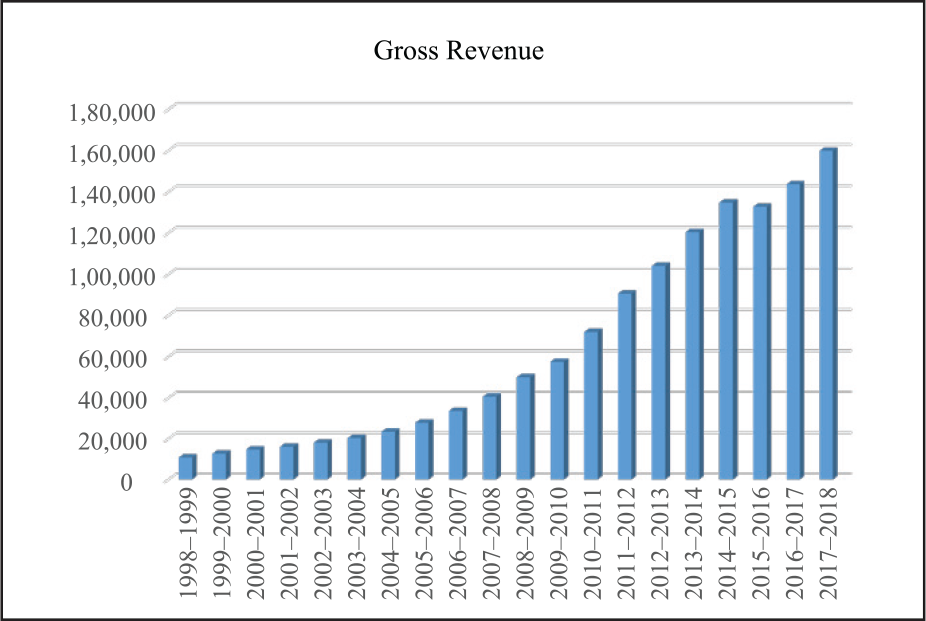
The HR function transitioned from handling trade union issues and managing employee personal information to handling standard and essential procedures such as payroll juxtaposed with complex strategic elements such as organizational restructuring and leadership development. These tasks have varied elements, requiring different management skills, and have varying levels of impact on the organization. Further, the 1991 economic reforms brought in stiff competition from within and outside the paint industry. Poaching of well-trained Asian Paints employees became a serious concern for the company. HR thus shifted the focus on the application of people management theories such as culture, change, motivation and organizational commitment. Personnel policies including job rotation, increment and promotion were revisited in order to retain talent. Systematic, robust and transparent HR systems were put in place to enhance employee satisfaction, engagement and retention. Owing to the multifaceted capabilities, the company survived and thrived over decades, undeterred by major economic and environmental changes.
Amit’s Journey
Amit Jain graduated from a top-tier business school in India and joined Asian Paints 19 years back as a management trainee. Being a bright and hardworking professional, he carved a niche for himself. Twelve years into the company, talent acquisition and talent management became his key focus area. As he moved up the corporate ladder, he often heard (directly or indirectly) that HR practices at Asian Paints were not standardized. For the first few years, he brushed aside any such conversation and focussed on his work but the fact that people around him were continuously grappling with people issues worried him.
Five years later while traveling to Australia for vacation, Amit bought a book, The Competent Manager: A Model for Effective Performance, at the airport from the management best-seller section. This book by Richard E. Boyatzis elucidated behavioural signposts, and as Amit read it, he got goosebumps on his discovery! The only way to build an all-pervasive language across Asian Paints was to clearly specify competencies required for each role. He recalled that a basic competency framework was rolled out sometime around when he joined Asian Paints, but the framework did not sustain itself, perhaps, because it did not connect the entire organization towards a shared understanding of HR practices. While re-crafting the competency framework, Amit had to mindfully synchronize all employee-related processes and practices by weaving a collective language throughout the organization.
Professionalizing HR
While Amit was involved actively in talent acquisition and management, in parallel, he initiated a mini-project on digging deeper into the ‘lack of common vocabulary’ at Asian Paints. In his one-month stint, Amit registered some employees’ words:
The leaders ‘knew’ the right person for the right job … and also, when that person was prepared to rise up the ladder … they just knew it … and their judgment never went wrong! I was assisting my manager in campus recruitment…. There was a candidate who answered most of the questions and I thought he would be selected … but I was wrong … when I asked my manager, he could not pinpoint as to what was missing … but he is a senior person, so I respect his experience and decision!
Amit assessed that employee issues arose owing to lack of clarity relating to HR practices. After returning from Australia in January 2017, Amit discussed his thoughts on the ambiguous understanding of people practices among employees, with the council members. The executive council comprised the president and board of directors and the operating council comprised VP and general managers (GMs) of various functions. The senior executives were aware of the issues and briefed Amit on the old competency framework (designed in 2001) and the challenges in its implementation. Since Amit had some guidelines emerging from Boyatzis’ work and an understanding of the functioning of systems at Asian Paints, the council gave him 18 months to develop and implement his strategy. What next?
The Famous Five
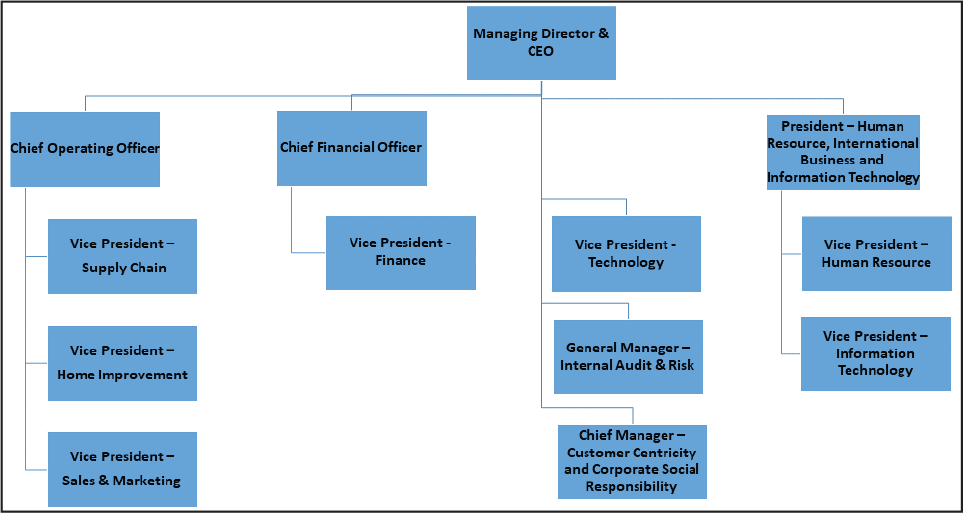
Amit could not embark on this journey alone—he had to build a team in order to give his vague idea a clear shape followed by organization-wide dissemination and execution. He keenly observed the organizational chart and employee database (Figure 2). He found two people suitable for his team and invited them for a discussion.
Mark Fernandez, a seasoned and multifaceted professional who had been with the production, quality, environmental health and safety, and manufacturing segment of Asian Paints since the past 15 years. A popular and credible leader as he believed in collaborating and leveraging people strength towards creating a sustainable business. Currently, he was the GM (supply chain) for one of the biggest plants of Asian Paints located in Pune that surpassed automation across paint plants worldwide. Despite being in process and operations management, he was widely recognized for his people management skills and cordial interpersonal relationships. He also possessed critical thinking and analytical skills which he often employed to resolve internal business issues.
Kaya Prasad, a result-oriented, focused and brilliant HR professional was inducted into the Asian Paints system 8 years ago. Her ability as an influential communicator complimented her sound business knowledge driving HR as a business partner. She gave people the freedom to take initiatives while at the same time encouraged them to stretch themselves to constantly learn and develop. Kaya, currently senior manager (HR), had worked with Amit two years back on a corporate recruitment stint. She would not miss an opportunity to work again with him and excitedly looked forward to the new assignment. After listening attentively to Amit’s ideas, Kaya suggested connecting to some reputed consultants since they did not possess in-house capabilities. Amit reached out to Creative Consulting who had partnered with Asian Paints on a few assignments before and had enormous experience in handling people practices issues.
Amit spoke to Lalita Dey, the head of practice for talent at Creative Consulting who had a wide range of industry experience of over 25 years. She became the main lead for this project of Asian Paints. Jay Anand, a bright and young organizational psychologist who had assisted Lalita in implementing competency frameworks in many organizations also joined the assignment. Lalita introduced Jay as an expert in end-to-end management and execution specialist that Creative Consulting was proud of.
The trio from Asian Paints shared their observations with the external experts:
Mark said,
I am a line manager and I love to work closely with my team…. I have always felt the need to pin down specific characteristics of people to develop or reward them … and I wish there were some guidelines to do so.
Kaya added,
I have heard people complaining that they are top performers consistently … their colleagues bank upon them for their technical knowledge … and their bosses appreciate them too … yet, they are not being promoted since the past few appraisal cycles.
After an hour of listening to her clients and making detailed notes, Lalita, being an expert in designing and implementing competency frameworks, understood what was to be done. They had to identify critical behaviours instrumental in the growth of employees at Asian Paints. A competency framework based on the identified behaviours would clarify Asian Paints’ expectations from its employees, would standardize decision-making across various functions and enhance the transparency of the system.
Assessing the Situation with the Leadership Team
Amit briefed his VP colleagues and organized a meeting with the consultant duo. There was a consensus among them that all businesses should be considered equally while developing the framework. Since the supply chain and sales functions comprised a major part of the workforce, there was fear among other functions that they may be neglected. Moreover, Asian Paints believed in employee development through job rotation. Hence, competencies specific to only functions would restrict the movement of employees into generic or newer roles. Perhaps, macro competencies under the umbrella of leadership traits would be more appropriate.
Anuj Kaul, VP Technology raised some concerns:
I foresee that the competencies would be different across levels and across functions…. At some levels, functional knowledge makes more sense while at other levels, leadership traits are more important…. How will this work for the entire organization?
Neel Seth, VP Finance, a man of few words, cleared his throat and said in a low tone:
This framework exercise should not hamper cross-functional movements.
While Anuj and Neel were skeptical of the idea of competency framework solving people practice issues, Joshua D’Souza and Suresh Kumar, VP supply chain and VP sales and marketing sounded a bit neutral, if not at loggerheads.
Joshua said,
We need to be abreast of the tools and techniques popular in the current times…. If competency framework is the key, let us try it.
Suresh added,
I am concerned about the plummeting satisfaction levels of the sales force … due to market competition, sales function has become very demanding … they push themselves really hard but sometimes not in the right direction … I would be glad if this project gives them some pointers on developing themselves.
Mark and Kaya agreed that once there is a complete buy-in of all VPs, things will fall in place. Amit felt that the battle was won as there was not any strong or adamant dissent. Nevertheless, he knew it will be an uphill task. The biggest challenge would be to develop competencies that cut-across different functions and domains. How will employees identify themselves with generic competencies? Will employees be able to connect with this tool towards self and organizational growth? Amit was determined that the competency framework should not remain on paper and must be integrated with all HR processes. The key question was: How? An ever-optimistic Jay uttered that as compared to other organizations, the first meeting at Asian Paints went quite well. Lalita smiled and drew a mind-map of how they would proceed. The weather was pleasant and they dispersed after a cup of coffee.
Interviewing Employees
To have a real feel of the ground, the consultants decided to talk to employees whom Asian Paints considers at the epicentre of each strategic initiative. Lalita developed an action plan and briefed the other members on the idea of competency-based interviewing. She suggested all the members be a part of the interview process for a couple of candidates. Once the interview methodology was clear, they could split into two teams and conduct interviews in parallel. It was agreed that a sample of a 100 employees cutting across different cadres would throw light on varied aspects of people practices.
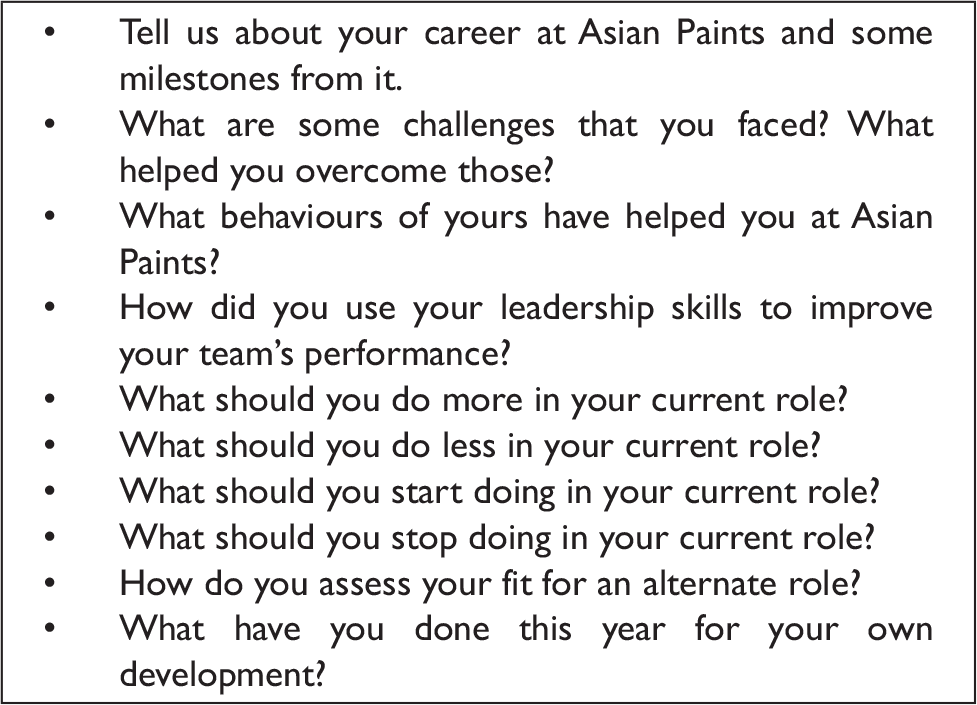
A set of structured questions were crafted to facilitate the interviews (Box 1). Candidates would be enquired about their behaviour in specific circumstances, which had to be backed up with concrete examples. They would be further probed into the examples and asked for specific explanations about their demonstrated behaviours or skills. Asking how the candidate dealt with difficult and challenging situations in the past would predict future behaviour in similar situations. Further, if the demonstrated behaviour yielded noteworthy consequences, it would become precedence for future actions for other employees. Kaya and Mark took up the responsibility of identifying the candidates and requesting them to participate. The shortlisted candidates were consistently top performers and drawing from this pool was crucial in order to gather key behavioural indicators that enabled the success of Asian Paints.
Leadership Competency Framework
While interviewing the candidates, extensive notes were taken. Post an in-depth analysis of the examples cited by the candidates, a list of behavioural indicators was compiled. Grounded theory was used by the team to identify emerging themes or categories. Once the broad themes were identified, they were populated with specific competencies. For instance, Asian Paints believes in becoming a forerunner by ‘actively empowering customers to create their dream homes’.4 This was found to be one of the key characteristics internalized by most of the interviewees. Hence, customer centricity emerged as a necessary competency for employees, irrespective of their level in the company and was demonstrable in understanding customer requirements proactively and driving customer responsiveness through efficient grievance handling mechanisms.
Another competency that emerged across the junior-level staff and managers related to challenging status quo and execution excellence. Challenging status quo included characteristics such as problem solving and driving innovation while execution excellence included planning and organizing and result orientation. An interview excerpt of a junior manager below highlights these competencies:
We started the year 2015 with a resolve to come up with new categories and ideas. We decided to launch a store called AP Homes—the first multi-category store, aiming to own the home decor space. Since it was out of our comfort zone, we had to develop the ability to take risks. Various stakeholders were involved in this large-scale project and it was important to integrate operations along various verticals. We had to work in ambiguous situations and take difficult decisions. It was also important to understand our consumer base. We opened the store by February 2016. The highlight was our ability to identify risks in advance, quickly mitigate the impact of risk and our nimble footedness.
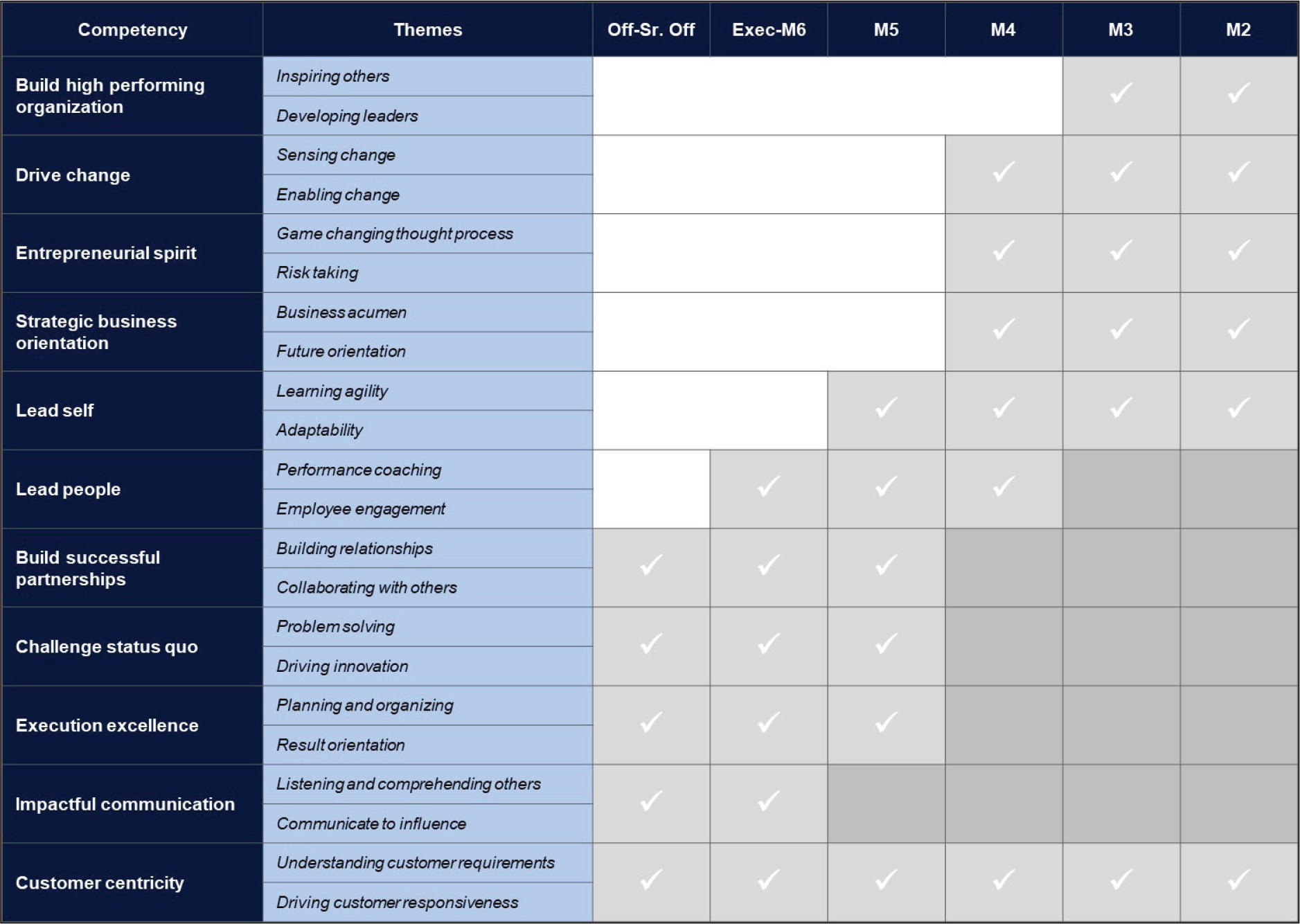
Once employees across different levels and functions were interviewed and themes were extracted, 11 leadership competencies emerged (Table 1). The key consideration was that all competencies are not required across all levels. Each level would be defined by five–six competencies; however, no weightage would be allocated to each competency. Roles and functional contexts would determine the importance of that specific competency. Further, the observable behaviours for each competency may differ across levels. For instance, for senior-level managers reporting directly to the chief executive officer (CEO), the competency lead self denotes, ‘drives a culture of learning by providing real-time opportunities for job enrichment and by establishing systems/ processes’, while for junior-level managers, it denotes ‘incorporates feedback from team and self-reflection into own style of functioning’. Moreover, as employees moved up the corporate ladder, some competencies would be included while others will be assumed to be present. For instance, building successful partnerships which is a necessary competency until senior manager level would be a mastered competency as the employee gets promoted to the chief manager level and would cease to be a differentiating competency. Post three months of development and deliberation, LCF was ready to be dispersed among Asian Paints employees.
The Roll-out
Leadership Competency Themes
Amit and his team initiated the dissemination of LCF in July 2017 and planned that each employee of Asian Paints should be acquainted with LCF within the next nine months. The first workshop included all VP, GM and HR managers. Since these participants were already aware of the initiation of this project and were looped in during different stages of the framework development, the objective of this workshop was to present the final framework and to prepare them for disseminating the framework to their subordinates. VPs and GMs would cascade the LCF to chief managers and senior managers who in turn would cascade it down to managers, executives and staff (senior officers and officers). HR manager would co-facilitate each workshop that was planned for a session of 150 minutes.
Post the debriefing workshop which brought all facilitators to the same level of conviction, the roll-out workshops across the country began. Although the first company-wide communication from the managing director (MD) & CEO in March 2017 set the context for the initiative, these workshops aimed at educating employees with the need for the framework, how it is linked to people processes and decisions, and how it can aid as a tool for standardizing practices across the company. The workshops were designed in an interesting manner with several interactive sessions, case discussions and gamified learning methods.
Through LCF, employees would not only gain clarity on the organization’s requirement of skill-sets during recruitment but also specify expectations for their personal growth including key indicators for developmental conversations with their bosses, people review process, capability building interventions and promotion. It was a conscious decision of the management that presently, LCF will not be employed for the purpose of performance evaluation (though adhering with LCF would indirectly enhance the career path). While some competencies were critical at one level and assumed to be mastered as employee rose up the ladder, customer centricity competency was emphasized as the key competency across all managerial levels. It was also highlighted that while the naming of competencies seemed similar across some levels, the description and deliverables at each level differed. Hence, as employees moved up the hierarchy, it was important to identify the distinction among the behavioural indicators, develop oneself and deliver accordingly.
Preliminary Assessment
By June 2018, all employees of Asian Paints had been briefed about the LCF. The past six months witnessed not just workshops with new participants but also the reinforcement of LCF concepts and functioning to the previous set of participants. This reinforcement was done through email communications from corporate HR and branch/factory managers during periodic meetings and developmental feedback sessions. With attractive employment opportunities and cross-industry movement of professionals, Asian Paints is not unscathed with shortening tenures of its employees. Lateral employees hired to enrich organizational operations often find it difficult to integrate into the system. Moreover, with divisional structures, managers are being shadowed by the siloed way of functioning. While continuous and mindful efforts were taken by managers across levels and functions, internalizing the competency framework would take some time, perhaps, two more years.
Looking Forward
It was July 2018 and raining cats and dogs in the financial capital of India. As he gazed out of his office window on the 20th floor of one of Mumbai’s skyscrapers, Amit had an intuition that the competency framework would address some of the employee concerns by standardizing people-related processes and practices. But seamless streamlining and internalization would take time, few years maybe.
While the company has aggressive growth plans to remain competitive, will the competencies needed by the torchbearers of Asian Paints remain the same? Will Asian Paints revisit the framework to incorporate changes fostered by industry trends such as workforce composition and technology? If the founders were alive, would they realize how the values of Asian Paints were embedded in the framework?
Amit glanced through the 18-months-journey report on the competency framework development and roll-out. With some future-oriented qualms and uncertainties in his mind, he prepared himself for the presentation to the Asian Paints Executive Council tomorrow morning.
Footnotes
Declaration of Conflicting Interests
The authors declared no potential conflicts of interest with respect to the research, authorship and/or publication of this article.
Funding
The authors received no financial support for the research, authorship and/or publication of this article.
