



Abstract
This article examines diasporic challenges, domestic abuse and patriarchal ideologies that constitute unique diasporic lives of first-generation migrant married Pakistani women (MPW) in Australia. For this qualitative study, 21 MPW residing in Australia were recruited for semi-structured in-depth interviews. Results from the interpretative phenomenological analysis of data revealed the diasporic encounters MPW face in Australia and the influence of patriarchal ideology on their lives in navigating those encounters. MPW’s responses to patriarchal norms in their married lives fell on a spectrum, which include conformation to the norms of patriarchal familial structures on the one side and resistance and bargaining against these structures on the other. On either side of the spectrum, whether to conform or to resist, women make decisions that they consider to be sensible. Implications of these findings for social policy and social development suggest culturally informed practices, awareness among the community about the prevalence of abuse and multi-perpetration, and the structural challenges that deskill immigrant women’s skills and qualifications.
Introduction
An individual’s movement across country borders, often with the purpose of retaining residence in the destination, is referred to as international migration. While migration may be temporary, permanent or circular, including migrants returning to their places of origin, migrants as such are broadly categorised by the United Nations into long term (staying more than a year) and short term (staying between 3 months and a year) (Fleury, 2016). The International Labour Organization considers that women constitute about one-half or more of the global migrant population (Fleury, 2016). Hence, it is important to consider gender as a key factor for understanding migration intricacies that can help policy and programmes directed to enhance the benefits and reduce the cost of migration for women (Fleury, 2016).
A burgeoning body of literature focuses on an intersectional analysis of migration and gender (Ameeriar, 2017; Ehrkamp, 2013; Fleury, 2016; Foner, 1998; Gaye & Jha, 2011; Ghosh, 2009; Kalra, 2009; Krummel, 2012; López et al., 2018; Mohammad, 2013, 2015; Zentgraf, 2002), and some studies have revealed migration’s unique ramifications for women. For example, Gaye and Jha (2011), in their study, used individual-level data from the Luxembourg Income Study (LIS) to examine and compare migrant women’s economic situations with non-immigrant women (Gaye & Jha, 2011). They found that, despite migrant women having higher educational attainment than non-migrant women in the destination country on average, they ended up in low wage occupations compared to the non-immigrant women.
Nonetheless, a body of literature about the Pakistani diaspora suggests that migration gives women opportunities (Jibeen & Hynie, 2012; Lindquist, 2018; Malik, 2022; Mohammad, 2015; Qureshi et al., 2014; Zakar et al., 2012). A significant consideration of these studies relates to the marital relationship. An argument is that migration has the potential to improve women’s self-respect, dignity and freedom, so they can act in pursuit of their goals. An example is the loosening of the ‘controlling grip of in-laws’ because they remain at a long distance in Pakistan, which enables women the assertiveness and autonomy through which they can direct their marital relationship (Mohammad, 2015, p. 601). Conversely, there is a growing body of literature that illustrates how cultural factors influence women’s experiences of migration (Anitha, 2010, 2011, 2019; Foner, 1998). Some feminist scholars argue that, despite improvement in certain aspects of life, migration can have serious repercussions for women, as patriarchal codes and practices continue to present challenges for immigrant women (Chowbey, 2017; Dasgupta, 2014; Milani et al., 2018; Shreya, 2008; Zakar et al., 2012). Structural constraints and cultural barriers can make women more vulnerable in receiving societies (Gharaibeh & Oweis, 2009; Gill & Brah, 2014; Gill & Walker, 2020; Hyman et al., 2011; Jordan & Bhandari, 2016; Milani et al., 2018; Payton, 2010; Salter, 2013). Feminist research using an intersectional framework suggests that the main structural constraint that elucidates towards patriarchal factors at the macro level is state and immigration control laws, which intersect with gender and influence women’s experiences of abuse (Vasil, 2023).
According to an intersectional theoretical lens, although subjugation against women is a universal phenomenon, immigrant women’s experiences of oppression are distinct due to their immigration status, gender, race, class, capabilities, cultural, ethnic and many other identities (Baz, 2020; Crenshaw, 1991; Davis, 2008; Davis & Zarkov, 2017; Kohli, 2015; Lim, 2018; Mahler et al., 2015; Salem, 2013; Werbner, 2013; Yuval-Davis, 2006). Hence, it is imperative to use intersectionality as a difference-measuring tool, as not doing so can make the experiences of minority groups invisible (Anitha, 2011; Batchelor, 2020). Additionally, Asian societies, including Pakistan, are exemplified by traditional patriarchal cultures that normalise male dominance over women and rigorous gender roles (Pio & Moore, 2022). The structure of Pakistani society is commonly acknowledged to be highly patriarchal (Mumtaz, 2003), where women are considered inferior beings. However, Pakistani women are not a homogenous group. In modelling women’s gendered experiences, both socio-economic and ethnic factors play an important role (Mumtaz et al., 2013). Considering these factors, Pakistani women’s experiences as a minority group in Australia are distinct.
Australia has one of the highest proportions of overseas-born residents of any country in the world, with 28.5% of the population born overseas (Murray et al., 2019). According to the recent data on Pakistani population in Australia from the Australian Bureau of Statistics, there are 89,633 people who were born in Pakistan (ABS, 2021). The male population stands at 58.8%, while the female population is lower at 41.2% (ABS, 2021). Scholarly attention on Pakistani immigrant women in Australia has been limited, with scarce research dedicated to identity politics, community, and gender construction conducted by two male researchers (Fijac & Sonn, 2004; Malik, 2009), although they do not focus on women’s experiences of abuse and structural oppression. Available research primarily focuses on culturally and linguistically diverse (CALD) women’s experiences, where the sample is taken from an ethnically diverse group. A notable research gap exists concerning Pakistani immigrant women in Australia, reflecting a need for understanding women’s cultural narratives and diasporic challenges women face while living in Australia.
Objectives
The aim of this study is to investigate how cultural patriarchal codes and domestic abuse influence women’s life options in Australia, which are intensified by diasporic settlement challenges. Particularly, it examines experiences of Pakistani migrant women within the Australian context, with a focus on gender and patriarchy. It also looks at married Pakistani women’s (MPW) perspectives, the barriers and obstacles that hinder women’s personal and social well-being, which can inform policy and programmes to enhance and offer more culturally specific support for CALD minority women in a diasporic context.
Methods
This qualitative study used in-depth semi-structured interviews with 21 MPW in the Perth metropolitan area of Western Australia from the 15 November to 31 December 2022. Participation in the study required that women were born and brought up in Pakistan, were married and were living in Australia for a minimum of 6 months at the time of the interview. Both convenience sampling and snowball sampling were employed for participant recruitment (Andrade, 2021), owing to the sensitive nature of the study and a hard-to-reach population that is hidden in many cases (Rowlands, 2023).
The interview script included 17 open-ended questions covering a range of issues and topics that included gender norms and values for men and women in Pakistani society, gender roles for men and women, lived experiences in marriage, reflections on lived experiences in Pakistan and Australia, and views on any changes in male dominance after moving to Australia. All interviews were conducted in participants’ first language, Urdu, and were transcribed verbatim. Study participants were further contacted for member checking and approval of the transcribed data. Two women whose first language was Urdu were employed for inter-rater reliability check (Gisev et al., 2013). Inter-rater reliability is a method that is employed to reduce a researcher’s bias in interpreting, presenting and reporting qualitative data, ensuring credibility and truthfulness (Gisev et al., 2013). Inter-rater reliability for this article was achieved by adopting two techniques: (a) inter-rater reliability of coded data, and (b) inter-rater reliability of transcribed interviews. For inter-rater reliability of transcribed data, two women were employed to check any inconsistency in transcription, which was followed by recontacting research participants to allow them to listen to their transcribed interviews and provide them with an opportunity to add or omit any information. For inter-rater reliability of codes, the list of codes was reviewed for any changes by experienced supervisors who are the co-authors of this article. The coding was done using both deductive and inductive coding. In this approach, the aims were to code data that explicitly indicates emotions, feelings and opinions of the participants and also to code data according to the research theoretical framework, main questions and objectives of the study (Braun & Clarke, 2023).
The study used NVivo version 1.6 software for organising, managing and coding of data, and Saldaña’s (2021) manual was used to aid this process. Data analysis involved inductive reflective thematic analysis comprising six steps as used by Braun and Clarke (2023). The six steps involve data familiarisation, coding, theme search, reviewing themes, naming themes and reporting themes. Codes have been used while reporting the findings to protect the anonymity of the participants. Intersectional feminist perspectives and a phenomenological viewpoint informed the analysis. Ethics approval for the study was obtained from the Edith Cowan University Human Research Ethics Committee (Approval Number: 2022-03505). A research information letter was read out to the participants over the phone for informed oral consent, and participants were informed that they have the right to withdraw from the study at any time without having to face any consequence.
Findings
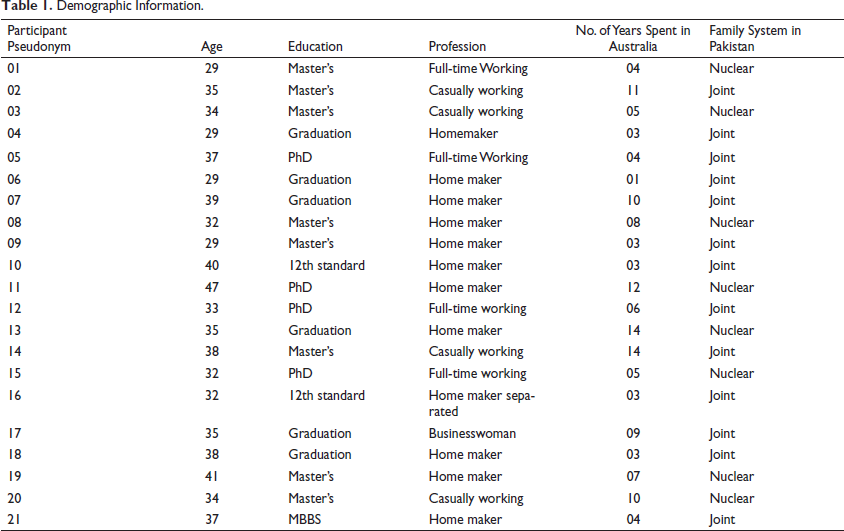
As presented in Table 1, the demographic background of participants shows that most of them were young adults, had tertiary qualifications, lived in Australia for more than 3 years, and came from both nuclear and joint families.
Demographic Information.
Domestic Abuse
Six participants reported having experienced domestic abuse. Both husbands and husbands’ family members perpetrated and instigated domestic violence, making its nature complex. Participants reported that interaction with family members via phone by husbands facilitated violence against them. According to the women who experienced abuse, their mothers-in-law frequently directed violence and did not always intervene to stop it. The role of the mother-in-law in inciting violence was identified as the most significant, followed by the role of the sister-in-law, husband’s siblings and father-in-law. Participants believed that family members of the husband caused intimate relationship abuse. They reported that the physical presence of their mothers-in-law provoked marital disharmony among couples in Australia.
Women’s narratives with abusive histories revealed that they employed different strategies to avoid violence and protect themselves. Some tried to mitigate the abuse and improve their relationships with their husbands. For example, Participant 15’s mother-in-law instigated violence using ‘WhatsApp’ calls with her son. When Participant 15 confronted her husband about this, she was physically assaulted by her husband. Participant 15 revealed that, after abusive episodes, her relationship became normal due to her son’s birth. Participant 15’s coping strategy was to conform her resisting thought process according to her husband’s demands.
I cope with controlling behaviour in a way that I dare not say no to any significant issue. Anything my husband is against; I justify or rationalise in my brain. I tell myself that I should be at peace with that. I bring contentment in my mind. I calm down to live a normal life. Secondly, being a female, for example, if my husband needs to talk to me. He calls me from his room. I go to him if I need to talk to him and I am very respectful.
Another participant, Participant 16, lived in a refugee centre. Her experience was that her husband’s mother and sister always controlled her marital life. Participant 16 decided to leave her abusive husband. She gained her strength from her strong belief in Allah (God). While narrating the impact of their control on her life, she stated: My in-laws (sister-in-law and mother-in-law) tortured me mentally, and I would only have money if I followed their commands. This is normal in our culture. This is slavery. Allah has created a woman from a man’s rib. Home is in peace if she stands next to the man. A wife is not a slave. We manipulate the woman’s position and tell her to stay in her Aukat (Limits). We think a man is a real provider, although the real provider is our creator. We have lost faith in Allah. This angle of thinking has corrupted Pakistani culture.
Participant 04 parents-in-law visited her and caused marital disharmony between the couple. She described how the threat of divorce negatively affected her psychological and mental health. She mentioned adjusting according to her husband’s wishes because of the children’s future and financial dependence. Participant 04 coped with patriarchal control by talking back, as the following excerpt shows: I am here for my kids. I do not want to affect my children. My in-laws have lost their place in my heart. I do not think that someone can take a stand for me. One must take a stand for oneself. I gave them a shut-up call. They complain that I answer back.
Participant 14 reported that her husband’s family and husband abused her for many years. After 15 years of abuse, she became resilient and resisted her husband’s control. However, she decided to stay with her husband because of her daughter’s future. She believed that her daughters’ marriage would become a problem if she got divorced. She thought being with an abusive husband was less evil than being divorced. Participant 14 decided to take antidepressants to reduce the negativity of an abusive relationship.
Participant 07 described how her husband’s siblings abused her both financially and psychologically while she was in Pakistan. However, she opined that her husband was helpless, as women in the families pulled the men into conflicts.
Men are helpless, and with time, you realise why your husband was harsh towards you. He is stuck up and has limitations. I am not worried that I am responsible for my children’s living. Thinking about providing for my children on my own, I think it is better to listen to his “harsh talks”.
The narratives indicate that MPW’s experiences of domestic abuse are complex, underscoring their marginalisation by family members, community and by the challenges of diasporic lives. The abuse in a diverse society such as Australia, is heavily influenced by a Western lens, which tends to focus on an intimate nature. Such a focus sometimes unintentionally ignores the involvement of family members, women’s reliance on men for their financial and emotional well-being, and the risks of modernity, which in this case are social media interactions. On the one hand, the modern means of communication and social interaction offer freedom and convenience, but on the other hand, these platforms are used to maintain a tight control of women.
Navigating Career and Family
Navigating career and family was one of the biggest challenges for all study participants; however, for women who were in abusive relationships, their economic dependence on men made them even more vulnerable. Women in abusive relationships had difficulty beginning their careers. Husbands coerced women to quit their jobs. Some husbands denied them possessions such as cars and deprived them of opportunities to exercise their choices. All women, irrespective of their relationship dynamics, thought of opting for different skills-based courses to minimise their vulnerabilities. However, their economic limitations became hurdles for enrolling in courses. Abusers feared that women’s financial independence would lead them to lose control over women, and hence they deterred women from starting their careers.
Participant 14 is in a 16-year relationship with her husband. She has two daughters. On numerous occasions, her husband’s mother and siblings instigated abuse. As she began her career, she encountered coercive tactics.
Initially, he would ask me to begin working, but once I began, he would ask me to quit. Since he had made me financially dependent on him, he was always afraid that I would leave him if I had money. I was concerned about taking care of my daughters… He forbade me from meeting anyone and I was by myself in the home. I would sometimes be so depressed that I wished to hit my head against the wall and cry.
Credentialling and qualification recognition processes challenged some women, and they had to change their careers. Participant 21, who reported no violence by her husband in her marriage, was an MBBS doctor, and despite spending 4 years in Australia, she could not pass the Australian Medical Council Exam. She could not afford the fee, and she received no support, so she switched to childcare. Similarly, Participant 11 obtained a graduate degree from Australia. However, she left her career to fulfil household responsibilities. Returning to work seemed ‘impossible’ as she had a child with special needs. She felt her husband would never cooperate with her.
Participant 18 was a lawyer and had a public-sector job, which she gave up after getting married. Now, her husband occasionally gives her 200 AUD a month. She wants to earn so that she could gain a sense of self-worth. However, she did not have the knowledge and money for the credentialing and qualification recognition processes for her degree.
These stories indicate structural challenges women face to enter the workforce despite having qualification, skills and intent to work. An intersectional lens shows that MPW are not incompetent, but are restricted by harsh workforce realities, making women’s economic contribution a challenge and visibility a social problem.
Escaping Abuse
Findings revealed that abused women felt dissatisfied and isolated, as they faced judgement from the Pakistani community. Five women who had experienced abuse reported the unfair treatment by other MPW who were once close friends. Women in their community stopped contacting them when they disclosed their experience of abuse.
Participant 16 is a housewife who escaped her house because her husband abused her physically many times. She used to live in another country with her husband, where she faced all types of abuse, for example, physical, sexual, psychological and financial abuse from her husband. She revealed that her mother-in-law and sister-in-law controlled her husband. Her husband had no control over his life. Physical abuse continued while being in Australia. She escaped abuse by leaving the house, although her documents were confiscated by her husband. She needed her documents to continue working. She became worried about accommodation and children’s needs. She mentioned the loss of self-esteem because of the experience of judgement by her own community members when she disclosed her problems and experience of abuse.
I was in pain, not because of my husband’s behaviour. I thought that in a first-world country, our people would change their mindset. They will support me. They will ask me if I need something. Do I need accommodation? They were totally opposite of my expectations. They mentally disturbed me and I was in trauma for one and a half month.
MPW’s accounts highlight that the community’s role in abuse prevention is not positive for women’s safety and well-being. It suggests the community’s role in preventing violence should be a high priority for the government. Abuse prevention programmes should target all communities embedding culturally sensitive and well-informed strategies.
Challenges from Community: Victim Shaming
The findings revealed that disclosing abuse could invite other problems such as victim bashing and shaming, which could multiply the victim’s ability to deal with ongoing abuse. Participant 14, Participant 15 and Participant 16 talked about their experiences with victim shaming. The community advised all abused women to stay silent and to learn how to cope with the abuse. Participant 15 stated, ‘My so-called educated friends and colleagues from the Pakistani community told me to stay silent and not answer back. They told me they had no problem because they do not answer back to their husbands’. Participant 16 shared the same reaction she received from her community: I shouted because my husband physically assaulted me. I screamed in pain. People told me, “Why did you shout from pain if he hit you? Why did you shout? You are too loud with him”. His friends came to me, and they were on his side by telling me I was shouting. My shouting was not justified, but his hitting was. I explained to them that my husband hit me because of my silence. He could not tolerate that I was quiet.
Mixed Understanding of Western Culture
Participants compared Western and Pakistani cultures, and their narratives showed conflicting views. Most of the participants had a negative perception of Western women as dominating, controlling, and disrespecting their men because of their financial autonomy. Western women marrying more than once was seen as not caring about their children and not valuing the importance of the institution of family and marriage. Children having stepfathers and stepmothers was seen as detrimental to children’s growth and development. However, Participant 01, Participant 19 and Participant 15 praised the Western system and lifestyle. They believed that Western culture gave independence to women.
You can see women stroll outside. Western women drive, they have jobs, they pick up and drop their children at school. Division of labour is not gender-specific. Men and women perform similar roles. Look at those elderly women at the table! They are talking, and if you compare them to Pakistani women of their age, our women lie on the bed at this age. Our women think of themselves as old. You feel good here as an independent individual. (Participant 19)
The study suggests from the analysis of women’s stories undertaken that living in a diverse society can offer opportunities for the women to adapt and adopt positive influences shared with one another.
Minimal Interaction with Support Systems
Participants showed little knowledge about the services available to survivors of abuse in Australia. Women with abusive episodes in their married lives did not seek help or had any knowledge about the refuge or shelter services in Australia. Only one participant, Participant 16, escaped to a refuge centre, which was referred by an Australian woman. Participant 14, however, dialled 000 to call the police.
I screamed, so my daughter came to me and threatened him that she would call the police. I dialled 000 and I did not know that they traced the number. I had no knowledge because he isolated me, so I did not know how to escape. I was not allowed to make friends or go out of the house. He was scared that if I knew anything, I would escape.
Participant 15 was slapped on her face by her husband. However, she only threatened him that she would call the police. Participant 16 and Participant 04 mentioned that men in Australia could not be as abusive as in Pakistan because they knew that women could call the police. However, other women did not reveal if they called the police or not when they faced abuse from their husbands.
The stories reveal that building trust in formal support systems such as police, healthcare and shelters is vital in abuse prevention for immigrant women who lack informal support such as family, friends and community, indicating disadvantaged conditions for these women and the importance of focusing on immigration status along with class, gender, nationality, culture and race to fully analyse the lack of agency in their circumstances.
Support from Family and Friends
Women reported mixed responses about the support they received from their families during the episode of abuse in their marriages. Participant 16 complained that her natal family did not believe her but rather blamed and socially isolated her after she disclosed that she separated from her husband due to prolonged and consistent episodes of abuse.
My bhabhi (brother’s wife) and brother did not believe me although I showed them the bruises on my face. I had blood stains on my face. My husband grabbed my mouth and then slapped me. I started bleeding. When I escaped to Pakistan, his fingerprints were on my face. My bhabhi and brother denied it even after seeing all the evidence. They said, ‘He is a good guy. There must be a problem with you. You might have done something wrong’. (Participant 16)
Participant 15, however, had a positive experience. She informed her own parents and husband’s father about her husband’s abusive behaviour and left the house for 1 week with her 1-year-old son. Participant 15’s parents did not blame her and supported her morally. Her parents told Participant 15 that they would support her in any decision.
I left for a week or 10 days. I started looking for another accommodation. I cannot live with this monster. How dare he hit me? My parents were supportive. In my case, he thought that it was normal and that I would go back to him. I was thinking about separation, divorce and cancelling his visa. He never had this idea that for me, it was not normal; it might not be normal for other families. In my family, it was not normal. It was a new concept.
Participant 04 informed her husband’s uncle about the psychological abuse she suffered from her in-laws and husband. She thought informing and involving her husband’s family could deter them from controlling her. She thought that the fear of discussing family matters would change the behaviour of her in-laws and husband. However, contrary to her thinking, her in-laws levelled a series of allegations against her.
Participants who reported that they received financial support from their families did not report abusive episodes in their marriages. Participant 14 received financial support from her mother to rebuild her career. Participant 13 thought her husband treated her like a ‘queen’. Participant 13 and Participant 20 received gifts and money from their brothers and fathers on their children’s birth. Participant 20 reflected: I never demanded money from my husband for 6 or 7 years. I never had pocket money. He gave me a grocery card. I never bought anything for myself. My husband would say, “You have the grocery card. Go buy whatever you want”. I wanted my pocket money. I did not have financial independence. My parents would send me money. They would send me gifts on different occasions like on a child’s birth and birthdays.
Collectively, the stories shared by MPW reveal that living in diaspora for immigrant women is not without challenges, which include but are not limited to gender, family, cultural and societal expectations. Additionally, the social structures and institutions in the host country can lead to obstacles rather than support immigrant women.
Discussion
The objective of this article was to explore how married Muslim first generation Pakistani women face inescapable oppression. Informed by an intersectional feminist framework, underlying causes were found extending beyond gender and race. These related to immigration status, community involvement in normalising and ostracising marginalised MPW, the deskilling of women’s education and qualification in the Australian job market, cultural patriarchal ideologies, and minimal trust in and use of social protection services. Additionally, the article provided an academic insight into how abuse within CALD immigrant women is not only more intense but also different. A study conducted by Australia’s national organisation for women’s safety (ANROW) highlights that immigrant women’s experiences of abuse are different from those of white women because immigrant women are further disadvantaged by other structural factors such as immigration policy and visa status and immigration stressors (Vaughan et al., 2016). Other studies argue that race and ethnicity are two important forms of inequalities that intersect with other factors (Kaur & Atkin, 2018; Vaughan et al., 2016). Immigrant women in diasporic contexts are considered not only the actors who are responsible for the biological construction of ethnic groups but also accountable for creating social identities (Féron, 2021). Women in diasporic contexts are faced with a dilemma where, on one hand, they are entrusted to be cultural agents who reproduce patriarchy, and on the other hand, resisting and standing against the traditionality can put women under more vulnerable situations. The cost of going against traditional patriarchy, as suggested by our findings, is ostracisation, which is congruent with a study that suggests that women are called traitors if they resist patriarchy (Féron, 2021). Using an intersectional framework, a study in the Australian context by Kaur and Atkin (2018) suggests that immigrant and refugee women face multidimensional forms of oppression. It is not only familial patriarchy that limits women’s options, but also public patriarchy that originates from immigration laws, which also make women dependent on men in public realms (Vasil, 2023). Familial patriarchy is further entrenched when social patriarchy reinforces it through mechanisms of stigma and shame. Thus, MPW encounter inescapable oppression through the clutches of familial, social and public patriarchy.
Findings revealed that MPW experience violence, including physical, psychological and financial, and it is perpetrated by husbands and in-laws. Women who experienced one form of abuse were likely to face other forms, making all types of abuse interconnected. Most of the women reported emotional abuse, which includes humiliation, insult and degradation. However, they did not worry about this form of abuse and tended to normalise it, which is consistent with other studies that suggest that agreeing with ideals of a good wife and mother has caused many South Asian women to endure abuse against them (Dasgupta & Warrier, 1996). In our sample, not all women normalised the abuse they faced from their perpetrators; however. women stayed in abusive relationships due to various insecurities, including the future of their children, financial dependence, fear of raising children on their own, fear of stigma attached to divorce and pressure to uphold cultural values, which are consistent with the findings of other studies (see Estrellado & Loh, 2019; Ghafournia, 2017; Gill & Brah, 2014; Gill & Walker, 2020; Kohli, 2015; Milani et al., 2018; Suma, 2001). The findings about women experiencing some level of positive change in their marital lives after coming to Australia are consistent with the findings in the study by Jibeen and Hynie (2012) that a positive change happens when there is a shift from a joint to a nuclear family system (Jibeen & Hynie, 2012).
Chowbey (2017) found that South Asian women employed a variety of techniques to resist financial abuse according to their social standing, including material, confrontational, mediational and developmental methods. The current study shows that some women acted as passive victims to condone financial violence. Results also highlight the multi-perpetration in committing violence such as financial, emotional and physical against women (Aplin, 2017; Jordan & Bhandari, 2016; Salter, 2013). Placing the attitudes and behaviours of female perpetrators as rational decisions that are in some way isolated from patriarchy is an overly simplified approach. This pervasive suppression to societal conventions occurs instinctively throughout the early stages of a woman’s socialisation (Aplin, 2017). Payton (2010) suggests that older women are given an important role in family councils and these women take an active role in conspiracies, given that they have internalised gender norms of patriarchal family structures.
The findings that women with abusive past and present histories relied on informal support system such as friends, community, marital and natal families are consistent with similar findings in other studies (see Anitha, 2010; Choi et al., 2012; Ikram & Usman, 2022). Nonetheless, the response from informal support systems did not help women to deter abuse; rather, informal support only reinforced patriarchal dominance, leaving women in a vicious cycle of abuse. Women decide to leave their relationships only after severe physical and psychological episodes that Milani et al. (2018, p. 53) referred to as ‘point of saturation’.
In the context of this study, the Pakistani community’s role in deterring abuse has been negative in general. The community ostracised women in the current sample who revealed abusive experiences in their marriage. Women’s social network participation is also within their husbands’ friends, and any disclosure of abuse in those circles ended in victim blaming and moral regulation of the women to another unrealistic standards. Women who disclosed their stories within their own network also experienced a similar response. Women in our sample sought help from natal families, which also ended in either rationalising abuse or encouraging women to keep the family and marriage intact at the cost of their well-being. In one case, a woman who escaped to a refuge reported that her brother and sister-in-law isolated her in the WhatsApp group created for the family. Her case indicates the fact that social ostracising in modern times might happen on social media for not obeying and enduring family values. Results from the present study validated the findings from previous research regarding abused women who decided to seek formal or informal help from collectivistic values (Milani et al., 2018). It also indicates that social media such as WhatsApp family groups are another means of social control. In line with the results of the present study, a previous study illustrated that participation in the husband’s family and friends’ network can be a reason for a husband committing violence against his wife. Participation in such networks by women can have added negative impacts on violence. If network members legitimise or even support violence against women, then participation in such networks may encourage men to use violence against their spouse (Choi et al., 2012).
A significant majority of the women in the current sample did not seek help from formal networks such as police or any social services. One reason for this is that they considered family matters as private (Milani et al., 2018). Previous research also indicates that women from an early age are made to believe that family matters should be kept private, and in any case, police interference can bring a bad reputation to the family (Dasgupta, 2007, 2014).
Previous studies suggest that abused women cannot properly communicate with police due to their limited knowledge of English language, and this can inadvertently advantage men who are fluent in English (see Dasgupta, 2007; Gill & Walker, 2020; Suma, 2001). In the past, officers have made prejudiced remarks to women and supported men (Dasgupta, 2007). This indicates that women face ‘structural constraints’ (Suma, 2001, p. 965), leading to ‘double victimisation’ and the harsh reality of being without family and community (Gill & Walker, 2020, p. 170). There are other factors of intersecting identities such as class, gender, nationality, religion, culture, abilities and physical characteristics, language, and immigration status, which leave women at ‘crossroads’ (Dasgupta, 2007, p. 211; Milani et al., 2018) of multiple oppression. A woman’s identity and situation in such scenarios can be recognised through exploring the unique place that emerges at the intersection of these multiple contributors (Milani et al., 2018). Culture may be taken as one axis of analysis. These intersecting identities converge and exacerbate women’s subordination (Yuval-Davis, 2006).
Women in our study had divided opinions about Western culture and women in Australia. Consistent with a previous study about Pakistani women in Germany related to immigration stressors (Zakar et al., 2012), our findings reflect women holding stereotypical views about Western culture and Western women as self-centred and not family-oriented. A study based on Pakistani women’s Muslim identity construction found women preferred respectable, natural, and appropriate femininity, which involved the religious and cultural expectations of conforming to appropriate feminine behaviour (Siraj, 2012).
Women who enjoyed financial independence before coming to Australia found the new situation and financial dependence on men distressing. Owing to limited knowledge about the new country, these women’s personal circumstances worsened and increased their chances of controlling behaviour by their abusers. Loss of jobs after migration is a psychological stress, which may increase women’s vulnerability to control and coercion by complete financial dependence on men and then being their husband’s dependent in a diasporic context by law. This indicates how patriarchy and male dominance are reinforced through legal power and how familial patriarchy is strengthened through public and social patriarchy. Though immigrants constitute diverse ethnic and national identities, the challenges this population may face in the host countries make immigrants a vulnerable group prone to different types of abuse (Gonçalves & Matos, 2016).
Arrival in a new country might expose women to different types of victimisation (Freedman et al., 2008). Although they possess education and skills from their country of origin, MPW find it difficult to maximise their options owing to immigrant status, which is consistent with findings from the qualitative study by Hague et al. (2010). This research in the UK demonstrated that immigrant women with educational qualifications and skills cannot get employment or work at very basic jobs on minimum wage or less. For some survivors of violence, the inability to secure good employment makes it difficult for them to leave the marital home. Employment rates among first-generation migrant women are generally lower than among natives (Algan et al., 2010). Another important study conducted in the European context also found that immigrant women’s qualifications and skills are underutilised compared to citizens, which also indicates job-market discrimination that immigrant women face (Kofman et al., 2009).
The current study found that the working status of MPW in Australia is not a protective factor for violence against women, which is consistent with a quantitative study in the Indian context (Raj et al., 2018), which suggested that the only protective factor for violence against women was women conforming to patriarchal familial codes. Similarly, our finding that controlling behaviours, both by husbands and marital families, were associated with increased likelihood of violence is consistent with the findings of the study by Anitha (2011). Husband’s controlling behaviour and level of societal response to partner violence may influence controlling behaviour, abuse and consequently the likelihood of physical violence (Anitha, 2011). However, in our study, women reported marital family control, which was not mentioned in Anitha’s (2011) study. As our findings revealed, women who lack the financial means to end an intimate partnership and are less capable of negotiating change are economically reliant on their spouse. This increases their chances of being subject to more controlling behaviour and an elevated risk of violence (Anitha, 2011).
A significant finding in our study was that women were exposed to violence when they transgressed patriarchal traditional gender roles. This is consistent with other studies from Pakistan (Ali et al., 2020), India (Raj et al., 2018), Bangladesh (Chowdhury, 2009), the USA (Chaudhuri et al., 2014; Hague et al., 2010; Lindquist, 2018; Mahapatra, 2012), Canada (Dekeseredy & Kelly, 1993; Hyman et al., 2011), Europe (Zapata-Calvente et al., 2019) and Australia (Afrouz et al., 2020; Borges Jelinic, 2019; Ibrahim, 2020; Truong et al., 2020).
Consistent with other research (Afrouz et al., 2020; Linos et al., 2013), underreporting is a concern in the present study due to the fact that 98% of the Pakistani population are Muslim and that the legal, state and cultural contexts of Pakistan are not only conservative, but highly patriarchal (Imran, 2005; Syed, 2010; Toor, 2007; Zia, 2017). This never-ending loop of patriarchy deters women from reporting violence. Zia (2019) mentions that if a woman seeks help from the state, or if she breaches the honour code, she is held accountable for dishonouring her family by exposing them in courts and in front of the world. The conservative contexts of the state influence women to perform traditional gender roles and reduce the likelihood of violence because a conservative legal and social milieu compels women not to transgress their roles for fear of punishment (Linos et al., 2013).
Pakistan is culturally, ethnically and socio-economically a diverse country, and the selected sample is not representative of all Pakistani women. The majority of the women in the current sample were from urban parts of the country. The study only included employed married women. Voices of other women who are divorced, single and widowed would have added more depth to the analysis.
The study findings suggest that MPW’s experiences can be best understood through the lens of intersectionality. Beneath the surface, their lives reveal multiple, overlapping layers of oppression and insecurity, shaped by cultural norms, community ostracism, procedural and structural barriers to workforce entry, immigration rules, and difficulty in seeking assistance with support systems when their circumstances deteriorate.
Implications for Policy and Practice
Given the worldwide endeavours to eliminate abuse against women, this study is important both from a social policy and social development perspective. In the global context, Sustainable Development Goals (SDGs) (n.d.) point out that gender equality is still an unfulfilled promise as women continue to experience legal, social and economic barriers to their empowerment. In the light of conservative sociopolitical contexts from which Pakistani immigrant women in Australia come, intervention and prevention of abuse require services, programmes and policies that are culturally informed and responsive to the varied needs of minority women (Milani et al., 2018). The findings also indicate towards adopting a holistic approach to empower women, which should not only focus on individuals but should include other important stakeholders such as families, communities, economic policies, job market policies, and social work and practices to understand the situations of marginalised women. The premigration context is also important for understanding women’s unique vulnerabilities. Hyman et al. (2011) mention that pre- and postmigration factors need to be contemplated in the prevention of violence in newcomer communities.
The emphasis needs to be on adopting a proactive integrated approach to controlling behaviour and multi-perpetration of violence within the society. Working in liaison with Pakistani community can provide a culturally suitable framework for dealing with abuse and violence (Hyman et al., 2011). The analysis highlights the importance of increasing the level of awareness among men and young boys within this ethnic minority to change the mindset through targeted and culturally informed interventions to reduce violence against women (Murshid & Critelli, 2020; Zapata-Calvente et al., 2019). Similarly, women’s access to economic resources can positively reduce violence and abuse in women’s married lives.
Conclusion
The purpose of this study was to explore Pakistani women’s perspectives about the challenges they face after coming to Australia. Although migration can have both positive and negative impacts on women, findings in the study reveal that women experience abuse and violence in the host country. Patriarchal norms and strict gendered roles within the family and in their own ethnic community continue to disadvantage women. Nonetheless, findings also indicate that women tend to perpetuate patriarchy and endorse a range of positive and rational thinking towards its acceptance. Their decisions involve a willingness to accept subservience and encourage themselves for future rewards and security through living in patriarchal filial structures. Social development warrants the well-being of all people, including all women, and appropriate social policies and culturally appropriate social services may help address the concerns of ethnic minorities such as the respondents of this study. SDGs (n.d.) recommend investment and comprehensive policy reforms for dismantling systemic barriers to achieve women’s equality. SDGs (n.d.) further add that gender equality must be a key focus of national policies and institutions.
Footnotes
Declaration of Conflicting Interests
The authors declared no potential conflicts of interest with respect to the research, authorship and/or publication of this article.
Funding
The authors received no financial support for the research, authorship and/or publication of this article.
