




Abstract
In June 2014 approximately 54 per cent of the total probation service workforce in England and Wales were transferred to the newly created Community Rehabilitation Companies (CRCs) as part of the government’s plans to establish a market for offender management services. This marked the beginning of one of the largest and most significant migrations of criminal justice staff from the public to the private sector in England and Wales. This article presents findings from an ethnographic study of the formation of one of these CRCs through to the period immediately following the transfer into private ownership. The authors discuss the key features of this migration which are identified as ‘splitting and fracturing’, ‘adapting and forming’ and ‘exiting or accommodation’. It is contended that this development not only has significant implications for the future of probation services but also provides a unique example of the impact on an occupational culture of migration from the public to the private sector.
Introduction
Probation has been at the sharp end of attempts by successive governments in England and Wales to apply a market approach in criminal justice involving a shift from public to private provision (Burke and Collett, 2015). This has led to the break-up of what was formerly a unified public body 1 with high risk public protection work retained within the public sector (in a new National Probation Service (NPS)) and the majority of probation work undertaken in 21 newly contracted and privately managed Community Rehabilitation Companies 2 (Ministry of Justice, 2013a, 2013b). This can be viewed within a broader context whereby ‘the ideologies of the market, entrepreneurship, consumerism, and individualism have “colonized” public sector cultures’ (Waring, 2015: 350). This trend raises fundamental questions regarding the migration of public sector workers into the private sector in terms of ‘how these cultural differences are reconciled, whether public values are substituted for those of private enterprise, and if new “hybrid” cultures are emerging’ (Waring, 2015: 345). While we do not assume that private sector involvement in criminal justice cannot produce positive outcomes, our contention is that the recent restructuring of the probation service brought about by the Transforming Rehabilitation (TR) reforms provides a particularly illuminating insight into these processes in two key respects. The first of these concerns how a private sector focus on profit maximization through income generation and streamlined productivity might impact on an organisation that has traditionally been structured around notions of altruistic public service. Second, the splitting of probation staff between the NPS and the CRCs also provides a unique insight into the potential impact(s) on occupational identities of individuals who are now working in different sectors, but were once part of a unified public organisation.
Capitalizing on a unique opportunity to observe this period of profound change in one case study area the research team were able to capture the experiences of ‘migrating’ workers from immediately prior to the dissolving of the existing public sector probation service (from March 2014) through to their operation within a private sector based Community Rehabilitation Company (in June 2015). The research team conducted semi-ethnographic fieldwork observing management meetings/decision-making processes throughout this time and routinely attending staff forums and team meetings during the fieldwork. The research team also conducted semi-structured interviews with staff from all levels of the organisation with participants divided into four categories: members of the Senior Management Team (n = 8); Middle Managers (n = 21); Probation Officers (n = 16); Probation Service Officers (n = 14) and other support and operational staff (n = 11). Four ‘sweeps’ of research activity took place in April–June 2014; September–November 2014; December–January 2015 and then March–April 2015, to coincide with significant moments in the transformation process. A sub-sample of our interviewees were interviewed on multiple occasions throughout the transition. A total of 120 interviews were undertaken.
One of the key concerns of the research, and the focus of this article, was to explore this process of staff migration and in particular how those affected by it were able to internalize and make sense of external changes to the organisational ‘field’ 3 or establish new points of identification within the context of rapid organisational upheaval. We were also aware that the transfer of staff between sectors had the potential to bring into contact divergent and sometimes oppositional professional cultures. Bourdieu and Wacquant (1992: 17) use the analogy of a ‘battlefield’ to describe how social action is played out in the struggle to achieve ideological dominion over other agents in the ‘field’.
A Probation Diaspora?
Waring (2015) draws on the concept of ‘diaspora’ to explain how cultures interact, adapt and blur through migration and resettlement. Diaspora refers to the dispersal or movement of a population from its original homeland. A defining feature of diaspora communities is that they are often characterized by a strong collective memory and commitment to their common heritage (see Brubaker, 2005). Waring and Bishop (2011) identify three interconnected lines from which strong occupational identities emerge. The first relates to the sense of identity associated with formal occupational membership and role which is often related to distinct training models and specialist knowledge. The second relates to the articulation of these roles and identities in the routine relationships and rituals of everyday practice which reinforce a sense of belonging and differences within the division of labour in the organisation. The third relates to how the prevailing structures, processes and cultures shape the work and how workplace social practices then operate to reflect and confirm organisational cultures and sometimes lead to change and challenge (Waring and Bishop, 2011: 664).
Research into the dominant practice culture, ethos and values within probation has consistently pointed to its resilience even though inevitably it has had to change and adapt to wider policy narratives. Despite attempts by successive governments to make probation more punitively orientated and risk-focused, and significant changes to professional training arrangements, there has not been much evidence of the emergence of a new breed or generation of probation staff with different orientations and motivations than their longer-serving peers (Annison et al., 2008; Deering, 2011; Robinson et al., 2014). The best evidence pertaining to the occupational identities of probation workers comes from a recent study by Mawby and Worrall (2013). 4 This timely research revealed three ‘ideal types’ of probation workers (‘lifers’, ‘second careerists’ and ‘offender managers’) distinguished principally by how they were trained and when they joined the service. ‘Lifers’ were those workers with only one usually very long career, and for whom probation might be described as a vocation. The ‘second careerists’ often arrived in probation from former careers in health, social work or elsewhere. The final type identified as ‘offender managers’ tended to be the most recently recruited and were predominantly young, pragmatic and adaptable. Despite their differences, however, individuals across all three categories were found to hold similar values, centred on ‘a belief in the capacity of the individual to change for the better’ (2013: 39). Canton however contends that the shared orientations of probation workers also stem from the fact that for the individual probation professionals values represent more than the moral beliefs or ideas which they bring to their work, but instead emerge and develop from the experience of dealing with morally complex situations. This means that the nature of probation values might be difficult to change precisely ‘because they are the product of reflective and ethical responses to the demands of practice’ (Canton, 2011: 33). This raises questions, not just about what it is about the nature of probation culture that makes it so enduring but also regarding its ability to survive the organisation upheaval following the implementation of Transforming Rehabilitation.
Waring (2015) contends that recent policy developments in England and Wales have created ‘a public sector diaspora’ where many established public organisations have been transferred (migrated) from their homeland (the public sector) to the ownership and management of the private sector (host territory). This process creates liminal in-between spaces and the possibility for hybrid cultures to develop based upon the interaction of divergent ‘sectoral cultures’ (Waring, 2015: 349). As such this transition from the public to the private sector is rarely seamless. It involves a range of complex interactions and relationships and where the nature of the displacement is involuntary it can result in an unsettled relationship with the host culture. Within our study the perception of the private sector as being predominantly concerned with profit maximization was a significant discontinuity for those accustomed to working in the public sector as the following quote would seem to encapsulate: ‘I don’t want to work for a profit organisation. This is not what I want to do, payment by results that sounds corrupt. Like, do you know what I mean? I am thinking, “No, this isn’t right”’ (Probation Officer).
Though diaspora communities can be characterized by highly developed customs and practices, in reality they are rarely homogenous. Inevitably some within the group will be privileged by their position and resources (Esman, 2009). Waring and Bishop (2011) conducted a two-year ethnographic study of the transfer of non-emergency National Health Service (NHS) provision from a regional public hospital to a privately managed Independent Sector Treatment Centre (ISTC). The privately run ISTCs were introduced by the government in 2003 to provide surgical services to NHS patients. The researchers found that ‘some workers who moved into the private sector learned new values, customs and practices; some tried to recreate their former workplace; and some survived only by mimicking what they found’ (Waring, 2014). Interestingly the views of those interviewed appeared to reflect the inequalities of their position within the organisation. Doctors tended to experience little discontinuity in their work and, freed from NHS bureaucracy, tended to regard the change as a catalyst for restoring their professionalism and autonomy. Nurses and other clinical practitioners on the other hand believed that there had been insufficient consultation and many felt disempowered, especially as their initial apprehensions were reinforced by the harsh realities of commercial healthcare. Healthcare assistants were similarly concerned with many of the newly introduced practices but as unqualified employees they felt that they could be easily replaced and were therefore reluctant to challenge them. These findings suggest that how staff adapt to major organisational change, particularly between different sectors is complex and potentially differentiated and as such the difficulties individuals' face in attempting to reconcile change with their existing ways of working need to be acknowledged and supported.
While for all grades of staff in our study, including Senior Managers in the CRC, migration from the publically funded Probation Trusts had also been an involuntary process, they described (and we observed) a range of emotions and reactions in terms of how they coped with these changes. Senior Managers in the CRC appeared somewhat energized by what they saw as an opportunity to develop new values, customs and practices that were more responsive to the needs of their service users, while at the same time they were keen to hold on to what they believed were the best aspects of probation work that had developed under the former Probation Trust. Support and administrative staff tended to be the most apprehensive about the changes, believing that they were most vulnerable to losing their jobs as a result of what they saw as an inevitable rationalization of these roles. Probation Officers also tended to be less secure in the new arrangements and some of the most aggrieved were from within this group. Changes to contemporary probation practice meant that their work had become increasingly focused on the assessment of higher risk offenders with medium and lower risk offenders being supervised by the Probation Service Officer grade. 5 With higher risk offenders now located in the NPS they were most suspicious of the government’s motives for the changes and feared becoming deskilled by the loss of working with high risk offenders and in the courts. The role and functions of Probation Service Officers, on the other hand, were largely unchanged in the new arrangements, as those individuals assessed as being medium or lower risk remained in the CRC. However, following the reallocation of cases as a result of the organisational split, their caseloads increased significantly, so although they generally presented as being less concerned about the prospects for their role, they often expressed concerns about increased workload pressures.
Although there may have been differences in the ways that different grades of probation staff anticipated and experienced the changes, they were all affected by the migration process in one way or another, and most significantly so. In the following sections we attempt to conceptualize the staff migration that occurred within probation during the course of the research. We do not claim to provide an all-encompassing framework that captures the individual journeys of all those involved in the migration process, or that the processes we highlight occurred in a linear fashion. Instead our analysis highlights what we perceived to be the dominant themes emerging from the research data as we tracked workers in a variety of roles through the transition.
Splitting and Fracturing
The first stage of migration involved probation workers moving from the Probation Trust to the Community Rehabilitation Company. 6 In the early stages of the research, following the announcement of Transforming Rehabilitation and before the creation of the CRC, probation staff had been largely united in their opposition to the splitting of the service and had taken the fairly unusual step of industrial action against the proposals, rallying around the call to ‘keep probation public’. As the research progressed it was clear that many staff were still trying to hold on to what they believed to be the essence of probation work, even if sometimes they found it difficult to articulate this, as the following quote suggests: ‘[w]hilst many won’t understand this and I know it doesn’t make sense to everybody, being a Probation Officer is part of my identity and part of who I am, I now feel like I’ve lost part of my identity’ (Probation Officer).
Following the allocation of staff between the NPS and the CRC
7
it quickly became clear that the organisational restructuring had not only led to the establishment of new roles and responsibilities within the CRC but had also fractured emotional bonds and existing relationships, most notably with former colleagues. Many interviewees mentioned the physical loss of former colleagues to the NPS (felt to be exacerbated by structural impediments to communication across the ‘interface’ between the two organisations) and/or the loss of human capital through voluntary redundancies. There were also perceived losses connected with the separation from the public sector which was seen by many to threaten both a ‘probation ethos’ and the authority and legitimacy of the new CRC. We also noted a powerful theme of loss in relation to the local identity of the former organisation (see also Robinson et al., 2016):
I think the greatest sense of loss is identity, I think there is an identity crisis between the two, in terms of the CRC versus the NPS. The whole idea of a probation organisation I think has been lost. I think the professional loss is seeping around everywhere, that you know, one appears to have the more professional tasks and one doesn’t. I think the loss of pride that we were always a pretty good Trust. (Probation Service Officer)
In this respect the division between the NPS and the CRC was perceived by staff as the most damaging aspect of the Transforming Rehabilitation reforms and, like those surveyed by Deering and Feilzer (2015), many of those interviewed in our study believed the process to be ‘arbitrary, artificial and permanent’. The speed with which some staff appeared to adopt new organisational identities in relation to their former colleagues based on status differentials could be seen as somewhat surprising given the previously documented resilience of the probation ethos in the face of externally imposed changes. However, this could also be indicative of the more utilitarian mechanisms identified by Campeau (2015: 683, emphases in original) in police culture whereby, ‘[p]olice may draw on more or less solidarity depending on the contextual circumstances at hand, or, alternatively, may supplant this resource altogether in favour of others that are more suitable to their condition’. From this perspective appeals to solidarity and higher values are cultural resources that may get appropriated (or not) in varied ways by the individual to make sense of their changed circumstances. This would suggest that individuals’ ‘alliances’ were relatively contingent on external events as well as their internal psychological dispositions and/or professional habitus. Significant events such as the announcement of the new owners, 8 or speculation in the media about possible redundancies, tended to heighten individual dispositions but this did not mean that they were uniformly experienced and responded to by staff in the CRC.
Adapting and Forming
The second element of the migration process concerns how workers adapted to their changed circumstances. In their study of how the involuntary transfer of work from the NHS to Independent Sector Treatment Centres was experienced by clinicians, Waring and Bishop (2011) identified three emergent identities among staff as they adapted to the changed organisational field. The first of these types Waring and Bishop identified as pioneers because they welcomed the move from the public sector and saw it as an opportunity to re-invigorate their practice, believing that the new working environment had the potential to provide more efficient services. These individuals had felt inhibited working in the public sector and appeared to be less committed to the values of the public sector or specifically those of the National Health Service. They believed that the new arrangements could offer them new opportunities in terms of the creation of new and enhanced roles within the organisation and would strengthen inter-occupational relationships. As such they were able to acquire a new sense of identity around notions of professionalism that were more focused on service delivery and the needs of those under their care.
The second emergent identity type in Waring and Bishop’s study viewed change in more critical terms and sought to sustain established values, practices and relationships within the new environment. These guardians viewed change as an opportunity to build a new organisational identity and culture that was distinct from, but true to, the traditions of the occupation. The third group identified by Waring and Bishop were classified as the marooned because they felt abandoned by their former employer and were struggling to adapt to the changes in their work. Some found it difficult to reconcile what they perceived as public sector values within a new working environment that emphasized competition and entrepreneurialism. Compared to the pioneers and guardians in Waring and Bishop’s study, the marooned exhibited less agency or capacity to reconstruct their identities. They displayed an overwhelming sense of nostalgia about the NHS and a desire to return ‘home’, even though this might result in a loss of pay or occupational status.
Waring and Bishop’s (2011) pioneers, guardians and marooned typology provides a helpful mechanism to frame the emergent probation occupational cultures we encountered within our research. We have developed these types further and within each can find space to develop identifiable sub-groups as mapped out in Figure 1.
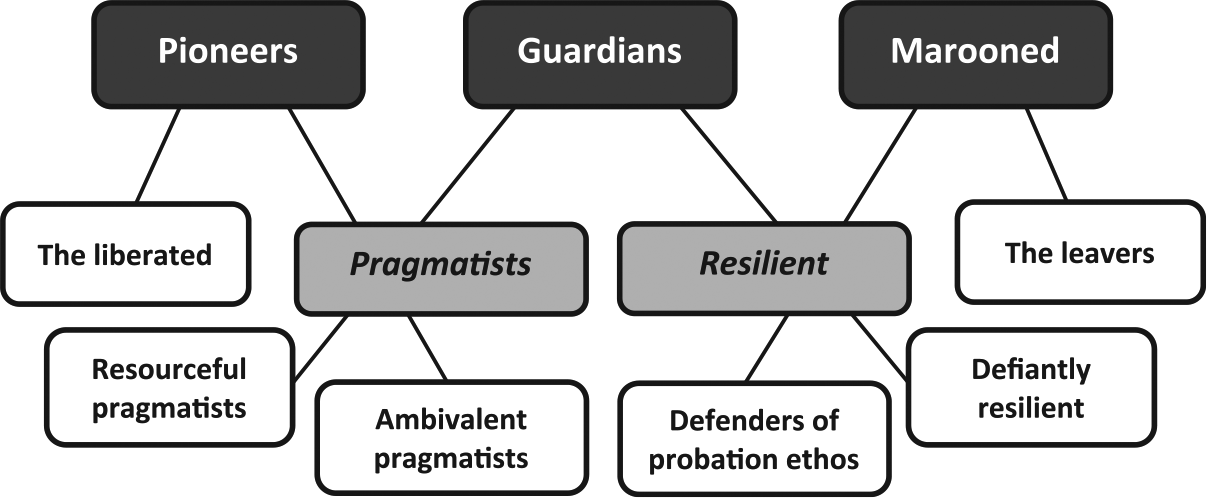
Identification of emergent probation occupational cultures as developed from Waring and Bishop’s (2011) typology of occupational identity narratives.
We observed elements of each of these types during our research, although the guardian and marooned types tended to be most prevalent among those longer-serving staff. For some staff the organisational split and creation of the CRC had provided an opportunity to develop their careers and take on new responsibilities. Senior Management in the CRC actively encouraged this, adopting a pioneering stance in the sense that they promoted the period before entering into new ownership as a ‘window of opportunity’ to rethink how services were delivered locally and develop new ways of working. On one level this pioneering spirit came from being a smaller organisation which could be more responsive to issues as they emerged and allowed new ideas to be fed into the decision-making processes more quickly than before. Interestingly, the Senior Managers in the CRC adopted similar techniques to those managers observed by Waring and Bishop (2011) in the ISTCs to build the legitimacy and identity of the new organisation. This included a series of engagement events and away days at which managers reiterated their aspirations for practice excellence, quality of service and more efficient and cost-effective delivery. They also made regular use of performance data that served to reassure staff that standards were being maintained (and in some cases improved) but also acted to highlight areas of poor performance and unmet contractual obligations (with the concurrent threat that this would be unacceptable under private ownership).
Despite significant anxieties about the wider application of commercial enterprise to probation practice, when we delved deeper we found that some staff beyond the senior management team in the CRC had also been energized – particularly by the prospect of improved IT systems, relaxation of national standards and a renewed emphasis on rehabilitation and meaningful engagement with service users:
The reason I find this change exciting is because the system that I loved and always wanted to be a part of, I found stifling. I’ve always felt like I’m working with shackles on, that it’s so rigid and it’s so prescribed, and it didn’t allow for me, as an individual who has […] I’m an ideas kind of person; creative ideas and creative ways of working, which the probation system didn’t allow for. Basically, TR goes, ‘let’s just cut those chains off you’ and I take them off. (Middle Manager)
A number of those interviewed had wanted to work in the CRC because they felt that the NPS would be too preoccupied with the management and surveillance of high risk cases and remain tightly controlled by the centre:
They are now civil servants, they’ve got to sign different documents and get used to a different support structure. Their culture is changing already. Ours is changing because we’re now coming up with our own values. We’re trying to create a brand. Those cultures are changing and they will change again. (Middle Manager)
In this respect some of those interviewed in our study felt liberated from what they saw as the overly ‘command and control’ approach of the National Offender Management Service which they felt had restricted the autonomy of the former Trust and had made it less responsive to local issues:
I came into probation to work with people that was what I wanted to do. I think over the last few years, things have become far too much office based and computer based and assessment based. At your desk, rather than with people. I am seeing the CRC as an opportunity to change that I suppose. (Probation Officer)
Others too sought to see the potential and the opportunities that reform could create. These resourceful pragmatists appeared to accept and process the changes – however opposed they may have initially appeared to be – and set about experimenting and innovating. In our host CRC area such innovative practice could be identified around developing early intervention behavioural programmes provision and building new models of working with, and referring service users into, multi-agency service providers. These two work packages were heralded as new initiatives, benefitted from Senior Management support and were seen as capable of generating income in the future. However, in both examples the operational activities that ensued were as much a result of the creativity and industry of the resourceful pragmatists developing new service provision as it was the CRC seeking to position itself in a new evolving marketplace of offender management services.
Notwithstanding their ‘pioneering spirit’, Senior Managers in the CRC also quite explicitly adopted the guardianship role and talked of a duty ‘to steward the organisation […] [to] carry through the values that we want for the next iteration’ (Senior Manager). Within the wider CRC staff group many of those interviewed continued to display a strong sense of loyalty to probation work and their former local Probation Trust which they commonly described as a ‘family’; although, as we have noted elsewhere, this sense of loyalty did not transfer unproblematically to the CRC (Robinson et al., 2016). CRC staff appeared keen to hold on to their former ‘probation’ identities, not least in public fora. Several interviewees gave examples of conversations or meetings with external organisations in which they consciously chose to describe themselves as being ‘from probation’ (see also Robinson et al., 2016). Like those in Waring and Bishop’s study, those staff who displayed the characteristics of guardianship in the CRC also tended to emphasize the needs of service users. Staff often conceptualized their guardianship role in terms of wanting to minimize the impact on service users of the organisational upheaval that had resulted from the implementation of the Transforming Rehabilitation reforms: ‘I can actually now say hand on heart it doesn’t matter who I work for, I know I’m still working for the public to reduce risk. It’s just that the Secretary of State is no longer paying my wages’ (Probation Service Officer).
Guardianship in this sense revolved around an enduring commitment to deliver quality probation services. In one respect the ambivalent pragmatists (arguably the largest group) were driven by a sense of ‘business as usual’ and their pragmatism informed a sense of not dwelling upon or being distracted by the wider context of reform. But for others their stance was very much informed by a defence of a vocational profession and ethos they valued. They blended resilience with pragmatism in an attempt to mediate and manage the impact of the reform and ensuing organisational changes, in order to remain resolutely focused on their deeper and enduring commitment to a probation ethos and set of probation values:
We need to be looking at what the priorities are and my own headspace at the moment is very much around domestic abuse and safeguarding issues, because that’s a very, very clear imperative […] how that establishes itself and works through on a day-to-day basis for members of staff, I think that needs to be determined, but as long as you can see progress, then I don’t care […] I don’t care if you’re following paragraph 321 of a policy or whether you’re just doing it because you understand it and you understand it’s good practice […] you get the point and you understand why you should be doing the job. (Middle Manager)
The number of staff presenting ‘marooned’ characteristics in our study was small but often vocal and they tended to be active in the local branch of the National Association of Probation Officers (Napo). In the most extreme cases the sense of being marooned led people to leave or to be seriously contemplating leaving the organisation. Those marooned employees who stayed were also characterized by their ideological opposition to what they saw as a shift ‘from the logic of the public good to the logic of the market’ (White, 2014: 1002). The sense of powerlessness associated with being marooned was reflected in the following quote which not only captures the sense of personal loss but a wider concern for other colleagues who were experiencing this involuntary change:
I feel devalued and de-skilled, by dint of a fairly random date to be chosen and I find that really hard to swallow and I feel for colleagues who, all of sudden, are told they can’t do something that they feel they’re good at. (Probation Officer)
The sense of distance from decision-makers and decision-making processes here is apparent. For some staff the sense of being disempowered and harbouring deep antagonism towards the reform agenda led to a defiant resilience. Their defiance manifested itself in their voicing of concern and dissatisfaction to management and others in raising awareness of the difficulties of their role. Their resilience was marked by their commitment to probation values and their service users to keep performing their roles in spite of their deep opposition to organisational reform and the compromised job satisfaction they reported. Where individuals’ defiant resilience was played out most powerfully revolved around the pressures they reported in meeting performance targets set within the contracts for CRCs. These targets were viewed as more onerous than previous expectations and the perceived heightened organisational emphasis on delivering on them was viewed as undermining their professionalism and added to their sense of feeling marooned:
This line of work is, I’m not bigging it up but it’s difficult. There’s a burnout point. Processing people is not processing objects […] to say you’ve got to produce [a sentence plan] in 15 working days and you think, ‘I’m only going to see that guy once in that time and I’ve got 60 other cases’, it’s not going to happen, is it? Well it is going to happen but it’s not going to be what you would expect it. Yes, you can’t process people I would say. I think they think you can. I think that is what they’re going to try and do, they’re going to process people. (Probation Officer)
Although typologies such as the one developed by Waring and Bishop provide a useful lens through which to explore the adaptation of individuals as they come to terms with significant organisational changes, they cannot completely capture the nuances and complexities of human behaviour which is rarely static or tied to a single or fixed identity. Moreover, in the case of the CRC workers we observed, it is possible of course that these characteristics might have pre-dated the changes brought about by Transforming Rehabilitation but, as Campeau (2015) notes, it is during these ‘generative moments’ of profound change and instability that they are brought most sharply into focus. In general, those probation staff encountered in our research displayed a high level of pragmatism and resilience in order to ensure that it was ‘business as usual’ despite their internal ideological opposition to Transforming Rehabilitation and apprehensions regarding the new arrangements. This in turn appeared to serve as a coping mechanism that enabled them to sustain and protect their professional habitus within the changed organisational field.
Exiting or Accommodation
Given the general organisational upheaval that provided the backdrop to the research it is perhaps unsurprising that, for some staff, the process of migration from the Probation Trust to the CRC was marked by a further migration in the form of leaving the organisation. Drawing on the model developed by Hirschman (1970), Mawby and Worrall identify ‘exit’ as one of a number of ways that employees respond to adverse workplace conditions. Exiting can involve the actual process of leaving the organisation or psychologically withdrawing and therefore no longer identifying with it. Staff turnover is a natural feature of organisational life and indeed many of the Senior Managers of the former Probation Trust had left the organisation in the period preceding the implementation of the new organisational arrangements, with the result that the CRC management team was somewhat inexperienced at the onset of the Transforming Rehabilitation reforms, and some managers were having to adapt to their new organisational responsibilities while at the same time implementing widespread organisational changes. However, it would also seem that across the organisation as a whole, the organisational turbulence and ongoing uncertainty caused by the implementation of Transforming Rehabilitation might well have speeded up the exiting process for some. Of course not everyone wanted to exit the organisation and the opportunity for individual workers to act on a desire to leave the organisation was often shaped by their personal circumstances, as discussed below.
Mawby and Worrall’s construction of ‘ideal types’ of probation worker referred to earlier can be usefully deployed here as an analytical tool to explain the process of migration through exiting that took place during the period covered by the research. The ‘lifers’ in our study, like those of Mawby and Worrall, tended to have spent most of their professional lives working in the probation service. These were characterized by their idealism and belief that probation work was a vocation. Many of them had been trained as social workers and saw a career in the probation service as a means to confront inequality (Mawby and Worrall, 2013: 27). Some of the lifers in our study who exited the organisation during this period had been thinking about leaving the organisation for some time as they felt that their personal values were increasingly coming into conflict with what they viewed as a preoccupation with targets, performance outputs and managerialism. Although their disillusionment may have pre-dated Transforming Rehabilitation, for this group the migration to the private sector marked a line in the sand and, because of their age and the voluntary redundancy packages on offer, they were able to act on their desire to exit the organisation.
The second group of probation workers identified by Mawby and Worrall were those individuals who had joined the probation service later in their careers, having been employed in other occupations. These were characterized as ‘second careerists’. Some of those who were identified as ‘second careerists’ in our study had exited the organisation because they felt that the changing nature of probation work was increasingly in conflict with what had attracted them to join the organisation in the first place (i.e. an interest in working with people or the greater job security which they associated with the public sector). Although both ‘lifers’ and ‘second careerists’ generally held common values and attitudes, these tended to be less strongly held in this latter group who had pursued other careers even though they may not have always found them rewarding. Some of the ‘second careerists’ in our study who were not in a position to physically exit the organisation because of their financial circumstances continued to psychologically exit in terms of becoming increasingly disillusioned and demotivated. Others took advantage of the window available to apply for posts in the NPS without adversely affecting their existing terms of employment, believing that it offered greater job security and status than the private sector.
The final ideal type identified by Mawby and Worrall were the ‘offender managers’ who tended to be more recent recruits with varied occupational backgrounds and who saw probation as one of a number of jobs they may undertake throughout their careers. The ‘offender managers’ tended to be younger members of staff who joined the probation service after 1997 and trained within the Diploma in Probation Studies framework. According to Mawby and Worrall, while this group shared a principled rehabilitative approach to working with offenders with those characterized as ‘lifers’ and ‘second careerists’, they were also much more pragmatic and likely to leave the probation service if the organisation failed to provide them with opportunities for career progression or promote ways of working with offenders that were congruent with their personal beliefs. As such they were the group most likely to ‘exit’ the organisation if it failed to meet their occupational needs. Significantly this group, perhaps reflecting the nature of their training, tended to be more comfortable with the increased emphasis on public protection, risk assessment and risk management that had become the dominant features of contemporary probation practice. Some of the Probation Officer grade staff we interviewed in our first sweep of interviews subsequently left the organisation for jobs in the National Probation Service when provided with the opportunity to do so, believing that working with high risk offenders, undertaking risk assessments and attendance at multi-agency public protection meetings (MAPPA) was more attuned to their professional skill sets. However, a number of those individuals who could be characterized as ‘offender managers’ chose to remain in the CRC, believing that it offered greater potential for career advancement.
These migrations, in-and-out of the organisation, resulted in a significant turnover of staff, with the majority of staff and managers remaining in the CRC being of the ‘offender manager’ type identified by Mawby and Worrall (2013). It will be interesting to see whether or not this further entrenches the desire of successive governments in England and Wales since the 1980s to change the ethos and focus of probation. Two dominant strands were evident as new staff entered the organisation to replace those who had exited. First, the majority of new entrants tended to be young women, thereby increasing the trend towards the ‘feminization’ of the probation workforce as highlighted by Annison (2007). Second, many of these new staff had not previously worked in probation and so did not possess an ‘organisational memory’ of it as a ‘unified’ public service. Many of them had been previously employed in the voluntary sector and were therefore more accustomed to precarious short-term employment, often tied into funding streams, and like the offender managers identified by Mawby and Worrall, did not necessarily see working in probation as a long-term career or vocation.
Probation Migration: A Unique Case?
It is likely that the exiting of probation staff will increase following announcements nationally that some of the new owners intend to reduce their staffing costs by up to 40 per cent (Napo, 2015). Equally there seems little to indicate that the migration of workers from the private to the public sector (NPS) will not continue in England and Wales for the foreseeable future at least. The experiences of probation staff following the implementation of Transforming Rehabilitation therefore provides a particularly instructive insight into the impact of migration/diaspora upon occupational cultures, although our contention is that it has some unique features that distinguish it from other public sector migrations.
First, in the case of probation, the migration from public to private ownership was not a linear process involving a straightforward takeover by the private sector. The speed with which the legislative provisions were enacted was such that the preferred bidders were not in place when the former Probation Trusts were dissolved. This meant that the publicly funded but privately minded CRCs acted as a ‘holding tank’ between the dissolution of the Probation Trusts and the transfer into new private ownership. This created an additional, and prolonged, period of uncertainty for those affected by the migration process as captured in the following response from a Senior Manager in the CRC:
You’re driving kind of on a route map of not really knowing where you’re going, but you’re on a journey. Which seems quite a strange thing to do, doesn’t it? ‘Let’s go for a drive.’ ‘Where?’ ‘I don’t know, but let’s go for a drive.’ That’s what we’re doing.
Second, and perhaps most significantly, not all probation staff were migrated into private ownership. This was a partial privatization in that the public sector element of probation work was retained through the creation of the NPS. This introduced a new interface between the NPS and the CRC and issues around risk escalation decisions will no doubt continue to be crucial to the efficacy of the new operating structures. HM Inspectorate of Probation (2016) have highlighted some of the early implementation problems around poor communication and the lack of clarity surrounding their respective responsibilities but they do not capture the whole story of the potential longer-term impact upon probation occupational cultures and the tensions and deeper fault lines that have resulted from this. Over the course of the research we observed the emergence of a more business-like relationship between the two organisations as they increasingly came to see themselves as separate entities with different responsibilities and accountabilities. This would appear to have created the potential for a new site of conflict as reflected in the following quote:
There is only a spiral staircase linking NPS and CRC, but I’m very conscious of how little I use that staircase and how, when I go downstairs to use the kitchen on the floor below, I feel like I’m in someone else’s territory. (Operational Support Staff)
This was exacerbated by the fact that throughout most of the research, both the NPS and CRC staff were located in the same buildings; although this may change as a result of the estates review undertaken by the new owners of the CRC.
Conclusion
This article has focused on the movement of groups of probation workers through a process of profound organisational change. Our research has tracked individuals who were employed in the public sector Probation Trust through the establishment and early operation of a privately owned Community Rehabilitation Company. Recording and exploring this group’s experience of change has demonstrated that adapting to major organisational restructuring can be difficult and that it is not always easy to reconcile change with established ways of working and prevailing forms of identification. The decision to partly privatize the probation service and the subsequent migrations to the NPS and CRC has not only had a profound effect upon those staff directly, but it also potentially threatens the conceptualization of a collective probation ethos in a number of respects. First, while we did not observe the wholesale substitution of public values and altruistic dispositions for private enterprise 9 during the course of the research, it was clear that the imperatives and language of the private sector were increasingly infusing CRC thinking and some staff were finding this more difficult than others to reconcile with what they viewed as the traditional ethos of probation. Nearly all those workers interviewed were keen to hold on to a notion of ‘public service’, even if this was no longer located within the public sector, and their hopes for new ownership were often implicitly tied to their perceived ability to do this. Their anxieties in this respect often revolved around uncertainty in how profit maximization could be reconciled with the delivery of ‘public service’, and the operational credibility of their organisation in the eyes of service users and criminal justice practice partners.
Second, the restructuring of established working relationships, both within and external to the case study area, have renegotiated the distribution of status and power between the various stakeholders in offender management, particularly in respect of the interface between the NPS and the CRC (HM Inspectorate of Probation, 2014, 2015, 2016; Robinson, forthcoming). The reforms have resulted in a significant loss of capital to the nascent CRCs as many experienced staff have subsequently left to join the NPS or decided to seek alternative employment. 10 Some of those staff interviewed in our study clearly resented what they perceived to be the creation of new hierarchical professional identities.
Third, the reconfiguration of probation service areas (and the probation staff groups working within them) into regional structures and contract package areas has consequences for the endurance of locally formulated area based loyalties that can be powerful influences on how individuals and collectives operate. This is likely to become more pronounced as the new owners of the CRCs develop and implement their individual operational models. These models are likely to promote more flexible and ‘agile’ working practices in terms of job roles and duties, as well as the movement of staff between locations, and existing staff may well continue to exit. As Deering and Feilzer (2015) note, different cultures are likely to emerge as the new owners of the CRCs seek to assert their organisational ‘brands’, and this may mean the end of a collective probation ethos.
This is not merely a question of the potential fragmentation of service delivery, as undesirable as this may be, which many critics of Transforming Rehabilitation feared. Probation workers may now be located in separate territories but they share a common heritage that transcends organisational and sectoral boundaries. These are the ties that have bound probation workers to ‘an honourable profession’ (Mawby and Worrall, 2013: 154). We have found the application of the concepts of migration and diasporic communities useful to identify the potential for groups within probation services to continue to share a collective (occupational) memory and to make sense of an uncertain and evolving policy and practice landscape around them. These tools have helped to demonstrate how uprooted individuals have felt by the pace and scope of the change Transforming Rehabilitation initiated, and they help capture how individuals articulate and mobilize their occupational values to shape their identity. These processes underline the observation that the importance of probation lies in the values that it represents as much as what it technically is. We are confident that those workers employed within the new organisational arrangements will continue to practise in a ‘civilly courageous’ manner (Worrall, 2015: 509) and hope that the new owners will be sympathetic to this. Our concern is that although the organisational values adopted by the owners of the CRCs may well seek to embrace the best traditions of probation practice, ultimately altruistic public service may only be actively supported if aligned to other commercial imperatives.
Footnotes
Declaration of Conflicting Interests
The author(s) declared no potential conflicts of interest with respect to the research, authorship, and/or publication of this article.
Funding
The author(s) disclosed receipt of the following financial support for the research, authorship, and/or publication of this article: This work was supported by the Economic and Social Research Council (Grant Number ES/M280000/1).