



Abstract
Anchored in Ostrom’s (1990) account of Governing the Commons, this article discusses community-based mechanisms and their potential implication for poverty alleviation and well-being improvement of societies. The material for this article draws on our research report on the application of community-based tourism (CBT) as social innovation for poverty alleviation and social well-being improvement in the Nglanggeran village from 2009 to 2016, which continues to be monitored to date. Our findings indicate that community-led initiatives have been successful in alleviating chronic poverty and social problems by integrating local institutions and developing resource-based businesses. However, recent government intervention has limited the initiatives, highlighting a power imbalance between government agencies and the community. Consequently, CBT has become an industry reserved for a select few villagers who have formed partnerships with the government. It reveals the recurring problems of government–community partnership, which, over the last two decades, has expanded in many Southern countries and has resulted in contestations of political interest within the empowerment programme, all of which produced institutional constraints to ‘commons approach’ application to governance. This article contributes to understanding the dynamics of empowerment initiatives by highlighting the intersection of collectivity and welfare capitalism as an analytical framework, enabling the application of ‘the commons theory’ within community/social development studies.
Introduction
This article examines the impact of community-based mechanisms on poverty reduction and societal well-being, utilising Ostrom’s (1990) idea of Governing the Commons. The notion of ‘commons’ in governance is perceived as an exemplary model, surpassing both market and state approaches in terms of democracy.
The state-based approach seeks to mitigate externalities through the assumption of resource stock ownership and the establishment of access regulations for resource users. In contrast, market conceptualisations centred around the West prioritise the attainment of maximal exclusive and private rights over common pool resources (CPRs). (For more in-depth discussions on scholarly debates regarding CPR, refer to the works of Bromley, 1991; Ostrom, 1990; Dasgupta et al., 1997; Hess, 2001.) Despite being a frequently discussed activity in governance research, political economists specialising in developing country studies must pay more attention to the state–market nexus. Based on this decentralised approach, ‘The Common Approach’ posits a broader definition of governance that transcends the state–market dynamic. Such an approach may entail the participation of local communities in development project representation.
In order to gain a deeper comprehension of the application of Governing the Commons in developing societies, we examine the Nglanggeran instance in Yogyakarta, Indonesia. In this case, the over-exploitation of resources with competing uses and excessive excludability—known as the ‘tragedy of the commons’—is stopped by using community-based tourism (CBT) as a successful programme to manage natural resources (Hardin, 1968). For over 20 years, research on CBT has demonstrated that it has become a significant instrument for sustainable development, especially in rural and suburban regions (Hong et al., 2021; Juma & Khademi-Vidra, 2019; Nugroho & Numata, 2022; Tam et al., 2022; Yanes et al., 2019). However, its contribution to averting the tragedy of the commons has not received much attention. The success story of the Nglanggeran village transformation is examined in this study, which builds on the implementation of Ostrom’s (1990) framework for Governing the Commons in empirical research and connects it with the themes of the CBT literature previously explored. The study also highlights the difficulties in accomplishing their sustainability objectives, particularly in avoiding resource over-fragmentation that can increase excludability. Thus, the study offers a fresh perspective on community development literature.
The case study’s discussion refuted that common property needs to be better managed and regulated through privatised or centralised power structures. It also served as an example of cooperation amongst socio-economic groups in natural resource governance. The Nglanggeran case also demonstrates the potential of collective governance to overcome poverty problems by integrating institutions and developing local resource-based businesses. In this case, village managers successfully developed participation as a CBT model through a group of youth called Karang Taruna, which was given the concession to manage a land area of 48 hectares in 1999. They then joined Pokdarwis, a tourism-conscious group formed by the local authority, to develop ecotourism in the village.
Our paper draws on the result of our project report for Gadjah Mada University and the Ministry of Tourism and Creative Economy about natural resource management managed collectively by rural communities located on the edge of a forest in the Greater Gunung Kidul area, Indonesia, with Nglanggeran being the core of the project. The project’s primary goal was to seek social innovation to enhance the economic and social well-being of the community in the village from 2009 to 2016, and it has continued to be monitored since then (discussed further in the Methodology section).
This article initially addresses the concept of common theory to bridge the connections with the case study we look over. The third section deals with methodology, and the fourth section narrates the historical background of Nglanggeran village and the unfortunate ‘Tragedy of the Commons’ that resulted in poverty in the community. This condition served as our motivation to initiate a project for the first time in 2009, aimed at empowering the village. In the fifth section, we address a general picture of how the village carried the process of transformation and institutional underpinnings required to establish a ‘commons’ governance system that empowers the village. The sixth section discusses the challenges we faced in achieving commons governance, which further motivated our upcoming empowerment project on the site. Finally, we summarise our findings and discuss future research opportunities in the social development field.
To sum up, this study broadens the scope of intersectional governance research. It incorporates CBT or community development by bringing up the topic of ‘empowering communities’ within the context of a broader social development study.
Literature Review and Theoretical Framework: Expanding ‘The Commons’ and Its Linkage to CBT
Property rights are important for understanding public goods issues and refer to the rights of individuals or groups to benefit from assets and exclude others. In the case of the CPRs, a lack of just resources ownership like property is highly possible, creating the common tragedy, where individuals prioritise their own self-interest and finite resources are exhausted, posing a challenge to sustainable development (Bromley, 1991; Dasgupta & Maler, 1997; Hess, 2001; Ostrom, 1990).
Elinor Ostrom, the 2009 Nobel Prize winner, has assessed the historical perspective that informs natural resource management and governance. Decades of observation throughout numerous studies with instances, concepts, analytic techniques and findings reveal a trend towards two extreme two-extracellular pendulums: the market and the state. Ostrom claims that these researchers created new theories to account for inappropriate phenomena in the dichotomous world, but they based their research exclusively on classical economic theory.
Human motivations are complicated and shaped by various organisations, including governmental, corporate, private and communal ones. This motivation aims to sustain life on a large scale and produce beneficial or harmful outcomes, depending on the situation. In these circumstances, Ostrom (2009) challenges the previous mainstream perspective that resources such as property in the hands of the common always have a weak management model to the point that the state/government must take over through centralised power or give it away to the private hand. Instead, she argues that local communities themselves can effectively manage common property. She (1990) also considers in her influential work Governing the Commons what might be needed to find sustainable, cooperative solutions to the tragedy of the commons and suggests how communities of individuals develop the capacity to create those conditions for themselves.
The structure of these complex societal problems also encouraged Indonesian economist Mubyarto (2005) to consider the problems of managing economic resources from a different perspective. If most economists make economic analyses solely from behind the desk, he always visited remote villages to better understand the complexity of the problems faced by people’s economy. Before passing away in 2005, he wrote a book titled A Development Manifesto: The Resilience of Indonesia’s People’s Economy during the Monetary Crisis. The book was published after he conducted fieldwork every month in many provinces, regions and villages, covering even the remotest part of the heartland from 2000 to 2002. Among the criticisms offered by Mubyarto is the common use of a neoclassical economic theory that places much emphasis on efficiency (and growth) while underestimating justice (and equal distribution). The viewpoint of that book was assessed by Daniel W. Bromley in the foreword thus:
In pondering Indonesia’s economic future, few economists have been as thoughtful and penetrating as Mubyarto. The essence of a true scholar is found in the pertinent questions being asked. The fundamental problem in our time is to rescue ourselves from the contrived absolutism of ideology—whether the ideology of globalization or an ideology of moral superiority of one form or another; in those days of ideology (both East and West) was quite suffocating.
Such dichotomous trends also actually emerge in Fleischman’s (2014) account, showing how the pattern of forest resource management in Indonesia is coloured by the tendency towards a centralistic pattern by the state and privatisation. He evaluated the use of the CPRs theory in practice and related it to the level of forest destruction from 1965 to 2012. He analysed two periods: 1965–1998, when Indonesia was under the New Order regime, with a centralised government, and 1998–2012, when it was under the Reform Order. The CPR theory generated a prominent policy debate related to the decentralisation of natural resource management in the late 1990s. This condition can open up opportunities for the application of the CPR theory, especially to demonstrate the success of managing small-scale natural resources. At the local level, various thoughts outlined in forest governance place much importance on the participatory role of humans as drivers, so that patterns become the best choice, while at the national level, the patterns of thinking that manifest in policies are not developed based on participatory or collective governance, but are rather top-down, still placing people only as ‘objects’.
During a more extensive discussion, the implementation of CBT, as outlined in the paper, is viewed as a viable solution for addressing the detrimental environmental, economic and socio-cultural impacts that arise from tourism, such as monopolisation or control of tourism operations by an elite group (see Gutierrez, 2023, for a comprehensive overview). Multiple studies have highlighted the importance of community viewpoints in effectively managing the interests of various stakeholders and serving as the main providers and managers of resources, services and experiences at a destination.
It is evident from this section that ignoring consideration of top-down bias when creating analytical models has left experts and decision-makers ill-prepared to integrate pertinent scientific and policy-related information into efforts at mitigating various environmental issues. Thus, it would be wise to prioritise shared governance and acknowledge the potential benefits it could have in preventing the tragedy of the commons and addressing the pressing social and environmental challenges.
This notion of the commons in the Nglanggeran case, which forms the setting for this case study, resonates with Andereck’s (1997) argument that managing resources using CBT can enhance the status of the venue as a public territory, for which common governance as proposed by Ostrom may be applied. Additionally, the social space described in this study may qualify as emergent commons, characterised by the gradual establishment of a recognisable set of rights not officially recognised in a realm with multiple conflicting interests.
Methods
This article aims to enhance the current body of research by presenting a comprehensive analysis of the implementation of CBT to enhance the welfare of the local community in Nglanggeran village, Indonesia. This research is unique in its analytical examination of a well-established framework called ‘Governing the Commons’, and its integration with the concepts found in the CBT literature. This integration serves as an epistemological foundation for analysing social growth and community welfare. Data for this article draw on longitudinal participatory action study report of community-based natural resource management in multiple case studies in localities in the Gunung Kidul area during 2009–2016. The research was commissioned by the Ministry of Tourism and Creative Economy, in collaboration with Gadjah Mada University to better understand the area’s potential for social innovation to manage their natural resource for economic and social well-being.
Our project was also made possible due to long-term and ongoing relationships between the Gadjah Mada University and local communities, based on productive collaboration. It brings together researchers, students, extension personnel, farmers and other related actors to co-create evidence and knowledge with locals to cultivate social innovation for managing local traditions and natural resources as alternative tourist sites; the details of this process are outlined in the subsequent part.
As this research adopts a participatory approach, researchers, along with stakeholders, are engaged in every single step of the empowerment initiatives and provide advice on suggestions for improvement. This article chose the specific case of Nglanggeran as it represents the most significant outcome among the other village projects handled. The success and dynamics of Nglanggeran are, thus, shared as a scholarly manuscript with the theme of governing the commons.
The project report utilised many methodologies, encompassing immersive engagement and interviews with 23 stakeholders. The participatory research obtained ethical approval from the Universitas Gadjah Mada Research Ethics Committee. The project was overseen by a Project Advisory Group of a professor from Gadjah Mada University, officials from local social affairs and representatives from the Nglanggeran community. The group offered expertise in research design and actively participated in discussions regarding data interpretation with the research team.
Furthermore, the participants in a research study were given pertinent details regarding the investigation before its initiation. They were assured that their identities would be kept anonymous in all reports about the study. They were also allowed to refuse participation if they so wished.
Our data are largely managed to unravel the longitudinal progress of empowerment and the outcomes of villages, informed by a wide variety of in-depth, participatory action research. All evidence was transcribed verbatim manually. The researchers conducted a thorough examination of the gathered information to verify its veracity after the collection of interview data. The information was classified into different thematic categories, which were further explained in the section of the paper dedicated to presenting the study findings.
Poverty and the Tragedy of the Commons in the Past in Nglanggeran
Nglanggeran village (700 metres above sea level) is an ancient volcano-based land formed around 0.6–70 million years ago, which has a tertiary age and very typical rocks dominated by volcanic agglomerates and breccias.
The village has a population of 2,680, down from 2,726 in 2008. The village website shows the figure to have declined again to 2,621 people or 820 households in 2018. The decline is not significant and is closely related to urbanisation for a better livelihood, inter alia.
Certain agricultural occupations, such as farmer and peasant, are regarded as low-potential professions, particularly among young people. Similarly, the agriculture sector nowadays is similarly regarded as less auspicious for enhancing welfare. Comparing the labour force and livelihood data for the two years is an intriguing exercise (Table 1). Of the total workforce, if the number of people engaged in agriculture in 2008 was 1,407 consisting of 678 farmers, 678 peasants and 51 farm labourers, by 2015, the number had come down to 841 farmers, 7 peasants and no farm labourers at all. In 2015, though the number of farmers shows an increase to 841 when the total number of engaged in agriculture (848) is considered, there is a reduction of 40% from the 2008 figure of 1,407.
Comparing Different Livelihoods in a Monograph 2008 and 2015.
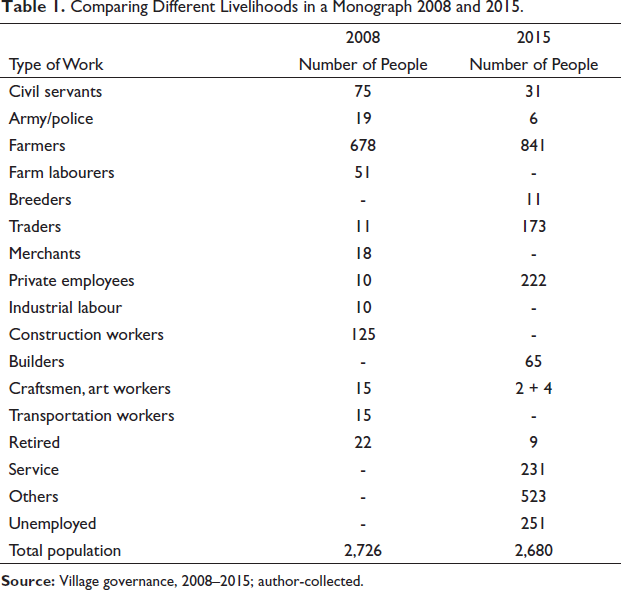
The agricultural sector’s failure to adequately meet the economic requirements of its dependents is compelling them to transition to alternative sectors, such as seeking employment outside the village through migration. Prima facie, some categories of livelihood not listed in the village monograph in 2008 appeared in 2015. These categories were farmers, breeders, artisans, individuals in the private sector and those without employment.
The predominant agricultural practice among the population is primarily dryland farming. Despite the scarcity of water, rice fields continue to hold significant importance for the community. The rice cultivation area is 27.34 hectares and is cultivated for a duration of one year, specifically during the rainy season. Additional agricultural products comprise ‘palawija’ crops, such as maize, cassava, peanuts and soybeans. Significant fruits such as rambutans, bananas and durian are also cultivated.
Some people also cultivate plantation crops such as cloves and chocolate; however, the quantity is minimal. The primary economic activity in the region is the utilisation of wood resources, including teak, acacia, sandalwood and mahogany, from both community and state forests in the surrounding communities. The community’s wood products are presently utilised as industrial raw materials beyond the village, especially in the adjacent village of Putat.
Nglanggeran may seem prosperous and well-endowed with resources, based on the given information. However, just a few years ago, before the implementation of the CBT initiative, the reality was quite different. Many of the villagers were living in poverty. The number of people of Nglanggeran registered as poor rice recipients, or the programme called Beras Miskin (Raskin) aims to distribute certain low quality of rice to the less unfortunate groups, is 300 homes distributed throughout 5 hamlets in total, forming 42.8% of the total 700 households. There is an interesting recognition of the poor families who responded to the survey when they were asked to show their family’s position in the community, to check whether it fell within the five categories based on prosperity. The first category is the most affluent, the second affluent and the third moderately affluent, while the fourth and fifth are less affluent and the least affluent correspondingly.
During the previous study in 2013, the local government recommended the village for classification as poor but not the poorest (See table 2). However, upon preliminary observation, it was found that poverty was not as severe as anticipated. This led researchers to question why the village was labelled as poor and what characteristics of poverty were experienced by the community. A small survey conducted in 2009 further fuelled these doubts. According to the village government’s list, 300 households were registered as poor and eligible for Raskin-rice, which is 42.8% of the village’s 700 households. It was interesting to note that when poor families were required to demonstrate their standing within the community, they identified and emphasised five distinct sorts of affluent groups. The initial group exhibited the highest level of prosperity, whereas the second group showed a similar level of prosperity, and the third group had a moderate level of prosperity. The fourth group was relatively less prosperous, while the fifth group was the least prosperous. The welfare survey results unveiled a notable disparity between the perspectives of the ‘impoverished individuals’ and the policymakers responsible for allocating Raskin. Although politicians perceive it as beneficial, a significant number of impoverished households do not deem it necessary.
The Impoverished’s Perspective on Welfare.
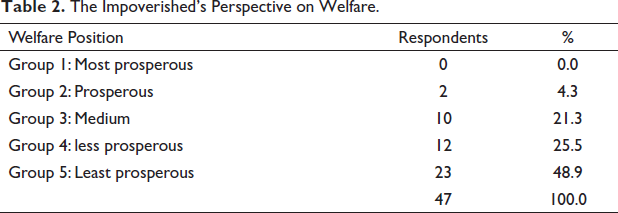
The conclusion is that poverty exhibits significant heterogeneity, encompassing both the incapacity of individuals to satisfy fundamental living necessities and a broader comprehension that incorporates social and moral dimensions. When linked to poverty resulting from inequitable land ownership, their individual and communal powerlessness becomes evident. The survey reveals the land ownership pattern of villagers as follows: Out of the total, 89% of individuals possess less than 0.5 hectares of land. This group is further divided into 21% who own land between 1,000 and 2,000 square metres, 21% who own land between 2,000 and 5,000 square metres, and 47% who have less than 1,000 square metres of land. Residents have found the problem is attributed to adverse environmental circumstances and reliance on external sources for agricultural inputs, including seeds, fertilisers and pesticides. Efforts have been made to address this issue through the implementation of improved cropping systems and the promotion of local inputs. This has partially alleviated reliance. Regrettably, the manufacturing is still being marketed solely as raw materials. The absence of value addition thus reduces the economic value of the produce. Meanwhile, the intermediaries who connect producers and consumers benefit the most from improved profit margins. Thus, while producers get only a pittance as the selling price, the consumers end up paying high prices, the difference between the two being pocketed by middlemen or traders.
Distribution or marketing networks also influence the performance of an economic sector, which reflects the level of control over production factors acquired. Only a small proportion of producers (11%) engage in self-marketing or directly sell their produce in the market. There are several aspects to this. First, as the characteristics and volume of the production are small, transportation costs are high. Second, the middlemen who have the means of transport bring agricultural products to market. Third, the short-term need for cash renders producer farmers lacking in ‘hold goods until the price is good’. Furthermore, the farmers lack the capacity to perform value-added processes on their agricultural products.
Based on the survey, most of the family income is derived from non-agricultural employment, accounting for 35%, while agriculture only contributes 30%. Approximately 77% of the family’s expenses are dedicated to meeting their dietary requirements. The remaining funds are allocated to non-food routine expenses (6%), children’s education (12%), health (3%) and social and other expenses (1%). This condition signifies that the entering capital (cash inflow) is insufficient to finance the production of the local economy. Another notable discovery pertains to the comparative accessibility of funds within the community, encompassing both formal and informal establishments. These funds are primarily utilised to fulfil consumption requirements rather than to support production endeavours.
Poverty in Nglanggeran is attributed to the economic system’s poverty factors, as evidenced by the circumstances; unequal land ownership contributes to meagre income and small-scale production. Additionally, land tenure is generally inadequate, as are control and access to production inputs, including capital (both material and intellectual capital). Given the substantial expenses involved and the fact that 90% of farmers are unable to sell their produce directly to consumers or the market, additional value must be ‘relinquished’ to other parties with direct access to the market. Reliance on imported goods, both food and non-food, has a negative impact on public consumption, particularly when such goods are locally producible.
The issue of poverty among the villagers cannot solely be deduced from the aforementioned facts but should be contextualised within a framework of relationships with economic entities that have gained ‘profit’ through the enhancement of production and distribution.
Transforming Nglanggeran: The Application of Commons Governance in Practice
It is imperative to acknowledge that the conditions prevailing in 2016 and today vary significantly from those encountered during the initial fieldwork in 2009. Nglanggeran village’s CBT has gained widespread popularity throughout Indonesia, with numerous government officials, non-government activists, community organisations and large private sector and state enterprises selecting this location for comparative studies. Further, hundreds of thousands of individuals visit the village to appreciate its natural splendour, scale its ancient mountain peaks and witness cultural events. Notably, the governance in Nglanggeran village is deemed democratic and a model for governing the commons. Nglanggeran was awarded the ASEAN Sustainable Tourism Award in Chiang Mai, Thailand by the ASEAN Tourism Forum in January 2018, demonstrating that the application of the commons theory can be used as a learning resource for numerous parties. In this regard, our present study work functions as a ‘model test’ to assess the degree to which the depiction of commons governance develops in the village, as expressed in CBT.
In this section, we discuss three main topics. First, we present the positive outcomes of commons governance, expressed in the form of CBT. Second, we describe the institutional factors that drive the success of commons governance, which have been analysed by applying the polycentric theory of Ostrom. This theory focuses on the analysis of the organisation’s workings and the operation of the rules of play in society. The last part of this section delves into the decision-making process, which is a crucial aspect of effective governance practices. By exploring these topics, we hope to gain a better understanding of how commons governance can be effectively implemented and sustained.
Transformation Outcome
Commons governance, as one of the main objectives that increase the collective bargaining power of people, was primarily applied through institutional governance, which was creatively handled by young pioneers by integrating and collaborating socio-economic activities of the people. From the overall evaluation record, we argue that this innovation has led to socio-economic improvements, which means it has become difficult now to attach the ‘poor village’ label to Nglanggeran village. In fact, the village has become known as one of the favourite places in the Greater Area of Gunungkidul.
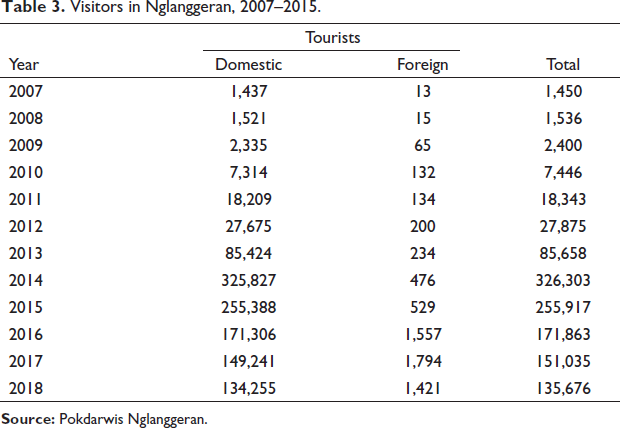
The data provided reveal a significant increase in tourist footfall to the village over the years. In the first year of the project (2009–2011), there were only 2,400 visitors, but in 2015, this number spurted to 255,000 (Table 3). This growth can be attributed to the implementation of collective bargaining, which has had a positive impact on the village’s economic development. It is worth noting that the number of visitors peaked in 2014, with 326,303 tourists; however, this number has since decreased due to management strategies aimed at limiting the number of visitors to protect the environment.
Visitors in Nglanggeran, 2007–2015.
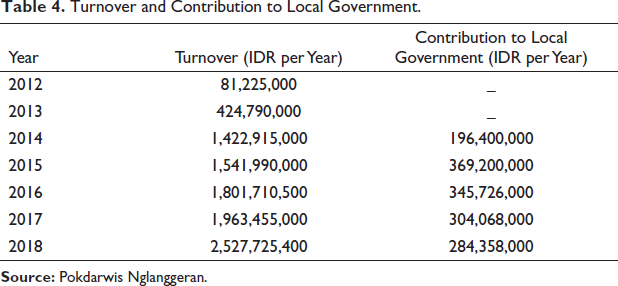
Notably, Table 4 reveals a surge in financial turnover over the years 2012 to 2015. In 2013, the turnover rose from IDR 81.2 million to IDR 424.7 million. The following year, it reached IDR 1,422.9 million, and in 2015, it peaked at IDR 1,542 million. Subsequently, the turnover has continued to escalate, with IDR 1,801 million in 2016, IDR 1,963 million in 2017, and IDR 2,527 million in 2018. This revenue can play a vital role in contributing to the local government’s income (PAD), which has been on a positive growth trajectory over the past four years (2014–2018).
Turnover and Contribution to Local Government.
Moreover, compared to what or how they were six years ago, the quality of locally owned goods and services that are currently offered collectively to travellers has also vastly improved. Some of them are (i) natural attractions consisting of vast rice fields near the area, stunning scenery and old volcanoes. Owed to the development of a bombing (mini reservoir) in 2016 on an area spanning 0.34 hectares, the village’s appeal as a tourism destination received a boost. This mini reservoir also functions to irrigate a fruit plantation spanning 20 hectares, apart from adding to the village’s scenic beauty. (ii) The management strategically incorporates the community’s tradition and culture into tourist packages, including traditional ceremonies, jathilan dance and resultant customs. Frequent occurrences of the event contribute to the sense of community cohesion, promote hospitality and harmony and sustain communal culture (gotong-royong), among other artistic and cultural traditions. (iii) Tourists can observe the process of creating masks and bracelets firsthand and can also receive instruction on how to make them. This educational resource is highly sought after by both international and domestic tourists, particularly students. (iv) Cassava brownies and dodol cocoa have emerged as the primary local cuisine; Rumah Coklat (House of Chocolate) is currently being floated by the management to become an outlet for local products, especially cocoa. (v) Besides the Nglanggeran mountain climbing route, artificial rides have also been developed, such as flying foxes, outbound games and packages for natural education (farming, cocoa production and environmental love), among others. Additionally, many locations offer advantageous positions for visitors to capture self-portraits.
Additionally, the physical amenities available to tourists have grown. The community co-managers currently offer a homestay option for individuals who wish to experience and embrace the daily life of the villagers, offered by residents prepared to accommodate tourists. Till now, there are 80 homestays, which can accommodate 280 visitors.
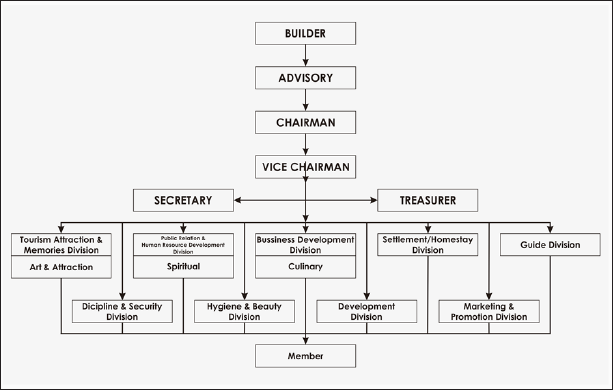
From the aforesaid description, it can be concluded that collaborative business has been developed through participative governance with collaboration with the community. The essential role of managers is in their ability to integrate various elements of prospective economic resources. From an institutional perspective, the resource management structure that impacts the ecotourism process comprises the core management team consisting of (i) 14 individuals who primarily oversee the management of nature tourism, specifically the ancient volcano and embung. (ii) The ‘Purbarasa’ collective comprises 55 female members who specialise in the production of processed food items, mostly chocolate and culinary delicacies. They also offer educational packages on cultivating techniques. (iii) The farmer group led by Kumpul Makaryo consists of 100 individuals who are actively engaged in the management of the area, particularly in matters relating to agriculture. (iv) The homestay owners’ organisation consists of 80 individuals who offer lodging for travellers seeking to experience both the rural lifestyle and travel opportunities. The homestay can accommodate a maximum of 280 individuals (See figure 1).
Organisational Structure of Pok Darwis.
The Institutional Underpinning of Transformation
Borrowing from the polycentric theory, inter alia, Ostrom developed an instrument called institutional analysis and development to describe the workings of the organisation and the operation of the rules of play in society. The aim is to look at the factors that influence the product of collective governance in terms of the biophysical aspects, community attributes and the rules in use. In the case of Nglanggeran, the pattern that developed is in line with polycentric, where the decision-making process concerning collective efforts emphasises the principles of substantive participation. Many factors cause these conditions to work and have been proven in the practice of developing collective business.
Potentially, there are quite a few social, economic and cultural organisations or institutions in Nglanggeran village, from the smallest units, dasawisma (ten households group), neighbourhood group (dukun tetangga) and hamlet or sub-village (Dusun), each of which has a regular meeting mechanism to discuss various common issues. Some organisations are traditionally related to certain attributes such as farmer groups, cooperatives, PKK (women groups), religious groups, traditional groups, arts, culture and others. Many groups related to socio-economic affairs were formed by the central government in the 1970s through the New Order regime. In the past, when the role of the ‘state’ was dominant, this organisation was used by the government to mobilise support (note: not to gain participation) for government programmes (cf. Klinken, 2018).
The most important functions of these organisations in the context of the theory of commons in this article are the activities referred to as routine meetings. Every group from the lowest to the highest level at the village level has a meeting. As the relationship between these institutions can also be said to be relatively autonomous, various problems faced by the members of the community can be discussed and solutions sought in the forum:
Here, we do everything together, especially important stuff every single day. On every matter, we try to be present face-to-face—the development of this tourist development included (from an interview with one of the stakeholders).
What is unique is that they usually determine regular meeting dates using a combination of the current calendar (Sunday to Saturday) and the traditional calendar that repeats every five days (pond, pahing, legi, kliwon, wage). For example, the Pok Darwis has a routine meeting every 35 days on Tuesday-klaxon. Besides that, there are several smaller meetings of the element or community, including hamlet Gurung Butak on the 20th of the month at 17:00 hours, in hamlet hall, hamlet Langerin Wetan on the 25th at 17:00 hours, Langerin Kulon on the 5th at 13:00 hours and the Young Pok Darwis weekly on Tuesday at 19:30 hours. What the CBT manager does is build the socio-economic institutions through direct interaction in each meeting, prepare a master plan and discuss work plans with each group, evaluate the programme, and so on. Here is the organisational structure of Pok Darwis that seems very ‘fat’ because it has representation from various institutions mentioned above.
Although there has been a decrease in tourist visits in the last three years, the income generated shows an increase. Knowledge about sustainable environmental management among activist managers is always discussed in every group meeting consisting of several layers. This condition ensures the general public’s support for the decision even though some people disagree. For managers, this condition is often conveyed as part of the challenges faced and so far, the conflicts between groups in Langerin have been overcome properly. From the internal side, regeneration is still a major obstacle. There are only a few people among the 139 involved in the collective business institution except the homestays, who are reliable and have good management skills:
Pok Darwis is having some trouble coordinating with different tour management groups because there are so many programmes involved. This means they don’t have enough experienced staff and the tasks aren’t getting distributed evenly (from an interview with one of the stakeholders).
Externally, the lack of collaboration between other tour management groups is also a problem. Besides, many programmes from various parties (governments and non-government) make Pok Darwis overwhelmed because of the lack of experienced human resources and the lack of even distribution of tasks among members themselves. It is hoped that there will be programmes for the regeneration of Pok Darwis managers and communication with other tourism management groups so that they have a common goal.
Collective Mechanisms of Governance and Decision-making Applied
The decision-making process in ecotourism governance scenarios can be conducted by participatory methods that take into account the ambitions of the people, or it can be determined through other means by a small group of elites, which needs to be analysed. Based on an in-depth discussion with the management, we got the picture that the highest decision regarding the management of tourism is by the forum, whose membership comprises youth, village government, community organisers, homestay operators, women’s organisations, farmer groups and traders. The youth will play a pivotal role in spearheading the socio-economic development associated with ecotourism in the village, as illustrated in Figure 2:
Figure 2 demonstrates how the community-based mechanism promotes a collaborative model of governance. The decision-making forum, Pokdarwis, is at the centre of this model and integrates all elements of socio-economic activities in tourism management. Every Tuesday, the forum holds general meetings for all community members, including the village government. This interconnection has theoretically increased the bargaining positions of the villagers, and our observations show that hierarchical status did not influence the selection process. However, there is limited evidence to suggest that certain individuals had control over participation. In its entirety, this forum serves as a fundamental component of the daily existence of the village, offering a communal area where villagers can enhance their abilities and forge stronger interpersonal bonds by leveraging their collective power.
Nglanggeran Integrated Social Governance.
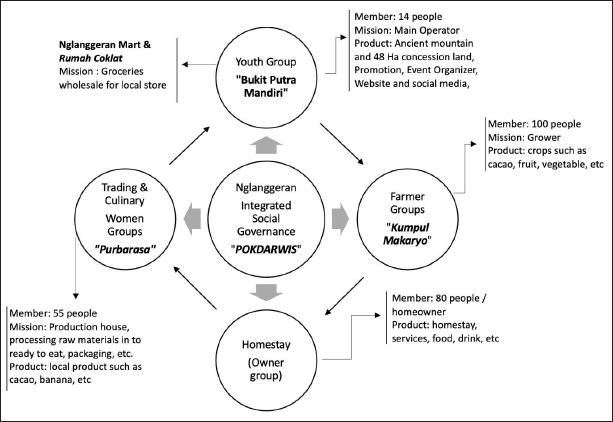
This research highlights the positive impact of networking among village groups who share common goals, leading to social empowerment through collective action towards shared concerns. For instance, the youth association in one village contributed to marketing strategies and creating awareness of the village as an innovative and empowered ecotourism destination for outsiders.
Further, it has been discovered that women’s groups functioning as production houses can stimulate changes in market distribution patterns. Formerly, raw materials produced in the village were the only products sold, but now they can be converted into processed culinary products. This increases the bargaining power of farmers in an indirect manner. Moreover, these women’s groups collaborate with youth to improve the marketing of their community’s products, including Rumah Coklat (Chocolate House). This promotes economic independence among women.
Furthermore, a homestay group is a sector within the home service business that has a substantial influence on the financial earnings of the owner’s family and the generation of employment opportunities. The administration of homestays involves systems that govern the ‘market mechanism’, which may be observed through the operator’s role in arranging accommodations for guests seeking to stay in the community. To choose a homestay, guests must go through the operator who will direct them to the appropriate accommodation. Guests cannot select a homestay on their own. The practice clearly promotes inclusive principles and reduces income inequality within the CBT mechanism.
This practice demonstrates that a robust sense of community cooperation can facilitate the rise of authority, thereby converting socialisation into a prospective instrument for empowerment. By enhancing community cohesion through a shared goal, the empowerment of the community can assist the villages in moving from being mere observers to being active participants.
The Challenge for ‘the Commons’
The struggle to develop the democratisation of natural resource management in Indonesia still has a long way to go. Although the reform movement that seeks to encourage people’s participation in resource management has been in progress for more than two decades (Li, 2000; Wardana, 2015; Wearing et al., 2010; Wijaya et al., 2020), and there has been ample evidence that people-driven strategies can develop local potential better, as in the Nglanggeran case, there still appears to be no guarantee that a wider pattern will emerge. The impressive case is arguably still very rare, compared to numerous other villages in Indonesia. An impressive, good story that runs by the case does not mean that this village has no problems to solve anymore. Internally, in the village, there are five Dusun (hamlets), and only people from two to three of them can participate and derive direct benefits from CBT. Much research remains to involve all elements and people in the village.
Other new challenges too arise. Nglanggeran was previously an impoverished village neglected by the government. Recently, the central government has granted powers to the tourism department to promote tourism in the area. However, this has led to interference with the community-based system, with the government attempting to harvest the results and create another business with the same commodity. Essentially, the central government comes to the site and creates competition with the existing businesses without acknowledging various actors and their actions. Consequently, tourism tends to be exclusive, with partnerships forming only between select villagers and external actors, such as the government. Our upcoming empowerment project aims to promote community independence, without relying heavily on government intervention. Our goal is to foster partnerships with the community, establish an equal relationship and effectively manage their resources. Overall, this report illustrates a conceptual examination of the interaction between the state and the community in the framework of sustainable development and proposes a better management strategy for empowerment. Legislative reform will be suggested in order to establish a mechanism that can rectify the imbalance of power that exists between the community and the government.
In summary, this study presents a conceptual examination of the interaction between the state and the community within the framework of sustainable development. It mobilises non-state sectors, actors and the state sector to address progressively complex socio-economic issues in a scenario where the government has increasingly implemented adaptive regulatory states. This approach suggests an improved empowerment management strategy. Therefore, it is crucial to view governance that incorporates government intervention not merely in absolute terms, such as ‘reintroducing the state’ at the expense of local community authority, but rather as an expansion of the state’s influence within society in collaborative and mutually transformative ways (see Migdal et al., 1994).
Discussion and Conclusion
This article contributes to the knowledge of the Governing the Commons approach based on CBT application in the case of Nglanggeran village. The evidence predominantly substantiates this claim by emphasising the application of Ostrom’s thesis concerning the constraints of ‘market and state’ to community power as a third nexus in Nglanggeran. This demonstrates the significance of the empowerment strategy in particular and the poverty alleviation approach as a whole. As indicated by findings, community-led initiatives for almost one decade have responded to the challenges in alleviating chronic poverty and rising social problems by integrating local institutions and developing local resource-based business efforts that go beyond market-centred and/or state-driven approaches. The finding aligns with the prevailing scholarship on social development (Adamson, 2010; Clark et al., 2007; Laverack, 2006; Phillips et al., 2010), which argues that community connection and a sense of ownership are fundamental components of sustainable development. This has emerged as an increasingly significant aspect of urban and rural development policies.
In broader discussions, the emphasis on ownership and community connectedness resonates with arguments about the participation-driven empowerment model described by Gutierrez (2023) as an ongoing communication that may lead to more empowerment and a higher degree of tourism participation. Conversely, this promotes the autonomy of the community.
From the case presented in this article, it has been demonstrated that the commons theory principles and models for managing CPRs were put into effect. However, the implementation was subject to limitations due to recent government intervention. As the results show, in the case of Nglanggeran, the unequal power dynamics between government agencies and the community have been a significant obstacle to maintaining established initiatives. Consequently, CBT has become an industry reserved for a select few villagers who have formed partnerships with external actors such as the government. As a further consequence, the participation of the community in welfare programmes has failed to achieve a more balanced distribution of power.
For a policy implication, this unravels the regular problems of government–community partnership which, over the last two decades, has expanded in many Southern countries and has resulted in contestations of political interest within the community-targeting social policy (cf. Yuda, 2020, 2021). To address this issue, it is suggested that legal amendments be made to support empowerment partnerships and establish a mechanism to tackle the unequal power dynamics between the community and external partners.
Meanwhile, to respond to the call for best practices in managing a rural society, this article emphasises the importance of collectivity in the daily well-being governance of communities. If facilitated properly, it can contribute significantly to the overall welfare and governance of common resources (see also Adamson, 2010). Moreover, the intersection of collectivity and welfare capitalism has played a crucial role as an analytical framework for understanding welfare dynamics in the Global South. Last, but not least, future research on social and community development should consider politics and the transfer of power distribution while adopting a broader commons perspective.
Monitoring the escalating trend of governance decentralisation and its impact on local community authorities and their resources will constitute a substantial undertaking for social development scholars in the coming years. In this context, verifying and consolidating existing arguments on community development in contexts comparable to Nglanggeran must also receive special attention. This will make the important findings in this growing body of literature more reliable and accurate. For example, it will be possible to look more closely at the conditions that led to the successful transformation of community solidarity initiatives into outcomes that gave people more power, at the same time when adaptive regulatory state regimes are becoming more common.
Footnotes
Declaration of Conflicting Interests
The authors declared no potential conflicts of interest with respect to the research, authorship and/or publication of this article.
Funding
The authors received no financial support for the research, authorship and/or publication of this article.
