



Abstract
This article examines the role of innovation capacity and business process agility (BPA) in the relationship between supply chain collaboration (SCC) and supply chain performance (SCP) of smallholder agro-based enterprises (SAEs). Based on the relational view and dynamic capability theories and the survey research design, the author used questionnaires to gather data from 226 SAEs who were sampled from agribusiness associations in four regions of Ghana via the quota sampling technique. Smart PLS-SEM 4.0 was used as the statistical method to analyze the data.
The results showed that SCC has a significant and positive relationship with SCP, innovation capacity, and BPA. Innovation capacity significantly mediates the relationship between SCC and SCP. Furthermore, BPA fully mediates the relationship between SCC and innovation capacity, with innovation capacity also influencing SCP. This study integrates relational and capability-based views to propose a comprehensive theoretical model showing the inter-relational effect of SCC, BPA, and innovation capacity on SCP. The empirical findings widen the context of SCC literature to include SAEs from emerging economies in sub-Saharan Africa. The empirical findings enrich the understanding of how SAEs can manage their SCCs to develop and use specific capabilities that positively impact SCP. The uniqueness of this article rests in the proposed model and new empirical knowledge, which extends the scope of the relational and capability-based views and SCC literature to include innovation capacity, BPA, and SCP of SAEs in emerging markets.
Introduction
Recent studies show that supply chains operate in a more dynamic and complex global environment characterized by supply chain disruptions, high customer responsiveness, and smart technologies such as the Internet of Things (IoT) and artificial intelligence (Hutter et al., 2023). The growing customization, the threats of global geopolitical risks, and the socioeconomic vulnerabilities require supply chain managers to manage and grow their collaborations to ensure that supply chains are flexible, resilient, efficient, and responsive to market changes (Natsir et al., 2023). Seeking better relational rent, new market opportunities, and productive efficiencies have heightened the interests of researchers and practitioners in supply chain collaboration (Uniyal et al., 2021). From the relational view theory (RVT), supply chain partners gain relational rent by leveraging resources embedded in inter-firm ties (Owot et al., 2023). Supply chain collaboration involves upstream and downstream partners who voluntarily pool together resources through close vertical and horizontal relationships to develop better inter-firm ties and boost mutual success (Duong & Chong, 2020). Supply chain partners strive for greater collaborations by leveraging customer and supplier relations, setting strategic goals, sharing vital information, and aligning data on inventory levels and market activities (Obonyo et al., 2023). Supply chain collaboration through information sharing and system integration leads to cost optimization, risk minimization, reduced information asymmetry, and improved access to quality complementary resources (Rachmawati & Salendu, 2022).
Although the relational benefits and potential of supply chain collaboration are well recognized in previous studies (Natsir et al., 2023), the majority of the literature on the subject is largely documented from the perspective of large enterprises, mostly manufacturing establishments (Zhou et al., 2022). To date, little research has been conducted from the perspective of smallholder agro-based enterprises (SAEs) (Despoudi et al., 2018). For example, Zhou et al. (2022) focused on 216 senior managers of large manufacturing firms in China to examine supply chain collaboration and resilience. The paucity of supply chain collaboration research on small enterprises deprives the body of knowledge on the comprehensive benefits of supply chain collaboration given that small enterprises differ substantially from large organizations.
Kurniawan et al. (2020) found that small enterprises struggle to realize the potential of supply chain collaboration. Compared to medium and large enterprises, small supply chain partners (enterprises) are unable to leverage supply chain collaboration because of their liability for smallness, newness, and limited internal capacity, which negatively affects the potential relational benefits in their supply chains. Small enterprises often face bottlenecks in logistic channels and suffer supply shortages due to imbalances in resource sharing and untimely access to information (Quaye & Mensah, 2019). The small agribusiness sector especially faces underdeveloped, more fragmented, and longer supply chains, requiring a deeper understanding of how to build strong supply chains (Obonyo et al., 2023). According to Ivanov (2020), unproductive supply chain collaboration reduces the economic performance of small enterprises.
Against this background, this article responds to recent and urgent calls made by Liu et al. (2021) and Duong and Chong (2020), for an empirical study on how small enterprises can develop capabilities to optimize gains from collaborative efforts. Again, few studies have empirically examined collaborations in the agribusiness supply chain and how capabilities could help achieve supply chain performance (Bairagi & Mottaleb, 2021). It remains unclear in the empirical literature how exactly collaboration relates to a firm’s ability to achieve supply chain performance (Duong & Chong, 2020). Given these issues, the present study aims to open the supply chain collaboration blackbox by theorizing and empirically validating the mediating and moderating roles of innovation capacity and business process agility in understanding how supply chain collaboration contributes to supply chain performance. In this regard, the study proffers three research questions: (a) Does supply chain collaboration contribute to supply chain performance? (b) Does innovation capacity mediate the relationship between supply chain collaboration and supply chain performance? (c) Does business process agility mediate and/or moderate the relationship between supply chain collaboration and supply chain performance? In answering these research questions, the study empirically validates the conceptual model grounded in the relational view and dynamic capability theory (DCT), which posits that innovation capacity and BPA mediate and moderate the relationship between supply chain collaboration and supply chain performance using survey data from SAEs in Ghana. The DCT underpins the relevance of organizational capabilities in a dynamic environment in enhancing performance (Namagembe & Mbago, 2023). From the DCT perspective, innovation capacity and business process agility are essential firm-specific capabilities that enable a firm in a volatile environment to cope with threats and take advantage of opportunities to perform better (Hutter et al., 2023).
The study has implications for both theory and practice. For theory, the study provides valuable insights into how supply chain collaboration as a relational intangible asset contributes to supply chain performance. Additionally, the study demonstrates how innovation capacity and business process agility as dynamic capabilities play an intervening role in channeling the contribution of supply chain collaboration to supply chain performance. For practice, the study provides better insights for SAEs into the need to foster deeper collaborations with supply chain partners to sustain performance.
Theories
Relational View Theory
The conceptual model of this study is based on RVT, which explains the relationship between supply chain collaboration and supply chain performance. RVT shows the interface between the resource-based view and inter-firm network perspectives was initially proposed by Dyer and Singh (1998). They argue that a firm’s competitiveness comes not only from internal resources but also across boundaries, which may be embedded in inter-firm linkages, routines, and resources. In the relational view, collaboration promotes joint value creation and offers advantages such as inter-organizational resources. Through collaborations, a firm generates relational rent—a supernormal profit jointly generated in an exchange relationship that can be created only through the joint idiosyncratic contribution of the specific alliance partners (Dyer & Singh, 1998). The theory explains inter-firm relations, firm-specific resources/assets/capabilities, and performance as the three main structures underpinning supernormal resource-based performance. In this study, the author argues that supply chain collaboration promotes access to complementary resources, which impact cost savings, information sharing, and decision efficiency (Obonyo et al., 2023). Access to new external knowledge strengthens the internal capabilities of the firm due to the consistency and the complex nature of collaborations, making resources rare, valuable, and costly to imitate (Dyer & Singh, 1998).
The Dynamic Capability Theory
Dynamic capability constitutes a special kind of ability or capacity to regularly build, integrate, reconfigure, and renovate internal and external competencies to promptly respond to emerging threats and opportunities (Khalil & Belitski, 2020). A combination of the firm’s competencies is required to achieve performance (Namagembe & Mbago, 2023). Dynamic capabilities can also be seen as firm-specific assets that can be deployed by an entrepreneur to achieve set goals, especially in a changing environment. Knowledge, technology, and managerial and organization-specific assets are essential capabilities for a firm to absorb new knowledge and promptly adapt to a changing market with superior value (Liu et al., 2021)). According to Galati et al. (2023), small enterprises could benefit from supply chain collaboration by looking beyond their boundaries for external knowledge to improve internal competencies. Other scholars suggest that dynamic capability provides a theoretical foundation to understand the ability of a supply chain partner to develop the capabilities required to leverage the multiple and complex web of collaborations to improve resource access, operations, and growth (Khalil & Belitski, 2020). Irfan et al. (2019) also revealed that agility, as a special capability, allows the firm to gain external knowledge and reconfigure internal operations to take advantage of the market gaps, develop innovations, and grow. In this study, the author draws on the foundation of dynamic capability theory to understand how SAEs could develop innovation capacity and business process agility from supply chain collaboration to improve supply chain performance.
Supply Chain Collaboration and Supply Chain Performance
Supply chain collaboration refers to the process of supply chain partners working together and sharing resources and information to achieve mutual goal(s) (Zhou et al., 2022). Cao et al. (2010) suggest that supply chain collaboration is a partnership and a relationship in which two or more partners plan and work together to mastermind and execute supply chain operations to achieve mutual benefits. Studies argue that supply chain collaboration as a process of developing close and long-standing alliances allows partners to set common strategic goals, exchange information, and share resources, rewards, and risks toward achieving a common purpose (Baah et al., 2021). Earlier, Cao et al. (2010) identified collaborative knowledge creation, resource sharing, communication, joint decision-making, information sharing, and target congruence as supply chain activities. Thus, information sharing, collaborative performance systems, incentive alignment, decision synchronization, and integrated supply chain processes could be seen as critical activities of supply chain. Information sharing, for instance, means generating accurate, varied, confidential, and relevant information and ensuring it flows timely among partners (Uniyal et al., 2021).
Building purposeful collaborations with supply chain partners enables each member to improve operations, efficiency, and effectiveness in business activities and decisions to maximize competitive advantage and operational performance (Adetoyinbo et al., 2023). Building strategic systems, sharing reliable data in real time, making risk mitigation strategies, and forecasting enable partners to respond quickly to market changes and improve performance (Al-Doori, 2019). Studies reveal that inter-firm alliances through information sharing optimize performance (Ocicka et al., 2022). Therefore, the author proposes that the following hypothesis:
H1: Supply chain collaboration significantly influences supply chain performance of SAEs.
Supply Chain Collaboration, Innovation Capability, and Supply Chain Performance
Innovation capacity is essential to the success or failure of supply chain relationships (Castillo et al., 2022). Ganguly et al. (2020) described innovation capacity as the capacity of the business to generate and manage resources to develop novel products and services. According to Ferreira et al. (2020), it is a form of complex activities that enable a firm to translate creative ideas into novel products, processes, and systems. The capacity enables a firm to develop, incorporate, and use new concepts, technologies, and procedures to create firm-specific advantages. Hence, technological developments such as digitization and system automation could be crucial for leveraging collaborative knowledge and fostering capacity for innovation. The literature reveals that innovation capacity is crucial for supply chain partners to respond efficiently and effectively to changes in the market for higher performance (Maldonado-Guzmán et al., 2020). Studies have identified product and process innovation capacity as the major dimensions or measures of innovation (Migdadi, 2022). Product innovation capability is the firm’s ability to develop and coordinate tangible and intangible resources to develop novel products and services that meet customer needs (Aljanabi, 2022). Process innovation capacity helps the business to alter the techniques and procedures and routines to deliver unique offerings (Aljanabi, 2022). This capacity enables enterprises to create new processes and inputs within operational activities, hence providing unique, quality, and cost-effective products/services (Najafi-Tavani et al., 2018). Innovation capability also enables flexibility, which allows the enterprise to reconfigure internal and external resources to develop innovation, which impacts firm performance (Ravichandran, 2018).
H2: Innovation capacity mediates the relationship between supply chain collaboration and supply chain performance of SAEs.
Supply Chain Collaboration, Business Process Agility, and Innovation Capacity
Business process agility refers to the ability of an enterprise to anticipate (sense) and respond appropriately to market changes with ease and promptness, which are essential to business survival (Kale et al., 2019). According to DCT, such process agility is a higher-order dynamic capability, which is a special kind of ability built over time, and enables the organization to understand forces and trends, promptly implement bold decisions, reconfigure business processes and systems, and quickly redeploy resources to respond to market shifts (Doz et al., 2008). Studies have revealed that agile organizations are market driven; possess higher-order capabilities and a degree of adaptability, flexibility, and responsiveness to sense opportunities and threats; and integrate internal routines with external functions/alliances to seize and transform them (opportunities) into a competitive advantage (Hutter et al., 2023). Adaptability allows swift and easy retooling of operations to meet changing market demands using a collective supply network, resources, and infrastructure for decision-making, risk mitigation, and abundant resources (Tallon & Pinsonneault, 2011). Flexibility makes it easy to adjust and adapt process designs and modular structures, as well as reallocate resources to meet changing conditions (Nejatian et al., 2018). Mozhayeva et al. (2019) also added that responsiveness is an essential form of agility, the capacity to act quickly to new consumer preferences, market trends, and competitive pressures with superior resources and capabilities. Audretsch and Belitski (2022) reveal that enterprises require agility in business processes to strengthen innovation capacity and improve performance. Agility also has positive effects on effective decision-making processes, workflow efficiency, and effective communication channels due to the ability to quickly alter their systems to respond to dynamic market changes with innovative value (Hutter et al., 2023). Other studies report that stronger business process agility reinforces the association between supply chain cooperation and firm performance (Zhang & Guo, 2017). Quick sensing of market changes allows enterprises with agile routines to improve innovation capability and market responses (Ayoub & Abdallah, 2019). In their study, Chen et al. (2020) ascertained that supply chain collaboration has a significant impact on firm performance, which is catalyzed by the flexibility and responsiveness of its internal processes.
H3: Business process agility moderates the relationship between supply chain collaboration and innovation capacity of SAEs.
Adaptability, flexibility, and rapid responsiveness to market changes are essential to business growth (Nejatian et al., 2018). According to Zhen et al. (2022), agility is an essential dynamic capability for a firm’s survival and growth. Agility can be realized and improved by regularly engaging the environment/market actors and relations/ties to exploit emerging changes and gaps (Menon & Suresh, 2020). A firm’s ability to quickly and effectively adapt to market changes is expected to help the firm improve cost savings (Chen et al., 2020) and take advantage of opportunities for innovation and competitive actions (Kale et al., 2019). In the manufacturing industry, business process agility could be essential for firms to create and deliver efficient and competitive innovations (Irfan et al., 2019). In a study of 224 listed businesses on the Asia Stock Exchange, Al Tawee and Al Hawary (2021) revealed a significant effect of agility on innovation capacity and firm performance. Tallon and Pinsonneault (2011) also showed that businesses with flexible internal processes, infrastructure, and resources gain a wide range of market responses, increasing the potential for innovations that positively impact market growth, profitability, and cost savings.
H4: Business process agility mediates the relationship between supply chain collaboration and innovation capacity of SAEs.
Agribusiness Supply Chain
The agribusiness sector is the backbone of global commerce, a source of food supplies, and a major catalyst of socioeconomic growth (Adetoyinbo & Mithőfer, 2023). The sector comprises any agricultural-oriented entity such as agricultural producers, processors, finance and insurance, research and development, marketing, distribution, and logistics businesses (Imbiri et al., 2023). In many economies, the sector is classified into input (seed, financing, and equipment), intermediate (storage, processing, packaging, distribution, and marketing), and consumption (restaurants and groceries). These industries run agriculture-related activities in complex relationships that mutually influence each other. In an agribusiness supply chain, actors (agro-based enterprises) and activities integrate into a network system and are connected directly or indirectly from upstream to downstream to distribute materials and information into the hands of end customers (Imbiri et al., 2023). In emerging economies, especially sub Saharan Africa (SSA), the agribusiness sector is vital for pro-poor economic growth. In Ghana, for example, the economy is driven by agriculture and agribusiness, employing approximately 55% of the population and contributing about 25% of the country’s gross domestic product. Despite the benefits and the potential, and the expected investment of US$1tn by 2030 from US$313bn in 2010, the sector faces problems of collaboration, competitiveness, and performance (Kwamega et al., 2019). The author reveals that the performance of the agribusiness in SSA, and Ghana especially, is declining due to challenges related to operation, marketing, purchasing and logistics, and information technology.
Kamal and Irani (2014) reveal that agribusinesses in emerging economies need to integrate their systems and processes with partners because they can no longer operate in a closed system and survive working alone. Moreover, the relational mechanism of agro-based small enterprises in supply chain is complex and asymmetric due to numerous partner interests and unrelated resources (Adetoyinbo & Mithőfer, 2023). In such view, close collaborations, information sharing, and system integration serve as strategies to improve competitiveness and performance (Obonyo et al., 2023). Other studies argue that the supply chain of SAEs remains unproductive and must develop the capabilities to leverage their alliances and generate superior economic relational rent (Adetoyinbo & Mithőfer, 2023). Unfortunately, it remains unclear in the supply chain empirical literature whether a combination of capabilities and competencies accounts for supply chain performance (Namagembe & Mbago, 2023).
Supply Chain Performance
Supply chain collaboration is vital in maintaining supply chain performance in the agribusiness sector (Natsir et al., 2023). Previous studies have used various indicators to measure supply chain performance (Ramos et al., 2022). Slack and Lewis (2017) measured supply chain performance based on speed, dependability, flexibility, cost, and quality (processes that yield products that meet customer specifications). Achieving supply chain performance means a firm is able to reach consistency in profitability, sales/turnover, staff strength, physical production, and total assets (Lozano & Garcia, 2020). Whitten et al. (2012) also measured supply chain performance using cost and quality, which are more based on end-customer satisfaction. Srai et al. (2019) reveal that cooperative efforts of supply chain partners have a favorable influence on financial performance. Thus, supply chain performance can be seen in this study to encompass cost reduction, quality product and service delivery, and growth in profit.
Conceptual Framework
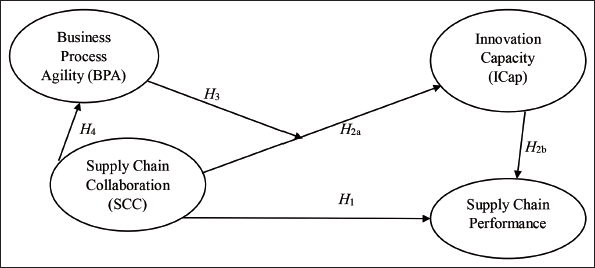
Figure 1 shows the conceptual framework based on the RVT and dynamic capability theory. Based on the theories, the framework explains the role of business process agility and innovation capacity in the relationship between supply chain collaboration and supply chain performance.
Conceptual Model.
Method
Design, Sample, and Data
To test the study hypotheses based on the positivist paradigm, the explanatory survey design was used to investigate the role of innovation capacity and business process agility in the relationship between supply chain collaboration and supply chain performance. The survey design via quantitative approach was used based on statistical procedures to empirically test and numerically analyze quantitative data that was gathered using a standardized questionnaire (Namagembe & Mbago, 2023). Again, the conceptual model in Figure 1 and the research processes were guided by the assumptions of RVT and DCT. Multi-stage sampling approach was used to guide the determination of the study’s respondents and sample size. The author purposively selected four regions of Ghana—Greater Accra Region, Ashanti Region, Central Region, and Western Region. The reason for the selection was to improve the quality of sample data. Particularly, the four selected regions are cosmopolitan, constitute the main economic hubs of Ghana, account for more than half of all enterprises in the country, and are noted for agro-based product processing, marketing, distribution and logistics, and finance activities (Ghana Statistical Service, Integrated Enterprise Survey Report [GSS IBES], 2016). In the second stage, the author contacted four agribusiness associations (processing, marketing, distribution and logistics, and finance) in Greater Accra and Central regions, which introduced the researcher to their counterpart associations in the Ashanti and Western regions. The associations in all four regions were contacted to confirm their participation in the survey. A list of potential respondents was subsequently generated from the associations in the four regions. The list was screened to ensure all potential respondents are actively involved in business; have 4–29 employees; are either agro-processing, marketing, distribution and logistics, or finance enterprises; and are also owners, managers, and owner-managers of the enterprises.
Out of 2,879 members in the final list, 350 respondents were sampled based on Snedecor and Cochran’s (1989) sample size determination framework and a similar study by Owot et al. (2023).
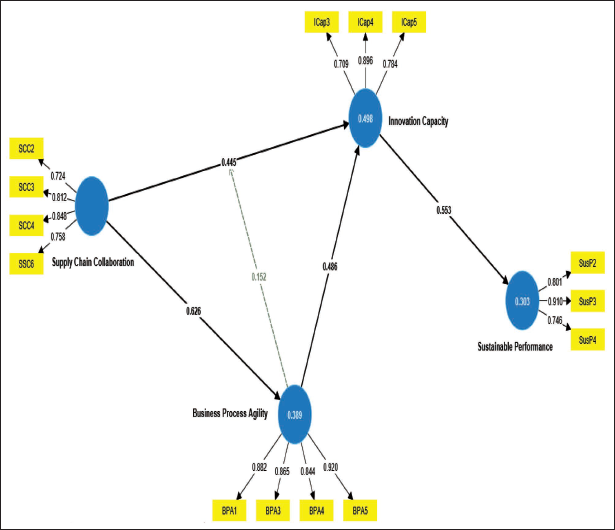
The final set of 226 questionnaires was coded into SPSS. SMART PLS-SEM v.4.0 was used to assess the measurement and structural models and estimate the path relationships. The variance-based technique was established in regression, principal component factor, path analyses, validity and reliability analyses, and statistical power analyses as indicated in Figure 2 (Hair et al., 2022; Namagembe & Mbago 2023). Effect size (f2) and p value (α = 0.05) were used to examine the statistical significance and beta (β) to determine the extent of effect.
Results
Multicollinearity and Common Method Biases
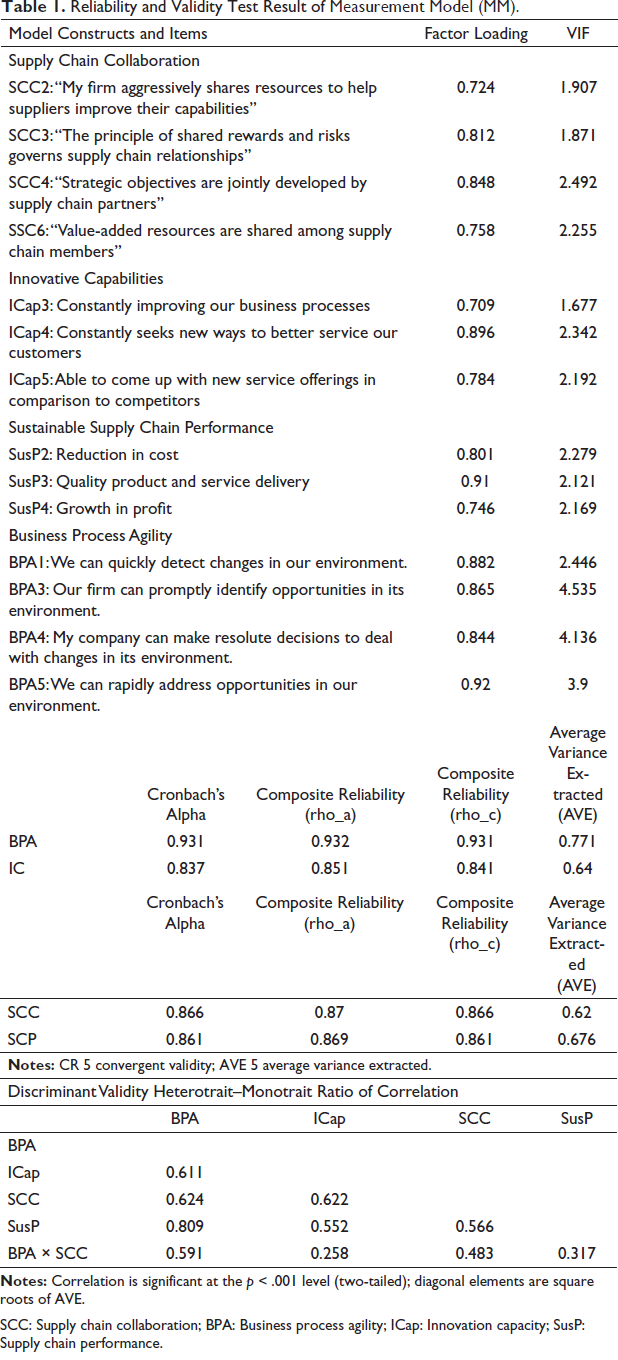
Statistical and non-statistical measures were followed to examine and curb the threat of multicollinearity and common method biases (CMB). First, the author followed MacKenzie and Podsakoff’s (2012) suggestions, whereby respondents were promised maximum anonymity, adapted items from different sources, and ensured that the constructs were separately presented in the questionnaire. Second, the variance inflation factor (VIFs) and Harman’s single-factor test were used to assess the possible presence of multicollinearity. A study model may be free from CMB or may indicate no threat of multicollinearity if all VIFs of the constructs are less than five (Hair et al., 2017). Table 1 shows that the outer VIFs of the constructs were all below 5, indicating no threat of multicollinearity. Harman’s single-factor test using the principal component analysis reveals that the first factor explains less than 50% of the cumulative variances. CMB exists if the correlation among the variables is large or greater than 0.9 (r > 0.9), but CMB does not exist if the correlation is smaller or less than 0.9 (r < 0.9) (Hair et al., 2022). Based on the thresholds, it was found that CMB is not a threat in this study. Kurtosis estimates of less than 7 and skewness values of less than 2 for all items indicate data normality (Namagembe, 2022).
Reliability and Validity Test Result of Measurement Model (MM).
SCC: Supply chain collaboration; BPA: Business process agility; ICap: Innovation capacity; SusP: Supply chain performance.
Measurement Model Assessment (Reliability and Validity)
A reflective model in statistical research is often assessed to establish its reliability and validity using convergent and discriminant validities and the composite reliability. These tests provide an understanding of the relevance and accuracy of the items to produce consistent results if replicated in another research procedure (Hair et al., 2022). The author adapted Hair et al.’s (2017) guidelines, and therefore, the measurement model was assessed for validity and reliability before the structural model (SM). For the measurement model, the convergent validity (outer loading scores and total variance extracted [AVE]), discriminant validity (heterotrait–monotrait [HTMT]), and construct reliability (composite reliability [CR] and Cronbach’s alpha [CA]) were assessed (Hair et al., 2017). Hair et al. (2017) suggested that CR and CA above 0.70 are acceptable. AVE and outer loadings above 5 and HTMT greater than 0.90 are acceptable (Hair et al., 2022). The study found that the CR (rho_a) (0.851 ↓ 0.932) and CA (0.861 ↓ 0.931) were all above the 0.70 threshold, which indicates that the constructs have high internal consistency (Hair et al., 2022). The measurement model was considered reliable after two items were deleted. Table 1 shows the reliability result of the measurement model analysis executed through the PLS algorithm procedure. Second, outer loadings achieved good varimax scores (0.724 ↓ 0.92) with an eigenvalue of 1 and a minimum threshold of 0.50 suppression (Hair et al., 2022). Five items were deleted due to non-loading. The constructs achieved AVE scores greater than 0.5 (0.62 ↓ 0.77) after three items were deleted. The AVE scores suggest that the constructs explain more than half of the indicator variance. The HTMT criteria also established discriminant validity since the similarities between the latent variables were all less than 0.9 (Hair et al., 2022). The AVEs of each variable were less than the squared correlation between the paired variables, supporting discriminant validity. The result is presented in Table 1.
Structural Model Assessment
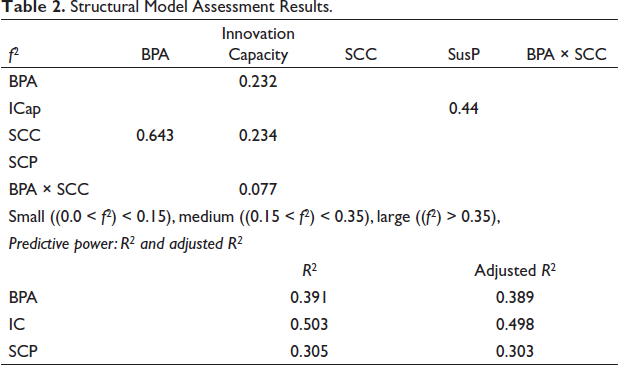
The study examined the model’s (independent variables) ability to predict the dependent variables as suggested by Hair et al. (2017). The predictive power and stability of the structural model were assessed using the coefficient of determination (R2), effect size (f2), and the predictive relevance (Stone–Geisser Q2). The R2 assesses the variance of the dependent variable accounted for by independent variables and the accuracy of the predictive strength of the structural model (Chicco et al., 2021). This study adopted adj. R2, which proved a good predictive strength that supply chain collaboration, innovation capacity, and business process agility jointly explain 30.5% of the variance in supply chain performance. Again, supply chain collaboration explains 38.9% of the variance in business process agility and 49.8% variance in innovation capacity. The assessment also shows that innovation capacity explains 30.3% of the variance in supply chain performance. The effect size (f2) shows the degree of effect of the exogenous constructs on the endogenous construct as explained by Chin (2010). According to Cohen (1988), f2 values < 0.02, 0.15, and 0.35 indicate no effect and weak and moderate effects, respectively, and f2 > 0.35 indicates strong effect. In this study, the SM assessment results show strong effects of supply chain collaboration on business process agility (0.643) and innovation capacity on supply chain performance (0.44). Furthermore, there is a moderate effect of supply chain collaboration on innovation capacity (0.234) and business process agility on innovation capacity (0.23). However, business process agility has a weak (0.077) effect on the relationship between supply chain collaboration and innovation capacity. The summary of the result shows a moderately strong effect of the synergy between supply chain collaboration, business process agility, and innovation capacity on supply chain performance. Table 2 presents the structural model assessment results.
Structural Model Assessment Results.
Result
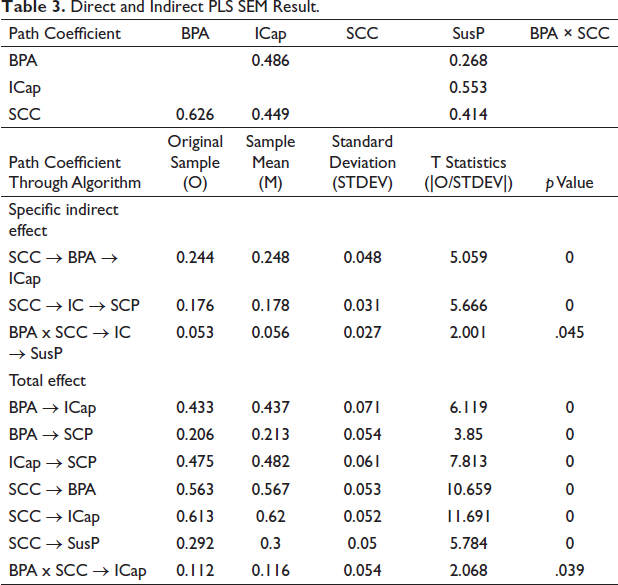
This section presents the statistical outputs from the PLS-SEM on the interrelationship among supply chain collaboration, business process agility, innovation capacity, and supply chain performance. First, the result shows a significant direct effect of supply chain collaboration on supply chain performance (β = 0.414), confirming the first hypothesis (H1). The analyses further revealed a significant effect of supply chain collaboration on business process agility (f2 = 0.64, β = 0.626) and supply chain collaboration on innovation capacity (f2 = 0.23, β = 0.449). Again, innovation capacity also has a significant positive effect on supply chain performance (f2 = 0.44, β = 0.553). Second, the PLS algorithm procedure through the bootstrapping approach confirmed the second research hypothesis (H2), that innovation capacity mediates the relationship between supply chain collaboration and supply chain performance (β = 0.176, t = 5.66). Analysis of the total effect reveals a superior significant effect of supply chain collaboration on innovation capacity (β = 0.613, t = 11.69), with innovation capacity also significantly influencing supply chain performance (β = 0.475, t = 7.813). The result indicates a significant mediation effect of innovation capacity on the relationship between supply chain collaboration and supply chain performance, based on Baron and Kenny’s rule of mediation.
Third, the result shows that business process agility moderates the relationship between supply chain collaboration and innovation capacity (β = 0.11, t = 2.06), leading to supply chain performance (β = 0.05, t = 2.00). Business process agility also has a significant influence on supply chain performance (β = 0.206, t = 3.85). Confirming the third research hypothesis (H3), a detailed analysis shows that the moderating effect of business process agility on the relationship between supply chain collaboration and innovation capacity was weak (f2 = 0.077). The result also confirmed the fourth research hypothesis (H4), that business process agility also mediates the relationship between supply chain collaboration and innovation capacity (β = 0.244, t = 5.059), whereby supply chain collaboration has a stronger significant effect on business process agility (β = 0.563, t = 10.659), which also has a significant effect on innovation capacity (β = 0.433, t = 6.119), indicating full mediation. Compared with the moderating role of business process agility, the result signifies that the mediating role of business process agility in the relationship between supply chain collaboration and innovation capacity is more significant. Table 3 presents the results for the direct, mediation, and moderating relationships.
Direct and Indirect PLS SEM Result.
Discussion
Supply chain collaboration has become integral for supply chain partners to seek valuable external resources and better performance (Ocicka et al., 2022). Based on the RVT and DCT, this study developed a conceptual model and set out to examine the role of innovation capacity and business process agility in the relationship between supply chain collaboration and supply chain performance. The finding suggests that SAEs are likely to achieve supply chain performance when they gain access to complementary relational (external) resources, jointly set objectives, take strategic decisions and work toward achieving them, and also share risk and rewards. This finding corroborates previous studies that collaborations allow partners to work together and share resources and information to achieve mutual benefits (Galati et al., 2023). Timely access to critical market information allows partners to promptly respond to emerging opportunities in the market and make strategic decisions in order to achieve economies of scale, optimize cost, minimize risk, and improve customer satisfaction (Natsir et al., 2023).
The study’s findings confirm the conceptual model and previous studies and further validate the assumptions of RVT on the relational benefits of collaboration as reported in Owot et al. (2023) and Dyer and Singh (1998). Supply chain collaboration is characterized by a complex web of linkages, intense competition, and opportunistic behaviors that affect the performance of small enterprises that are over-dependent on limited internal resources and capabilities (Ivanov, 2020). Therefore, the supply chain performance of SAEs will depend on the capacity to regularly innovate and/or build and reconfigure resources and capabilities to promptly detect and respond to opportunities and gaps in the market (Khalil & Belitski, 2020). According to the study, this capacity depends on access to new complementary resources from supply chain partners. As per the DCT, the study confirmed that innovation capacity and PBA are essential capabilities, and therefore, SAEs can achieve supply chain performance by growing and utilizing these capabilities to respond to environmental changes (Zhen et al., 2022). The study validates the DCT and extends previous studies (Namagembe & Mbago, 2023) by showing that a combination of innovation and agile capacities is essential for SAEs to influence supply chain performance.
Regarding innovation capacity, the findings extend the DCT in the supply chain management literature (Zhen et al., 2022) by showing that supply chain collaboration helps SAEs to develop and grow their innovation capacity, which positively impacts supply chain performance. Therefore, SAEs in supply chain collaboration are likely to achieve supply chain performance when they possess the capacity to constantly improve internal processes, seek new and better ways to serve customers, and develop services/products that are superior to those of their competitors. By this finding, the study responds to Liu et al. (2021) and Duong and Chong (2020), for more empirical studies on how small enterprises can develop and deploy capabilities to achieve supply chain performance. It also extends Ravichandran’s (2018) study that innovation capacity ensures flexibility, which allows entrepreneurs to reconfigure their resources to develop innovations that impact supply chain performance.
Regarding business process agility, the study confirms the capacity (agility) as both a mediator and a moderator, which explains how being agile is necessary for supply chain partners to optimize the impact of supply chain collaboration on innovation capacity and subsequently supply chain performance. The study reveals that as a mediator, supply chain collaboration provides SAEs with external knowledge to develop and strengthen the capacity (process agility) to quickly detect market changes and emerging opportunities and threats, and promptly address them with innovative solutions. Consequently, being agile in business processes is likely to impact innovation capacity, thus confirming Menon and Suresh’s (2020) and Kale et al.’s (2019) studies. The study also extends Audretsch and Belitski’s (2023) and Ayoub and Abdallah’s (2019) postulation that a significant relationship exists among flexible business processes, innovation potential, and firm performance. As a moderator, the study findings confirm DCT, that being agile in business processes has a significant contingency role (moderate) on how supply chain collaboration impacts innovation capacity. Thus, an agile business process is necessary to improve the ability of the SAEs to leverage supply chain collaboration for knowledge to strengthen innovation abilities, which positively impact a firm’s overall product quality, efficiency, and profit.
Theoretical Contribution
The theoretical implication of this study rests on the proposed model based on the RVT and DCT, which explains the inter-relational effect of supply chain collaboration, innovation capacity, and business process agility on supply chain performance. The proposed model provides a comprehensive insight into how supply chain collaboration impacts innovation capacity and business process agility, as specific capacities (being innovative or agile), which in turn influence supply chain performance. The proposition of business process agility and innovation capacity presents a unique capability-capacity theorization in appreciating how SAEs leverage supply chain collaborations to develop specific capabilities. The empirical findings extend supply chain collaboration research (Zhou et al., 2022) to include innovation capacity, business process agility, and supply chain performance of SAEs in emerging economies in SAEs.
Managerial Implications
The study has implications for practitioners and policymakers on supply chain collaboration, organizational capabilities, and supply chain performance. First, the empirical findings provide unique insights for SAEs and managers on how to build innovation capacity and business process agility via supply chain collaboration to achieve supply chain performance. By implication, this article advises SAEs in emerging markets who seek superior supply chain performance to recognize and appreciate the value of collaborations. Given the increasing supply chain disruptions and the associated challenges facing SAEs in recent years (Obonyo et al., 2023), supply chain collaboration will reduce the threat of isolation, by providing access to market opportunities, productive efficiencies, and complementary knowledge and resources that will strengthen internal competencies of the firm to respond promptly to market opportunities and threats. Importantly, SAEs need to enhance the usefulness of their supply chain collaborations by cultivating deep alliances and working with industry and non-industry partners. Cross-industry collaborations enhance the potency of common growth strategies, risk warning plans, and improve the value, reliability, accuracy, and access to real-time industry and market information and other resources.
SAEs must redeploy their business systems and internal resources to quickly sense and leverage emerging external knowledge to develop their innovation capabilities. Coordinating and integrating external knowledge with internal resources will improve a firm’s innovation competencies, process improvement, customer service, and competitive products to supply chain partners and end consumers. To maintain a high level of innovation adequacy, practitioners need to develop a guide for their supply chain collaboration to ensure that innovations reflect in mutual gains such as efficiency/cost savings, quality products and services, and better profitability. Organizational structures, processes, operations, and routines must be flexible, responsive, and adaptable to market changes if SAEs want to improve the impact of innovation capacity on supply chain performance. Flexibility and adaptability are necessary for early detection of market changes—threats, opportunities, and gaps—and provide the required responses. Being agile is necessary for SAEs to directly and indirectly improve the benefits of collaborations for innovation abilities and subsequently for performance.
This study is particularly useful for managers and owners of agro-processing, marketing, distribution and logistics, and finance enterprises in emerging economies. Government, agro-based enterprise associations, and small enterprise development agencies will also find this study useful in fashioning better relational strategies to improve collaborations, relational rents for members, and the capabilities of small firms to respond to market threats and opportunities.
Limitations and Future Research Directions
This study tested assumptions based on cross-sectional data from SAEs in Ghana. Future studies can focus on comparing small and medium enterprises in different upper middle income countries using longitudinal data.
