



Abstract
Introduction
Child sexual abuse (CSA) is a distressing and pervasive issue that affects countless children worldwide. Prevalence studies indicate that this form of child maltreatment is alarmingly widespread, ranging from 8% to 31% for girls and 3% to 17% for boys (Barth et al., 2013). The negative consequences associated with CSA are diverse and long-lasting (Hailes et al., 2019). These repercussions may have a significant impact on many areas of a child’s life, including the academic domain, which remains scarcely studied (Mitchell et al., 2021). Yet, the bulk of studies conducted to this day pinpoint to a diversity of outcomes in victims of CSA. For some children, the experience of maltreatment is associated with many psychological and physical consequences, while other children will display little or no repercussions following the abuse (Yoon et al., 2020). Various cross-sectional and longitudinal studies have underscored this diversity of adjustment patterns of abused children and adolescents (Martinez-Torteya et al., 2017; Yoon et al., 2020).
One of the few longitudinal studies conducted among maltreated adolescents (n = 711) supports the hypothesis that resilience levels can vary over time (Yoon et al., 2020). This study was conducted in the United States among adolescents aged 11 to 17 (mean age = 13.5) who had been victims of maltreatment (physical abuse, emotional abuse, sexual abuse, neglect and/or exposure to violence at home). Resilience was measured across four domains: externalizing behavior problems, internalizing behavior problems, social skills, and cognitive skills. Authors found four resilience development patterns between Time 1 and Time 2 (18 months after Time 1): stable maladaptation, stable resilience, increased resilience, and decreased resilience (Yoon et al., 2020). This study highlights that there are several trajectories of positive adaptation and that this positive adaptation can include several areas of the child’s life. Further longitudinal studies on the psychological adjustment trajectories of abused children are needed to fully document what these domains are. Adaptation to school, for example, is an important area of child development that can be greatly impacted by an experience of maltreatment.
CSA and academic performance
Traumatic events such as CSA impact the academic domain leading to notable disruptions in the educational performance and achievements of victims (Romano et al., 2015). Childhood is a crucial and pivotal period for the development and consolidation of social, academic, and adaptive skills, which have long-term implications for adults (Batra, 2013). Furthermore, the school setting is an integral part of children’s lives and the institution most present in their daily routine. This environment can therefore be a source of permanency and stability for more vulnerable children. Findings of a systematic review reveal that a history of CSA is associated with lower levels of academic performance in college-level students (Mitchell et al., 2021). This literature review included 14 articles: six retrospective studies, seven longitudinal study and one prospective study (Mitchell et al., 2021). Of this sample, nine articles involved college or university students and five articles involved a community-based sample. The longitudinal studies included in the review suggested that academic achievements can be impaired long after the occurrence of CSA (Mitchell et al., 2021). Furthermore, compared to non-victims, adolescents and adults who had been victims of childhood maltreatment would display lower IQ scores and higher reading difficulties, as suggested by various longitudinal and cross-sectional studies (De Bellis & Zisk, 2014). These statistics are particularly worrying, even though tailored interventions may reduce the level of psychological distress or post-traumatic stress in abused children. Indeed, if the child performance at school remains in jeopardy over time, career options, future employment opportunities, and social and health benefits could also be put at risk (Mitchell et al., 2021).
To our knowledge, there is no longitudinal study exploring trajectories of academic performance in sexually abused children. However, research on other forms of maltreatment provide valuable insight into this area. Holmes and colleagues (2018) observed five trajectories of academic performance and language development among 1,022 children aged 0 to 10 who have been physically abused or neglected. In this American study, they found two resilience trajectories (High and stable over time and Increasing over time) and three maladaptive trajectories (Low and stable over time, Decreasing over time, and Decrease/Recovery/Decrease). These results suggest that there is a diversity of school performance trajectories. Various variables at the individual and relational levels were found to be protective factors of academic performance trajectory membership (Holmes et al., 2018). Children with high prosocial skills and a caregiver with more than a high school education predicted membership in resilience trajectories compared with maladjustment trajectories.
Potential correlates of academic performance
The academic performance of children can be influenced by numerous factors, namely psychosocial functioning variables, sociodemographic variables, and abuse characteristics. Among psychosocial functioning variables, behavioral problems, coping strategies and peer victimization are considered as potential correlates of school performance in the normative population or in maltreated children (Glew et al., 2005; Romano et al., 2015). A systematic review on maltreated children suggested that high externalizing and internalizing behavioral problems were associated with lower academic performance across various studies (Romano et al., 2015). The literature also revealed that experiences of peer victimization and higher level of avoidance coping strategies were associated with lower academic performance in children of the normative population (Glew et al., 2005). As for sociodemographic variables, Romano and colleagues (2015) highlighted that being a boy or an adolescent (as opposed to children) was associated with lower academic results in maltreated children. Socioeconomic disadvantage was also associated with lower academic performance (Romano et al., 2015). Finally, abuse characteristics can be associated with outcomes. Past studies have found that severe or chronic abuse perpetrated by an intrafamilial abuser, is generally associated with difficulties in the academic spheres (Haselgruber et al., 2020).
While past studies offer relevant insights, it is difficult to know whether they apply to sexually abused children, since sexual abuse differ from other forms of maltreatment in several aspects. For instance, sexually abused children show higher levels of internalizing and externalizing behavior problems than children who are victims of other forms of abuse (Lewis et al., 2016). In addition, certain characteristics of the child’s environment may interact differently according to the form of maltreatment experienced (Khambati et al., 2018). For instance, engagement in extracurricular activities was associated with greater well-being in emotionally maltreated children, but not in physically abused children (Khambati et al., 2018). Correlates of academic performance, specifically in sexually abused children, remain little studied. Since experiences in the school environment or the academic performance can vary according to the form of abuse, it seems essential to assess in greater depth what influences the experience of sexually abused children in the school context.
The present study
Considering the gaps in the literature, the first objective of the present study was (1) to identify longitudinal trajectories of school performance among sexually abused children. Based on the literature (Galatzer-Levy et al., 2018), we hypothesized that four trajectories of academic performance in sexually abused children would be identified: a high and stable trajectory, a low and stable trajectory, a low trajectory that improves over time, and a high trajectory that deteriorates over time. The second objective was (2) to determine which variables (psychosocial functioning variables, sociodemographic and abuse characteristics) were correlated to trajectory membership. By identifying trajectories, examining correlates, and highlighting implications for interventions, this study has the potential to inform evidence-based practices that foster resilience, improve educational outcomes, and promote the overall well-being of sexually abused children.
Methods
Participants and settings
The sample consisted of 738 sexually abused children aged 5 to 14 (M = 9.0, SD = 2.0) and their non-offending caregivers. Recruitment took place in five intervention centres specialized in sexual abuse in the province of Quebec, where the families were seeking services. At the intervention centre, a caseworker was assigned to each family and informed them of the possibility of participating in a research project on the adaptation trajectory of children who have experienced adversity. It was also made clear that participation was voluntary and their decision to participate or not would not affect the quality of the services received. The consent form was signed by the parent and verbal assent was obtained from the child. Once the consent obtained, the caseworker completed information concerning the characteristics of the sexual abuse and families completed a questionnaire at T1 (following their first visit at the centre), T2 (6 months later) and T3 (one-year after the first visit at the centre). They were first interviewed at the specialized intervention centre on their initial visit before receiving services. Then, they were interviewed again at T2, six months later which corresponded to the end of service provision. Finally, children and their parents completed a T3 assessment at their home six months after the T2. At each measurement time, a questionnaire was sent to the child’s teacher with the caregiver’s written consent. A $5 gift card was also sent to the teacher after the questionnaire was completed. The study design was approved by the Human Ethics Research Committee of the Université du Québec à Montréal and the CHU Sainte-Justine, approval #2050_2021.
Measures
A measure of academic performance was used to derive the trajectories. To facilitate reading, we have divided variables into three categories: psychosocial functioning variables, sociodemographic variables, and abuse characteristics were used as potential correlates. These correlates were evaluated at T1.
Trajectory indicators
Academic performance
Assessment of academic performance of the child was completed by their teacher using the Competence subscale of the Teacher Report from for Ages 6-18 (TRF; Achenbach & Rescorla, 2001). This instrument was completed at the three measurement points. The teacher had to assess the child’s recent performance in Mathematics/Arithmetics, French, English and Science and technologies on a 5-point Likert scale ranging from Failed (1) to Above average (5). A continuous total score was then calculated and transformed in T-scores based on age and gender norms established by the authors (Achenbach & Rescorla, 2001). The T-scores established by Achenbach and Rescorla (2001) varies between 35 and 65. A higher T-score was associated to a better academic performance.
Psychosocial functioning correlates
Internalizing and externalizing behavioral problems
Behavioral problems were evaluated using the Teacher Rating scale (TRF; Achenbach & Rescorla, 2001). This scale consists of 113 items assessing the occurrence of behavior problems that the child may have presented in the past two months. Teachers could answer on a 3-point Likert scale ranging from Not true (0) to Very true or Often true (2). Two continuous scores can be generated from this scale. An internalizing behavioral problems score that includes all items related to anxiety, withdrawal or somatization behaviors and an externalizing behavioral problems score that comprises the aggressive and rule breaking behaviors items. From these continuous scores, T-scores were computed according to the age and gender norms developed by the authors (Achenbach & Rescorla, 2001). A higher score on the subscales suggested higher levels of behavioral problems. In addition, the clinical threshold established by the authors was used, with a T-score of 64 on both subscales. Internal consistency was measured using Cronbach’s alpha and McDonald’s omega and showed good results for both the externalizing behaviors subscale,
Peer victimization
Caregivers were asked to complete a measure of peer victimization experienced by the child in his or her school (Parent Report Victimization Scale; Ladd & Kochenderfer-Ladd, 2002). This 5-item instrument could be answered on a 3-point Likert scale ranging from Never/Rarely (1) to Often (3). A continuous score was calculated from the average of the responses to the five items. A higher score on the scale was associated with higher levels of peer victimization. In the present study, the internal consistency of the scale was good,
Coping strategies
The child’s coping strategies in relation to the sexual abuse were measured using the Self-Report Coping Style (Causey & Dubow, 1992). The child was asked to respond to 20 items assessing the use of approach or avoidance strategies. The approach strategies comprised two dimensions: social support (4 items) and problem-solving (4 items). The avoidance strategies consisted of three dimensions: distancing (4 items), externalizing (4 items), and internalizing strategies (4 items). Children were asked to respond on a 5-point Likert scale, ranging from Never (1) to Always (5). One continuous score, ranging from 4 to 20, was computed for both subscales (Approach strategies and Avoidance strategies). The approach strategies score was calculated based on the average of the responses to the items in each of its two dimensions. The avoidance strategies score was calculated from the average of the responses to the items in each of its three dimensions. A higher score indicated a higher level of use of the strategy. The internal consistency of the approach strategies subscale was good,
Sociodemographic correlates
At T1, the caregiver completed sociodemographic information, including age and gender of the child. Participants’ postal codes were used to derive material and social deprivation scores using the Material and social deprivation index (Pampalon et al., 2012). This Canadian index is used to assess the level of disadvantage by geographic area and is computed from data collected during the Canadian censuses conducted in 2006, 2011 and 2016. The two dimensions that can be derived from the index were used in this study and were based on the regional variations between the 17 administrative regions in the province of Quebec. The social deprivation score is calculated based on data collected in each of the geographical areas on the rate of people who live alone, are single-parent families, separated, divorced, or widowed. This dimension reflects the quality of social, family, and community support. The Material dimension, calculated from data on the level of education, income, and employment, reflects the availability of material resources such as goods and services of daily life. The Material index and the Social index were divided in three levels: the very advantaged quartile (25% of individuals), the two middle quartiles (50% of individuals) and the very disadvantaged quartile (25% of individuals). From this, dichotomous scores were derived to allow comparisons between the three levels.
Abuse characteristics correlates
The caseworkers at the intervention centres completed an adaptation (Hébert & Cyr, 2010) of the History of Victimization Form (HVF; Wolfe et al., 1987) to gather information about the identity of the abuser, the severity, and the frequency of the abuse. The identity of the abuser was coded into two categories: intrafamilial (i.e., parent, step-parent, sibling, cousin or aunt/uncle) or extrafamilial. The severity of the abuse was coded in three categories, which was less severe (i.e., physical contact over clothing), severe (i.e., physical contact without penetration) or very severe (i.e., physical contact with penetration). Similarly, the frequency of sexual abuse was divided in three categories according to whether the child had experienced a single episode of sexual abuse, a few episodes or chronic abuse.
Analytical plan
All analyses were conducted on MPlus 7.4 (Muthén & Muthén, 1998–2017). To handle missing data, we used Full Information Likelihood (FIML) with the maximum likelihood robust (MLR) estimator, enabling all participants to be included in the analysis while generating estimators robust to non-normal data (Lanza & Cooper, 2016). We identified trajectories of academic performance in our sample using Latent Growth Class analysis (LGCA; Nagin & Land, 1993).
Unconditional latent growth curve models, with fixed within-variances to zero, were tested to determine how many classes would best suit our sample (Kreuter & Muthén, 2007). The 2-,3-,4- and 5-class solutions were investigated. Fit indices were examined to choose the best solution. The Akaike Information Criteria (AIC) and Bayesian Information Criteria (BIC) are comparative indexes and allow to identify the most parsimonious model (i.e., a smaller value indicated a better fit). The quality of the classification of participants by class is measured by the entropy and a value close to 1 suggests a better classification. The Parametric Bootstrapped Likelihood Ratio Test (BLRT), the Lo-Mendell-Rubin Likelihood Ratio Test (LMR LRT) and the Vuong Lo-Mendell-Rubin Likelihood Ratio Test (VLMR-LRT) were examined to verify if one class solution was better than the n-1 model and ensure parsimony of the chosen model. The Average Latent Class Probabilities (AvePP) assess the level of accuracy of the sample distribution in each trajectory. A value of 1 indicates that the participants are perfectly assigned to their respective latent trajectory group. The number of participants per class was also examined to ensure that at least 5% of the sample is included in each class.
The BCH and the DCAT procedures were used to investigate the effect of auxiliary variables (i.e., psychosocial functioning variables, sociodemographics and abuse characteristics) on the probability of participants’ trajectory membership. The BCH method, for continuous correlates, and the DCAT procedure, for categorical correlates, both yield an omnibus Chi-Square test. If significant, the pair-wise comparisons were then interpreted. This method is available in the MPlus software.
Results
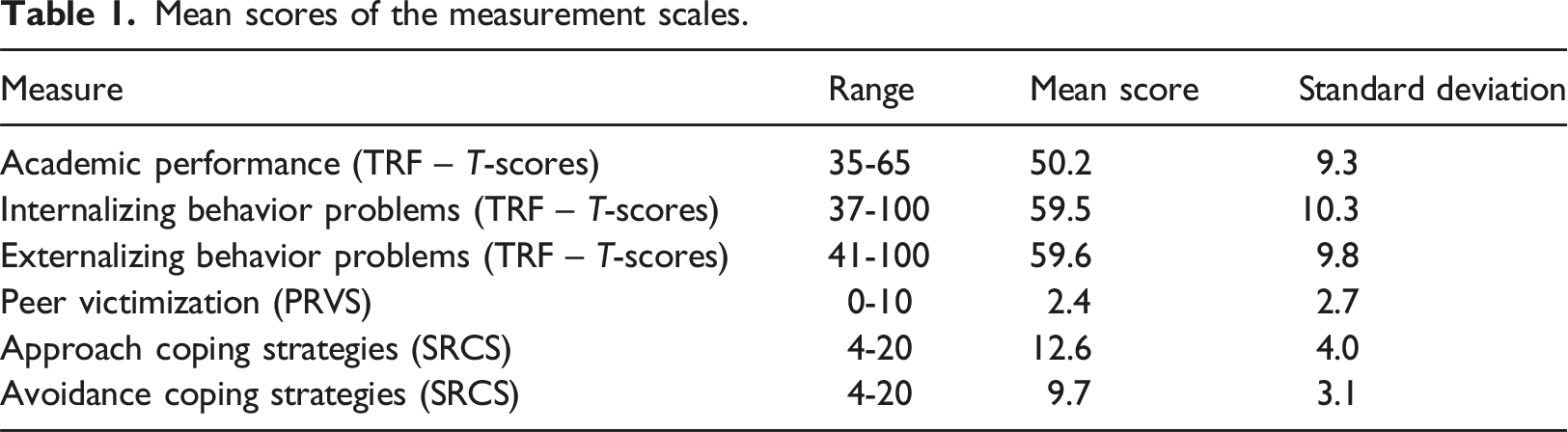
Descriptive statistics
Mean scores of the measurement scales.
Identification of trajectories
LCGA model selection
Fit indices for the LGCM model and the LCGA models.
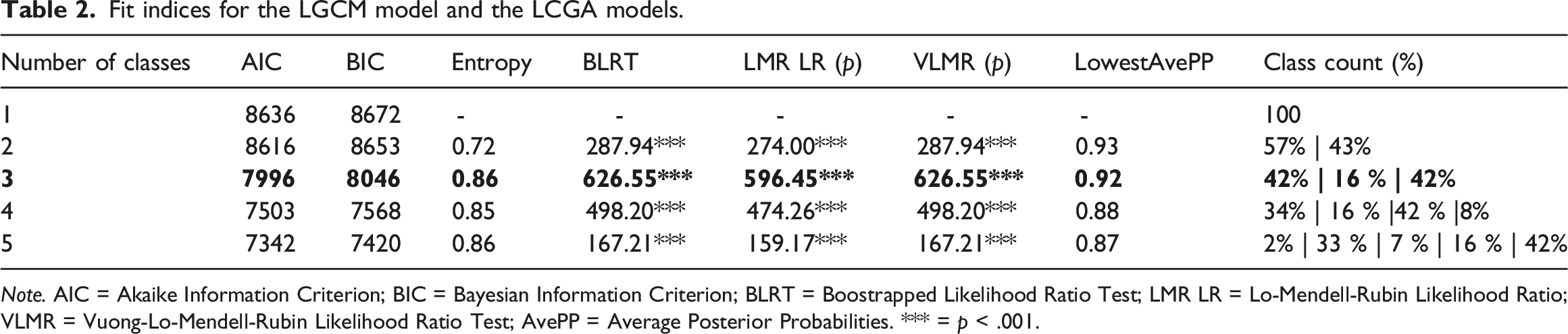
Note. AIC = Akaike Information Criterion; BIC = Bayesian Information Criterion; BLRT = Boostrapped Likelihood Ratio Test; LMR LR = Lo-Mendell-Rubin Likelihood Ratio; VLMR = Vuong-Lo-Mendell-Rubin Likelihood Ratio Test; AvePP = Average Posterior Probabilities. *** = p < .001.
Description of trajectories
The three trajectories were identified as the High functioning trajectory, the Moderate and Stable trajectory and the Low and Increasing trajectory. The High functioning trajectory, representing 42% of the sample, included children that show high academic performance at T1 that decreased slightly over time. Participants in the Moderate and Stable trajectory, comprising 42% of the sample, showed an average performance over time. Finally, children in the Low and Increasing (16% of the sample) showed a low performance at T1 that increased over time. According to TRF norms (Achenbach & Rescorla, 2001), where a clinical T-score falls between 35 and 37, a critical score is between 37 and 40, and a non-clinical score ranges from 41 to 65, children in the Moderate and Stable trajectory (T-score = 47), as well as those in the High Functioning trajectory (T-score = 60), exhibit non-clinical scores in terms of their academic performance, whereas children in the Low and Increasing trajectory (T-score = 35) display clinical scores at T1. Trajectories can be observed in a graph illustrating the differences between classes (Figure 1). Trajectories of school performance among child victims of sexual abuse.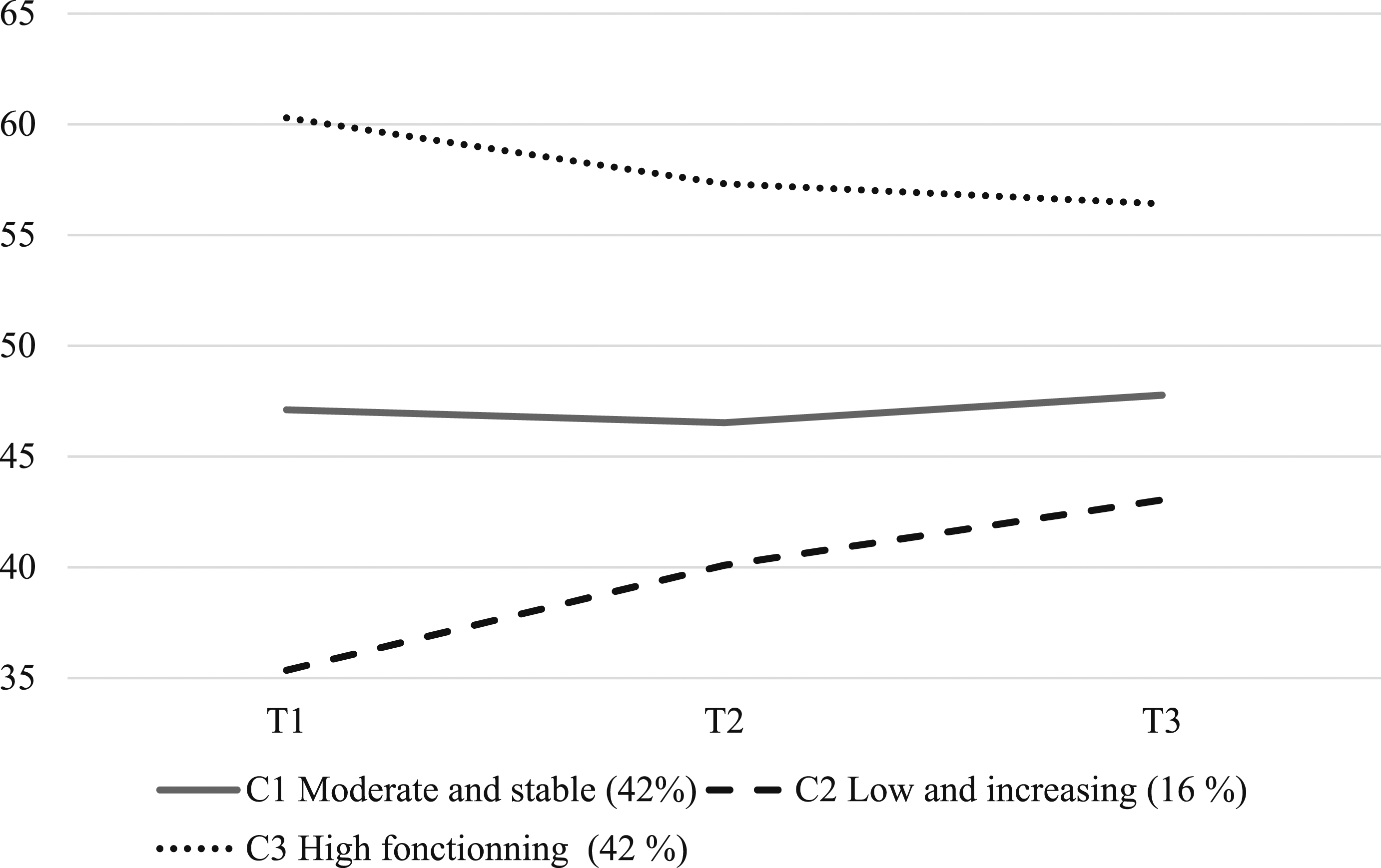
Psychosocial functioning correlates
Continuous correlates.
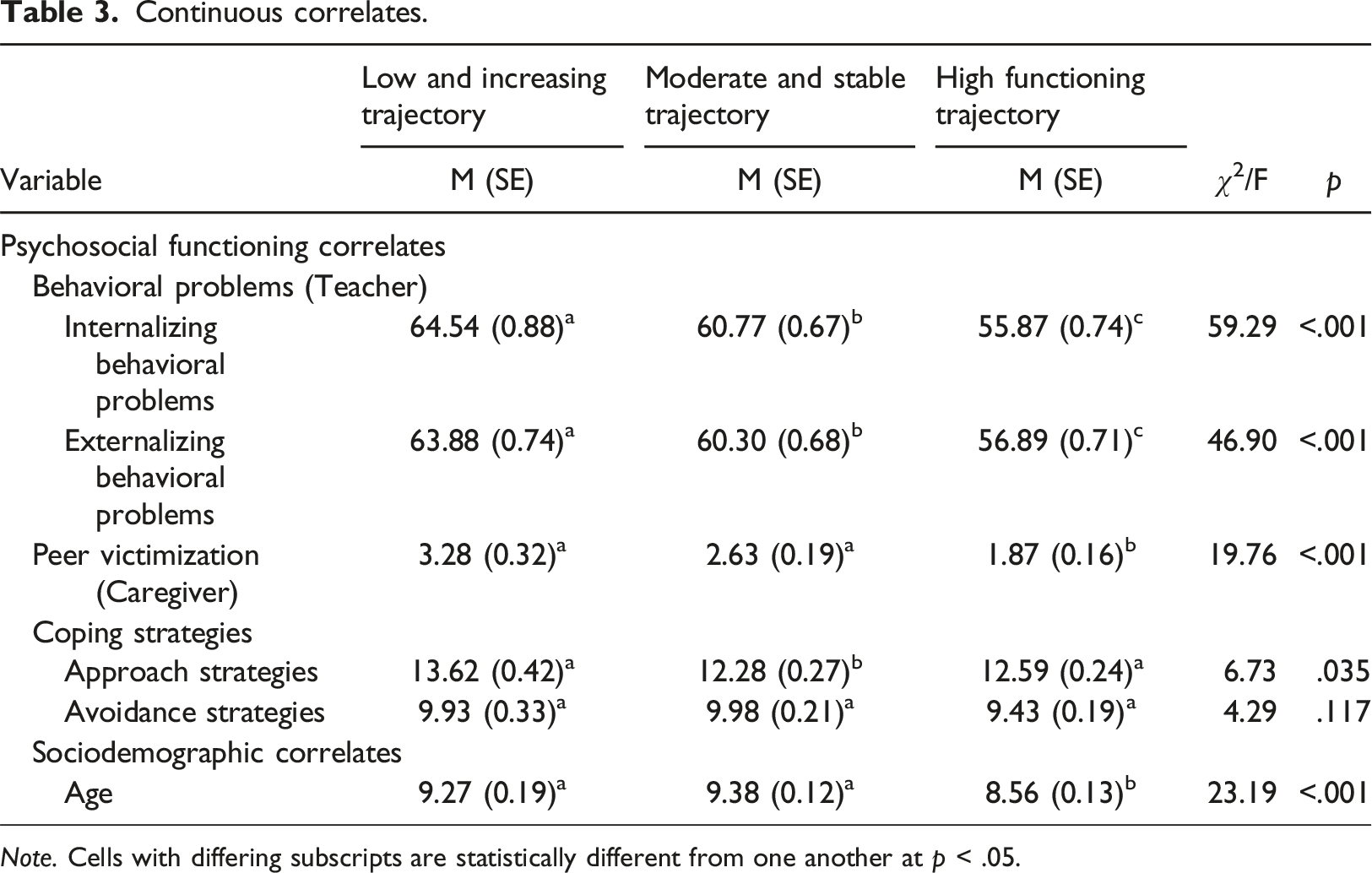
Note. Cells with differing subscripts are statistically different from one another at p < .05.
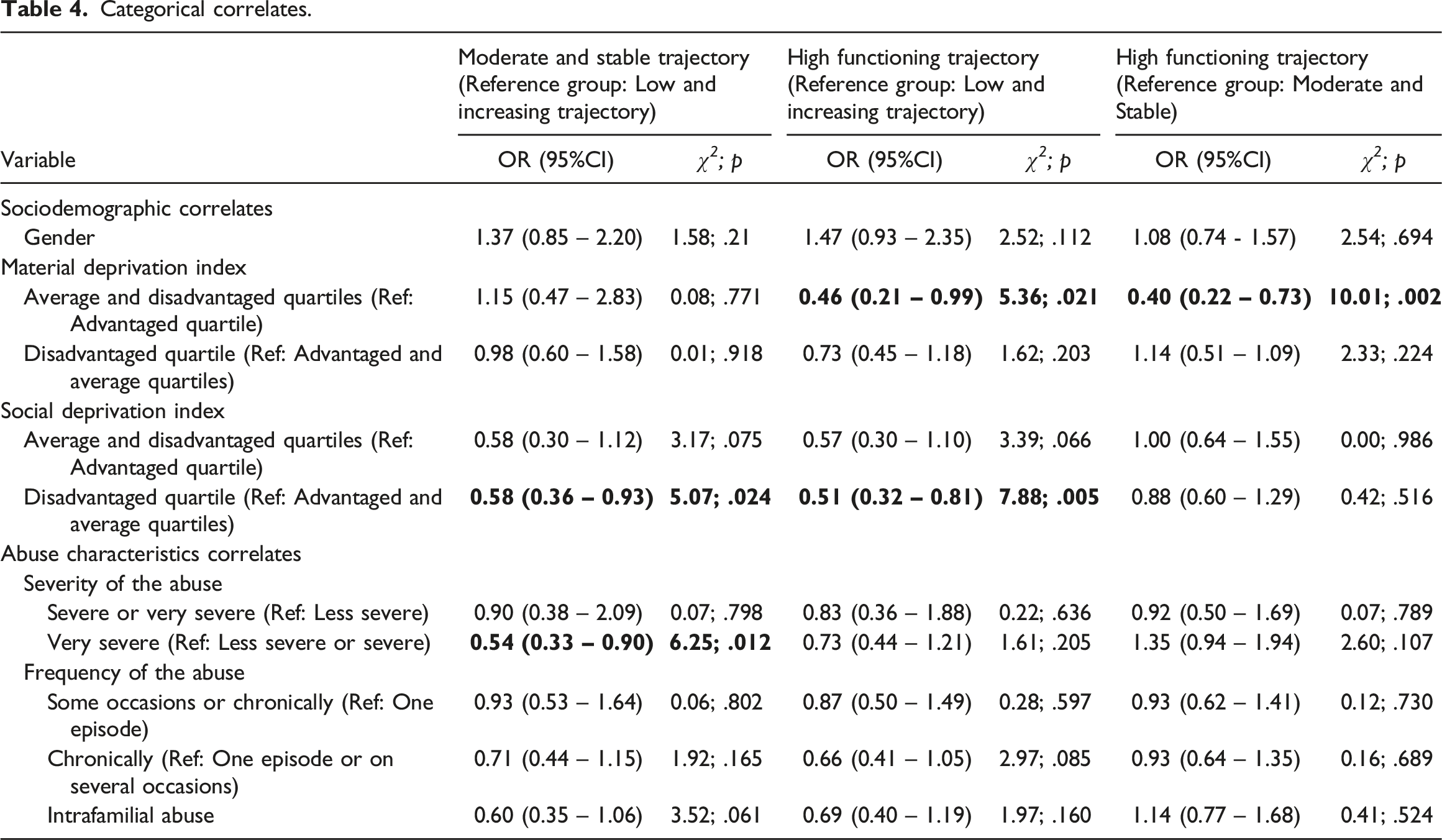
Categorical correlates.
Children’s level of internalizing and externalizing behavior problems reported by the teacher were significant correlates of trajectory membership. Teachers reported less internalizing behavior problems (M = 55.87; SE = 0.74) and externalizing behavior problems (M = 56.89; SE = 0.71) in children in the High functioning trajectory than children assigned to the two other trajectories. Also, according to their teacher, children in the Moderate and Stable group exhibited less internalizing (M = 60.77; SE = 0.67) and externalizing (M = 60.30; SE = 0.68) behavior problems than the children in the Low and Increasing trajectory (internalizing: M = 64.54; SE = 0.88; externalizing: M = 63.88; SE = 0.74). Means of the child peer victimization experiences, reported by the caregiver, were also significantly different between trajectories. Caregivers of children in the High functioning trajectory (M = 1.87; SE = 0.16) reported less peer victimization experiences than caregivers of children in the Moderate and Stable trajectory (M = 2.63; SE = 0.19) and the Low and Increasing trajectory (M = 3.28; SE = 0.32). The difference was not significant between the Moderate and Stable trajectory and the Low and Increasing trajectory. While the use of avoidance coping strategies was not a significant auxiliary variable, reliance on approach coping strategies differed between trajectories. Children in the Low and Increasing trajectory (M = 13.62; SE = 0.42) and in the High functioning trajectory (M = 12.59; SE = 0.24) reported a greater use of approach coping strategies than children in the Moderate and Stable trajectory (M = 12.28; SE = 0.27). There was not significant difference between the Low and Increasing trajectory and the High functioning trajectory.
Sociodemographic correlates
Sociodemographic variables were included in the analyses. Age, as a continuous variable, was examined, using the BCH method. Results revealed that children in the High functioning trajectory were younger (M = 8.56; SE = 0.13) than children in the Moderate and Stable trajectory (M = 9.38; SE = 0.12) and the Low and Increasing trajectory (M = 9.27; SE = 0.19). The difference was not significant between the Moderate and Stable trajectory and the Low and Increasing trajectory.
To examine the other sociodemographic correlates (gender and the material and social deprivation index), which were all categorical variables, the DCAT method was used. No significant differences were found between the trajectories regarding the gender of the children. The material and social deprivation index were significant auxiliary variables. As specified in the methodology, dichotomous scores were derived from the three-category ordinal score. The first score compared families in the advantaged quartile (0) to the median and disadvantaged quartiles (1). A second score compared families in the disadvantaged quartile (1) to the median and advantaged quartiles (0). When the family was classified in the disadvantaged or average quartiles of the material deprivation index, children were 2.20 times more likely to belong to the Low and Increasing trajectory, OR = 0.46; p = .021, and 2.52 times more likely to be in the Moderate and Stable trajectory, OR = 0.40; p = .002, than to be categorized in the High functioning trajectory. As for the social deprivation index, when classified in the disadvantaged quartile, children were 1.96 times more prone to be categorized in the Low and Increasing trajectory than the High functioning trajectory, OR = 0.51; p = .005. Also, when categorised in the disadvantaged quartile, sexually abused children were 1.74 times more likely to belong to the Low and Increasing trajectory than the Moderate and Stable trajectory, OR = 0.58; p = .024.
Abuse characteristics correlates
The abuse characteristic correlates were examined using the DCAT method. Regarding these variables, results showed that only the severity of the abuse was associated with trajectory membership. Compared to the Moderate and Stable trajectory, children who experienced a very severe sexual abuse (i.e., acts involving penetration or attempted penetration) were 1.85 times more likely to be in the Low and Increasing trajectory, OR = 0.54; p = .012.
Discussion
CSA exerts a profound influence on the lives of children that extends to their academic performance as well (Mitchell et al., 2021). Although past studies have examined this issue, to our knowledge, none have yet examined the longitudinal changes in school performance among these vulnerable children. The first objective of the present study was to elicit longitudinal patterns of school performance in a large sample of victims of CSA. Results revealed three trajectories: the High functioning trajectory, the Moderate and Stable trajectory and the Low and Increasing trajectory. The results of the present study are consistent with the literature on the general psychological adjustment profiles of maltreated children, which reveals a diversity of outcomes and identifying between three and five different profiles of outcomes (Holmes et al., 2018; Martinez-Torteya et al., 2017; Yoon et al., 2020). Although the Low and Increasing trajectory was expected, the other trajectories that emerged from our analyses diverge from our initial hypotheses. This will be further discussed in the sections below.
The High functioning trajectory
The High functioning group was the first trajectory and comprised 42% of the sample. This trajectory was characterized by a high academic performance that slightly decreased over time, and appeared to integrate elements from two initial trajectories we hypothesized, namely the high and stable trajectory and the high and decreasing trajectory. This group was comprised of children who do best at school, consistently over a one-year period. These findings were consistent with the previous studies in maltreatment, which suggests that some children show high psychological functioning or few symptoms despite adversity (Yoon et al., 2020). Only one longitudinal study had explored school adjustment in a sample of neglected or physically abused children and corroborates the presence of heterogeneous school adjustment profiles in children (Holmes et al., 2018). At first glance, the High functioning trajectory of our study was similar to the High and Stable Over Time trajectory identified in Holmes et al. study (2018), denoting that children in these groups appear to present a profile of resilience and perform well in school over time. However, although school performance remained higher than the other two trajectories, the High functioning trajectory of our study showed a decrease in school performance between T1 and T3. This slight decrease between measurement times, a pattern that was also illustrated by the Decreasing Over Time trajectory in the study by Holmes et al. (2018), is worrying and could also reflect the phenomenon of delayed-onset symptoms. As suggested in the literature, symptoms can sometime emerge after the events and affect the various spheres of the child’s life, including her or his academic performance (Galatzer-Levy et al., 2018). Considering that our study takes place over a one-year period, it is not clear which tendency would be maintained if it took place over a longer period. It is possible that the observed effects simply indicate a transient decline and that such a temporary decrease could potentially stabilize again after a certain period of time, similar to the Decrease/Recovery/Decrease trajectory in the study by Holmes et al. (2018).
The Moderate and stable trajectory
Around 42% of the sample was classified in the Moderate and Stable trajectory, grouping together children with a near-average school performance over time. This trajectory was not postulated in our initial hypotheses and was not similar to any group in the study of Holmes and al. (2018) discussed above. Yet, it is possible that these children showed negative outcomes following sexual abuse but that the academic sphere remained less affected. For instance, a cross-sectional study with 597 12-years-old children revealed five adjustment patterns: consistent maladaptation, post-traumatic stress problems, school maladaptation, low socialization skills, family protection, and consistent resilience (Martinez-Torteya et al., 2017). While the low socialization skills and post-traumatic stress problems profiles respectively showed children with low levels of social skills or high post-traumatic stress symptoms, the academic sphere remained almost unimpaired for these children (Martinez-Torteya et al., 2017). Notwithstanding this, children in the Moderate and Stable trajectory had results below average, with school performance T-scores ranging from 46.53 to 47.77. This still points to some learning challenges at the academic level. The effects of trauma can be complex, and it is crucial to consider a holistic understanding of the child’s well-being, in addition to their academic results.
The Low and Increasing trajectory
Finally, the Low and Increasing trajectory showed a pattern of school performance that was low at the first measurement time and tended to improve until the third and final measurement point. This trajectory accounted for 16% of the sample and was expected, given that the literature suggests that some children may experience greater repercussions following sexual abuse, including in the academic domain (Yoon et al., 2020). The pattern of this trajectory suggested an increase in academic performance, which is similar to the Increasing trajectory in Holmes et al. (2018) study. The literature indicates that this pattern could be explained by the fact that some negative consequences may lessen over time, making it possibly easier for these children to build resilience (Holmes et al., 2018; Yoon et al., 2020). As mentioned earlier, it is difficult to know whether the upward trend would continue after one year, or whether it would stabilize and remain low, which would be more akin to the Low and Stable Over Time trajectory of Holmes et al. (2018).
Psychosocial functioning correlates
The second objective of our study was to elucidate the different correlates associated with the distinctive trajectories. With regards to the psychosocial functioning variables, participants who displayed higher levels of externalizing and internalizing behavior problems were more likely to be categorized in the Low and Increasing trajectory or in the Moderate and stable trajectory than in the High functioning trajectory. This result is coherent with other studies among maltreated children that found that externalizing and internalizing behavior problems monopolize cognitive resources, making children less available for learning (Romano et al., 2015).
Furthermore, peer victimization was also a significant correlate of academic performance trajectories, as the High functioning group reported lower levels of peer victimization than the two other trajectories. This finding highlights the importance of considering other form of victimization when assessing vulnerable children. Sexually abused children are more likely to be victimized by their peers, which could have a cumulative effect on their behavioral problems and, in turn, negatively impact the child’s availability for academic learning (Tremblay-Perreault & Hébert, 2020).
Previous studies have also found that coping strategies can impact the adjustment of sexually abused children (Boxer & Sloan-Power, 2013). Our findings revealed that children in the Low and Increasing trajectory and in the High functioning trajectory used more approach strategies than children in the Moderate and Stable trajectory. In regard of the High functioning trajectory, this finding is consistent with a comparative study suggesting that the use of approach strategies is associated with greater levels of positive adaptation (Afifi & MacMillan, 2011). Approach strategies involve the use of problem-solving and support-seeking techniques, which are also useful skills for academic performance. As for the Low and Increasing trajectory, this result is in line with a meta-analysis that found a statistically significant positive association between the use of approach strategies and post-traumatic stress symptoms (Littleton et al., 2007). Some authors suggests that this association may be explained by the participant’s need to display more coping strategies precisely because of the presence of more severe difficulties (Littleton et al., 2007). As for the present study, the children in the Low and Increasing trajectory also exhibited more experiences of peer victimization than their counterparts. They may use more approach strategies to cope with their problems, which would be representative of the child’s level of distress.
Sociodemographic correlates
When trajectories were compared based on potential sociodemographic correlates, findings revealed that younger children were more likely to be classified in the High functioning trajectory than the two other groups. The literature shows contradictory results regarding the impact of age in the various studies on maltreatment. While some argue that there are differences according to age (Romano et al., 2015), other results show the opposite (Yancey et al., 2013). As suggested in the study by Yancey and colleagues (2013), further studies are needed to better identify the effect of age and to be able to interpret these results. As for the material deprivation index, the present study indicates that the High and functioning group was more likely to be categorized as advantaged compared to the two other trajectories. As for the social deprivation index, results revealed that the Low and Increasing trajectory was less likely to be categorized as average or advantaged compared to the two other trajectories. These findings demonstrates that children who consistently perform well at school are also those who seem to have access to more material and social resources, enabling them to feel supported, but also parents to feel they have the skills and resources to support their child. The literature indeed shows that poverty, both material and social, in maltreated children can compromise the efficacy of other protective factors such as parental practices (Romano et al., 2015). Neighborhood resources are protective factors that can be modified by institutions and organizations and can be enhanced to provide a more supportive environment for vulnerable children.
Abuse characteristics correlates
Several studies on complex trauma suggest that repetitive and severe sexual abuse at a pivotal developmental period has a significant long-lasting deleterious effect on many spheres of a child’s life (Haselgruber et al., 2020). The academic sphere, among others, can be affected by the characteristics of the abuse (Haselgruber et al., 2020). Our results were consistent with this literature in regard to severity of the abuse being associated with a heightened likelihood to be in the Low and Increasing trajectory.
Implications
Our results highlight the need for agencies, institutions, and organizations to efficiently utilize the wider environment of the child such as the school, the neighborhood in which they live and the material and social resources available as it might influence their academic results. For instance, institutions could incorporate trauma-informed practices among individuals working in schools, such as administrators and teachers, but also school staff. Some authors have suggested recommendations to support schools in the academic success of trauma-affected children, such as training school employees to know how to deal with these children and identify barriers they may face to take action (Cole et al., 2005). Policies are needed to promote equitable access to resources to reduce the social inequalities in health which has deleterious effects on the psychosocial development of vulnerable children. These more holistic preventive measures could also help identify sexually abused children with more general difficulties, not just academic ones, and offer them upstream resources. As shown by the Moderate and Stable trajectory, some children may initially appear unaffected in their school environment, while the impact of trauma may manifest itself in other forms over time. Therefore, more community-based preventive initiatives would make it possible to monitor the psychological adaptation of these children and the appearance of other risk factors or adverse life events in their environment that could affect their well-being.
Another important academic factor to consider for these children is the exposition to peer victimization. It could be worth setting up prevention programs and targeted interventions to reduce peer-to-peer violence at school, so that children see school as a safe place that contributes to their well-being. This could improve the experiences of all children, but especially those who are victims of sexual abuse, since they are more at risk (Tremblay-Perreault & Hébert, 2020).
Limitations and strengths
This study must be considered with certain limitations. First, our sample is not representative of the population of sexually abused children in Quebec, as our sample was recruited from families seeking services in specialized intervention centres. Second, the measurement of school performance is based on the teacher’s perception, not on objective data about the child’s academic results. However, the teacher is a direct witness to the child’s behaviors in school and his or her expertise is valuable to assess the academic performance of the child (Tremblay-Perreault & Hébert, 2020). Finally, other forms of trauma experienced, in addition to sexual abuse, were not considered, although the literature indicates that it is common for a child who has experienced one form of trauma to be more likely to experience other forms (Lee et al., 2023). This polyvictimization could have a cumulative impact on school adjustment, as it does on psychological consequences (Lee et al., 2023).
Despite these limitations, it is important to highlight the various strengths of this study. First, the use of a longitudinal design allowed us to explore changes in academic performance over a year. Also, the sample size is considerable which allowed for analysis of distinct trajectories. Finally, we were able to rely on three respondents, collecting data from the children, their caregiver, and their teacher. This provided us with data on the child’s behaviors in the home environment as well as in the school environment.
Conclusion
The present study is the first, to our knowledge, to investigate longitudinal profiles of school performance in children who have been sexually abused and highlights the existence of heterogeneous trajectories of academic performance. Our results reveal that sexually abused children who show a high overall academic performance also tend to exhibit more environmental resources and a higher psychosocial functioning. Our study also shows that children who are more victimized, have fewer resources, and more behavioral problems tend to show more academic difficulties. It is important to note that despite these various difficulties, the academic performance of some children still increases over time. This finding is encouraging and suggest that the most vulnerable sexually abused children are not predestined to suffer more lasting negative consequences and can also build their resilience capacities.
Footnotes
Declaration of conflicting interests
The authors declared no potential conflicts of interest with respect to the research, authorship, and/or publication of this article.
Funding
The authors disclosed receipt of the following financial support for the research, authorship, and/or publication of this article: This study was funded by the Canadian Institutes of Health Research (110945, 353537, 77614).
