




Abstract
The disclosure process for children who have experienced maltreatment is often difficult. In an effort to support children in their disclosures, interviewers have increasingly turned to empirically-based interview protocols (i.e., questioning strategies) that both decrease the suggestibility of questions while also increasing the productivity of children’s statements. Despite efforts to improve the structure of forensic interviews, interviewing support tools, such as note-taking, have received less empirical attention. To date, research examining interviewers’ notes has primarily focused on the accuracy of such records for evidentiary reasons. Yet, note-taking may serve other purposes; for instance, the process of note-taking may increase the accuracy of interviewers’ questions (i.e., use of child’s words) and memory (i.e., follow-up questions and themes) throughout the interview. In the current review, we describe the limited forensic note-taking literature, as well as the potential strengths and weaknesses of note-taking during forensic interviews with children. We end by suggesting potential avenues of research to assist with the creation of practical guidelines for the use of notes during forensic interviews.
Children may act as witnesses in court for a variety of reasons (i.e., criminal, custodial cases); however, their role is exceedingly important in cases where adult witnesses and physical evidence may be lacking, such as in cases of child sexual abuse (Finkel & DeJong, 1994; Smith et al., 2018). Children are unique witnesses as they are more vulnerable to suggestion (Leitchmen & Ceci, 1995), as well as more reticent to disclose witnessed events compared to adults (Sperry & Gilbert, 2005). In an effort to increase disclosure rates, standardized interviewing protocols have been developed, which improve the credibility (Hershkowitz et al., 2014; Hershkowitz & Lamb, 2020) and informativeness (Lamb et al., 2007) of children’s disclosures while simultaneously attempting to reduce reluctance and the risk of false reports during interviews (Blasbalg et al., 2019).
The most researched forensic interviewing protocol, the structured NICHD Investigative Interview Protocol, recommends that interviewers minimize the risk of contamination and suggestion in interviews through open-ended prompts (e.g., “Tell me what happened”) and cued invitations (Lamb et al., 2008). When posing a cued invitation question, interviewers use the child’s own words for follow-up questioning (e.g., “You said X, tell me more about X”; Henderson et al., 2019; Lamb et al., 2018). However, to successfully translate these recommendations into a substantive and productive interview, interviewers must complete two mental operations almost simultaneously. First, they must attend to the child’s responses in order to process the broad meaning of the child’s words and construct logical follow-up questions. Second, interviewers must attend to the specific language and details provided by the child so that the follow-up questions include the child’s words and not the interviewer’s own language or ideas. Overall, a forensic interview, when done correctly, is a cognitively-demanding task. Although, individual differences in memory and attention most certainly exist (Bui & Myerson, 2014; Jarrold & Towse, 2006), making these tasks easier for some interviewers compared to others (Hershkowitz & Lamb, 2020). Thus, a fruitful new direction for research is to identify tools that have the potential to improve adherence to protocols by attenuating some of the cognitive burden placed on interviewers.
One potential tool is for interviewers to take notes of children’s statements during the interview process. In principle, note-taking can allow an interviewer to summarize or record key words children may use, meaning the interviewer no longer has to hold these concepts in memory to construct follow-up questions. Note-taking also allows interviewers the opportunity to highlight entire topics for follow-up without interrupting a child during their narrative. While note-taking can be useful within the context of a forensic interview for the aforementioned reasons, many trainee resources feature only a small section about note-taking, if it is included at all. Moreover, recommendations for the practice of note-taking in such resources often lack an empirical basis and appear to be founded on hearsay experience and customary paradigms (Groth-Marnat & Wright, 2016; Owens et al., 2010; Sattler, 2014). Anecdotally, a number of forensic interviewers report varying perceptions of the practicality and benefits of note-taking during forensic interviews. For instance, some hold the opinion that note-taking should be avoided by interviewers because it may be distracting to a child or could have negative effects on rapport (Hickling et al., 1984; Miller, 1992; Mills, 2012; National Child Advocacy Center [NCAC], 2016). Others express concerns over the potential legal consequences of the document created during note-taking. Yet, no empirical research to date has documented forensic interviewers’ perceptions or use of note-taking specifically (Starcher & Stolzenberg, 2020), nor has there been any empirical evidence to directly support or refute these claims within the forensic interviewing context.
In the current review, we begin to close this gap in the literature by synthesizing the note-taking research that does exist from forensic and clinical contexts. We begin by reviewing the few studies conducted on note-taking within child forensic interviewing. Next, we review the literature across disciplines with an eye toward addressing potential risks and benefits of the practice of note-taking within a forensic context. We then highlight the specific style, strategies, and methods for note-taking that are expected to increase the benefits and decrease the risks of taking notes during an interview. Finally, we conclude with policy implications and a call for future research that will provide the information needed to create empirically-based recommendations for forensic interviewers.
Forensic interviewing and note-taking practices
Note-taking has been historically viewed as a means to document an interview rather than to facilitate an interview. For example, social worker Claudia Wannamaker first introduced the concept of detailed documentation of interviews by employing a stenographer to record interviews with precision (as cited in Kogan, 1950). The historical framing of note-taking as evidentiary in value can still be seen in more recent research, which has situated note-taking within the realm of documenting a child’s narrative (Berliner & Lieb, 2001; Cauchi & Powell, 2009; Lamb et al., 2000). For instance, Cauchi and Powell’s (2009) field study of both interview logs and casebooks highlighted how interviewers’ notes contained errors of omission and commission. Similarly, Lamb et al.’s (2000) comparison of forensic interviewers’ verbatim notes to audiotaped recordings of interviews with alleged victims of child sexual abuse found omissions of interviewers’ utterances and child witnesses’ statements. Moreover, Berliner and Lieb’s (2001) field study comparing forensic interviewers’ written notes to recordings found that interviewers tended to neglect recording their own questions or utterances. Thus, the majority of such field-based research supports the argument that note-taking is susceptible to human error and that electronic means of recording interviews provides a more exact and impartial method of documenting a child’s statements.
Similar to field-based work, experimental research examining interviewers’ notes has also focused on the accuracy of notes. In Cauchi et al.’s (2010) experimental study, interviewers recorded question content over question type, as the content of questions was identifiable more often than the type. As such, their findings demonstrated that note-taking, as a means to document a child’s narratives and an interviewer’s questions, is likely not as precise as other forms of recording, such as electronic recording. Moving beyond notes as a record of the interview, Cauchi et al.’s results do highlight an important function of note-taking during a forensic interview, that is, notes as a tool for the interviewer rather than documentation. Specifically, recording content or question type could be similar to capturing key words and ideas of a child’s narrative, suggesting that the goal of note-taking could be to use notes as a tool for formulating questions rather than verbatim documentation.
To date, both field and experimental studies support the argument that written records (i.e., notes) of interviews hold relatively poor accuracy, frequent omissions, and some commission errors (i.e., incorrect details, false tense of child’s statement), which may have a detrimental effect on a child’s credibility if used as evidence of their disclosure. The studies reviewed above are crucial and impactful as they provide overwhelming support for the importance of electronically recording forensic interviews. Thus, a critical point that is worth reiteration is that note-taking should not be used as a strategy to replace the electronic recording of interviews. However, none of the aforementioned studies considered alternative benefits of note-taking, such as the effects of note-taking on the quality of the interview in real time. We argue, then, that the focus on note-taking in the literature thus far, while legitimate in order to advocate for the use of electronic recording in interviews, has potentially underestimated the advantages of note-taking.
Note-taking as an interviewing tool: Risks and benefits
Despite the paucity of research examining note-taking during forensic interviews, there are several arguments in favor of the practice. The most salient rests in the potential benefit notes provide for the structure of interviews and more specifically, the wording and accuracy of questions. Accurate follow-up on children’s utterances is of particular importance during forensic interviews when cued invitation questions are used. This form of questioning includes referring to details provided earlier in the interview in order to elicit additional information from free recall (Brown & Lamb, 2015; Henderson et al., 2019; Lamb et al., 2007). Notably, in Bearman et al.’s (2020) examination of interviews of adults with limited expressive language, the use of “careful note-taking” is encouraged as a means to ensure the interviewee’s own words are used in questioning, suggesting that note-taking is applicable to recommended forensic interviewing practices. However, if note-taking during forensic interviewers is an obviously useful tool, why have practical guidelines and researchers not developed greater resources to encourage the practice to date? Likely because there are potential risks that come when introducing an unstructured activity into the interviewing context. Valid concerns exist regarding the potential influence note-taking may have on those being interviewed, as well as the demands that note-taking may place on the interviewer (e.g., negative effects on attention and rapport).
Risk: The effect on rapport building
The most predominant criticism of note-taking across various disciplines is the potential for the practice to impair rapport by disrupting the flow and pace of an interview (Goldbloom, 2011; NCAC, 2016), as well as detracting from attention to an interviewee, potentially harming the productivity of the interview (Mills, 2012). Although there is little to no empirical research or commentaries on note-taking within forensic interviews, the scant literature within the psychological and medical literature reveals a recurring concern that note-taking lacks substantial benefits and may adversely affect client or patient interviews (Lo & Wadsworth, 2014; Mills, 2012). Rapport building is critical in forensic interviews, so much so that explicit sections of many structured interview protocols, both the revised NICHD protocol (Hershkowitz et al., 2014) and Ten Step Investigative Interview (Lyon, 2005), include specific sections dedicated to building rapport. Therefore, any tool that may detract from this goal needs to be examined. Unfortunately, to date, the body of research examining the impact of notes on rapport rests within clinical interviewing contexts.
Only a handful of theoretical papers exist pertaining to note-taking in therapeutic settings (i.e., psychology and counseling) and regrettably the conclusions vary significantly. Some consider note-taking to be an integral component of ethical practice in the context of record-keeping (Bemister & Dobson, 2011), while others argue note-taking has the potential to be deleterious as it may detract from a clinician’s attention toward the client (Mills, 2012). The empirical findings in these fields also lack consistency, which is likely a function of differing methodology and operationalization. For instance, some studies have found note-taking may influence rapport (Hartley, 2002; Hickling et al., 1984; Miller, 1992) while others do not (Christie et al., 2015). For example, Goldbloom (2011) argued the frequent pauses for note-taking has the ability to destroy the flow of an interview. Conversely, Owens et al. (2010) and Sattler (2014) postulated the pauses needed for note-taking provide useful breaks for peace and reflection, or allow the opportunity for interviewees to build upon their thoughts.
Inconsistencies also exist in third parties’ perception of note-taking during a therapy or assessment session. Although forensic interviewers are different from clinical interviews or therapy, insights from these fields can provide some context for the concerns that forensic interviewers have in relation to rapport and note-taking. In an early study, Hickling et al. (1984) examined social work graduates’ perceptions of therapists who took notes and therapists who did not take notes. Results revealed therapists who took notes were rated as significantly less effective than those who did not take notes. However, in a later study that compared undergraduate students’ perceptions of school counselors who took notes during a counseling session and those who did not take notes, students did not perceive any differences in the counselors’ competence or trustworthiness when taking notes (Miller, 1992). However, the participants did report that they would be significantly less likely to seek help from the note-taking counselor compared to the counselor who did not take notes. So, although there are some inconsistencies, both studies together point to the conclusion that, at least from a third party perspective, note-taking may detract from a practitioner’s effectiveness and ability to build rapport with clients.
When perceptions are measured using the “client” perceptions of note-taking, rather than a third party, note-taking does not seem to have the same negative influence. Christie et al. (2015) examined the impact of note-taking on clients’ perceptions of a therapist, whereby a large sample of undergraduate students viewed a video depicting a simulated therapy session. In the video, the therapist either took notes or did not take notes, and following the video, participants rated their perception of the therapist’s effectiveness. Overall, the researchers found no significant effect of note-taking on perceptions of the therapist’s effectiveness, suggesting that while a third party may feel the behavior is distracting (Hickling et al., 1984; Miller, 1992; Mills, 2012), the practice of note-taking did not detract from a client’s perception of a therapist within a dyadic interaction (i.e., similar to a forensic interview). It is important to note, however, that the divergent findings across studies could also be due to variations in note-taking practices used. It is important for future studies to determine whether inconsistent results are a product of unintentional variations in the note-taking manipulation, such as the frequency or duration of note-taking.
The above research is helpful in informing how note-taking could negatively influence rapport during forensic interviews, but there are several limitations that impede our ability to directly apply the findings. First, rapport may function differently in the context of forensic interviews than it does in other contexts. That is, the goal of forensic interviews with children is to maximize productivity and accuracy of children’s disclosures, while simultaneously minimizing false reports (Saywitz et al., 2018). Rapport building, while shown to be helpful in increasing children’s productivity and disclosure (Hershkowitz et al., 2014; Hershkowitz & Lamb, 2020), is arguably not the same as it would be in a repeated and long-term therapeutic context. Therefore, if note-taking enhances productivity and reduces suggestibility within an interview, and only minimally detracts from rapport, it is possible that it may be more justified in a forensic interview setting than it would be in other fields. Second, it is important to consider that the aforementioned studies examined adults’ perceptions of note-taking rather than children’s. It is conceivable that children, particularly young children, may have different perceptions of note-taking than adults, as they have different expectations about their interactions with others based on their cognitive and social development. Lastly, it needs to be considered whether note-taking could actually influence what a child tells an interviewer. For example, one study found that visibly taking notes when clients referenced mothers reinforced the frequency of responses related to mothers (Gottlieb et al., 1979). Future research is needed to address these concerns and begin to elucidate the true risks of note-taking on rapport during forensic interviews.
Risk or benefit: Memory and note-taking
Another concern regarding note-taking is the cognitive effort it requires during the interview. Note-taking may be extremely mentally demanding (Bui & Myerson, 2014; Jansen et al., 2017; Piolat et al., 2005), and in the case of forensic interviewers, the cognitive demands of note-taking, in addition to the emotionally taxing content of children’s disclosures, may play a role in dissuading interviewers from adopting note-taking practices. Moreover, note-taking may appear trivial or as an additional burden on the interviewer when they are already attempting to concentrate, attend to, and also consolidate the emotional information they are receiving. In contrast, note-taking may also enhance forensic interviewers’ memory as the act of writing notes may assist the interviewer in moving the child’s statement to longer term memory (i.e., for later questioning during the interview; Bohay et al., 2011; Kiewra et al., 1991). Notes may also provide structure for interviews and so it remains to be seen (i.e., through empirical research) whether note-taking is in fact too mentally demanding for forensic interviews.
In clinical settings, notes can serve as a source of details that are unlikely to be remembered by the interviewer (Di Vesta & Gray, 1972; Kiewra, 1989; Kiewra et al., 1991) and are therefore useful when one needs to record information that is not easily remembered (Hartley, 2002; Kiewra et al., 1991; Owens et al., 2010). Furthermore, researchers have found that note-taking promotes processing of relevant material, facilitating improved comprehension of the material and simultaneous reinforcement of connections made between ideas (Bohay et al., 2011; Kiewra et al., 1991). Thus, notes may aid the interviewer’s memory for a child’s statement or words during the interview, potentially resulting in more precise and more child-specific language being used in questions. Based on this research, once practiced and developed, note-taking may be used as a beneficial tool in the forensic interview.
Risk: Legal concerns
Forensic interviewers may choose to forgo taking notes during their interviews in fear that those notes may be discoverable and used by the defense in a criminal prosecution to discredit their, or the child’s, testimony. These worries are reflected in commentaries about the preservation of evidence from forensic interviews in various formats (e.g., Cauchi & Powell, 2009; MacFarlane, 1985; Vieth, 2009) and emerge out of the rules of discovery, which dictate that prosecutors must turn over evidence in their possession to the defense if that evidence is exculpatory (i.e., points to the defendant’s innocence) and material to the outcome of the case ( Brady v. Maryland, 1963). United States law dictates that evidence is generally considered material “if there is a reasonable probability that, had the evidence been disclosed to the defense, the result of the proceeding would have been different” ( United States v. Bagley, 1985, p. 682). This prescription extends to evidence that could impeach the credibility of a witness when the reliability of that witness’s statement is central to the case outcome ( Giglio v. United States, 1972).
The discovery rules have obvious implications for forensic interviewers. The information produced in forensic interviews may very well be exculpatory and material to the outcome of a case. The defense may try to use the statements that the child made or the questions that the interviewer asked during the interview to impugn the credibility of the accusations. Thus, certain pieces of evidence from the forensic interview will indeed be discoverable. Yet, focusing narrowly on the notes that interviewers take during those interviews does not lead to one clear and concise conclusion about discoverability. In practice, the discoverability of the notes forensic interviewers produce during their interviews with children will rest on what information those notes contain. It will come down to the questions of whether the information in those notes is exculpatory and material to the outcome of the case.
The application of the discovery rules in child abuse cases is complicated by the fact that all states have statutes in place to protect the confidentiality of official records regarding child abuse (Child Welfare Information Gateway, 2017). These statutes generally serve to preserve the confidentiality of child abuse reports and therefore, place heavy restrictions on which individuals can access the information contained therein. Case law does not provide definitive answers about how courts may balance the conflict between confidentiality statutes and discovery rules. In Pennsylvania v. Ritchie (1987), the U.S. Supreme Court grappled with this tension by balancing the compelling state interest in protecting information about child abuse with the right of a defendant to obtain information that is exculpatory and material to his defense. The Court ultimately concluded that the defendant did not have unfettered discretion to search through the government’s files but instead was entitled to know whether the files contained discoverable evidence. Instead of allowing the defense access to the files to determine the discoverability of their content, the Court held that allowing the trial court to conduct the inquiry was sufficient to serve all parties’ interests. Thus, the defense has some rights to discover the information contained in confidential child abuse files, but those rights are restricted to protect the sensitive information they contain.
Taken together, it may or may not be the case that forensic interviewers’ notes are discoverable to the defense in a criminal prosecution. The discoverability will rest on what information those notes contain. Nevertheless, within this backdrop of discovery rules, some additional considerations are worth attention.
First, with the rise of video-recorded forensic interviews and the likely discoverability of those records (McGough, 2002), the discovery of notes should be less cause for concern. Presumably, if the notes contain merely excerpts of the information that the child disclosed during the interview, then the notes themselves would not provide any material evidence above and beyond what is already contained in the tape. However, if the notes contain additional information, such as the interviewer’s opinions or evaluations of the child, then the notes may provide material evidence beyond the recording itself. Thus, interviewers who are concerned about the discoverability of their notes can minimize those concerns by carefully attending to what information they include in their notes.
Second, notes may actually serve a protective function. They may help the forensic interviewer substantiate their claims about the child or their questioning strategy rather than requiring the interviewer to merely rely on his or her own memory. As attorneys often exclaim, “if it isn’t written down, it didn’t occur” (Knapp & VandeCreek, 1996). Additionally, if the interviewer conducted a quality interview, their notes could substantiate their claims that they used appropriate questioning strategies. As one legal scholar argues, “thorough, accurate, ongoing documentation is convincing evidence of proper practice” (Myers, 2002, p. 416). This idea is especially true in the case where no video-recording exists. The notes can provide corroboration for the statements that the forensic interviewer makes during their testimony that, without the existence of such documentation, would be otherwise left to their memories alone.
In sum, the fear that forensic interviewers’ notes may be discoverable is not necessarily unwarranted. This fear, however, can be possibly mitigated by using alternative documentation formats (i.e., video-recording) or adopting certain note-taking strategies (e.g., writing down informative rather than evaluative information; see below for recommendations). It is also important to balance these concerns with the fact that notes can be useful to the forensic interviewer both inside and outside of the courtroom. As such, considering the importance of using notes as a forensic interviewing strategy, rather than a record of the interview; the question needs to be asked, if interviewers opt to use notes, what is the best method (or style) for note-taking during forensic interviews?
Applying research to practice: Note-taking strategies for the forensic interviewer
The above research and discussion provide some insight into the potential risks and benefits of note-taking within the forensic context. However, a common caveat across disciplines is the notion that not all notes are created equal. In other words, many of these risks and benefits are based on the type, content, and frequency of an interviewer’s notes. Although there are no forensically-oriented recommendations for how interviewers should take notes, there is some evidence to suggest that some strategies could undermine the proposed benefits or exacerbate the identified risks.
Visual style: Linear compared to non-linear notes
In the context of a forensic interview, the visual style of notes (i.e., how the note-taker is organizing the information on the page) is arguably just as important as the content that is recorded. The purpose of note-taking within a forensic interview is to facilitate the formulation of questions in real time. Thus, the information should be highly organized and easily available, in order for an interviewer to quickly find the relevant key words without disrupting the flow of conversation. If notes are highly disorganized or contain too much information, the cognitive burden of both recording and using the notes will likely undermine all of the aforementioned benefits. Unfortunately, there are not many studies that have explored the efficacy of various visual styles of note-taking. However, there have been observational studies which provide some evidence suggesting that the usefulness of a given visual style is directly tied to the purpose the notes are serving.
Of those forensic interviewers who use a specific note-taking style, two visual styles have been predominantly identified within the literature (Cauchi & Powell, 2009; Cauchi et al., 2010). The linear visual style typically involves alternating lines for questions and responses while using spaces or indentation to identify questions and responses, or by using symbols, such as “Q” for questions and “A” for answers. Linear styles are typically associated with superior note quality in terms of both the proportion of questions recorded and proportion of questions recorded in which the question type could be interpreted (Cauchi et al., 2010). However, to date, this research has been focused on the quality of detailing in notes, but not how notes can help an interviewer adhere to protocols (i.e., cued invitation questions) and increase productivity of the interviews.
A second note-taking strategy which may suit the needs of forensic interviewers is the diagrammatic approach, where the goal is to organize key terms and topics, rather than attempting to record a verbatim transcript. Studies have tended to report that diagrammatic visual style strategies are more effective for learning than linear notes (Bui & McDaniel, 2015; Piolat et al., 2005). For instance, Bui and McDaniel (2015) found that diagrammatic note-taking strategies were more beneficial (compared to no note-taking) for learning, particularly for those with lower cognitive abilities, measured by participants’ ability to create coherent mental representations, or models. However, note-taking in the context of forensic interviewers has different goals than for those who take notes for the purposes of learning material. Specifically, note-taking in forensic interviewers, if used as a tool, is meant to hold specific concepts or words, so that the interviewer may return to them and use them in questions once the child has finished providing a narrative.
As a result, we acknowledge that neither fit the exact needs of forensic interviewers. Instead, what we need is a hybrid (see Figure 1), that is, something that still picks up specific terms and points like the linear fashion. However, is also simplified, well-organized and visually easy to navigate in real time like the diagrammatic approach. Therefore, we propose a hybrid of the linear and diagrammatic approaches, which is specific to forensic interviewing (see Figure 1).
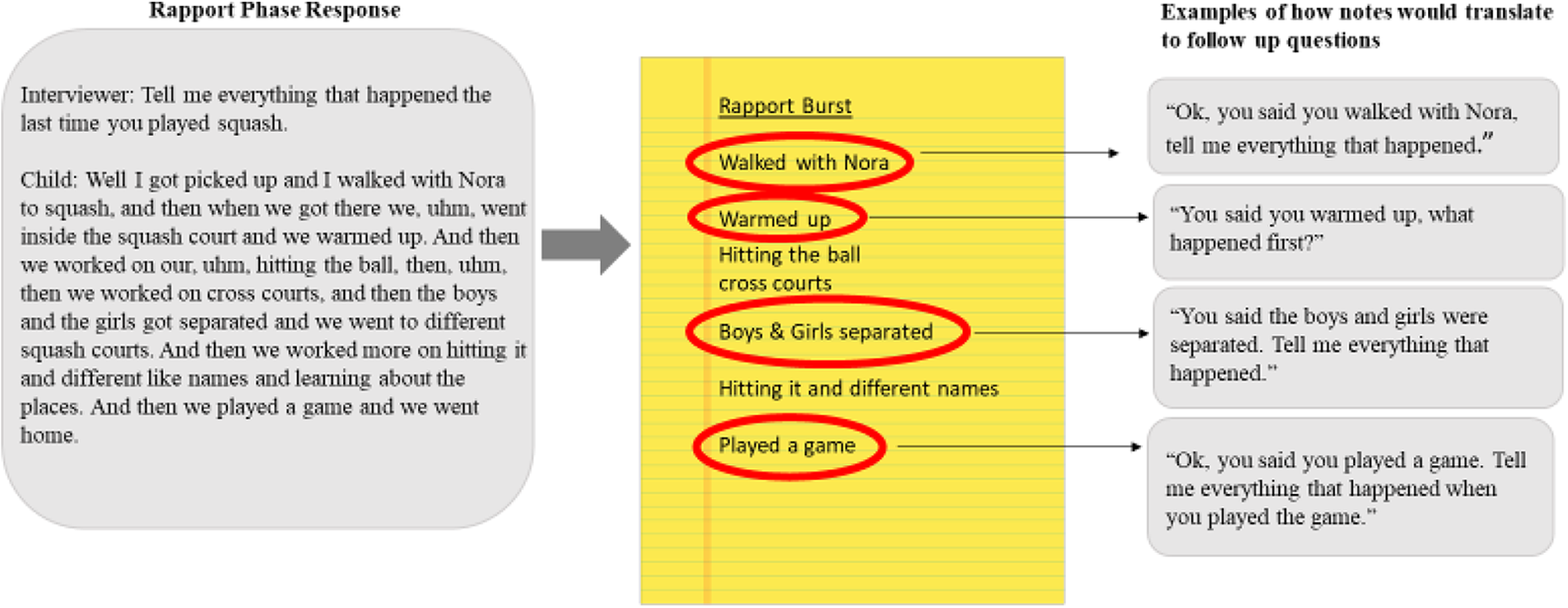
Potential layout of linear note-taking style for forensic interviewers with child’s rapport narrative, example of the notes from the interviewer, and use of notes in follow-up questioning. Paper image “Legal Paper” Copyright 2013 retrieved from openclipart.org.
Pre-determined structure: Outline versus free notes
The use of a predetermined structure, or a general template, to assist an interviewer in organizing an outline is something that is not often mentioned within the context of forensic note-taking. In other fields, the use of an outline is common and widely recommended, as outlines have been shown to enhance both note quantity and quality (Bui & McDaniel, 2015; Kauffman et al., 2011; Peverly et al., 2013). A pre-existing outline may be beneficial in terms of easing cognitive load, thereby promoting higher quality notes and increased attention on an information source. For example, Kauffman et al. (2011) found that participants who organized notes in a matrix with pre-defined headings recorded more details and demonstrated better recall than students who took linear notes. Similarly, Peverly et al. (2013) found using a skeletal outline was associated with significantly more notes and improved recall upon testing.
Pre-interview preparation for forensic interviews is already encouraged through the child advocacy center multidisciplinary team approach. Outlines can be created during this stage of the process. However, it is important to know that previous disclosures and allegations will likely be known at this stage and interviewers will need to use caution not to allow outlines to become sources of contamination and suggestion (Rivard & Compo, 2017). Consistent with this warning, pre-interview preparation remains controversial (Fessinger & McAuliff, 2020), and some experimental studies (Rivard et al., 2016) and legal cases ( Idaho v. Wright, 1990) have argued against it in favor of allegation-blind interviewing. However, it is possible to create an outline that is general and can be used across different forensic interviews, thus minimizing the risk of contamination. For instance, an outline could provide non-allegation-specific sections for the interviewer to place linear notes and follow-up questions which would maximize organization, while still minimizing the potential for suggestion or misinformation (Figure 2)
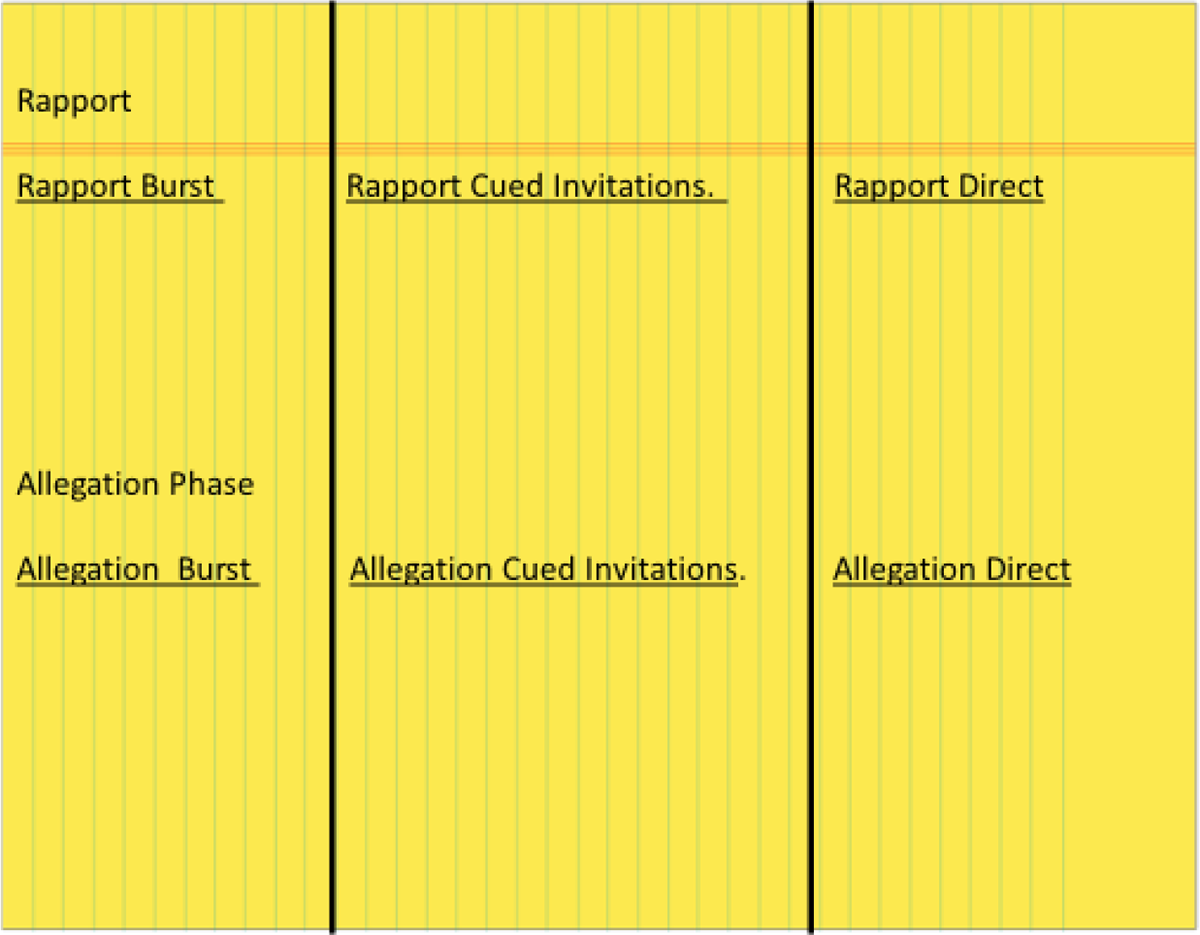
Example of pre-determined structure in the form of a non-allegation specific outline. Paper image “Legal Paper” Copyright 2013 retrieved from openclipart.org.
Future research recommendations
In the current review, we propose that note-taking reduces the demands placed on interviewers and provides interviewers with a tool to make their questions more specific to the child’s narrative (i.e., use of the child’s words in follow-up questions). Through a review of the current literature, we have highlighted the significant gaps in both empirical knowledge and practical guidelines for note-taking during forensic interviews. This is despite recent research suggesting that note-taking may be an interviewer characteristic or behavior that may influence the child’s willingness to disclose (i.e., a child’s disclosure of abusive events in an interview and provide elaboration on their abuse narrative; Hershkowitz & Lamb, 2020). Through our review, we have highlighted the arguments both in favor of, and against, note-taking.
Those who favor the practice reference the potential benefits to memory (Bemister & Dobson, 2011; Groth-Marnat & Wright, 2016; Owens et al., 2010; Sattler, 2014), as taking notes has been shown to increase one’s memory for content (Di Vesta & Gray, 1972; Kiewra, 1989; Kiewra et al., 1991). The implications of memory for note-taking can be further argued when note-taking is practiced and used consistently (Peverly et al., 2013). Finally, note-taking as a working tool in the context of a forensic interview is a strong argument in favor of the practice as interviewers may be able to highlight key words provided by the child within their narrative and to then follow up on these words via cued invitations.
Arguments against note-taking include the potential for the task to be too mentally demanding (Bui & Myerson, 2014; Jansen et al., 2017; Piolat et al., 2005), which is made more taxing on interviewers given the sensitive and emotionally demanding nature of their interviews (Fansher et al., 2020; Starcher & Stolzenberg, 2020). Furthermore, many interviewers fear the potential impact note-taking has on rapport building during the interview (Goldbloom, 2011; Mills, 2012), as well as the potential for suggestion through note-taking behaviors (Gottlieb et al., 1979). Finally, legal impaction of note-taking is another area of concern, with many agencies directing their forensic interviewers on the legal ramifications of taking notes and the potential for notes to be used at trials.
Lastly, we have proposed, based on our review of different note-taking strategies, a hybrid note-taking model for forensic interviewers. Although both linear and diagrammed approaches have been highlighted in our review, we argue for the use of a hybrid of these approaches, which allows forensic interviewers to note in a linear fashion the words children use in their disclosures, while also using diagrams or lines to draw connections between words used in follow-up questioning of children’s subsequent disclosures or narratives. As well, we argue that the use of a pre-determined outline may assist interviewers in structuring their notes during interviews and adhering to best-practice protocols.
Future directions
First, the most pressing need in terms of research is to systematically examine the rates and perceptions of note-taking by forensic interviewers and child interviewees. In their survey of forensic interviewers, Rivard and Compo (2017) found that 62.5% of forensic interviewers in their sample (N = 160) reported taking notes during forensic interviews. If this percentage is representative of forensic interviewing practices across North America, it would indicate that more than half of forensic interviewers are employing note-taking during their interviews. However, interviewers’ perceptions of note-taking and their use (i.e., consistently throughout interviewers, during just the allegation phase) of notes is still unknown. To date no research has actually asked children about their views on note-taking in an interview and its potential impact on rapport. Anecdotally, there are varying views of note-taking within the forensic interviewing community, but to date no systematic survey or study of note-taking has been conducted.
Second, research needs to directly examine the utility of notes during forensic interviews for the purposes of follow-up and cued invitations. In the current review, we have applied research within the field of education, which has highlighted the role of note-taking in facilitating memory and accuracy of academic material (Bohay et al., 2011; Jansen et al., 2017; Kiewra, 1989). Given the difficulty in designing an experimentally based measure, fieldwork with examinations of forensic interviewers conducting interviews both with and without the use of notes may provide a fruitful avenue to examine this question.
Third, research should be conducted on specific methods of note-taking. The main purpose of the current review was to highlight the gaps in the existing literature as it relates to forensic interviewing and note-taking, while also providing arguments, both for and against the practice, through a cross-disciplinary analysis of the note-taking literature to date. In the current review we have provided evidence for the use of a hybrid style for taking notes. Direct measurement of the best and most productive note-taking styles should be examined empirically through experimental paradigms as well as within field-based research.
Policy and practice recommendations
Through the current review, recommendations for practical guidelines on approaches to note-taking can also be made as well as policy recommendations for those organizations conducting forensic interviews. Notably, interviewers may be concerned that their notes could be discoverable to the defense and used to discredit their, or the child’s, testimony. As noted, these concerns are not necessarily unwarranted but will largely depend on the content contained in their notes (i.e., whether it is material and exculpatory). Thus, interviewers should use their notes to keep track of things the child mentioned that they wish to return to at some later point and should omit any opinions about the truth-value of what the child has said. Additionally, best practices call for interviewers to video-record their interviews and doing so will likely detract from their notes providing any information above and beyond what is already contained in that record. Despite these recommendations, specific guidelines and policies for forensic interviewers regarding the information contained in notes as well as when it is best to retain notes (following their use in an interview) remain unknown. Many jurisdictions have implemented multidisciplinary teams to assist and interview children when allegations of sexual abuse have been made. This model often includes the use of Child Advocacy Centers, which serve as a centralized location for interviewing, as well as providing medical and therapeutic services to children and their families. Although not all Child Advocacy Centers adhere to one uniform interviewing protocol (or model), the majority use a form of structured protocols for forensic interviewing of children. These protocols should include direct recommendations regarding note-taking and organizations conducting forensic interviews should tailor their policies regarding note-taking to reflect the potential use of notes as an interviewing aid rather than a record of the interview.
Conclusion
Note-taking during forensic interviews is an important area of inquiry and one that continues to be overlooked by protocols and empirical researchers. The current review has provided support for the use of notes as a tool to assist interviewers. Specifically, notes can help interviewers organize questioning and use specific words used by children in their follow-up questions. Going forward, both field-based and experimental studies should address the utility of note-taking as a practice within forensic interviews, the effect of notes on rapport with children, and the cognitive demands on interviewers. Finally, if note-taking is to continue as a practice, greater emphasis needs to be placed on the most effective style of note-taking for the forensic interviewing context. At present, we have provided some guidance based on research and field experience, however, further examination is required.
Footnotes
Declaration of conflicting interests
The author(s) declared no potential conflicts of interest with respect to the research, authorship, and/or publication of this article.
Funding
The author(s) received no financial support for the research, authorship, and/or publication of this article.
