




Abstract
Background:
Allergic conjunctivitis is a prevalent ocular condition characterized by inflammation of the conjunctiva due to hypersensitivity reactions to various allergens. Understanding its epidemiology and clinical characteristics is crucial for effective management and public health interventions.
Methods:
This cross-sectional study investigated the prevalence, triggers, and associated factors of allergic conjunctivitis among residents of the Southern region of Saudi Arabia. Data were collected using a structured questionnaire administered through Google Forms. Statistical analysis was performed using IBM SPSS, including descriptive statistics and bivariable/multivariable analyses.
Results:
A total of 693 participants were recruited through convenience sampling via online platforms. Among the participants, 73.9% reported ocular symptoms, while 26.1% did not. Dust emerged as the most common trigger for ocular symptoms (32.9%), followed by eye drops/contact lenses (8.7%), animal dander (6.9%), and chemicals (5.8%). Notably, 39.7% reported experiencing ocular symptoms throughout the year. Despite the prevalence of ocular symptoms, only 26.7% consulted an ophthalmologist. Multivariable analysis revealed that gender and seasonal variation in symptoms were associated with allergic conjunctivitis diagnosis. Females showed a lower odds ratio (OR) of being diagnosed with allergic conjunctivitis compared to males (OR: 0.62, 95% CI: 0.29–1.31), and participants experiencing symptoms with no specific season had significantly lower odds of being diagnosed with allergic conjunctivitis (OR: 0.28, 95% CI: 0.11–0.72). A history of allergic rhinitis demonstrated a strong positive association with allergic conjunctivitis diagnosis (OR: 3.77, 95% CI: 1.83–7.75).
Conclusion:
The study highlights the considerable burden of allergic conjunctivitis and the underutilization of healthcare services among affected individuals in the Southern region of Saudi Arabia. Tailored interventions and increased awareness are essential for effective management and mitigation of allergic conjunctivitis’s impact on affected individuals and healthcare systems.
Keywords
Introduction
Allergic conjunctivitis is a prevalent ocular condition characterized by inflammation of the conjunctiva due to hypersensitivity reactions to various allergens. It manifests with symptoms such as eye redness, itching, burning sensation, and excessive tearing, significantly impacting individuals’ quality of life. 1 Allergic conjunctivitis poses a substantial public health concern globally, affecting individuals of all ages and socioeconomic backgrounds.1,2
The prevalence of allergic conjunctivitis has shown a steady rise worldwide, with varying rates reported across different regions and populations. 1 In Saudi Arabia, limited research has explored the prevalence and associated factors of allergic conjunctivitis, particularly in the Southern region.3–5 Understanding the epidemiology and clinical characteristics of allergic conjunctivitis in this region is essential for implementing targeted interventions and optimizing patient care.
Environmental factors play a pivotal role in the development and exacerbation of allergic conjunctivitis.6,7 Airborne allergens such as pollen, dust mites, animal dander, and mold spores commonly trigger allergic conjunctivitis, inducing immune responses in susceptible individuals.6,8 The Southern region of Saudi Arabia, characterized by unique environmental conditions such as arid climates, desert landscapes, and diverse vegetation, may influence the prevalence and triggers of allergic conjunctivitis in the population.
Moreover, allergic conjunctivitis frequently coexists with other allergic conditions such as allergic rhinitis and bronchial asthma, termed the “unified allergic airway.” Individuals with allergic rhinitis face an increased risk of developing allergic conjunctivitis, with both conditions potentially exacerbating symptoms and reducing overall quality of life.9–11
Despite the significant impact of allergic conjunctivitis on affected individuals and healthcare systems, there exists a dearth of population-based studies investigating the epidemiology and clinical characteristics of allergic conjunctivitis in the Southern region of Saudi Arabia. Existing research predominantly focuses on Western regions of the country, underscoring the necessity for region-specific studies to comprehensively elucidate the burden of allergic conjunctivitis and its associated factors.
This study endeavors to bridge this gap in the literature by conducting a cross-sectional survey to evaluate the prevalence, triggers, and associated factors of allergic conjunctivitis among residents of the Southern region of Saudi Arabia. By elucidating the epidemiology and clinical profile of allergic conjunctivitis in this population, the study aims to inform targeted interventions, raise awareness, and optimize patient care, thereby alleviating the burden of allergic conjunctivitis on affected individuals and healthcare systems.
Methods
This study employed a cross-sectional design to examine the prevalence, triggers, and associated factors of allergic conjunctivitis among residents in the Southern region of Saudi Arabia. The study protocol obtained approval from the Institutional Review Board of King Khalid University No. ECM#2023-3309, ensuring adherence to ethical standards for online research. Informed consent was acquired electronically from all participants prior to survey participation, with measures implemented to safeguard confidentiality and data security. Participant anonymity was strictly preserved throughout the study.
Participant recruitment
Six hundred ninety-three participants were enlisted through convenience sampling via online platforms, including social media networks such as Telegram, Twitter, and WhatsApp. The study’s eligibility criteria, encompassing residency in the Southern region of Saudi Arabia, and the capability to provide informed consent, were communicated through digital advertisements and postings. Interested individuals were directed to an online survey platform where they could complete the questionnaire.
Data collection
Data collection was executed using a structured questionnaire administered via an online survey platform on Google Forms. The questionnaire was structured to acquire information on participant demographics, symptom assessment, medical history, and potential triggers of allergic conjunctivitis. To ensure validity and reliability, the questionnaire underwent pilot testing prior to full-scale deployment.
Participants provided demographic information such as age, gender, and residential city through the online survey platform to characterize the study sample. They recounted their history of ocular symptoms, including eye redness, itching, burning sensation, and excessive tearing, fever, using the online questionnaire. Those reporting symptoms were further probed about triggers, seasonal patterns, frequency, and consultation with an ophthalmologist in the past 12 months. Participants also provided their medical history, including diagnoses of allergic conjunctivitis, bronchial asthma, and allergic rhinitis. Additionally, participants were queried about symptoms of nasal congestion, discharge, itching, and fever.
Data analysis
Following data cleansing and validation for completeness and consistency, statistical analysis was conducted using IBM SPSS for Windows, version 26 (IBM Corp., Armonk, NY, USA). Descriptive statistics were employed to summarize participant characteristics, prevalence rates of ocular symptoms and diagnoses, triggers, and associated factors. Bivariable and multivariable analyses were carried out to evaluate factors linked with the diagnosis of allergic conjunctivitis, adjusting for potential confounders such as age, gender, and residential city. Odds ratios with 95% confidence intervals were estimated and reported compared to the designated reference group. Missing data were addressed through complete case analysis.
Results
Participant characteristics
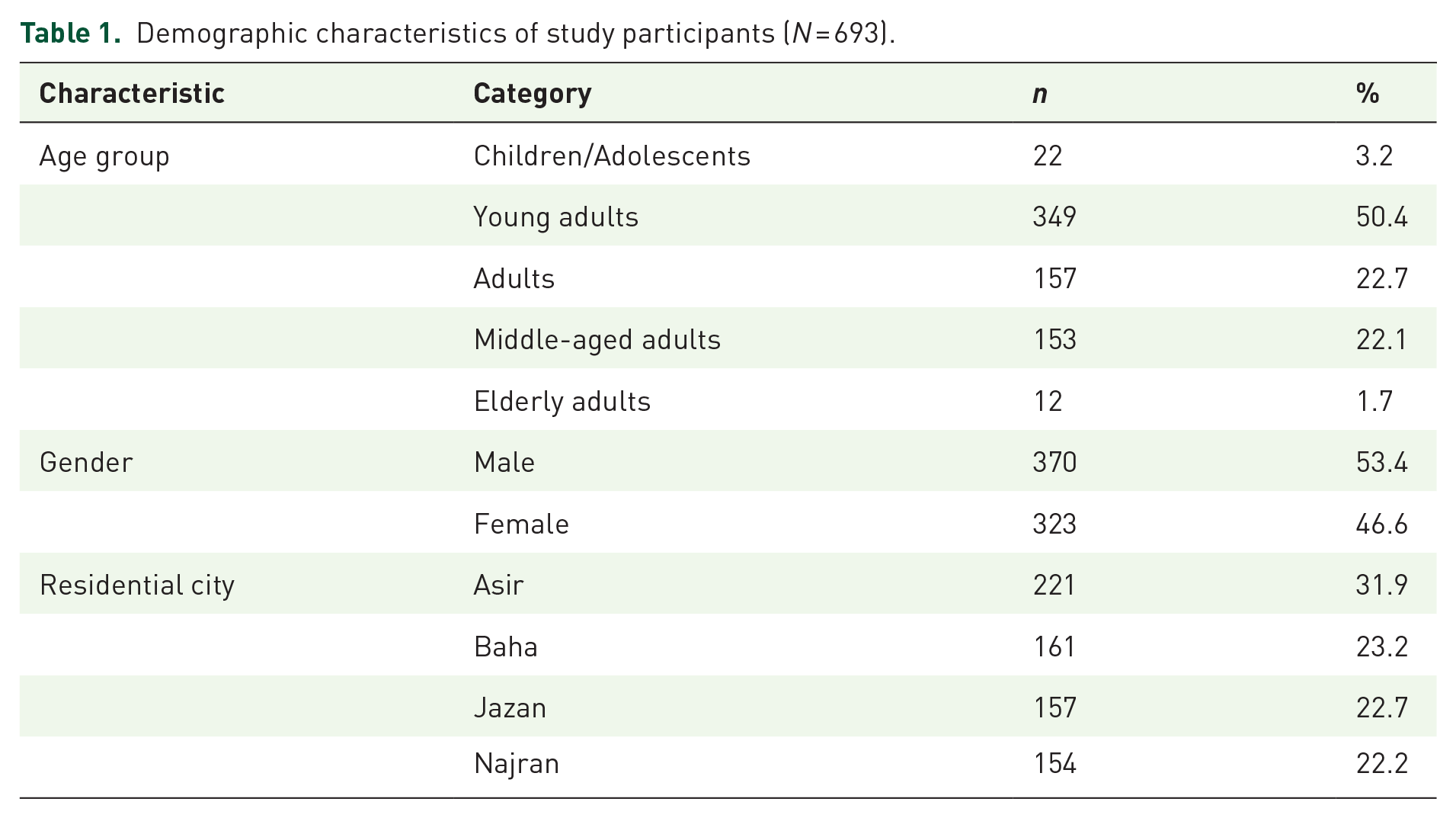
Table 1 provides an overview of the demographic characteristics of the study participants. Among the 693 participants, the majority were classified as Young Adults, comprising 50.4% (n = 349) of the sample. The distribution across age groups was as follows: Children/adolescents 3.2% (n = 22), Adults 22.7% (n = 157), Middle-aged adults 22.1% (n = 153), and elderly adults 1.7% (n = 12). Gender-wise, 53.4% (n = 370) of the participants were male, while 46.6% (n = 323) were female. In terms of residential distribution, the largest proportion of participants resided in Asir (31.9%, n = 221), followed by Baha (23.2%, n = 161), Jazan (22.7%, n = 157), and Najran (22.2%, n = 154).
Demographic characteristics of study participants (N = 693).
Symptom assessment and medical history
Table 2 delineates the symptom assessment and medical history of the study cohort. Among the participants, 73.9% (n = 512) reported experiencing ocular symptoms, while 26.1% (n = 181) did not. Dust emerged as the most common trigger for ocular symptoms, affecting 32.9% (n = 228) of the participants, followed by eye drops/contact lens (8.7%, n = 60), animal dander (6.9%, n = 48), and chemicals (5.8%, n = 40). Notably, a substantial proportion (52.7%, n = 365) reported experiencing ocular symptoms without association with any specific season. Regarding frequency, 34.8% (n = 241) reported experiencing symptoms occasionally, 8.7% (n = 60) frequently, and 7.9% (n = 55) very frequently. Despite the prevalence of ocular symptoms, only 26.7% (n = 185) of the participants consulted an ophthalmologist. Furthermore, 9.1% (n = 63) of the participants were diagnosed with allergic conjunctivitis, while 90.9% (n = 630) were not. Regarding medical history, 10.0% (n = 69) reported a history of bronchial asthma, and 19.0% (n = 132) reported a history of allergic rhinitis (Figures 1 and 2).
Symptom assessment and medical history.


Distribution of causative agents for allergic conjunctivitis in Southern Saudi Arabia.

Allergic conjunctivitis cases presentation by season in Southern Saudi Arabia.
Bivariable analysis of factors associated with diagnosis of allergic conjunctivitis
Table 3 illustrates the bivariable analysis of factors associated with the diagnosis of allergic conjunctivitis. Among different age groups, the prevalence of diagnosed allergic conjunctivitis varied slightly, with the highest proportion observed in middle-aged adults (11.8%, n = 18) and the lowest in elderly adults (16.7%, n = 2). Gender did not show a significant association with the diagnosis of allergic conjunctivitis (p = 0.37). Regarding the residential city, participants from Asir exhibited a slightly higher prevalence of diagnosed allergic conjunctivitis (12.7%, n = 28). Notably, the seasonality of ocular symptoms demonstrated a significant association with the diagnosis (p < 0.01), with the highest prevalence observed in participants experiencing symptoms all over the year (26.5%, n = 13) and the lowest in those experiencing symptoms during summer (6.9%, n = 2). Additionally, a history of bronchial asthma and allergic rhinitis exhibited significant associations with the diagnosis of allergic conjunctivitis (p < 0.01), with higher proportions observed among participants with a history of these conditions.
Bivariable analysis of factors associated with diagnosis of allergic conjunctivitis.
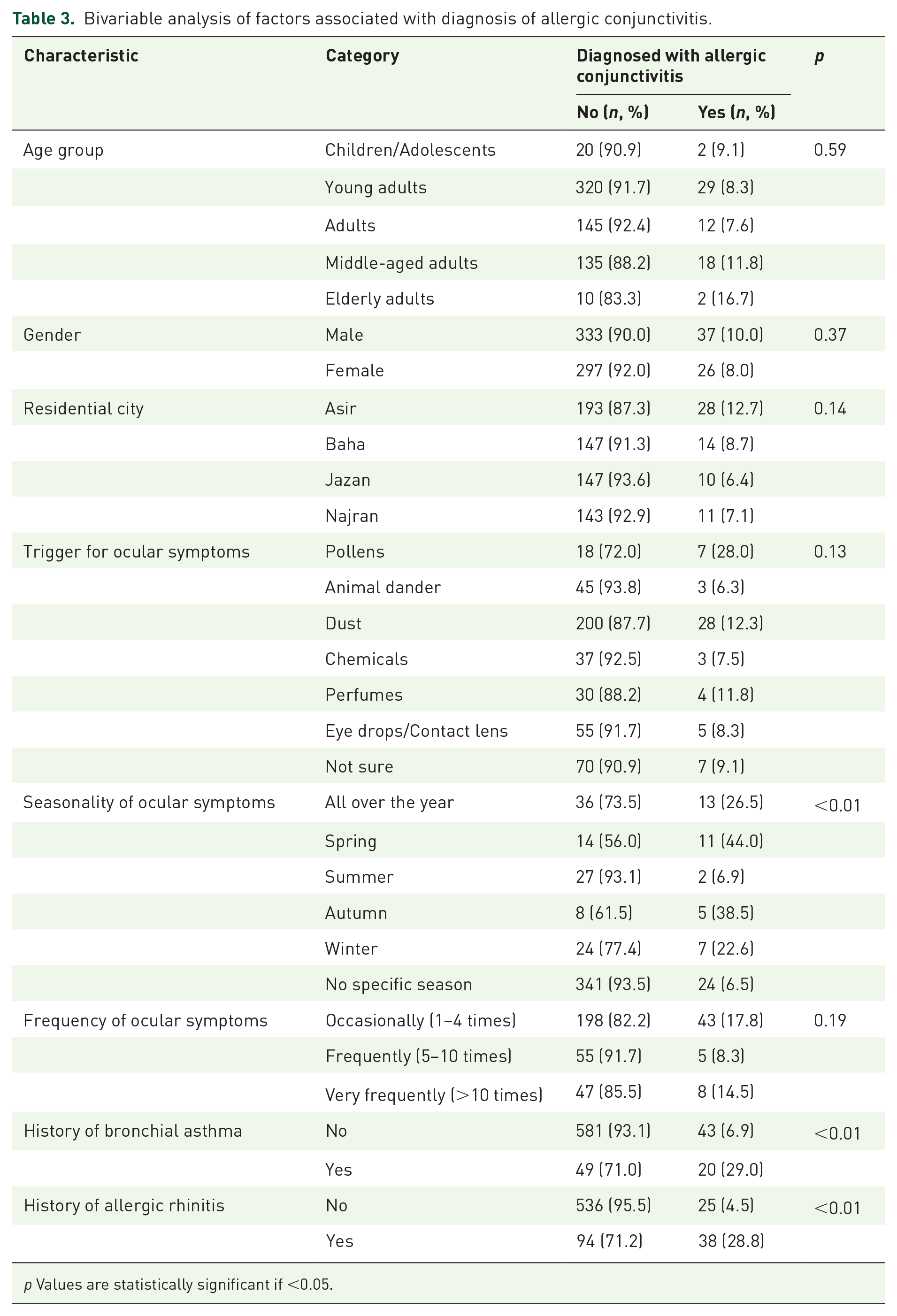
p Values are statistically significant if <0.05.
Multivariable analysis of factors associated with diagnosis of allergic conjunctivitis
Table 4 presents the results of the multivariable analysis assessing factors associated with the diagnosis of allergic conjunctivitis. Regarding gender, females showed a lower odds of being diagnosed with allergic conjunctivitis compared to males (odds ratio: 0.62, 95% CI: 0.29–1.31, p = 0.21). Residential city did not exhibit significant associations with the diagnosis, with participants from Baha, Jazan, and Najran showing similar odds compared to Asir, the reference group. Among the triggers for ocular symptoms, none demonstrated significant associations with the diagnosis. However, participants experiencing symptoms with no specific season showed significantly lower odds of being diagnosed with allergic conjunctivitis (odds ratio: 0.28, 95% CI: 0.11–0.72, p = 0.01). Similarly, participants experiencing ocular symptoms more frequently (>10 times) did not exhibit significant associations with the diagnosis. Conversely, a history of allergic rhinitis demonstrated a strong positive association with the diagnosis (odds ratio: 3.77, 95% CI: 1.83–7.75, p < 0.01), indicating that participants with a history of allergic rhinitis were nearly four times more likely to be diagnosed with allergic conjunctivitis compared to those without such a history.
Multivariable analysis of factors associated with diagnosis of allergic conjunctivitis.

p Values are statistically significant if <0.05.
Discussion
Allergic conjunctivitis represents a significant health concern globally, affecting individuals’ quality of life and imposing substantial economic burdens on healthcare systems. Understanding the prevalence, associated factors, and triggers of allergic conjunctivitis is crucial for effective management and public health interventions. This study aimed to elucidate these aspects among residents of Southern Saudi Arabia.
The findings of this study revealed a considerable prevalence of ocular symptoms among participants, consistent with the increasing recognition of allergic conjunctivitis as a common condition worldwide. Dust emerged as the most prevalent trigger, corroborating existing literature linking airborne allergens to allergic conjunctivitis. This may explain Assir as the most affected region because of its environmental surroundings that consist of mountains without marine factors Interestingly, while pollen is typically a significant trigger, its relatively lower prominence in this study suggests potential regional variations in allergen exposure or species distribution.
The seasonal pattern of symptoms demonstrated a notable association with the diagnosis of allergic conjunctivitis, with participants experiencing symptoms throughout the year exhibiting the highest prevalence of diagnosed allergic conjunctivitis. This finding aligns with previous research indicating that perennial allergic conjunctivitis, often triggered by indoor allergens such as dust mites, tends to be more severe and persistent compared to seasonal allergic conjunctivitis.12,13 Such insights underscore the importance of considering temporal patterns in allergic conjunctivitis diagnosis and management strategies.
Previous studies conducted in different regions of Saudi Arabia have also reported significant prevalence rates of allergic conjunctivitis among adults. Alqurashi et al. 3 estimated a substantial prevalence of allergic conjunctivitis among adults in the Western region of Saudi Arabia, highlighting the burden of the condition and its associations with allergic rhinitis and bronchial asthma. Similarly, Ur et al. 14 found a high prevalence of allergic conjunctivitis in Arar City, identifying airborne dust, hot and humid weather, and chemical exposure as common precipitating factors.
Consistent with findings from global studies, our research underscores the impact of allergic rhinitis as a significant risk factor for allergic conjunctivitis.15–18 According to Hom et al. 15 Numerous cell types, including mast cells, basophils, eosinophils, neutrophils, macrophages, and dendritic cells, can be activated, inhibited, or stimulated during an allergic reaction, which can also cause these cell types to migrate through nearby structures by the bloodstream. Moreover, Xu et al. 16 Included 462 individuals who received treatment at hospital between January 2018 and December 2020 and had an allergy diagnosis of either allergic rhinitis or allergic conjunctivitis. Patients were divided into two groups according to their first department of consultation: the allergic conjunctivitis group and the allergic rhinitis group. Two hundred thirty-two patients with allergic conjunctivitis from the ophthalmology department made up the allergic conjunctivitis group, while 230 patients with allergic rhinitis from the ENT department made up the allergic rhinitis group. In the allergic conjuctivitis group, 174 patients (75.00%) had concurrent allergic rhinitis, while in the allergic rhinitis group, 169 patients (73.48%) had concurrent allergic conjunctivitis.
Despite the high prevalence of ocular symptoms observed in our study, only a minority of participants sought medical consultation, suggesting potential underdiagnosis and undertreatment of allergic conjunctivitis in the region. Addressing this gap in healthcare utilization is crucial for improving patient outcomes and reducing the burden of allergic conjunctivitis on affected individuals and healthcare systems.
The multivariable analysis identified several factors associated with the diagnosis of allergic conjunctivitis, shedding light on potential determinants of disease prevalence and severity. While there were no significant correlations found with gender or residential city. Thus, the diagnosis was negatively correlated with the seasonal change in symptoms. This finding underscores the importance of considering symptom patterns and triggers in diagnosing and managing allergic conjunctivitis, as individuals with perennial symptoms may require different therapeutic approaches tailored to their needs.
One limitation of this study is the method of diagnosis for allergic conjunctivitis, as it relies on patient-reported symptoms. Depending solely on patient reports for diagnosis may introduce the potential for misclassification or inaccuracies. Other limitations associated with sampling through online surveys include selection bias as the sample drawn from online platforms may not be representative of the target population, leading to skewed results. Moreover, non-response bias could occur if certain groups of individuals are less likely to participate in online surveys, leading to an incomplete or biased dataset. Recognizing and addressing these limitations is essential for maintaining the integrity of the research findings. Future research could employ objective measures, such as allergen-specific immunoglobulin E testing, to confirm diagnoses and identify specific allergens triggering allergic conjunctivitis. Additionally, longitudinal studies incorporating environmental monitoring and genetic predisposition assessments could provide further insights into the complex etiology of allergic conjunctivitis.
Conclusion
In conclusion, this study provides valuable insights into the epidemiology and clinical characteristics of allergic conjunctivitis among residents of the Southern region of Saudi Arabia. By elucidating the prevalence, triggers, and associated factors of allergic conjunctivitis in this population, the study enhances our understanding of this common ocular condition and informs targeted interventions to optimize patient care. The findings underscore the significant burden of allergic conjunctivitis on affected individuals and healthcare systems, highlighting the importance of raising awareness, implementing preventive measures, and improving access to specialized care for better management of allergic conjunctivitis. Future research endeavors should focus on longitudinal studies, environmental monitoring, and interventions tailored to the region-specific triggers and risk factors of allergic conjunctivitis to mitigate its impact effectively.
Supplemental Material
sj-docx-1-oed-10.1177_25158414241294020 – Supplemental material for Clinical characteristics of allergic conjunctivitis in the Southern region of Saudi Arabia: a cross-sectional study
Supplemental material, sj-docx-1-oed-10.1177_25158414241294020 for Clinical characteristics of allergic conjunctivitis in the Southern region of Saudi Arabia: a cross-sectional study by Waleed ALDhabaan, Saleh Ghulaysi, Albatool Alqahtani, Eman Hurissi, Manar M. Alamri, Almuhannad G. Alnami, Ahmed H. Sumayli, Yahya A. Dhamri, Amani A. Mosleh, Ethar A. Khawaji, Abdullah A. Alshahrani, Abdulsalam S. Alfaifi and Saja M. Alghamdi in Therapeutic Advances in Ophthalmology
Footnotes

References
Supplementary Material
Please find the following supplemental material available below.
For Open Access articles published under a Creative Commons License, all supplemental material carries the same license as the article it is associated with.
For non-Open Access articles published, all supplemental material carries a non-exclusive license, and permission requests for re-use of supplemental material or any part of supplemental material shall be sent directly to the copyright owner as specified in the copyright notice associated with the article.
