



Abstract
Conventional drug delivery formulations, such as eye drops and ointments, are mainly administered by topical instillation. The topical delivery of ophthalmic drugs is a challenging endeavor despite the eye is easily accessible. Unique and complex barriers, serving as protection against extrinsic harmful factors, hamper therapeutic intraocular drug concentrations. Bioavailability for deeper ocular tissues of the anterior segment of the eye is exceptionally low. As the bioavailability of the active substance is the major hurdle to overcome, dosing is increased, so the side effects do. Both provoke patient poor compliance, confining the desired therapeutic outcome. The incidence and severity of adverse reactions amplify evenly in the case of chronic treatments. Current research focuses on the development of innovative delivery strategies to address low ocular bioavailability and provide safe and convenient dosing schemes. The main objective of this review is to explore and present the latest developments in ocular drug delivery formulations for the treatment of the pathology of the anterior segment of the eye. Nanotechnology-based formulations, that is, organic nanoparticles (liposomes, niosomes/discosomes, dendrimers, nanoemulsions, nanosuspensions, nanoparticles/nanospheres) and inorganic nanoparticles, nanoparticle-laden therapeutic contact lenses, in situ gelling systems, and ocular inserts, are summarized and presented accordingly.
Introduction
The eye is a unique, intricate and highly specialized sensory organ characterized by complex anatomy and subjected to a vast range of pathology. Both local and systemic diseases may affect different anatomical regions of the eye. Intraocular drug delivery can be broadly classified into anterior and posterior segments. Various protective barriers, that is, static (membranes, cornea), dynamic (clearance through tear turnover, lymphatic and blood vessels, aqueous outflow), and metabolic (metabolizing enzymes, transporter proteins), not only subserve as protection but also hinder drug permeation in the anterior chamber. 1 Ocular protective mechanisms are vastly effective in shielding from xenobiotics and environmental stress, though constraint intraocular therapeutic drug levels. 2
Topical administration is the most common route for anterior segment drug delivery. The main modality for the treatment of ocular diseases is topical instillation. More than 90% of the marketed ophthalmic formulations are in the form of eye drops. Bioavailability of these conventional formulations is, however, particularly limited. Approximately less than 5% of the applied dose reaches the intraocular tissues. Restricted bioavailability predominantly outcomes drug wastage due to ocular surface factors, mainly tear turnover, which leads to a gradual dilution and clearance (mean half-life on the ocular surface: 4 min).2 –5 Frequent instillations are necessary to attain and maintain therapeutic levels in tissues under treatment. Consequently, the risk of induced toxic side effects is fostered, thus hampering patient compliance, especially in chronic diseases, such as glaucoma or uveitis.3,6 Other issues are the improper administration of topical medications, such as drops missing the eye, the delivery of an incorrect number of drops, and the contamination of the bottle tip. To avoid drug wash-out, it is suggested to wait 5 min between two subsequent topical applications, but less than half of the patients comply with this recommendation. The instillation of drops at fixed intervals causes a high variability of the intraocular drug concentration during the treatment, which would be avoided with a continuous drug release.7 –11
Promising management of eye ailments lies on innovative strategies that focus on surpassing the limitations of conventional formulations, assuming the correlation between the concentration of the active substance at its intended site of action and the resulting pharmacological effect. Contemporary approaches could be concisely classified into two broad categories. The first intends to enhance drug penetration through ocular barriers (liposomes, niosomes, discosomes, nanoparticles/nanospheres, nanosuspensions and nanodispersions, nanoemulsions, dendrimers, and in situ-forming gels). As encapsulated via supramolecular interactions or covalently bound to carriers, therapeutic agents may transcend pharmacological barriers, and could even be deliberately directed to specific tissues and cells, to bring about novel methods for better management of the ocular diseases with innovative therapeutic modalities.5,12 The most commonly used vectors are of viral origin. Although effective, this type of carrier has several drawbacks, including its carcinogenic potential, the limited amount of therapeutic agent that can be transported, the induced immune response, and its cytotoxicity.13 –15 The second approach aims at prolonged and continuous administration of active substance based on the application of sustained drug delivery systems (microparticles, ocular inserts, intraocular implants, and contact lenses). Prolonging residence time on the ocular surface is the cornerstone of newer approaches. By increasing the drug residence time on the cornea, the drug bioavailability is increased, while the necessary drug dose for achieving a therapeutic effect is reduced. Consequently, lower systemic drug absorption is expected when compared to eye drops.5,16
Drug delivery systems, that is, high-viscosity materials, such as gels and ointments, corneal penetration enhancers, and the prodrug strategy, were employed to improve intraocular bioavailability. Ointments are the mixtures of semi-solid and solid hydrocarbons (paraffins), which break up into small droplets that tarry in the conjunctival sac and form a drug reservoir for protracted periods. Although safe and well-tolerated by the eye, ointments inflict blurring of vision. 5 Gels lead to a prolonged precorneal residence time, which depends on their viscosity properties, their ability to diffuse on the ocular surface, and their water retention capacity. Gels, however, achieve only a limited improvement in bioavailability, and the dosing frequency can be decreased to once a day at most.17,18 Prodrug is a chemically modified molecule of the active substance to enhance its lipophilicity to facilitate corneal permeability. Subsequently, it is metabolized enzymatically to the pharmacologically active compound. Due to pharmacokinetic and pharmacodynamic complexities, only a few prodrugs exist in ophthalmic therapeutics.12,19 Penetration enhancers (or absorption promoters) amplify permeability through the corneal epithelium, by modulating its integrity. Their application, especially long-term, lurks ocular surface irritation, toxicological complications, tissue damage, and aggravation of inflammatory eye diseases of the ocular surface, such as Dry Eye Disease. Better drug pharmacokinetics, pharmacodynamics, non-specific toxicity, immunogenicity, and biorecognition can be accomplished to improve therapeutic efficacy when drugs are loaded in nanotechnology-based delivery systems.20 –24
The intrinsic limitations of conventional management of ocular diseases have propagated the growth of ocular nanomedicine. The latest advances in ophthalmic preparations to amplify intraocular bioavailability portray significant desirable characteristics and improve patient compliance.2,4,5,19 Current review article discusses the novel developments and presents the commercially available or under clinical trial formulations for ocular application.
Nanotechnology-based formulations
Nanotechnology refers to the handling of structures at the nanoscale size level, which lies between 1 and 100 nm and is proportionally comparable to peptide drugs. 25 Nanomaterials are characterized by a large surface area and high intracellular biodistribution, which is beneficial for drug encapsulation, in vivo imaging, biosensing, and non-invasive tracking. Their fundamental physicochemical properties, especially size, surface charge, hydrophilicity, hydrophobicity, and biodegradability, are strongly associated with their therapeutic effectiveness in the ocular pathological milieu. Nanomedicine refers to the applications of nanotechnology in the diagnosis and treatment of diseases. The human eye is regarded as one of the most exquisite organs of the body and serves as a perfect platform for nanoparticle delivery, capable of bypassing systemic circulation. Different routes of administration influence nanoparticle biodistribution. Ocular nanomedicine can be elaborately engineered based on concrete biological scenarios (physicochemical cues, location and immunologic environment) to promote biostability and bioavailability in pathological regions, targeted release, on-demand gene delivery, pathology-oriented diagnostics and therapeutics (theranostics), and side-effect mitigation.12,26 –29 For instance, metal nanoparticles, such as silver nanoparticles, with intrinsic anti-inflammatory, antibacterial, and antiangiogenic functions reportedly improve therapeutic efficacy in related ocular diseases. 30
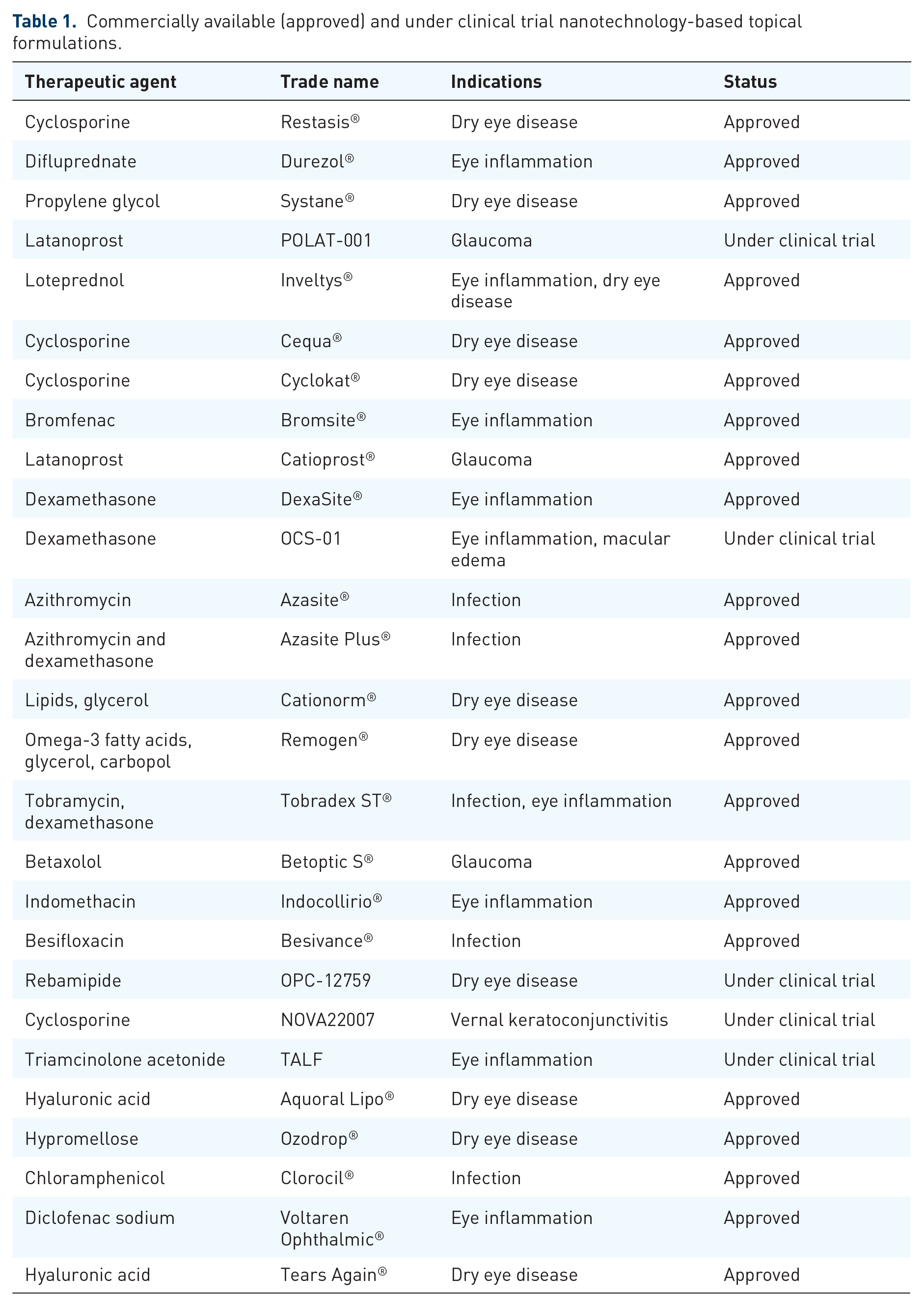
Nanotechnology applications have been introduced since 1980s in the development of ophthalmic pharmaceuticals, with the aim of improving the properties of drug delivery. Nanocarrier-based systems are immensely developing interdisciplinary field of science, embracing material engineering, physics, chemistry, and biology, where nanoscale materials are manipulated to amplify drug delivery.19,27,31,32 Several nanotechnology-based strategies have been enmeshed to address unmet needs such as increase precorneal residence time, enhance drug penetration across the ocular barriers, eliminate degradation of unstable drugs, metabolic clearance, and toxic side effects. Accordingly, bioavailability is enhanced, allotting more convenient dosage regimens, thus, ameliorating patient compliance. Nanotechnology-based ophthalmic formulations fall into two broad categories: organic nanoparticles (liposomes, niosomes/discosomes, dendrimers, nanoemulsions, nanosuspensions, and nanospheres) and inorganic nanoparticles (metallic, carbonous, and silica nanoparticles and quantum dots).5,27,29 Organic nanoparticles are essential carriers of pharmaceutical compounds, while inorganic nanoparticles have garnered significant attention for their theranostic properties. Despite, mesoporous silica inorganic nanoparticles are capable of absorbing exceptionally copious amounts of active substance inside their pores. Likewise, organic nanoparticles incorporate by diverging mechanisms (solubilization, encapsulation, chemical bonding, and absorption) with the active substance within their respective structures. Biological components of purified biomolecules (exosomes, microvesicles, and apoptotic bodies that are virtually secreted by all cell types and can deliver an expansive cargo into nearby cells and over long distances via the bloodstream) exhibit a considerable aptitude for drug/gene delivery, regulation of angiogenesis and inflammatory pathways, immunomodulation, tissue regeneration, and immunotherapy. Great interest has been given to them for their role in cell-to-cell communication, disease progression, or as biomarkers, and more recent studies have interrogated their potential as a therapeutic that may replace paracrine-acting cell therapies.19,26,27,29,33–36 Table 1 catalogs the approved nanotechnology-based topical ophthalmic formulations and those under clinical trial.2–5,12,16,18–20,26–30,32,33,37–45
Commercially available (approved) and under clinical trial nanotechnology-based topical formulations.
In situ-forming gels
On instillation, ophthalmic in situ gelling systems undergo a phase transition in the conjunctival sac in response to the environmental conditions (pH, temperature, and ionic charge) to form a viscoelastic gel. Increased viscosity brings about a prolonged residence time on the ocular surface. The active substance is released in a sustained manner which leads to enhanced bioavailability.5,46 A natural polymer, chitosan, is often supplemented in ophthalmic formulations due to its endogenous mucoadhesive nature. Its positively charged amino groups interact with the negatively charged layer of the tear-film mucinous layer. The association of chitosan with stimuli-responsive polymers increases the mechanical strength of the formulation, resulting in an exponential increase in bioavailability. 47 Table 2 summarizes the commercially available in situ-formulated gels.28,31,33,46 –49 Drug-loaded nanocarriers incorporated in situ-forming gels exhibit pronounced prospects for efficient sustained ophthalmic drug therapy. The nanoparticulate in situ-forming gels are designed to explore the double benefit of nanocarriers and in situ gelling systems. On the one hand, nanocarriers are able to permeate across ocular drug delivery barriers, solubilize poorly soluble active compounds, and enhance the pharmacokinetic profile of the administered drug by both protecting from physical, chemical, and biological degradation and enabling tissue targeting. On the other hand, gels afford extended retention on the ocular surface, sustained drug release combined with comprehensive biocompatibility, and a vastly well-tolerated patient profile. Ongoing preclinical studies yielded auspicious results.26,48,50 –54 Indicatively, a newly developed curcumin-loaded ocular nanogel taking advantage of a cationic nanostructured lipid carrier exhibited a notably superior pharmacokinetic profile against the corresponding curcumin solution, denoting a significantly improved bioavailability. 55 Furthermore, microsphere-loaded ion-activated in situ gel of ofloxacin-exhibited in vivo in rabbits enhanced bioavailability by 11.7 times relative to the commercial ofloxacin eye drops (0.3% w/v). 56
Commercially available topical formulations based on in situ-forming gels.

Ocular inserts
The ocular inserts describe solid, drug-impregnated micro-devices that are disposed in the conjunctival sac and behave like a drug reservoir to bestow prolonged, controlled, and continuous release of the active substance. Bioavailability is improved and dose-dependent toxicity of preserved formulations is eliminated. Yet, possible intolerance on placement, foreign body sensation, and difficulty in self-application or handling may provoke patient incompliance. 4 Moreover, implant retention rates are commonly reported low, usually due to inadvertent loss of the device, which is not always perceived, although as patients gain usage experience, retention rates gradually improve significantly. The development of resorbable devices is challenging since the complete material and its metabolites should be non-toxic. Most resorbable devices have a limited duration of action (typically less than 24 h) and thus may require frequent administration.16,37 Ocular inserts are sorted into biodegradable (the active substance is released as the implant material decomposes), hydrophilic water soluble or insoluble (both release the active compound by diffusion control for soluble drugs and dissolution control for less-soluble drugs, only the latter require manual removal), osmotic (the drug is released due to its osmotic pressure gradient), and membrane-controlled inserts (a surrounding hydrophobic polymer membrane control drug’s diffusion rate from the core to the surrounding environment).33,37 In case, inserts are placed in the tear duct, they are called punctum plugs. Punctum plugs normally function by blocking the punctum and canaliculus to shrink tear drainage and increase the amount of tears on the ocular surface. They can also be impregnated with various medications which are slowly released over a period of time.2,37,57 Table 3 lists the commercially available ophthalmic implants and those in clinical trials.16,19,20,33,37,57,58
Commercially available (approved) and under clinical trial ophthalmic inserts.

Contact lenses
Contact lenses are explored as a drug reservoir medium, with the aim of controlled, prolonged drug release for therapeutic purposes to increase the bioavailability of the drug, avoiding the side effects of frequent instillations. Contact lenses can be easily replaced and are, therefore, suitable for both short-term and prolonged treatments. Potentially, drug-eluting contact lenses could be used to simultaneously correct refractive errors, provided they maintain their clarity throughout treatment.7,19,59,60 On application, the embedded active substance diffuses into the thin lacrimal layer, between the lens and the cornea, called Post-Contact Lens Tear Film, and then diffuses to adjacent tissues. Previous techniques (‘soak and release’ approach, since 1960s) by simply dipping the lens (often hydrogel) into a drug solution have not managed to deliver any commercially available product. The main issue of the soaking method still is the limited control over the drug release profile, which is usually characterized by a high initial release rate and a short delivery time after lens placement onto the eye. Furthermore, economic and environmental concerns arise due to the waste of the drug present in the soaking solution.37,58,61,62
Nowadays, research is focused on innovative methods of integrating the pharmacologically active substance into the lens polymer. Entrapping the drug in nanoparticles incorporated into the lens body is called ‘particle-laden contact lens drug delivery’. Contact lenses made of microemulsion-laden gels are expected to deliver drugs at therapeutic levels for several days. The delivery rates can be tailored by controlling the particle size and the drug loading. To implement drug-eluting reservoirs, coating techniques (e.g. layer-by-layer deposition, spray coating, dip coating, and plasma-assisted grafting) have been investigated. Molecular imprinting is a technique used to generate template-shaped cavities in polymer matrices. The basis of this technique is the ‘lock and key’ model that is used by enzymes for substrate recognition. Another approach investigates of ion ligands to form a coordination complex. Oppositely charged ions from a solution could be exploited for drug loading. Impregnation with a supercritical fluid, which exhibits favorable attributes for diffusion in polymer matrices, consists in the dissolution of the drug in the solvent (generally supercritical CO2), followed by the interaction with the target material. Supercritical CO2 is a better solvent for drugs than water and also a better plasticizer for polymer networks; therefore, drug loading is enhanced when compared to traditional techniques such as soaking.7,59 –61,63 –65 The commercially available daily lenses incorporate moisturizing macromolecules for the treatment of dry eye (Focus Dailies with AquaRelease – Alcon, Dailies AquaComfort Plus – Alcon and Ciba Vision, 1-Day Acuvue Moist – Johnson & Johnson, Fusion 1 day – Safilens). Current research has been focused on the development of drug-eluting contact lenses loaded into therapeutic agents to efficiently treat chronic ocular diseases (mainly glaucoma–latanoprost, Ophthalmology Massachusetts Eye and Ear Infirmary, Harvard Medical School, brimonidine, Ophthalmology & Visual Science and the Department of Pharmacy, Eye & ENT Hospital, Shanghai, but also neurotrophic keratitis, persistent epithelial defects, diabetic keratopathy, diabetic neuropathy and for the recovery of corneal epithelium after surgery) and persistent infections (keratitis – e.g. fungal, amphotericin B, Department Eye and Vision Science, Institute of Aging and Chronic Diseases, University of Liverpool).7,37 The chief concerns in the implementation of contact lenses for therapeutic purposes are associated with ocular surface damage, increased risk of ocular infection, mainly due to inappropriate hygiene practices, and inappropriate handling of contact lenses, especially in the elderly.19,57,61
Future prospects
The eye is one of the most inaccessible organs in terms of achieving intraocular therapeutic drug levels. Traditional methods of administration, such as the topical instillation or systemic administration, present significant limitations, in terms of intraocular permeability or concurrent side effects, which are mainly related to the frequency of the dosing scheme and systemic exposure.2,18
Although the role of ocular nanomedicine remains only partially elucidated, it is highly expected that ocular nanomedicine will confer marked contributions to ocular disease management based on advanced concepts and improved theranostic performance. Nowadays, nanotechnology applications are the most emerging concept in pharmaceutical sciences. Future perspectives focus on developing non-invasive drug delivery systems capable of achieving efficient intraocular levels to effectively cure ocular diseases. Meanwhile, novel therapeutic strategies should be user-friendly, well-tolerated, thus ensuring a high safety and efficacy profile.19,39,66 Upcoming marketed products are desirable for ophthalmic application in particular, including the active compound, carriers, or both, as adverse reactions of existing commercial formulations are largely related to ocular nonspecificity. Further studies are required to exploit drug delivery via the noncorneal route, mainly of ionic moieties, but also of drugs exhibiting preferential corneal absorption, to provide a synergistic delivery route.5,67,68
Nanotechnology and biomaterial engineering science has boomed in recent decades, representing half of the patent filings and one-third of publications in the United States. Corresponding market shows an annual increase in approximately 22%. With a multiplicity of advantages, such as drug targeting, sustainability, increased intraocular bioavailability, and thus reduction of the dosage, innovative nanotechnology applications in imaging, diagnostics, and therapeutics are expected to revolutionize therapeutics. Successful application in contact lenses promises the entry of a therapeutic alternative in ophthalmic arsenal to expand ocular therapeutic capabilities. Therapeutic intraocular lenses are being investigated to perform efficient prophylaxis for post-cataract inflammation. Furthermore, potentials expand in gene therapy (corneal dystrophies, diabetic retinopathy, retinitis pigmentosa, Leber congenital amaurosis, Stargardt disease, red–green color blindness, age-related macular degeneration, primary open-angle glaucoma) through nanotechnology-assisted techniques, as nanotechnology-based delivery systems may substitute viral vectors to perform gene delivery.4,18,28 –30,40 Nanosystems loaded with siRNA silencing human antigen R expression (lipoplexes), consisting of solid lipid nanoparticles and liposomes, efficiently delivered into the rat retina and succeeded in blunting vascular endothelial growth factor levels in an animal study, impending potential candidates to manage retinal diseases, such as diabetic retinopathy. An increase in the vascular endothelial growth factor signaling characterizes diabetic retinopathy. Indeed, inhibition of vascular endothelial growth factor-mediated pathological angiogenesis is regulated by RNA-binding proteins, and among them a key role is played by the embryonic lethal abnormal vision proteins. The ubiquitously expressed human antigen R (also called ELAVL1) represents one of the best-characterized RNA-binding proteins. 69 Topical nanotechnology-based formulations have been developed and shown potential in drug delivery into the posterior segment of the eye to substitute invasive methods of administration. Intravitreal injections of corticosteroids, such as dexamethasone in nanotechnological implant, are commonly used for the treatment of many vitreous and retinal disorders, such as retinal vein occlusions, uveitis, and diabetic macular edema. 70 A topical ophthalmic triamcinolone acetonide-loaded liposomes formulation (TALF) safely and efficiently transported triamcinolone acetonide into the posterior segment of the eye when instilled on the ocular surface to significantly improve visual acuity and diminish central foveal thickness in patients with diabetic macular edema. 71 Intravitreal injections bare devastating ocular complications. Infectious endophthalmitis remains one of the most deleterious complications (incidence ranges from 0.019% to 1.6%) of intravitreal injections, followed by sterile intraocular inflammation and retinal detachment. A less severe complication, subconjunctival hemorrhage inflicts nearly 10% of injections, with higher frequency in patients who were receiving aspirin. 72 Ongoing research relevant to ocular implants may bring about the concept of ‘dropless cataract surgery’, which refers to the drastic reduction of perioperative eye drop instillation, to reality. Recently (2016), FDA decided to accept first in-human trials earlier and promised to simplify the approval process of new devices that may advance the introduction of new nanotechnology products. 73 Furthermore, to control infection in the era of growing antibiotic resistance in conjunction with the longwinded development in new antibiotics, the antibacterial ability against drug-resistant bacteria is being explored. Metal dichalcogenides quantum dots by sulfur vacancies realized the sterilization efficiency of Gram-positive Staphylococcus aureus and methicillin-resistant S. aureus more than 99.9% within 20 min at room temperature and for biomedical application in an animal model against bacterial keratitis, eliminated the occurrence of severe clinical manifestation, such as ocular perforation, possibly signifying potential clinical therapeutic efficacy. 74 To sum up, the imminent prospects are immense, potential to ‘start a brave, new chapter’ in therapeutics, only human antigen R is involved in a variety of pathologies, such as cancer, cardiovascular diseases, and chronic inflammation.4,18,29,40,69,71,74
Last but not least, although numerous cellular studies and animal investigations have been performed to determine therapeutic outcomes of designed ocular nanomedicine, it is still challenging to completely clarify the underlying mechanisms of nanomedicine on ocular cells/tissues. Mainly therapeutic results, rather than the biological processes, are established. Recently, multifunctional optical probes have been developed to evaluate the distribution and therapeutic concentration of specific biochemical ingredients in the biological milieu, which may be beneficial for the precise characterization of therapeutic processes in vivo, consequently clarifying the relationship between ocular nanomedicine and in vivo behavior.26,75
Conclusion
Enhancing the bioavailability of drug formulations is inextricably linked to titivate treatment efficacy. Potential restraint in dosing frequency may eliminate adverse side effects, thus promoting patient compliance and quality of life. The introduction of innovative nanotechnology-based formulations stands as a challenge. Preclinical studies dominate available data, while relevant clinical trials remain confined. Accordingly, commercially available drug-laden nanocarrier preparations are yet limited. Unmet needs will keep in the forefront the interest in innovation and progress in the field of nanopharmaceuticals to ameliorate the therapeutic efficacy of ocular formulations.
