




Abstract
Background and purpose
Candida infections have increased significantly in the antimicrobial resistance era, and synthetic antifungal drugs have limitations. The present work aimed to review the antifungal properties of Zataria multiflora (Z. multiflora) as an herbal remedy.
Method
PubMed, Scopus, ScienceDirect, Web of Science, SID, Civilica, and Magiran databases were searched for the antifungal activity on in vitro, in vivo, dental biofilm, and clinical studies of Z. multiflora on Candida species.
Results
Overall, 33 articles evaluated the effect of Z. multiflora on Candida species and classified them into four groups, as follows in vitro (23), dental biofilm (6), in vivo (2), and clinical studies (3). All studies considered Z. multiflora effective in reducing or even inhibiting the growth of Candida species. NoMFC significant differences were seen in the effect of Z. multiflora on susceptible Candida compared to the resistant groups of Candida in the studies. It was also influential in inhibiting C. parapsilosis, C. glabrata, C. krusei, C. kefyer, and C. zeylanoides.
Conclusion
Considering the side effects and resistance of current antifungal drugs as well as the benefits of using herbal medicines, such as lower cost, less likely to develop drug resistance, the absence of side effects, and toxicity compared with chemical ones
Introduction
Candida consists of round, oval yeasts 3 to 30 micrometers in diameter and contains 150 different species. Of these, only a small number are isolated from the human body, which is colonized as an indigenous microbial flora on the mucosal surfaces of the human body. 1 Candida species are responsible for approximately 96% of opportunistic fungi; Candida albicans is the most common species that causes superficial, mucosal, and systemic infections in humans. 2 The prevalence of infections caused by Candida species has increased significantly in the last two decades due to the further spread of immunocompromised diseases, improper use of immunosuppressive drugs, endocrine disorders, malnutrition, and the widespread use of broad-spectrum antibiotics and medical devices, as well as aging.3,4 Additionally, we are facing an emerging multidrug-resistant C. auris, which is causing outbreaks all over the globe. 5 Despite antifungal drugs therapy, morbidity and mortality rates of invasive candidiasis remain high. 6
There are currently three classes of antifungal drugs available to treat candidiasis: azoles, echinocandins, and polyene, which have limitations such as low susceptibility of some species or strains of Candida, resistant species, high cost, toxicity, drug interactions, or lack of oral drug formulation.7,8 Treatment has become challenging with the emergence of Candida species resistant to common antifungal drugs. 9 Herbal derivatives have attracted much attention in the last decade since researchers believe herbal medicines have much fewer side effects and toxicity than chemical drugs and do not cause drug resistance.10,11 Therefore, medicinal plants with antimicrobial properties help reduce synthetic substances, side effects, and toxic effects and are more economical. 12
According to the literature, more than 258 plant species from 94 families have been studied for the survey anti-Candida Activity.13,14 Shirazi Thyme belongs to the mint family (Lamiaceae or Labiatae) and is also known as Zataria multiflora (Z. multiflora). Z. multiflora grows wild in the central and southern regions of Iran, Afghanistan, and Pakistan. 15 The branches of this plant, collected for medicinal purposes in the early flowering period, contain essential oils, tannins, saponins, and plant disinfectants and are rich in peppermint tannins polymethoxy flavonoids, triterpenes, and polysaccharides. Two critical compounds in Z. multiflora essential oil are thymol and carvacrol, both of which are terpenoids. Most of this plant's antimicrobial properties have been attributed to these two substances.16,17
Given the above and the fact that so far, no secondary study has been conducted to put together the results of studies to evaluate the antifungal properties of the essential oils extracted from Z. multiflora on Candida species; In the present systematic study, we aim to classify the results of evidence-based methods of all published documents in a single systematic review.
Methods
Study Design
This Systematic review was performed according to the preferred reporting items for systematic reviews (PRISMA) guidelines. 18
Search Strategy
In this Systematic review, international electronic databases such as Scopus, PubMed, ScienceDirect, and Web of Science and national databases such as SID, Civilica, and Magiran were searched, restricted to articles in English and Persian, to find the relevant studies. Searches included articles published before 1 August 2021, using different keywords including “Zataria multiflora,” “Thyme,” “Shirazi thyme,” “Avishan Shirazi,” “Avishan-e-Shirazi,” “Candida,” and “candidiasis.” The main MeSH terms were searched alone and combined with the other keywords. Two of the authors conducted the search independently. The third-party evaluated the searched items and hand-searched references of the papers to ensure that no study was missed.
Inclusion and Exclusion Criteria
Inclusion criteria included studies that reported an association between Z.multiflora and Candida species, Articles in English and Persian were investigated.
The exclusion criteria included review studies, conference papers, book chapters, and articles and abstracts that did not contain the full text. In addition, articles that were impossible to quality evaluate were excluded from the study.
Selection of Studies
After completing the search in the second stage, duplicate articles were removed using Endnote software version 20. Then the titles and abstracts of articles were reviewed, and irrelevant items were removed. Finally, the full text of the related articles was reviewed, and unrelated items were removed. Two researchers independently performed the selection of articles. Disagreements were also investigated and resolved by a third party.
Data Extraction
The Excel software was used in order to extract the data based on the name of the first author, year of study, plant region, Z. multiflora chemical components, Z. multiflora formulation, Antifungal susceptibility testing method, Candida species, and Minimum inhibitory concentration (MIC) index (MIC50, MIC90), Minimum fungicidal concentration (MFC), from each of the initial studies.
The studies were reviewed based on the type of study and classified into four groups: in vitro assay, dental biofilm studies, in vitro studies, and clinical studies. All studies carried out to evaluate the antifungal susceptibility of Z. multiflora were included in the study.
Results
Study Characteristics and Search Results
In the initial systematic literature search in the databases, 2366 articles were found, and after eliminating the duplicates, the amount was reduced to 2248 articles. After reviewing the title and abstract, 2196 articles were excluded due to irrelevance. Finally, after reviewing the full text, 33 articles were selected as relevant articles. The process of article screening and selection is presented in Figure 1.

PRISMA flow diagram of the detailed process of selection of studies for inclusion in the systematic review.
Finally, 33 articles were selected in this review and classified into four groups that performed antifungal activity of Z. multiflora on Candida species in different conditions, as follows: 1- In vitro studies (23 papers); 2- Dental biofilm studies (6 papers); 3- In vivo studies (2 papers); 4- Clinical studies (3 papers). One analysis has been classified in both in vitro studies and dental biofilm studies.
19
A graphic summary of this study is shown in Figure 2.

Graphic summary of the study on antifungal activity of Z. multiflora on Candida species.
Antifungal Activity of Z. multiflora on Candida species in in Vitro Conditions
Among the 23 relevant articles19–41 that surveyed the antifungal effects of Z. multiflora on Candida species, 23 articles reported that Z. multiflora has adverse effects on Candida species. This is demonstrated in Table 1. All studies have generally shown that Z. multiflora could reduce or even inhibit the growth of Candida species.
Antifungal Activity of Z. multiflora on Candida species in in Vitro Conditions.

.ZM; Z. multiflora, AFST; Antifungal susceptibility testing, BD; Broth microdilution, DD; Disk diffusion, MFC; Minimum Fungicidal Concentration, MIC; Minimum inhibitory concentration.
Resistant and susceptible species of C. albicans were used in two studies.22,39 Consequently, these results indicated that no significant difference was seen in the effect of Z. multiflora on these two groups of Candida. For example, in the studies of Katiraiee et al,22,39 which used two strains (susceptible and resistant) of C. albicans, no significant difference was observed in the MICs of these two strains to Z. multiflora.
The Z. multiflora extracts used in these studies have different formulations. These extracts include aqueous, ethanolic, methanolic, acetonic, ethyl-acetate, and hydroalcoholic extracts.
Among these, in three studies,20,25,28 antifungal activities were not observed in Z. multiflora aqueous extract. However, in contrast to the three studies mentioned above, a study conducted by Rahimi et al 19 examined aqueous and ethanolic extracts and reported that they effectively inhibited the growth of C. albicans. In a study by Shokri et al, 29 C. zeylanoides, and a study by Esfandiary et al, 36 Clinical isolates of C. parapsilosis, C. glabrata, C. krusei, and C. kefyr species were examined. In both of these studies, Z. multiflora effectively inhibited the growth of these non-albicans Candida species.
In Moghim, Mahmoudabadi, Naini, Rahimi, and Rezaie Keikhaie studies,19,20,25,33,40 the ethanolic extract of Z. multiflora and Mahmoudabadi, Arbabi- Kalati, Abedini, Nouri, and Rezaie Keikhaie studies,20,30,37,40,42 the methanolic extract of Z. multiflora were examined. According to the MIC index, these extracts were effective in all cases, but the ethanolic extract was more effective than the methanolic extract. Also, the highest amount of MIC for the ethanolic extract was reported in Mahmoudabadi's study. 20
Eleven studies used Z. multiflora essential oil to investigate its antifungal effects,24,26,28,29,31,34–36,38,39,41 which all studies reported that Z. multiflora was effective in reducing the growth of Candida species.
In 9 studies, chemical compositions of Z. multiflora were analyzed using Gas Chromatography-Mass Spectrometry (GC-MS), which among these, thymol, carvacrol, γ-Terpinene, and linalool had a more critical role in the antifungal properties of Z. multiflora.24,26,28,31,34,35,38,39,41
Antifungal activity of Z. multiflora on dental biofilm of Candida species derived from dental plaque and intraoral appliances
6 studies19,43–47 investigated the antifungal effects of Z. multiflora on dental biofilm containing C. albicans derived from the acrylic plates, root canals, and mobile orthodontic appliances, all of which were effective in reducing the growth of C. albicans species (Table 2). In a study by Jafari, 43 which used nystatin as a control group to compare its antifungal effects with Z. multiflora, the results showed that concentrations of 50 and 25 mg/mL of Z. multiflora essence effectively (removed 100%) removed Candida cells from acrylic plates similar to the control group. A study by Aghili et al, 44 used chlorhexidine mouthwash as a control group to evaluate the antimicrobial effects on the contaminated orthodontic elastomeric ligatures. The findings indicated that both Z. multiflora and chlorhexidine effectively eliminated C. albicans cells from the orthodontic elastomeric ligatures. Another study that aimed to compare the antifungal activity of Z. multiflora with sodium hypochlorite (NaOCl) as a root canal irrigant against C. albicans concluded that a 1 mg/ml concentration of Z. multiflora and NaOCl showed the highest antifungal efficacy in removing the biofilm of C. albicans from the surface of root canals. 45 Aghajani et al 46 compared the antifungal effect of Z. multiflora on the surface of acrylic resin dentures with the control groups (sodium hypochlorite, Deconex®) in two time periods (10 and 60 min). They concluded that the control groups disinfectant with higher potency in 10-min intervals compared to Z. multiflora. Still, after a 60-min period, Z. multiflora displayed similar effects as those of the chemical disinfectants.
Antifungal Activity of Z. multiflora on Biofilm of Candida species Derived from Dental Plaque and Intraoral Appliances.

*ND; Not Determine, ** Z.M; Z. multiflora.
Oshagh et al 47 compared the efficacy of 25 mg/ml Z. multiflora and 0.12% chlorhexidine in eliminating dental biofilm containing Candida from the acrylic baseplates of removable orthodontic appliances. They concluded that a 25 mg/ml concentration of Z. multiflora did not show desirable disinfectant properties compared to chlorhexidine. In another study that evaluated the effects of ethanolic and aqueous extracts of Z. multiflora on biofilm inhibitions of C. albicans, the results showed that both the two extracts significantly inhibit the fungal biofilm formation. Interestingly, the ethanolic extract has more ability (97%) to eliminate Candida biofilms compared to the aqueous extract (87%). 19
Antifungal activity of Z. multiflora on Candida infection in in vivo studies
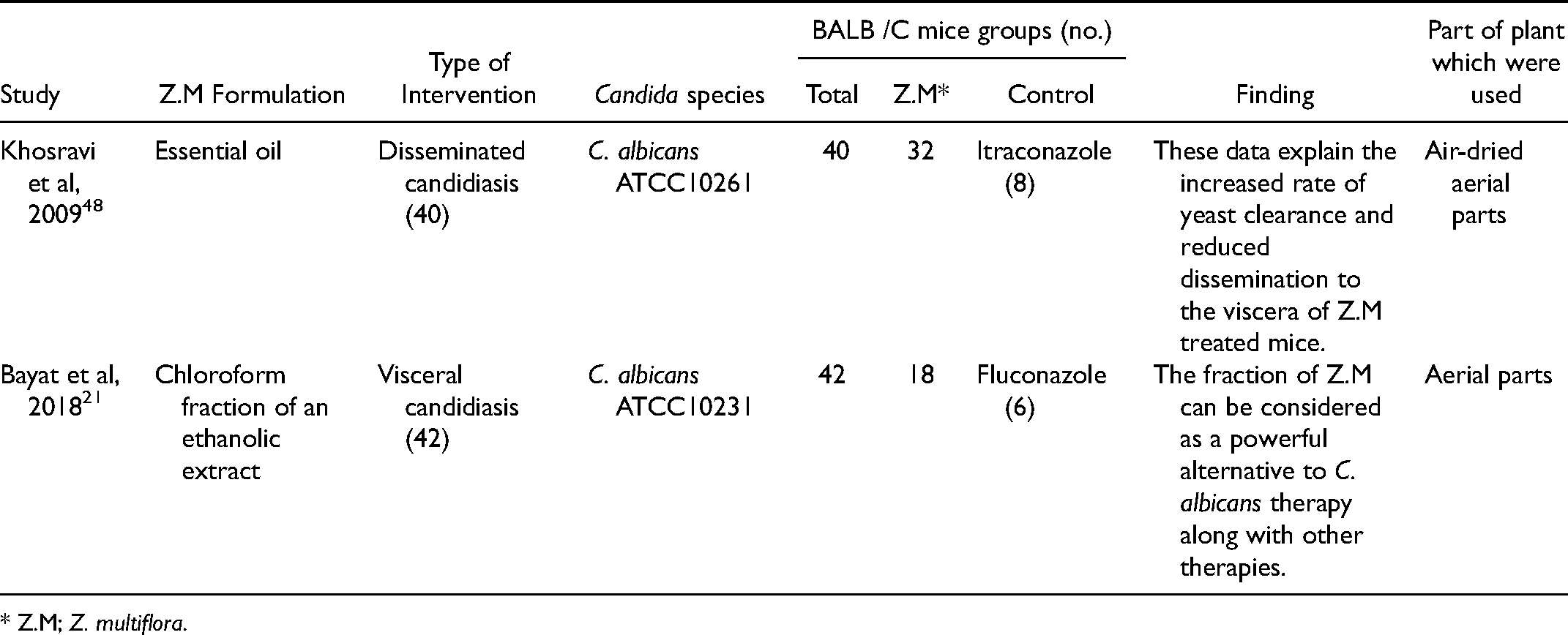
Two studies examined the antifungal activity of Z. multiflora in animal models (Table 3). Fluconazole and itraconazole were used in the Khosravi 48 and Bayat 21 study as the control group, respectively. The results of both studies showed that Z. multiflora could be used as an alternative to antifungal drugs to inhibit the growth of C. albicans in mice models.
Effects of Z. multiflora on Candida Infection in in Vivo Studies.
* Z.M; Z. multiflora.
The results demonstrated that the fraction of Z. multiflora could be considered a powerful alternative to C. albicans therapy and other therapies.
Antifungal activity of Z. multiflora on Candida infections in clinical studies
Three clinical studies were performed on the effects of Z. multiflora on Candida infections.49–51 The result of these clinical studies is summarized in Table 4. Two studies with a total sample size of 80 concluded that 0.1% Z. multiflora vaginal cream was effective in treating vaginal candidiasis and significantly diminished the clinical signs and symptoms of vaginal candidiasis compared to the same control group (clotrimazole 1% cream).50,51 Overall, Khosravi et al 50 and Fouladi et al 51 suggested that Z. multiflora cream can be considered a good antifungal agent in treating vaginal candidiasis.
Effects of Z. multiflora on Candida Infections in Clinical Studies.

* Z.M; Z. multiflora.
In a study by Amanlou et al, 49 the effects of Z. multiflora were investigated to treat Candida-associated denture stomatitis. This study showed that Z. multiflora gel reduces the number of fungal colonies and mucosal erythema more effectively than the control group, a miconazole 2% gel.
Discussion
The present systematic review evaluated the antifungal properties of various extracts and essential oils (EO) of Z. multiflora against different Candida species. It was shown that Z. multiflora inhibits the germination of Candida species, which leads to the deformation and destruction of these cells. Also, some studies reported that based on the MIC index, the antifungal properties of ethanolic extract were more significant than the methanolic extract, but due to the presence of various compounds in Z. multiflora, variant harvest locations, and preparation methods, this result cannot be generally considered. In some studies, resistant and susceptible species of Candida were used to examine the antifungal properties of Z. multiflora, but no significant changes were seen in the effect of Z. multiflora when it was used against either resistant or susceptible species of Candida. Generally, Z. multiflora has been an effective alternative in eliminating Candida rather than chemical antifungal drugs. This finding suggests that the antifungal properties of Z. multiflora essential oils are independent of changes associated with resistance to azole drugs. 52 In general, in order to eliminate Candida colonies, Z. multiflora is a more suitable alternative than chemical drugs. 43
However, Sharifzadeh et al reported that FLU-susceptible species were more susceptible to essential oils. 53 Essential oil is a volatile, natural aromatic oil obtained from various parts of the plant. Mainly, the biological activity of EOs, such as antibacterial, antiviral, anti-inflammatory, antifungal, anti-mutagenic, anti-carcinogenic, antioxidant, and other activities, has been attributed to its compounds. 54 The main issue associated with using EOs is their instability to light, air, moisture, and volatility, which can easily lead to evaporation and reduce their efficiency. 55 Phenolic compounds such as carvacrol, thymol, and eugenol are the main components of Z. multiflora essential oil, which are generally stored in young leaves during plant growth. 56 Studies have shown that thymol, carvacrol, and γ-Terpinene are the main components for inhibiting Candida species. Differences in EO compositions may be due to differences in concentrations and factors such as the plant species, solvents, raw materials used to prepare the EO (dried / fresh Z. multiflora), the soil in which the plant grows, the time of harvesting and extraction techniques, which all can affect the antifungal power of the EO. 57 It should also be noted that higher altitudes of areas where the plant is collected reduce carvacrol and increases the amount of thymol. 58 Therefore, the difference in these two compounds also depends on ecological and geographical factors. 59 This can be considered an explanation for the difference in the number of compounds in the EO of Z. multiflora in different studies. Therefore, in a study by Niczad et al, 41 despite the different compositions of Z. multiflora harvested from different Fars province cities, no difference was seen in the amount of their antifungal effects. Kavoosi's study showed that the higher amounts of thymol result in a more significant antifungal effect and a higher MIC. 35 In a study by Zomorodian et al, Z. multiflora species gathered from Darab, Fars province, had higher carvacrol levels and had more significant antifungal effects based on MIC than species collected from Lamerd and Zarghan. 26
In Saei-Dehkordi ‘s study, 24 Z. multiflora gathered from Najafabad, Isfahan had the highest amount of thymol compared to Z. multiflora species in the present study. Still, its antifungal effects on C. albicans based on MIC index were less than other types of Z. multiflora in this study. Also, Z. multiflora species gathered from Poldokhtar Laarestan had the lowest amounts of thymol and carvacrol compared to other areas but had the most antifungal effects based on the MIC index.
Suppose a lower concentration of Z. multiflora essential oil can exert its antifungal properties. In that case, it may be due to the resistance of microorganisms or differences in the effective composition of the Eos. 31 Monoterpenes, such as thymol, found in Z. multiflora EO, are derived from isoprene hydrocarbure (2-methyl-1,3-butadiene) by binding two or more isoprene molecules. Studies have shown that thymol can affect the structure and electrostatic surface of cell membranes and lead to asymmetric membrane tension. 60 The ability to disrupt the adhesion of C. albicans has also been attributed to terpenes. They also inhibit the cellular respiration of Candida, which has destructive effects on the mitochondria. 61 According to Zia et al's study, if the concentration of C. albicans suspension decreases, the number of colonies growing in the culture medium will also decrease by reducing the concentration of Z. multiflora extract in the culture medium, C. albicans colonies will increase. 62
Scanning and transmission electron microscopy have explained the mechanism of action of Z. multiflora compounds as follows: at a concentration of 50 ppm of Z. multiflora essential oil, the integrity and uniformity of the fungal cell wall is destroyed in some areas. In some areas, the cell membrane separates from the cell wall and invaginates into the cytoplasm.56,63
Loss of density and vacuolization also occur at this concentration. At a concentration of 100 ppm, a greater degree of destruction occurs along with a detachment of cell membranes from the cell wall, which have collapsed and undergone herniation at various intervals, leading to mycelia deformation. At 150 ppm, however, the damage is caused by depletion of the cytoplasmic content, which causes the mycelia to appear electron-lucent. Detachment and fragmentation of the plasma membrane and the formation of lysosomes (small vesicles attached to the membrane) could also be observed beneath the cell wall, and membrane fragments spread throughout the cytoplasm. Also, swelling and deformation of mycelia are other changes observed in this concentration. Also, at a concentration of 200 ppm, the germination of Candida is effectively inhibited, and no mycelia are formed at this concentration. 63
Some Candida cells have a standard shape at this concentration, but others show changes in the range from vacuolization to cell membrane detachment and deformation; therefore, by increasing EO concentration up to 400 ppm, further degradation, including the destruction of the plasma membrane and the cell wall, are evident. Hyphae are entirely free to enter the cytoplasm.
Usually, mycelia have a homogeneous and dense cytoplasm, and their intracellular septa are completely intact. Also, hyphae enclosed by a cell wall have a fully integrated structure, and the plasma membrane is wholly attached to the cell wall and is smooth and Non-wrinkled.64,65 On the other hand, the starting point for neutralizing the invasive state of C. albicans is the reduction of adhesion and its dimorphic transition to a filamentous state, both of which are significant factors in the pathogenesis of candidiasis. 61
Although the antifungal mechanism of thymol or carvacrol is still unclear, their antifungal activity is likely due to the lipophilicity of thymol and eugenol, which can co-occur with carvacrol in the fatty acid chain of cell membranes and impair cell membrane fluidity and permeability. 66 This process, especially in C. albicans, affects the regulation and function of essential enzymes that bind to membranes and catalyze the synthesis of cell wall polysaccharide compounds (such as beta-glucans, chitin, and mannan) and eventually disrupts cell growth and envelope morphogenesis. 67 According to Braga et al, During envelope morphogenesis, thymol alone exerts more destructive effects than eugenol, which may be related to the degree of infiltration of monoterpenes into the fungal cell wall and cell membrane structure. 67 Thymol and eugenol have different molecular properties; These differences include molecular volume, surface area, polarity, hydrophilic/lipophilic balance, percentage of hydrophilic surface area, hydrogen bond capacity, and hydrogen bond acceptor capacity. Therefore, the difference between these two compounds is different in terms of strength and their mechanism of action, which can explain the synergistic effect of thymol and eugenol in combination with each other. Disorder in envelope morphogenesis is also functional, leading to dysfunction in important pathogenic factors such as adhesion. 67
Other mechanisms theoretically cause damage to the cell wall and membrane along with rupture due to morphological deformation, the spread of this rupture, collapse, and damage to fungal filaments 68 ; Therefore, Z. multiflora essential oil leads to irreversible destruction of the cell wall, cell membrane and cell organs of the fungal microorganism, which affects its growth and morphology 69 and the resulting essential oil can suppress fungal colony size and sporulation. 63
The evidence obtained from this systematic review can guide researchers in discovering novel antifungal agents from Z. multiflora.
Conclusion
Considering the side effects and resistance of current antifungal drugs as well as the benefits of using herbal medicines, such as lower cost, less likely to develop drug resistance, the absence of side effects, and toxicity compared with chemical ones
Limitations and Suggestions
This systematic review highlighted that the reviewed studies lack consensus and standardization of MIC, MIC50, and MIC90 values for defining antifungal susceptibility testing and biofilm assay for Candida species. Since different extracts or essential oils were evaluated in the studies extracted from different regions, the number of differences in chemical compounds in the extracted plant extracts or essential oil was affected by this topic. Thus, it is impossible to report a single concentration or MIC to be more effective. Furthermore, each researcher determines his/her own measurement scale for what could be considered as a significant inhibition zone or MIC and what could not.
Moreover, the difference in Z. multiflora concentrations, plant region, formulation, incubation time, incubation temperatures, and duration of treatment are not equivalent in these studies, which will significantly affect the results and outcomes of studies and make it hard to compare.
Footnotes
Acknowledgments
We sincerely thank the kind contributions of all who helped us to finalize this research.
Authors’ contributions
AMS., N.E.G. and J.J. collected the data, M.E.S. and J.J. performed the statistical analyses, interpreted data, and drafted and revised the manuscript for important intellectual content.
AMS., P.N. and N.E.G. reviewed the analyses and the final version of the manuscript. M.E.S., J.J. and AMS. interpreted data, revised the manuscript for important intellectual content, and approved the final version.
All authors have read and approved the manuscript.
Availability of Data and Materials
The datasets used and/or analyzed during the current study are available from the corresponding author on reasonable request.
Consent to participate and publish
Not applicable.
Declaration of Conflicting Interests
The author(s) declared no potential conflicts of interest with respect to the research, authorship, and/or publication of this article.
Ethical approval
Not applicable
Funding
The author(s) received no financial support for the research, authorship, and/or publication of this article
