



Abstract
Aromatic herbal remedies, hydrosols, and essential oils are widely used for women’s hormonal health. Scientific investigation of their major constituents may prevent unwanted infertility cases, fetal abnormalities, and drug-herb interactions. It also may lead to development of new medications. A list of 265 volatile molecules (mainly monoterpenes and sesquiterpenes) were prepared from a literature survey in Scopus and PubMed (2000-2019) on hydrosols and essential oils that are used for women’s hormonal and reproductive health conditions. The PDB (protein data bank) files of the receptors (136 native PDB files) that involve with oxytocin, progesterone, estrogen, prolactin, acetyl choline, androgen, dopamine, human chorionic gonadotropin, luteinizing hormone, follicle-stimulating hormone, aromatase, and HER2 receptors were downloaded from Protein Data Bank. An in silico study using AutoDock 4.2 and Vina in parallel mode was performed to investigate possible interactions of the ligands with the receptors. Drug likeliness was investigated for the most active molecules using DruLiTo software. Aristola-1(10),8-diene, bergapten (5-methoxypsoralen), α-bergamotene, bicyclogermacrene, α-bisabolol oxide A, α-bisabolone oxide, p-cymen-8-ol, 10-epi elemol, α-elemol, β-eudesmol, 7-epi-β-eudesmol, ficusin, β-humulene, methyl jasmonate, nerolidol, pinocarvone, (+)-spathulenol, and thujone had better interactions with some androgen, aromatase, estrogen, progesterone, HER2, AChR, and/or dopamine receptors. Most of these molecules had an acceptable drug likeliness except for α-bergamotene, bicyclogermacrene, β-humulene, and aristola-1(10),8-diene. Some volatile natural molecules can be considered as lead compound for drug development to treat hormonal conditions.
Keywords
Essential oils are natural volatile compounds with strong odor mainly extracted from aromatic plants as secondary metabolites. They are considered as active constituents of medicinal plants with diverse biological activities. They are usually obtained by steam- or hydro-distillation first developed in traditional Persian medicine. 1 –3 Essential oils are very complex mixtures that can contain about 10 to 80 natural components at quite different concentrations. The main constituents of the essential oils are included in the class of terpenes and terpenoids, mostly monoterpenes and sesquiterpenes. Some other aliphatic and aromatic volatile compounds such as alcohols, normal alkanes, aldehydes, and small phenolics also can be found in the essential oils, which are generally called aromatic compounds, all characterized by low molecular weight. Structurally, terpenes are made from combinations of several 5-carbon-base (C5) units called isoprene. Sesquiterpenes are formed from the assembly of 3 isoprene units (C15). Monoterpenes are composed of 2 isoprene units (C10). 4 They constitute 90% of the essential oils with diverse structures and biological activities. Many of these molecules are optically active, which means they have (+) or (−) enantiomers. Some enantiomers exhibited different biological activities. They have shown a variety of biological activities including antibacterial, 5 –7 antifungal, 8 insecticidal, 9 cytotoxic, 10 antispasmodic, anxiolytic, and antidepressant effects. 11 Many of the aromatic plants’ volatile components are ingested in different countries as traditional medicine remedies, herbal tea, or infusions. They have an important role in aromatherapy for treatment of a range of conditions, especially for women’s well-being and health care. For example, in Persian traditional medicine and nutrition culture, products containing essential oils especially hydrosols soft drinks (aromatic waters, distillate, Araq, or aragh) are very popular to treat women’s hormonal and reproductive health conditions such as premenstrual syndrome, menopausal symptoms, hormonal imbalance, infertility, or as contraceptives. 12
On the other hand, essential oils’ constituents of medicinal plants, which are mostly considered as potent molecules when ingested in pure form or in high doses, may cause some adverse effects on pregnant women or their fetus. 13 –16
Scientific investigation of safety and efficacy of aromatic herbal remedies, essential oils, and their major constituents, monoterpenes and sesquiterpenes with potential effects on hormonal condition, may prevent a notable number of unwanted infertility cases, abortions, fetal abnormalities, and drug-herb interactions. It also may lead researchers to develop new medicines as well as functional foods or beverages for use as supplements. 17 –19
Recently, computational aids for assessing bioactivities, especially in silico screening by target-ligand docking, caught researchers’ attention to find phytochemicals’ biological properties. 20 In the present study, a list of monoterpenes, sesquiterpenes, and aromatic compounds and their isomers (about 265 structures), which have been previously reported from hydrosols, essential oils, or medicinal plants with application for women’s hormonal conditions, was prepared and an in silico study was performed to evaluate their interaction with receptors that have a role in regulating women’s hormonal balance or women’s hormonal conditions. These receptors are those that are involved with oxytocin, progesterone, estrogen, prolactin, acetyl choline, androgen, dopamine, human chorionic gonadotropin (hCG), luteinizing hormone (LH), follicle-stimulating hormone (FSH) receptors, as well as aromatase and human epidermal growth factor receptor 2 (HER2).
Also, drug likeliness of the selected active molecules was investigated (in silico) to evaluate their chance to be considered as orally active drugs for human.
Materials and Methods
Ligand Set Up
A list of 265 volatile small molecules (mainly monoterpenes and sesquiterpenes) was prepared from literature survey in Scopus and PubMed (2000-2019) from hydrosols (aromatic waters, distillates) and essential oils that can affect women’s hormonal health and reproductive system. 12,19,21 –23 The list was prepared from any volatile molecule that was reported in related articles regardless of whether it is a major or minor constituent. In addition, different isomers of these molecules were downloaded from the NIST WebBook.
All the structures were converted to 3D mol2 using open babel 2.3.2. Gasteiger partial charges and merging nonpolar hydrogen atoms were added to all structures using MGLTOOLS 1.5.6 by means of a shell script in order to yield 265 pdbqt (Protein Data Bank [PDB], Partial Charge [Q], and Atom Type [T]) files. The names of molecules can be found in Supplementary File 1.
Receptor Set Up
A list of the receptors that are involved in women’s hormonal and reproductive health conditions was prepared according to the book Burger’s Medicinal Chemistry and Drug Discovery, 24 and the PDB files of the receptors were downloaded from Protein Data Bank. These receptors are those that involve with oxytocin, progesterone, estrogen, prolactine, acetyl choline, androgen, dopamine, HCG, LH, FSH, as well as aromatase and HER2 receptors.
For self-docking, all 136 native PDB files of receptors were subjected to a bash script in Linux operating system in order to extract the cognate ligands, add partial charges to both proteins and ligands, generate configuration files for Autodock and Vina, and finalize self-docking simulation. The center of grid box for all PDB codes was the central atom of the cognate ligands. Self-docking procedure was repeated with modified parameters with the above-mentioned criteria in such a way so as to result in root-mean-square deviation (RMSD) values lower than 2 angstroms. Among different PDB files of the receptors only those with a non-ionic and non-sugar HETNAM, which had RMSD lower than 2 angstroms after validating redock (self-docking) procedures that were selected for the experiments. 25
Docking Procedure
For automatic running of AutoDock 4.2 and Vina in parallel mode, the docking simulation was carried out using an in-house batch script named DOCKFACE. This batch script was designed to facilitate the virtual ligand screening in stepwise mode, which includes ligand preparation, receptor preparation, grid maps generation, and finalization of docking runs. Processing of docking with Vina was also performed with DOCKFACE. 26 In the Autodock 4.2 experiments, genetic algorithm search method was applied to find the best pose of each ligand in the active site of the receptors.
A grid box of 30 × 30 × 30 Angstroms, and the exhaustiveness of 100 was used as docking parameters. The spacing between grid points was adjusted to 0.357 angstroms (one quarter of the carbon-carbon simple bond length), and the maximum number of docking mode was set to 9. Random orientations of the conformations were made after translating the center of the ligand to a specified position within the active site of the receptors. This process was repeated until the desired number of low-energy orientations was obtained. The docking procedure was performed in the rigid mode. Protein ligand complexes visualization was done using VMD software. 25,26
Drug Likability
In order to calculate drug likability of the active components resulting from docking procedures the Lipinski’s rule of five was used. The ability of the ligand to pass the blood-brain barrier and also drug likability of these molecules was evaluated applying DruLiTo software.
Results and Discussion
A list of 265 volatile small molecules (mainly monoterpenes and sesquiterpenes) previously reported from hydrosols or essential oils for women’s hormonal conditions are listed in Supplementary File 1. The names of all 136 native PDB files of receptors are listed in Supplementary File 2, but self-docking results led to reasonable RMSD values lower than 2 only for some receptors, which are included in Table 1. These receptors included some estrogen, progesterone, androgen, aromatase, dopamine D3, HER2 kinase domain, and human M2 muscarinic acetylcholine receptors. This means that we were not able to evaluate other receptors that are involved in prolactin, FSH, LH, HCG, and oxytocin due to not having a suitable PDB file with enough resolution in Protein Data Bank, non-ionic and non-sugar HETNAM or RMSD value lower than 2 angstroms after validating redock.
A List of Receptors Type, Number of Found PDBs in RCSB.org for the Receptors, and the PDB of the Receptors Used in the Study after Validating Redock.

a The detailed list of the receptors can be found in supplementary File 2.
The binding energy of the ligand and receptors obtained from the docking procedure are listed as a heat map in Supplementary File 1. In this file, the energies are ranked with colors from red (nearest binding energy to the binding energy of co-crystallized ligand) to green (the farthest binding energy to the binding energy of co-crystallized ligand). The red colored cells showed more favorable binding energy. Considering binding energy of the ligands to the receptors, having more negative values with closer or higher amount in comparison to the value of co-crystallized ligand, means more interaction with receptor, which is more favorable. In this study, the binding energy of the co-crystallized ligand to their receptors were considered as 100%, and only the evaluated ligand that had a binding energy more than 70% of the related co-crystallized ligand binding energy are discussed here as the possible active molecules.
Androgen Receptors
Among the 265 investigated molecules, only aristola-1(10),8-diene, bergapten, β-humulen, bicyclogermacrene, α-bisabolol oxide A, α-bisabolone oxide, β-eudesmol, ficusin, p-cymen-8-ol, pinocarvone, thujone, cis-α-bergamotene, and (+)-spatulenol had suitable binding energy to the androgen receptors especially for receptor with the PDB code of 4oj9. As an example, in comparison to the related co-crystallized ligand hydroxyflutamide (energy of −7.9) most of the named ligands especially pinocarvone (−8.3), bergapten (−7.8), aristola-1(10),8-diene (−7.9), ficusin (−8.6), cis-α-bergamotene (−7.9), and the (+)-spatulenol (−8.6) had an equal or better binding energy to the androgen receptor 4oj9 (Supplementary File 1, Table 2). The structures of the named molecules are shown in Figure 1.
A List of the Ligands With the Best Interaction With the Receptors as Well as Their Likeliness to Drug and their Ability to Pass the Blood-Brain Barrier (BBB)a

a The detailed list can be found in Supplementary File 1.
*Those ligands which had binding energy more than 70% of the related co-crystallized ligand binding energy
**Those ligands which had equal or better binding energy than the co-crystalized ligand
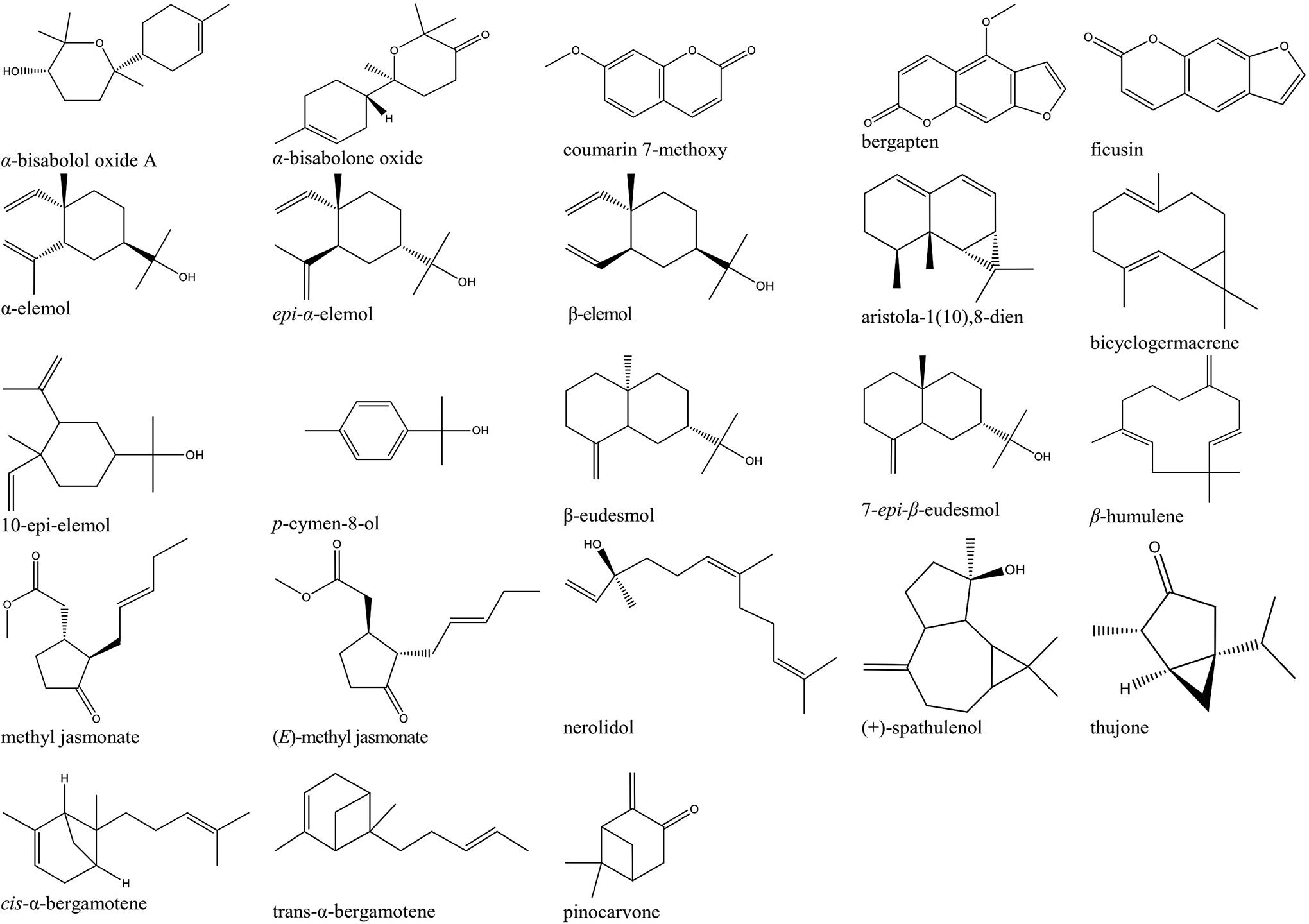
The structures of selected molecules that showed better interactions with the investigated receptors.
Molecules that are active on androgen receptors are rarely used as major therapeutics for women, but due to unwanted effects of androgenic substances in women, caution should be considered for their intake by women. Excessive consumption of androgenic substances ultimately results in secondary sexual traits related to men in women such as hirsutism, thickening of sound, and so on. 27 –29 On the other hand, androgens are commonly used in combination with estrogens to reduce postpartum breast congestion or as replacement therapy in postmenopausal women and also for increasing sexual desire. 30 –32 Anti-androgenic compounds, such as cyproterone, have been used in women to treat hirsutism. 33,34
Aromatase Receptor
With menopause, the ovaries stop or significantly reduce estrogen production, and in fact after menopause, estrogen is produced from the circulating androgens in the blood, especially andrestenedione, which turns into estrogen. The conversion of androstenedione to estradiol is negligible. It seems that after menopause, testosterone is also slightly secreted from the ovaries, which also converts into estradiol. All these conversions are performed by the aromatase enzyme. 35 –37 Thus, by inhibiting this enzyme, the level of estrogen decreases, which is very important. For example, the level of peripheral estrogen is increased in breast cancer or endometriosis. 38,39
None of the investigated molecules showed a better binding affinity to the aromatase receptors than the related co-crystallized ligand. But, aristola-1(10),8-diene, α-elemol, bergaptene, β-elemol, β-humulene, bicyclogermacrene, α-bisabolol oxide A, α-bisabolone oxide, epi-α-elemol, β-eudesmol, ficusin, pinocarvon, (+)-spatulenol, 7-epi-β-eudesmol, and (Z)-trans-α-bergamotene (Figure 1) showed a better interaction than other ligands with binding energy of about 60% to 80% of relative co-crystallized ligand binding affinity.
Based on the binding energy of the ligands, α-bisabolol oxide A had a better interference with aromatase receptors of different PDB codes. The amount of interference energy for this ligand was −9.4 to −9.8, which was 70% of co-crystallized ligand binding energy (−13.7 to −13.9) with an exception for 4g17 aromatase receptor (Supplementary File 1, Table 2). The best interactions for 4g17 aromatase receptor can be attributed to ficusin with an interfering energy of 7.7, which is in fact about 79.59% of the co-crystallized ligand (−8.8). Thus, it is likely that ficusin interferes with this receptor.
The named ligands in this section that had a partial interference with the aromatase receptor may have beneficial effects but they can also interfere (agonize or antagonize) with the effects of orthodox medication such as letrozole.
Estrogen Receptors
Most estrogens produced in women are estradiol, estrone, and estriol. Estradiol is a secreted ovarian product. Estrone, as well as the other estrogens, are synthesized from cholesterol and secreted mainly from the gonads.
Estrogen is responsible for the development and regulation of the female reproductive system and development of female secondary sexual characteristics, such as breasts. They are also involved in the thickening of the endometrium and regulating the menstrual cycle. 40 –43 Estrogen receptors (ER) are a group of proteins that are activated by estrogen. Two classes of estrogen receptors are 1-nuclear estrogen receptors (ERα and Erβ, the members of the nuclear receptor family of intracellular receptors) and 2-membrane estrogen receptors (GPER [GPR30], ER-X, and Gq-mER, which are mostly G protein-coupled receptors). 44,45
In the present study, only estrogen receptors with the PDB codes of 1DB1, 1UOM, 3UUD, 1QKM (from Homo sapiens), and 1S9P (from mouse) were valid for the in silico study.
Among the different evaluated molecules, bergapten, β-elemol, β-humulene, bicyclogermacrene, α-bisabolol oxide A, α-bisabolone oxide, β-eudesmol, ficusin, pinocervone, (+)-spatulenol, 7-epi-β-eudesmol, cis-α-bergamotene, trans-α-bergamotene and aristola-1(10),8-diene (Figure 1) could interact with the estrogen receptors with a binding energy of 60% to 97% of the energy of the co-crystallized ligand (Supplementary File 1, Table 2).
Among the different investigated estrogen receptors, the receptor with the PDB code of 1S9P showed the highest interaction with the ligands. The binding energy of this receptor with its co-crystallized ligand was −9.9. (+)-Spathulenol showed the best binding energy (−9.4) to 1S9P estrogen receptor. From this point of view, the interaction energy of this ligand with the 1S9P receptor relative to its co-crystallized ligand was about 96.8%.
Progesterone Receptor
The progesterone receptor (PR) or NR3C3 (nuclear receptor subfamily 3, group C, member 3) is an intracell protein that is activated by the steroid hormone progesterone.
In humans, PR has 2 main forms, PR-A and PR-B, and a lesser-known isoform, the PR-C. PR-B is the positive regulator of the progesterone effects, while PR-A and PR-C antagonize the effects of PR-B. 46,47
Among the reported crystal structures for progesterone, 17 receptors were valid to perform the in silico study; their PDB codes are listed in Table 1.
Among the investigated molecules, bergaptene, β-elemol, β-humulene, bicyclogermacrene, α-bisabolol oxide A, α-bisabolone oxide, β-eudesmol, pinocarvone, (+)-spatulenol, 7-epi-β-eudesmol, cis-α-bergamotene, and aristola-1(10),8-diene showed a better interaction with the PR receptors.
The binding energy for these ligands ranged between 60% and 97% of the energy of the co-crystallized ligand (Supplementary File 1, Table 2).
The results showed that the progesterone receptor with the code of 3g8o had a higher interaction with the investigated ligands. Among the named ligands, pinocarvone had a more favorable energy in terms of interference with the receptor. The amount of binding energy for pinocarvone with 3g8o was −8.6 (97.8% of the co-crystallized ligand).
Progesterone receptors involve in a variety of female reproductive and nonreproductive activities and health issues such as sexual behavior, 48 neuroendocrine gonadotrophin regulation, ovulation, uterine function, 49,50 ductal branching morphogenesis, and lobuloalveolar differentiation. 51 In addition, progesterone receptors’ function is also implicated in bone maintenance, the cardiovascular and central nervous systems, as well as regulation of thymic involution. 52 Progesterone is necessary to induce the progesterone receptors, and different agonists and antagonists have been developed for progesterone receptors. The important applications of ligand that can interact with the PRs are hormone replacement therapy, 53 developing contraceptives, 54,55 maintaining or even ending pregnancy, 55 –58 as well as developing medications for controlling breast cancers or uterus fibroids. 59,60
Human Epidermal Growth Factor Receptor 2 (HER2)
HER2 is a member of the human epidermal growth factor receptor (HER/EGFR/ERBB) family. It is also called HER2/neu, receptor tyrosine-protein kinase erbB-2, CD340, and ERBB2. Amplification or overexpression of this oncogene receptor plays an important role in the development and progression of some aggressive types of breast cancer. HER2 has become an important target of therapy for approximately 30% of breast cancer patients. 61 HER2 overexpression is also known to occur in ovarian and aggressive forms of uterine cancers, such as uterine serous endometrial carcinoma and lung adenocarcinoma. 62 –64 HER2 is the target of the monoclonal antibody trastuzumab (marketed as Herceptin). In theory, any molecules that compete with trastuzumab for binding to HER2 may alter its effects.
Among the ligands that interact with this receptor are bergaptene, β-elemol, β-humulene, α-bisabolol oxide A, α-bisabolone oxide, β-eudesmol, ficusin, methyl jasmonate, nerolidol, p-cymen-8-ol, pinocarvone, (+)-spatulenol, and cis-α-bergamotene (Figure 1) had a better interaction with this receptor. The binding energy for these ligands ranged between 60% and 77% of the binding energy of the co-crystallized ligand.
From the said ligands, (+)-spatulenol interacted with the HER2 receptor (3rcd) with the binding energy of −7.7, which was 77% of the binding energy of the co-crystallized ligand (Supplementary File 1, Table 2).
Acetylcholine Receptor
Acetylcholine receptors (AChR) are integral membrane protein with 2 main classes named nicotinic and muscarinic receptors. In painful menstrual periods, administration of anticholinergic agents such as hyoscine may help reduce the painful abdominal spasms. On the other hand, for maintaining the health and well-being of all mammals, numerous aspects of physiology are controlled by neurotransmitters and neuroendocrine mechanisms. 65 Also, some neurotransmitters have a regulation effect on gonadotropin-releasing hormone (GnRH) and LH. For example, it was reported that in polycystic ovarian syndrome (PCOS) condition, the GnRH and LH inhibitory neurotransmitters such as acetylcholine, serotonin, dopamine, and γ-aminobutyric acid (GABA) are reduced, while glutamate, a major stimulator of GnRH and LH release, is increased. On the other hand, the changes in the levels of this neurotransmitters during PCOS may have a role in the observed anxiety-like mood disorders in these patients. 66
Among different subtypes of AChR only 3UON (human M2 muscarinic acetylcholine receptor PDB code) was valid for the present in silico study. In human, the M2 muscarinic receptors are located in the heart, where they act to slow the heart rate down to normal sinus rhythm; thus, inhibition of M2 receptors will cause a raise in heart rate. We could not find an evidence for presence of M2 muscarinic receptor in human reproductive system in the literature but several studies reported the presence of this receptor in uterus, ureter, bladder, and prostate of different animal models (rabbit, mice, and guinea pig) with a contractile activity on the muscles. 49,67 –69
This in silico study has shown among the explored molecules, only 15 structures including 10-epi-elemol, α-elemol, bergaptene, β-elemol, β-humulene, bicyclogermacrene, α-bisabolol oxide A, α-bisabolone oxide, epi-α-elemol, β-eudesmol, pinocarvone, (+)-spatulenol, 7-epi-β-eudesmol, cis-α-bergamotene, and aristola-1(10),8-diene (Figure 1) have a better interaction with the acetylcholine receptor. Their binding energy ranged between 69% and 81% of the co-crystallized ligand binding energy. Among the molecules mentioned, spathulenol, with a mean energy of −9.4, had a closer energy to the co-crystallized ligand binding energy (−11.5; Supplementary File 1, Table 2).
Dopamine Receptors
Dopamine agonists can produce anti-prolactin effects. Therefore, they might be used to reduce or stop lactation in women. They also have a role in regulation of GnRH and LH. 66 Dopamine (DA) receptors (DR) are prominent in the vertebrate central nervous system (CNS) with a role in many neurological processes, including motivation, pleasure, cognition, and so on. There are at least 5 subtypes of dopamine receptors, D1, D2, D3, D4, and D5. Among different subtypes of dopamine receptor only, 3PBL (PDB code of a dopamine D3 receptor, D3R) was valid for the present in silico study. Some reports give evidences for dopamine intrinsic direct role in the regulation of the ovary reproductive function. It was reported that DA/DR system exerts a dual modulatory function in the lifespan of corpora lutea (the DA/D1R as luteotropic and the DA/D3R as luteolytic). 70
Among the investigated molecules, aristola-1(10),8-dien, β-humulene, bicyclogermacrene, α-bisabolol oxide A, α-bisabolone oxide, coumarin-7-methoxy (herniarin, umbelliferone), β-eudesmol, ficusin, methyl jasmonate, nerolidol, p-cymen-8-ol, pinocarvone, spathulenol, thujone, (+)-spathulenol, 7-epi-β-eudesmol, cis-α-bergamotene, trans-α-bergamotene, and (E)-methyl jasmonate (Figure 1) had a reasonable interaction with the dopamine receptors. The binding energy for the named ligands ranged from 88.60% to 100% of the co-crystallized ligand of the dopamine receptor. In comparison to energy of the co-crystallized ligand (−7.8), the best binding energy was observed for pinocarvone (−8).
Drug Likeliness
As it was said, according the Lipinski’s rule of five, DruLiTo software was used to calculate drug likability and the ability of passage through the blood-brain barrier for the molecules that had a better interaction with the above receptors (23 molecules out of 265 investigated compound).
Lipinski’s rule of 5, which is also known as the Pfizer’s rule, is a rule of thumb to determine if a chemical compound with a certain pharmacological or biological activity has chemical and physical properties that would make it a likely orally active drug in humans (drug likeliness). 71,72 Lipinski’s rule claims that, in general, an orally active drug has no more than one violation of the following properties: (1) no more than 5 hydrogen bond donors, (2) no more than 10 hydrogen bond acceptors, (3) a molecular mass ≤500 Da, (4) an octanol-water partition coefficient (log P) ≤5.
In addition, lipid solubility, charge, tertiary structure, and degree of protein binding of a molecule can affect its ability to partition from blood into the blood-brain barrier. 73 For the present study, DruLiTo software was used to evaluate blood-brain barrier passage of these molecules considering the following rules: (1) a molecular mass ≤400 Da, (2) not having an acidic group in the structure, (3) total hydrogen bonds ≤8. All of the investigated molecules in Table 2 could pass the blood-brain barrier. These molecules except for α-bergamotene (cis and trans), bicyclogermacrene, β-humulene, and aristola-1(10),8-diene showed an acceptable drug likeliness. It can be concluded that molecules in Table 2 with an acceptable drug likeliness might be interesting lead compound for further drug development.
Conclusion
Overall, among different 265 ligands (mostly monoterpenes and sesquiterpenes) only few molecules (about 23 molecules) showed reasonable binding energies to the investigated receptors that are involved in women’s hormonal and reproductive health conditions. Among 136 native PDB files investigated, some androgen, aromatase, estrogen, progesterone, HER2, AChR, and dopamine receptors had a better interaction with some of these molecules such as pinocarvone, (+)-spathulenol, α-bisabolol oxide A, and β-eudesmol. Most of these possible active molecules had acceptable drug likeliness.
This study did not give investigated possible agonist or antagonist effects of these ligands. Despite the limitations of the in silico studies, it can be useful to select most probable active molecules among a huge number of the candidate molecules in medicinal plants. In addition, some similarities can be found in the structure of the molecules that showed a reasonable interaction with a same receptor, which might be helpful for further drug design studies. Also, some of these molecules are analogs of each other with a very similar structures; therefore, they might have synergistic effects on a same receptor. On the other hand, a variety of receptors may be involved in a same health condition such as infertility. Overall, further in vitro, in vivo, and clinical investigations have to be conducted to consider these molecules as lead compounds for drug development.
Supplemental Material
Supplemental Material, supplementary_file_no_1_ligand_and_docking_results - An Assay on the Possible Effect of Essential Oil Constituents on Receptors Involved in Women’s Hormonal Health and Reproductive System Diseases
Supplemental Material, supplementary_file_no_1_ligand_and_docking_results for An Assay on the Possible Effect of Essential Oil Constituents on Receptors Involved in Women’s Hormonal Health and Reproductive System Diseases by Amirhossein Sakhteman, Ardalan Pasdaran, Mehdi Afifi and Azadeh Hamedi in Journal of Evidence-Based Integrative Medicine
Supplemental Material
Supplemental Material, supplementary_file_no_2 - An Assay on the Possible Effect of Essential Oil Constituents on Receptors Involved in Women’s Hormonal Health and Reproductive System Diseases
Supplemental Material, supplementary_file_no_2 for An Assay on the Possible Effect of Essential Oil Constituents on Receptors Involved in Women’s Hormonal Health and Reproductive System Diseases by Amirhossein Sakhteman, Ardalan Pasdaran, Mehdi Afifi and Azadeh Hamedi in Journal of Evidence-Based Integrative Medicine
Footnotes
Authors’ Note
This study was part of the PharmD thesis project of Mehdi Afifi, an author of this article.
Author Contributions
Afifi collected the data. Hamedi, Sakhteman, and Pasdaran contributed in designing the study, analyzing data, writing the manuscript, and revising the final version of the manuscript.
Ethical Approval
This is an in silco study on natural molecules and does not need ethical approval.
Declaration of Conflicting Interests
The author(s) declared no potential conflicts of interest with respect to the research, authorship, and/or publication of this article.
Funding
The author(s) disclosed receipt of the following financial support for the research, authorship, and/or publication of this article: The project was funded by Shiraz University of Medical Sciences (Grant No. 94-01-70-9252).

Supplemental Material
Supplemental material for this article is available online.
References
Supplementary Material
Please find the following supplemental material available below.
For Open Access articles published under a Creative Commons License, all supplemental material carries the same license as the article it is associated with.
For non-Open Access articles published, all supplemental material carries a non-exclusive license, and permission requests for re-use of supplemental material or any part of supplemental material shall be sent directly to the copyright owner as specified in the copyright notice associated with the article.
