




Abstract
Employees are the most valuable assets of an organization; therefore, it is very important to understand their behavior. In this regard, the present study was carried out in order to examine the effect of organizational climate on job involvement among nurses working in the teaching hospitals of Qazvin Province, Iran. The present descriptive analytical study was done in 2017. To randomly select a specific proportion of nurses from each of Qazvin teaching hospitals, stratified sampling was used. In total, 340 nurses were selected. Data were collected using 3 questionnaires: Halpin and Kraft Organizational Climate Questionnaire, Job Involvement Questionnaire (Kanungo), and Allen and Myer Organizational Commitment Questionnaire. For data analysis, confirmatory factor analysis and structural equation modeling were used applying AMOS-24 software. The results of path analysis showed the effect of organizational climate on the nurses’ job involvement. Moreover, organizational climate influenced organizational commitment through the mediation of job involvement. According to values obtained for degree of freedom based on chi-square, goodness-of-fit index, root mean square error of approximation, and comparative fit index were in the defined range; therefore, the validity of the conceptual model was approved. Based on the results of the present study, managers of health organizations can achieve their goals by understanding the organizational climate of the hospitals and its effect on the employees’ job involvement and discovering strategies needed for organizational commitment improvement.
Development of national economic and social sectors is not possible without the help, support, and guidance of human resources. Nurses, as one of the most important human resources in health care organizations, play an important role in promoting community health. In this regard, it is necessary to understand the nurses’ mood and analyze factors affecting their performance in hospitals. 1 Organizational climate, which is an integral part of overall organization of hospitals refers to correct social behavior and the way to manage conflicts, ambiguities, and challenges in hospital organization. 2 In fact, efficient organizational climate leads to more dynamic communication among the members of the organization, resulting in members’ willingness to accept more responsibilities in order to achieve their common organizational goals. 3 On the other hand, organizations need employees who comply with the values and objectives of the organization, have high motivation, are committed, are inclined to continue their organizational membership, and are involved with their job. In fact, job involvement is an organizationally favorite motivational variable especially in the modern economy in which organizational rules are specified for full human resource mobilization. 4 In health organizations, job involvement is one of the issues that can significantly affect the nurses’ job satisfaction and performance. Job involvement is one of the variables which can lead to positive results in the organization. 5 Employees with job involvement can form a spiritual relationship with their job and invest certain resources in their current job. 6 Stress has been found among different jobs, including nurses, because of their close contact with patients with severe conditions and at the risk of death. 7,8 In addition, they usually undergo huge workloads in order to provide efficient and qualified healthcare services. On the other hand, successful and appropriate nursing care in a hospital requires a high level of commitment. 9 Researchers consider organizational commitment as an important variable in understanding the employees’ behavior. Accordingly, organizational commitment has potential and serious effects on organizational performance; therefore, its ignorance can be harmful and costly to the organization. 10 Tsai et al, 11 in Taiwan, and Huang et al 12 showed the effect of organizational climate on organizational commitment among nurses. Moreover, Liou 13 and Ho et al 14 indicated that job involvement can be an important factor in the realization of organizational commitment. Given the importance of nursing profession and the unique organizational climate in hospitals and the need for increasing organizational commitment among nurses and other medical employees, it is undoubtedly necessary to analyze the role of these dimensions in achieving the goals of health system. In this regard, the present study was carried out to investigate the effect of organizational climate on organizational commitment using mediation of job involvement among the nurses working in teaching hospitals of Qazvin, Iran. The results of the present study can be significant for health planners and the managers of health organization to understand the dimensions affecting the commitment of the health workers, especially the nurses.
Methods
Design
This analytical cross-sectional study was done in 2017. The statistical population included all the nurses working in the selected teaching hospitals (Rejaei, Bu Ali, Ghods, Velayat, and 22 Bahman) located in Qazvin, Iran.
Research Sample
To select the nurses, Morgan table was used. First, stratified sampling was carried out based on the hospitals; afterward, randomized sampling was used in each stratum with a certain proportion.
Data Collection
For data collection, 2 standard questionnaires, including Halpin and Kraft Organizational Climate Questionnaire (1970), Job Involvement Questionnaire (Kanungo), and Allen and Myer Organizational Commitment Questionnaire were distributed among the selected nurses. Halpin and Kraft Organizational Climate Questionnaire (1970) was used to measure organizational climate. This questionnaire consists of 32 questions in 8 dimensions (team spirit, harassment, intimacy, interest, consideration, distancing, influence and dynamics, and focus on production). Scoring of this questionnaire is based on a 5-point Likert-type scale from very low (1) to very high (5). The Job Involvement Questionnaire (Kanungo) was used to measure job involvement. It consists of 10 questions that are scored based on a 5-point Likert-type scale ranging from completely disagree (1) to completely agree (5). The Allen and Myer Organizational Commitment Questionnaire was used to measure organizational commitment. This questionnaire includes 24 questionnaires and covers 3 dimensions (emotional commitment, continuous commitment, and normative commitment) with a 5-point Likert-type scale from completely disagree (1) to completely agree (5).
Data Analysis
Out of 340 distributed questionnaires, 330 were completed. The validity and the reliability of the mentioned questionnaires are confirmed by the researchers. However, to confirm the questionnaires reliability in the present study, a pilot study containing 30 individuals was chosen from our statistical population. Overall internal reliability (Cronbach’s alpha) of the questionnaires was calculated to be .78, .76, and .72, respectively, for the Halpin and Kraft Organizational Climate Questionnaire (1970), Job Involvement Questionnaire (Kanungo), and the Allen and Myer Organizational Commitment Questionnaire. After the required data were collected, they were analyzed using AMOS-24 software. Structural equation modeling was used to test the hypotheses. To show the significance of the model parameters and to show the effect of the variables, t test and impact factor were, respectively, used. P < .05 was considered as significant level.
Results
Participants
In the present study, most of the participants were women (90.3%). Moreover, 76.1% of the respondents were married. Considering educational degree, the participants mostly held bachelor’s degrees. With regard to experience, most of the nurses had an experience of more than 20 years (Table 1).
Participants’ Demographic Data.

Dimensions and Components
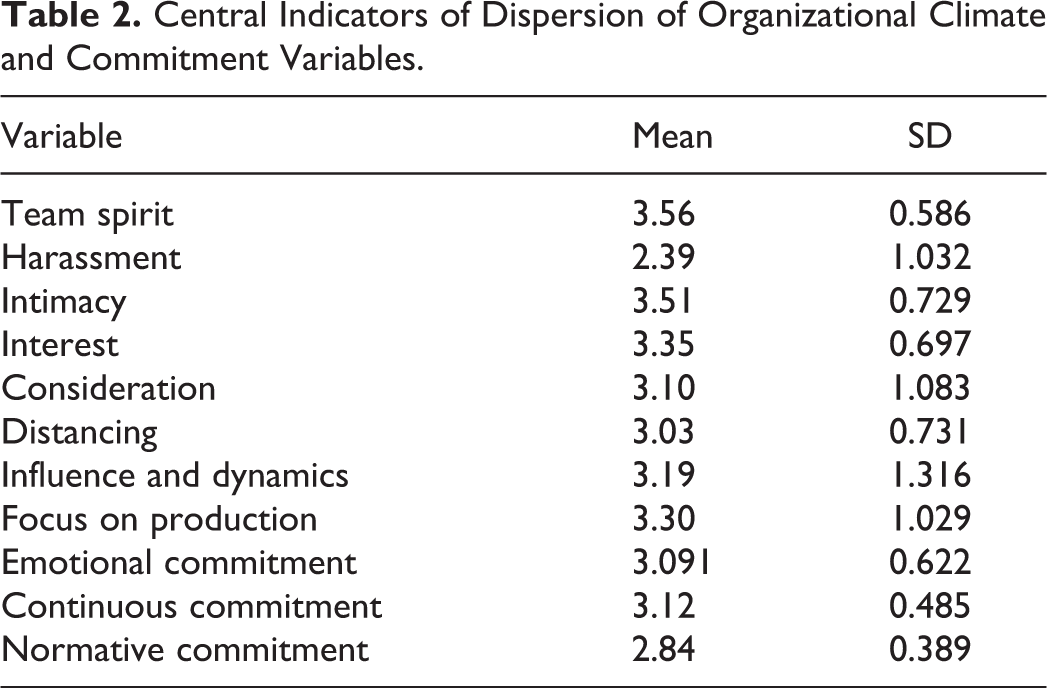
According to the results of the study, the dimensions of group mood and continuous commitment, respectively, had the highest mean values for organizational climate and organizational commitment (Table 2).
Central Indicators of Dispersion of Organizational Climate and Commitment Variables.
Fit Indices
Additionally, the target hypotheses were tested using structural equation modeling. The results of fit indices of the model are presented along with their values in Table 3. These indices represented acceptable fit for the proposed model and the model validity was also confirmed.
Fit Indices of the Redefined Conceptual Model.

Abbreviations: GFI, goodness-of-fit index; RMSEA, root mean square error of approximation; CFI, comparative fit index.
Model Validation
Since the model was fitted to data, the path coefficient (direct effect) of each path was observable. The path coefficient is a numerical standard between 1 and −1. In the above model, positive sign indicates the positive relationship among the considered variables. For example, the path coefficient between organizational climate and commitment was 0.22. However, to examine the significance of this coefficient, Student’s t statistics corresponding to each coefficient was employed and the values are presented in Figure 1.

Estimation of the research’s structural model with standard coefficients.
According to the conducted path analysis, all t statistics were greater than 1.96, indicating that all path coefficients were significant at a confidence interval of 95%; therefore, all the path coefficients were significant. As a result, it can be concluded that the study’s hypotheses are approved (Table 4).
The Results on the Evaluation of Structural Research Model Fit.
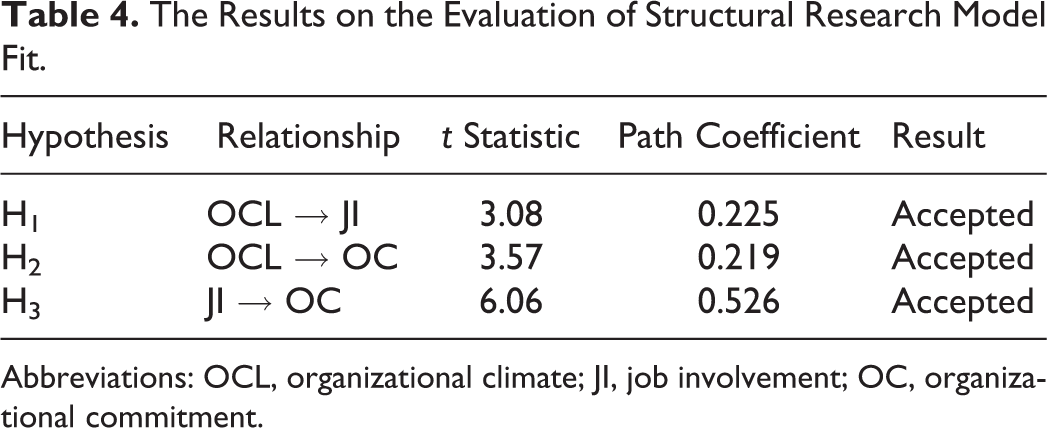
Abbreviations: OCL, organizational climate; JI, job involvement; OC, organizational commitment.
Discussion
Organizational commitment is one of the essential factors that can create a healthy organizational climate, increase the organizational ethics, induce motivation, and enhance the productivity of the organization. 15 In this regard, particularly in health system, the achievement of hospitals organizational goals and an improvement in the delivery of efficient medical services can be obtained by improving the components of organizational climate, keeping competent and committed staff, and promoting commitment among employees. Resorting to path analysis framework, the results of the present study indicated that positive and efficient organizational climate can improve job involvement among the nurses. In other words, organizational climate made the employees involved with their job. Accordingly, it seems that an employee with job involvement considers the organization and job as his or her own and tries hard to be successful in his or her job. This effect is more obvious in hospital organization which has a challenging and difficult environment and at the same time requires an appropriate working climate in order to achieve its predetermined goals. In agreement with the results of the present study, Motlagh, 16 Li et al, 17 and Varela González and García Garazo 18 indicated that organizational climate can affect job involvement among the employees; in addition, they held that employees with healthy work environment take steps toward higher efficiency and better workplace by using all their capacity. On the other hand, the results of the present study showed a significant relationship between job involvement and organizational commitment and the capability of job involvement in predicting organizational commitment well. In hospital environment, where there is a dire need for high-efficiency work and attention to specialized profession, employees need to devote themselves to work, organization, and its goals. Therefore, job involvement can be regarded as an important prerequisite to improve organizational commitment among the employees of hospitals, and it should be paid special attention. Along with the present study, Jang et al 19 studied physiotherapists in hospitals and Hudek-Knežević et al 20 studied nurses and indicated that job involvement had a positive effect on organizational commitment. The results of another study conducted by Cho et al, 21 however, showed that some dimensions such as occupational burnout among nurses had a negative effect on organizational commitment. Finally, the results of path analysis revealed that organizational climate also affected organizational commitment and could predict it well. This result actually indicated that organizational climate improvement can enhance commitment among employees and managers and maintain the capacities and competitive advantages of hospital organization. In this regard, McMurray et al, 22 in Australia, Abou Hashish 23 in Egypt, and Olson 24 in the United States showed that positive and efficient organizational climate can create stabilized organizational commitment, encourage nurses to be more committed to their profession, and help hospitals achieve their goal, that is, health improvement. On the other hand, the results of a study conducted by Delgoshaei et al 3 indicated that emphasis on production and trouble had an inverse relation with organizational commitment among hospital managers and employees. Altogether, organizational commitment and dimensions affects can be different in various hospital jobs, suggesting the conduction of further comprehensive studies through identifying the effective dimensions and controlling and managing them in order to improve the nurses’ commitment toward their profession.
Conclusion
In line with previous studies, the results of the present investigation indicated the important role of organizational climate in job involvement and consequently organizational commitment. Accordingly, managers and authorities of hospitals are recommended to pay close attention to organizational climate in order to improve organizational commitment among nurses, which in turn can lead to positive attitudes and enthusiasm toward organization and organizational commitment.
Footnotes
Acknowledgments
The authors want to express a special recognition to the nurses who have participated in the data collection of this study, without whom the study could not be possible.
Author Contributions
RK, OK, and MH conducted data analysis, wrote the first draft of the manuscript, and approved the final manuscript. PK, OK, HH, MH, and SM supervised data collection, conceptualized the analysis, revised the manuscript, provided mentorship for project completion, and approved the final manuscript.
Declaration of Conflicting Interests
The authors declared no potential conflicts of interest with respect to the research, authorship, and/or publication of this article.
Funding
The authors received no financial support for the research, authorship, and/or publication of this article.

Ethical Approval
The written informed consent was gained from all participants and they were assured that their provided information will remain confidential. The present study was approved by Ethical Committee Medical Sciences University of Qazvin.