



Abstract
In recent years, the field of psychology has increasingly recognized the importance of conducting research with lower-socioeconomic-status (SES) participants. Given that SES can powerfully shape people’s thoughts and actions, socioeconomically diverse samples are necessary for rigorous, generalizable research. However, even when researchers aim to collect data with these samples, they often encounter methodological and practical challenges to recruiting and retaining lower-SES participants in their studies. We propose that there are two key factors to consider when trying to recruit and retain lower-SES participants—trust and accessibility. Researchers can build trust by creating personal connections with participants and communities, paying participants fairly, and considering how participants will view their research. Researchers can enhance accessibility by recruiting in participants’ own communities, tailoring study administration to participants’ circumstances, and being flexible in payment methods. Our goal is to provide recommendations that can help to build a more inclusive science.
By many metrics of socioeconomic status (SES), most people live in lower-SES contexts. In the United States, up to 61% of people report living paycheck to paycheck, 53% could not afford an unforeseen $500 expense, and 62% over the age of 25 have not completed a college degree (U.S. Census Bureau, 2020; LendingClub, 2022; Personal Capital Corporation, 2022). Despite this socioeconomic diversity, the typical psychology research sample is Western, Educated, Industrialized, Rich, and Democratic (i.e., WEIRD; Arnett, 2008; Henrich et al., 2010). Given that SES is more than just a financial reality and can shape self, identity, health, and ways of being (Markus & Stephens, 2017), a well-ordered science must be inclusive to the experiences of lower-SES individuals (McGorray et al., 2023). As a result, it is essential to diversify psychological science.
Yet even researchers who have the admirable goal to recruit more socioeconomically diverse research samples may encounter challenges. One source of these challenges may stem from the overrepresentation of higher-SES and underrepresentation of lower-SES culture and backgrounds in academic settings. At present, researchers are disproportionately from higher-SES backgrounds; 71.3% of American professors have at least one parent with a college degree, and 22.2% have a parent with a PhD—a rate 25 times higher than the number of PhDs in the population (Morgan et al., 2022). Furthermore, research institutions are often dominated by ways of “knowing and being” (i.e., ways of viewing and understanding the world that guide how people act and make decisions) that stem from the cultural models of socioeconomically privileged groups (Adams et al., 2015; Stephens et al., 2014). Because researchers are disproportionately from higher-SES backgrounds and because research institutions draw on higher-SES norms and values, default strategies to recruit and retain participants are, at best, likely to be more effective in higher-SES contexts and, at worst, may actively dissuade people in lower-SES contexts from participating in research. Thus, conducting stronger and more representative psychological science will require that the field develop effective approaches for working with lower-SES individuals and communities.
We present two key, interrelated factors that researchers should address to develop these approaches: trust and accessibility (Fig. 1). We first outline why trust and accessibility are greater barriers to participation in lower-SES contexts compared with higher-SES contexts. We then provide specific recommendations for how to build trust and accessibility into every stage of the research process. Although we believe that many of these recommendations are relevant to countries and cultural contexts around the world, we recognize that they are drawn from our knowledge base as U.S. researchers and may be especially pertinent to this context. Furthermore, although we draw on research where available, we acknowledge that this advice, at times, is based on our own experience—in recruiting lower-SES romantic couples from the Chicago metropolitan area (e.g., Emery & Finkel, 2022); K–12 and university students from lower-SES backgrounds (e.g., Hernandez et al., 2021; Silverman, Hernandez, & Destin, 2023); lower-SES families from the greater Trenton, New Jersey, area; and lower-SES adults from across the country in online samples (e.g., Carey & Markus, 2023). We do not claim that these are the only considerations that researchers could consider or the only strategies that might be effective. Our goal is to contribute to growing conversations about how to conduct research that better represents historically marginalized communities and the population at large (e.g., Jamieson et al., 2022; Kuhlman et al., 2019).
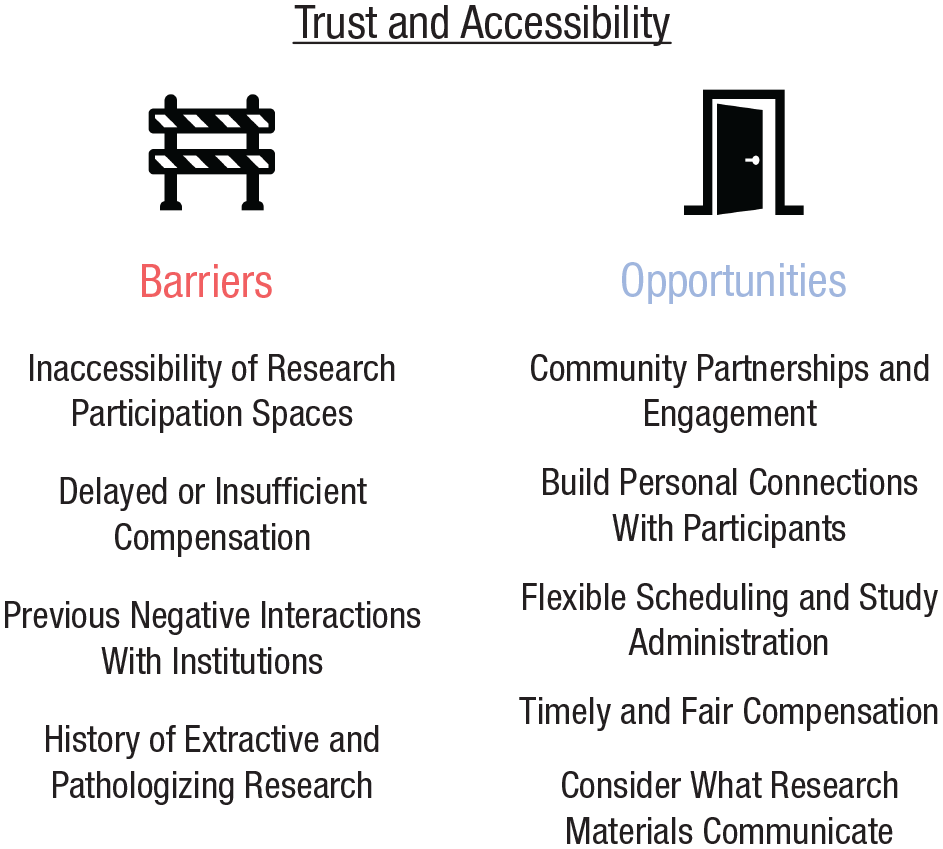
Summary of barriers and opportunities related to trust and accessibility with lower-socioeconomic-status (SES) samples. This list is nonexhaustive and is meant as a starting point for considering the factors that are critical for increasing representation of lower-SES participants in psychological research.
The strategies we present are meant to serve as a useful, if not exhaustive, resource for researchers—whether they are (a) completely new to working with lower-SES participants or have extensive histories of working with them, (b) seeking to recruit exclusively lower-SES participants or just increase the amount of SES diversity in their samples, (c) asking SES-related research questions or just aiming to recruit more inclusive samples, or (d) looking for strategies that are relatively easy to implement or are open to foundational changes in how they approach research.
Throughout the article, we use the terms “lower-SES participants” or “lower-SES individuals” to refer to individuals navigating environments in which they have relatively limited access to economic resources and/or in which they are afforded relatively low status in society as a factor of their economic circumstances. We do not see SES as an essential part of any individual but, rather, as a powerful set of external factors that shapes a person’s lived reality and consequent psychological tendencies (see Antonoplis, 2022; Stephens et al., in press). In the article, we occasionally contrast work with lower-SES participants and communities against more traditional samples of college students. Samples of college students can (and often do) include a proportion of students from lower-SES backgrounds (e.g., first-generation/low-income students); however, these samples typically skew strongly toward students from higher-SES backgrounds (e.g., continuing-generation/high-income students).
Although in this article we focus on SES specifically, the experiences, outcomes, and considerations that people associate with their SES often closely intertwine with other social identities, including their gender, race, sexual orientation, and immigration status (to name just a few). These identities are not randomly distributed across SES contexts; thus, in addition to the recommendations here, we suggest that people working with lower-SES participants consider how SES may intersect with important social identities (see Cole, 2009) and how the practices laid out in the following sections are related to other best practices for working with participants who have identities that are more likely to be represented among lower-SES individuals (e.g., racially minoritized people, Yancey et al., 2006; transgender people, Staples et al., 2018; members of a multigenerational household, Pilkauskas et al., 2020).
The Importance of Trust in Lower-SES Contexts
People are asked to place a great deal of trust in researchers when they agree to participate in research. They trust that researchers will compensate them appropriately, protect their privacy, represent the data collected from them fairly, and treat them with dignity and respect. Yet scientific research in lower-SES communities has a troubled history that can undermine this trust. Research conducted with lower-SES individuals, particularly lower-SES people of color, has been marked by unethical, extractive, and pathologizing practices (Silverman, Rosario, et al., 2023). Examples range from research painting individuals in lower-SES contexts as cognitively deficient compared with people in higher-SES contexts to the Tuskegee Syphilis Study, in which researchers actively withheld 4 decades of treatment from impoverished Black men while observing the progress of the disease as it debilitated and killed them and their families (Brandt, 1978; McDermott & Vossoughi, 2020; Valencia, 1997).
Even if members of lower-SES communities are unaware of these histories, there are still many reasons they may not experience the same levels of trust in unknown others and impersonal research institutions as people in higher-SES communities. In many contexts across the world, unguarded trust in impersonal institutions and unknown others leaves people vulnerable to harm or exploitation (Yamagishi & Hashimoto, 2016). Indeed, people in lower-SES contexts are generally less trusting than people in higher-SES contexts of people they do not personally know (Kim et al., 2022; Navarro-Carrillo et al., 2018). This discrepancy is particularly apparent in lower-SES individuals’ interactions with formal institutions, such as when interacting with doctors, police officers, or teachers (Lareau & Calarco, 2012). Although these lower levels of trust partly stem from the greater vulnerability of holding lower-SES standing, they also stem from a history of interactions with formal institutions in which lower-SES individuals are taken advantage of, afforded less dignity and respect, face more discrimination, and experience worse outcomes than higher-SES individuals. As a result, lower-SES individuals may be understandably wary of scientific research, and researchers must actively create opportunities to build trust with lower-SES participants (e.g., Blumenthal et al., 1995; Mendelson et al., 2021; Nicholson et al., 2011; Patel et al., 2003; Shavers et al., 2002). Moreover, as researchers build trust with lower-SES participants, they must also create accessible studies to recruit, retain, and work effectively with lower-SES participants.
The Importance of Accessibility in Lower-SES Contexts
The choices made in recruiting participants and conducting research can and frequently do disproportionately favor higher-SES participants. That is, these choices make research more accessible for higher-SES participants—they increase the likelihood that higher-SES individuals both want to and can participate in research. Research becomes accessible across SES when everyone has a true and fair chance to participate regardless of their economic status or positioning.
Consider a typical research study in your field. Where is the study most likely to take place? Do participants need to travel to the research site? How and to whom are studies most commonly advertised? If community partnerships are involved, how are those connections created? Psychological research is often conducted where researchers are located—on university campuses, clinics, or academic medical centers. These sites are readily accessible to higher-SES individuals but require greater travel time and distance for many lower-SES individuals (Bozick, 2008; Frenette, 2004). Traveling to research sites may also be more challenging in general for lower-SES participants because they are less likely to own a car or to have consistent access to one (Brown, 2017; Klein & Smart, 2017) and often have less access to reliable public transportation (White, 2015). Moreover, they are more likely to have jobs with unpredictable and inflexible hours (Mills, 2004; Pew Research Center, 2017; Schneider & Harknett, 2019) and have less access to formal child care (Carrillo et al., 2017; Center for American Progress, 2019). This greater travel time also typically means they will incur greater costs and are more likely to be traveling to unfamiliar neighborhoods.
One clear solution is to bring research to lower-SES participants. As we elaborate on below, this is a good strategy when done thoughtfully but still includes potential challenges and pitfalls. A common way that people in the field may increase the accessibility of their studies is by moving their research online, especially if they lack the resources to conduct intensive community-based work. Yet online research is subject to some of the same recruiting barriers of in-person research (e.g., time constraints) and introduces additional technological barriers (e.g., access to computers, Internet, online banking). Some researchers may hesitate to use websites such as MTurk and Prolific because they are increasingly filled with bots and professional participants. And for some researchers (e.g., people doing physiological work), conducting a study online is not possible.
Moreover, moving research online does not guarantee a more socioeconomically diverse sample. In all of the authors’ experiences, recruiting a set number of lower-SES participants online requires much more time than recruiting the same number of higher-SES participants. This is because of the relatively higher base rate of higher-SES participants in online samples and because higher-SES participants often complete studies more quickly. Thus, unless researchers intentionally recruit a sample of lower-SES participants, online samples can skew toward higher-SES participants. Overall, “business-as-usual” research strategies present accessibility barriers that contribute to underrepresentation of lower-SES participants.
Building trust and accessibility is key to increasing representation of lower-SES participants in research. Although long-term structural change in how researchers recruit and work with participants is the best solution to address this underrepresentation, there are meaningful individual-level changes that researchers can adopt to help produce more socioeconomically diverse research. Below, we issue specific recommendations that researchers can incorporate to help build trust and accessibility among lower-SES participants. Trust and accessibility are mutually related; many (but not all) of our recommendations may speak to both. Thus, our recommendations have overlap in how they contribute to these key considerations for conducting research with lower-SES participants. For an illustration of how researchers can build both trust and accessibility into each stage of the research process and beyond, see Figure 2.

Steps in the research process in which researchers can build trust and accessibility. We elaborate on each of these points throughout the article.
Opportunities to Build Trust
Establishing trust requires researchers to think critically about default research practices in the field and to be thoughtful about the needs, input, and goals of lower-SES individuals and communities. The process of establishing trust starts well before researchers begin collecting data and extends beyond the time of participation.
Create personal connections with participants and communities
Community engagement
Lower-SES contexts in the United States often give rise to more relational trust (Carey & Markus, 2017; Granovetter, 1973). That is, when people in lower-SES contexts express trust, it is more likely to be in people they know personally (Hamamura, 2012; Navarro-Carrillo et al., 2018). Thus, researchers can increase trust by building relationships and personal connections with participants. For instance, researchers may volunteer at community centers and schools or attend neighborhood events. Such face-to-face engagement not only provides researchers with the opportunity to get to know a community but also allows community members to get to know researchers.
Indeed, partnerships with relevant communities and organizations, including mutualistic partnerships, are an especially effective method of building trust with lower-SES participants. We use the term “mutualistic partnerships” to refer to a range of partnership methods that are defined by close collaboration between researchers and community members to identify and carry out research projects that are relevant to the community’s strengths, needs, experiences, and interests. These methods were in large part developed within public health and community and educational psychology to bridge divides between research and practice (Coburn et al., 2021; Collins et al., 2018; Gebbie et al., 2003). Related ideas about partnership have also emerged from counseling psychology to emphasize the importance of engaging deeply with the voices of community members for advancing social justice (e.g., Goodman et al., 2004). Although different methods of mutualistic partnership have been developed in recent years—including community-based participatory research and research-practice partnerships—these methods broadly aim to make the most of the expertise and experiences of both researchers and community members through positioning both parties as equal contributors throughout the research process (see Cacari-Stone et al., 2014; Penuel & Gallagher, 2017). As a result, mutualistic partnerships are an important tool for creating trust, particularly when it comes to participant recruitment. Although it is beyond the scope of the current article to fully describe how to create mutualistic or related partnerships (for additional references across disciplines, see Coburn et al., 2021; Green & Mercer, 2001; Hacker, 2013; Henrick et al., 2017; Wallerstein et al., 2017), we have a few concrete recommendations.
To reap the benefits of a mutualistic partnership, you must think critically about what partnerships to pursue. Given that research partnerships are often established through researchers’ personal connections, common methods of working with outside groups may favor higher-SES settings. Instead, identifying potential community partners is often as simple as conducting an Internet search for relevant organizations (e.g., community organizations, schools) and reaching out to them. It is important to be patient waiting on a response from these organizations, which are often overburdened and rely on volunteers. Partners may also be identified at relevant convenings, such as nonprofit conferences and town halls, or with the help of other individuals who are embedded in the community’s surrounding areas.
In initial interactions with the potential partnership organization, you should focus on whether and how the partnership benefits the organization’s goals or needs. For example, one of the authors has convened informal meetings with teachers, principals, and other community members to learn more about how different education-based research projects may or may not fit with the community’s goals and infrastructure. This step is applicable outside of education—many community organizations are inundated with demands from researchers, policymakers, and community members. Approaching these organizations from a standpoint of wanting to learn about the community’s needs, strengths, and goals opens researchers’ eyes to considerations that they may not have been previously aware of while ensuring that the researchers are not simply piling another request on the community. Just as researchers must be sensitive to potential partners’ time and resources, researchers should also be protective of their own effort. Given the challenge of sustaining a strong partnership (Farrell et al., 2019), you should carefully evaluate whether an organization has the necessary resources and interest to invest in your joint work before initiating a project. In our experiences, the major barrier to finding a partner organization is not a lack of interest but a lack of time and resources (Viswanathan et al., 2004). Thus, researchers should seek opportunities to alleviate these barriers in the early stages of a partnership, such as through applying for grant funding to compensate partners for their time. Once an initial relationship with a partner has been established, you can begin the work of cocreating research and building trust together among potential participants.
These partnerships require time and effort to create and maintain, and researchers do not have to do so alone. Often, multiple research teams at a given university are working independently within similar communities, inadvertently duplicating each other’s work. The university could help to identify research teams that would benefit from working together. For example, the Institutional Review Board (IRB) office might be able to identify researchers who could team up in their recruitment and partnership efforts.
Beyond pairing up teams of researchers, universities can also help with outreach itself. Many universities have strained relationships with their immediate or nearby communities, and local communities may understandably mistrust the university. Many of these universities are also attempting outreach efforts to communities and community stakeholders, but these typically do not involve research. It may be fruitful to discuss with university staff how to involve researchers in these efforts and to highlight how university research and resources might benefit the broader community.
Personalizing
In addition to community engagement, you can build trust through personalizing—associating research activities with real, named individuals, typically people who are part of the study team. Researchers personalize their recruitment and retention efforts when they deemphasize the research institution and emphasize the researchers. Minimizing use of the institution’s name can fly in the face of common practice. Not only do IRBs usually require this information on recruiting materials, researchers frequently believe that university logos and institutional information lend legitimacy to their research. And certainly, they do—among individuals and communities who trust these institutions in the first place or among whom the university name builds credibility (Baum et al., 2013; Hudson, 2006; Jury et al., 2017). However, a university’s name can arouse suspicion or concern just as easily as it arouses respect and trust. Researchers should consult with community members or individuals with experience in the community to understand how their university is perceived. For example, in a conversation with a nonprofit leader in a local lower-SES community, one of the authors brought up the topic of how the community perceives the university. While discussing whether using the university name would aid in recruitment, the nonprofit leader responded with a resounding “hell no.”
If the university name has negative associations in a community, researchers can instead feature the name of their study and a project logo. Moreover, researchers can personalize their recruitment materials. Study advertisements and communications can include a specific name to contact (e.g., “Call Emma for more information”), and emails can be signed with the person’s name rather than the name of the lab. We have also used study advertisements that include pictures of the principal investigator and lab members, rather than simply a list of names, so that participants felt like participating in the studies involved working with other people rather than a faceless institution (for an example flyer, see the Supplemental Material).
There are many points in the research process when diversity and representation on the research team matters; this is one of them. Representation will help to build trust among participants if people from their communities are involved in initial recruitment and communication. Consider not just SES background but also other intersecting identities that participants may hold (e.g., race, gender, sexual orientation) and the importance of seeing themselves represented on the research team as part of building trust, especially for identities that may be more visible than SES or SES background.
Compensate participants fairly, promptly, and frequently
Trust is deeply tied to how and when researchers pay their participants. Participants will place more trust in researchers if they are confident they will be fairly and fully compensated for their time and effort.
Fair compensation
When deciding on compensation, researchers may face challenging questions about what is fair and what is coercive. Researchers’ intuitions may be that lower-SES participants are primarily motivated by financial incentives and if offered greater incentives, may be more likely to participate in research when they otherwise would not have. Although finances are not always a central motivation for these participants (e.g., Gross et al., 2001), they are a key reason behind the IRB’s regulations about “undue influence” in financial compensation (e.g., U.S. Food and Drug Administration, 2018). Undue influence, according to the Belmont Report, “occurs through an offer of an excessive, unwarranted, inappropriate or improper reward or other overture in order to obtain compliance,” especially among vulnerable populations (National Commission for the Protection of Human Subjects of Biomedical and Behavioral Research, 1979). In other words, the concern tends to be focused on the risks of overpaying participants.
However, medical- and legal-ethics scholars have argued that this focus can represent a form of research exceptionalism—the notion that research is fundamentally different from other contexts in which people are paid (Largent & Lynch, 2017). These scholars suggested that many IRBs focus more on the risks of overpaying participants than on the risk of underpaying them, a stance that they categorized as “unacceptably paternalistic” and argued that “it is backward to think that protecting them requires paying less in light of their poverty; ideally, the response should be to pay them more” (Largent & Lynch, 2017, p. 40). That is, when a person has fewer financial resources, it is even more important to pay them fairly for their labor, and the concern about whether lower-SES participants are paid enough has not received nearly as much attention.
What counts as fair compensation can depend on several factors and should take into account the cost of living in an area. One way in which researchers may inadvertently underpay participants and undermine their trust is by underestimating the amount of time it takes to complete a study. In our experience, lower-SES participants, on average, take longer than higher-SES participants to complete surveys. To assure you are providing fair compensation, you should pilot test your study materials with lower-SES participants so that if you are offering, say, $15 for a 30-min survey, you can be confident that the survey will actually take no longer than 30 min. As we discuss in greater depth below, this also provides an opportunity to ensure that your survey makes sense to your participants; a questionnaire filled with jargon will take longer to complete and be more difficult for both lower- and higher-SES participants to understand.
Prompt and frequent compensation
Payment in longitudinal studies introduces another challenge to trust among lower-SES participants. IRB guidelines vary across universities about how frequently to pay people; some institutions may permit most of the payment at the end of the study or suggest payment every few sessions, whereas some may require payment after every portion of the study participants complete. Regardless of what a given institution will allow, any approach that does not pay participants after every wave of the study will likely backfire when working with lower-SES participants because it relies on a tremendous amount of trust in the researchers. How can participants be sure that they will actually receive their payment after completing multiple portions of the study? Why should participants be motivated to remain in the study if they will not receive compensation for weeks or months when they could use the money now? You can build trust among lower-SES participants by providing fair compensation after each wave of the study, which will demonstrate that participants can expect to be paid for their work. Researchers can provide a larger bonus payment at the end for completing all follow-ups or a high percentage of follow-ups, but participants should be paid for their time and effort after each survey they complete.
Relatedly, researchers can create trust by paying lower-SES participants as quickly as possible. Payment reliability is a form of responsiveness. Having a responsive partner builds trust in close relationships—and an unresponsive partner can undermine it (Reis & Clark, 2013). How can participants trust researchers if they have to wait months to receive their payment or if they must repeatedly contact the researchers to receive their payment? In the same way that the historical emphasis and value that institutions have placed on higher-SES individuals may lead them to trust that they will ultimately receive their payment, the historical devaluing of lower-SES individuals may make it challenging for them to share this trust. Paying participants promptly is not sufficient alone to earn their trust; but not paying them will easily lose it.
Giving back to communities
Finally, although fair and prompt financial compensation is essential, researchers can compensate participants and their communities in additional ways that help build trust. For example, researchers can host outreach events like science-themed family fun days, give family-relevant gifts like children’s books, or share the results of their research with participants (e.g., via newsletters or presentations) and highlight the important role they played in it. Furthermore, they can help with fundraising and grant writing or could join community boards. Researchers should ask communities what specifically they would benefit from so that they can ensure what they are giving is something that actually benefits the community. These ways of giving back should be in addition to (but not in replacement of) money.
Consider How Participants Will View Your Research
Throughout the research process—whether in the early stages of forming a new research question or when putting the finishing touches on a manuscript—most researchers think about how their peers, journal editors, and Reviewer 2 will view their ideas and research designs. Researchers much more rarely consider what their participants will think. And yet, building trust with participants requires researchers to consider critically what their studies communicate to participants. Consider a survey that asks only lower-SES participants how often they consume fast food in the context of a study on health inequalities. The survey does not ask them whether they can afford fresh food, whether there is a grocery store in their neighborhood, whether other people place demands on the time they would spend cooking, or even whether consuming fast food is their personal preference. As a result, participants may view the research as ignorant to their realities and place less trust in the research.
There is a spectrum of assumptions that can enter into surveys, and participants can pick up on them. For example, when deficit-based thinking filters into study designs, research questions frame lower-SES individuals as “lacking” in some way, such as agency, valuable skills, work ethic, or appropriate cultural practices (McDermott & Vossoughi, 2020). This thinking results in a narrow focus on measuring how lower-SES individuals compare with higher-SES individuals, often on measures that are tailored for use with higher-SES participants, rather than considering the breadth of lower-SES individuals’ experiences, strengths, and structural challenges. At the opposite end of the spectrum, assumptions that focus only on strengths can also convey ignorance. A survey that asks lower-SES participants only about their individual ability to overcome obstacles does not afford them the same level of dignity and humanity as other people because it conveys a narrative about a “mythic superhuman capacity” to overcome challenges while overlooking lower-SES individuals’ other experiences, strengths, and challenges (Silverman, Rosario, et al., 2023). Just as deficit-based thinking may signal disrespect, judgment, or ignorance, an overly rosy view of lower-SES individuals’ experiences may convey that the researchers are oblivious to their realities or not invested in research that seeks to dismantle the barriers that lower-SES individuals face.
To address these potential pitfalls, we recommend that researchers take concrete steps to examine the influence of underlying assumptions on their research designs and adapt their materials in ways that generate trust with lower-SES participants. Ideally, you should incorporate practices that capture a broad array of lower-SES participants’ experiences. Qualitative and mixed-methods data collection—including focus groups, semistructured interviews with community members, and naturalistic observations—are especially useful tools toward this end. Beyond offering more nuanced descriptions of participants’ experiences that benefit researchers’ engagement with lower-SES individuals and communities, qualitative data offer “meaning” to participants’ quantitative responses (e.g., Manning & Kunkel, 2014). This meaning helps researchers to contextualize their findings in lower-SES individuals’ realities and to avoid biasing their interpretation of results through imposing narratives on their participants.
We have employed a wide range of qualitative-data techniques throughout our projects. Ideally, researchers have opportunities to conduct in-depth interviews with lower-SES individuals before, during, and after a study to ensure that each step of the research process is guided by direct insights from relevant populations. Cognitive-interviewing techniques—in which you request verbal or, in some cases, written input from participants on your measures directly—are especially helpful for avoiding common narratives about lower-SES individuals in your research (Beatty & Willis, 2007). More generally, conducting interviews during the data-collection and data-analysis phases of a study can also help ensure that your work aligns with the experiences and interests of your participants. For example, on the basis of the input that school community members shared in semistructured interviews, one of the authors recently developed measures that asked students from lower-SES backgrounds about the unique skills and perspectives they bring to the world. In response to these measures, a lower-SES student said, “I like that the [survey] questions ask about my strengths and stuff. I feel like I didn’t get asked about that before.” To earn participants’ trust, it is important to convey an accurate understanding of the range of their experiences and to enable them to make their opinions heard.
Conducting and analyzing interview data properly can be time- and resource-intensive, however. Thus, you may instead turn toward less involved qualitative-data approaches—although researchers must still engage thoroughly with individuals’ responses to translate them into opportunities to build trust in a research project. For instance, at the end of our surveys, we include open-ended questions that allow participants to share insights that the measures in the study did not capture (e.g., asking participants what else they think you should know). This method not only demonstrates that your research considers the voices of lower-SES participants but also centers participants as experts on their experiences and perspectives (McGrath & Johnson, 2003). Regardless of the exact form, collecting qualitative data is a necessary part of acknowledging and valuing the expertise that lower-SES individuals bring to your research and, consequently, an essential step toward building trust.
Considering how participants view your research applies in its early stages and in the sorts of questions you ask, but it also applies to later stages as researchers wrap up their projects. In a meeting with an administrator at a high school serving primarily lower-SES students of color, one of the authors was told that the school was hesitant to participate in research projects because of past experiences with researchers who used the school’s time and resources to collect data that were, in turn, never shared with the school. In this case, another researcher’s lack of communication and extractive research practices created a sense of mistrust and limited opportunities for future work. If researchers take up time and resources in lower-SES communities, and especially if they promise to deliver anything back to those communities, it is imperative to follow through once the research has concluded. Otherwise, participants will feel exploited and lose trust in future research.
Taken together, these approaches discussed so far can help to build trust. However, in and of itself, trust is not enough to ensure that you can effectively recruit, retain, and work with lower-SES participants. Thus, we now turn to recommendations for building accessibility into your research projects.
Opportunities to Build Accessibility
Lower-SES participants are often underrepresented in part because research is not designed to be accessible to them. Conducting research that is accessible to lower-SES participants requires researchers to think critically about how to adapt common practices within the field to work with a population that is frequently not the focus of psychological research. We suggest that you can build accessibility by recruiting in lower-SES communities, tailoring your study administration to participants’ specific circumstances, and being clear and flexible in payment.
Recruit in participants’ own communities
Where and how researchers recruit can be an early barrier to recruiting lower-SES participants. When recruiting participants, researchers often post flyers and advertisements in locations near the university. However, given that most universities are located near relatively affluent communities, this strategy is less likely to reach lower-SES participants; thus, researchers need to advertise outside of convenient locales. Particularly, researchers should target lower-SES neighborhoods, especially locations potential participants are likely to visit, such as grocery stores, public libraries, laundromats, and churches (with permission from the location). Craigslist is also an effective online tool for reaching lower-SES participants; many people who do not know what Prolific is, for example, use Craigslist to find opportunities to supplement their income. Social media sites, such as Facebook, are also promising avenues for recruitment via specific Facebook groups or targeted advertising.
But researchers do not have to work alone to recruit lower-SES participants. As discussed earlier, researchers can form mutualistic partnerships. Rather than defaulting to typical recruitment practices that are not tailored to lower-SES communities, mutualistic partnerships encourage researchers to listen to the expertise of community members to identify particularly effective recruitment locations (e.g., community centers) and outreach methods (e.g., group chats). These partnerships provide researchers opportunities to form relationships with community members and to access social networks that enable snowball sampling and increase retention (Parker et al., 2019).
Tailor study administration to participants’ circumstances
Once you have recruited your participants, you should be flexible in when, where, and how they participate in your study. This flexibility will make it more likely that lower-SES participants will be able to participate in your study and more likely that they will remain in it once you have recruited them.
Scheduling
The design of the study should feature flexible scheduling because time constraints are often a major challenge to retaining lower-SES participants. For example, in a sample of low-income parents, the top two reasons participants gave for dropping out of the study were lacking time or having scheduling conflicts (Gross et al., 2001). This flexibility is doubly important in studies focused on more than one participant at a time, such as couples or families. Researchers should offer participation times both within 9-to-5 hours (for participants working night shifts) and in the evenings and on weekends. This greater flexibility in scheduling will, in all likelihood, introduce some noise into your study methods and timeline; we urge reviewers and journal editors to account for the greater flexibility needed for research in these communities.
Participant tracking
When conducting longitudinal studies, more information than typical is often necessary to keep track of lower-SES participants, who tend to move residences more frequently, are less likely to own a cell phone, and are less likely to have access to an Internet-enabled computer (Clark, 2018; Pew Research Center, 2021). Lower-SES individuals are also more likely to experience cell-phone service disruptions (e.g., being unable to buy minutes in a given month), use no-contract plans, or share phones with family or friends (Gonzales, 2014)—consequently, their cell-phone contact information may change more frequently. Researchers should collect multiple means of contacting participants—a participant’s own phone number, email address, and address and contact information of someone who would know how to reach them.
Study location and administration
Researchers can also make their studies more accessible by considering where to conduct them. In-person research should ideally not take place in the researcher’s own lab space or university clinic (although this may not be an option for researchers who need access to specialized equipment). If possible, researchers should conduct in-person components of their studies at participants’ homes, schools, or other community locations, such as reserving space in a local library. Within clinical psychology, home-based treatments are linked with higher retention rates, even with difficult-to-retain populations (Henggeler, 2011); data collection for these treatment trials also takes place in the home.
Homes or community locations can be ideal sites for research among lower-SES participants for several reasons. First, many participants are more comfortable in their homes, especially if they can choose where in their home to conduct the study. Second, having researchers travel to participants reduces the time and financial burden to the participants, instead placing that burden on researchers. Third, lower-SES participants in particular may be more likely to experience discomfort in a university lab space, which can affect the results of research. Thus, this approach not only increases accessibility to lower-SES participants but also may improve data quality.
However, there are some key caveats to this approach. First, researchers need to plan for alternatives in case participants are not comfortable having strangers in their homes. In a socioeconomically diverse community sample that one of the authors recently collected, 5.6% of participants were not comfortable with researchers in their homes and preferred an alternative location. Second, the research team needs to be trained to treat participants with respect and dignity in the context of being in their homes. For example, team members should be sensitized to potential microaggressions, such as seemingly benign situational comments (e.g., “What a nice home you have”) that could indicate surprise or judgment. In addition to these general caveats, we also emphasize that it is important to create conditions of safety for both researchers and participants. We recommend sending researchers in teams so that they are not going alone to strangers’ homes and so that the participants are never left alone with a single researcher.
Finally, flexibility in how the study is administered can also create accessibility. Many psychology measures have been developed and validated with college-student samples; thus, these measures may include language that is less accessible to lower-SES participants. It is important to pretest measures with lower-SES participants and determine the most effective method of administering the study. For example, some participants may benefit from alternative assessment methods to written surveys, such as teleconferencing, audio-computer assisted software (e.g., ACASI), or phone interviews. Such approaches also increase accessibility for English-as-a-second-language participants.
Be flexible and clear in payment methods
Beyond study administration, creating accessibility in your study requires flexibility in how you pay participants. Researchers have a range of options when considering how to pay participants—common methods include Amazon gift cards, prepaid Visa cards, online Visa cards, and cash. Amazon gift cards may be easiest for the researcher, but they are often not optimal for lower-SES participants. People in lower-SES contexts are less likely to use Amazon than other large outlets such as Walmart (Hansbury, 2020), and given that they may have less reliable Internet access (Pew Research Center, 2021), they often prefer physical payments to online gift cards. In fact, in one author’s recent study in which participants were given multiple payment options, lower-SES participants were more than twice as likely to request a prepaid physical card compared with the higher-SES participants. Offering multiple payment options may require working with your university. Many universities do not, by default, allow cash payments, or if they do, they require large hurdles, such as providing an approved list of participant names in advance, and have complex rules around cash advances. Some universities may allow checks, which take time to print and typically expire. Payments that expire are not optimal for lower-SES participants, who generally tend to cancel and reschedule appointments more frequently (see e.g., Darrat et al., 2021), and checks are not an accessible payment method for people without a bank account. If possible, work with your university to approve straightforward cash payments as an option and ask participants what payment method they prefer. In addition to offering as many payment options as possible, researchers should ensure that the means of accessing them are clear. For example, if you issue prepaid or online Visa cards, it should be clear to participants how to activate them. This clarity also reinforces trust; if participants find it difficult to access their payments, they will lose trust in the research team. Once again, trust and accessibility often go hand in hand.
Future Directions: Structural Change
In this article, we have largely focused on individual changes that researchers can implement. However, implementing these individual changes ultimately requires long-term, structural change. We join conversations that other researchers have already begun (e.g., Nzinga et al., 2018; Roberts et al., 2020) and offer a few thoughts about what these changes might look like at the level of universities, research labs, and the field as a whole. Universities must critically attend to how IRB practices affect recruitment of populations that have been underrepresented in research. University IRBs should engage in critical reflections of how “simple” commonplace research processes, including compensation policies, may dissuade researchers from recruiting lower-SES participants or discourage participants themselves from engaging with research. Rethinking ideas about ethical payment practices is therefore one avenue for institutional change. Research labs can increasingly implement research-methods training for working with lower-SES participants. Many researchers who might want to do this work have to learn on their own, and formal training in graduate school would mean that people have the methodological tool kit needed. Finally, the field needs to create structures that encourage people to conduct this kind of work. Given that these structures have historically been built to cater to higher-SES participants, research with lower-SES participants is generally more challenging, takes longer, and is often messier. It is crucial to recognize in the editorial process that these samples may be smaller and that the methods involved may have more noise than in more traditional higher-SES samples. It is also important for junior scholars to be able to do this work and have hiring and promotion committees understand the greater resources and difficulty involved. These are just a few starting points for a broader conversation about avenues for structural change; we hope that the field continues to discuss other sources of change so that researchers are encouraged to do meaningful work with lower-SES participants.
Conclusion
A guiding principle of the Association for Psychological Science (2022) states that “psychological science has the ability to transform society for the better and must play a central role in advancing human welfare and the public interest.” To do so, psychology research must achieve more diverse and inclusive research samples. Lower-SES samples are more difficult to recruit and retain than higher-SES samples, largely because of barriers surrounding trust and accessibility. In this article, we outlined strategies to build trust and accessibility. Critically, these opportunities begin long before recruiting your first participant. When generating research ideas and study materials, researchers can increase trust by questioning the assumptions their study might communicate to participants. Researchers can increase accessibility by recruiting in lower-SES communities and partnering with community leaders; such connections will also build trust. Clear and flexible payment methods will make the study more accessible, and paying participants fairly, promptly, and frequently are key to maintaining trust. Sharing research and giving back to community partners will maintain trust once the given study has ended.
Although broader changes within research structures are essential to promote socioeconomically representative research, these recommendations should help researchers recruit, retain, and more effectively work with lower-SES participants. Doing so is critical for a healthy psychological science and one that represents most people’s experiences. Ultimately, we hope that these recommendations not only help researchers engage effectively with lower-SES individuals in their work but also spur critical discussions of the broader changes necessary to ensure a more representative science.
Supplemental Material
sj-docx-1-amp-10.1177_25152459231193044 – Supplemental material for Conducting Research With People in Lower-Socioeconomic-Status Contexts
Supplemental material, sj-docx-1-amp-10.1177_25152459231193044 for Conducting Research With People in Lower-Socioeconomic-Status Contexts by Lydia F. Emery, David M. Silverman and Rebecca M. Carey in Advances in Methods and Practices in Psychological Science
Footnotes
Acknowledgements
We thank Eli Finkel, Courtney Jones, and Kaitlin Sheerin for helpful comments on a previous version of this article. This work was initiated while L. F. Emery was at the Kellogg School of Management at Northwestern University.
Transparency
Action Editor: David A. Sbarra
Editor: David A. Sbarra
Author Contribution(s)

References
Supplementary Material
Please find the following supplemental material available below.
For Open Access articles published under a Creative Commons License, all supplemental material carries the same license as the article it is associated with.
For non-Open Access articles published, all supplemental material carries a non-exclusive license, and permission requests for re-use of supplemental material or any part of supplemental material shall be sent directly to the copyright owner as specified in the copyright notice associated with the article.
