



Abstract
A growing number of psychological research findings are initially published as preprints. Preprints are not peer reviewed and thus did not undergo the established scientific quality-control process. Many researchers hence worry that these preprints reach nonscientists, such as practitioners, journalists, and policymakers, who might be unable to differentiate them from the peer-reviewed literature. Across five studies in Germany and the United States, we investigated whether this concern is warranted and whether this problem can be solved by providing nonscientists with a brief explanation of preprints and the peer-review process. Studies 1 and 2 showed that without an explanation, nonscientists perceive research findings published as preprints as equally credible as findings published as peer-reviewed articles. However, an explanation of the peer-review process reduces the credibility of preprints (Studies 3 and 4). In Study 5, we developed and tested a shortened version of this explanation, which we recommend adding to preprints. This explanation again allowed nonscientists to differentiate between preprints and the peer-reviewed literature. In sum, our research demonstrates that even a short explanation of the concept of preprints and their lack of peer review allows nonscientists who evaluate scientific findings to adjust their credibility perception accordingly. This would allow harvesting the benefits of preprints, such as faster and more accessible science communication, while reducing concerns about public overconfidence in the presented findings.
Scientific findings, in psychology and beyond, are rapidly becoming more open and accessible. As part of this open-science movement, preprints—that is, scientific manuscripts preceding formal peer review and publication—have gained popularity, and their number is growing exponentially (see Fig. 1). This development has been accelerated by the COVID-19 crisis, during which researchers aim to rapidly disseminate their findings instead of going through the traditional peer-review process (Kwon, 2020; Polka et al., 2021; Rahal & Heycke, 2020). Moreover, this development was facilitated by an increasing availability of preprint servers in general (e.g., OSF Preprints) but also for specific disciplines (e.g., PsyArXiv for psychological research).

Development of the number of manuscripts published per year on two major preprint servers for psychology and the social sciences since 2017. Numbers were derived by searching for available preprints on Google Scholar and filtering for each year and server.
The fact that preprints are typically not peer reviewed does not seem to be a significant barrier to their success. One reason for this may be that the peer-review process has several drawbacks. First, the peer-review process is time-consuming and contributes to a substantial delay between the discovery and the publication of research findings (Cooke et al., 2016; Huisman & Smits, 2017). Second, peer reviewers are humans, and thus their judgments can be biased and influenced by factors other than scientific quality (Helmer et al., 2017; Jukola, 2017; Okike et al., 2016). Finally, peer review may further hinder scientific progress because some reviewers oppose unconventional theories, methods, and practices, such as publishing nonsignificant findings or failed replications (Eisenhart, 2002; Elson et al., 2020; French, 2012; Olson et al., 2002). For these reasons, some scholars even argue that peer review is a deeply flawed process and should be abolished (Heesen & Bright, 2021; Smith, 2006).
Nevertheless, peer review is currently the established standard quality-control process for scientific publications (e.g., Elson et al., 2020; Nosek & Bar-Anan, 2012). Indeed, there is empirical evidence that peer-reviewed manuscripts have a higher quality of reporting compared with their non-peer-reviewed version (Carneiro et al., 2019; Cobo et al., 2011; Goodman et al., 1994). Moreover, various studies have shown that peer reviewers usually detect some errors in manuscripts (Godlee et al., 1998; Okike et al., 2016; Schroter et al., 2004). Hence, researchers across disciplines consider peer review as a guiding principle on which work they read and cite. For example, a large international survey found that scientists considered peer review as the most significant factor for determining the quality and trustworthiness of research (Tenopir et al., 2016), and most scientists emphasize that it is important that preprints are ultimately submitted to a peer-reviewed journal (Soderberg et al., 2020).
However, preprints are not available only to scientists (who, in general, can be assumed to know that preprints are not peer reviewed). Instead, because preprints typically are published in open access, they are also openly available to the general public, who might not be aware that preprints are usually not peer reviewed. In fact, especially during the COVID-19 crisis, many preprints became part of the public discourse through traditional and social media (Fraser et al., 2021). For example, a now-retracted preprint that described an “uncanny similarity” between SARS-CoV-2 and HIV spurred discussion on social media on whether SARS-CoV-2 is a genetically engineered bioweapon (Koerber, 2021), which later became one of the leading coronavirus-related conspiracy theories (Imhoff & Lamberty, 2020). Presumably because of this incident, the preprint server bioRxiv, who provided this questionable preprint, added a warning to their website that preprints are preliminary, non-peer-reviewed reports (Forster, 2020). In another example, a preprint on the SARS-CoV-2 viral load in children was disparaged on the title page of the largest German newspaper (Niggemeier, 2020). The newspaper, however, ignored that the work was a preprint and heavily criticized some preliminary analyses. This public debate over a preprint might have damaged trust in science in Germany (Lindner, 2020), which could have had serious consequences for the adherence and adoption of recommended protective behaviors (Dohle et al., 2020). These examples illustrate what many researchers fear: members of the general public treating non-peer-reviewed preprints as established evidence, leading to ill-advised decisions and potentially damaging public trust in science (Fox, 2018; Heimstädt, 2020; Rahal & Heycke, 2020; Sheldon, 2018).
This concern about preprints, which has been described as the most frequent argument against them (Vazire, 2020), goes beyond COVID-19-related research and is highly relevant for all research findings of public interest. Indeed, media outlets and public-science communication blogs also cover preprints on psychological topics such as climate change anxiety (Chow, 2021), personality (Adam, 2019), or even the trustworthiness of psychological research as a whole (Chivers, 2020). Preprints in psychology may be especially likely to catch the public eye because they deal with questions related to human behavior and society. It thus seems likely that some nonscientists even directly seek out psychological preprints because they often address topics highly relevant to their lives.
The central assumption underlying concerns about the public availability of preprints is that nonscientists fail to differentiate between preprints and peer-reviewed literature and thus treat them as equally credible sources. However, this assumption currently lacks empirical evidence. Because preprints are often presented with no or very little accompanying information (e.g., simply stating that the results stem from a preprint), we believe that in such a situation, nonscientists will indeed fail to incorporate this information in their credibility judgment. This is because they lack the necessary background knowledge that preprints are not peer reviewed. We hypothesize that without an additional explanation of preprints and their lack of peer review, people will perceive research findings from preprints as equally credible compared with research findings from the peer-reviewed literature (Hypothesis 1).
However, recent research suggests that even very brief explanations (e.g., warning labels) allow nonscientists to adjust their credibility ratings (Koch et al., 2021), even for complex scientific topics (Anvari & Lakens, 2018; Hendriks et al., 2020; Wingen et al., 2020). If such a brief explanation of preprints includes that they are not peer reviewed and thus did not undergo the established standard quality-control process for psychological publications, nonscientists might perceive preprints as less credible. Emphasizing increased quality control, for example through consumer reviews or quality-management systems (Adena et al., 2019; Boiral, 2012; Resnick et al., 2006; Silva & Topolinski, 2018), and highlighting adherence to community norms and standards (Bachmann & Inkpen, 2011; Blanchard et al., 2011; Wenegrat et al., 1996) are linked to increased credibility and trustworthiness. We thus hypothesize that after receiving an explanation of preprints and their lack of peer review, nonscientists would perceive preprints as less credible than peer-reviewed articles (Hypothesis 2).
Overview of Studies
We conducted five experimental studies to test whether nonscientists perceive preprints as less credible than peer-reviewed literature and whether this depends on whether they receive an explanation of the peer-review process. We focused on preprints covering research findings from psychology and the social sciences because they seem particularly likely to be comprehensible and interesting to the general public. In the pilot study, we explored whether preprints in psychology and the social sciences typically provide an explanation of preprints and the peer-review process. We coded 200 recent preprints and examined whether they sufficiently explain their lack of peer review. Study 1 (German sample) and Study 2 (U.S. sample) tested whether nonscientists would be able to differentiate between peer-reviewed literature and preprints without an explanation of preprints and the peer-review process. Study 3 (within-subjects design) and Study 4 (between-subjects design) tested whether nonscientists would perceive preprints as less credible than peer-reviewed articles after receiving an explanation of preprints and their lack of peer review. Finally, in Study 5, we developed a shortened version of this explanation and tested whether this very brief explanation allowed nonscientists to differentiate between preprints and peer-reviewed literature. We, moreover, cross-sectionally explored how this explanation may work (mediation) and whether the effect of this explanation depends on education and familiarity with the publication process (moderation).
Preregistration
Studies 1 to 5 and the Supplemental Study 1 are preregistered. All preregistration forms are shared on the OSF (https://osf.io/egkpb). The pilot study, which focused on coding existing data, was not preregistered.
Data, materials, and online resources
All materials, anonymized data sets, and analyses code are shared on the OSF. Statistical analyses were conducted using R (Version 4.0.4; R Development Core Team, 2021), and for the main analyses, we relied on the packages effsize (Torchiano, 2020), lavaan (Rosseel, 2012), psych (Revelle, 2021), pwr (Champely et al., 2018), yarrr (Phillips, 2017), and TOSTER (Lakens, 2017). Details regarding our recruitment strategy and regarding one additional study (see Reporting section) are reported in the Supplemental Material available online.
Reporting
For each study, we report how we determined our sample size, all data exclusions, all manipulations, and all measures in the study.
The studies are numbered 1 through 5 for narrative style. Chronologically, the studies were run in the following order: 3, 4, 1, 5, 2. Coding for the pilot study was completed shortly after Study 3. We conducted one further study before Study 5. We found that this study likely contains a high percentage of inattentive respondents (for details, see the Supplemental Material available online), which render the obtained null results largely uninterpretable. We thus refrain from discussing this study in the main text, but to increase transparency, we provide details about this study in the Supplemental Material available online and on the OSF. All analyses with a preregistered hypothesis were tested with one-sided p values. In all studies in which we predicted the absence of an effect, we relied on equivalence tests with preregistered equivalence bounds. This is a commonly recommended frequentist method to provide evidence for the absence of a meaningful effect (Lakens, 2017; Lakens et al., 2018).
All participants who completed our studies were included in the analyses unless they met preregistered exclusion criteria or did not respond to our central dependent variable (i.e., perceived credibility, not explicitly preregistered). Participants were blocked from participating in more than one study to avoid nonnaïveté (Chandler et al., 2015). Sample sizes were preregistered in Studies 1 to 5; however, some deviations occurred because we recruited participants online and thus had limited control over the final sample size (for details regarding sample sizes and deviations, see the Supplemental Material available online). However, in no case was the final sample size determined based on the obtained results.
Ethical approval
All studies were conducted consistently with the Declaration of Helsinki, and all are exempt from institutional review board approval by guidelines of the German Psychological Society (2018).
Pilot Study
Method
For the pilot study, we collected the information presented in the 303 most recent manuscripts (at the time of coding; June 2020) on two popular social science preprint servers, commonly used by psychological scientists. These servers were PsyArXiv (https://psyarxiv.com) and the social and behavioral sciences section at OSF Preprints (https://osf.io/preprints). We first collected general bibliographic information (authors, publication date, language, doi, whether the manuscript was a postprint). We excluded 63 manuscripts from our analyses because they appeared to be accepted versions of articles (postprints) and thus peer reviewed, thereby not meeting our definition of preprints. We furthermore excluded 33 non-English preprints and, finally, seven documents that were not preprints (e.g., supplemental materials, book chapter scans).
Given these necessary exclusions, the coders continued coding (by going back further in time and coding earlier preprints) until eventually 200 suitable manuscripts (100 from each server) were included. We coded whether the authors of the preprint (a) mentioned that it is a preprint, (b) mentioned that it is thus not peer reviewed, (c) explained that peer review serves as a quality-control process, (d) explained that peer review is the standard procedure for scientific publication, (e) and/or added another indication that the findings might be preliminary or less credible.
Results
The results showed that only 27.50% of the preprints explicitly stated that they were preprints. Even fewer preprints (15.50%) contained information that they had not undergone peer review yet. Finally, not a single preprint provided information explaining that peer review serves as a quality-control measure. Detailed results for each preprint server are presented in Table 1.
Information About Peer Review in Recent Preprints on Two Major Preprint Servers

The overall number includes nine publications mentioning that they are “under review” but not 11 publications mentioning that they have been “submitted for publication” because we believe the latter does not clearly indicate to nonscientists that the work has not yet been peer reviewed.
Study 1
In Study 1, we tested whether participants would evaluate psychological research findings that were published as peer-reviewed articles as equally credible as research findings published as preprints.
Method
Participants and design
Participants were German university students recruited online in exchange for course credits and individuals recruited through postings in public German social media groups for voluntary research participation. The study employed a between-subjects experimental design. We randomly assigned participants to one of two between-subjects conditions (preprint condition, peer-review condition). Sample size considerations were made in relation to Study 4, which chronologically took place before Study 1; compared with Study 4, we aimed to double our sample size. The recruited sample was slightly larger and consisted of 277 participants (after excluding 35 participants who already took part in Study 4, as preregistered), out of which 204 provided responses to all credibility ratings and were therefore included in the main analysis (74.5% female; age: M = 25.41 years, SD = 7.09). Power analyses revealed that the sample size of 204 had a 99.87% power to detect the effect observed in Study 4 (d = 0.70, α = .05) and a 95% power to demonstrate in an equivalence test that an observed effect is considerably smaller than the effect observed in Study 4 (preregistered equivalence bound of d < 0.5 compared with d = 0.70 in Study 4).
Procedure
Participants were presented with five different research findings (for an overview of research findings used as stimuli, see Table 2). The findings were described as being published either as a peer-reviewed journal article or as a preprint, depending on condition. For each research finding, participants indicated their perceived credibility (“How credible is this study result?”) on a 7-point scale (1 = not at all credible, 7 = very credible). Participants received no further information (e.g., an explanation of the peer-review process). In fact, all five findings (Gervais & Norenzayan, 2012; Hauser et al., 2014; Nishi et al., 2015; Shah et al., 2012; Wilson et al., 2014) were published in the peer-reviewed journals Nature or Science. Descriptions of these findings were adapted from prior work and were proved to be comprehensible to nonscientists (Hoogeveen et al., 2020). Findings covered various psychological and economic behavioral science topics, and participants judged the credibility of these five research findings. An average credibility score across all five ratings was computed and served as the dependent variable.
Overview of Research Findings Used as Stimuli in Studies 1, 2, 4, and 5

Results
In line with our preregistration, we computed an average credibility score across all five credibility ratings. As predicted, without a brief explanation, participants considered research findings published as preprints (M = 4.09, SD = 0.80) to be equally credible compared with findings published as peer-reviewed journal articles (M = 4.24, SD = 0.88), t(202) = 1.25, p = .211, d = 0.18, 95% confidence interval [CI] = [–0.10, 0.46]. This finding is presented in Figure 2. A preregistered equivalence test, a test that provides support for the absence of a meaningful effect, showed that the observed effect size, which is conventionally considered very small, was equivalent with an interval containing only small to medium effects (d < 0.5), t(202) = 2.29, p = .012. Descriptive statistics for the perceived credibility across studies and conditions throughout this article are presented in Table 3.

Pirate plot showing perceived credibility as a function of publication mode in Study 1 (German participants), in which participants received no explanation of preprints. The black dots represent the jittered raw data, which are shown with smoothed densities indicating the distributions in each condition. The central tendency is the mean, and the intervals represent two standard errors around the mean.
Perceived Credibility of Research Findings Depending on Source and Explanation Across All Studies Presented in This Article

The t-tests results refer to the comparison of the respective condition with the peer-review condition in each study. These are t tests for dependent samples in Study 3 and for independent samples in the other studies.
One-sided p values are reported for directional hypotheses.
Study 2
In Study 2, we aimed to replicate the findings from Study 1 in a different population using an even larger sample size (N = 466; U.S. sample) and a stricter preregistered criterion of what constitutes a negligible difference (d < 0.3). The design was identical to Study 1 except that Study 2 also included a basic text-comprehension check that had to be answered correctly to ensure that participants were aware that the five research findings were published as preprints or peer-reviewed journal articles, respectively.
Method
Participants and design
Participants were U.S.-based individuals recruited on the Amazon Mechanical Turk (MTurk) platform in exchange for $0.50. The target sample size was set to 578, which allowed us to detect group differences of d = 0.30 (1 – β = 0.95, α = .05) and, moreover, provided sufficient power for an equivalence tests (1 – β = 0.95, equivalence bounds of d = 0.3). To increase data quality, we opted to exclude participants who failed a basic text-comprehension check (see below). This decision was based on previous research raising concerns about MTurk workers not reading study materials or even being bots (Chmielewski & Kucker, 2020). To compensate for potential exclusions, we recruited 753 participants, of which 476 passed the preregistered comprehension check. Finally, 466 participants answered all credibility items and were therefore included in the main analysis (42.15% female; age: M = 37.00 years, SD = 11.97). Despite this reduced sample size, a sensitivity analysis revealed that the final sample size had an 80% power (with α = .05) to detect an effect of d = 0.26 and a 95% power to detect d = 0.33.
Procedure
For the text-comprehension check, participants had to answer how the research findings were published and were presented with eight options (e.g., “as textbooks,” “as preprints”). If participants answered the text-understanding question incorrectly, they were asked to carefully read the text again. If they failed the text-understanding question again, they were excluded from our analyses. We also added a few exploratory questions about whether participants perceived the research findings as strictly quality controlled, whether they believed that the researchers adhered to the standard publication procedure, and participants’ education and familiarity with the publication process (to ensure comparability with Study 5). Apart from this, the procedure and design were identical to Study 1.
Results
We computed an average credibility score across all five credibility ratings. As predicted and in line with Study 1, participants rated research findings from preprints (M = 4.58, SD = 1.00) as equally credible as research results from peer-reviewed journal articles (M = 4.73, SD = 1.11), t(464) = 1.50, p = .136, d = 0.14, 95% CI = [–0.04, 0.32]. This finding is presented in Figure 3. An equivalence test showed that this observed effect size, which is conventionally considered very small, was equivalent with an interval containing only small effects (d < 0.3), t(464) = 1.741, p = .041.
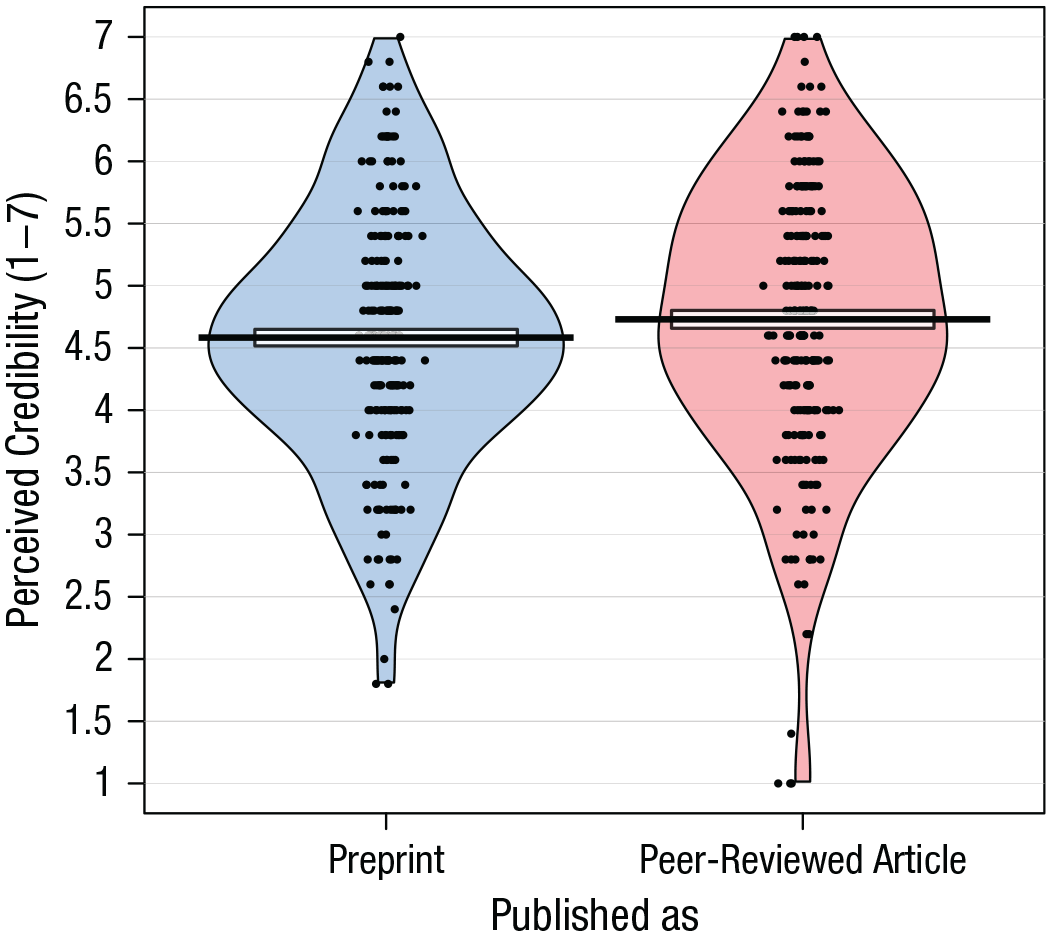
Pirate plot showing perceived credibility as a function of publication mode in Study 2 (U.S. participants), in which participants received no explanation of preprints.
Study 3
Studies 1 and 2 found that without an explanation, nonscientists rated research findings from preprints as equally credible as research findings from peer-reviewed journal articles. Study 3 tested whether nonscientists truly believe that the two types are equally credible or whether they start to differentiate once they get an explanation of preprints and the peer-review process and can directly compare these two options. Study 3 straightforwardly tested this by employing a within-subjects design in which participants rated research findings in general.
Method
Participants and design
Participants were recruited through postings in public German social media groups for voluntary research participation. The targeted sample size was set to 45, based on an a priori power analysis for 95% power (one-sided α of .05) to detect a moderate effect of dz = 0.5 that would be typical for similar social-psychological research. The recruited sample was slightly larger, as is often the case in online studies, and consisted of 65 participants. Of these participants, 52 responded to all credibility items and were therefore included in the main analysis (73.08% female; age: M = 30.83 years, SD = 9.71).
Procedure
This study employed a within-subjects design. Participants read a short, jargon-free description of the peer-review process, which highlighted that peer review serves as a quality-control process and that peer review currently is the standard procedure for scientific publication. They were also informed that some research findings are initially published before the peer-review process as preprints to achieve rapid dissemination of results. The full description reads as follows (translation by authors): Usually, scientific articles are subject to an extensive peer-review process. This means that other scientists anonymously review articles submitted to a scientific journal. They then speak out for or against a publication and provide important suggestions for article improvement. This procedure is considered the gold standard of scientific journals. Only articles that receive positive reviews have a chance of being published. This procedure is intended to ensure that the articles are of particularly high quality. However, some articles are now published online as preprints without having been peer reviewed. This allows scientists to make their results available to the public very rapidly, whereas the time-consuming peer-review process can take several months. Normally, peer review is then carried out after the article has been submitted to a scientific journal.
Afterward, participants reported the perceived credibility of research findings published as peer-reviewed articles (“How credible are research findings that are published as journal articles [with peer review]?”) and as preprints (“How credible are research findings that are published as preprints [without peer review]?”) on a 7-point rating scale (1 = not at all credible, 7 = very credible). Finally, participants indicated whether they had heard about preprints and peer-reviewed articles before the study, completed demographics, and were debriefed.
Results
As predicted, participants rated research findings from preprints (M = 4.00, SD = 0.93) as less credible than research results from peer-reviewed journal articles (M = 5.63, SD = 1.34), t(51) = 10.06, one-sided p < .001 , dz = 1.39 (see Fig. 4).
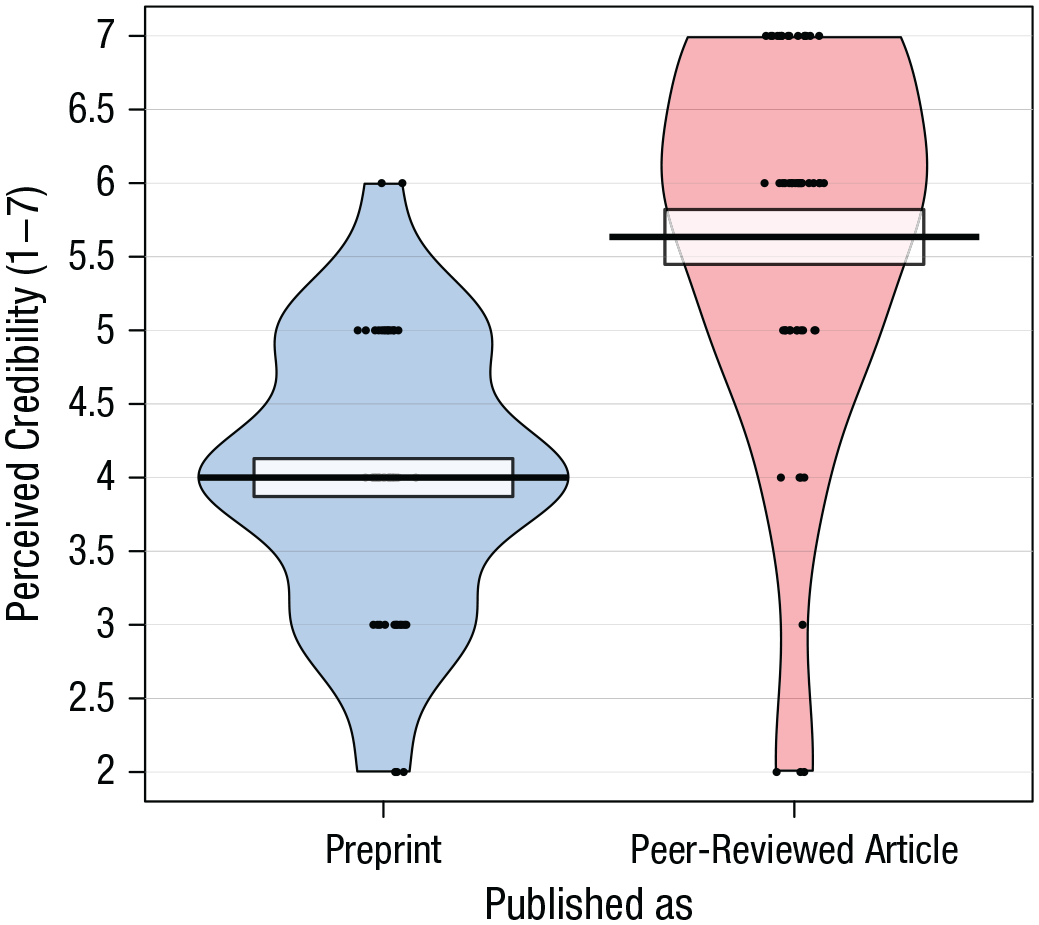
Pirate plot showing perceived credibility as a function of publication mode in Study 3 (German participants), in which participants received an explanation and directly compared the two options.
Study 4
Study 4 tested whether the finding of Study 3 generalizes to a more realistic situation in which participants do not directly compare preprints and peer-reviewed articles with each other. Instead, participants judged specific research findings, and the design was largely identical (and thus directly comparable) to Studies 1 and 2.
Method
Participants and design
Participants were German university students recruited online in exchange for course credits. The study employed a between-subjects experimental design. We randomly assigned participants to one of two between-subjects conditions (preprint condition, peer-review condition). The target sample size was set to 102, based on an a priori power analysis for 80% power (one-sided α of .05) to detect a moderate effect of d = 0.5. The recruited sample consisted of 140 participants, of which 113 responded to all credibility items and were therefore included in the main analysis (76.11% female; age: M = 23.75 years, SD = 5.10).
Procedure
Participants read the same short descriptions of the peer-review process and preprints as in Study 3 and answered two exploratory text-comprehension questions. Participants judged the credibility of five research findings (the same research findings used in Studies 1 and 2). The findings were described as being published either as peer-reviewed journal articles or as preprints. Ratings were made on a 7-point scale (1 = not at all credible, 7 = very credible). Participants also indicated whether they had heard about preprints and peer-reviewed articles before the study, received an exploratory open-entry question on how they made their credibility judgments, completed demographics, and were debriefed.
Results
In line with our preregistration, we computed an average credibility score across all five credibility ratings. As predicted, participants rated research findings from preprints (M = 3.67, SD = 0.72) as less credible than research findings from peer-reviewed journal articles (M = 4.15, SD = 0.65), t(111) = 3.74, one-sided p < .001, d = 0.70, 95% CI = [0.32, 1.09]. This pattern is depicted in Figure 5.

Pirate plot showing perceived credibility as a function of publication mode in Study 4 (German participants). This study provided participants with an explanation of preprints and the peer-review process.
Study 5
In Study 5, we developed a shortened version of the explanation used in Studies 3 and 4, which could be easily added to preprints. We tested whether this explanation allows nonscientists to differentiate between preprints and the peer-reviewed literature. We further tested whether it matters if this brief explanation is provided by the authors or by an external source but expected the explanation to be effective in both cases. Because most preprints are published in English, we tested this in an English-speaking population (N = 727; U.S. sample). We also aimed to explore the underlying mechanism of our explanation and tested preregistered mediators (perceived quality control and perceived adherence to publication standards) and moderators (education and familiarity with the publication process).
Method
Participants and design
Participants were U.S.-based individuals recruited on the Amazon MTurk platform in exchange for $0.50. We randomly assigned participants to one of four between-subjects conditions (peer-review condition, preprint: limited-information condition, preprint: authors’-explanation condition, preprint: external-explanation condition). The target sample size was set to 1,000, which allowed us to detect group differences of d = 0.29 (1 – β = 0.95, one-sided α of .05) and, moreover, provided sufficient power for an equivalence tests (1 – β = 0.91, equivalence bounds of d = 0.3). We recruited 1,051 participants, of which 739 passed the preregistered text-comprehension check. For the text-comprehension check, participants had to answer how the research findings were published (see Study 2). If an additional explanation of peer review and preprints was given, they also indicated for three additional text-comprehension questions whether they were true or false (“Scientific articles are usually peer reviewed”; “As part of the peer-review process, independent researchers evaluate the quality of the work”; and “Preprints have been peer reviewed”). If participants answered any of the questions incorrectly, they were asked to read the text carefully again. If they again failed any of the text-comprehension questions, they were excluded from our analyses. Finally, 727 participants responded to all credibility items and were thus included in the main analyses (43.39% female; age: M = 39.24 years, SD = 12.68). One participant did not respond to the remaining items, which reduced the sample size for secondary analyses to 726. Despite this reduced sample size, a sensitivity analysis revealed that for all possible group comparisons, our sample had at least an 80% power (with α = .05) to detect an effect of d = 0.30 and a 95% power to detect d = 0.39.
Procedure
Participants learned that they would judge the credibility of five research findings and were randomly assigned to one of four conditions. In the peer-review condition, participants were informed that the findings went through a peer-review process and were published in a scientific journal. The preprint: limited-information condition stated that the findings were preprints, but in contrast to Studies 1 and 2, it was also added that preprints are not peer reviewed (without further information, however, what is meant by peer review). In the other two conditions, the research findings were presented as non-peer-reviewed preprints, but participants received an additional explanation of preprints and the peer-review process. This additional explanation was allegedly either provided by the authors of the preprint (preprint: authors’-explanation condition) or without any reference to the source in the introduction of the study (preprint: external-explanation condition).
The explanation was drafted building on the information provided in Studies 3 and 4 but incorporated further feedback from colleagues from various disciplines (anthropology, biology, psychology, and sociology) and from nonscientists to ensure an interdisciplinary perspective and comprehensibility. The explanation highlighted two important aspects: that peer review serves as a quality-control process and that peer review currently is the standard procedure for scientific publication. Compared with Studies 3 and 4, we aimed to keep this explanation as comprehensive as possible. This explanation read: Scientific articles usually go through a peer-review process. This means that independent researchers evaluate the quality of the work, provide suggestions, and speak for or against the publication. Please note that the present article has not (yet) undergone this standard procedure for scientific publications.
After judging the credibility of the research findings, participants were also asked about the perceived quality control of the research findings, the perceived adherence to scientific publication standards, their education, and their familiarity with the publication process. Credibility ratings were given on a 7-point rating scale (1 = not at all credible, 7 = very credible). Familiarity with the publication process (“I am familiar with the scientific publication process”), perceived quality control of the research findings (“The quality of the research findings has been strictly controlled”), and perceived adherence to scientific publication standards (“When publishing their findings, the researchers followed the standard procedure of the research community”) were measured on a 7-point scale (1 = strongly disagree, 7 = strongly agree).
Results
Main analyses
We again computed an average credibility score across all five credibility ratings. As predicted, across both preprint-explanation conditions, participants reported lower credibility of research findings compared with the peer-review condition (M = 4.65, SD = 1.00). This was the case when participants received the explanation by the authors (M = 4.39, SD = 1.07), t(359) = 2.32, one-sided p = .010, d = 0.25, 95% CI = [0.04, 0.45], and by an external source (M = 4.31, SD = 1.02), t(379) = 3.25, one-sided p < .001, d = 0.33, 95% CI = [0.13, 0.54] (see Figure 6). Unexpectedly, this was also the case when participants received only very limited information (M = 4.42, SD = 1.15), t(379) = 2.02, p = .044, d = 0.21, 95% CI = [0.01, 0.41]. The three preprint conditions did not significantly differ from each other (all ps > .317, all ds < .10), and the observed differences between these conditions were all equivalent with an interval containing only small effects (d < .3), all ps < .031 (see OSF analyses for details).

Pirate plot showing perceived credibility as a function of publication mode and explanation in Study 5 (U.S. participants). Raw data are not visualized in the figure because of the large number of data points.
Quality control and adherence to scientific publication standards
However, the three preprint explanations differed regarding the perceived quality control of the research findings and the perceived adherence to scientific publication standards. Participants who received an explanation reported lower perceived quality control of preprints compared with the limited information condition (M = 4.27, SD = 1.79). This was the case no matter whether participants received this explanation by the authors (M = 3.72, SD = 1.63), t(344) = 2.97, one-sided p = .002, d = 0.32, 95% CI = [0.11,0.53], or by an external source (M = 3. 81, SD = 1.71), t(363) = 2.51, one-sided p = .006, d = 0.26, 95% CI = [0.06, 0.47]. Likewise, after receiving an explanation, participants reported lower perceived adherence to scientific publication standards compared with the limited-information condition. This was again the case no matter whether participants received this explanation by the authors (M = 3.83, SD = 1.72), t(344) = 3.15, one-sided p < .001, d = 0.34, 95% CI = [0.13,0.55], or by an external source (M = 3.95, SD = 1.79), t(363) = 2.50, one-sided p = .007, d = 0.26, 95% CI = [0.05, 0.47].
Moderation analyses
In line with our preregistration, we also tested whether education or familiarity with the scientific publication process moderated the effect of our explanation on the perceived credibility of research findings (compared with the peer-review condition). For these analyses, we merged the preprint: authors’-explanation condition and the preprint: external-explanation condition because they did not differ on any of the relevant variables. We conducted multiple linear regression analyses to test whether any of our potential moderator variables moderated the relationship between explanation (detailed explanation vs. peer review) and credibility. Indeed, whereas centered education did not significantly interact with our explanation (b = −0.22, SE = 0.14), t(539) = 1.58, p = .115, centered familiarity with the publication process was a significant moderator, which indicates that our explanation was more effective for people who indicated a higher familiarity with the scientific publication process (b = −0.12, SE = 0.05), t(539) = 2.49, p = .013 (see Table 4).
Multiple Linear Regression Predicting Perceived Credibility From Condition, Centered Familiarity With the Publication Process, and Their Interaction Term

Mediation analyses
Finally, we explored preregistered mediators of the effect of our explanation on credibility (compared with the peer-review condition). For these cross-sectional analyses, we again merged the authors’-explanation condition and the external-explanation condition because they did not differ on any of the relevant variables. We investigated whether perceived quality control or perceived adherence to publication standards mediated the negative effect of explaining preprints on perceived credibility. To test this, we ran a parallel mediation model (see Fig. 7) with 10,000 bootstrap resamples using the R package lavaan (Rosseel, 2012). This model revealed that both perceived quality control (b = −0.23, 95% CI = [−0.14, −0.33]) and perceived adherence to publication standards (b = −0.25, 95% CI = [−0.15, −0.35]) simultaneously mediated the effect.

Parallel mediation analyses involving perceived quality control and adherence to publication standards as dual, simultaneous mediators for the link between explanations (0 = peer-review condition, 1 = merged-explanation conditions) and perceived credibility. Values represent standardized path coefficients. The total effect is presented in parentheses. Asterisks indicate significance at the p < .05 level (*), at the p < .01 level (**), and at the p < .001 level (***).
Because this mediation model relied on cross-sectional data, these results should be considered with caution because the mediating variables were not experimentally manipulated and may be biased (Bullock et al., 2010). An observed statistical mediation cannot conclusively prove actual mediation (Fiedler et al., 2011) and should, rather, be seen as a tentative hint for mediation.
General Discussion
A central argument against preprints is that nonscientists might fail to differentiate them from the peer-reviewed literature (Fox, 2018; Vazire, 2020). Indeed, nonscientists from Germany (Study 1) and the United States (Study 2) perceived research findings published as preprints as equally credible as research findings published in peer-reviewed journals. However, a brief explanation of the peer-review process combined with the information that preprints are not peer reviewed led nonscientists to perceive identical research findings published as preprints as less credible than the peer-reviewed literature. This effect was observed for research findings in general (Study 3) and specific psychological research findings (Studies 4 and 5). Study 5 further suggested that even a very brief explanation, which could be added to all preprints, allowed nonscientists to differentiate them from the peer-reviewed literature. Note that this effect emerged independently of whether this explanation was allegedly provided by the preprints’ authors or by an external source, albeit the effect was descriptively smaller in the former situation. The explanation seemed to be especially effective for individuals who are rather familiar with the scientific publication system, and it seems to work by influencing whether nonscientists see preprints as quality controlled and as adhering to publication standards. In other words, when nonscientists are well informed about the source of information, they can adjust their credibility ratings accordingly.
In practice, however, most psychological preprints do not contain such an explanation. The pilot study, in which we coded recent preprints from two popular psychological preprint servers, revealed that less than 30% of preprints contained information that they are a preprint. Even fewer mentioned that they are not peer reviewed, and virtually none provided an explanation similar to the one used in our studies. Taking this current status quo into account, our findings suggest that nonscientists might currently be unable to differentiate between preprints and the peer-reviewed literature.
Some scholars (e.g., Elmore, 2018) have pointed to the fact that the term “preprint” is a misnomer because there may never be a future print version in a scientific journal (e.g., if the preprint does not pass the peer-review process). Nonscientists might, however, believe that preprints are in fact earlier versions of already published and peer-reviewed articles. This discrepancy could explain why Study 5 found that simply stating that preprints have not yet passed peer review—something that many individuals are probably not aware of—already reduced perceived credibility. The same study, however, also demonstrated that a more detailed explanation led to a stronger differentiation between preprints and peer-reviewed literature regarding their perceived quality control and their perceived adherence to publication standards, which were relevant mediators. We thus recommend that future authors of preprints, but also preprint servers or science journalists covering preprints, should briefly explain the peer-review process and highlight that preprints are not peer reviewed. Our research suggests that such an explanation might be especially effective if it includes elements that indicate that peer review serves as a quality-control process and that it is the standard procedure for scientific publication.
One important discussion point, however, is whether it is desirable that nonscientists differentiate between preprints and peer-reviewed literature in terms of credibility. Although the peer-review system leads to improvements of a manuscript (Carneiro et al., 2019; Godlee et al., 1998; Goodman et al., 1994; Schroter et al., 2004), it also has serious drawbacks (Heesen & Bright, 2021; Huisman & Smits, 2017; Jukola, 2017), and one might argue that preprints are not necessarily less credible than peer-reviewed articles. Regardless of whether peer-reviewed articles are objectively more credible, we find that if provided with information about the differences between preprints and peer-reviewed articles, participants used this information to inform their credibility judgments. We, therefore, argue that this information should not be withheld. In contrast to more patronizing statements, such as the statement by BioRxiv (preprints “should not be regarded as conclusive, guide clinical practice/health-related behavior, or be reported in news media as established information”), our approach leaves it up to the reader to decide whether a preprint is less credible.
Even if one agrees that preprints are on average less credible than peer-reviewed articles, it could be argued that it is not desirable to reduce the perceived credibility of all preprints because some preprints may in fact be highly credible. However, because psychological research findings are often nonreplicable (Open Science Collaboration, 2015) and context sensitive (Van Bavel et al., 2016), we argue that it is better to err on the side of caution by increasing nonscientists’ vigilance toward preprints even if this may not always be necessary. This does not imply, of course, that nonscientists should rely solely on whether a manuscript is a preprint when evaluating its content. In fact, recent work suggests that nonscientists are also sensitive to other important aspects of scientific research, such as the strength of evidence (Hoogeveen et al., 2020) or successful replications of the presented work (Hendriks et al., 2020).
It is also important to discuss the generality of our findings (Simons et al., 2017). First, because we replicated our findings in rather different samples (U.S. MTurk users and German students), we expect our findings to replicate also in more representative samples for these and other Western countries. Note, however, we found that our explanation was more effective for participants who reported a high familiarity with the publication process. This might explain why we observed substantially larger effects in Germany: Because the German samples mostly consisted of undergraduate students, they might be more familiar with the publication process compared with the U.S. samples of Amazon MTurk users. Thus, familiarity with the publication process might constrain the generality of our findings. From an applied perspective, it seems likely that nonscientists seeking out preprints might be rather familiar with the publication process (e.g., journalists), which means that our explanation would be rather effective in such a situation. However, it is also possible that this is a methodological artifact: Participants who read our materials more closely might consequently report a higher familiarity with the publication process and being more strongly affected by the manipulation.
Moreover, it seems likely that the effectiveness of our explanation depends on participants’ general trust in science because our explanation highlights that preprints do not follow the established scientific publication procedure. If, however, participants’ trust in the established scientific knowledge is generally low, a deviation from established standards might not reduce trust but could even increase it. This could, for example, be the case for politically highly conservative participants, who are contemporarily characterized by relatively low trust in science (Gauchat, 2012).
Finally, it would also be vital to test whether our findings generalize to other forms of non-peer-reviewed science communication, such as blogs, podcasts, or popular science magazines. For example, during the COVID-19 crisis, some scientists shared their findings through non-peer-reviewed podcasts and even press conferences (Kupferschmidt, 2020). In such a situation, it might also be desirable to inform the public that the presented research findings have not been peer reviewed to avoid public overconfidence in the presented research. It, however, remains possible that the public already perceives such publication formats as rather uncommon and thus less credible, which would leave no room for such an explanation to have an additional effect. This remains an interesting question for future research.
In sum, our work suggests that concerns about nonscientists not differentiating between preprints and peer-reviewed psychological literature are legitimate. However, we also suggest and test a solution: Preprint authors, preprint servers, and other relevant institutions can likely mitigate this problem by briefly explaining the concept of preprints and their lack of peer review. This would allow harvesting the benefits of preprints, such as faster and more accessible science communication, while reducing concerns about public overconfidence in the presented findings.
Supplemental Material
sj-docx-1-amp-10.1177_25152459211070559 – Supplemental material for Caution, Preprint! Brief Explanations Allow Nonscientists to Differentiate Between Preprints and Peer-Reviewed Journal Articles
Supplemental material, sj-docx-1-amp-10.1177_25152459211070559 for Caution, Preprint! Brief Explanations Allow Nonscientists to Differentiate Between Preprints and Peer-Reviewed Journal Articles by Tobias Wingen, Jana B. Berkessel and Simone Dohle in Advances in Methods and Practices in Psychological Science
Footnotes
Acknowledgements
We thank Nicolas Alef and Antonia Dörnemann for their valuable practical support. We further thank Paul Davies and Luzie U. Wingen for their extensive feedback on materials. We finally thank Angela Dorrough and Jan Landwehr for valuable comments on an earlier version of this manuscript. The submitted manuscript was previously posted on a preprint archive,  .
.
Transparency
Action Editor: Alexa Tullett
Editor: Daniel J. Simons
Author Contributions
T. Wingen generated the idea for the research project, with feedback from J. B. Berkessel and S. Dohle. T. Wingen and J. B. Berkessel jointly programmed the study and collected the data. T. Wingen wrote the analysis code and analyzed the data, and J. B. Berkessel verified the accuracy of those analyses. T. Wingen wrote the first draft of the manuscript, and all authors critically edited it. All of the authors approved the final manuscript for submission.
References
Supplementary Material
Please find the following supplemental material available below.
For Open Access articles published under a Creative Commons License, all supplemental material carries the same license as the article it is associated with.
For non-Open Access articles published, all supplemental material carries a non-exclusive license, and permission requests for re-use of supplemental material or any part of supplemental material shall be sent directly to the copyright owner as specified in the copyright notice associated with the article.
