




Abstract
Posting preprints online allows psychological scientists to get feedback, speed dissemination, and ensure public access to their work. This guide is designed to help psychological scientists post preprints and manage them across the publication pipeline. We review terminology, provide a historical and legal overview of preprints, and give guidance on posting and managing preprints before, during, or after the peer-review process to achieve different aims (e.g., get feedback, speed dissemination, achieve open access). We offer concrete recommendations to authors, such as post preprints that are complete and carefully proofread; post preprints in a dedicated preprint server that assigns DOIs, provides editable metadata, is indexed by GoogleScholar, supports review and endorsements, and supports version control; include a draft date and information about the paper’s status on the cover page; license preprints with CC BY licenses that permit public use with attribution; and keep preprints up to date after major revisions. Although our focus is on preprints (unpublished versions of a work), we also offer information relevant to postprints (author-formatted, post-peer-review versions of a work) and work that will not otherwise be published (e.g., theses and dissertations).
Keywords
Psychological scientists write and share papers so that they can be read, used, and built on by others. They can disseminate papers by submitting them for publication in journals or books and by posting them on the Internet via institutional repositories, scholarly repositories, personal websites, or other public venues. Disseminating work through journals takes months or years, requires approval from journal editors, and results in the publication of a professionally formatted, peer-reviewed version of the paper that, depending on the type of journal, can be read, used, and built on only by people affiliated with wealthy academic institutions. In recent years, there has been a dramatic rise across the sciences, including in psychology, in the posting of preprints as a way to address these barriers to dissemination. Preprints are broadly defined as scientific documents made available outside of the traditional publisher-managed framework and often disseminated online via trusted repositories. Disseminating work by posting it online can result in the publication of an author-formatted version of the paper that may or may not be peer reviewed and that anyone can read, use, and build on.
Researchers write and share papers to advance collective knowledge, but they also write and share papers to meet the expectations of their training program, employer, or funder. The choice to disseminate work in peer-reviewed journals serves scientists’ careers (Nosek et al., 2012), particularly when work is disseminated in journals that are highly ranked in citation metrics or are otherwise considered prestigious. Disseminating work through journals and by posting preprints online allows scholars to reap the career benefits of publishing in journals while ensuring public access to the work. Furthermore, in recent years, major publishers of psychological science, like the American Psychological Association, and societies that publish high-impact journals, like the Association for Psychological Science, have revised their policies, websites, and journal submission processes in ways that explicitly support the routine posting of preprints. Some publishers show support for posting works online more clearly than others, but all major publishers in psychology allow authors to post preprints (Tables 1 and 2; for policies of more than 200 journals in psychology, see https://osf.io/e5u4a/).
Overview of Major Non-Open Access Publishers in Psychology, Affiliated Societies, Number of Journals, and Example Psychology Journals
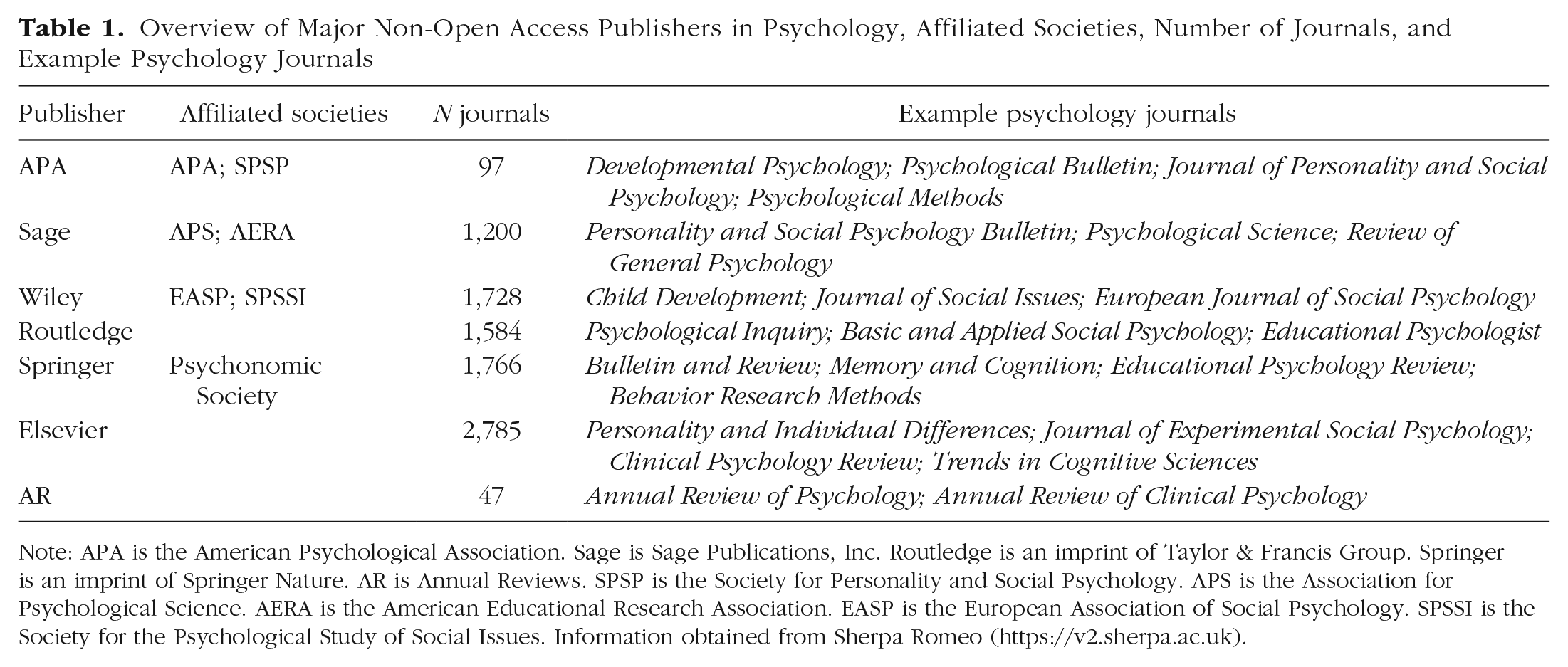
Note: APA is the American Psychological Association. Sage is Sage Publications, Inc. Routledge is an imprint of Taylor & Francis Group. Springer is an imprint of Springer Nature. AR is Annual Reviews. SPSP is the Society for Personality and Social Psychology. APS is the Association for Psychological Science. AERA is the American Educational Research Association. EASP is the European Association of Social Psychology. SPSSI is the Society for the Psychological Study of Social Issues. Information obtained from Sherpa Romeo (https://v2.sherpa.ac.uk).
Overview of Major Non-Open Access Publishers in Psychology and Whether and Under What Circumstances They Allow Authors to Post Preprints of the Submitted Version and the Accepted Version of a Paper

Note. APA is the American Psychological Association. Sage is Sage Publications, Inc. Routledge is an imprint of Taylor & Francis Group. Springer is an imprint of Springer Nature. AR is Annual Reviews. As of this writing, publisher policies can be found at the following URLs: APA: www.apa.org/pubs/journals/resources/internet-posting-guidelines; Sage Publications: us.sagepub.com/en-us/nam/journal-author-archiving-policies-and-re-use; Routledge: authorservices.taylorandfrancis.com/research-impact/sharing-versions-of-journal-articles; Springer: www.springer.com/gp/open-access/publication-policies/self-archiving-policy; Elsevier: www.elsevier.com/authors/submit-your-paper/sharing-and-promoting-your-article; Annual Reviews: www.annualreviews.org/page/authors/author-instructions/distributing/self-archiving.
Although researchers can disseminate work through both journals and by posting preprints online, the copyright laws, publisher policies, and publication agreements that describe authors’ rights use legal jargon that can obscure this fact. Even after reading journal policies, authors may not know that they can post preprints of papers that will be submitted for publication or have already been submitted for publication. Unlike with submitting articles for publication in journals, posting papers online does not have to follow a particular formal procedure, and psychology does not have clear norms that can guide authors in their decisions about why, when, and how to post papers online.
In this guide, we offer concrete information and advice about posting and managing preprints. We provide answers to questions people may have, offering definitions, legal and historical context, and a procedure for posting and managing preprints that will maximize the benefits to authors and readers.
What Are Preprints?
The term preprints traditionally referred to unpublished versions of manuscripts that were publicly posted or circulated before submission to a journal for peer review (“working papers”), with the primary purpose being to receive helpful comments and catch errors before submission. Preprints can also refer to manuscripts that are currently under review, gray literature that may not otherwise be published (e.g., conference papers), and sometimes to author-formatted versions of manuscripts that have been accepted for publication. This latter category is more accurately referred to as postprints, or more colloquially as an open-access version, because preprint servers are not protected by paywalls and therefore anyone can access them on the Web. These differences aside, the term preprint has come to mean any document that is posted on a preprint server, and thus the term alone does not tell you much about the status of the paper (i.e., draft, under review, accepted). Despite this expansion in the use of the term preprint, we advocate for using postprint when referring to the author-formatted version of a published work.
Although posting preprints online in psychology has only recently become common, preprint repositories have been around in different forms for more than 30 years (Cobb, 2017; Ginsparg, 2009). Preprints are a routine part of the process of writing and publishing manuscripts in some fields (Ginsparg, 2011). For example, in physics, math, computer science, and adjacent disciplines, arXiv, a repository that hosts more than 1.8 million preprints (arXiv Management Team, 2021), has long been a primary outlet for sharing and finding new research (Berg et al., 2016; Larivière et al., 2014). In economics, authors have also routinely shared preprints for several decades via the Social Science Research Network and the National Bureau of Economic Research Working Papers Series (Baumann & Wohlrabe, 2020; Cruz & Krichel, 2000). In biology, posting preprints has become part of the normative publication process only since about 2013 with the advent of bioRxiv (a biology preprint repository; Abdill & Blekhman, 2019; Callaway, 2013; Penfold & Polka, 2020) and further bolstered with the creation of medRxiv in 2019 (a health sciences preprint repository; Rawlinson & Bloom, 2019).
In psychology, infrastructure for posting preprints dates to 1989 (Harnad, 1990), a time when not even traditional journals published content online (Ginsparg, 2009). This infrastructure, an online platform called Psycoloquy, was not popular as a preprint repository and eventually became a peer-reviewed Open Access (OA) journal that was sponsored by the American Psychological Association (Tomney & Burton, 1998). Posting preprints remained uncommon in psychology for several decades (Hajjem et al., 2006; Hardwicke et al., 2020; Piwowar et al., 2018; Tomney & Burton, 1998). The recent rise of posting preprints in psychology was precipitated by the creation of PsyArXiv, psychology’s dedicated repository. PsyArXiv was founded in 2016 by the Center for Open Science and the Society for the Improvement of Psychological Science (Barner et al., 2016) to facilitate the use of preprints as part of a broader effort to improve psychological science through open and transparent research practices (Nosek & Bar-Anan, 2012). As of March 2021, PsyArXiv hosts more than 14,000 preprints. As we discuss in more detail subsequently, psychological researchers post preprints across the full spectrum of what the term represents (e.g., working papers, manuscripts under review, and as postprints). In sum, preprints play an increasingly important role in the dissemination of research across the sciences (Baumann & Wohlrabe, 2020; Larivière et al., 2014; Penfold & Polka, 2020; Sarabipour et al., 2019), including psychology, and thus psychological researchers will benefit from knowing what preprints are and how to incorporate them into their workflow.
Why Should I Post Preprints?
Posting preprints offers many different benefits to authors (Bourne et al., 2017; Fry et al., 2019; Sarabipour et al., 2019; Tennant et al., 2016). Primarily and necessarily, posting preprints ensures that anyone can access the paper on the Internet for free, regardless of their institutional affiliation (i.e., OA; “Budapest Open Access Initiative” [BOAI], 2002; Suber, 2012). Unrestricted access to scientific work manifests the principle that science is owned collectively by the public (i.e., the norm of communalism; Merton, 1942/1973). OA also improves a work’s reach and impact metrics; papers that are publicly accessible get more engagement and more citations relative to inaccessible research (Davis, 2011; Fraser et al., 2020; Fu & Hughey, 2019; Piwowar et al., 2018; Sotudeh, 2020; Tennant et al., 2016). Nominal support for OA has been high for more than a decade among psychologists (Dallmeier-Tiessen et al., 2011) and health researchers (Anderson et al., 2007, 2010). Yet as recently as 2015, most research was not accessible to the public, which suggests that there are barriers preventing OA (Piwowar et al., 2018; Tennant et al., 2019).
There are several nonexclusive ways that a paper can become OA. 1 First, papers can be openly accessible at the point of publication (Gold OA; Harnad et al., 2004). Gold OA papers—whether they are published in journals that charge subscribers for access to some articles or journals that are completely OA—often charge authors a fee (an article processing charge [APC]; Suber, 2012). APCs can be waived, paid by an author’s institution, or paid by research funds. Second, papers can be openly accessible as preprints or postprints on a personal website, archive, or repository (Green OA; Harnad et al., 2004). Increasingly, funders, governments, and government agencies require research products they have funded to be publicly accessible, either as Gold OA (e.g., as described in the Dutch Copyright Act, Auteurswet Art. 25fa) or as Green OA in special archives that may add formatting and indexing (e.g., as with the American National Institutes of Health and PubMed Central; Joseph, 2008). Some types of scholarship, including book chapters and thesis papers, may not have a Gold OA option. To make book chapters, thesis papers, and other works that cannot be OA at the point of publication, authors must post them online.
There are other reasons that people post preprints beyond seeking to make their research OA. Posting preprints allows authors to disseminate works faster than the traditional peer-review process (Baumann & Wohlrabe, 2020; Bourne et al., 2017; Desjardins-Proulx et al., 2013; Larivière et al., 2014). And although posting preprints does not offer formal, editor-controlled peer review, it can enable a fast, informal form of peer review via public conversation and comments (Desjardins-Proulx et al., 2013). This informal feedback process can sometimes lead to new collaborators joining the authorship team 2 or can help forge future collaborations. Posting a preprint can serve to document and time-stamp a paper or specific features of a paper, which can establish the precedence of a work (Desjardins-Proulx et al., 2013; Tennant et al., 2019) and make changes resulting from the peer-review process transparent (Bourne et al., 2017). Finally, by posting a work soon after it is written, authors can both speed and ensure dissemination of a work regardless of its acceptance at a journal, thus reducing research waste (Bourne et al., 2017).
Where Do I Post Preprints?
To ensure accessibility, reach, and discoverability, preprints should be posted in a stable, public location, like an institutional or scholarly repository that is designed to host preprints and maximize their use to researchers (a preprint server). In psychology, many preprints are posted in a psychology-specific repository, PsyArXiv (psyarxiv.com), which is currently one of several repositories hosted on the OSF (osf.io/preprints). However, there are several other repositories that are relevant to psychological research, including bioRxiv, SocArXiv, EdArXiv, MetaArXiv, 3 and other kinds of focused repositories (e.g., Thesis Commons for theses and dissertations). Although these repositories share many similarities, there are also some subtle differences that researchers should be aware of (see Table 3).
Overview of Repositories for Posting Preprints

Note: The listed subject-focused preprint repositories and Thesis Commons use OSF Preprints infrastructure (https://osf.io/preprints/). OA = Open Access.
Dedicated preprint servers offer more benefits to researchers than personal or institutional websites do. PsyArXiv and many other repositories currently offer several functions that help integrate preprints into the broader scientific literature. First, they assign a digital object identifier (DOI) that permanently identifies the preprint (inclusive of previous and subsequent versions). This provides a stable path to discovering and accessing the preprint and promoting it as a citable product. Second, preprint servers offer editable metadata fields, including those that link to project data and the final publication DOI, if it exists. Third, they are indexed by GoogleScholar and thus are discoverable and citable by the broader research community. Fourth, preprint servers are becoming increasingly interactive; for example, preprints on PsyArXiv are integrated with tools designed to facilitate critical review and document formal endorsements of a work. Finally, preprint servers have built-in version control. Preprints are often made public before they are finalized and so may become out of date as a work progresses through the publication process. Many scholarly repositories allow new versions of a work to replace previous submissions while maintaining a record of the previous submission. Updated versions that are issued a new posting date or include date information can be specifically cited. Updated versions can be licensed differently than previous versions of the same paper. Works that are updated in scholarly repositories with versioning are both persistent (and thus preserve the scientific record) and modifiable. Furthermore, versioning can make a work’s evolution over time transparent.
When Should I Post Preprints?
The question of when in the research cycle researchers should post a preprint is closely intertwined with why they want to do it. Posting preprints can serve different functions, including to get feedback, speed dissemination, and make work OA. Thus, the timing of the initial post should be aligned with the primary goal.
Authors who post preprints to get feedback on a work in progress should do so when they have a complete draft. This version should be reasonably polished and certainly one that all authors are comfortable with releasing into the world because posting creates a stable, public copy of the work that will remain accessible even if the paper is later updated. Once the preprint is posted, the authors can circulate a weblink and encourage personal feedback or public feedback. Many preprint services, like PsyArXiv, are indexed by Google Scholar, so anyone in the scholarly community may come across the paper and provide feedback.
Authors looking to disseminate a completed work faster than it would otherwise be published should post a preprint when they have a finalized draft, such as in tandem with submission to a peer-reviewed outlet. This allows the submitted work to reach others quickly, and it also serves to clearly document changes introduced by the peer-review process. Some authors who want to speed dissemination may prefer to first post a later version of the preprint (e.g., a version that has been revised following the first or second round of peer review). Posting the work at any stage during the peer-review process will speed dissemination relative to waiting for the work to be published by a journal.
Authors looking to make their work OA should post a preprint when the project is completed. This can potentially be done immediately at the time of acceptance for publication or at any point in the future. Book chapters are one type of work that fits well with this use and timing of posting preprints. Book chapters are rarely made OA at the point of publication, and they are notoriously difficult to access, even for people whose libraries own the book. As noted, works posted at this point are most accurately called postprints but nevertheless are often labeled and referred to as preprints. Authors often have questions about the legality of posting papers that have been published or accepted for publication, an issue we address in the subsequent section (also see major publishers in Table 1 and their relevant policies in Table 2).
Note that different motivations for posting preprints are not mutually exclusive, and you can integrate them by initially posting a preprint early in the life cycle and updating it as it progresses through to publication. Indeed, by managing preprints across the full publication pipeline, you can help combat publication bias because even if the paper is not ultimately accepted for publication, there then remains a permanent, accessible record of the preprint.
Is It Legal to Post Preprints?
It is perfectly legal to post preprints. When someone writes a paper, they and their coauthors are its legal owners. Their ownership (or copyright) permits them to use and distribute the work however they would like to; they can charge people to access the work, or they can post it freely online. The authors of a work retain these rights until and unless they explicitly transfer the ownership of the work to another person or entity. So until and unless you sign a publication agreement or other contract that transfers the ownership of your work to someone else, you own the papers you write and can post them as preprints. OA journals typically do not ask authors to transfer their ownership of a work, but non-OA journals typically do become the owners and copyright holders of the final version of the accepted paper (Gadd et al., 2003; Tennant et al., 2016; Willinsky, 2002). Transfers of ownership apply to a particular version of a work and not to every version. Thus, even after authors sign a publication agreement, they retain ownership of earlier drafts of the work, and they continue to be able to post them as preprints. The version of the paper that publishers become the owner of is the version of record (i.e., the final, post-peer-review version that was accepted for publication).
For many papers, it is also perfectly legal to post the author-formatted version of record of a paper (a postprint). Many publishers that ask authors to transfer ownership allow the authors to retain some of their rights, like the right to distribute the article as an author-formatted document. This means that authors can post any version of the paper as long as it is a version they formatted and not the version the journal formatted. Sometimes this permission to post postprints is delayed following an embargo period of 6 months or a year. Sometimes the permission to post postprints comes with requirements, for example, to include information about the publisher’s copyright on the cover page of the postprint.
In Table 1, we list major publishers in psychology, and in Table 2, we summarize their current preprint and postprint policies. In Table 2, we also summarize any requirements that publishers place on postprints. As we summarize, in their formal policies, a few publishers make requests that authors include particular kinds of information in preprints that have been submitted or will be submitted to their journals (e.g., to include the draft’s date and information about the version of record). In our online supplement, additional tables include the policies associated with more than 200 journals (https://osf.io/e5u4a/).
Sometimes, local laws or preexisting agreements take precedence over the publication agreement and enable the author to legally post postprints or otherwise make the version of record openly accessible even if a journal does not permit them to. For example, in some jurisdictions, any work that was supported by public funds must be publicly accessible regardless of the publication outlet’s policies (e.g., the Netherlands; the Dutch Copyright Act, Auteurswet Art. 25fa). Dozens of government and scientists groups have long called for public access to publicly funded work (e.g., BOAI, 2002; see Harnad et al., 2004), a basic standard that may be realized in the coming years (e.g., see the European Commission and the European Research Council’s PlanS and cOAlition S; Schiltz, 2018).
How Do I Post Preprints?
The process of posting preprints should be informed by the fact that preprints are persistent. Scholarly and institutional repositories are part of the scientific literature. Repositories have different policies about removing preprints; some allow authors to remove preprints, some allow authors to remove preprints but retain a “tombstone” page that announces why the work has been removed (e.g., PsyArXiv), and others have a formal procedure for removing preprints and do so only under particular conditions (e.g., Duke ScholarWorks; scholarworks.duke.edu). Furthermore, once a preprint is made public in any venue, it may continue to exist even after it is removed (e.g., as a downloaded file on someone’s computer). Preprints should be complete, proofread, and free from any ethical or legal issues. They should be approved for dissemination by all authors, adherent to repository policies, adherent to copyright laws, and adherent to institutional ethics requirements in terms of the information they share about participants.
Given the persistence and discoverability of preprints, we recommend that authors take care in preparing a work before posting it as a preprint. It behooves authors to spend some attention to the formatting of preprints they post. In terms of typesetting, they can be formatted however authors wish, similar to journal submissions (e.g., double-spaced manuscripts written in American Psychological Association [APA] style), in a style that mimics the formatting of published articles (see templates at osf.io/hsv6a; Wiernik, 2019), or by using customized typesetting via LaTex or R Markdown (see the R package papaja; Aust & Barth, 2016). Beyond aesthetics, authors should ensure that readers of the work know what version they are reading and can find later versions. We recommend that authors incorporate information about the preprint’s date and publication status in the file name, on the preprint title page, and/or in the metadata. In many repositories, including PsyArXiv, the name of the preprint file is publicly visible, is retained as the file name when users download the work, and can be changed in subsequent versions. Title the preprint file descriptively and include a version date (e.g., first author last name, version date, brief content description). On the preprint’s title page, include the version date and other information about the work, like its status in the peer-review process (e.g., “Not yet submitted for publication,” “Submitted for publication,” “Resubmitted for publication,” and “Published”). For works that are published, include the entire citation to the published article. In the repository metadata, we recommend that you provide as much information as possible about the work, including affiliated data or material repository links and, for postprints, the peer-reviewed publication DOI.
Given that preprints are persistent and discoverable, it benefits authors to keep preprints up to date by posting a new version after major revisions, such as those that are demarcated by a submission or resubmission and those that affect your work’s major claims. With each new version, authors should update information about the version date and status. Reserve version updates for major revisions; the more versions of a preprint there are and the less obvious the differences between them, the less use versioning has as a method of documenting aspects of the revision process. We recommend including a brief, high-level summary of the changes that have been implemented between versions, particularly when updating preprints that have been cited or have garnered attention from the press or other scientists.
Should I License My Preprint?
A license is a formal way to communicate how people can use your work, including whether they can build on it, adapt it, share it, or sell it and whether you want to be given credit for the work if they do those things. Psychological scientists typically want their work to be read, built on, shared in full with others, or used to develop tools or interventions so long as the work is properly cited and not being used for monetary gain.
To signal that other people can use your work in particular ways, we recommend that you license your work; otherwise, readers must guess your preferences and expectations. If you do not mind or would like people to use your work in ways that extend beyond what is allowed by basic copyright (e.g., fair use in the United States), communicate that to your readers. Normative academic preferences and expectations fit well with CC BY Attribution 4.0, which allows you to retain ownership of the work and get credit for it while letting others use it freely. For example, a CC BY license would permit other people to translate your work and distribute it in another language, with an attribution to you. For tools like analytic code, you may want a CC0 license that puts your work in the public domain and allows other people to use your work as if it were their own, meaning that they can copy it in full, modify it, and profit from it without giving credit. For a description of different types of licenses, see Table 4.
Overview of Common Licenses for Preprints

Note: License information retrieved from Creative Commons (creativecommons.org). CC BY License features can be combined (e.g., CC BY-NC-ND), and there are other features that can be added to CC BY licenses. For information about combining and tailoring licenses, see creativecommons.org.
Skipping a license may seem like a good way to signal that you support normative academic use of your work, but it is not. Legally, having no license defaults to the permissions allowed by copyright (e.g., fair use only in the United States). CC BY fits with academic norms because it explicitly permits people to engage in normative academic use: People can redistribute and adapt your work as long as they give you credit. PsyArXiv currently supports two licenses (CC0 and CC BY Attribution 4.0). Users can select between these licenses and no license as part of the repository process. However, there are many other Creative Commons licenses that can be used to tailor permissions (e.g., to prohibit commercial uses or derivative uses; see Table 4 and creativecommons.org). To license your preprint with a license not offered by a preprint repository, simply include text that describes the license on the manuscript’s cover page or another visible place. The Creative Commons website offers detailed instructions about selecting and declaring licenses. You can change the license on a preprint as it is updated. However, once a work is placed in the public domain (as in CC0), updating the license cannot restore attribution and other rights. A work can become more public (as in updating from CC BY to CC0), but it cannot become more private (as in updating from CC0 to CC BY).
What Are Some Potential Concerns About Posting Preprints?
Posting preprints is a new behavior in psychological science, and with unfamiliar behaviors often come questions and concerns. We have attempted to assuage some of those concerns in the preceding (e.g., Is it legal?), but in our experience, there are many specific concerns that authors have. We address some of those here but also maintain a living FAQ at https://osf.io/e5u4a/ to respond to the ever-evolving landscape of preprints.
Will a journal desk reject a submission because it has been posted as a preprint?
Major publishers in psychology explicitly permit authors to post preprints before submission and therefore should not reject work because it has been posted as a preprint (see Tables 1 and 2). However, not all administrative staff for journals are fully aware of preprint policies. If your manuscript has been posted as a preprint at the time of submission, you should disclose this fact in the cover letter and include a link to the file. For example, you can say, “A version of this manuscript is posted as a preprint on PsyArXiv (https://psyarxiv.com/dp4x9),” tailoring the repository name and the preprint URL. For publishers that request specific language be added to the preprint (i.e., APA, Annual Review), you can confirm that you included language consistent with the publisher policy.
What would happen if I posted a preprint that violates publisher policy or my publication agreement?
If you submitted a journal-formatted published article to a dedicated preprint repository, the repository would probably reject your submission. If you did manage to post a publisher-formatted version of your paper online, the publishers may eventually notice and send you or the repository a formal request to remove the article. Format-related copyright violations are obvious, but content-related violations like posting the author-formatted version of record are far harder to detect by both repositories and publishers.
Do papers posted as preprints get scooped by other researchers?
There is no evidence that posting papers as preprints results in scooping (Bourne et al., 2017; Sarabipour et al., 2019; Tennant et al., 2019). If work posted as a preprint was later plagiarized or otherwise copied, proving the plagiarism would be straightforward (for an example, see Oransky, 2013). Unlike with other ways that people share work before publication (e.g., conference talks), a preprint itself serves as a conclusive, dated record that establishes its precedence.
There are more ambiguous forms of scooping that authors may fear when posting a work as a preprint. It is possible that in posting a preprint, authors may inspire another group to publish a related, improved, or more elaborated work faster, thus nullifying the original work. This version of scooping is quite hard to distinguish from both multiple discovery, in which independent scholars have the same insight at the same time, and the ordinary course of scientific progress, in which groups build on other people’s work using different materials or methods. Scholars already accept the risk of this kind of scooping when they present posters and give talks that contain unpublished ideas or data. Disseminating work in any way enables others to build on or otherwise be inspired by it. This is the purpose of dissemination, and it is core to the scientific process. Publication systems that select works based on novelty incentivize mutual secrecy and competition among people with similar research interests. Posting preprints can help indirectly prevent this kind of scooping by helping shift the publication system to be better aligned with core scientific mechanisms and values.
Will posting my preprint affect the peer-review process?
Posting a preprint can affect the peer-review process. For example, preprints sometimes attract press that may complicate the editorial process, and preprints might inadvertently identify you to peer reviewers in a masked review. Ultimately, the effects of preprints on the peer-review process are the editor’s and publisher’s to contend with. You can do your part by disclosing whether your work is or will soon be posted as a preprint to the editor during the submission process and by avoiding making changes in response to public feedback while it is under review.
Will updating a preprint create too many versions of it and create confusion about which version people should use and reference?
Uploading multiple versions of a preprint can create confusion about which version is most current, particularly when versions have different titles and authors. You can prevent version confusion by following our recommendations to use a repository that supports versioning, to include clear information about each version on its title page (including a summary of what changed between each version and the previous version), and to avoid creating new versions for minor updates.
Will posting preprints affect how the work is cited?
Works posted as preprints tend to be cited earlier and gather more citations in the long run (Berg et al., 2016; Fraser et al., 2020). Select a repository that assigns a DOI so that citations to the preprint get aggregated. When using a preprint repository that assigns a DOI, the same work may eventually have two sets of citations, one for the preprint and one for the published version. In repositories like PsyArXiv that are indexed by Google Scholar, both versions will be indexed and affiliated with your author profile, where their citations can be merged, which avoids having separate sets of citations for the same work.
Summary and Conclusion
Posting preprints is a free and legal way that researchers can make their work OA, and it offers a host of other benefits to individual researchers and to the field of psychology, broadly. We offer concrete recommendations that can help authors maximize the benefits of preprints. We describe how, when, and where authors can post preprints to make their work more accessible to other scholars and to the public and to derive more direct benefits, like increased exposure and citations, feedback before journal submission, connections with other scholars, time-stamping the work, making changes that resulted from peer-review more transparent, speeding dissemination (or ensuring it if the paper is rejected for publication), and reducing research waste. We recommend that authors post preprints only when they are final, proofread, and otherwise fit for public consumption; that they post preprints in a stable, public repository with features that enable others to find and cite the final version of a work; that they include information about the preprint’s version and status on its cover page; and that they license the preprint and replace their preprints with a postprint (an author-formatted version of the published article) when and if they can. Preprints are a powerful tool that allows psychologists to realize the fundamental scientific value that science belongs to everyone.
Footnotes
Acknowledgements
We thank Maimoua Hoang for collecting and tabling preprint policies for more than 200 journals, which is available in the online supplement at https://osf.io/e5u4a/. Earlier versions of this article are archived at https://psyarxiv.com/dp4x9. Portions of text in this article previously appeared in M. Syed’s blog post, Managing Preprints Across the Publication Pipeline (https://getsyeducated.blogspot.com/2020/05/managing-preprints-across-publication.html), and in a PsyArXiv blog post written by H. Moshontz, Licensing Your Work on PsyArXiv ( ).
).
Transparency
Action Editor: Brent Donnellan
Editor: Daniel J. Simons
Author Contributions
H. Moshontz generated the idea for this article. H. Moshontz, G. Binion, and B. T. Brown drafted the manuscript, consulting H. Walton about copyright, licenses, and taxonomies of Open Access. M. Syed provided critical edits and revisions. All of the authors approved the final manuscript for submission.