



Abstract
Shnabel and Nadler (2008) assessed a needs-based model of reconciliation suggesting that in conflicts, victims and perpetrators have different psychological needs that when satisfied increase the chances of reconciliation. For instance, Shnabel and Nadler found that after a conflict, perpetrators indicated that they had a need for social acceptance and were more likely to reconcile after their sense of social acceptance was restored, whereas victims indicated that they had a need for power and were more likely to reconcile after their sense of power was restored. Gilbert (2016), as a part of the Reproducibility Project: Psychology (RP:P), attempted to replicate these findings using different study materials but did not find support for the original effect. In an attempt to reconcile these discrepant findings, we conducted two new sets of replications—one using the RP:P protocol and another using modified materials meant to be more relatable to undergraduate participants. Teams from eight universities contributed to data collection (N = 2,738). We did find moderation by protocol; the focal interaction from the revised protocol, but not from the RP:P protocol, replicated the interaction in the original study. We discuss differences in, and possible explanations for, the patterns of results across protocols.
Keywords
Research on conflict resolution typically focuses on the ways in which two parties come to an agreement in distributing material resources (Scheff, 1994). This approach does little, however, to address the emotional needs of people in conflict (A. Nadler & Liviatan, 2006; J. Nadler, 2003; Thompson, Nadler, & Lount, 2000). Previous research has demonstrated that neglecting the socioemotional needs of people in conflict often disrupts reconciliation—a crucial step in ensuring future and sustained cooperation among the parties (Frijda, 1994; A. Nadler & Shnabel, 2008). This needs-based model of reconciliation assumes that both parties involved in a conflict (i.e., the victim and perpetrator) have distinct psychological needs that they are deprived of during the conflict. Moreover, these needs must be satisfied for reconciliation to ensue (A. Nadler & Shnabel, 2008).
Previous research on conflict resolution and reconciliation has rarely focused on both victims and perpetrators, and when it has done so, it has failed to acknowledge the differing needs of the two parties. To address this gap in the literature, Shnabel and Nadler (2008) investigated whether victims and perpetrators were more likely to reconcile after a conflict when their different needs were met. Specifically, they hypothesized that conflicts would leave victims with an impaired sense of power and perpetrators with an impaired sense of their public moral image, and that restoring these impaired identity dimensions would encourage reconciliation. The authors tested these predictions by asking participants to imagine being part of a conflict in which they were the victim or perpetrator. The participants’ willingness to reconcile was measured before and after they read a message from the other person involved in the conflict (e.g., those asked to imagine being the victim read a message from the perpetrator of the conflict). The message was intended to either empower the receiver or express social acceptance of the receiver.
Shnabel and Nadler (2008) found evidence to support various aspects of their model. First, immediately following a conflict, participants assigned to the victim condition reported lower power and higher need for power than did those assigned to the perpetrator condition. Participants assigned to the perpetrator condition reported lower public moral image and greater need for social acceptance than did those assigned to the victim condition. Second, victims were more willing to reconcile after receiving a message of empowerment than after receiving a message of acceptance, whereas perpetrators were more willing to reconcile after receiving a message of acceptance than after receiving a message of empowerment. Taken together, these results suggest that (a) following a conflict, victims have a greater need for power and perpetrators have a greater need for social acceptance; (b) receiving messages of empowerment and social acceptance, respectively, can restore these impaired resources; and (c) victims and perpetrators are more likely to reconcile after their different psychological needs are satisfied.
Shnabel and Nadler’s (2008) study was the subject of a replication attempt as part of the Reproducibility Project: Psychology (RP:P; Open Science Collaboration, 2015). Gilbert (2016) sought to replicate the study among a sample of undergraduate students in the United States. This change in the sample made some of the materials from the original study (which was conducted in Israel) not applicable, and the materials were therefore changed to suit the new sample. Specifically, aspects of the original study related to experiences that are central to the societal ethos in Israel (e.g., military service for men) and not that of the United States. Gilbert did not find evidence for the original effect, possibly as a result of the changes to the original procedure.
In an attempt to resolve these discrepant results, we conducted two new replications: one using the protocol developed by Gilbert (2016) for the RP:P and the other using a revised protocol, approved by the original authors, with materials modified to be more relatable to a sample of non-Israeli college students.
Disclosures
Preregistration
The experimental design and all confirmatory analyses were preregistered on the Open Science Framework (OSF; osf.io/q85az/). The results-blind version of the manuscript was also registered on OSF (https://osf.io/szuyk).
Data, materials, and online resources
All study materials and all data and analysis code are available on OSF (osf.io/kz6q5/). The Supplemental Material (http://journals.sagepub.com/doi/suppl/10.1177/2515245920917334) includes the exact wording of the female version of the vignette used, demographic information on participants at each data-collection site, and the results for the preregistered, underspecified three-way interaction model predicting willingness to reconcile.
Reporting
We report how we determined our sample size, all data exclusions, all manipulations, and all measures in the study.
Ethical approval
This study was approved by the University of California, Riverside’s institutional review board (HS 16-206) and was carried out in accordance with the provisions of the World Medical Association Declaration of Helsinki.
Pilot Study
In the original study, Shnabel and Nadler (2008) presented participants with a vignette describing an employee who took a 2-week leave from work (maternity leave for women, military service for men). The choice of the type of leave for each gender was in accordance with the idea that men’s role as warriors and women’s role as mothers are central to the societal ethos in Israel. Both the type and the duration of the leave would be unusual in other settings. For instance, maternity leave lasts an average of 5 weeks in the United States. Therefore, a story describing a woman coming back after just 2 weeks from maternity leave would not be realistic in the United States. Similarly, there is no mandatory military service in the United States. For these reasons, Gilbert (2016) asked participants to imagine taking a 2-week leave to go on their honeymoon (see https://osf.io/kz6q5/ for the complete RP:P protocol). This scenario might not have adequately represented a common reason for absences in the U.S. workplace, and therefore may not have been a believable scenario. Moreover, this workplace scenario may not be relatable to undergraduates, who may not have yet held a full-time job. To address these issues, in the revised protocol we used a vignette created from a pilot study with undergraduate students. For this pilot study, we reached out to the Many Labs 5 replication teams and asked them to recruit undergraduate research assistants to participate. Each replication team collected data from these pilot participants, who were asked to describe situations in which they felt they were either victims or perpetrators and to rate how they felt after these situations occurred. The first author then looked for themes and commonalities among participants’ responses and devised a victim vignette and a perpetrator vignette relevant to college students.
Method
Sample
We recruited participants from psychology departments’ participant pools. We replicated Gilbert’s (2016) power analysis, using the effect size for the focal effect from the original study (η2 = .07) and α of .05. This analysis indicated that we would need 175 participants per protocol (350 participants in total) to achieve 95% power at each site. We aimed to collect data from samples of at least this size at a minimum of three data-collection sites. In case some sites were unable to achieve the minimum sample size, we sought to collect data at as many sites as feasible in order to maximize power.
The final sample consisted of 2,738 participants recruited from eight data-collection sites. The overall sample had a mean age of 20.20 years (SD = 4.67) and was 65.44% female (see Table S1 in the Supplemental Material for demographic information on each site’s sample).
Materials and procedure
All participants completed a procedure meant to replicate Shnabel and Nadler’s (2008) Study 4. Accordingly, they were met and greeted by a research assistant in a laboratory and participated in groups of up to 5. Unlike in the original study, which was done using pencil and paper, materials were presented on a computer. To account for differences in attention that the new format might introduce, we added an attention check (Oppenheimer, Meyvis, & Davidenko, 2009) to the revised protocol; this attention check was adapted to fit the context of the revised vignette. Participants were randomly assigned to complete the RP:P protocol or the revised protocol. Because the protocols differed in the content of the vignette, the questionnaire that followed the vignette in the revised protocol was modified to reflect the new content. It was also edited to be more concise so that participants’ attention would be maintained. In this section, we focus on describing the new, revised protocol. (See https://osf.io/58ayh/ for a full account of differences between the RP:P and revised protocols.)
Participants were first presented with one of two vignettes, matched to their gender. The vignettes were designed based on the pilot study’s results. The vignette in the victim condition told participants to imagine that they were a recently unemployed college student and upon returning from visiting family for 2 weeks had been told by their roommate (Amy/Andy) that he or she had found a new roommate who could commit to paying the next year’s rent and that they had to move out. The vignette in the perpetrator condition told participants to imagine that they had found a more reliable roommate to replace their recently unemployed current roommate, who had left for 2 weeks to visit family and would have to move out (see the Supplemental Material for the exact wording of the female version of each vignette).
After reading the assigned vignette, participants received a series of short measures, including a manipulation check and evaluations of their sense of power, public moral image, emotional needs for power and social acceptance, and willingness to reconcile. They then read a continuation of the vignette that included a message of either social acceptance or empowerment from the roommate (see the Supplemental Material for the exact wording) and completed a set of final measures.
Initial manipulation check
To assess the effectiveness of the role manipulation (i.e., victim vs. perpetrator), we asked participants to indicate on 7-point scales the degree to which they (a) were hurt by Amy or Andy, (b) had hurt Amy or Andy, and (c) perceived that Amy or Andy was angry with them. Ratings on the first item assessed perceived victimhood, and ratings on the second and third items assessed perceived perpetration.
Sense of power
Three items on 7-point scales measured participants’ sense of power: The first scale measured participants’ perception of their talents being appreciated (scale from 1, my talents are not so highly appreciated, to 7, my talents are highly appreciated). The second scale measured participants’ perception of their influence as a roommate (scale from 1, I am not at all influential as a roommate, to 7, I am highly influential as a roommate). The third scale measured participants’ perception of their status as a roommate (scale from 1, I have pretty low status as a roommate, to 7, I have pretty high status as a roommate). Another three items on 7-point scales measured participants’ perception of their public image of power (i.e., the extent to which participants thought Amy or Andy viewed them as powerful). Participants rated Amy’s or Andy’s view of their strength (scale from 1, relatively weak, to 7, relatively strong), their influence (scale from 1, not at all influential, to 7, highly influential), and their status as a roommate (scale from 1, relatively low status as a roommate, to 7, relatively high status as a roommate; Cronbach’s α = .75).
Public moral image
Three items on 7-point scales measured participants’ public moral image. Specifically, they rated the extent to which they believed that Amy or Andy viewed them as being moral (scale from 1, not being completely moral, to 7, being completely moral), as someone who should feel guilty (scale from 1, someone who should feel guilty, to 7, someone who should not feel guilty), and as fair (scale from 1, not a fair person, to 7, a fair person; Cronbach’s α = .57).
Emotional needs
Three items on 7-point scales measured participants’ need for power. Specifically, they rated the extent to which they would like to have more influence and power in the apartment, have more control over decisions made at the apartment, and be more appreciated at the apartment. Participants rated these items on a scale from 1 (very much so) to 7 (not at all; Cronbach’s α = .83). These three items were reverse-coded such that higher ratings indicate a stronger need for power.
Five items on 7-point scales measured participants’ need for social acceptance. Specifically, they rated the extent to which they would like Amy or Andy to understand the reasons for their behavior and to know that they did not mean to harm him or her, how important it was to them for Amy or Andy to know that they are moral and fair and for Amy or Andy to not hold a grudge against them, and how much they would like to clarify that the situation was hard for the two parties to the same extent. Participants rated these items on a scale from 1, very much so, to 7, not at all (Cronbach’s α = .86). All five items were reversed-coded such that higher ratings indicate a stronger need for acceptance.
Willingness to reconcile
Ten 7-point scales measured participants’ willingness to reconcile with their roommate (Cronbach’s α = .80). Four items measured participants’ general affective response. Specifically, participants rated their anger (scale from 1, I am not angry at all, to 7, I am very angry), how they would describe their feelings toward Amy or Andy in general (scale from 1, as positive, to 7, as negative), how they would describe their feelings toward their relationship with Amy or Andy in general (scale from 1, as positive, to 7, as negative), and how close they felt to Amy or Andy (scale from 1, I feel that we have some closeness between us, to 7, I feel that there is a lot of distance).
Three items measured participants’ willingness to continue being friends with their roommate. Specifically, participants rated their interest in having a friendly relationship with Amy or Andy, whether their willingness to make an effort to reconcile was high, and whether they felt they owed it to Amy or Andy to make an effort to amend the situation. These three items were rated on a scale from 1, very much so, to 7, not at all.
Three items measured participants’ perceptions of their future relationship with their roommate. Specifically, participants rated their expectation that they could have a positive relationship in the future), their perception of whether the impairment of their bond with their roommate was critical), and their belief that the atmosphere between them and their roommate could be pleasant in the future. These three items were rated on a scale from 1, very much so, to 7, not at all.
We first reversed-coded all 10 items and then averaged the ratings to obtain a single measure of willingness to reconcile. Higher scores indicate more reconciliatory tendencies.
Final measures
After reading the message of social acceptance or empowerment, participants were presented with a series of questions. To assess the effectiveness of the message manipulation (i.e., empowerment vs. acceptance), we asked them to indicate on 7-point scales the degree to which their roommate (a) appreciated their interpersonal skills and (b) thought of them as competent. Also on 7-point scales, they again rated their sense of power (Cronbach’s α = .77), their public moral image (Cronbach’s α = .68), and their willingness to reconcile (Cronbach’s α = .90). Finally, they responded to one item measuring their general affective response to the feedback from the roommate, on a scale from 1, the feedback . . . gave me a better feeling, to 7, the feedback . . . did not give me a better feeling. 1
Results
Manipulation checks
In order to test the theory of interest, we first examined the effectiveness of the manipulations. First, we tested whether participants assigned to the victim condition felt more like a victim and those assigned to the perpetrator condition felt more like a perpetrator. Next, we tested whether participants perceived the content of the feedback message as intended, by assessing whether those who received the message of empowerment believed the other party appreciated their competence more and those who received the message of acceptance believed the other party appreciated their interpersonal skills more.
The two items assessing perceived perpetration were not uniformly correlated in either protocol (revised protocol: r = .67; RP:P protocol: r = .83) and were therefore not averaged together within each protocol. As shown in Tables 1 and 2, both manipulations in both the revised and the RP:P protocols were successful. Specifically, regarding the role manipulation, participants randomly assigned to the victim condition felt more hurt after the conflict than did those assigned to the perpetrator condition. In addition, perpetrators perceived that they had hurt their roommate more and that their roommate was angrier with them than did victims. Regarding the message manipulation, participants who received the message of acceptance perceived their roommate as appreciating their interpersonal skills to a greater extent than did participants who received the message of empowerment, whereas participants who received the message of empowerment perceived their roommate as seeing them as competent to a greater extent than did participants who received the message of acceptance. These results imply that a failure to replicate the focal effect would not be due to a failure of the manipulations.
Descriptive Statistics and Condition Comparisons for the Social-Role (Victim vs. Perpetrator) Manipulation Check in the Two Protocols
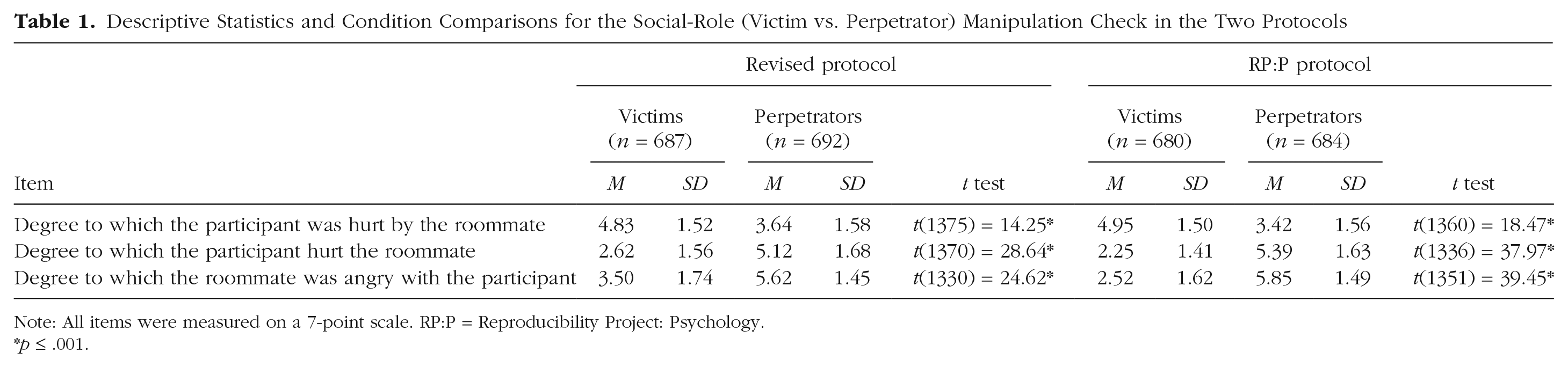
Note: All items were measured on a 7-point scale. RP:P = Reproducibility Project: Psychology.
p ≤ .001.
Descriptive Statistics and Condition Comparisons for the Type-of-Message (Empowerment vs. Acceptance) Manipulation Check in the Two Protocols
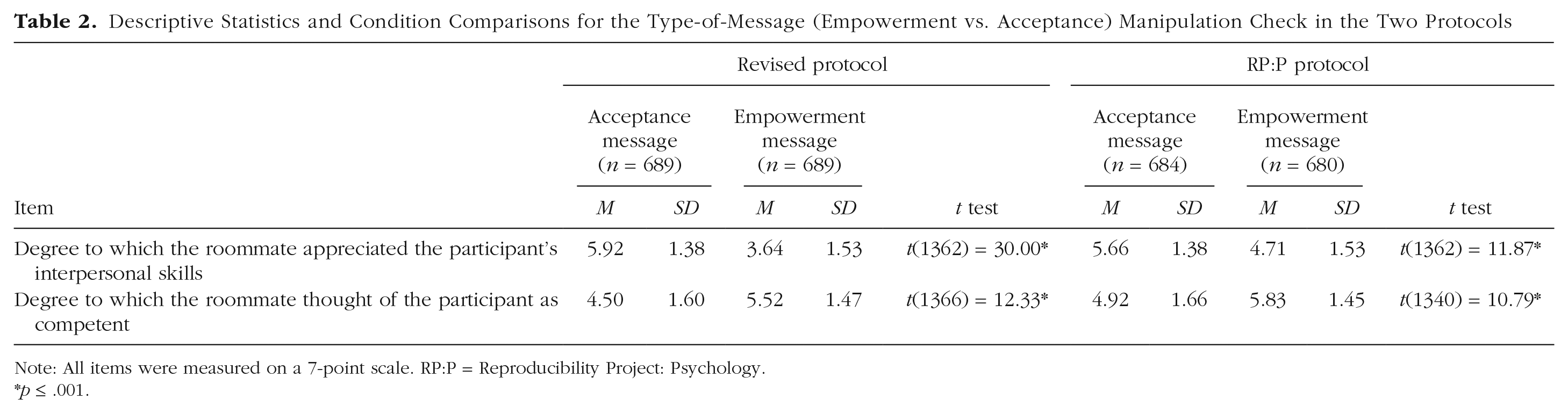
Note: All items were measured on a 7-point scale. RP:P = Reproducibility Project: Psychology.
p ≤ .001.
Analysis of measures prior to the message of acceptance or empowerment
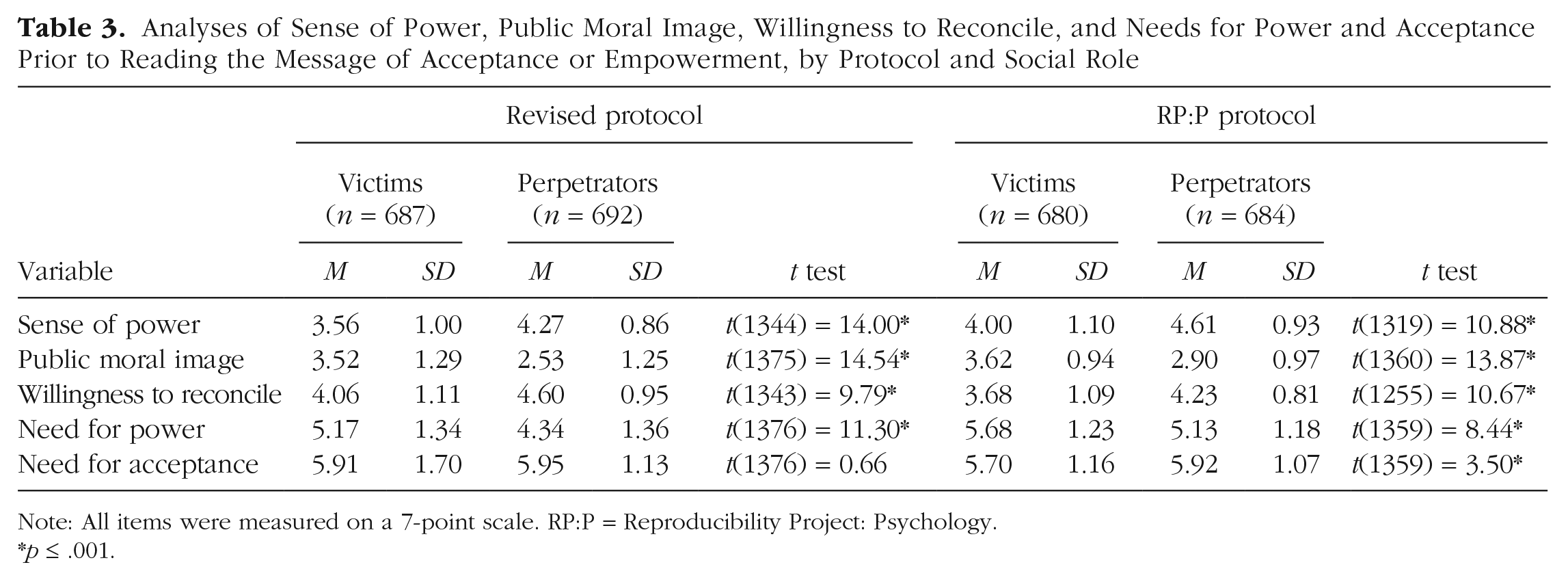
Central to Shnabel and Nadler’s model (2008) is the hypothesis that victims and perpetrators have different psychological needs. Thus, before testing the focal effect, we ran a series of t tests on the measures assessing participants’ sense of power, public moral image, willingness to reconcile, and psychological needs for power and acceptance prior to receiving the message of acceptance or empowerment. These analyses were not included in the preregistered plan or in the results-blind version of the manuscript but were added to aid in the interpretation of the focal effect targeted in this replication study. They should be considered strictly exploratory (see Table 3 for means, standard deviations, and t-test results).
Analyses of Sense of Power, Public Moral Image, Willingness to Reconcile, and Needs for Power and Acceptance Prior to Reading the Message of Acceptance or Empowerment, by Protocol and Social Role
Note: All items were measured on a 7-point scale. RP:P = Reproducibility Project: Psychology.
p ≤ .001.
In the revised protocol, participants assigned the victim condition, compared with those assigned to the perpetrator condition, had a lower sense of power, t(1344) = 14.00, 2 p < .001, Cohen’s d = 0.75; had a more positive perception of their public moral image, t(1375) = 14.54, p < .001, Cohen’s d = 0.78); and were less willing to reconcile, t(1343) = 9.79, p < .001, Cohen’s d = 0.53. Likewise, in the RP:P protocol, participants assigned to the victim condition, compared with those assigned to the perpetrator condition, had a lower sense of power, t(1319) = 10.88, p < .001, Cohen’s d = 0.59; had a more positive perception of their public moral image, t(1360) = 13.87, p < .001, Cohen’s d = 0.75; and were less willing to reconcile, t(1255) = 10.67, p < .001, Cohen’s d = 0.58.
After the act of perpetration in the revised protocol, participants assigned to the victim condition, compared with those assigned to the perpetrator condition, expressed a higher need for power, t(1376) = 11.30, p < .001, Cohen’s d = 0.61, and a similar need for social acceptance, t(1376) = 0.66, p = .66, Cohen’s d = 0.04. In the RP:P protocol, participants assigned to the victim condition, compared with those assigned to the perpetrator condition, expressed a higher need for power, t(1359) = 8.44, p < .001, Cohen’s d = 0.46, and a lower need for social acceptance, t(1359) = 3.50, p < .001, Cohen’s d = 0.20.
These results mostly support Shnabel and Nadler’s (2008) notion that being a perpetrator weakens individuals’ perception of their public moral image and strengthens their need for social acceptance. Conversely, being a victim weakens individuals’ sense of power and strengthens their need for power. Finally, before these psychological needs for power and acceptance are met following a conflict, victims are less willing to reconcile than perpetrators are. This finding is in line with what Exline and Baumeister (2000) termed the magnitude gap: Perpetrators perceive conflicts as less serious or harmful than the victims do.
Focal effect: change in willingness to reconcile
Our primary focus concerned whether we could replicate prior findings that victims and perpetrators are more willing to reconcile after their respective psychological needs are satisfied. We began by testing the predicted pattern in the aggregate data. As a first step, we constructed a linear mixed-effects model predicting willingness to reconcile from the following fixed effects: main effects of role (victim vs. perpetrator, between participants), message (acceptance vs. empowerment, between participants), and time (before vs. after the message, within participants); all two-way interactions; and the three-way interaction (the focal effect). We included two random intercepts: one for participants nested within sites and one for sites. 3 This modeling approach closely resembles that of the original study, and although we discuss a high-powered, alternative model in the Exploratory Analyses section, this approach served as the basis for our main interpretation.
Table 4 presents the results for the full model (Model 2), as well as a model testing the two-way interactions (Model 1). With the data aggregated across protocols, the three-way interaction of role, message, and time did improve the model’s prediction of willingness to reconcile, χ2(1, N = 2,743) = 14.58, p < .001, pseudo-R2 = .003. These results indicate that perpetrators were more willing to reconcile when their needs were satisfied than when those needs were not met (see Fig. 1 for a forest plot of the results from the full model, separately for victims and perpetrators at each site).
Model-Fit Comparison of Mixed-Effects Models Predicting Willingness to Reconcile From Participants’ Role (Victim vs. Perpetrator), Message Received (Acceptance vs. Empowerment), and Time (Before vs. After the Message)
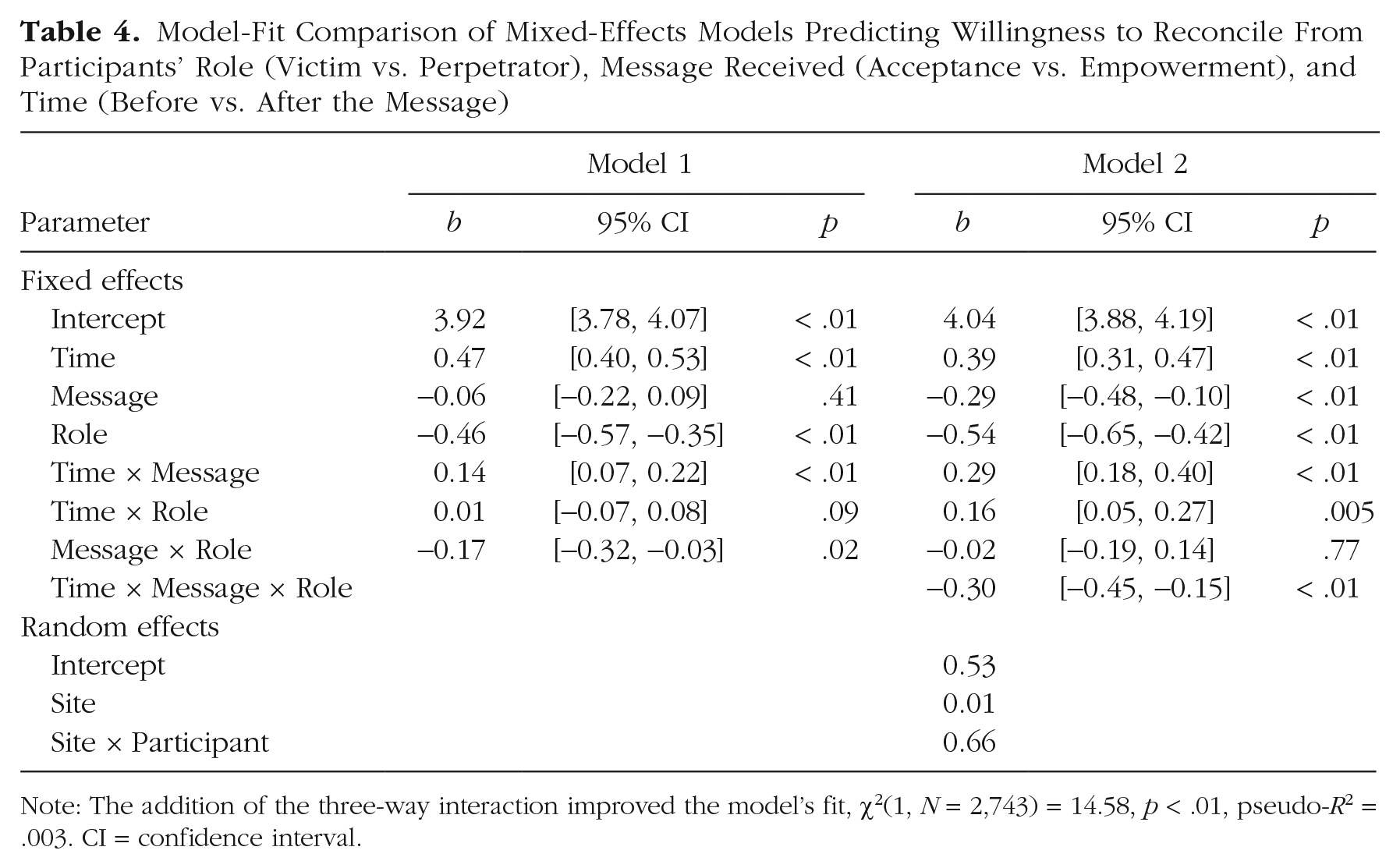
Note: The addition of the three-way interaction improved the model’s fit, χ2(1, N = 2,743) = 14.58, p < .01, pseudo-R2 = .003. CI = confidence interval.
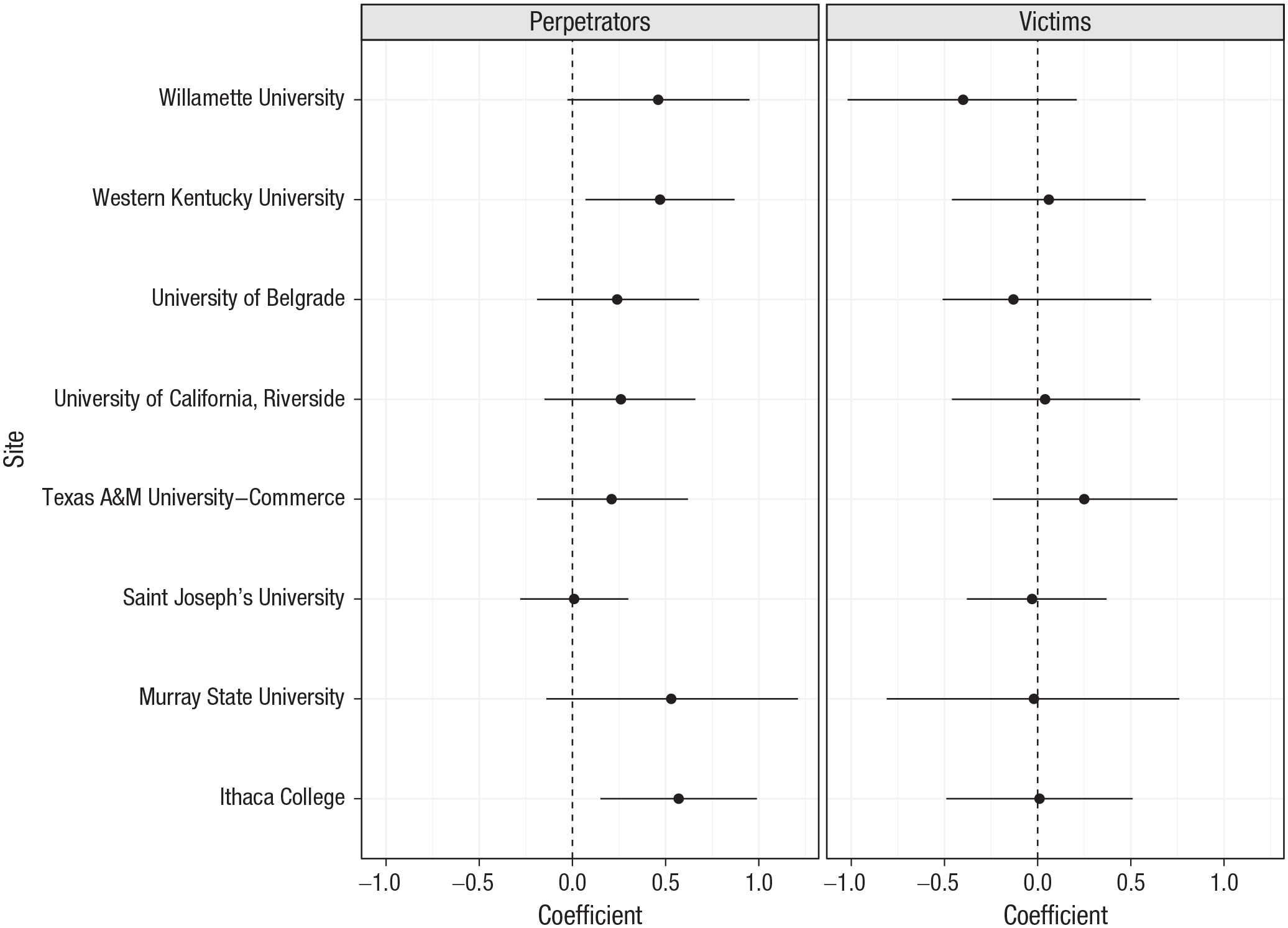
Results for the data aggregated across protocols: forest plot of the coefficient for message type as a predictor of change in willingness to reconcile, separately for perpetrators (left) and victims (right) at each data-collection site. Error bars indicate 95% confidence intervals. In both panels, a positive coefficient means greater change in willingness to reconcile after receiving a message of acceptance, relative to receiving a message of empowerment, whereas a negative coefficient represents a greater change in willingness to reconcile after receiving a message of empowerment, relative to receiving a message of acceptance.
Confirmatory analyses: moderation by protocol
Next, we examined whether the focal interaction was moderated by protocol. Although we did find evidence for the focal three-way interaction in the full data set, this effect could have been stronger for one protocol than the other. To test this possibility, we added the interaction with protocol as a fixed effect to the mixed-effects model. This interaction term did improve the model, χ2(1, N = 2,734) = 6.31, p = .012, pseudo-R2 = .001.
To better understand this four-way interaction, we applied the mixed-effects model for testing the focal effect in each protocol separately. For the revised protocol, results from the mixed-effects model, nesting participants within site, indicated that the three-way Message × Role × Time interaction did improve the model’s reliability in predicting participants’ willingness to reconcile, χ2(1, N = 1,369) = 20.55, p < .01, pseudo-R2 = .008. There was a significant interaction of role, message, and time, F(1, 2739) = 20.64 p < .01, η2 = .01; victims’ increase in their willingness to reconcile was greater after receiving a message of acceptance than after receiving a message of empowerment, t(1360) = 2.49, p = .01, and the increase in perpetrators’ willingness to reconcile was also greater after they received a message of social acceptance than after they received a message of empowerment, t(1372) = 8.58, p < .01 (see Fig. 2 for a visual representation). It should be noted that although we did replicate the focal effect (i.e., Message × Role × Time interaction), the pattern of results is partially inconsistent with that of the original study. Specifically, willingness to reconcile did increase after participants received a message, but contrary to the theory put forth by Shnabel and Nadler (2008), victims’ willingness to reconcile increased more for participants who received a message of acceptance than it did for participants who received a message of empowerment. A possible explanation for this discrepancy is discussed later.
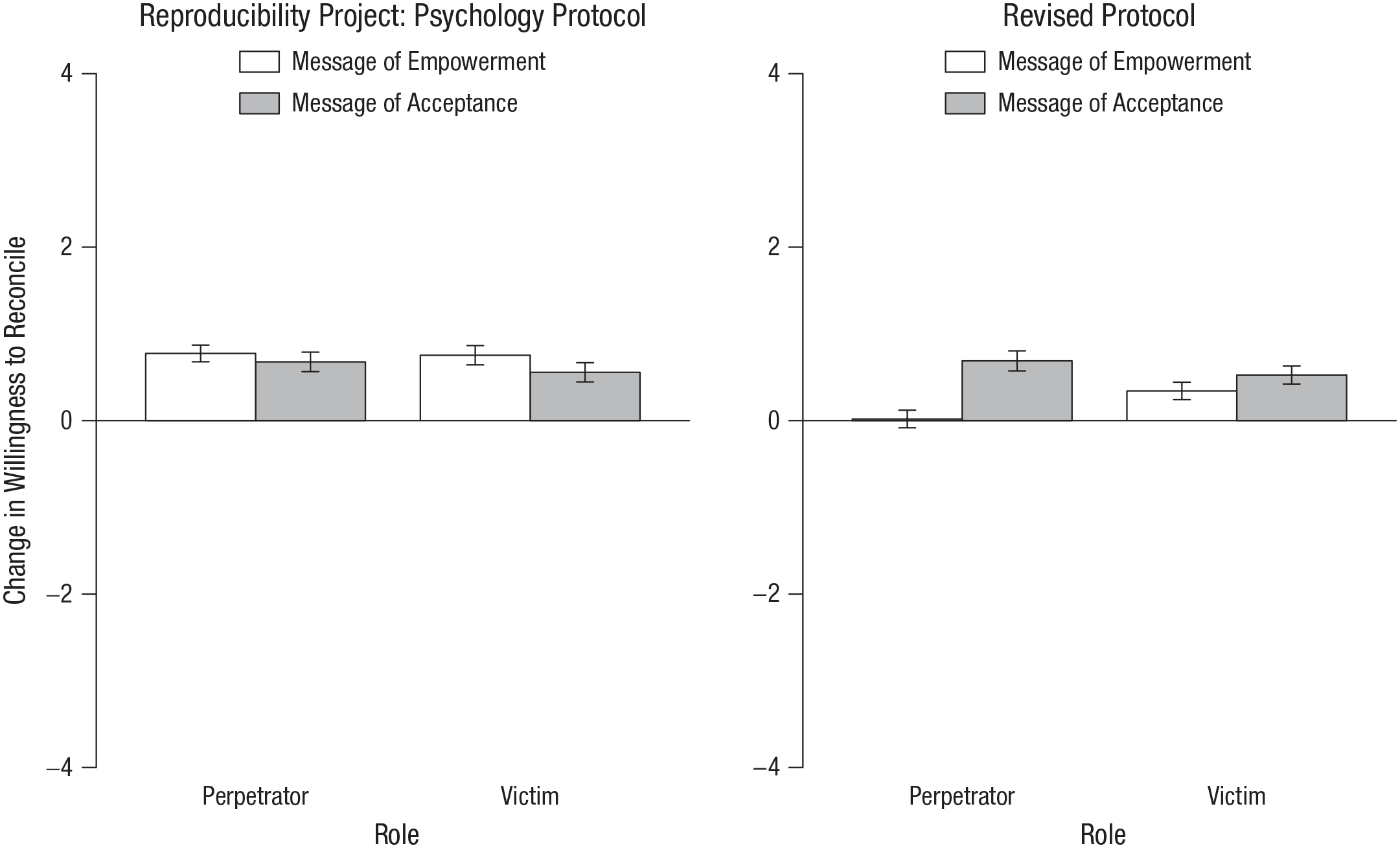
Mean change in willingness to reconcile by role and message, separately for the Reproducibility Project: Psychology protocol and the revised protocol. Error bars represent 95% confidence intervals.
For the RP:P protocol, results from the mixed-effects model with participants nested within site indicated that the three-way Message × Role × Time interaction did not improve the model’s reliability in predicting participants’ willingness to reconcile, χ2(1, N = 1,357) = 0.88, p = .35, pseudo-R2 < .001. Unlike for the revised protocol, there was a nonsignificant three-way interaction, F(1, 1357) = 0.88, p = .35, η2 < .01; victims’ willingness to reconcile was greater after they received a message of empowerment than after they received a message of acceptance, t(1358) = 2.48, p = .01, and perpetrators’ increase in willingness to reconcile was no greater after they received a message of social acceptance than after they received a message of empowerment, t(1364) = 1.25, p = .21.
Exploratory analyses
In this section, we report analyses that either were not included in the original study or were not part of our preregistered analysis plan. However, they add to the understanding of the results of the focal analyses just reported.
First, as explained earlier, to ensure that participants were paying attention throughout the study, we included an instructional attention check (Oppenheimer et al., 2009), adapted to fit the revised vignette (see https://osf.io/a3u6p/ for the exact wording within the revised protocol). We tested whether the focal effect (i.e., the three-way Role × Message × Time interaction) changed when participants who failed this check (i.e., did not click the area of the question prompt as per the instructions) were excluded from the sample. The model’s ability to predict willingness to reconcile was worse when these participants were excluded from the sample, χ2(1, N = 1,496) = 1.97, p = .16, pseudo-R2 = .001, yet the three-way interaction’s ability to predict willingness to reconcile was similar for the models with and without these participants. Although excluding participants who failed the attention check caused the focal three-way interaction to become nonsignificant, the pattern of results was in the same direction. To test the interaction effect directly, we added the attention check (pass/fail) as a moderator of the focal three-way interaction. Results indicated that passing the attention check did not moderate the three-way interaction of role, message, and time, t(1379) = 1.77, p = .07.
Next, although our analyses testing the focal effect matched those of Shnabel and Nadler (2008), a model with a three-way interaction is less reliable and has lower power than models with fewer terms. To account for this limitation, we conducted a 2 × 2 analysis of covariance to test the effects of role and message, adding willingness to reconcile before receiving the message as a covariate. This analysis tested the primary effect while controlling for preexisting reconciliatory tendencies. For the revised protocol, results showed a significant Role × Message interaction, F(1, 1370) = 12.66, p < .01, η2 = .009. Specifically, victims who received a message of empowerment were more willing to reconcile than were victims who received a message of social acceptance, F(1, 692) = 16.72, p < .01, η2 = .01, whereas perpetrators who received a message of social acceptance were more willing to reconcile than were perpetrators who received a message of empowerment, F(1, 677) = 20.44, p < .01, η2 = .03.
For the RP:P protocol, results showed a nonsignificant Role × Message interaction, F(1, 1353) = 1.65, p = .20, η2 < .01. Victims who received a message of empowerment were no more or less likely to reconcile than were victims who received a message of social acceptance, F(1, 667) = 2.57, p = .10, η2 = .002, and perpetrators who received a message of social acceptance were no more or less willing to reconcile than were perpetrators who received a message of empowerment, F(1, 685) = 0.10, p = .75, η2 < .01.
Finally, although the three-way interaction of time, message, and role was the focus of this replication, in order to provide a comprehensive analysis of the components of this interaction, we ran additional analyses evaluating mean-level change in willingness to reconcile as a function of message condition (i.e., message of acceptance or empowerment) and role (i.e., victim or perpetrator). As illustrated in Figure 2, for the revised protocol, willingness to reconcile increased for perpetrators given the message of acceptance (mean change = 0.69); however, it did not increase for perpetrators receiving a message of empowerment (mean change = 0.02), t(677) = 8.56, p < .01. For victims, both messages led to an increase in willingness to reconcile; receiving a message of acceptance led to a stronger increase (mean change = 0.53) than did receiving a message of empowerment (mean change = 0.34), t(681) = 2.50, p = .01. For the R:PP protocol, in contrast, willingness to reconcile increased regardless of participants’ role or message; however, the degree to which reconciliatory tendencies increased varied across groups. Specifically, whereas perpetrators had equal increases in willingness to reconcile after messages of acceptance (mean change = 0.68) and empowerment (mean change = 0.77), t(664) = 1.29, p = .10, victims’ willingness to reconcile increased more after a message of empowerment (mean change = 0.75) than after a message of acceptance (mean change = 0.56), t(676) = 2.47, p = .01.
Discussion
Shnabel and Nadler (2008) proposed a series of hypotheses outlining a needs-based model of reconciliation. Their study demonstrated that following a conflict, victims and perpetrators have different psychological needs (i.e., need for empowerment and need for social acceptance, respectively) that, when satisfied, will prompt a willingness to reconcile. The current replication attempt tested whether this focal effect could be observed using a protocol from a previous replication attempt (RP:P) and using a revised, peer-reviewed protocol. First, for both protocols, following a conflict but before receiving the message of acceptance or empowerment, victims did report having a weaker sense of power and a stronger need for empowerment than did perpetrators, whereas perpetrators reported having a weaker public moral image than did victims. In the RP:P protocol, but not the revised protocol, perpetrators also reported a stronger need for acceptance compared with victims. Next, we observed that when the data were collapsed across protocols, the focal hypothesis that Shnabel and Nadler proposed was confirmed; victims and perpetrators were more willing to reconcile when their needs were satisfied than when those needs were not met.
Finally, we tested whether the hypothesized effect was moderated by protocol (i.e., revised vs. RP:P). Protocol had a significant moderation effect. Specifically, in the revised protocol, perpetrators’ willingness to reconcile increased more after they received a message of social acceptance from their partner than after they received a message of empowerment from their partner. Indeed, perpetrators’ willingness to reconcile did not change at all if they received a message of empowerment. In contrast, victims’ willingness to reconcile increased regardless of whether they received a message of social acceptance or a message of empowerment; however, willingness to reconcile increased more among victims who received a message of acceptance than among those who received a message of empowerment, a pattern contrary to the proposed hypothesis (see Fig. 2).
In the RP:P protocol, messages of social acceptance and empowerment did not differentially increase or decrease perpetrators’ willingness to reconcile. Indeed, perpetrators who received the acceptance message and those who received the empowerment message increased in their willingness to reconcile to a similar extent. As hypothesized, victims’ willingness to reconcile increased more after they received a message of empowerment than after they received a message of acceptance.
It appears that the revisions made to the RP:P protocol may have strengthened part of the focal effect. Indeed, mean-level exploratory analyses revealed that a message of acceptance, compared with a message of empowerment, was more predictive of reconciliation in a roommate situation (revised protocol), and a message of empowerment was more predictive of reconciliation in a workplace situation (R:PP protocol). That is, for the revised protocol, which used a roommate-conflict scenario, participants in both roles increased in their willingness to reconcile after receiving a message of acceptance, whereas for the RP:P protocol, which used a workplace-conflict scenario, participants in both roles increased in their willingness to reconcile after receiving a message of empowerment, and for victims, the increase was significantly greater after the message of empowerment than after the message of acceptance. That said, despite this pattern of results, protocol did moderate the focal three-way interaction of time, message, and role: The revised protocol yielded better ability to predict increased willingness to reconcile than did the RP:P protocol.
That said, the manipulation checks indicated that the manipulations were successful in both protocols (see Tables 1 and 2). The successful manipulations of role and message type imply that our college-student participants understood the psychological differences between victims and perpetrators and between messages of acceptance and messages of empowerment following a conflict. The fact that the focal effect was replicated only in the revised protocol (albeit, in the case of victims, the pattern for the two message types was contrary to the theory) implies that the content of the protocol had an effect on the outcome of reconciliation over and above the effect of participants’ ability to conceptualize the differences between victims and perpetrators and messages of empowerment and acceptance.
The most notable difference in content between the protocols was the context of the interpersonal conflict: In the revised protocol, participants read a vignette describing a roommate conflict, whereas in the RP:P protocol, participants read a vignette describing a workplace conflict. Several issues regarding the content of the RP:P vignette prompted us to revise the protocol. First, the RP:P vignettes described an employee who took a 2-week leave from work for a honeymoon. This scenario is likely not something that a college student has experienced, so for the revised protocol we conducted a pilot study of undergraduate students to create vignettes. The revised vignettes described a recently unemployed college student who, upon returning from a 2-week family visit, was told by his or her roommate to move out before the end of the lease because the roommate had found someone who could commit to paying the next year’s rent. We believed that the target effect of this study is not dependent on a particular scenario. Instead, it is most important that participants can relate to a situation that elicits a sense of victimization or perpetration. The revised vignettes therefore were meant to appeal to undergraduate students broadly while eliciting the target psychological states.
The change in the vignette’s context (i.e., workplace conflict vs. roommate conflict) also changed the way that the independent variable (i.e., type of feedback message) was manipulated. Specifically, in the RP:P protocol, participants read a second vignette in which either professional or interpersonal feedback was given during a regular office meeting. In the revised protocol, participants read a continuation of the roommate vignette in which, as part of a class on intergroup dynamics, they received feedback containing a message of competence (empowerment) or social acceptance from their roommate. In sum, although our undergraduate participants were able to understand the psychological differences between victims and perpetrators and between messages of empowerment and acceptance following a conflict, it is possible that they were not able to imagine themselves as well in the RP:P protocol as they could in the revised protocol. In other words, given that all of the participants recruited for this replication attempt were college students, the increased relevance of the revised protocol’s vignette scenario likely helped participants connect to the study’s premise to the degree that the focal effect could be observed in their responses.
Limitations
A significant limitation of the analytic method in both the original study and the current replication attempt is the use of a between-participants design. Follow-up communication from the original authors after our replication attempt concluded that a such a design is not ideal for testing one of the main predictions: that victims and perpetrators are more willing to reconcile after their role-specific needs are met (empowerment and acceptance, respectively). Specifically, the original authors posit that, regardless of condition, participants will expect negative feedback in a typically negative situation (i.e., a conflict), so they will respond to the positive nature of the message they receive regardless of what that message is (empowerment vs. acceptance; see Birnbaum, 1999, for a discussion of the limitations of between-participants designs). Accordingly, the original authors have begun using a within-participants design in which participants read and respond to two conflict scenarios, one followed by a message of empowerment and the other followed by a message of acceptance (see Shnabel, Nadler, Ullrich, Dovidio, & Carmi, 2009; SimanTov-Nachlieli & Shnabel, 2014). A between-participants design is still appropriate for testing the needs-based model’s prediction that victims and perpetrators have different identity threats and consequently different psychological needs following a conflict.
Finally, it is important to note that nearly half (45%) of the participants who received the revised protocol did not pass the attention check. We can only speculate, but given this rather large percentage, it may be the case that it did not successfully check whether participants were paying attention to the study. Indeed, whether or not participants passed the attention check did not moderate the focal three-way interaction.
Conclusion
The current multisite attempt to replicate Shnabel and Nadler’s (2008) Study 4 did align with the original investigation in that participants’ willingness to reconcile improved after they received a message of acceptance or empowerment, although victims’ willingness to reconcile was greater in response to the non–theoretically prescribed message than in response to the theoretically prescribed message. This partial replication was observed only when participants received the revised and peer-reviewed version of the original protocol. These results underscore the importance of thoughtful consideration of how the content of the replication materials will be received by the population from which participants are selected.
Footnotes
Acknowledgements
We thank Courtney Soderberg for her feedback on our analysis plan.
Transparency
Action Editor: Daniel J. Simons
Editor: Daniel J. Simons
Author Contributions
E. Baranski developed the study’s materials, conducted the analyses, contributed to data collection, and drafted the manuscript. C. R. Ebersole helped revise the manuscript. E. Baskin, S. Coary, L. E. Krueger, L. B. Lazarević, J. K. Miller, A. Orlić, M. R. Penner, D. Purić, S. C. Rife, L. A. Vaughn, A. L. Wichman, and I. Žeželj contributed to data collection and helped revise the manuscript.

Notes
References
Supplementary Material
Please find the following supplemental material available below.
For Open Access articles published under a Creative Commons License, all supplemental material carries the same license as the article it is associated with.
For non-Open Access articles published, all supplemental material carries a non-exclusive license, and permission requests for re-use of supplemental material or any part of supplemental material shall be sent directly to the copyright owner as specified in the copyright notice associated with the article.
