



Abstract
Background:
The vaccination for human papillomavirus (HPV) is a widely acknowledged global measure aimed at preventing cervical cancer. However, the rate of vaccine adoption differs across various regions and countries due to a number of discouraging factors. Therefore, this study aimed to assess the uptake of HPV vaccination and associated factors among high school female students in Dessie City Administration, Northeast Ethiopia, 2023.
Methods:
School-based cross-sectional study was conducted among 410 high school female students in Dessie City Administration from April 1, 2023, to May 1, 2023. Participants were selected using a simple random sampling technique. The data were collected using self-administered questionnaires. Data were entered using EPI data version 4.6 and exported to SPSS version 26 for analysis. Data were presented with frequency tables, graphs, and pie charts. To determine the factors associated with the outcome, a two-step logistic regression approach was employed. Initially, a bivariable analysis identified potential predictor variables with a p-value of less than 0.25, which were then included in a multivariable model. A p-value of less than 0.05 and an adjusted odds ratio at a 95% confidence level were used to confirm associations. In addition, the Hosmer–Lemeshow test was used to assess the model’s goodness of fit.
Results:
The overall uptake of the HPV vaccine among female high school students in Dessie City was 54.9% with 95% CI (50.2, 59.8). In this study finding, fathers’ educational level (AOR = 5.00, 95% CI: (1.59, 15.73)), source of information (AOR = 2.08, 95% CI: (1.13, 3.83)), and having positive attitude toward HPV vaccination (AOR = 1.88, 95% CI: 1.23, 2.87) were variables that showed a significant association with uptake of HPV vaccine.
Conclusion:
In this study, nearly half a percent of female high school students did not uptake the HPV vaccine. Fathers’ education level, source of information, and positive attitude were positively associated with the uptake of the HPV vaccine among female high school students. Therefore, schools should provide continuous school-based training about the HPV vaccine to foster attitudinal change among female high school students.
Introduction
The primary cause of cervical cancer is the human papillomavirus (HPV). Vaccination against HPV is highly effective in preventing cervical cancer. 1 The two vaccines, bivalent and quadrivalent, are very effective at preventing infections from HPV types 16 and 18. In addition, the quadrivalent vaccine is also effective in preventing anogenital warts caused by HPV types 6 and 11. At present, the primary focus of HPV vaccination is the prevention of cervical cancer. 2 By 2020, over half of the countries that are members of the WHO had established HPV vaccination programs to achieve the 90% elimination target set for the 2030 Sustainable Development Goals. 2
Globally, cervical cancer is one of the most common cancer types in women, accounting for approximately 604,000 new cases and 342,000 deaths in 2020. 3 The 2020 International Agency for Research on Cancer report revealed a significant disparity in cervical cancer mortality rates, with 12.4 deaths per 100,000 women in developed countries and 5.2 deaths per 100,000 women in developing countries. 4 Research indicated that the rates of HPV vaccine uptake (administering at least one dose) differed greatly between countries, ranging from as low as 1.1% to as high as 94.4%.5,6 It is estimated that approximately 75% of sexually active individuals will contract HPV, making it the most common sexually transmitted infection. 7 The World Health Organization recommends that the primary target for HPV vaccination should be girls aged 9 to 14, while women aged 15 and older should be considered a secondary target group. 8
Various factors influence the uptake of the HPV vaccine. These factors encompass a lack of awareness regarding cervical cancer and HPV infection, negative perceptions toward the vaccine, as well as demographic elements such as age, place of residence, educational level, parental education, and the occupational status of parents.9–11 Furthermore, factors such as a family history of cancer, participants’ knowledge about the HPV vaccine obtained from sources like school, newspapers, and the internet, as well as concerns about the possibility of future HPV infection, were key contributors to the likelihood of receiving the HPV vaccine. 12 To investigate these factors, numerous significant studies have examined adolescents’ knowledge and attitudes toward vaccines, revealing that limited awareness and negative perceptions greatly impact vaccine uptake. 13
Individuals who did not receive the HPV vaccine are at a significantly higher risk of developing cervical cancer compared to those who are vaccinated. Consequently, the mortality rate in these populations has increased sharply over time. 10
Cervical cancer is a major public health concern in Ethiopia, accounting for approximately 7000 new cases and 5000 deaths annually, making it the second most common cause of cancer-related deaths among women in the country. 14 The low rate of HPV vaccination among female high school students is likely to lead to increased costs associated with disability and death from cancer. Since the introduction of the HPV vaccine, numerous countries have implemented school-based immunization programs that have proven highly effective in increasing vaccination rates among adolescents. 15 HPV vaccinations are a new program in Ethiopia; their acceptance by the public has been lagging for several reasons. 16
To the knowledge of the investigator, only a few studies have been conducted on the uptake of the HPV vaccine and associated factors among female high school students in Ethiopia. However, no research has been done on this topic, particularly in this study area. Therefore, this study aims to assess the proportion of HPV vaccine uptake and its associated factors among female high school students in Dessie City Administration. This study will contribute to generating information that may be helpful in understanding the current situation of HPV vaccine utilization. In addition, it will highlight gaps encountered in the uptake of the HPV vaccine among female high school students, providing valuable insights for supporting organizations and the government to focus on when targeting vaccine provision.
Methods and materials
Study design, area, and period
A cross-sectional study was carried out in Dessie City from April 1 to May 1, 2023. Dessie City is situated 401 km from Addis Ababa and 490 km from Bahir Dar. As per the 2017 population estimates for Ethiopia, the town has a total population of 209,226, with 103,429 (49.4%) being male and 105,797 (50.6%) being female. Dessie City is administratively divided into five sub-cities and comprises 12 high schools, consisting of nine public schools and three private schools, with a total enrollment of 8001 female students. Specifically, there are 7300 female students from government-run schools and 701 from private schools.
Population
Source population
All female students enrolled in Dessie City High School for the 2022/2023 academic year.
Study population
The study population included all female high school students enrolled in Dessie City high schools during the 2022/2023 academic year who were available for data collection during the study period.
Inclusion and exclusion criteria
Inclusion criteria
All female students enrolled in both public and private high schools within the Dessie City Administration.
Exclusion criteria
All female students enrolled in public and private high schools in Dessie City who were absent during the data collection period, following two separate visits, were not included.
Sample size determination and sampling technique
Sample size determination
The sample size was determined using a single population proportion formula, with calculations based on the uptake rate of the HPV vaccine to account for a larger sample size. It was assumed that the proportion of female students in Bahir Dar City who had received the HPV vaccine was 45.3% 9 with a 95% confidence level and a 5% margin of error to determine an optimal sample size.

where:
n = minimum required sample size
Z = the Z-value corresponding to the 95% confidence level (1.96)
p = proportion of students vaccinated
d = margin of error
Using this formula, the calculated sample size was 381. After adding a 10% non-response rate, the final sample size became 419.
Sampling procedure
In Dessie City Administration, there are 12 high schools. Among these, nine are government schools and three are private high schools. A total of 8001 female students were enrolled in these high schools during the 2022/2023 academic year. Samples were taken from all government and private high schools, proportionally to their size, using a simple random sampling technique from each school (Figure 1).
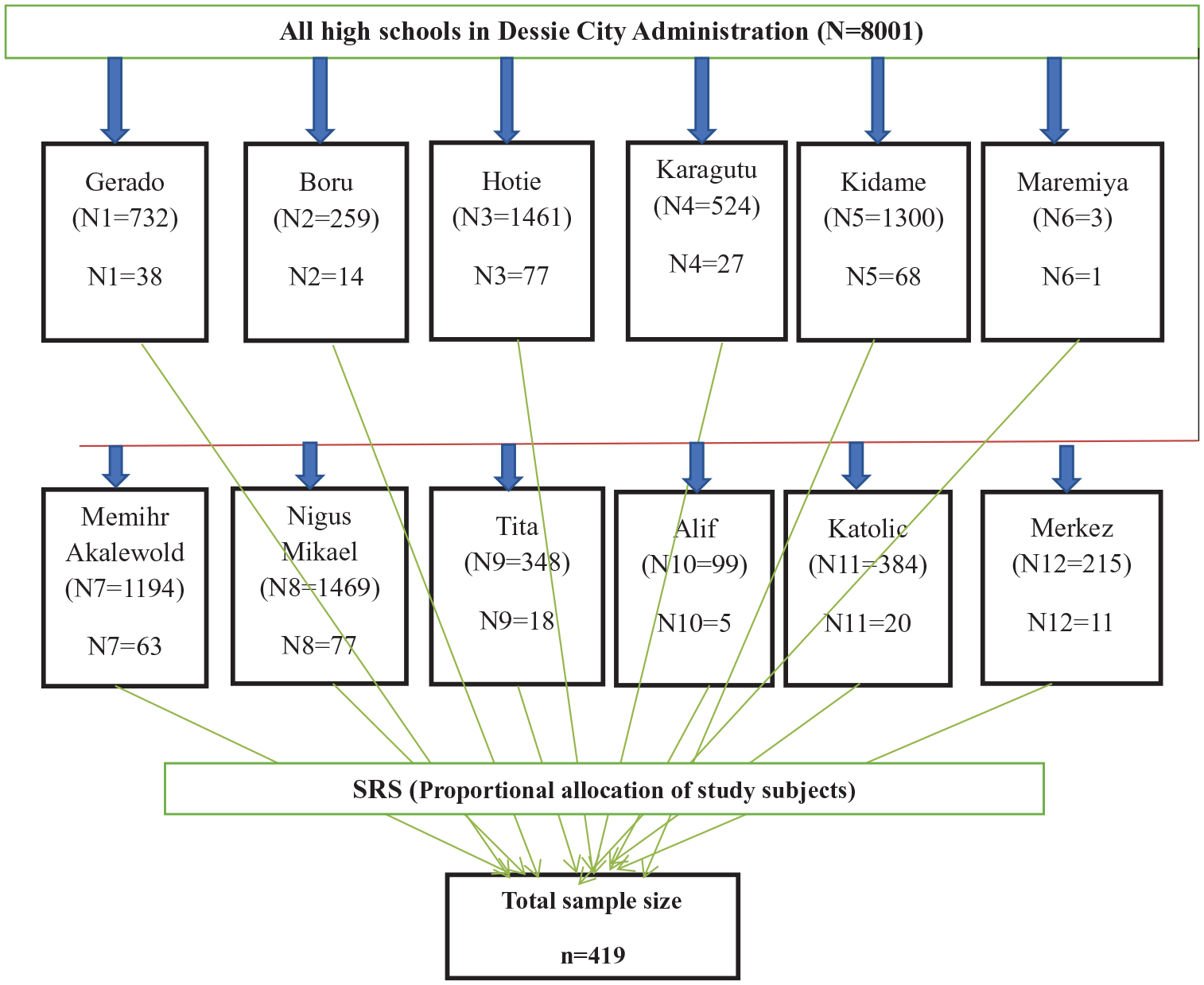
Sampling procedures about the uptake of the HPV vaccine among female high school students in the Dessie city administration, 2023.
Study variables
Dependent variables
➢ Uptake of HPV vaccination.
Independent variable
Socio-demographic factors: Age, marital status, residence, educational status, religion, family income, and parents’ educational status
Health system factors: Existence of promotion and pre-information, awareness creation about the HPV vaccine at school, availability of vaccine, and source of information.
Knowledge and attitude-related factors: Knowledge about the HPV vaccine and Attitude toward the HPV vaccine.
Operational definition
HPV Vaccine: The HPV vaccine protects against HPV, which is recognized for its role in preventing cervical cancer and other HPV-related infections in women. 9
Uptake of HPV vaccine: It refers to participants who had received at least 1 dose of the HPV vaccine and will be measured as a binary outcome (uptake and not uptake). 17
Knowledge: The evaluation consisted of 13 knowledge-based questions, where respondents received 1 point for each correct answer and 0 points for each incorrect one. 17
Good knowledge of HPV vaccine: Participants who answered at least the average number of 13 HPV vaccine knowledge questions correctly were deemed to have good knowledge of the vaccine. 17
Poor knowledge of HPV vaccine: Participants who answered fewer than the average of 13 HPV vaccine knowledge questions were regarded as lacking knowledge.
Attitude for HPV vaccine: It was assessed using 10 items with a 5-point Likert scale. 17
Positive attitude: Participants who scored at least the average of 10 attitude questions were classified as having a positive attitude toward the HPV vaccine. 17
Negative attitude: Participants who scored below the average of 10 attitude questions were deemed to have a negative attitude toward the HPV vaccine. 17
Data collection tools and quality control
A structured, self-administered questionnaire in English was developed. The questionnaires were first translated into Amharic and then back into English to ensure consistency and to facilitate ease of administration. The questionnaires were pre-tested at Kombolcha High School with female students and 21 study participants, and necessary modifications were made. The principal investigator provided a 1-day training session for data collectors and supervisors, covering the study’s objectives, questionnaire content, data collection procedures, methods to assist study participants, and various ethical considerations. Throughout the study, the principal investigator and supervisor regularly reviewed the collected data daily to ensure its completeness.
Data processing and analysis
The data were coded and input using EpiData Version 4.6 software, and then exported to SPSS version 26 for additional statistical analysis. Various frequency tables, graphs, and descriptive summaries were employed to illustrate the study variables. Logistic regression analysis was conducted to assess the significance of the relationship between the dependent and independent variables. Bivariable and multivariable logistic regressions were conducted to examine the relationship between health-seeking behavior and various independent variables. The bivariable logistic regression analysis was utilized to identify potential candidate variables for the multivariable regression, including those with a p-value less than 0.25. These were then included in the multivariable logistic regression analysis. A p-value below 0.05 and an adjusted odds ratio (AOR) with a 95% confidence interval (CI) were used to determine statistical significance. The model’s fit was evaluated using the Hosmer and Lemeshow goodness-of-fit test (p = 0.275).
Results
Sociodemographic characteristics of the study participants
From a total of 419 participants, 410 female students in high schools in Dessie city participated in this study, resulting in a response rate of 97.85%. The mean age of respondents was 17.36 years, with a standard deviation of ±2.57 years. More than half of the participants, 316 (77.1%), were urban residents. The majority, 358 (87.3%), were single in marital status. Nearly half of the participants, 216 (52.7%), identified as Muslim in religion (Table 1).
Sociodemographic characteristics of study participants in Dessie City High Schools, Amhara Region, Northeast Ethiopia, 2023 (n = 410).

Uptake of HPV vaccine among high school female students in Dessie City
The overall uptake of HPV among high school female students in Dessie city was 225 (54.9%; Figure 2).
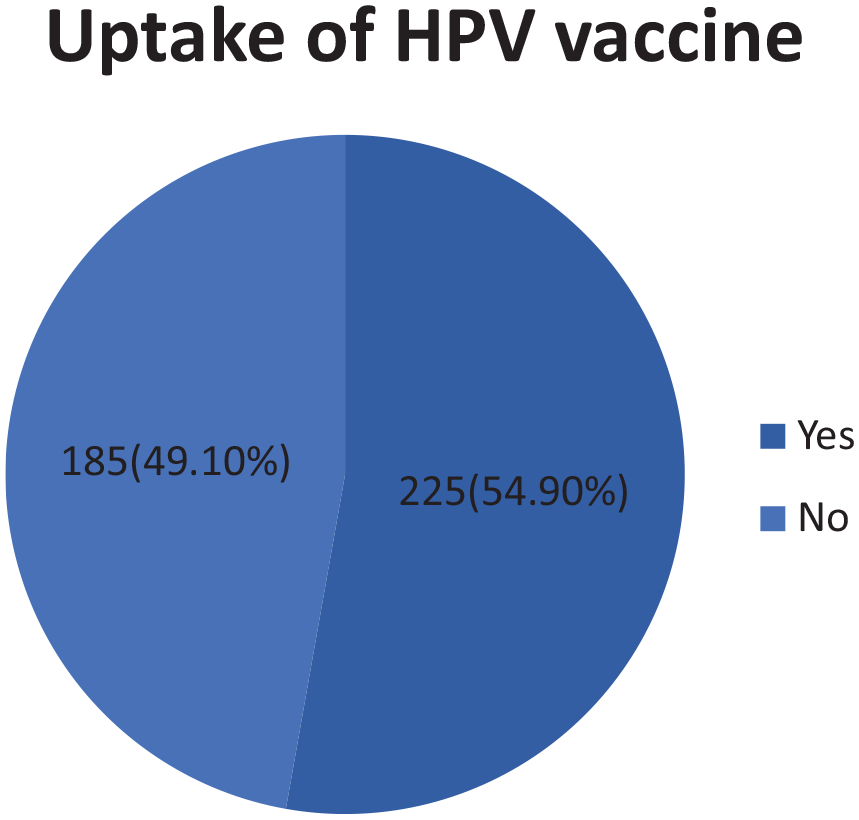
Uptake of HPV vaccine among high school female students in Dessie City, Northeast Ethiopia, 2023.
Reasons for not taking the HPV vaccination among female high school students
The main reasons for not taking the HPV vaccine among female high school students were not knowing where the vaccine was received 59 (14.4%), followed by not being informed by health care providers 53 (12.9%; Figure 3).
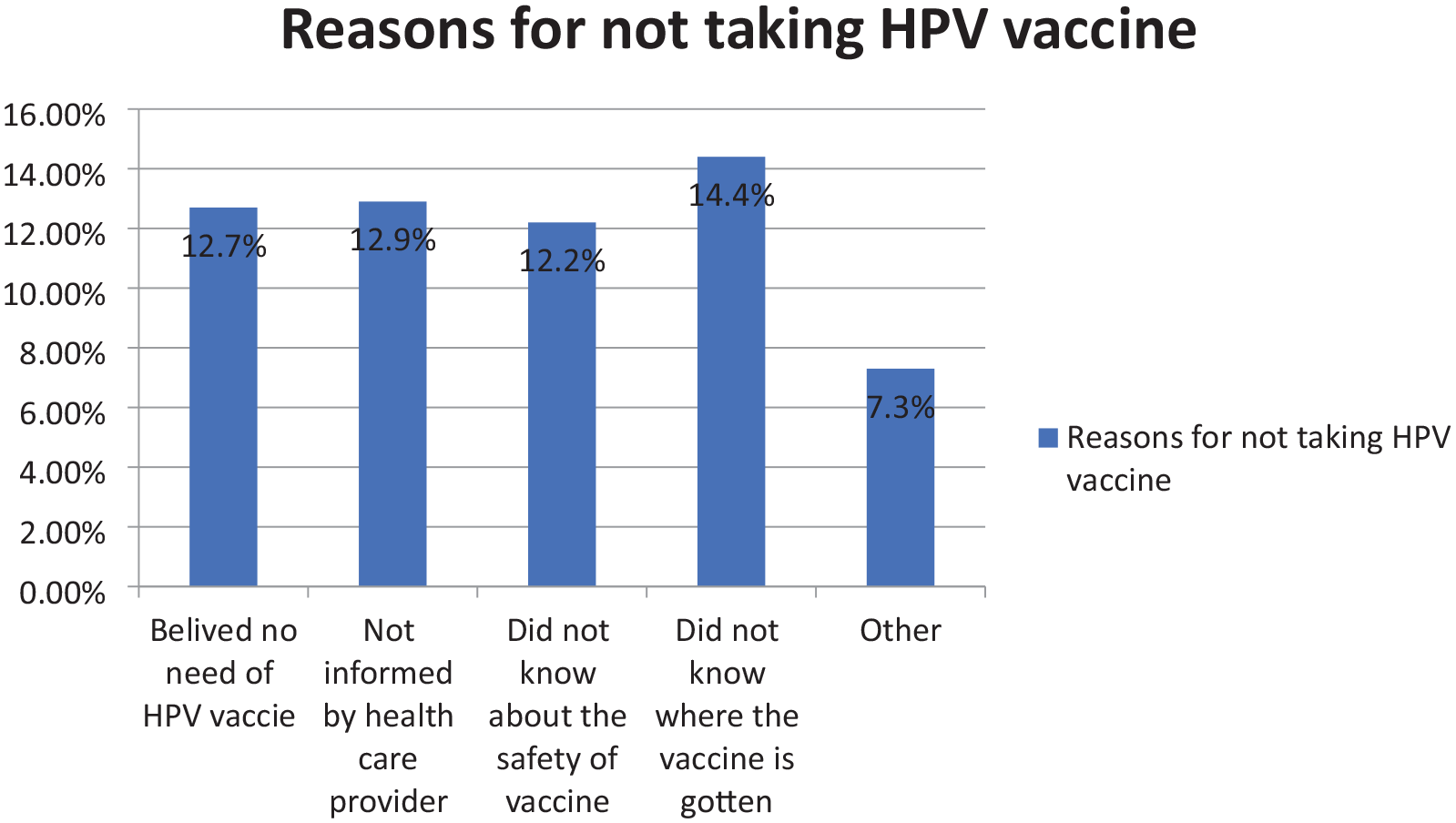
Reasons for not taking HPV vaccination among female high school students in Dessie City, Northeast Ethiopia, 2023 (n = 185).
Knowledge about HPV vaccination among female high school students
In this study, 187 (45.6%) of the participants scored less than the average score of the knowledge questionnaire (Figure 4).

Knowledge about HPV vaccination among female high school students in Dessie City, Northeast Ethiopia, 2023 (n = 410).
Attitude toward HPV vaccination among female high school students
More than half of 230 (56.1%) of the study participants scored more than the mean value of attitude questions (Figure 5).

Attitude toward HPV vaccination among female high school students in Dessie City, Northeast Ethiopia, 2023 (n = 410).
Health information and the availability of the health system among high school female students
In this study, 205 (50%) of the study participants got information from healthcare providers. One hundred fourteen (34.1%) of the participants need more information about the HPV vaccine and cervical cancer (Table 2).
Health information and availability of health system among high school female students in Dessie city high schools, Northeast Ethiopia, 2023 (n = 410).

Factors associated with uptake of the HPV vaccine among female students
In bivariable analysis, nine variables, namely, residence, age, marital status, level of education, father’s level of education, mother’s occupation, source of information, attitude, and need for further information, were candidate variables for multivariable logistic regression at a p-value of less than 0.25.
In multivariable logistic regression, three of the nine variables were significantly associated with the uptake of the HPV vaccine among female students at a 5% level of significance. The significant factors of uptake of the HPV vaccine were a source of information, the father’s level of education, and the attitude of the students, which had a statistically significant association with uptake of the HPV vaccine among female students.
Participants who had a positive attitude toward the HPV vaccine were two times more likely to uptake the HPV vaccine as compared to those who had a negative attitude (AOR = 1.88, 95% CI: 1.23, 2.87). On the other hand, those fathers whose level of education of primary, secondary, and diploma and above were 5, 5, and 4 times more likely to uptake of HPV vaccine, respectively, when compared to those fathers who can only read and write (AOR = 5.00, 95% CI: (1.59, 15.73)), (AOR = 5.27,95% CI: (1.72, 16.13)) and (AOR = 4.265, 95% CI: 1.54,14.00)). Those who had sources of information from healthcare providers and at school were two times more likely to uptake of HPV vaccine when compared to those who had gotten it from radio/television (AOR = 2.08, 95% CI: (1.13_3.83)) and (AOR = 2.07, 95% CI: (1.09, 3.91)) (Table 3).
Multivariable analysis for factors associated with uptake of HPV vaccine among female students in Dessie city high schools, 2023 (n = 410).

Hosmer and Lemeshow goodness of fit test = 0.275.
p < 0.05. **p ⩽ 0.001. ***p < 0.0001.
AOR, adjusted odds ratio; COR, crude odds ratio.
Discussion
Cervical cancer is a significant public health challenge worldwide. More than 99% of cervical cancer cases are linked to infections caused by specific strains of HPVs (9). Vaccination is a key preventive measure against HPV infection, which can prevent over 90% of related cancers. 18 The main implication of low uptake of HPV vaccination among female high school students is an increase in the costs associated with disability and death from cancer.
In this study finding, the overall uptake of the HPV vaccine among study participants was 54.9% with 95% CI (50.2, 59.8). The finding of this study is in line with the findings conducted in China (53.5%) 19 and Nekemte town, Oromia Region (52%). 18 The present finding of this study is higher than the studies done in Nigeria (40.9%), 20 Ambo town (44.4%), 21 and Bahir Dar City, Amhara Region (43.3%). 9 The possible explanation for these discrepancies might be related to sociodemographic and cultural variations in the uptake of HPV vaccination among the study areas.
In this study, fathers’ primary education level, secondary education level, and having a college diploma and above were found to be positively associated with the uptake of the HPV vaccine among female high school students. Those who had a primary and above their father’s educational level were more likely to uptake the HPV vaccine as compared to those who had a father’s educational level of only read and write. This finding is in line with the studies conducted in Jimma town 22 and Nekemte town. 18 This could be due to the fact that as the educational status of the parents increases, the chance of getting advice about the advantages of taking the HPV vaccine also increases.
The other important variable that showed a positive association with the uptake of the HPV vaccine was a source of information. Having sources of information from healthcare providers and schools was positively associated with the uptake of the HPV vaccine among the study participants. Those who had information from healthcare providers and schools were more likely to uptake the HPV vaccine as compared to those who had information from radio and television. This study finding was similar to the study done in Nigeria. 20 The possible reason might be due to students who have heard about the HPV vaccine may read about it or ask others about its benefits.
On the other hand, having a positive attitude was positively associated with the uptake of the HPV vaccine. This finding is in line with the studies conducted in Nekemte town, Oromia Region, 18 and Bahir Dar City, Amhara Region. 9 Those who had positive attitudes were more likely to uptake the HPV vaccine as compared to those who had negative attitudes. This might be because that individuals who have a positive attitude toward the vaccine may utilize it.
Strengths and limitations of the study
The study’s results were derived through a cross-sectional analysis of the respondents; as a result, the data were subject to response bias. In addition, a mixed study design was not employed to obtain in-depth information about knowledge and attitudes toward the HPV vaccine. However, its important contribution as a source of information on the factors associated with the uptake of the HPV vaccine among high school female students is one of its key strengths.
Conclusion
The overall uptake of the HPV vaccine among female high school students in Dessie City was around 50%. In this finding, fathers’ education level, having a source of information from health care providers and school, and having a positive attitude were variables that showed a significant association with the uptake of the HPV vaccine. It is recommended that targeted educational programs be developed aimed at fathers, emphasizing the importance and safety of the HPV vaccine to increase their understanding and support for vaccination. Utilize trusted sources such as healthcare providers, schools, and community leaders to disseminate accurate, accessible information about HPV and the benefits of vaccination. Implement community engagement initiatives and peer education programs to foster positive perceptions and attitudes toward HPV vaccination among students and parents. Integrate HPV vaccination into school health services to facilitate easy access and increase uptake rates among high school students.
Supplemental Material
sj-docx-1-tav-10.1177_25151355251375970 – Supplemental material for Uptake of human papillomavirus vaccination and associated factors among high school female students in Dessie City Administration, North East Ethiopia: a cross-sectional study
Supplemental material, sj-docx-1-tav-10.1177_25151355251375970 for Uptake of human papillomavirus vaccination and associated factors among high school female students in Dessie City Administration, North East Ethiopia: a cross-sectional study by Abdu Hussen, Nigusie Tadesse, Endalew Minwuye Andargie and Yonas Fissha Adem in Therapeutic Advances in Vaccines and Immunotherapy
Footnotes
Acknowledgements
We would like to first and foremost express our sincere gratitude to Wollo University College of Medicine and Health Sciences for providing this opportunity. The authors would like to thank all the participants who participated in this study.
Declarations

Supplemental material
Supplemental material for this article is available online.
References
Supplementary Material
Please find the following supplemental material available below.
For Open Access articles published under a Creative Commons License, all supplemental material carries the same license as the article it is associated with.
For non-Open Access articles published, all supplemental material carries a non-exclusive license, and permission requests for re-use of supplemental material or any part of supplemental material shall be sent directly to the copyright owner as specified in the copyright notice associated with the article.
