



Abstract
Background:
The COVID-19 pandemic has had an extreme global impact, transforming our daily lives, educational systems, and healthcare systems. Healthcare workers’ views on mandatory vaccination and experience with vaccines may play a pivotal role in vaccination rates and public health policy.
Objectives:
The purpose of this study is to uncover the perspectives of pharmacy students, at Xavier University of Louisiana, concerning COVID-19 vaccination mandates in educational institutions and healthcare environments, specifically the ethical, legal, and logistical dimensions. Furthermore, it will also assess the varying perceptions of vaccine safety and its impact on herd immunity while analyzing demographic characteristics.
Design:
A questionnaire survey.
Methods:
This cross-sectional study was conducted among students at Xavier University of Louisiana College of Pharmacy. Data were collected from the students using an online, anonymous questionnaire system named QualtricsXM. The survey was distributed to all 291 XULACOP students through email, text message, and GroupMe as a web link or QR code from August 25th to August 31st, 2023. Demographic data collected in the survey included age range, gender, and race/ethnicity. The 16-question survey assessed the students’ understanding, opinions, and experiences regarding COVID-19 vaccines and mandates.
Results:
The study sample included 151 students, reflecting a 52% response rate. Approximately, half of the study respondents believe the vaccine should be mandatory for the public, which was associated with opinions about students believing COVID-19 vaccines should be mandatory for school admissions were seven times more likely (OR = 7.33) and students believing mandatory vaccination infringes on personal freedom were 26% less likely (OR = 0.26) to support mandatory COVID-19 vaccines for the public(p = 0.000). When analyzing demographic characteristics, there was a significant difference in outcome between Black and non-Black students in their belief about mandatory vaccination for herd immunity (p = 0.016).
Conclusion:
The findings of this study indicate that half of the students support making the vaccine mandatory for the public. However, significant concerns about personal freedom and individual rights were expressed by those who opposed this view. Varying pharmacy student opinions among demographic groups on vaccine mandates and understanding the factors influencing these differences can offer valuable insights into public health policy.
Introduction
When the outbreak of SARS-CoV-2 happened, it brought our world to a standstill, exposing the interrelationship within our global society. As this respiratory virus took over, it caused a plethora of challenges, affecting the way we work, live, and interact. As of August 2023, there are roughly 770 million confirmed cases and almost 7 million deaths reported related to the virus. 1 In efforts to combat the virus, nearly 13 billion COVID-19 vaccines have been administered as of August 2023, signifying a significant stride in global immunization campaigns. 1
Debates among healthcare workers regarding policies on mandatory vaccination and bioethics have emerged in the wake of the catastrophic effects of COVID-19. 2 Healthcare workers’ “Good Medical Practice” code and obligation to minimize risk to their patients may complicate and influence their acceptance of vaccine mandates.3,4 Vaccines remain a crucial tool in protecting individuals against COVID-19, with governments and institutions mandating actions, particularly for high-risk groups and frontline workers. 1 The approval of the Pfizer- BioNTech/Comirnaty mRNA vaccine by the U.S. Food and Drug Administration in August 2021 marked a crucial development in the fight against symptomatic COVID-19. 5 Evidence suggests the U.S. COVID-19 vaccination program has substantially reduced the burden of disease in the United States by preventing serious illness in fully vaccinated individuals and interrupting chains of transmission. 5
Frontline workers, including nurses, pharmacists, emergency responders, and physicians, played an essential role during the pandemic. A study revealed that medical students, considered frontline healthcare workers, faced potential exposure to COVID-19, highlighting the importance of high vaccination coverage in this population. 4 However, vaccine hesitancy among medical students was evident, with studies indicating hesitancy rates and contributing factors.6-8 Reflecting on the H1N1 pandemic 12 years ago, experts gathered to explore the subdued acceptance of the vaccine, shedding light on the complexities surrounding its adoption.1,9
Vaccine hesitancy, identified by the World Health Organization as a major public health crisis, is influenced by various factors, including concerns about rapid vaccine development, and uncertainties about their long-term effects, which contribute to doubts about their safety.1,10 Mistrust in authorities and pharmaceutical companies, fueled by historical injustices and unethical practices, further fuels skepticism and reluctance to embrace mandatory vaccination, specifically in minority communities.1,11 Across the United States, Black and African American communities have been disproportionately affected by COVID-19, with higher case rates, more deaths, and more severe economic effects than other racial and ethnic communities.12,13 Healthcare workers may play an essential role in eliminating health disparities by providing community-specific health education and trust in healthcare advice. Furthermore, the introduction of new vaccines and new combinations of vaccines spark new questions, seeking clarity in a complex environment incorporated with misinformation and accurate, scientifically grounded data. 10
In the ongoing efforts to reduce health disparities, pharmacists have emerged as trusted healthcare providers, playing a pivotal role in patient education, preventive care, and personalized health management. 12 Their pivotal role extends beyond medication dispensing, encompassing patient education, preventive care, and fostering a personalized approach to health management. As accessible and knowledgeable healthcare professionals, pharmacists contribute significantly to building trust and bridging gaps in healthcare delivery, making them invaluable allies in the pursuit of equitable and unbiased healthcare for all. Pharmacists, being more readily available to patients than other healthcare providers, have a responsibility to cultivate trust and confidence in addressing vaccine hesitancy. 11 The engagement of pharmacists as immunizers or advocates, or both, has shown positive outcomes in increasing immunization rates, particularly for influenza vaccines in the United States and some high-income nations. 14 With the global expansion of pharmacist roles in immunization, additional research is needed to explore their impact, especially in developing countries. 14
The main purpose of the study at Xavier University of Louisiana College of Pharmacy, an HBCU (Historically Black College or University), was to evaluate students’ attitudes toward the mandatory COVID-19 vaccine mandates within educational institutions and healthcare settings. Through a comprehensive survey, this study will also analyze demographic information and qualitatively assess students’ thoughts on hesitancy, safety, mandate exemptions, and effectiveness of the COVID-19 vaccine. This investigation will provide insights into diverse perspectives, informing future policies and interventions in educational and healthcare settings.
Methods
A cross-sectional study was conducted among students at Xavier University of Louisiana College of Pharmacy as an online survey. The survey was created using Qualtrics and was administered to all 291 College of Pharmacy students, which provided a comprehensive range of perspectives. The anonymous online survey consisted of 16 questions (Supplemental Data). The questions assessed the students’ demographic data, understanding of the safety and efficacy of the COVID-19 vaccine, opinions on vaccination mandates, and experiences related to COVID-19. The Institutional Review Board (IRB) approved the study #934. To ensure a diverse sample, the survey was distributed through email, text message, and GroupMe as a link or QR code. Responses were collected on August 25th–August 31st, 2023. Students were given informed consent and were advised that completing the survey was voluntary. Fisher’s exact tests were used to identify differences in survey response rates among sample groups.
Results
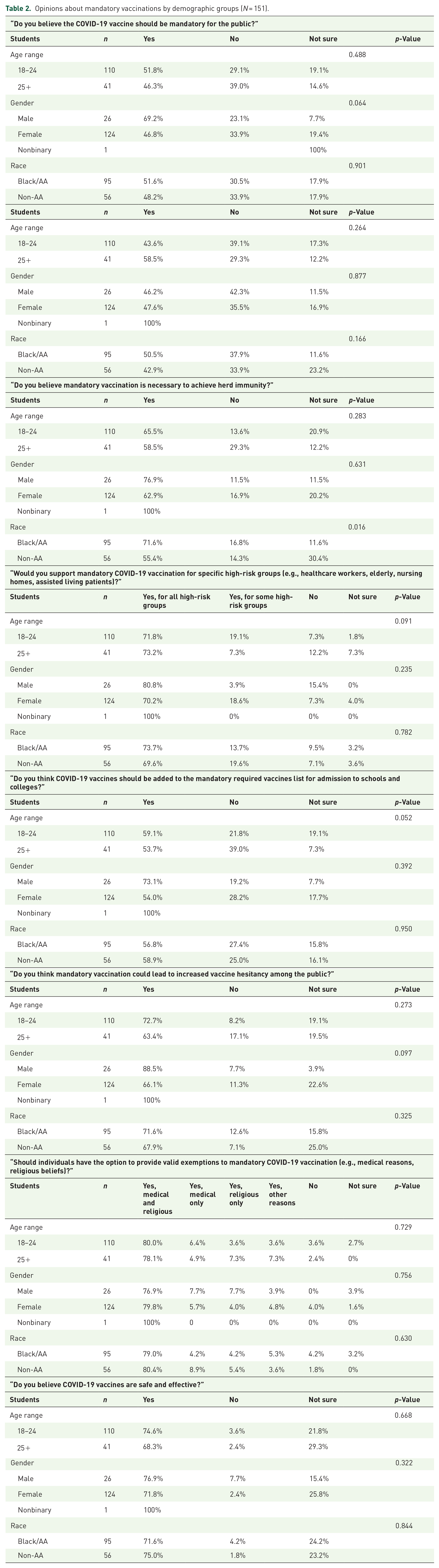
The study sample included 151 students, reflecting a response rate of 52%. Students were predominantly 18–24 years old (n = 100, 73%), female (n = 124, 82%), Black (n = 95, 63%). Table 1 details COVID-19 testing and vaccination history reported by students. Sixty-two percent of students reported ever testing positive for COVID-19 and 97% reported receiving at least one dose of the vaccine. Table 1 also details the proportions of student responses to questions regarding COVID-19 vaccinations. Half of the students believe the vaccine should be mandatory for the public. Of those supporting mandatory vaccines, 58% cite protecting public health as the reason for support. Of those opposing mandatory vaccines, 73% cite concerns about personal freedom and individual rights as the reason. While 72% support mandatory vaccination for high-risk groups such as healthcare workers and the elderly, 95% support exemptions for medical, religious, and other reasons. Nearly two-thirds of students believe COVID-19 vaccines are safe and effective, and only 15% have experienced any serious side effects from the vaccine.
Baseline characteristics and COVID-19 perspectives (N = 151).

Significant differences in proportions of responses among demographic groups regarding COVID-19 opinions were only found between Black and non-Black students and their belief around herd immunity (p = 0.016; Table 2). Seventy-two percent of Black students believed mandatory vaccination was necessary to achieve herd immunity compared to 55% of non-Black students.
Opinions about mandatory vaccinations by demographic groups (N = 151).
Some opinions were found to be associated with support of mandatory vaccination for the public (Table 3). Students believing mandatory vaccination infringes on personal freedom were more likely to oppose mandatory vaccinations for the public (p < 0.01). Students believing mandatory vaccination is necessary to achieve herd immunity were more likely to support mandatory vaccination (p < 0.01). Most students supporting mandatory COVID-19 vaccination for all high-risk groups also supported mandatory vaccination for the public; however, most students either supported vaccination for some or no high-risk groups opposed mandatory vaccination for the public (p < 0.01). Of students supporting the addition of COVID-19 vaccines for school and college admissions, 86% support mandatory vaccination for the public (p < 0.01). Lastly, students believing COVID-19 vaccines are safe and effective were more likely to support mandatory vaccinations for the public (p < 0.01).
Opinions associated with mandatory vaccination.

Stepwise logistic regression was conducted to evaluate the influence of varying opinions on students’ belief that COVID-19 vaccines should be mandatory for the public. Opinions found to be significantly associated with the belief in bivariate analysis were considered for the regression model (see Table 3). Analysis indicated significant levels of 0.3 to be added to the model and 0.35 to remain in the model. The resulting model included two student opinions (p = 0.000). Students believing COVID-19 vaccines should be mandatory for school admissions were more than seven times more likely (OR = 7.33) to support mandatory COVID-19 vaccines for the public. Students believing mandatory vaccination infringes on personal freedom were 26% less likely (OR = 0.26) to support mandatory COVID-19 vaccines for the public.
Discussion
Due to the high death rates and the main transmission routes being direct person-to-person respiratory droplets, fighting against COVID-19 has proven to be a challenging task. 15 The development of the COVID-19 vaccine and the promotion of immunization aided in combating the pandemic. 15 This study assessed the views and opinions of pharmacy students at Xavier University of Louisiana about COVID-19 vaccination mandates providing insight into this student population’s experiences and opinions. Overall, most students surveyed supported COVID-19 vaccination for themselves and high-risk groups. The opinions regarding universal mandates were similar to a meta-analysis of 22 studies with 50% of students supporting mandatory vaccination for the general public. 4 Of the Xavier pharmacy students who did not support universal mandates, about one-third opposed due to concerns about personal freedom and rights. These opposing viewpoints echo broader debates regarding public health ethics and vaccine mandates during the pandemic. 1 In addition, most students recognize the need for mandatory vaccinations for healthcare workers to fight a worldwide pandemic, achieve herd immunity, and halt the transmission of viruses. This aligns with arguments that patient and public safety should correlate with requirements for healthcare professionals.2,4 The emphasis should be on prioritizing the well-being of the community over individual liberties in times of crisis.
Recognizing that no single person’s rights should outweigh public health interests highlights the importance of implementing targeted mandates effectively. 2 However, those who oppose mandates raise valid points regarding government overreach versus important decisions in medical care. With such haste release of vaccination mandates, reminders of historical betrayals such as the Tuskegee experiments were once again established creating vaccine hesitancy. 16 Apart from the dark chapters in history, the essence of preserving personal freedoms and rights, which is fundamental, should not be overlooked.
The views and opinions one forms can be affected by various circumstances in their life.
Something as common as getting the COVID-19 vaccination can be determined by their upbringing and economic status in life. As this study focuses on pharmacy students, various studies including students’ majors and their parents’ education levels were evaluated to get a better understanding of what types of people were more inclined to get vaccinated. 17 Overall, students who are in the health sciences were more inclined and had a more positive reaction to getting vaccinated. 17 One study compared attitudes, knowledge, acceptance, and perceptions of the COVID-19 vaccination among pharmacy students versus non-pharmacy students. 18 Although vaccine safety and efficacy were mutual concerns between non-pharmacy and pharmacy students, non-pharmacy students exhibited higher hesitancy toward COVID-19 vaccination. 18 Another study conducted among pharmacy students demonstrated implementation of various vaccine-supportive strategies led to increased acceptance of mandatory vaccination, increased vaccine uptake, and decreased vaccine hesitancy. 19 Similar strategies may be implemented when promoting preventive health measures during a pandemic or other health crisis.
A distinct finding in the study was Black/African American students were more likely than non-Black/African American students to see mandatory vaccination as necessary for herd immunity. This may reflect a closer experience with COVID-19’s disproportionate impacts in Black communities and a stronger determination to curb transmission through vaccination. 11 Some studies confirmed the most hesitant groups of people resisting the vaccine included the African American population and pregnant or breastfeeding women. 20
While vaccine hesitancy among minorities is often emphasized, these findings challenge assumptions. 13 Despite the success in vaccination rates of Black/AA students at Xavier, and nationwide, the African American population’s vaccine uptake has been underwhelming with only 51.3% of the population receiving one dose and only 45% being fully vaccinated. 21 In general, most African American communities lag in vaccinations despite the increased burden of COVID-19 rates. 22 This mistrust and hesitancy can stem from a pervasive history of distrust and structural racism, coupled with media misinformation, attitudes toward vaccination, and other fundamental beliefs about vaccine efficacy.23,24 However, mistrust and hesitancy can be understood in African Americans with historical tragedies such as the Tuskegee trials. 16 According to Willis et al., distrust of medical establishments is usually linked to the Tuskegee trials, but “distrust is deeply rooted beyond that single incident and is predicated on centuries of racism and medical exploitation by medical researchers and doctors.” 25
To abandon the stigma of the vaccine, one solution can be to have Black pharmacists and community leaders come together to combat misinformation and try to establish a common ground for minority groups that experience this lack of trust in the government and healthcare systems. 22 Openly addressing historical traumas and considering diverse perspectives are crucial for planning future pandemic responses and promoting COVID-19 vaccination uptake.
In addition, students who viewed vaccines as safe and effective were more inclined to support universal mandates. Historically, mistrust in pharmaceutical companies has driven some vaccine hesitancy. 10 The rapid COVID-19 vaccine development may have raised some safety concerns, even among the pharmacy students surveyed. One study showed even when COVID-19 was at its peak the vaccination rates were not higher than voluntary influenza vaccination rates. 26 Improving vaccine confidence could make mandates more acceptable. Pharmacists have become integral healthcare providers during COVID-19 and future pharmacists’ perspectives offer valuable considerations for public health policy. 12 Overall, findings indicate these students critically weigh public health interests against personal choice issues regarding mandates. 27 Policymakers should consider the viewpoints of providers, health professional students, and the general population in pandemic response planning.
Vaccine hesitancy is a huge threat to global health and is affected by things such as pervasive and misinformed messages being portrayed about the vaccine. 28 Vaccine hesitancy peaks whenever a new vaccine is introduced, with many preferring to wait and observe its effectiveness and safety before deciding to get vaccinated. 16 Although most students surveyed reported the vaccine to be safe with no serious side effects, the adverse effects have been unique from person to person. 29 Some individuals express concerns regarding rumors of infertility in both males and females, while others worry about severe reactions such as blood clots associated with vaccine-induced immune thrombotic thrombocytopenia, and the majority now fear the long-term consequences of being vaccinated. 29 The presence of adverse effects, misinformation, and the imposition of mandates may have created challenges for some students in endorsing vaccination policies and mandates.
Xavier students acknowledged reasons for exemption, including medical and religious reasons, indicating nuanced perspectives. Surprisingly, during the COVID-19 pandemic, religious hesitancy was seen as a critical factor in vaccination resistance. 30 Political and religious preferences were noted to play a role in some people’s vaccination stance during the pandemic. Most notably, republican political preferences and conservative religious views were more likely to be skeptical of getting the vaccine. 31 It is also crucial to discern between vaccine hesitancy and the more entrenched and ideological vaccine refusal, marked by profound political, cultural, and emotional foundations, often observed within “anti-vax” communities that resist change and perpetuate misinformation rooted in a century-long history of anti-vaccine propaganda. 16 Nonetheless, this study provides initial insight into the views of an important stakeholder group and adds to understanding factors underlying vaccine acceptance versus hesitancy.
Understanding these implications can clarify diverse vaccination behaviors while highlighting the need for personalized, compassionate education to prevent biases from obstructing vaccination progress.
Limitations
This study has several limitations. It was conducted at only one pharmacy school; therefore, these students’ opinions may not reflect the nationwide consensus. Since these students were mandated, with a few exemptions, to receive the COVID-19 vaccine, this may have influenced their opinions. Another limitation is that the survey was not validated prior to administration.
Finally, the strength of the study was an overall good response rate of 52% providing insight into a subject that needs investigation.
Conclusion
Although most students supported vaccination, especially for high-risk groups, a divide emerged regarding universal mandates, reflecting broader debates on personal freedom and rights. The study highlights the need for trust-building, targeted education, and considering diverse perspectives in pandemic response planning. Recognizing ideological vaccine refusal can guide compassionate vaccination efforts, ensuring public health progress. Further research could explore regional and institutional differences in pharmacy students’ opinions on vaccine mandates.
Supplemental Material
sj-docx-1-tav-10.1177_25151355241303628 – Supplemental material for Insight into pharmacy students’ perspectives on mandatory COVID-19 vaccines in schools and healthcare settings
Supplemental material, sj-docx-1-tav-10.1177_25151355241303628 for Insight into pharmacy students’ perspectives on mandatory COVID-19 vaccines in schools and healthcare settings by Fahamina Ahmed, Saja Ottallah, Azeem Siddiqui, Candice Smith and Amne Borghol in Therapeutic Advances in Vaccines and Immunotherapy
Footnotes

References
Supplementary Material
Please find the following supplemental material available below.
For Open Access articles published under a Creative Commons License, all supplemental material carries the same license as the article it is associated with.
For non-Open Access articles published, all supplemental material carries a non-exclusive license, and permission requests for re-use of supplemental material or any part of supplemental material shall be sent directly to the copyright owner as specified in the copyright notice associated with the article.
