



Abstract
It is stated, with increasing frequency and urgency, that Entrepreneurship Education should help society move past Business as Usual, the unsustainable development pathway which depletes communities and is driving climate and ecological breakdown. We agree with this ideal, but our lived experience suggests that the everyday philosophy and practice of mainstream Entrepreneurship Education means this shift will be challenging for many educators. Mainstream narratives of economic growth and tools such as Business Model Canvas erase social and ecological concerns, compromising the Entrepreneurship Educator in the way they prioritize economic concerns over un/sustainability. Our question is, given the demand for transformation in Entrepreneurship Education, how do we—educators—change ourselves and our practice? In this paper we blend action-based accounts of change with interpretations from a dialogic perspective to elaborate how Entrepreneurship Educators can, and already are, taking action in light of climate and ecological breakdown. We provide a way of thinking about how change happens—in and through relations and dialogue between people—and new conceptual directions—the metacrisis and time between worlds—which aim to contribute a source of agency for educators.
Introduction—An Unsustainable Present
In this paper, we take the disruptions caused by climate and ecological breakdown as our starting point. A basic assumption is that we are existing on a planet that is facing the immediate consequences and long-term implications of ecological overshoot, indeed this diagnosis has been made, again and again (Catton, 1982; Fanning et al., 2022; Raworth, 2017). Now ecological overshoot is making itself more visible through recurring extreme weather events, and also interacts with the depletion of natural resources and existing social inequalities to create misery and harm for half the world’s population (IPCC, 2021, 2022). Scientists have warned that earth systems are entering unchartered territory, where 20 of the planet’s ‘vital signs’ (such as emissions, sea level rise, glacial melting, ocean temperatures and areas lost to forest fire), are at record extremes, following the continued pursuit of Business as Usual (Ripple et al., 2023). Business as Usual is the term used for an economic system that is dependent on fossil fuels, economic growth and high-emitting lifestyles and where powerful and affluent countries, governments and corporations seek to maintain the status quo—and social tolerance towards the status quo—rather than securing communal benefit (Stoddard et al., 2021). In this unfolding scenario, harms done are borne disproportionately by low-income people, people of color and indigenous people, whereas the wealthy and those enjoying privilege and power are able to avoid costs whilst appropriating benefits (Stoddard et al., 2021).
We observe that these social, ecological and ethical concerns have been strongly asserted into the mainstream EE conversation (Dodd et al., 2022; Hoppe & Namdar, 2023; Klapper & Fayolle, 2023; Loi et al., 2021). And yet. Our lived experience (and one reflected in some literature), is that many everyday Entrepreneurship Educators, may find themselves engaged in activities that work to support Business as Usual. For example, the focus on entrepreneurial value creation for present generations ignores the potential consequences for generations to come and creates a ‘tragedy of the commons’ (Hummels & Argyrou, 2021). In addition, we may support the start of make-and-consume businesses and promote companies which extract and pollute (Hallonsten, 2023). We may teach through business model frameworks that erase ecology (Nybye & Ellborg, 2023). We may co-opt creativity and innovation to serve short term economic benefits and unrestrained growth (Schaefer & Hallonsten, 2023). We may promote norms and values which prioritize competition, individual success and student satisfaction over collective well-being (Biesta, 2021; Hytti, 2018). When such conflicts exist, how do we act in the face of sustainability challenges that are planetary in scale? Or, put another way, how do we change ourselves and our practice, when we find ourselves so entangled in Business as Usual?
A landmark survey (Wyness et al., 2015), capturing thoughts of educators in EE about sustainability, illuminates the challenges the field faces. The survey identified that the Higher Education sector has a vital part to play in enabling sustainable shifts, as well as creating critical spaces where graduates might understand, negotiate and thrive within growing complexity and uncertainty. However, despite repeated calls by policy and guidance, entrepreneurship educators’ actions were weak: there was limited sophisticated deployment of sustainability provision within EE curricula, scant evidence of coherent, embedded approaches to sustainability teaching and “barely one example” where sustainability forms the underpinning ethos to a programme (Wyness et al., 2015, p. 846). Indeed, despite awareness of sustainability challenges, only 17% had included sustainability in a module or course, whilst other survey participants were still at the stage where they had identified a need for sustainability (11%), were thinking about introducing sustainability (32%), had no plans but a general awareness of sustainability (18%) or were planning to continue with Business as Usual (21%). Whilst of course we assume there will have been positive movement since 2015, given the urgency and scale of transformation required—and the literature we cite about continued Business as Usual—it is still possible to agree with the survey conclusions that sustainability is an emergent issue in EE, and individual progress does not equal serious collective change. Wyness et al. identified the need to re-think EE but also acknowledged the challenge of this given that educators in this field often do not have a grounding in educational theory or sustainable development.
Given all of this, in this paper we illuminate the experience of (re)thinking and trying to influence change in our own work over a two-year period, starting in 2021. This period covers a phase when increasing concerns about climate and ecological breakdown pierced Entrepreneurship Education’s mainstream, and it is when we started to make efforts to shift ourselves and our practice. At the time neither author was involved in sustainability and had no track record in researching the area. Rather each author was motivated by personal concern and recognized being entangled in mainstream characterizations of entrepreneurship which emphasize the heroic, profit-making entrepreneur and the creation of fast-growing firms for a market driven society (Berglund & Wigren-Kristoferson, 2012). This is likely to feel like a familiar situation for increasing numbers of educators in EE, who may find themselves increasingly aware of the seriousness of climate and ecological breakdown and yet trapped in norms and practice which support Business as Usual. How do we move on? What action can we take to develop our practice and our field? By qualitatively exploring a lived response to this question and connecting it to collective movement in the field of EE, this paper contributes to demands that empirical examples are needed about how educators might change to support sustainability, rather than simply advocating that they do (Klapper & Fayolle, 2023), and develops an action-based and relational perspective of how change can happen.
Background—Calls for a Different Future
We ground this paper in recent literature calling out for Entrepreneurship Educators to contribute to a different and better future. These authors vividly confront the various social and environmental crises which are now the wider context for education, and call for educators and scholars to transform their practice.
Loi et al. (2021), discuss Entrepreneurship Education (EE) being at a crossroads, that is, where the changed context and real-world challenges of inequality, environmental breakdown and climate change, require new knowledge priorities and new ways of teaching and researching. As the world moves on but we don’t, we are perceived as providing a ‘cretin’s education’ or being a ‘Trojan Horse’ for business ideology (Riot in Loi et al., p. 126). New directions are signposted: (re)imagining entrepreneurship from the perspective of happiness, (re)living an activist-like experience of joining marches to defend public science and act on the climate crisis, and (re)positioning entrepreneurship education away from a profits perspective (Loi et al., 2021). The authors show us researchers engaging actively with the world outside the University, for example participating in activism and discussing new research practices that are more sustainable and aware of the climate crisis. In providing the concluding thoughts to this paper, Loi and Fayolle say that poverty and climate change call into question conceptions of environmental sustainability, and that human welfare demands that the limits of resources are acknowledged (Loi et al., 2021, pp. 129–131). They conclude that entrepreneurship is anchored in these constraints and that education and educators must evolve with them.
Dodd et al. (2022) tackle the ‘crisis environment’ in which educators exist head on. They describe that the context for our work in EE is the economic, environmental and socio-spatial crisis that is depleting communities and the planet. Such a challenging context and uncertain futures demands new pedagogies which focus on positive, hopeful transformations, and take seriously the responsibilities of educators in shaping an entrepreneurship that is environmentally positive, socially inclusive and ethically aware (Dodd et al., 2022). The writing of these authors is urgent, they take as their starting point “the hope and horror of living in a crisis society” and acknowledge the “major crisis which we have collectively brought upon ourselves and the planet is the environmental climate disaster unfolding around us” (Dodd et al., 2022, p. 688). Authors go on to describe three practical examples which illuminate how sustainability, social justice and hope may be brought to life in education.
Klapper and Fayolle (2023), discuss the “pressure of increasing awareness of the scarcity of key natural resources and deepening perceptions of injustice and inequity in our societies, notably in terms of sharing natural resources and wealth” (Klapper & Fayolle, 2023, p. 2). This paper makes an important point in its reviews of existing literature, that despite a wealth of articles conceptualising the importance for EE of ESD (Education for Sustainable Development), there remains relatively little research on the implementation of EE developments that are sustainable. Klapper and Fayolle call not just for transformed practice, but more work on how to theorize and conceptualize this, and—just as importantly—how to practice it, in terms of teaching and impact of such teaching on the wider organizational and societal context.
Most recently, in re-conceptualizing Entrepreneurship Education for a cause, Hoppe and Namdar (2023), call on current and new educators in the field to challenge and change their understanding of what and why we need to change in light of the unsustainability of life as we know it. Consumption, wealth distribution, the voracious desire for growth, are part of an economic machine which is not sustainable for people or planet. Entrepreneurship educators can help change a collective mindset away from this unsustainability and towards the transformation needed for sustainability (Hoppe & Namdar, 2023).
We wholeheartedly agree with the important calls made by authors in relation to changing Entrepreneurship Education. We contribute to this conversation by focusing on the Entrepreneurship Educator and how change can happen, individually and collectively through action and interaction. In the next section we elaborate the approach to inquiry.
Approach to Inquiry
Qualitative inquiry has a strong orientation towards the possibilities to transform the world (Creswell & Poth, 2016). Qualitative researchers assert that “words and language have a material presence in the world…words have effects on people” (Denzin, 2000, p. 257). This has been acknowledged in our mother field of entrepreneurship also, where the field can be viewed as socially constructed through interactions and interpretations (Lindgren & Packendorff, 2009). This means that words are not just words, they also make worlds (Berglund & Wigren-Kristoferson, 2012). Even a modest textual space such as a journal article can (re)produce a different version of a phenomenon, opening up possibilities for social change (Steyaert & Katz, 2004).
Qualitative inquiry is an approach that cuts across disciplines and subject matter and privileges no practice, theory or methods over any other, but rather stresses the value laden-nature of research and recognizes the role of the researcher/s in what is studied (Denzin & Lincoln, 1998). In the case of this study, the ‘we’ refer to in this paper are two long-term enterprise and entrepreneurship educators, who have been engaged in the field, from a practical and scholarly perspective for many years. We initially connected over a shared interest in questioning dominant modes of inquiry (c.f., Brentnall & Higgins, 2022a, 2023). But more recently our conversations turned to how EE, and we, might change our practice in light of the various social and environmental crisis in which we are steeped.
This paper reflects the fundamentals of qualitative work, where there is “description and interpretation of a problem…and a contribution to a call for change” (Creswell & Poth, 2016, p. 8, emphasis added). In the previous section we set out the calls for change to which we intend to contribute, now we will say something about how the description and interpretation dimension of the inquiry emerged.
The experience of qualitative research has been likened to the work of a bricoleur, where different tools and materials are used to piece together an approach over time (Denzin, 2008), and our approach adapted and emerged in that way. Initially, we aimed to work from a perspective of collaborative auto-ethnography (Chang et al., 2016; Ngunjiri et al., 2010), and use some of the techniques of generative critical conversation (Huntsley & Brentnall, 2021), where recorded conversations are used as artefacts for reflection and insight development. Yet we found that the writing that emerged from this approach was depressing to read. What took over was the use of writing as the vehicle for making sense of the research. Trying to make sense of the experience and the research in this way, our process is an example of what Gibbs (2007) describes, where it is through writing that discoveries are made and produced. Writing is not “an after effect of the research, but forms its very fabric” (Gibbs, 2007, emphasis added, p. 222). We embrace Gibbs’ view that writing is a mode of inquiry in its own right. Writing can be seen not just as method but as analysis, where the act of creating and manipulating sentences transforms cognition (Menary, 2007). Writing is thinking in action, where representations and scripts, having been made real on a page, lead to conceptualizations being developed or challenged (Menary, 2007). This paper can be viewed as “part and parcel of the research methodology” involving and implying an “affect laden” creative process driven by the “interest and desire…frustrations and misery…productive joy and excitement” of the authors (Gibbs, 2007, p. 223).
It was reading about the lack of impact made by writing about the climate that also influenced the approach taken in this paper. Concerns have been expressed that the detached tone of science has not communicated sufficient urgency (Penz, 2022), or had the desired effect of inspiring agency to act regarding climate and ecological crisis (Rayner & Minns, 2015). Therefore, here, three action-based stories (description) are presented, which are then interpreted from a dialogical change perspective (interpretation). From the dialogic perspective, creating change “requires changing the conversation” which means that reality is constructed through conversations that people—or, Entrepreneurship Educators—have everyday (Bushe & Marshak, 2016, p. 2). This perspective in underpinned by ideas from social constructionism, where knowledge is seen “not as something a person has or doesn’t have, but as something that people do together” (Burr, 2003, p. 9). Such approaches do not have to aim for linear, dispassionate and controlled inquiry, but can communicate care, elevate human agency, move and motivate action (Gergen, 1999). Therefore, as well as revealing how interactions influence change, an action-based approach to communication (De Meyer et al., 2020, pp. 3–6), also demonstrates “imaginable paths…do-able tasks…and a meaningful role in addressing the problems at hand” (Rayner & Minns, 2015, p. 3) that Entrepreneurship Educators can, and are already, undertaking. This approach also contributes to the call to write differently in management research (Gilmore et al., 2019).
In terms of validity, work such as this might be judged on the extent to which it might illuminate or even inspire the thinking and actions of others (De Meyer et al., 2020). Considering the EE literature we connect this study to, we can see that their work is not, as Denzin says, an innocent practice, but very much be engaged with influencing a better world, rather than just interpreting it (Denzin, 2000). We hear the calls for change made by Loi et al. (2021), Dodd et al. (2022), Klapper and Fayolle (2023) and Hoppe and Namdar (2023) and in this paper try to show ways that educators in EE are answering. This approach shows people and groups doing things, building the capacity to know how to act in the face of climate crisis (De Meyer et al., 2020). We draw on various literature to support and interpret the action-based stories. This approach is further elaborated in the next section.
Action Over Issue
This paper leans on the ideas of authors who argue for a move from an issues-based conceptualization of climate change to an action-based conceptualization (De Meyer et al., 2020). An issues-based conceptualization means that climate change is presented as “a threat that we should be concerned about…rather than as something we know how to act on…” (De Meyer et al., 2020). They argue that this issue-based conceptualization, combined with the immense and existential nature of climate threat, can lead to a lack of agency, where people might be concerned, but don’t know how to act. This has led to opportunities to act being narrowly categorized as consumer choice and/or climate activism, rather than a focus on people doing things in whatever practical or professional context they find themselves (De Meyer et al., 2020). Whilst De Meyer et al. talk about extensive projects to create action-based story telling in climate communications, they also elaborate key ideas and a useful way of thinking about agency and how it might be supported in the stories that are told (De Meyer et al., 2020, pp. 3–6). In terms of ways of thinking about story telling in relation to climate change, they propose four ideas which underpin the shift to action. The first idea is that actions can drive beliefs and lead to deep engagement with issues. This turns on its head the notion that awareness and knowledge leads to action, but rather posits that taking action is an act of self-persuasion, where changes in beliefs, attitudes and emotional responses come as a consequence of behavior. The second idea they describe is that, in regards to climate change, agency is lacking, and that building capacity to know how to act and the ability to act is a pre-cursor to acting. The third key idea De Meyer et al. describe is that we could use our “capacity to learn from stories about other people’s actions” as a way to build agency. Whilst De Meyer et al. discuss projects with fictional stories and characters, they also say that stories can be “factual accounts” of real people and groups, but what is crucial is that they are not issues based, but that they model opportunities for people to engage in actions specific to a context or community of practice (De Meyer et al., 2020, p. 6). The theoretical underpinning for their focus is Bandura’s social learning theory (Bandura, 1962). Whilst a full exploration of this underpinning is beyond the scope of this paper, De Meyer et al. particularly emphasize Bandura’s ideas about people learning through the actions and experiences of others. Leading on from this, they assert that it is productive to share stories of individuals and groups who have already developed agency and are taking action in some practical or professional setting. They provide high level advice about how to structure action-based stories which are: start by modeling where you/we are now, be action-based and show individuals and groups making progress on short term goals which build personal and collective efficacy.
Inspired by this, we combine three stories (descriptions) with theory informed explanations (interpretations) of how Entrepreneurship Educators have already started to take action. In the theory informed interpretations, we use the perspective of dialogic development to situate the action within a broader theory about how change happens. Dialogic development has a perspective on change which says: change is created in and through relations and dialogue (Bushe & Marshak, 2014, 2016). As well as providing a relatable explanation of our lived experience as Entrepreneurship Educators trying to change ourselves, it also represents a do-able strategy for others. In dialogic development, change is characterized as evolving through three processes, first there is a disruption to the status quo, then people start to organize for new ways forward to emerge, and finally, that process encourages generativity, that is: new and more complex ways of organizing (Bushe & Marshak, 2014, 2016; Holman, 2010, 2013; McGerkow, 2020). The three stories presented here focus on these three areas: the disruptions, starting to organize, and the emergence of new and more complex ways of doing and thinking. Following each story, interpretation is provided using concepts and resources from dialogic authors (and, where appropriate authors exploring climate communications), to provide a theory informed perspective on action. In the first story, following the advice of De Meyer et al. (2020), we combine a description of the setting, and introduce the (action-oriented) disturbances that prompted us to act.
Setting the Scene
It is September and the beginning of the academic year in EE is punctuated by IEEC (International Enterprise Educators Conference, run by Enterprise Educators UK). The world is still in Covid times and the conference is online again. Professor Ulla Hytti is the keynote, a Finnish scholar who has written about the McEducation (Hytti, 2018) of entrepreneurship education (EE). Her topic is Inclusive Entrepreneurship Education and in her early slides she contrasts the (traditional) strong business focus of EE with a need for inclusivity. There are pictures of piggy banks and coins juxtaposed with human hands placed on a tree branch and seeds being planted. She highlights the way that certain ways of performing in EE force students into market based entrepreneurial identities (Komulainen et al., 2020). She talks about the agenda to revitalize EE, set out by Berglund and Verduijn (2018), which could include not just teaching students about the rules of the game, but how to change the rules of the game. Her final message is that we (the EE community) should take an active role in creating more inclusive practice, for the sake of students…and for the sake of the planet. The words hang in the virtual air. Just a few days before this keynote a report from the IPCC (IPCC, 2021), warned of a Code Red for Humanity. Now the spectre of climate breakdown has been asserted into a mainstream keynote in our field.
Such ideas are raised again, later in the term, at the Institute for Small Business and Entrepreneurship conference, where the conference theme is Bridging Enterprise, Policy and Practice, Creating Social and Public Value. In one session Dr Charlotte Carey explores the cuts to creative discipline education in a ‘multi-crisis environment’. Describing the ‘hostile policies’ towards creative education, she questions why—in a post-Covid, Brexit adapting and climate emergency context—would creative discipline education be cut? Don’t we need, she asks, architects and designers who can create new materials and contribute to innovation and mitigation in the face of existential threats? (Carey, 2021).
These disruptions in the typical EE narrative are enough to prompt new conversations, over coffee at the conference, then over WhatsApp, over email and Teams. Have you seen the IPCC report? What are you working on? What can we do? These conversations lead to the pulling together of an abstract: “We need to talk about the Intergovernmental Panel on Climate Change” (Brentnall et al., 2022). At that conference another abstract explicitly mentions climate change, a paper where authors analyze teacher development curricula to assess the prominence of sustainability. Jónsdóttir et al. (2022), write “Given the urgency of problems such as global climate change, the goals and contents in these curricula related to EE and sustainable development are very limited.” Many more papers mention sustainability and the environment (ECSB, 2022). Examples range from combining the Economy for the Common Good with Lean Start-Up methods (Campos et al., 2022), to using Responsible Research and Innovation frameworks (Sjøtun et al., 2022), and the power of a field trip to the Global South to trigger students compassion and increased ethical understanding of sustainability issues (Lindvert, 2022). Such examples are inspiring, but a question that arises around the water cooler is: how do practitioners and scholars take action on an issue that is not their area? People may have spent a long time carving out niches and becoming expert in areas that are not sustainability related, or potentially support unsustainability. In addition, a turn towards sustainability may have grown out of specific or lucky professional and relational contexts where the conditions were right for the development of sustainability related practice and scholarship. What if you are an Entrepreneurship Educator working in a context where those conversations aren’t happening, or, where you are not part of them?
Later on in the year EEUK (Enterprise Educators UK), use a word—planetary—in the criteria of the sustainability strand of its EERPF (Enterprise Education Research Projects) grants. The organization seeks projects which explore the relationship between EE and planetary sustainability. Conversations in the professional setting move on from expressing and sharing concerns to: have you see the EERPF research themes? Now conversations can move upwards in the institution: what could we do…[and]…can we apply? But to do what? This is not our area. What do you do when you don’t know what to do?
Our approach is to develop an application where we will create a process to explore what to do when you don’t know what to do. The project application is based on prototyping a workshop to enable EE stakeholders to generate ideas regarding how our work should change in light of climate and ecological breakdown. A toolkit including presentation assets and a participatory co-design method will be created so EE stakeholders can try the approach for themselves. Events and scholarly outputs will be created to disseminate the project. The first dissemination opportunity is at IEEC 2022 (Brentnall & Higgins, 2022b). This year there are more disruptions to the Business as Usual narrative. A keynote is Dr Shima Barakat, who frames the environment (the planet) as a strategic issue which should be integrated into organizational strategy. The Drop Bear Beer Company, run by Joelle and Sarah Drummond, talk about creating the world’s first carbon neutral alcohol-free brewery. Dr Shailendra Vyakarnam talks about the deleterious effects of shareholder primacy on society and the environment. We start to plan a paper that explores taking action in EE.
On Disruptions
Disruptions break apart the status-quo (Holman, 2013). They interrupt ordinary life and through doing so, create the possibility of change. Disruptions can be physical, such as an extreme weather event, or they can be dialogic, that is, connected to dialogue and language. Bringing ‘the planet’ into a keynote, the focus on ‘planetary sustainability’ by EEUK in its research projects, the practitioners and scholars presenting their practice at 3e—these are all empirical examples of potential disruptions for those who listened, read or were told about what was said. They are also all empirical examples of what agency looks like in the field of EE. In the words of De Meyer, they provide “do-able examples” of people taking action in a particular practice setting, in this case, the use of a platform to raise the issue of planetary sustainability, the re-drafting of criteria, the development of scholarship and practice in service of sustainability. These are also examples of, in Holman’s words (2010), disruptions to the status quo. They illustrate the climate crisis showing up in mainstream EE, making itself known, demanding attention and innovation. But when you cannot see the future where do you begin? How do people find ‘AfterNow’ (Stilger, 2017), that is, what comes after where we are now. In the next action-based story, authors present their next steps in looking for what comes after now.
Two Workshops…
July. An email arrives: congratulations, we are very pleased to inform you that your project application has been successful. The work (a)theoretical work begins. Our research project proposed to design and pilot a workshop in and around our two respective universities. We committed to recruiting stakeholders interested in business, enterprise and sustainability to participate in a process to inform how EE can and should change (in light of climate and ecological breakdown). The workshop is billed as being in two parts: a briefing about the climate and ecological context and a participatory decision-making process (called OPERA), to surface and prioritize ways forward for EE.
As part of learning what should go in the briefing we conduct a series of interviews with people—experts—in climate, business, and sustainability education. Every interview brought new insight but diverging opinions. “People are bored of hearing about carbon”; “…people need a basic understanding of the physics of climate change…”; “People need to connect with the topic emotionally”; “people get overwhelmed easily with the weight of emotion.” Alongside this process there was the increasing burden of knowledge accumulation. The exceeding of planetary boundaries (Rockström et al., 2009), climate tipping points (Lenton et al., 2008), the Doomsday Glacier melting (Mackintosh, 2022), the Amazon Rainforest emitting more carbon than it sinks (Wunderling et al., 2022). The increasing knowledge of the seriousness of the planetary situation had to be balanced with the pragmatic demands driving the project: what could we in EE do, in our contexts? Where our expert interviews converged was in two areas: approach the briefing from a personal perspective with a personal story, and second, focus on what’s possible.
During this time we were grappling with a way to think about the workshop and the process we were designing. One activity we planned to use was Future Search (Weisbord & Janoff, 2010)—which is described as being ‘dialogic’ in nature, that is, it prioritizes dialogue that builds relationships, resolves conflicts, generates innovations and inspires collaborative actions (Holman et al., 2007). Discovering this dialogic framing opens us up to the work of authors who argue that change is generated dialogically, in and through relations (Bushe & Marshak, 2014, 2016). We start to think how this dialogue has started before the workshop, with the experience of learning from experts, with the experience of learning through recruiting stakeholders to the workshops, and before that by listening to colleagues and reading papers: each conversation builds connections and knowledge.
As the workshops get closer, iterations of slides evolve. More technical information and bad news gets cut from the PowerPoint deck as we agree that our climate briefing will be ‘lite’. Many people know the bad news. But they don’t know what to do. So we will present the background and assumptions to the project and take the climate and ecological changes as our context, but we won’t dwell on it. Instead, we will share our own concerns and facilitate others to share their personal stories to create connections between ourselves and the topic, the participants and each other. In the first pilot workshop, people create personal Avatars which explain their connection to sustainability and use these as a stimulus for introducing themselves to fellow participants in networking rounds. In the second pilot workshop, participants are encouraged to write words on a flipchart labeled with decades to illustrate their connections and emotions to sustainability and related issues over time. The middle part of the workshops involve facilitating a participatory decision making method called OPERA, where people work on their Own, and in Pairs, to Explain, Rank and Arrange possible ways to address the question driving the workshop: how can and should EE change in light of the climate and ecological context? This process involves selecting and synthesizing ideas, and then ranking contributions by asking ‘what ideas should we prioritize for future actions’? (see Appendix 1 for an artefact of this process). The final part of the workshop is a Future Search, where participants are invited to work in any way they want (alone, in their OPERA pairing, or seeking out someone specific), and articulating how they visualize a better future two years from now (see Appendix 2 for some examples). This provides participants with the chance to contribute or reinforce ideas they feel strongly about. Finally, people are asked to leave exit tickets (Danley et al., 2006), and provide reactions in relation to ‘a thought/feeling’ (Appendix 3) at the end of the session, and ‘something that struck them’ (Appendix 4). At the end of both workshops people stay to talk to each other and to us. If the sessions had felt energetic and thought provoking, the atmosphere at the end felt warm and hopeful. We overhear some of the chatter, people swapping email addresses, people curious about running an OPERA for themselves. On one occasion, as we are rearranging the exit tickets to take photographs, a discussion is taking place about the positive feelings expressed by many at the end of the workshop. Someone asks: given the gravity of the situation, is hope a dangerous thing? Glancing through the post it notes, amongst such sentiments as Inspired, Encouraged, Motivated and Connected one ticket asks ‘Will this make any difference?’ What a good question.
On Emergence
From a dialogic perspective, systems change through a pattern of emergence (Holman, 2010, 2013), where an increasingly complex order self-organizes out of disorder. Holman uses the example of an earthquake to illustrate the idea of emergence. In the face of an earthquake there will be a range of responses such as fear, grief and anger. She describes that while some people will be immobilized for different reasons, some will take on different tasks, such as looking for food or water, caring for animals, creating a ‘find your loved ones site’ on the internet. This pattern of emergent change has a certain flow: disruptions break apart the status quo, the system differentiates and surfaces innovations and distinctions amongst its parts, and as different parts interact, a new, more complex coherence arises (Holman, 2013). Working with this pattern of change creates the possibility of cultivating the consciousness and skills of people within a system to engage with changes, develop new relationships and shared purposes and support a more capable and engaged system (Holman, 2013). Considering the OPERA outcomes, Future search examples and exit tickets (see Appendices), there is evidence that the workshops, as is aimed for in dialogic processes, created new directions and energy, which are crucial ingredients for finding a way forward (Devane, 2007). In regard to the question ‘is hope dangerous?’, this is interesting to consider. Dialogic authors see change as happening through conversations. What happens in life is influenced by who talks with whom, in what ways, about what, when and how (Stacey, 2015). ‘In what ways’ is important, as dialogic authors tend to emphasize the interdependence of people and how change can be enabled (or constrained) via the quality of relationships and communication (Bushe & Marshak, 2016). Thus, from a dialogic perspective, it is the sign of a successful change event if people feel motivated and experience a positive group energy, indeed, this is instrumental in generating the sorts of emotional engagement needed for change (Holman et al., 2007).
In climate literature, active hope is a way of being and state of mind which is able to confront climate reality without being paralyzed (Macy & Johnstone, 2012; Rayner & Minns, 2015), it seeks ways forward and aims to reimagine new social and economic relationships with humans and nature that would be sustainable. Dialogic author Holman (2016), quips things are too bad to be pessimistic. Instead, she asserts that dialogic work is a practical contribution to betterment in the way it invites people into spaces of ‘not knowing’ through which they can move into innovation, creativity and possibility. Returning to the question ‘will this make a difference?’, Wheatley and Frieze (2006), have a useful framing for how change emerges. They say change does not happen one person at a time, but rather change emerges as networks of relationships form amongst people who discover they share a common cause. This is good news for those concerned about change in the wider world, as rather than worrying about critical mass, work should focus on fostering connections. We don’t need to convince large numbers of people to change, instead we need to connect with kindred spirits (Wheatley & Frieze, 2006). These ideas are encapsulated in the two loops model of change (Frieze, 2014), elaborated visually through a descending arc that represents a dominant but dying system and an ascending arc of an emergent system.
The figure aims to communicate that change will involve stagnation, disintegration and decomposition, and a new system, will be germinated through people connecting over a shared purpose and growing new ideas, approaches and influence. Frieze (2014), suggests we look at the two loops and ask ourselves, ‘where are we now?’ in the process of change and also, how can people trying to pioneer change connect to and nourish each other so that approaches that are alternative can go mainstream. Finding ‘Afternow’ then starts with small groups of people (Stilger, 2017), but groups become networks, networks become communities of practice and these have the possibility of system influence (Wheatley & Frieze, 2006). We (re)create this image at presentations and in seminars (see Figure 1). A participant at one presentation emails to say thank you for putting words to their change experiences. The two loops model (inspired by Rose, nda).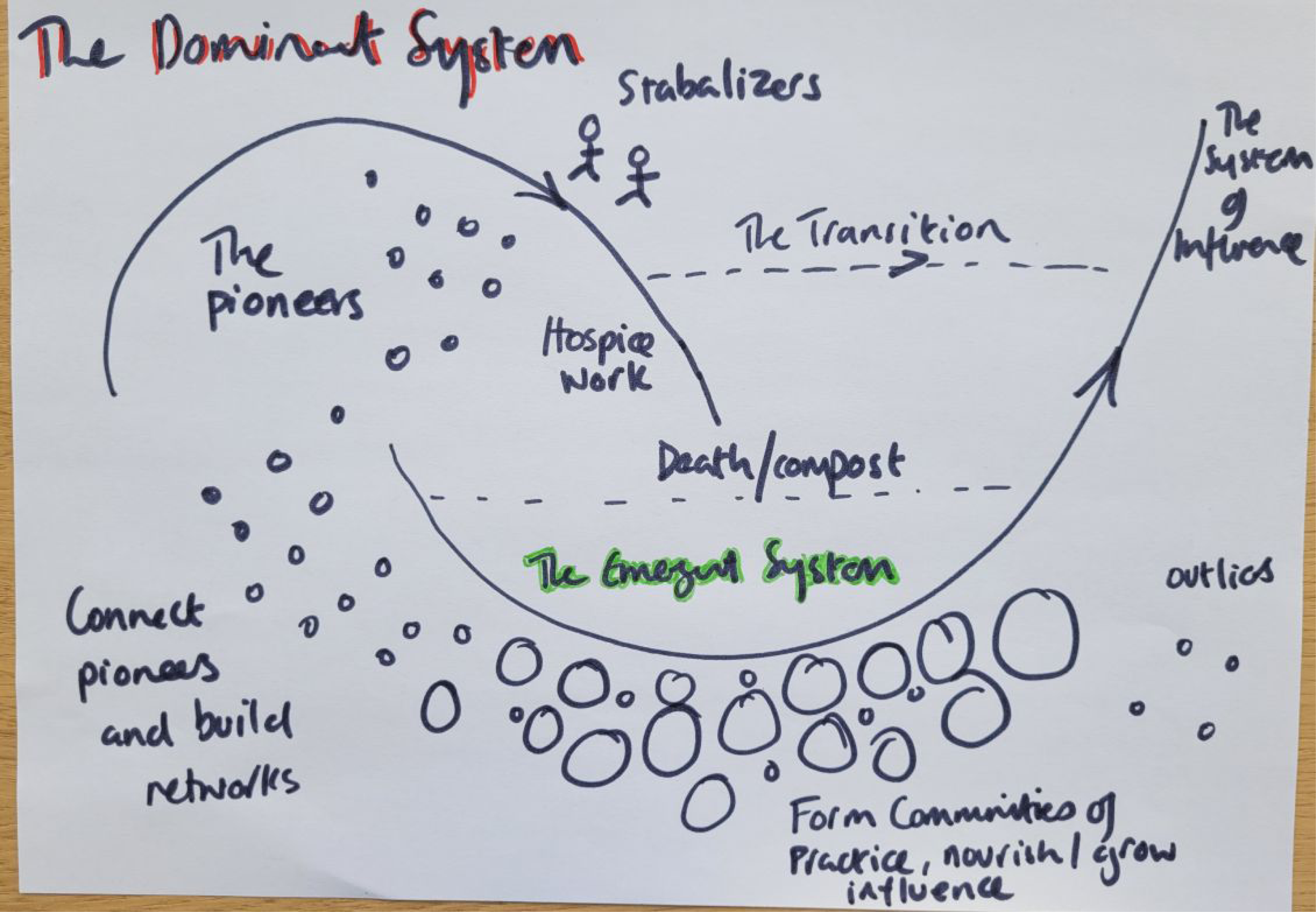
In the final action-based story we present, we aim to illustrate that even though we are at the early stages of changing ourselves, that taking action delivering the workshops and starting to write has led to new connections, ideas and activity, which are resources in the face of growing dissonance.
New Directions
February. Paper development mode, thinking through writing and editing. There is a struggle to find the right tone. The development process involves a back and forth with written text and WhatsApp voice notes. Early writing about disruptions, methodologically influenced at that point by authors working with a collaborative auto-ethnographical approach, focusses on the personal and weaves biographical elements to show the researchers position in the socio-cultural context (Chang et al., 2016; Ngunjiri et al., 2010). An early vignette contrasted the experience of increasing disturbance at extreme weather events with the realities of being embedded in a complex industrial society, now aware of the individual and institutional carbon emissions that are heating the planet. In this vignette, the planetary dimension of planetary sustainability looms large, with references to carrying capacity (Catton, 1982), and overshoot (Hickel, 2019), and the possibilities of a hothouse earth (Steffen et al., 2018). The accounts sound overwhelmed and are depressing to read. But they prompt searches for advice about writing about climate change. The discovery of De Meyer et al.’s descriptions of action-based stories and modeling action in specific professional contexts generates a new turn. From this perspective, the disruptions we could communicate are not the ones we experience personally, but the ones we experience within a particular practice-setting, and which are created by those in the field already taking action.
Later on, as we create a toolkit for the workshop process we developed (Brentnall & Higgins, 2023), we converse about the sentiment captured by the question: will this make any difference? And ask each other: what has this process generated for us so far? From the OPERA and the Future Search outcomes we re-visit different phrases and images which captured our imagination—the prioritizing of collaboration over competition; the concept of ‘Preventative Innovation’; the idea that ‘Nature should have a seat at the table’ in business decision making—and which could inform team and institutional conversations about how (and why) to better harmonize EE and sustainability. But what emerged from our workshops were not only ideas, but new connections and confidence to act. In the case of the first author, a training session on how to run an OPERA took place so that interested stakeholders could recreate the activity in their setting, further disseminating the motivation behind the project and building contacts for new sustainability-related activity. In addition, a conversation with the Director of the University’s sustainability institute leads to conceptual work (about introducing ‘Planetary Boundaries’ to EE) and practical work (developing a session on Regenerative Business Design for educators). For the second author the process provided the catalyst to develop a new module—‘Humanity, Ethics and Morality—The Sustainable Self’—where students have the opportunity to evaluate and challenge their assumptions and become more ethically minded business practitioners. Further to this, a connection between the author and the University’s Centre for Sustainable Business now exists, generating opportunities to co-plan activities and join events.
However, whilst we both were undertaking new practical activity in service of sustainability our sense of dissonance was growing. The act of searching for all things sustainability, ecology, and bio-sphere related changes what the internet algorithms now offer. For example, an alert for a new title pops up: “The Impossibilities of the Circular Economy: Separating Aspirations from Reality” (Lehmann et al., 2023). The opening chapter asserts that policy makers should not be misled by empty circular economy slogans, but should focus on real problems, real developments and real solutions in the real world, instead of ideal solutions in an idealized world (De Man, 2023). The book has an accompanying infographic which re-frames the story, from the goal of a circular economy to the goal of regenerating the planet through sustainability (Lehmann et al., 2023). A similar reality check is found in Frederick (2018), in regards to entrepreneurship, who asserts that all human activity, including economic activity, takes place within the biosphere, and that “we are collectively reaching the tipping point where we have to change our business models [and education models] to respond to sustainability issues” (Frederick, 2018, p. 406). Dissonance refers to an inconsistency between one’s beliefs and actions. Holding beliefs about the impossibilities of circularity and impending tipping points and then engaging in ordinary life and work, generates emotions that swing between urgency, despair and exhaustion.
And yet. The workshop project has connected us to members of the EE community who are also concerned, or who have already been working on this area, and who offer solidarity and ideas for practice. Engagement with this community prompts the idea of a Special Interest Group for EEUK members. A fringe event is held at IEEC 2023. There is more. A new European project with six universities, Transforming Enterprise Education (TrEE, nda), which reminds us in their project introduction: entrepreneurship has the potential to contribute to solving as well as worsening social and ecological challenges, therefore, education is key. And, therefore, educators are key. We wonder if this is the two loops model of change in action: people connect with people, people become groups, groups might become networks, and networks might become communities of practice that have a chance of influencing more systemically. As we draft our paper, we return to the photographs of the OPERA outcomes. These are not just ideas about how EE can and should change, they are also the desires and fears of stakeholders—including educators—in and around two Universities. People who want to connect to evolve the system. People who want to get to Afternow, to work out what needs composting (and how), and what needs germinating.
On Generativity
From a dialogic perspective social life is facing unprecedented situations that challenge traditional approaches to change (Bushe & Marshak, 2016). An empowering aspect to the perspective is how the ‘dialogic mindset’ is described as an effective approach when facing wicked problems and adaptative challenges where there may be no agreement on what is happening or no absolute remedies or solutions to address the situation (Bushe & Marshak, 2016). Instead of top-down visions and plans, dialogic approaches aim to foster generativity (Bushe & Marshak, 2016). Generativity creates change by offering people new images that allow them to see old things in new ways and to make new actions available that could not be conceived before (Bushe & Marshak, 2014). At a most basic level, dialogic scholars and practitioners, with their interest in social and language construction, consider that, in the face of disruption people need “hosts” for change, and experiences which bring together who and what needs to interact to “inspire explorations that lead to positive change” (Holman, 2013, p. 22). We feel that we experienced what Holman et al. (2007), suggest, that change methods “demonstrate how quickly people can have a voice” and “fuel enthusiastic participation” (Holman et al., 2007, p. 7). This approach also provided a perspective to think from, regarding change emerging not from focusing on diagnosis (what’s the problem?), but from focusing on dialogue (given the climate and ecological context, what’s possible?). From this perspective words make worlds, that is new phrases, concepts and images induce new patterns of thought (Bushe & Marshak, 2014), an insight already described in entrepreneurship scholarship (Berglund & Wigren-Kristoferson, 2012). Words may not seem much in the face of planetary scale sustainability challenges, yet changing the conversation, creating new possibilities through dialogue, is something that may feel and be achievable for practitioners and scholars in EE.
Concluding by Becoming the Future of EE
In this paper, we have aimed to provide an empirical example of how two people working in EE, but not specifically focused on sustainability, started to change themselves and their practice. Three action focused stories were presented to demonstrate the types of actions already being taken by people and groups in the practice-context of EE. By interpreting this action using concepts and resources from a dialogic perspective, a picture of change is developed showing how new approaches emerge from disruptions in the status quo and can be seeded and nourished through the dialogue of EE practitioners and scholars.
In relation to this paper, our final dialogue has of course been with reviewers, who share concern about our subject matter but also challenge, question and signpost, (re)shaping our thinking once more. We edit, add, straighten out the narrative, remove some ideas and develop others. Removing ideas is easy, after all, thinking moves on over the course of developing a paper as dialogue with new literature and new concepts is always in process. The starting point for this paper was climate and ecological breakdown, but where does it end?
Articulating a Metacrisis
By paper-revisions time we are reading about ‘a time between worlds’, the sense that an old and unsustainable world is not working so well, but a new world has yet to be born (Stein, 2019). Being in this time of epochal shift is painful, as Roy (2023), says: you don’t mind being a caterpillar, you don’t mind being a butterfly, but no-one wants to be the wicked mush pupating in between. The ‘metacrisis’ is now part of our vocabulary and conversations, the idea that beneath the complexly interrelated global crises there is an underlying network of overlapping root causes (Hedlund, 2021). The word meta-crisis has been used to describe the deep-rooted issues within contemporary capitalism where sustaining abstract growth through financialization, debt and profit extraction is at the cost of creating genuine value that serves human needs and sustains the commons on which shared prosperity depends (Milbank & Pabst, 2015). Hedlund (2021) develops a broader concept, outlining various crises including an eco-social crisis (including climate and ecological breakdown), an ethical crisis (including inequality, racial and gender injustice, abuse of animals), an existential crisis (including alienation, exhaustion, mental health and addiction epidemics), and an epistemic crisis (including post-truth culture, decreased attention span, polarization and cultural decay), and arguing it is a metacrisis which underpins these. Other developments of the metacrisis concept also aim to articulate the idea that around and in between all other various crises, there is a philosophical, cultural, psychological and spiritual crisis, or put simply, the composite metacrisis can also be seen as the failure of culture to evolve quickly enough to save itself from itself (Rowson, 2021). Rowson defines the meta-crisis as the “historically specific threat to truth, beauty and goodness by our specific misunderstanding, misvaluing and misappropriating of reality”, it is a “multi-faceted delusion arising from the spiritual and material exhaustion of modernity” and is manifesting “institutionally and culturally to the detriment of life on earth” (Rowson, 2024). We link this concept to literature (Sterling, 2011), signposted by a reviewer and to which EE can connect, which explores transformative learning in education for sustainable development. In the face of complex socio-ecological challenges, Sterling discusses the need for education that goes beyond traditional methods and works with deeper levels of knowing that involve and affect different levels of consciousness. The model he proposes is illustrated as a triangle with nesting levels of perceptions and conceptions from top to bottom (or from shallow to deep): actions; ideas/theories; norms/assumptions; beliefs and values; paradigm/worldview; metaphysics/cosmology (Sterling, 2011). Transformative learning at deeper levels involves seeing things differently and opens up the possibility of the sort of paradigm change which would be needed to realize and work with the metacrisis.
What is Next?
In revising this paper, a reviewer asked us to render the workshop exit tickets in a more readable format (see tables in Appendix 3). At this time new thoughts bubble up as the tables are constructed. Recent examples of deadly and unliveable extreme weather events and conditions in the Global South (BBC, 2023a; BBC, 2023b). Incredulity that action on climate is delayed in the Global North (BBC, 2023c). But also, (re)reviewing the exit tickets, memories of the sense of energy, appreciation of diversity, the possibilities for collaboration, which are practical resources that can contribute to change. One exit ticket asks: What is next?? In trying to answer such a question, Rowson (2021), suggests we remind ourselves that “what should I do…is always asked by particular, knowable, historic, geographic, embodied, learning individuals”, the answer therefore will be “unique to their pattern of character formation, their professional skill, social influence and growth potential” (Rowson, 2021, p. 33). Or, put another way “when one of the eight billion asks us then: What should I do? At least part of the answer has to be: You tell me.” (Rowson, 2021, p. 34).
In relation to EE, and our role as educators in a time of climate and ecological breakdown and various other poly, perma and meta crises, a starting point might be to re-examine our purposes and practices. New frameworks such as GreenComp and new tools such as Social, Triple Bottom Line and Flourishing Business Model Canvas, may be seen as attempts at the practice component of this, yet it is not clear the extent to which they unsettle our fundamental beliefs, values and world views. In mainstream EE around the world, do we still need a full “reckoning” (Rowson, 2021), where the fragility, inequality, interdependence of the world and our civilizational purpose is collectively grappled with? In arguing that Education is the Metacrisis Stein (2022), acknowledges that systems and societies are in trouble but asserts that “it is the psyche—the human dimension—that is in the direst of straits” (Stein, 2022, p. 8). He differentiates four aspects of crisis that need attention—a sense making crisis, a capability crisis, a legitimacy crisis and a meaning crisis. Stein discusses ‘best case scenarios’ which could be aimed for, through education. These are: collective sense making which enables people to comprehend truth and complexity; reviving educational initiatives for a new economics; new forms of governance, collective choice making factoring in planetary dynamics and a democratization of enlightenment, sanity and psychological sovereignty where people can question the purpose of their existence, the goodness of the world and the value of ethics and beauty (Stein, 2022, pp. 8–9). This may seem a challenge from where we are now in mainstream EE, but another meta-crisis thinker reminds us that the cooperative action and solidarity that emerged during the Covid pandemic show that people can organize participation with deeply human, pro-social values and collective intelligence (Roy, 2020).
Reflecting on some of the action exemplified in this paper is it possible, that in mainstream EE, perhaps a time is being reached where the various external crises, emergency and depletion is prompting increasing existential inner crises of dissonance, meaninglessness and alienation. These disruptions are felt more frequently and more strongly by educators, and, as the status-quo is pierced, opportunities for emergence and generativity are created. At that point, as we have already seen, people use their platforms to bring the planet into the conversation, organizations change their research criteria, practitioners and scholars take sustainable turns in their work. As Wheatley and Frieze (2006), describe, the focus is not on critical mass, but rather change comes through fostering connections and finding kindred spirits who want to develop a different future. People become groups. Groups become networks. Networks become communities of practice. But as one reviewer asked: is that enough? Where this paper started was in aiming to show people in a particular context and professional setting—Entrepreneurship Education—taking action, where this modeling might inspire the agency of others. The motivation was external: climate and ecological breakdown. Where this paper ends is in articulating the internal, human dimension of crisis, the sense that change is needed, inside us, not just ‘out there’. What comes Afternow, and it is already happening, is a greater movement of people—educators—grappling to evolve in a time between worlds. Reckoning with themselves and the field of EE and its entanglements with unsustainability. Wanting to have a chance at not just a more sustainable, but a more beautiful world. Trying to become, individually and collectively, the future of EE.
Supplemental Material
Supplemental Material - Entrepreneurship Educators in an Age of Climate and Ecological Breakdown
Supplemental Material for Entrepreneurship Educators in an Age of Climate and Ecological Breakdown by Catherine Brentnall, and David Higgins in Entrepreneurship Education and Pedagogy.
Footnotes
Declaration of Conflicting Interests
The author(s) declared no potential conflicts of interest with respect to the research, authorship, and/or publication of this article.
Funding
The author(s) disclosed receipt of the following financial support for the research, authorship, and/or publication of this article: This study is supported by Enterprise Educators UK.
Ethical Statement

Supplemental Material
Supplemental material for this article is available online.
References
Supplementary Material
Please find the following supplemental material available below.
For Open Access articles published under a Creative Commons License, all supplemental material carries the same license as the article it is associated with.
For non-Open Access articles published, all supplemental material carries a non-exclusive license, and permission requests for re-use of supplemental material or any part of supplemental material shall be sent directly to the copyright owner as specified in the copyright notice associated with the article.
