



Abstract
This paper presents the findings from a systematic literature review (SLR) which explores the impact of extracurricular entrepreneurship education (EC) within Higher Education Institutions (HEIs). It identifies (i) examples and influences of EC in HEIs, (ii) their impact, (iii) causal relationships between EC and entrepreneurial outcomes and (iv) further research needed. It shows that EC in HE appears in many forms and generally has a positive effect on the entrepreneurial mindset (EM); entrepreneurial intention (EI); entrepreneurial action (EA) and entrepreneurial competences. This SLR (i) informs entrepreneurship educators of previous practice of EC and its impact on EM, EI and EA enabling them to develop and sustain EC for positive outcomes and (ii) stimulates policy makers to promote entrepreneurship as an essential catalyst for wealth creation. Further research identified: (i) the need for longitudinal studies to clarify more precisely the causal relationships between: (a) EC and EM development, EI and EA and (b) intended and actual learning outcomes of entrepreneurship education and the development of entrepreneurial competences; (ii) the progression between EI and EA; (iii) the impact of specific forms of EC and (iv) the need to research the impact of EC and gender on EM, EI, and EA.
Introduction
In our global, rapidly changing society, it is essential that the competences of the entrepreneurial mindset, knowledge, skills, attitudes and behaviours of teams and individuals, is developed through entrepreneurship education (EE) to act upon opportunities and ideas to shape the future for the common good. (Bacigalupo et al., 2016). The impact of EC on entrepreneurial intention and entrepreneurial action is under-researched with Pittaway et al., (2015), Nabi et al. (2015) and Preedy et al. (2021) identifying an absence of research about EC in HE research. In the UK, Ribeiro and Plonski (2020) and Rae et al. (2012) find that the majority of HE students are not engaged with EC activity, depriving them of the opportunity to develop desirable employability skills, even though around 63% of UK HEIs offer some form of EE. Furthermore, in China Cui and Bell (2022) and Jefremovs and Kozlinska (2022), in their European city support the need for longitudinal research into the impact of EC on outcomes and EA. This SLR responds to the call for more research including longitudinal into the impact of EC (e.g. Nabi et al., 2015; Padilla-Angulo, 2019; Preedy et al., 2021; Rae et al., 2012), to provide more evidence and credibility to causal inferences between EC and EA. Whilst there is no universal agreement on the definition of the plethora of extracurricular activities, it can be classified as non-credit bearing activity in HE which the student undertakes voluntarily and are usually applied, experiential activities where theoretical underpinning is downplayed (Griffiths et al., 2021; Thompson et al., 2013). Students who participate in extracurricular activities tend to have higher grades and develop employability skills (Prospects, 2023) indicating the importance of EC and the need to identify any specific causal relationships. Examples of EC include but is not limited to business planning, guest speakers, networking, incubators, shared co-working spaces, competitions, involvement with the start-up or sustaining processes and alumni events. These are delivered as discrete, one-off activities or part of a short course, summer school or other EC programme. This paper seeks to investigate the impact of extracurricular entrepreneurship education on the entrepreneurial mindset, entrepreneurial intention and entrepreneurial activity through a systematic literature review of extracurricular entrepreneurship education within HEIs.
The purpose of this paper is to identify the impact and any causal relationships of extracurricular entrepreneurship education (EC) in Higher Education Institutions (HEIs). Because of the paucity in research which studies EM, EI and EA pre and post engagement with entrepreneurship education, EC and the associated and clearly specified, intended learning outcomes (ILOs), the detailed impact of EC is unclear. The research method is a systematic literature review (SLR). The contribution to knowledge is:
Methodology
An SLR for a particular topic is a recognised method to conduct a review of research in order to capture all relevant sources of research, analyse it to produce a complete interpretation of research results and identify research gaps (Hulland, 2020; Pittaway & Cope, 2007; Poklepović Peričić & Tanveer, 2019). An SLR method was chosen as it is an effective method of synthesizing entrepreneurship knowledge which is diversified, multi-disciplinary and dynamic (Pittaway et al., 2014) to provide new and objective insights through objectivity, rigour and replicability (Tranfield et al., 2003). In this paper, the SLR employed the Preferred Reporting Items for Systematic Reviews and Meta-Analyses (PRISMA) (Moher et al., 2010) process to provide a transparent summary of the literature using a consistent method using the following steps. Search criteria were established and results for publications that related to the impact of extracurricular entrepreneurship education of students ante and post-graduation from higher education were collected systematically. These citations were reviewed and downloaded into bibliographical software (Proquest RefWorks). Once the initial citation database was developed a thematic analysis was undertaken with a review of each publication and themes identified and coded using Nvivo (an application that lets users organize, analyse and visualize information).
To systematically review the literature on extracurricular activity entrepreneurship education (EC) in higher education (HE), the search terms of “Higher Education” AND “‘extra-curricular” AND “entrepreneurship” AND ‘impact” were chosen as they are relevant and used to search the full Sheffield Hallam University (SHU) Library Collection for the period 1980 (the earliest available) to 2020. Enterprise and entrepreneurship are often used synonymously, however, the term entrepreneurship was used to provide a focus on entrepreneurial action outcomes such as venture creation and performance rather than generic application of EE to all areas of professional life (Aboobaker & Renjini, 2020; QAA, 2018). The search included mainstream entrepreneurship research databases (Appendix 1) containing articles, book chapters, conference proceedings, dissertations/theses, journals/ejournals, reference entries, reports and reviews limited to items that were peer reviewed to ensure scholarly good practice and a minimum quality threshold although grey literature such as some books may be omitted. An indicative list of the publications databases is included in Appendix 1. The preferred search string was: “Impact” AND “Higher Education” AND (“Extracurricular OR Extra-Curricular”) AND “Entrepreneurship Education”. As impact studies are a recognised form of research and the focus of this paper, the search term “impact” was included. Synonyms of impact include effect and influence. These were not included in the search terms as studies researching effect and influence are known globally as impact evaluations (Gertler, 2016, p. 3). The SHU Library Collection search engine ignores capitalisation although capitals were used in the search string to provide clarity. It ranks the returns in order of relevance using a validated algorithm, the more relevant at the top. It does recognise hyphenation and distinct searches and analyses with firstly extra-curricular then extracurricular undertaken, the results are summarised in Appendices 2 and 3 respectively. The SHU search returns a description e.g., the abstract or summary of each search result, and this was initially used to identify if four specific criteria were met in the publication. Where a description did not exist or further clarification was required, the full publication was reviewed, searching for ‘extracu’ in order to efficiently pinpoint relevant sections of the paper. The first round of screening to identify which publications met all four criteria was to systematically answer four questions: i. Was Higher Education Extracurricular Entrepreneurship Education activity studied? ii. Were Higher Education students (undergraduates or postgraduate) studied? iii. Was the same cohort of students as in (ii) (alumni/Graduates) interviewed/studied? iv. Was the study Entrepreneurship specific?
The first and second criteria were used to ensure the result was about EC in HE. The third criterion was included to identify ante and post treatment studies of the impact of EC whilst the fourth criteria was used to ensure the result was entrepreneurship specific. Results meeting criteria (i) and (iv) were relevant to this paper. If criteria (ii) and (iii) were met, the study was longitudinal and relevant to the purpose of this SLR. For each criterion, where the description met the criterion, the result was awarded the score of 1; where it did not, 0; where it was unclear from the abstract, the character ‘?’ was allocated. Where ‘?’ was awarded, if the result attracted a score of 3 in the other areas, then the remainder of the paper was reviewed to allocate a score. Scores were recorded in an Excel spreadsheet. The scores were summated. A score of 4 indicates that all four of the above criteria were met and the publication studies EC in HE for a cohort of students whilst studying and as alumni and the publication was relevant to this paper.
In practice, the search was conducted in two main stages followed by a third stage to identify literature published in 2021 and 2022. The first search (using extra-curricular) returned 600 results. To check the search string for relevance, the first 50 results of search 1 were downloaded, analysed and confirmed as relevant and the remaining 550 results downloaded into distinct folders of the bibliographic software. Duplication arose where publications appeared in multiple databases and/or databases used different referencing styles. Deduplication was undertaken by exporting into an Excel spreadsheet and using conditional formatting to identify exact matches. A second phase of manually sorting by publication title to identify duplicates left 593 publications to be analysed from search 1. Of the 593 publications, 11 scored 4 and analysed further.
The second stage search (using extracurricular) applied the same criteria as the first and returned 264 results. An initial scan identified some duplication arising from publications containing both ‘extra-curricular’ and ‘extracurricular’. This time, to increase efficiency and reduce IT problems such as stalling of downloads, the method of importing results was adapted. Batches of 50 citations were imported into the bibliographic software and an Excel spreadsheet. Deduplication between the results of E-C and EC was undertaken before the analysis of the EC search by exporting both sets of results into an Excel spreadsheet, annotating which search had generated each publication, sorting the merged set of results alphabetically by publication title and removing the duplicate entry returned by the EC search. Further deduplication of the EC search was required where papers had, for example truncated versions of their title in different databases reducing the overall unique number of returns of the EC search to 223 with 11 relevant after meeting all of the criteria. The third stage used the combined search string for the period 2021 and 2022 and returned 6 publications, none of which were longitudinal studies.
Screening Out, Add-back & Screening in
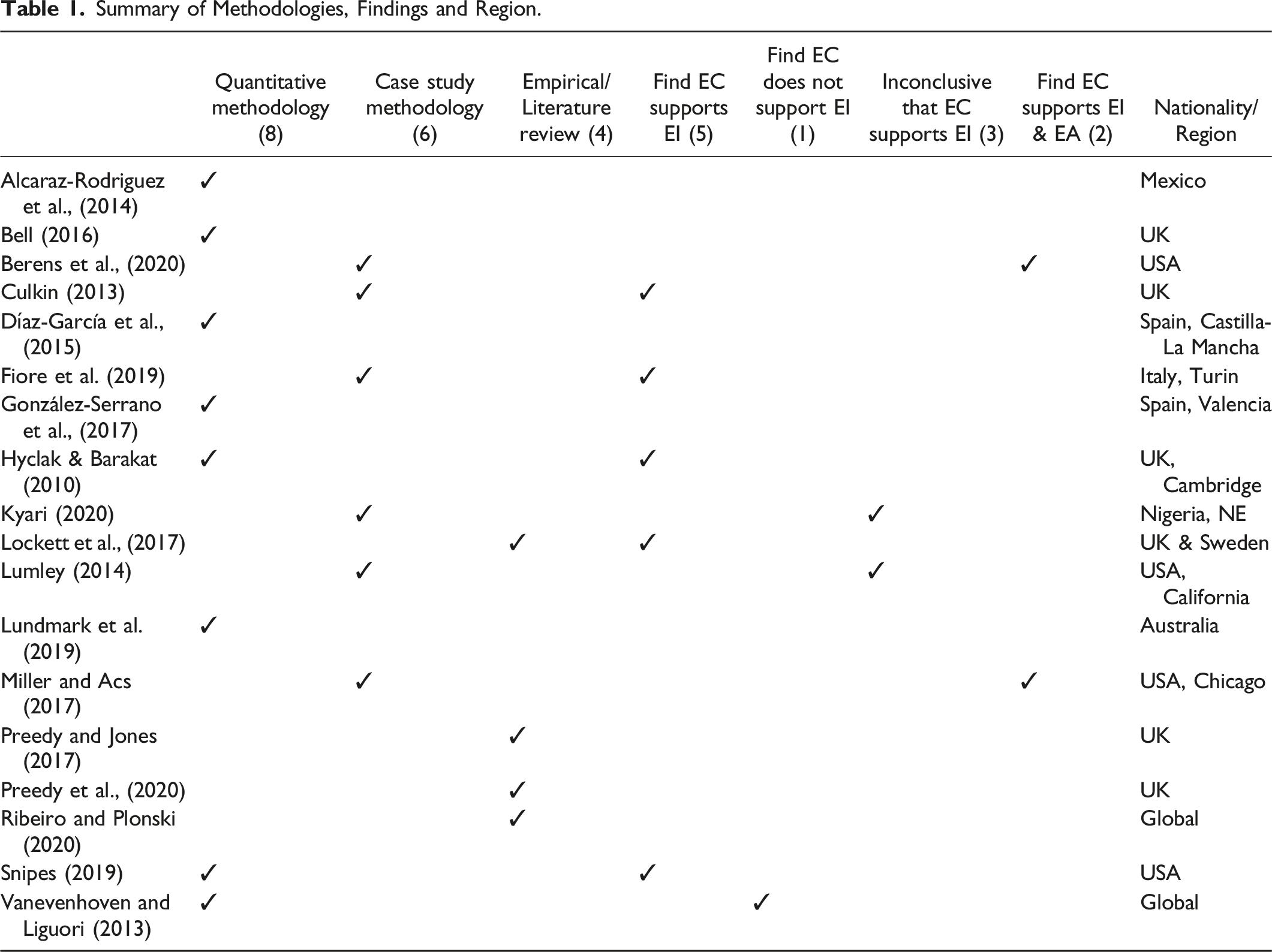
Of the 22 publications meeting the search criteria, five were withdrawn because one was a summary of enterprise education (Rae et al., 2012), one drew on the literature (Nabi et al., 2015); Erdil (2020) and Huq and Gilbert (2013) were wholly curricular and Weaver et al., (2012) is an Entrepreneurial Leadership Development Program for Secondary School educators delivered as extracurricular. One publication, Berens et al. (2020), screened out for not meeting the criteria but of close interest was added back for analysis leaving 18 publications for review.
The resultant publications were analysed to: i. Summarise the literature on EC, ii. Summarise studies that met the analysis criteria, iii. Identify any gaps in the literature and recommendations for further research.
Findings
Profile and Context of the Publications and their Research Approach
Summary of Methodologies, Findings and Region.
Thematic Analysis of the Publications
Themes Arising From this Extracurricular Entrepreneurship Education SLR.
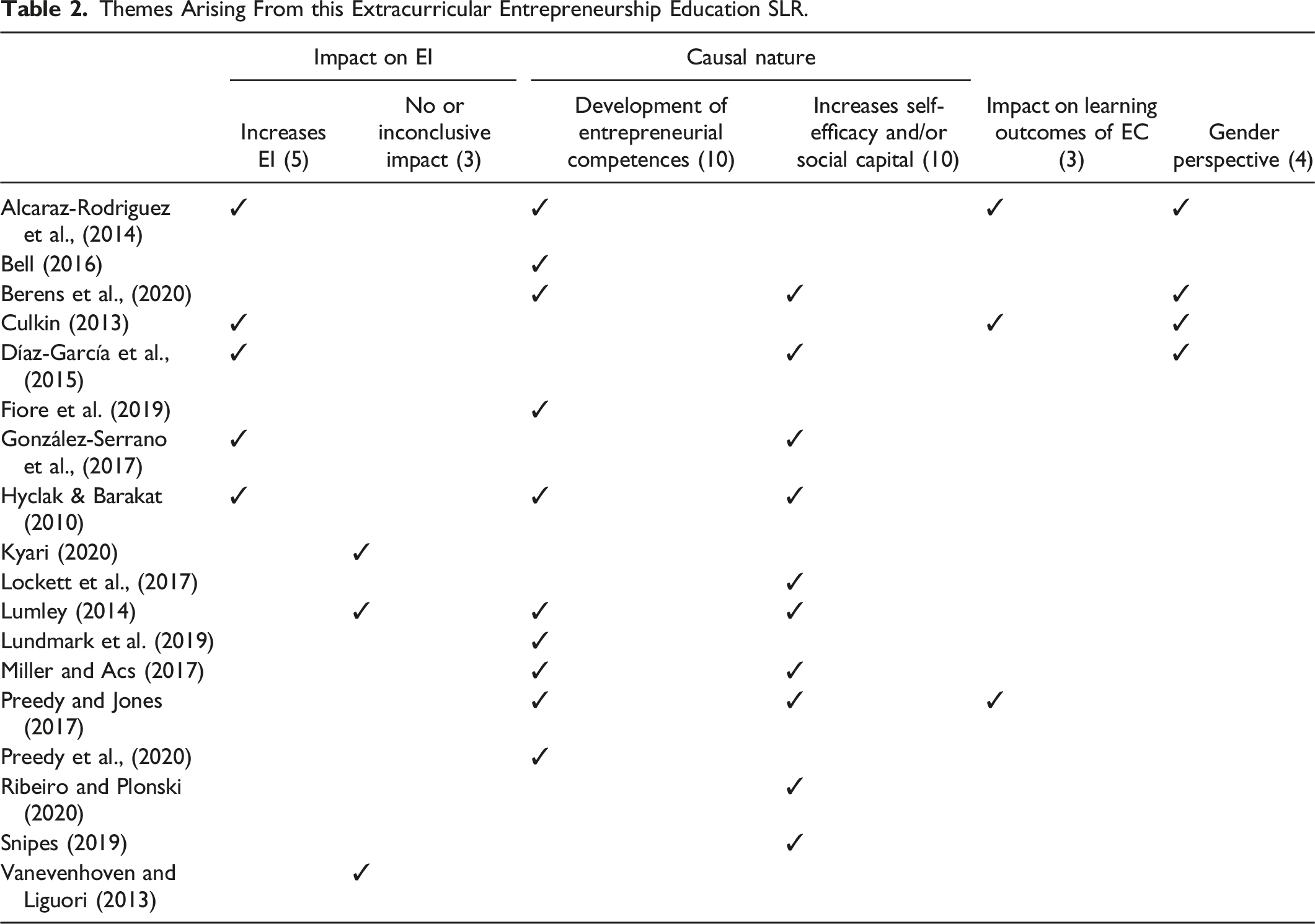
Four findings emerge from these five themes: (i) support that EC generally increases entrepreneurial competences and EI and/or EA; (ii) EC does not always clearly support EI or EA development; (iii) The causal nature between EC learning outcomes and EI or EA is not well understood and (iv) a perceived gender bias in EC.
Impact of EC on Entrepreneurial Competences and EI or EA
Entrepreneurial competences are shown to improve through the practical, experiential learning opportunities of EC. Skills developed through engagement with entrepreneurship education programmes, or one-off EC activities include planning, financial and digital literacy, leadership, short courses, and negotiation. Behaviours that are developed include autonomy, creativity, problem-solving and reflection with increases in self-efficacy and social capital clearly identified through participation in EC. Where EC activity is student-led, this has a further increase on EI. (e.g. Gerba, 2012; Hattab, 2014).
In two publications, EI was not improved through involvement with their family business (Kyari, 2020; Lundmark et al., 2019) although Culkin (2013) finds participation in family-led business to have a positive impact on EA leading inconclusively to the impact of family business involvement on EI and EA. In contradiction to the majority of studies, Vanevenhoven and Liguori (2013) find through rigorous testing that key entrepreneurial behaviours such as self-efficacy, outcome expectations, intentions, interests, and goals are not improved with EC activity.
Overall, this SLR shows that engagement with EC as programmes or discrete events increases EI and develops competences for entrepreneurial endeavours. Increases in social capital and self-efficacy are often noted except in rare cases when testing specifically for self-efficacy. Finally, improvements in entrepreneurial competences arise more generally where the student is involved with the start-up or enterprise sustaining processes are prevalent.
The Causal Nature Between EC Learning Outcomes and EI or EA
A causal effect between EC and entrepreneurial outcomes is identified in 15 of the publications although the detailed cause of the outcome remains as difficult to pinpoint (Preedy & Jones, 2017). Thus, the specific activities that contribute to the development of specific entrepreneurial competences are not identified. In part this is caused by the nature of EC activity and the lack of clear intended learning outcomes (ILOs) of short EC activities although programmes may have generic ILOs. ILOs are implicitly attached to EC and so it is hard to measure the impact of the specific activity. To evaluate EC, ILOs need to be explicitly specified in the design of the activity and pre and post data collection undertaken to determine if there is a causal effect. Alcaraz-Rodriguez et al. (2014), Culkin (2013) and Preedy and Jones (2017) identify the need for longitudinal research to link more precisely the forms of EC activity that lead to specific entrepreneurial outcomes. However, unintended learning outcomes will exist, and it is the engagement with the EC that is identified to produce changes in entrepreneurial competences and intentions.
A Perceived Gender Bias in EC
An emerging but prevalent theme in the literature is a perceived gender bias. Alcaraz-Rodriguez et al. (2014), Culkin (2013) and Preedy et al. (2020) identify that the majority of HE EC incubator users in the UK are male with Berens et al. (2020) address the perceived masculinisation of EE by adopting a feminist pedagogy with horizontal power structures, embedded overlap of student responsibilities and an ethic of care and mutual dependence for their US EC trade press. However, Díaz-García et al. (2015) find no gender bias in the entrepreneurial outcomes of their EC programme but along with Culkin call for longitudinal research into the demographic related outcomes of EC activity.
Further Research
This SLR identifies the need for further research. Bell, (2016), Huq and Gilbert (2013) and Díaz-García et al. (2015) identify the need for longitudinal research to gain further insights into, for example, the impact of work based learning and follow-up after graduation with Lockett et al. (2017), Nabi et al. (2015) and Rae et al. (2012), supplementing with the need to research any resulting entrepreneurial action from entrepreneurship education. Additionally, all the publications from the 21/22 search recommended further longitudinal research with two also recommending research into entrepreneurial activity resulting from entrepreneurship education. Whilst there is considerable focus on the positive impact of EC on EI (Alcaraz-Rodriguez et al., 2014; Bell, 2016; Culkin, 2013; Díaz-García et al., 2015; Fiore et al., 2019; González-Serrano et al., 2017; Hyclak & Barakat, 2010; Kyari, 2020; Lockett et al., 2017; Lumley, 2014; Lundmark et al., 2019; Miller & Acs, 2017; Preedy et al., 2020; Preedy & Jones, 2017; Ribeiro et al., 2018; Snipes, 2019; Vanevenhoven & Liguori, 2013), two other areas of interest are identified, (i) the need to link the development of specific entrepreneurial competences with EC through analysis of the ILOs and actual LOs (Alcaraz-Rodriguez et al., 2014; Culkin, 2013; Preedy & Jones, 2017). This will support the development of targeted EC activities for individuals who need or want to develop specific entrepreneurial competences and (ii) the need to research the impact of gender and EE on EI and EA and the perception that EE has generally been masculinised (Alcaraz-Rodriguez et al., 2014; Berens et al., 2020; Culkin, 2013; Díaz-García et al., 2015).
Conclusion
This SLR shows that whilst extracurricular entrepreneurship education can appear in many forms, some studies of EC in HEIs have suggested that EC can increase entrepreneurial intention, skills needed for entrepreneurship, self-efficacy, social capital and entrepreneurial behaviours. Whilst a general positive impact is observed. The detailed impact of EC on the entrepreneurial mindset is unclear, primarily because of the paucity in research with the need for longitudinal research which studies EI, EA, and EM pre and post engagement with EC clearly specified in terms of ILOs. Further research is identified as longitudinal studies of the impact of the specific extracurricular activities, work-based learning and gender on entrepreneurial activity and the entrepreneurial mindset, before, during and post entrepreneurship education.
Footnotes
Declaration of Conflicting Interests
The author(s) declared no potential conflicts of interest with respect to the research, authorship, and/or publication of this article.
Funding
The author(s) received no financial support for the research, authorship, and/or publication of this article.
