



Abstract
The purpose of this study was to explore the impact of a 3-day entrepreneurship camp on nursing students’ empowerment to act entrepreneurially. Data were collected through individual semi-structured interviews with 17 nursing students conducted both before and after the camp. The data also included student drawings, as well as documents and interviews with 10 stakeholder representatives. Our findings show that students had very limited knowledge of entrepreneurship and had disregarded any valuable or natural link between nursing and entrepreneurship before entering the camp. The four changes in the empowerment process are as follows: (a) From ‘Entrepreneurship is not something nurses are supposed to do’ to ‘Nurses are potential actors in entrepreneurial processes’. (b) From ‘Observing problems in practice’ to ‘Nurses can shape healthcare’. (c) From ‘Not knowing how to define problems sufficiently small to act upon’ to ‘Knowing how to approach problem definition’. (d) From ‘Knowing little about the potential steps of realising a solution’ to ‘Knowing the first steps to testing a solution’s feasibility’. Our study provides insights into the meaning of empowerment to act entrepreneurially in the context of an entrepreneurship education for nursing students and has implications for the entrepreneurship education literature for non-business students.
Introduction
During the last 20 years, entrepreneurship education for non-business students has expanded (Huang-Saad et al., 2020) to a broad range of disciplines in higher education. The introduction of entrepreneurship education in the engineering discipline has resulted in particular designs and methods intended for engineers (Duval-Couetil et al., 2016), including, for instance, the micro-credentialling of entrepreneurship education in practice-based programmes (Eager & Cook, 2020), problem-based learning (Chau, 2005), multidisciplinary course collaboration (Roy et al., 2020) and real-life cases (Creed et al., 2002). Compared to business and engineering, the entrepreneurship education curriculum for nursing students has been less developed (Gilmartin, 2013), although some studies have explored tailored entrepreneurship education for undergraduate and graduate students, as well as courses for employed nurses (Boore & Porter, 2011; Fletcher, 2010; Gilmartin, 2013; Lacey et al., 2012; Wall, 2013; Wilson, 2003). The need for entrepreneurship and innovation in healthcare has been recognised (Berte & Narapareddy, 2019; Narapareddy & Berte, 2018; Ramsgaard & Christensen, 2018), indicating that nurse educators must cultivate nursing students’ empowerment capacity to act entrepreneurially to prepare them to change the healthcare system (Siu et al., 2005).
The entrepreneurship camp, which was the empirical setting of this study, is a compulsory part of nursing education in our institution. It represents nursing students’ first 3 days of exposure to entrepreneurship education, which is introduced after two full years of nursing studies. Previous studies have suggested several potential measures of entrepreneurship education outcomes, such as entrepreneurial competencies, intentions and self-efficacy (Neck & Corbett, 2018). Due to their short duration, entrepreneurship camps tend to focus on the outcomes of student satisfaction, inspiration and perceived learning. Given the variety of available measures, calls have been made for increased contextualisation of the intended outcomes to fit the character of the interventions, as well as the students’ disciplines (Aaboen et al., 2020). Previous studies on entrepreneurship education for non-business students have suggested that the development of entrepreneurial skills should be viewed as a complement to and reinforcement of knowledge related to the functional discipline of a study programme (Winkler et al., 2015). In this study, we used the concept of empowerment as an analytical lens through which to examine how nursing students use their competencies to develop meaningful suggestions for improvement and change in their field and envision themselves having an impact. Using this as our point of departure, we aimed to explore how nursing students can gain a sense of their power to act entrepreneurially and thus feel empowered to make a difference in their future roles as nurses after receiving entrepreneurship education. According to Santos et al. (2019, p. 7), ‘empowerment is about knowing and acting to change the status quo, seeking for new solutions regardless of the context’. In this study, we aimed to answer the following research question: ‘How are nursing students empowered to act entrepreneurially after an entrepreneurship camp?’
Empowerment has been diversely defined in the nursing literature – for example, as a means of researching high-quality patient care (Laschinger et al., 2010), nurse self-employment (Lyden et al., 2018), professional growth and development (Kuokkanen & Leino-Kilpi, 2000), and learning approaches in nursing education (Bradbury-Jones et al., 2007; Siu et al., 2005). Concerning nurse entrepreneurship, Vannucci and Weinstein (2017) distinguished between psychological and structural empowerment (Kanter, 1993) and found that nurse entrepreneurs considered psychological empowerment (e.g. meaning, impact and confidence) more important than structural empowerment (e.g. power, information and resources) in terms of gaining the motivation needed to start a business.
This study contributes to the literature on entrepreneurship education for non-business students by proposing and exemplifying empowerment as a perspective on the impact of entrepreneurship education as an alternative to existing measures. This is accomplished by pinpointing the ways in which entrepreneurship education can be meaningful for professions not normally associated with entrepreneurship.
The structure of this paper is as follows. In the next section, we present the theoretical frame of reference, including a review of the literature on experiential learning and empowerment. Next, we describe the research method. Subsequently, we describe how students’ perspectives on the meaning of being entrepreneurial changed. Finally, we present the conclusions drawn from the study and the implications.
Experiential Learning and Empowerment in Entrepreneurship Camps
Camps are short-term interventions in which participants collaborate in a shared space to find solutions to complex problems in temporal and informal settings (Kianto & Nisula, 2016; West et al., 2012). The camp model enables students to ‘travel’ outside regular education (Nielsen & Stovang, 2015), thus acquiring knowledge that does not fit into and is not integrated with regular structures. Camps may therefore be used to provide a ‘creative entrepreneurial pulse’ in universities’ institutional structures, thus serving as a quick response to policy demands for an increased focus on entrepreneurship (Heidemann & Nielsen, 2011, p. 288). Entrepreneurship camps share many features with both start-up weekends and design sprints. For example, Hiss (2018, p. 64) described a start-up weekend as ‘an event for young entrepreneurs (and those who want to be ones) to work creatively in a low-risk, high-energy atmosphere and develop ideas into small businesses’. In a similar vein, Knapp (2017) described a design sprint as an intervention that aims to expand students’ creative capacity and encourage innovation. According to Bager’s (2011) classification, an entrepreneurship camp resembles a student camp aimed at developing ideas and fostering an entrepreneurial spirit among students and graduates. In this respect, an entrepreneurship camp can be seen as a potential means of supporting students’ empowerment to act entrepreneurially.
Recent entrepreneurship education literature reviews have pointed to an increased interest in pedagogy, especially in the relationship between pedagogical methods and specific outcomes (Gabrielsson et al., 2020; Nabi et al., 2017). This interest in pedagogy has resulted in several classification systems for approaches to entrepreneurship education, such as models, action-oriented approaches, worlds of entrepreneurship education and continuums of entrepreneurship education (Aadland & Aaboen, 2020). However, the impact of entrepreneurship education on students has yet to be examined in rigorous studies (Longva & Foss, 2018). From a pedagogical point of view, an entrepreneurship camp provides an experiential learning situation that differs in content and structure from traditional classroom learning (Neck & Corbett, 2018). Students must conduct their own opportunity identification process during the camp and can use this direct, hands-on experience as part of their reflections and discussions, in line with Kolb’s (1984) experiential learning cycle. Other important dimensions of experiential learning are emotional critical incidents (Cope, 2003) leading to high-level learning, which is primarily associated with student-centred rather than teacher-led learning (Jones, 2019; Verzat et al., 2017). Entrepreneurial knowledge can, therefore, be seen as a synthesis of primary and secondary entrepreneurial experiences, in which the primary experience is the act of entrepreneurship, while the secondary experience resembles a reflection on that experience (Hägg & Kurczewska, 2020). This synthesis, in turn, serves as input for new entrepreneurial experiences. In this respect, an entrepreneurship camp may provide nursing students with their first primary and secondary entrepreneurial experiences in a nursing context.
Following this logic, the role of an entrepreneurship camp is to encourage and support nursing students in acting entrepreneurially, which implies that empowerment can serve as a useful lens through which to understand this process. As a psychological concept, empowerment is about seeing the correspondence between goals, having a sense of how to achieve these goals, and gaining access to and control over resources (Zimmerman, 1995). Based on the literature on empowerment theory and experiential learning, Santos et al. (2019) introduced the concept of entrepreneurial empowerment, which they defined as a cognitive state characterised by meaning, competence, self-determination and impact related to entrepreneurial activities. Meaning refers to ‘the value of a work goal or purpose, judged in relation to an individual’s own ideals or standards’ (Spreitzer, 1995, p. 1143). Competence, reflected in self-efficacy, refers to individuals’ belief in their capability to perform entrepreneurial activities skilfully (Bandura, 1982). Self-determination pertains to individuals’ sense of autonomy in decision-making and pursuit of a course of action (Ryan & Deci, 2002). Impact refers to the degree to which individuals perceive their own behaviours and actions as influencing work outcomes (Spreitzer, 2008). Entrepreneurial activities are typically associated with high fulfilment and actualisation (Santos et al., 2019), with considerable potential to increase individuals’ autonomy in terms of making decisions on what entrepreneurial opportunities to pursue and what outcomes to produce from these actions. Consequently, empowerment is not only about having the ability and willingness to participate in decisions that may lead to positive changes but also about having the power to act on those decisions. Although self-efficacy is about the belief that barriers can be overcome, empowerment is about the capacity and willingness to actually overcome them (Shellman, 2014). In entrepreneurship research, the concept of empowerment has primarily been used in contexts of poverty or risk that typically require proactivity. Such studies have highlighted the relevance of empowerment to entrepreneurship (Santos et al., 2019). From the perspective of experiential education, Shellman (2014) argued that such education may facilitate the development of a more empowered state in students because successfully responding to challenges is an empowering process. Inspired by Shellman’s (2014) ideas about experiential education as a highly effective means by which learners can develop an empowerment capacity, Santos et al. (2019) integrated empowerment theory and experiential learning into a conceptual model of empowerment-based entrepreneurship education. In their conceptual model, empowerment plays a mediating role between learning approaches and learning outcomes. Based on these insights, it is reasonable to assume that experiential learning embedded in entrepreneurship camps can serve as a means of promoting nursing students’ empowerment capacity to act entrepreneurially. Through empowerment-based education, nursing students can recognise the empowering potential of acting entrepreneurially and thus develop their empowerment capacity to make a difference in their professional roles as nurses.
Methodology
This was a qualitative single-case study with embedded cases. This is a useful approach to thoroughly examining an event in its natural context (Crowe et al., 2011). We sought not to generalise but to understand and explain the phenomenon of entrepreneurship education in the context of nursing (Koivu & Hinze, 2017). The case was an entrepreneurship camp as an experiential learning event, including the backdrop of the initiative, case structure and student participants. The analysis focussed on students’ individual empowerment processes, capturing the interplay between educational initiatives and the development of students’ empowerment capacity to act entrepreneurially.
Backdrop
Combining entrepreneurship and nursing has traditionally been seen as controversial due to a perceived conflict between values (profit vs. free care) (Arnaert et al., 2018; Nadin, 2007; Wilson et al., 2003), among other reasons. Although scholars have discussed entrepreneurship education for nursing students since the 1980s (Scruby & Farrell, 1987), few nurse education programmes offer entrepreneurship education (Arnaert et al., 2018). As a result, entrepreneurial nurses face barriers, such as knowledge gaps and a lack of institutional support (Arnaert et al., 2018; Elango et al., 2007; Sharp & Monsivais, 2014; Wilson et al., 2003). Thus, this study represents a rare example of an entrepreneurship camp for nursing students organised at a large Norwegian university. Basic nurse education in Norway spans 3 years and leads to a bachelor’s degree in nursing. In Norway and globally, nurse education programmes aim to provide students with a foundation in behavioural, life and nursing sciences and to prepare them for nursing practice, such as the promotion of health, the prevention of illness, and the care for ill and disabled people. Nurse education programmes are also expected to prepare students to assume leadership roles, teach, conduct research and advance nursing practice (International Council of Nurses, 2018).
The camp was based on a draft of new guidelines for Norwegian health and social science education. The draft (and the enacted law) stipulates that future nurses in Norway should have the necessary knowledge and skills to handle technological tools and innovative solutions in healthcare. Furthermore, nurses should be able to identify challenges related to healthcare quality and contribute to service innovation (Kunnskapsdepartementet, 2018, p. 7; Norsk Lovtidend, 2019). The initiative for the camp was also inspired by the need for knowledge of technology and efficiency in healthcare services, as well as the demand for and supply of welfare technology (NOU 2011:11, 2011).
Case Structure
The 3-day entrepreneurship camp was organised for the first time in 2017 by the faculty of the Department of Public Health and Nursing in collaboration with Junior Enterprise. Historically, Junior Enterprise has focussed on primary, secondary and high school students – for instance, hosting events and facilitating entrepreneurship competitions. Over the years, it has also organised entrepreneurship championships for undergraduate students, and in 2015, it established a camp programme targeting higher education students.
Faculty from all disciplines can use this programme as a structure for their own entrepreneurship camps. This has been the fundament for the camp since 2018. The camp was arranged as part of a 10-credit course called ‘Nursing Third Year’ and hosted at the very beginning of the autumn semester. The students were informed about the camp through their course curriculum. Participation in the camp was mandatory and exclusively for third-year students. The camp included various lectures on nurse entrepreneurship, teamwork, global healthcare challenges and pitching. Three external stakeholders were involved throughout the camp’s duration: the municipality, the local university hospital and a national centre for entrepreneurship education. Two council members and one nurse represented the municipality, one nurse represented the hospital, and three PhD students and former entrepreneurs, one professor and one assistant professor represented the centre for entrepreneurship education. The stakeholders presented real-life, context-specific assignments to the students, which were based on real needs, problems and solutions in healthcare. The municipality asked the students to identify the unmet needs and wishes of the users of welfare services. The hospital asked the students to search for solutions to the problems of increased patients and employee shortages. The centre for entrepreneurship education asked the students to identify a problem that they had experienced in the health sector and find one or two solutions to it. The stakeholders acted as mentors and jury members, along with faculty, representatives of the collaborating youth organisation and representatives of a student entrepreneurship organisation at the university.
Before the camp started, the faculty divided the students into three large groups, each of which collaborated with one stakeholder to complete its assignment. The faculty further split each group into 10 smaller teams, forming 30 teams with approximately seven students in each team. Since it was the faculty that formed the teams, some students may not have talked or collaborated with each other before the camp. The student teams were asked to define, explore and complete the assignments presented by their respective external stakeholders. The students were also encouraged to reach out to experts to gain knowledge of the problem and produce solutions. Mentors offered the student teams advice on the first and second days. On the third day, the student teams pitched their ideas before three juries – one for each overarching group. The juries evaluated the student teams based on evaluation criteria set by the university, focussing on their ability to explain the need or problem and the solution, the key resources needed and their potential sales strategies. Lastly, the juries evaluated the group presentations. The camp ended with each stakeholder naming its winners and presenting them with prizes.
Participant Sample
Sampling from Groups A, B and C.
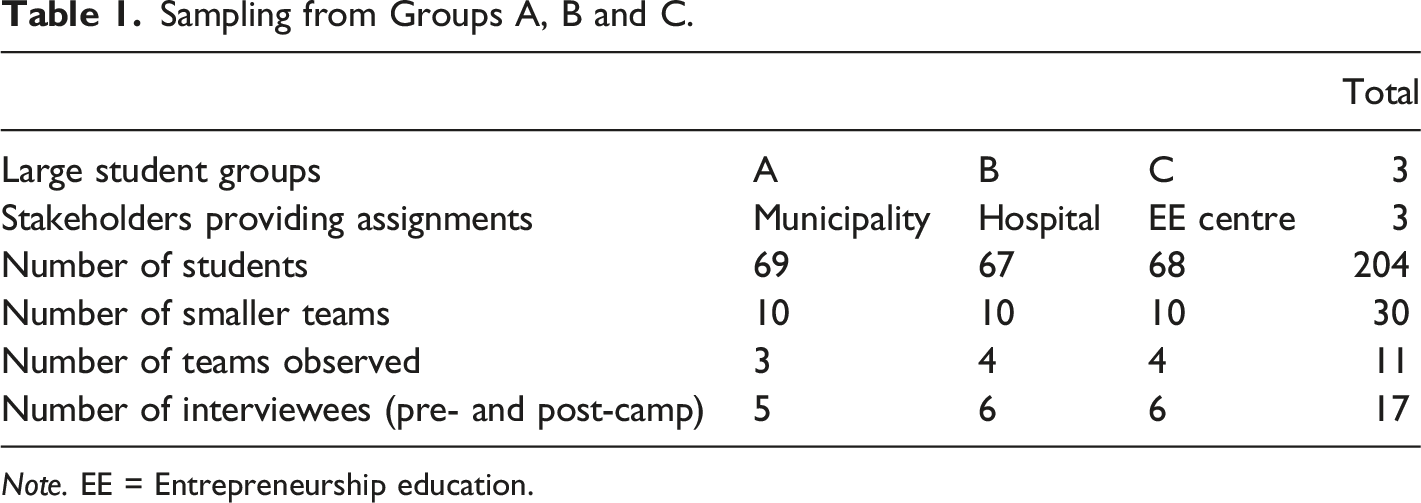
Note. EE = Entrepreneurship education.
Groups A, B and C are hereinafter referred to as the municipality group, the hospital group and the entrepreneurship education group, respectively. The interviewees were between 22 and 31 years old at the time of the interviews. Eleven of them were female, and six were male. Concerning prior entrepreneurship experience, one student had attended an entrepreneurship camp in secondary school, another student had organised an event in secondary school and two students had run student ventures during high school. The remaining 13 students had no prior entrepreneurship experience. Thus, the sample consisted of a diverse group of nursing students in terms of age, gender and prior entrepreneurial exposure, allowing us to capture a broad range of nuances of the meaning of empowerment to act entrepreneurially in the context of entrepreneurship education for nursing students.
Data Collection
The collected data consisted of individual semi-structured interviews with 17 students and 10 stakeholder representatives, drawings obtained from the participating students, team and group observations and documents. One of the authors planned and conducted all the interviews and observations. The observations and stakeholder interviews were used for contextual understanding. The observations took place on-site throughout the duration of the camp and encompassed student work in the observed teams and gatherings of all students, such as during the introduction to the camp, lectures and entertainment on the first day. The observations also included team-based feedback sessions with mentors and stakeholders and presentations before the juries on the final day. Field notes were taken during the observations. The observations informed the interviews, enabling the interviewer to ask specific questions regarding, for instance, work effort, work methods and collaboration in the team. The observations revealed, for example, that some teams did not show up on the second day of the camp, while others worked intensively to produce good solutions to the problems specified in their assignments. Hence, the observations of student teams served mainly as a focal point of discussions during the post-camp interviews, encouraging students to engage in meaningful discussions related to what they had experienced in the camp.
The 10 stakeholder representative interviews were conducted after the camp. The participants represented all involved organisations: the municipality, the hospital, the centre for entrepreneurship education, the nursing faculty, the youth entrepreneurship organisation and the student entrepreneurship organisation. The stakeholder interviews lasted between 32 and 71 min, with an average duration of 52 min. The interviews were transcribed and used to inform the case structure. In this respect, the stakeholder interviews provided us with contextual insights into the overall design and structure of the camp but also into the ways in which the different stakeholders perceived and experienced their roles in the camp and their expectations of the intervention in terms of outcomes.
The interviews with the participating students were conducted in the building in which the camp was hosted. The pre-camp interviews were conducted one or 2 days before the camp started, while the post-camp interviews began immediately after the camp and continued up to 1 week afterwards. Each interview lasted between 18 and 40 min. The pre-camp interviews lasted 30 min on average, while the post-camp interviews lasted 31 min on average. All interviews were voice-recorded and later transcribed by one of the authors and research assistants. All students were asked about their overall understanding, associations and experiences of entrepreneurship before and after the camp. The interviews consisted of open questions, such as ‘What is an entrepreneurial opportunity for you?’ During the interviews, all interviewees received a pen and a blank A4-size sheet, which they used to increase their sense-making while communicating complex ideas (Weick et al., 2005). The interviewer encouraged the interviewees to draw while talking. As an interview method, drawing triggers observation, reflection and evaluation of one’s ideas (Bagnoli, 2009; Zweifel & Van Wezemael, 2012). However, such drawings must be supported with narrative descriptions of the rich context of these ideas. The students were therefore prompted to draw with questions such as ‘Can you draw and explain an entrepreneurial opportunity that you have seen or experienced?’ This was not related to their upcoming teamwork assignment in the camp but rather focussed on individually perceived opportunities. Based on their drawings, the students explained how they could proceed to implement their perceived opportunities, describing an entrepreneurial process. In the post-camp interviews, the students were shown their drawings from the pre-camp interviews to comment on their opportunities and suggest actions regarding their implementation. They could choose to edit and add details to their entrepreneurial processes or to start over with a new opportunity or process. All drawings were scanned directly after the interviews with the participants’ consent. Documents related to the camp, such as the camp programme, schemes for the juries, templates and informative posters for students, were also included in the analysis to support and discuss the findings derived from the interviews and observations. These documents also provided a contextual understanding of the overall design and structure of the experiential learning intervention.
Data Analysis
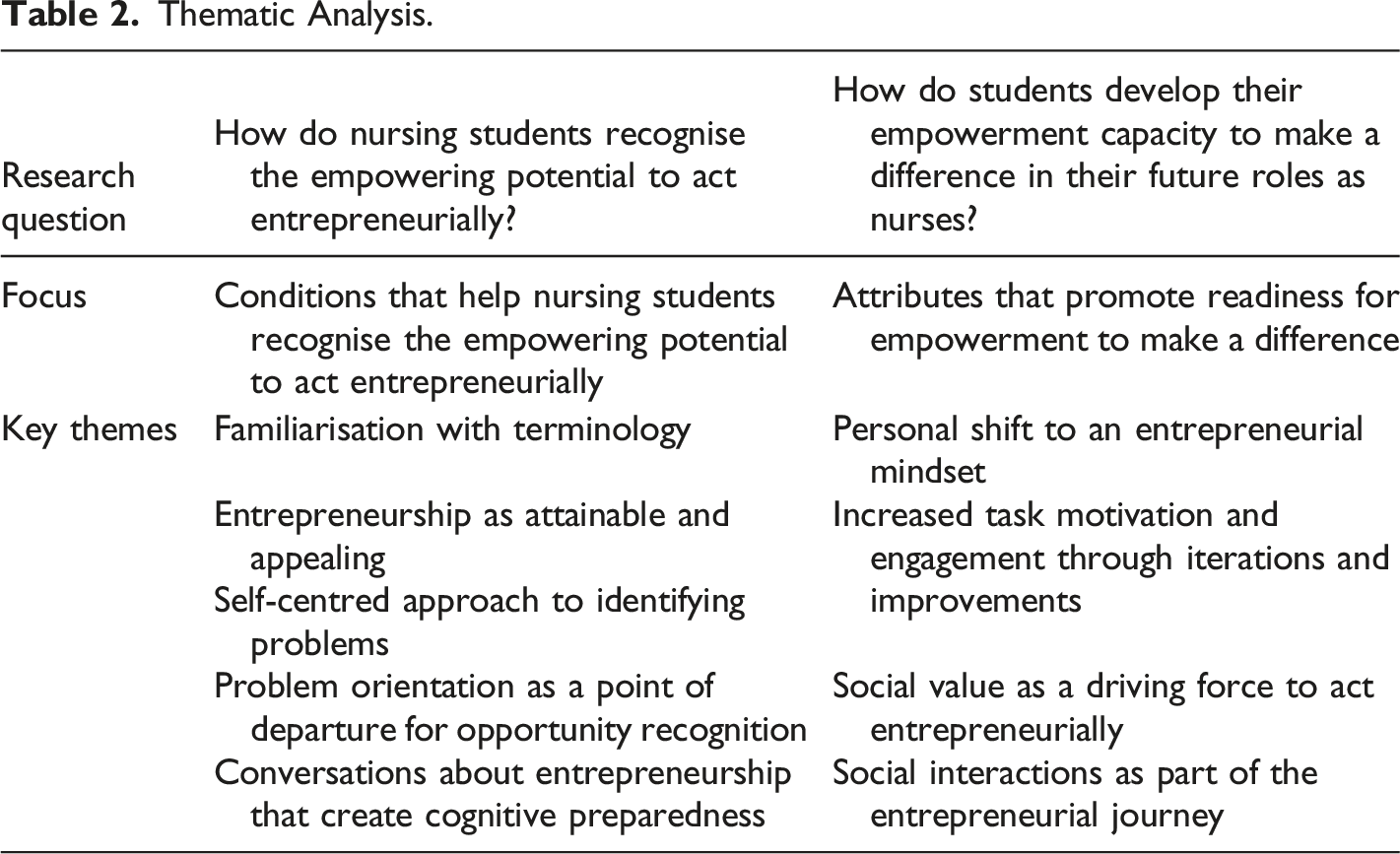
Thematic Analysis.
To further support our findings, we embedded the students’ pre- and post-camp drawings in the thematic analysis. We compared each participant’s pre- and post-camp drawings to identify differences in their visual presentations of entrepreneurial opportunities before and after the camp, as well as shifts in their perceptions of how to proceed to realise these ideas. We performed these comparisons while listening to the interviews and reading the transcripts, as some of the participants spoke more than they drew. All participants were asked to describe their drawings and reflect on them orally. This output was also embedded in the thematic analysis.
Conditions that Help Nursing Students Recognise the Empowering Potential to Act Entrepreneurially
We identified five key conditions that helped students recognise the empowering potential to act entrepreneurially after the entrepreneurship camp: familiarisation with terminology, self-centred approach to identifying problems, problem orientation as a point of departure for opportunity recognition and conversations about entrepreneurship and cognitive preparedness. These conditions played a key role in encouraging students to perceive and talk about themselves in relation to entrepreneurship with a sense of power to act entrepreneurially.
Familiarisation with Terminology
Familiarising oneself with entrepreneurship terminology helped students recognise the empowering potential to act entrepreneurially. This was particularly evident in the pre-camp interview conversations regarding definitions of entrepreneurship and the associations with these definitions. Most students had very limited or no prior knowledge of entrepreneurship, and some associated their prior knowledge with a short or elective course in secondary school or high school. For example, two students recalled experiencing an entrepreneurship initiative in secondary school. Nevertheless, even students with some prior experience reported a lack of knowledge about entrepreneurship and associated entrepreneurship with uncertainty, risk and luck. Before the camp, several students expressed ambivalent feelings about entrepreneurship. They underlined their statements through silence, hesitation, and rephrasing multiple times when talking about entrepreneurship. Some students struggled to say anything at all, while others described entrepreneurship using terms such as ‘novelty’ or ‘groundbreaking activity’. One student expressed her understanding of entrepreneurship as follows: ‘Eh, it is to create something new, and then . . . I kind of picture people who, well, make something that no one has thought of before. You are the first to come up with an idea. . . . Innovation, I think, is more about revolutionising, and so forth—something very new and useful’. This and similar statements suggested that most students perceived and talked about entrepreneurship as something extraordinary performed by only a few people. As most students lacked prior entrepreneurial knowledge and skills, the pre-camp interviews served as a platform for discussing their previous understanding of entrepreneurship and at the same time providing them with opportunities to reflect on what entrepreneurship meant in the context of their functional discipline. Therefore, familiarisation with entrepreneurship terminology served as an important condition that encouraged students to engage in meaningful discussions in which they could reason about the potential role of entrepreneurship in their own field. Their understanding of entrepreneurship terminology improved during the camp, helping them recognise the empowering potential to act entrepreneurially by talking about entrepreneurship with confidence.
Entrepreneurship as Attainable and Appealing
Students’ perceptions of entrepreneurship as attainable and appealing rather than as exceptional and unappealing was another condition that helped students recognise the empowering potential to act entrepreneurially. Before the camp, most students saw no natural connection between entrepreneurship and nursing. A student from the municipality group stated that entrepreneurship in nursing was a new concept for the students. Students from all three groups made similar statements. One student from the entrepreneurship education group explained that entrepreneurship had nothing to do with her motivation to become a nurse and that, if she had been interested in entrepreneurship, she would have chosen another type of education. She articulated her hesitation to perceive herself as entrepreneurial as follows: ‘I do not know if I am that kind of person’.
Although some students thought that the camp was irrelevant to nursing, others were simply surprised to see entrepreneurship in the nursing curriculum. In the words of one student, ‘When you have [entrepreneurship] in the nursing curriculum, it is obvious that you are going to . . . think along these lines’. The student explained that entrepreneurship was a completely new way of thinking about nursing for her. She was not aware that entrepreneurship could be an aspect of nursing practice before the camp. Several students had similar viewpoints before the camp but shifted from viewing entrepreneurship as exceptional and ‘someone else’s business’ to seeing it as attainable with personal attachment during the camp. Students from the hospital group served as an example. Before the camp, they described entrepreneurship as unfamiliar and, to some extent, unappealing. To them, it was simply a way to earn money or a way to create change for politicians: ‘Healthcare needs a lot more money to change things. We have the opportunities, but we do not prioritise it’. They related entrepreneurship to change, saw the economy as a barrier, and placed the responsibility for initiating entrepreneurship at the national level, especially in terms of politics. This stood in contrast to their post-camp perceptions. After the camp, students spoke of entrepreneurial opportunities from a personal perspective and as something that they could envision themselves undertaking in the future. They emphasised their potential to identify problems and opportunities as nurses, using their skills and experiences to improve nursing practice. One student expressed this conviction by stating, ‘I think that it is actually possible to make a difference. It is actually possible for us working in healthcare to shape it’. Thus, perceiving entrepreneurship as attainable and appealing served as a key condition that helped students recognise the empowering potential to act entrepreneurially.
Problem Orientation as a Point of Departure for Opportunity Recognition
All students were asked to draw an entrepreneurial opportunity during the pre-camp interviews. Although a few students instantly presented some opportunities, others struggled for several minutes to think of potential entrepreneurial opportunities. Some students needed a great deal of guidance to envision a problem and an opportunity to solve it. The students seemed more confident talking about problems than about potential solutions and hesitated more often when suggesting solutions. Some students even said that they wished they had prepared in advance. Several interviewees identified problems related to clinical nursing in municipalities and hospitals. For example, they highlighted the problems of loneliness among the elderly living at home or in institutions, drug abuse among the youth, ethical considerations in psychiatry and the distribution of clean scrubs in institutions. One student identified the problem of children struggling to express their thoughts and feelings while being hospitalised. The student suggested creating a drawing station for children to use when discussing their issues with psychologists.
Students’ previous experiences of acting on problems in healthcare were not positive. One student shared an unpleasant experience from her summer job at a nursing home, where she had seen healthcare personnel treat patients disrespectfully: ‘They shoved the patients so they hit their heads in the guard rail of the bed’. The student had tried to talk about this to both managers and co-workers, who responded, ‘Welcome to the real world’. She expressed anger at ‘the old way of doing things’ and the culture of avoiding change. Based on such experiences, she felt that it was hard to present new ideas for improvement in the nursing profession. This student’s experiences exemplified the idea that nurses and nursing students discover problems that are not necessarily experienced by authorities and other roles that students associated with change. Although such problems can fuel personal motivation to initiate change, harsh responses from peers and supervisors may discourage entrepreneurship. Overall, our findings showed that departing from problems as potential sources of entrepreneurial opportunities-initiated students’ thought processes of entrepreneurship related to opportunity recognition.
Self-Centred Approach to Identifying Problems
A fourth condition that helped students recognise the empowering potential to act entrepreneurially was a self-centred approach to identifying problems. Most students were more comfortable identifying problems based on personal observations or experiences in healthcare. Although most students did not associate entrepreneurship with nursing before the camp, they could recognise several problems related to healthcare. Perhaps more interestingly, they described these problems from their own experiences as nursing students or assistants.
Students from all three groups had a clear idea of healthcare issues that needed to be tackled. They had recognised and reflected upon several areas for improvement in the healthcare sector before the camp. For example, a student from the hospital group presented a wide range of opportunities for improvement in healthcare, fuelled by seeing ‘a lot of roughness in nursing homes’. She shared several stories about how she had initiated small changes in institutions to relieve patients’ and caregivers’ pain and despair. These and other examples showed that the students had recognised various opportunities to create change in healthcare long before participating in the camp. However, they did not necessarily translate these problems into entrepreneurial opportunities.
Conversations about Entrepreneurship Creating Cognitive Preparedness
Another condition that helped students recognise the empowering potential to act entrepreneurially was conversations about entrepreneurship from a nursing point of view, which created cognitive preparedness to enter the camp. Several students described the pre-camp interviews as the actual initiation of their entrepreneurial processes. They also found that the pre-camp interviews helped them engage in meaningful conversations about entrepreneurship from a nursing perspective, which stimulated reflective thinking. Unintentionally, the interviews seemed to have cognitively prepared the participants for the camp by prompting them to reflect on their learning at the camp after its completion, which was a valuable learning experience since most students were inexperienced in entrepreneurship. The pre-camp interviews included conversations about what entrepreneurship meant and how it could be interpreted from a nurse’s perspective. They also helped students tap into their own experiences of healthcare and connect them to entrepreneurial opportunities.
The interviews included the act of drawing, which supports reflection on the past and present (Bagnoli, 2009). In this respect, the pre-camp interviews served as an arena in which students were encouraged to initially explore the concept of entrepreneurship and initiate the process of empowerment to act entrepreneurially. Moreover, the drawings stimulated meaningful conversations about entrepreneurship, guided students in envisioning entrepreneurial opportunities and facilitated reflection on and assessment of their own ideas. A student from the municipality group stated that the pre-camp interview was the first time she had been exposed to entrepreneurship terminology. This suggested that the entrepreneurial process had already begun in the pre-camp interviews. In support of this finding, a student from the hospital group noted that the pre-camp interview had initiated her thought process about entrepreneurship, making her feel better prepared when entering the camp.
Attributes That Promote Readiness for Empowerment to Make a Difference
We identified four key attributes that promoted readiness for empowerment to make a difference in students’ future roles as nurses. These attributes included a personal shift to an entrepreneurial mindset, increased task motivation and engagement, social value as a driving force to act entrepreneurially and social interactions as part of the entrepreneurial journey.
Personal Shift to an Entrepreneurial Mindset
After the camp, several students changed their minds about their roles in entrepreneurial processes. They demonstrated new perceptions of their ability to create change, this time with more confidence. Given their scepticism about entrepreneurship before the camp, the fact that most students described it with confidence and using positive terms in the post-camp interviews was a surprising outcome. Students clearly stated that the camp experience had broadened their views of entrepreneurship and influenced their perspectives on nursing. They saw themselves as potential actors in entrepreneurial processes, arguing that their knowledge as nurses could provide unique opportunities to create change for a better society. For example, a student from the hospital group reflected on how to deal with challenges that arose in daily life, stating that their team had found this intriguing during the camp: ‘It was actually very educational. . . . We came up with something really clever, and it was exciting to hear what others had come up with. [They had found solutions to] these tiny things that annoy us in our daily lives!’ Students talked about the camp with engagement and joy, explaining that they had experienced a personal change in mindset during the camp and felt empowered to make a difference as nurses. Students recognised that nurses have unique insights into the challenges of nursing and saw this as a foundation for entrepreneurship. One student described himself as a person who avoided conflicts. He explained that he used to see problems but just ignored them – they were someone else’s job to solve. However, his mindset changed during the camp: ‘We learnt to approach [problems], talking to like-minded people, checking with other clinics, and considering the economic aspects and all the other things—to see if this is actually possible to implement’. These examples revealed a shift in many students’ mindsets, as they now viewed themselves as potential actors with the ability and confidence to create change. In this respect, they developed an entrepreneurial mindset, altering their perceptions of the relevance of entrepreneurial behaviour to their future roles as nurses.
Increased Task Motivation and Engagement
Another attribute that promoted readiness for empowerment to make a difference was increased task motivation and engagement through iterations and improvements. When students identified an entrepreneurial opportunity, the interviewer asked, ‘What would you do to act on this opportunity?’ Before the camp, students drew only a few steps in their envisioned entrepreneurial journeys. One of these steps was to talk to people who had undergone similar processes. Thus, the need for complementary competence and experience was evident before the camp. In the post-camp interviews, the interviewer encouraged the students to make any changes they wanted to their pre-camp interview drawings. Some chose to add information and alter their pre-camp descriptions of their journeys and opportunities. However, their responses varied. Students from the hospital group made many changes to and iterations of their drawings in the post-camp interviews. They pinpointed the need for a diverse and competent team to understand the costs and benefits involved and the need for financial support. They also suggested simplifying their potential products and services using standardised components and narrowing their focus instead of trying to ‘save the world’. Two students redid their drawings to provide less expensive solutions to the problems at hand. Another student chose to examine similar solutions to determine why they did not work optimally. These findings suggested that students had gained increased task motivation and engagement, bringing their new knowledge and experience to the discussion. Thus, increased task motivation and engagement served as an important attribute for developing the empowerment capacity to make a difference.
Social Value as a Driving Force to Act Entrepreneurially
Social values, such as quality of care and quality of life, were the most important motivations for students’ ideas and served as the driving force to act entrepreneurially. During the interviews, all students were introduced to entrepreneurship as a process of creating financial, environmental or social value. Nevertheless, only one student mentioned environmental value as a potential outcome of entrepreneurship. None of the students cited economic gain as the main outcome, although one student nearly mentioned it, as shown below. Interviewer: So, how can you create value by solving this challenge? What value do you create for individuals or the society? Student: Well, the problem leads to unnecessary stress for many already in a scary situation… A solution can provide better quality of life. Interviewer: So if we go back to the three values I mentioned – environmental, economic and social – where does your idea fit? Student: None. There is probably an economic value in here as well… it is hard. Social – is it social?
A student from the municipality group stood out by suggesting a high-technology product idea that she had been thinking about for quite some time. She hesitated while talking about it: ‘It is very hard to create this idea. . . . I do not know if [this technology] exists. However, if it does, it can look through the different layers of the skin’. Her idea was to detect pressure ulcers (decubitus) before they manifested themselves to the senses using camera technologies to monitor the skin. She explained that she had conceived this idea when doctors photographed her baby to detect jaundice. Seeing cameras as diagnostic tools, she began to think of other diseases that could be monitored using such technology. This student was one of the few who saw opportunities for creating products, whereas most were service-oriented.
Social Interactions as Part of the Entrepreneurial Journey
In the post-camp interviews, students were asked to suggest how they could proceed to implement their ideas. Certain differences in the ways in which students envisioned their entrepreneurial journeys were evident and were mainly related to their perceived roles in social interactions (both within their teams and with stakeholders) as part of their entrepreneurial journeys. When encouraged to alter their envisioned entrepreneurial journeys, students from the hospital and municipality groups recognised the need to talk to several new people. They listed people who had worked in the field, people with specific experience, knowledge, and skills and individuals with various roles, such as investors, sponsors, users and buyers. One student highlighted the need to create a heterogeneous team, including end users: ‘It does not have to be only nurses, doctors, and experts but also people using it’. To reach out to these people, students included communication, such as pitching, in their envisioned journeys after participating in the camp. Being introduced to the local entrepreneurship ecosystem, understanding the role of networking, and learning from others were essential learning outcomes of the camp. For example, a student from the hospital group identified an opportunity to create videos for nursing education as supplements to books, lectures and practice. In the post-camp interview, he refined his idea of how to pursue this opportunity by recognising the need to approach additional stakeholders. These social interactions included contacting organisations for entrepreneurship to receive feedback, targeting audiences to test ideas and make necessary changes, contacting investors to secure financing and conducting marketing before launching products. This refined view of the entrepreneurial journey was to some extent reflected in this student’s drawings in the post-camp interview. As shown in Figure 1, the post-camp drawing, to the right, included additional (and refined) steps and social interactions with key stakeholders to support the student’s entrepreneurial journey, thus indicating readiness for empowerment to act entrepreneurially. Refinement of the entrepreneurial journey envisioned.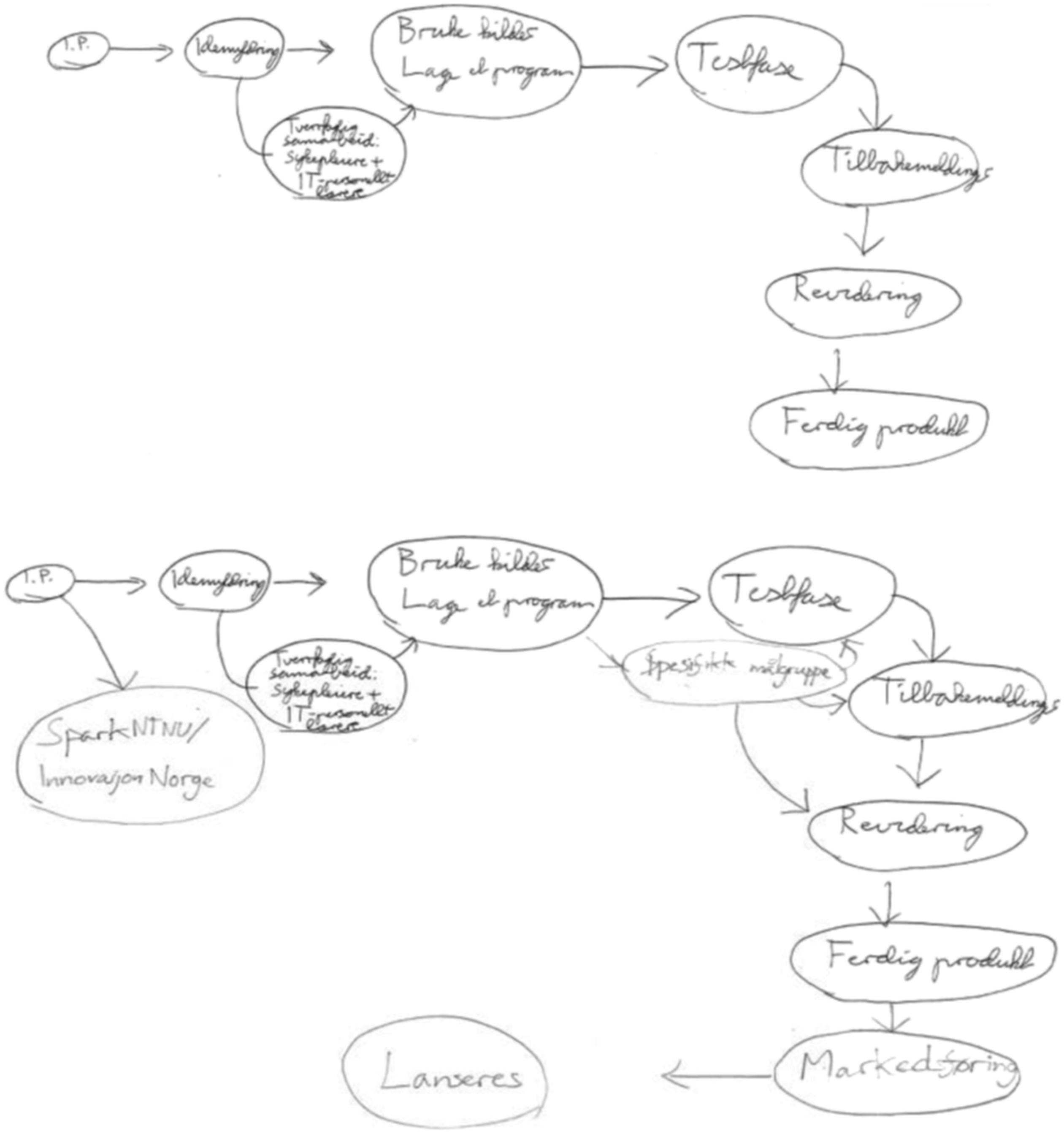
Several students recognised the need for social interactions to develop an empowerment capacity to make a difference. As one student noted, ‘the most important part is to know that there are people out there who are willing to help you with an idea’. Another student expressed a negative image of the willingness of actors in the healthcare industry to pursue change: ‘[A big IT company] has already developed a solution similar to our idea. . . . And the municipalities have chosen not to use it because it is too expensive. . . . I find it weird that they say that this is a huge problem . . . when they have something to use but do not invest in it’. Learning from experts gave the students a realistic image of the complexity of their ideas and the need to receive positive feedback from the market.
Overall, the students from the municipality group were optimistic, stating that they still liked their ideas. However, the group was split regarding writing down further actions. Some of the students had numerous suggestions on how to improve their envisioned entrepreneurial journeys. They added several details about the people to whom they would talk and the importance of targeting an audience, testing their service and securing financing. However, not everyone had specific suggestions for improvements. Two students seemed unsure after the camp. One of them stated that she was not sure whether the idea was feasible or even possible to realise, although it was a well-established model of volunteerism. The other student eventually added ‘idea generation’ to their envisioned journey but did not know how to develop the idea any further. Students from the entrepreneurship education group evaluated their opportunities from a more general perspective. They considered their solutions too ‘big’ and attempted to narrow their scope. They seemed to question whether the problem that they wanted to solve was relevant to other people and thought that their potential product or service might already exist elsewhere in the country. Two students stated that they did not wish to make any changes to their previous drawings, while another student from the same group only added finance to her envisioned journey.
The students who made the fewest changes to their drawings appeared less engaged in the camp. The team observations revealed that these students were working individually on their computers. They did not talk much with one another, and there were no signs of any joint brainstorming sessions, collaboration or discussions. They left the school before the first day ended and did not return on the second day. This lack of engagement was addressed in the interviews. A student from the entrepreneurship education group stated that their team did a minimal amount of work on the second day and did not show up at school until the presentation on the third day: ‘If I had known that [the prize] was cinema tickets, I would have worked a bit more on the second day… While some students worked hard and won all the prizes, others found it pleasant to take a day off’. The differences between students’ empowerment to act entrepreneurially revealed in the post-camp interviews may have been related to individual preferences and to the degree to which students prioritised social interactions as part of their entrepreneurial journeys.
Discussion
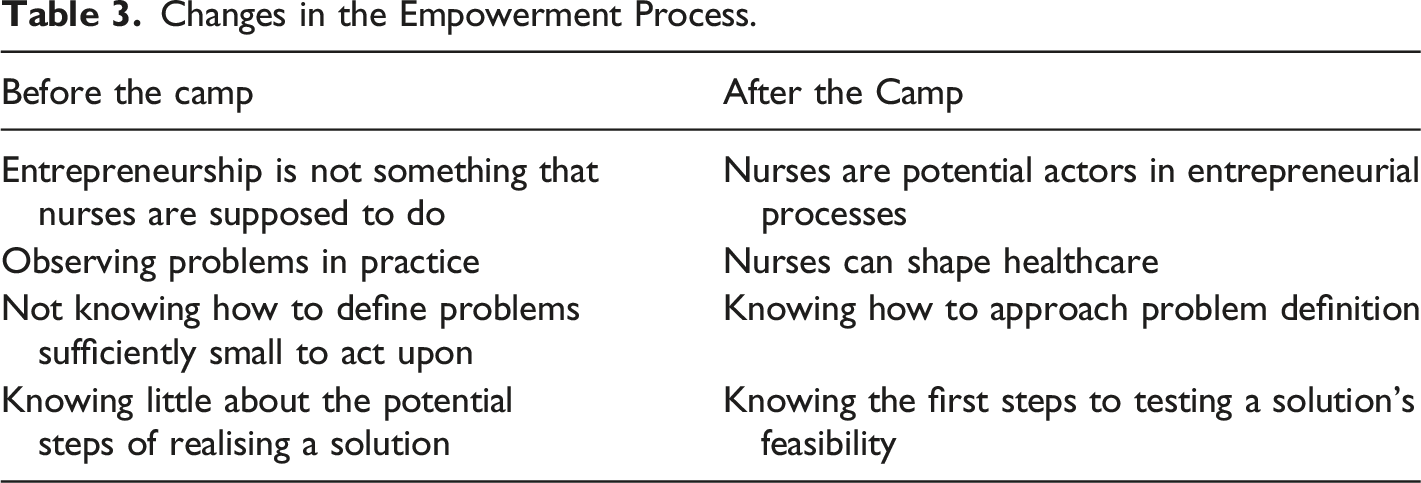
In this study, through the lens of empowerment, we investigated the role of an entrepreneurship camp as an experiential learning intervention that encourages and supports nursing students in acting entrepreneurially. We identified five conditions that help nursing students recognise the empowering potential to act entrepreneurially and four attributes that promote readiness for empowerment to make a difference. In sum, the four changes in the empowerment process are as follows. (a) From ‘Entrepreneurship is not something nurses are supposed to do’ to ‘Nurses are potential actors in entrepreneurial processes’. As the condition entrepreneurship as attainable and appealing shows, students went from being surprised that entrepreneurship was even in the curriculum for nurses before the camp to identifying themselves as potential actors in entrepreneurial processes, arguing that their knowledge as nurses could provide unique opportunities to create change for a better society after the camp. (b) From ‘Observing problems in practice’ to ‘Nurses can shape healthcare’. The condition problem orientation as a point of departure for opportunity recognition shows that students brought many experiences from observing problems in healthcare to the camp. However, while they had previously only observed problems and assumed that governmental or hospital management actors would solve them, the condition entrepreneurship as attainable and appealing shows that they entertained different thoughts after the camp. (c) From ‘Not knowing how to define problems sufficiently small to act upon’ to ‘Knowing how to approach problem definition’. Particularly the drawings, but also the attribute increased task motivation and engagement, show that students went from trying to ‘save the world’ before the camp to simplifying their envisioned products and services using standardised components and narrowing their focus after the camp. Although students identified complex problems before the camp, such as loneliness among the elderly and drug abuse among the youth, they subsequently focussed on more concrete issues inspired by the revelations that they had during the camp. (d) From ‘Knowing little about the potential steps of realising a solution’ to ‘Knowing the first steps to testing a solution’s feasibility’. As the attribute social interactions as part of the entrepreneurial journey shows, students were able to list several useful actors whom they could contact to further promote their potential solutions. They were also able to identify necessary activities, such as pitching and user testing and critical resources that they needed to access during development. To students, the first crucial steps in their entrepreneurial journeys were more social than previously anticipated, as the development of opportunities was conducted in teams and in interaction with other actors, which in turn changed their perceptions of what they personally needed to do to create change.
Thus, our findings suggest that the entrepreneurship camp served as a learning intervention that helped nursing students recognise the empowering potential to act entrepreneurially and develop an empowering capacity to make a difference in their future roles as nurses. These cognitive states may be crucial for becoming empowered to act entrepreneurially (Santos et al., 2019). After all, ‘entrepreneurial activities are powered by meaning’ (Santos et al., 2019, p. 9). The incentives for nursing entrepreneurship are often associated with a wish for autonomy and self-determination, competence, impact and meaningfulness (Vannucci & Weinstein, 2017) – four dimensions that were facilitated during the camp. These are all key aspects of psychological empowerment (Santos et al., 2019; Thomas & Velthouse, 1990). In terms of structural empowerment, which is linked to power, opportunities, information, support and resources (Kanter, 1993; Siu et al., 2005), the camp facilitated information (e.g. through lectures), support (e.g. through mentoring), and the identification of multiple opportunities.
Changes in the Empowerment Process.
Limitations
This study provides valuable insights into the experiences of nursing students participating in an entrepreneurship camp. However, certain limitations must be acknowledged. First, our findings must be interpreted in light of the outset of this research. In this respect, the pre- and post-camp interviews became part of the intervention for the 17 interviewees and are thus difficult to separate from the camp itself. Consequently, we deviated from a pure objectivist perspective to explore the impact of the camp intervention, combining it with an interventionist approach. Therefore, the process of empowerment can be understood as a double intervention, consisting of the camp itself, controlled by the camp organisers and the interviews, controlled by the researchers. Our findings suggest that future studies should examine the potentially positive role of interviews as pedagogical interventions to enhance the impact of camp interventions.
Second, this study was confined to a nursing programme in a university located in Norway, a country characterised by a well-developed infrastructure for entrepreneurship, with innovation support systems that strongly encourage and assist in entrepreneurship and innovative ideas. Given that different national cultures and institutional frameworks may create different attitudes towards entrepreneurship, extrapolations to other empirical settings should be performed with caution. Therefore, we recommend critical and context-sensitive studies based on our findings across national cultures and institutional frameworks.
Conclusions and Implications
This study was based on empirical data from a unique entrepreneurship camp for nursing students. The research question guiding the study was, ‘How are nursing students empowered to act entrepreneurially after an entrepreneurship camp?’ The findings reveal certain key conditions that help nursing students recognise the empowering potential to act entrepreneurially and attributes that promote readiness for empowerment to make a difference. Our study contributes novel insights into the meaning of empowerment to act entrepreneurially in the context of entrepreneurship education for nursing students.
Implications for Practice
For organisers of entrepreneurship camps for nurses, we wish to particularly emphasise the value of the experiential element of camps, the value of learning the social aspects of acting entrepreneurially, and the value of preparing the students before a camp. Our study shows that the experiential element contributes to contextualisation. Furthermore, our results show that it is important for students to engage during a camp and to be able to make sense of the experience. We therefore suggest that, before a camp, students become familiarised with entrepreneurship terminology and engage in conversations about the importance of acting entrepreneurially for nurses to prepare them cognitively and thus help them see the potential to become empowered. It has been argued that the camp model enables students to ‘travel’ outside regular education (Nielsen & Stovang, 2015). However, our findings show that the distance between nursing and entrepreneurship is very long, and it is therefore helpful for students to embark on the journey prepared.
Implications for Future Research
Various stakeholders were involved in this camp, contributing to its organisation, facilitation and structure and presenting problems to be solved. These actors had different roles and different levels of knowledge of nursing and entrepreneurship. We found this mix complex and intriguing. Accordingly, we suggest that future research focus on the impact on students’ learning and empowerment imparted by different types of actors and the particular roles and competencies of these actors. Moreover, the problems to be solved were formulated in three different ways, focussing on problems ‘owned’ by stakeholders, patients and nursing students. We therefore argue that future studies should examine how such problems should be formulated in the nursing setting to facilitate the experiential aspect and promote engagement in the process to produce meaningful outcomes. As several quotes presented herein show, nursing students have already experienced a rather harsh environment that is not conducive to change in nursing practice. Although students may feel more empowered at the end of a camp, this may not have a career-long effect. Future studies should therefore focus on appropriate follow-up interventions for nurses. Furthermore, due to practicalities and time limitations, it was not possible for this study to adopt a longitudinal approach spanning years or decades. We therefore encourage future studies to employ longitudinal designs, following participants into employment to determine whether and how camps may influence them in the long term.
Footnotes
Acknowledgments
We are indebted to the valuable comments from three anonymous reviewers.
Declaration of Conflicting Interests
The author(s) declared no potential conflicts of interest with respect to the research, authorship, and/or publication of this article.
Funding
The author(s) received no financial support for the research, authorship, and/or publication of this article.
