




Abstract
Objective
This study aimed to explore the practical application and effect of Kolb's experiential learning theory in the clinical nursing training of traditional Chinese medicine (TCM).
Methods
This study is a quasi-experimental study. Eighty clinical nurses from a class-III grade-A general hospital were enrolled in 2020 and 2021, respectively, as research subjects. The subjects in the control group were trained in “theory explanation, clinical practice, summary and Q&A, [and] centralized examination.” The subjects in the experimental group were first grouped according to Kolb's experiential learning style. The training followed a “problem–exploration–practice–exploration–theory–explanation–summary–centralized examination” structure based on Kolb's experiential learning cycle, the training place is Conference Room 1 of the hospital. The training time is from February to August 2020 and 2021. The application effect of the experiential learning theory was evaluated by analyzing course evaluation questionnaires and the final examination results.
Results
The total score of the course evaluation questionnaire of the experimental group was 112.23 ± 5.88. The difference compared with the control group was statistically significant (P < .01). In the experimental group, the theoretical score was 85.27 ± 3.29, and the operational score was 85.36 ± 3.01. The differences compared with the control group were statistically significant (P < .01).
Conclusion
The application of Kolb's experiential learning theory to the training of TCM clinical nursing can make the clinical practice of TCM nursing more “scientific” and the training more effective, and it can improve the subjective initiative of students.
Keywords
Background
The Outline of the Strategic Planning for the Development of Traditional Chinese Medicine (2016–2030) 1 points out: “By 2020, everyone will have access to traditional Chinese medicine (TCM)-related services. TCM nursing plays a vital role in TCM health services.” TCM nursing technology refers to the theory of traditional Chinese medicine under the guidance of nursing work, perfect fit into the western health concept and the overall concept of TCM and syndrome differentiation, with safe, effective, simple, and easy, characteristics of low-cost, in health care, slow disease management, and rehabilitation management has obvious advantages, favored by the masses. 2 However, most nurses in general hospitals graduated from schools specializing in Western medicine and have a relatively weak knowledge of TCM, limiting the implementation of TCM clinical nursing. 3 The solidification of the TCM nursing teaching mode, its divorce from practice, and the flexible application of TCM nursing techniques also limit the cultivation of TCM nursing talents. 4 Therefore, how to implement TCM clinical nursing training is worthy of further exploration. Kolb experiential learning theory is a scientific pedagogical theory, which has been widely applied worldwide, from simple curriculum and training program design to university curriculum system construction, and even to the formulation of national teaching policies and norms. It has also achieved good results in the process of higher nursing education, in-service nursing education, and health education for patients in clinical beds.5–13
The nursing department of our hospital actively responded to the national call and established a professional technical team for TCM nursing in 2020. It conducted TCM nursing training using the teaching mode based on Kolb's experiential learning theory to explore its application effect in TCM clinical nursing training.
Materials and methods
This study is a quasi-experimental study, and 80 clinical nurses in 2020 and 2021 from the professional technical group of traditional Chinese Medical science in a Class III Grade A comprehensive hospital were selected as the research objects. In 2020, 80 nurses were selected as the control group, all female, aged 35.61 ± 2.52 years; Title: 37 nurses in charge, 26 nurses, and 17 nurses; Nursing working years: 10.03 ± 3.58 years; Education: 21 junior college students and 59 undergraduate students. In 2021, 80 nurses were included in the experimental group, all female, aged 35.28 ± 2.31 years; Professional title: 40 nurses in charge, 22 nurses, and 18 nurses; Nursing working years: 9.56 ± 4.19 years; Education level: 24 junior college students and 56 undergraduate students. There was no significant difference in general data between the two groups (P > .05).
Study methods
Control group
From February to August 2020, the subjects in this group were trained in “theory explanation, clinical practice, summary and Q & A, [and] centralized examination.”
Experimental grouping
From February to August 2021, Kolb's experiential learning theory was used to carry out TCM nursing training. Kolb's experiential learning theory includes experiential learning styles and experiential learning cycles. 14 The experiential learning styles include Diverger, Assimilator, Converger, and Accommodator. In the learning process, subjects should clarify their style, give full play to their advantages, and compensate for their shortcomings to improve learning efficiency. The experiential learning cycles include four links: (i) concrete experience, (ii) reflective observation, (iii) abstract conceptualization, and (iv) active experimentation, which reflect “learner-centered” experiences. 15
Grouping for training
In this study, Kolb learning style questionnaires developed by QuestionnaireStar software were distributed, and the questionnaire form recovery rate was 100%. Among the subjects, there were 19 Divergers, 18 Assimilators, 22 Convergers, and 21 Accommodators. A total of 18 groups were formed by randomly selecting one person from each of the four different styles. The first 17 groups had four subjects in each group, and the 18th group consisted of the remaining 12 subjects.
Training design
Through the nursing problems encountered in their work, the team members searched the authoritative literature and books on TCM and held a meeting to discuss the best scheme. After obtaining the consent of patients and family members, they implemented the treatment scheme and fed back the results and problems in a WeChat group to find solutions. After five months, theoretical training and case sharing were undertaken, and theoretical and operational assessments were conducted (Figure 1).
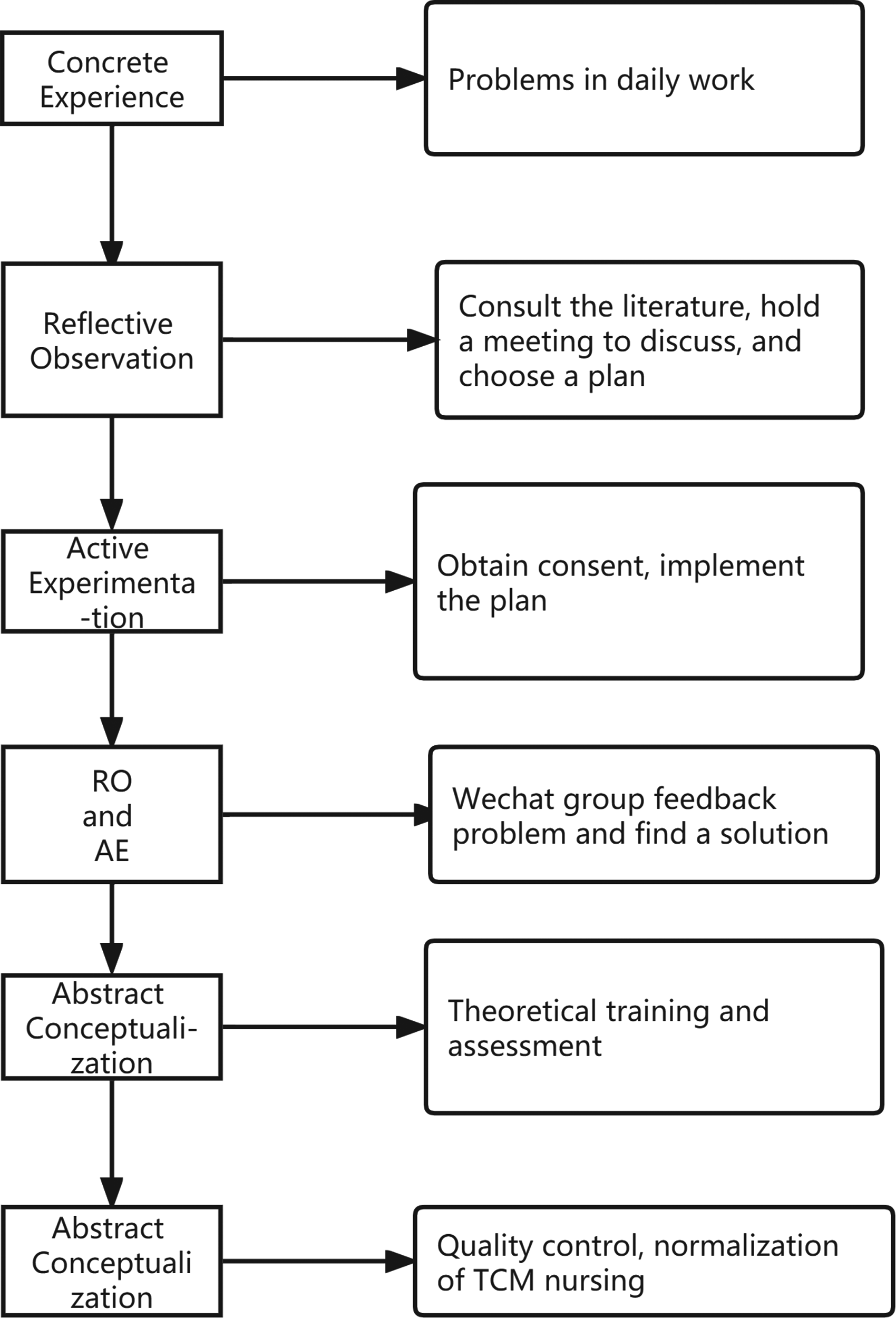
Training program based on Kolb's experiential learning theory.
Research tools
Course valuing inventory
The questionnaire included four dimensions: course value, content learning, personal learning, and behavior learning, with a total of 36 items. The item scoring method was “1 for very disapproval, 2 for disapproval, 3 for approval, and 4 for very approval.” The total course valuing inventory 16 (CVI) score was the sum of the scores of the four dimensions; the higher the score, the better the course evaluation result. The Cronbach’s α coefficient of the scale was 0.937. A total of 160 questionnaires were sent by QuestionnaireStar software, and 160 replies were returned, with a recovery rate of 100%.
The final scores
The final scores of the two groups of students were composed of theoretical and operational scores. The theoretical assessment was conducted in the form of test papers. The experimental group and the control group were scored by the same four examiners, and all 160 students participated.
Statistical analysis
SPSS 26.0 software was used for data analysis, and measurement data were expressed as mean ± standard deviation, and t-test is adopted. The counting data were described by percentage and chi-square test was performed. P < .05 was considered to demonstrate statistically significant differences.
Results
The scores of course valuing inventory
The scores of each dimension of the course evaluation questionnaire are shown in Table 1. Table 1 reveals that the course value (29.05 ± 2.15), learning content (27.93 ± 2.96), personal learning (27.36 ± 2.14), learning behavior (27.38 ± 2.37), and the total score (112.23 ± 5.88) in the questionnaire in the experimental group were higher than those in the control group. The differences in the scores of each dimension and the total score were statistically significant (P < .01).
Comparison of scores of each dimension of the course evaluation questionnaire between two groups of students.

The final scores
The final examination results comprised both theory and operation, and the scores are presented in Table 2. As shown in Table 2, in the experimental group, the theoretical score was 85.27 ± 3.29, and the operational score was 85.36 ± 3.01. In the control group, the theoretical score was 79.35 ± 6.61, and the operational score was 79.36 ± 4.65. The theoretical and operational scores of the experimental group were higher than those of the control group, and the differences in the theoretical and operational scores were statistically significant (P < .01).
Comparison of final scores of two groups of students (

Discussion
Kolb's experiential learning theory makes clinical TCM nursing more “scientific.” The nursing concept of TCM pays more attention to the “moral spirit,” and lacks the “scientific spirit” in Western medicine. 17 The traditional training model often includes the theoretical training first, followed by practical training, however, some TCM nursing curriculum content that rely only on theory teaching is difficult to achieve the ideal training effect, such as “syndrome differentiation” need to share different patients' nursing experience and experience, so you need to change the existing mode of training, science education theory was applied to the TCM nursing training to combine the scientific spirit of continuous practice and reflection with the morality of TCM nursing, so as to carry out the clinical practice of TCM nursing better. The training strategy based on Kolb's experiential learning theory has improved nurses’ competence and scientific research ability and enhanced their core competitiveness in the training of orthopedic specialist nurses. 18 Kolb’s experiential teaching improves the level of humanistic care and enhances the core competency of midwives in obstetric practice teaching. 19 The training model based on Kolb’s learning circle has realized the effective interaction between theory and practice in the training of hospice specialist nurses. 20 The training model of TCM nursing based on Kolb’s experiential learning theory constructed in this study has achieved good results in the training process of the professional technical team of TCM nursing in our hospital, which makes the concept of “dialectical nursing care” of TCM nursing more vivid and concrete and easier for students to understand and grasp.
The application of Kolb's experiential learning theory in TCM nursing training enables students to give better play to their subjective initiative. China's national conditions meant that TCM nursing started late, and there are gaps in educational levels and clinical needs. 21 At present, in traditional nursing teaching methods, learners passively accept theoretical explanations and operation demonstrations, lacking both subjective initiative and the ability to find and solve problems. Therefore, how to improve learners’ enthusiasm and subjective initiative is the key to solving the problem of TCM nursing education. Educators need to present their students with problems, let them explore solutions, and constantly reflect, summarize, and give full play to their subjective initiative. This way, the experience is both profound and beneficial. 22 When using Kolb's experiential learning theory for clinical TCM nursing training, our hospital grouped and regrouped the subjects according to the survey of learning styles. This group-based “integrated learning” can expand the horizons of each group member and liberate them from narrow fields, enabling students with different learning styles to give full play to their own advantages in the group and integrate and use the strengths of others to achieve the ideal “learning cycle.” 23
The theoretical and operational scores of the experimental group were higher than those of the control group, and the CVI score of TCM clinical nursing in the experimental group was also higher than in the control group, suggesting that Kolb's experiential learning theory has a good application prospect in TCM clinical nursing training. There is a saying: “it's better to teach people to fish than to give fishes to people.” Students should be given the initiative so that they can understand the difference between TCM nursing and Western medicine nursing in the process of exploration–reflection–practice, explore the mystery of TCM nursing in clinical practice in twists and turns, and improve their learning efficiency.
Limitations and suggestions
Due to the late development of the professional technical group of TCM nursing in our hospital and the small number of team members, whether the results are one-sided needs to be studied by multiple medical institutions with a larger sample size. Whether Kolb's experiential learning theory can improve the core competence of TCM nursing 24 also needs further research in the future.
Conclusion
Kolb's experiential learning theory has realized good results in TCM clinical nursing teaching in our hospital. It not only improves the theoretical and operational achievements but also mobilizes the students’ subjective initiative, which can be used as a reference for TCM clinical nursing teaching in the future. However, due to the small sample size, more practice is needed to verify its effectiveness.
Footnotes
Declaration of conflicting interests
The authors declared no potential conflicts of interest with respect to the research, authorship, and/or publication of this article.
Funding
The authors received no financial support for the research, authorship, and/or publication of this article.
