



Abstract
Originating from business plan competitions at universities, start-up competitions (SUCs) are nowadays a widely used policy tool to foster entrepreneurial learning among a larger group of potential and nascent entrepreneurs. While the literature on entrepreneurial learning highlights the importance of participants’ prior experiences, studies on learning in SUCs often ignore these experiences, but detect different perceptions of the learning outcomes from SUCs. To address this research gap, we explore configurations of prior experience and the participation routines of entrepreneurs at SUCs. To do so, we apply fuzzy-sets qualitative comparative analysis (fsQCA) to in-depth interview data from 26 participants at two German SUCs. Based on theories on entrepreneurial learning, insights from the interviews, and our empirical results from fsQCA, we identify one necessary condition and two specific configurations of conditions that lead to the outcome. The absence of entrepreneurial knowledge was found to be a necessary condition for entrepreneurial learning in SUCs. Prior industry experience is part of both solutions, but whether the presence or absence of it is important depends on whether it is combined with active participation in the competition. We present implications for policymakers, entrepreneurs, and researchers.
Keywords
Introduction
Fostering small and medium-sized enterprises (SMEs) and entrepreneurship has been a policy goal for decades (Gilbert et al., 2004; OECD, 2003). However, entrepreneurs are less tangible than SMEs; they may merely be pursuing an idea but have not yet founded a venture (Lundström & Stevenson, 2005; Raposo, 2009). Thus, supporting entrepreneurship requires systemic approaches that address both financial and “soft” aspects, such as transmitting knowledge and entrepreneurial skills or providing network opportunities to other entrepreneurs (Audretsch, 2004; Lundström & Stevenson, 2005). The development of these skills is often embedded in programs for entrepreneurial education in schools and universities, either within the curriculum or extracurricular activities (Lundström & Stevenson, 2005; Mason et al., 2020), or combined with other support services in specific programs such as incubators (Amezcua et al., 2013; Schwartz, 2009).
A policy instrument that has gained popularity as a learning environment for entrepreneurs is start-up competitions (SUCs) (Passaro et al., 2017; Russell et al., 2008; Stolz, 2020; Watson et al., 2015). Rooted in business plan competitions at U.S. universities in the 1970s (Katz, 2003), SUCs have spread outside of universities and internationally quickly. While comprehensive overviews do not exist, studies for single countries reported 77 active SUCs in Italy (Passaro et al., 2017) or 71 in Germany (Schwartz et al., 2013), but in each case the majority of these are not associated with universities and they are aiming to support all nascent entrepreneurs in the region. While the primary goal of SUCs is to provide evaluation and feedback regarding the business (or idea), they may also offer additional coaching and training sessions, as well as opportunities to pitch and network (Schwartz et al., 2013; Stolz, 2020). A rich body of research examines the learning processes that occur during participation in SUCs (Foo et al., 2005; Russell et al., 2008; Watson et al., 2015; 2018; Wen & Chen, 2007). However, the results are ambiguous. Various types of training during SUCs affect entrepreneurs differently (Klinger & Schündeln, 2011). Some learning effects are perceived as helpful for future competitions, rather than in the “real” business world (Gailly, 2006; Watson et al., 2018). The effects differ among entrepreneurs (Russell et al., 2008; Thomas et al., 2014; Watson et al., 2018). Further research is needed on which types of entrepreneurs benefit from the learning effects in these competitions (Watson et al., 2018). Theory on entrepreneurial learning suggests that the learning process for entrepreneurs is influenced by the outcome of previous events, as well as an individual’s management, industry, and start-up experience (Minniti & Bygrave, 2001; Politis, 2005; Rae & Carswell, 2001). Prior studies on entrepreneurial learning in SUCs have not accounted for this. It is unclear whether the presence or absence of conditions such as prior management experience hinders or enhances learning in SUCs.
By considering these conditions, we present a novel approach to understanding learning in SUCs and event-like policy instruments to foster entrepreneurship. We draw on configurations theory to identify configurations of sets that lead to entrepreneurial learning in SUCs. We utilize a fuzzy-sets qualitative comparative analysis (fsQCA) based on interview data from 26 participants at two German SUCs. Qualitative comparative analysis (QCA) is a set-theoretic method that examines the relationships between the outcome of interest and all possible combinations of states of its predictors (Fiss, 2007; Ordanini et al., 2014). This approach is useful for complex phenomena like entrepreneurial learning because it allows for going back and forth and switching between cases and relevant theories (Rihoux & Ragin, 2009); thus, it can provide greater insight into a theoretical and practical understanding of the topic and the individual cases (Douglas et al., 2020; Şahin et al., 2019).
The remainder of this paper is structured as follows. First, we provide a literature overview on policy instruments to foster entrepreneurial learning. Next, we describe the research field of entrepreneurial learning in the context of SUCs and develop propositions for the fsQCA, based on prior theories on how entrepreneurs learn. We describe the sample and overview the methodology. The propositions are analyzed using fsQCA, and the results are presented and discussed. We describe the implications for entrepreneurs (future participants of SUCs), policymakers, and further research.
Theoretical Background
Policies to Support Entrepreneurship: The Case for Entrepreneurial Learning
Behind public support for entrepreneurship stands the empirically based recognition that start-ups and small firms contribute substantially to job creation (Birch, 1987; Haltiwanger et al., 2012). While policies for small and medium-sized firms have existed since the 1950s, policies aimed at entrepreneurship are a comparatively recent phenomenon (Audretsch, 2004). Policies for entrepreneurs are different from those that apply to SMEs (Audretsch, 2004; Lundström & Stevenson, 2005; Raposo, 2009). A key difference is the measures used to support these firms, due to the difficult target group that entrepreneurs comprise—they may not yet have a firm that could be supported, while SMEs are easily identifiable firms. Financial incentives or benefits can be applied to SMEs, while entrepreneurship policies may have to use nonfinancial levers, such as supporting and providing networks, support services, training, and education (Raposo, 2009). Among various policies that address the particular problems of (potential) entrepreneurs (e.g., administrative burdens and access to loan finance or equity capital) are policies that support the development of entrepreneurial skills (Audretsch, 2004; Lundström & Stevenson, 2005). These policies cover the further development of skills in existing small entrepreneurial firms or the general teaching of entrepreneurial skills—for example, through entrepreneurial education in universities (Audretsch, 2004). Entrepreneurial education can be conducted in schools and universities as part of the curriculum, as well as through extracurricular activities and programs such as start-up competitions, entrepreneurship clubs, and bootcamps (Mason et al., 2020; Pittaway et al., 2011; Pittaway et al., 2015).
As part of these policies, notable approaches include accelerators, incubators, and SUCs (Albort-Morant & Oghazi, 2016; Amezcua et al., 2013; Hochberg, 2016; Schwartz et al., 2013). Programs such as incubators combine financial support (such as subsidized office space and office services, including meeting rooms and cafeterias that function as meeting spaces) with learning or educational services through business advising or coaching (Amezcua et al., 2013; Schwartz, 2009; Tamásy, 2007). By comparison, SUCs are similar to events and normally have lower entry barriers because incubators often require attendees to have a scalable business model or first customers already in place (Bliemel et al., 2016).
Compared to incubators, SUCs are a rather old tool for fostering entrepreneurship—they have been conducted for half a century in the United States (Katz, 2003). However, universities and politicians in other countries quickly adopted them to target and support entrepreneurs (Lundström & Stevenson, 2005). While SUCs are often associated with entrepreneurship in higher education (Lundström & Stevenson, 2005; Russell et al., 2008; Watson et al., 2015), more recent overviews show a broad range of competition types outside of universities, often held by public organizations or as cooperative efforts between public and private organizations (Passaro et al., 2017; Schwartz et al., 2013). The goal behind SUCs is to increase awareness of entrepreneurial opportunities and entrepreneurship as a career path (Lundström & Stevenson, 2005), or more generally to increase the quality and quantity of entrepreneurship. This is accomplished by shaping individual decisions to become an entrepreneur and by providing individuals with relevant skills (Schwartz et al., 2013). The key feature of SUCs is the learning environment they provide to develop these skills; this has been discussed theoretically (Passaro et al., 2017; Stolz, 2020) and analyzed empirically using both qualitative and quantitative methods (Klinger & Schündeln, 2011; Russell et al., 2008; Watson et al., 2015, 2018).
The results are twofold. While there is quantitative evidence that SUCs increase the probability that participants (particularly winners) will actually found a venture (Gailly, 2006; Klinger & Schündeln, 2011; Michelsen et al., 2013), it has also been reported that a significant portion of participants do not found a venture (Michelsen et al., 2013) and that the learning outcomes are also ambiguous (Klinger & Schündeln, 2011; Russell et al., 2008; Watson et al., 2018). A gap between the learning outcomes which intended to and obtained from exists (Watson et al., 2018). It is unclear whether some participants learn much more in these competitions than others and why that may be the case.
Entrepreneurial Learning in SUCs
Ever since Knight (1921) theorized that entrepreneurs make profits by anticipating what can be sold in markets in the future, the knowledge and experience of entrepreneurs has played an important role in entrepreneurship research. Kirzner (1973, 1979) sees entrepreneurs as people whose whole function in the economy is finding unknown opportunities. To do so, entrepreneurs need a specific kind of knowledge that is less concerned with knowing the market data and more focused on where to find the relevant data. Kirzner describes this as the alertness to find market data. He defines entrepreneurial knowledge as “a rarefied, abstract type of knowledge—the knowledge of where to obtain information (or other resources) and of how to deploy it” (Kirzner, 1979, p. 8). The literature suggests that this knowledge is generated in an iterative process: entrepreneurial learning (Minniti & Bygrave, 2001; Politis, 2005). Entrepreneurial learning has been analyzed in three different contexts, as Wang and Chugh (2014) identify after examining the literature body: the start-up environment, established firms, and general entrepreneurship (with no clear specification of the firm type or age). For this paper, only the first is relevant because established firms—although they may behave entrepreneurially—are not the focus of SUCs (Schwartz et al., 2013). SUCs are aimed at nascent entrepreneurs and often even declare only nascent entrepreneurs with a specific stage of their idea to be eligible to apply (Passaro et al., 2017; Schwartz et al., 2013). With that focus on nascent entrepreneurs, SUCs are aimed at persons in the earliest stage of the entrepreneurial process (Davidsson & Honig, 2003). Studies suggest that SUCs contribute to the learning of such persons in three possible ways: 1) by providing direct feedback on the business idea (Russell et al., 2008; Watson et al., 2018); 2) by providing entrepreneurial education on specific topics such as marketing and accounting (Schwartz et al., 2013; Sekula et al., 2009); 3) by enabling interactions with other entrepreneurs or experienced judges or coaches (Passaro et al., 2017; Russell et al., 2008).
These possibilities of learning target different types of entrepreneurial knowledge. Scholars have emphasized the importance of market knowledge and general knowledge of “how to be entrepreneurial” (Minniti & Bygrave, 2001; Siegel & Renko, 2012). While the usefulness of static business planning has been critically discussed (Honig & Karlsson, 2004; Hopp, 2015; Karlsson & Honig, 2009; Kirsch et al., 2009), in SUCs, it may provide specific market knowledge. Interview data suggest that participants find the planning process helpful (Russell et al., 2008). Interactions with others and activities such as pitching and networking could enhance knowledge on “how to be entrepreneurial”. The latter is particularly relevant, as entrepreneurial learning should be experimental (Minniti & Bygrave, 2001; Rae & Carswell, 2001).
Based on Sarasvathy’s (2001) argumentation, scholars in the 21st century also emphasize entrepreneurial learning as an effectual process (Haneberg, 2019). In effectual entrepreneurship, the entrepreneurs take their stakeholders with them on their entrepreneurial journey to reduce uncertainty and eliminate barriers (Sarasvathy, 2001). While SUCs are clearly structured and appear to be a classically causational tool for entrepreneurial education and learning, their strong focus on networking could also help to facility effectual means, for example, supporting entrepreneurs with regard to “who they know” and “what they know” (Watson et al., 2015).
Previous research on SUCs mainly focussed on the question how entrepreneurs could learn from SUCs and what they were learning (Gailly, 2006; Passaro et al., 2017; Russell et al., 2008; Stolz, 2020; Thomas et al., 2014; Watson et al., 2015). However, literature on entrepreneurial learning highlights the importance of prior experiences for learning (Aldrich & Yang, 2014; Dahl & Sorenson, 2012; Hajizadeh & Zali, 2016). Studies on SUCs have not taken these into account, yet detecting differences in the learning outcomes (Watson et al., 2018).
Politis (2005) differentiates between entrepreneurial experience as an input of the learning process and entrepreneurial knowledge as an outcome. Based on Reuber et al. (1990), he argues that entrepreneurial experience refers to the direct observation of events associated with the creation of a new venture or to participation in that creation. Experiences may include prior management, industy-specific, or start-up experience (for an overview on prior experiences see also Hajizadeh & Zali, 2016). Studies suggest a positive effect on firm success or survival from all of these experience types: start-up experience (Dyke et al., 1992; Gimeno et al., 1997), management experience (Fuentes Fuentes et al., 2010; Gimeno et al., 1997), and industry-specific experience (Brüderl & Preisendörfer, 1998). Studies have also found an influence of prior experience on entrepreneurial learning (Markowska & Wiklund, 2020; Michelsen et al., 2013; Politis, 2008; Politis & Gabrielsson, 2005). Therefore, we argue that these prior experiences enhance the learning outcome of nascent entrepreneurs in SUCs. Unclear is, whether these experiences influence each other and if combinations of them might be more important for the learning than others. Also, some forms of experience may be substitutable (Mallon et al., 2018). A configuration that leads to learning effects might not include all of them. Taking this into account, we propose the following:
A nascent entrepreneurs start-up experience, management experience, and industry-specific experience are conditions that enhance the learning outcome (together and/or separately) of SUCs. The absence of one condition may be substitutable by the presence of another condition or combinations of others. While the core process of entrepreneurial learning is performing entrepreneurial tasks and consolidating learning outcomes from experience, it is also important to apply or transfer one’s own and others’ learning outcomes when performing tasks (Wing Yan Man, 2012). Relationships and interacting with others play key roles in entrepreneurial learning (Cope & Watts, 2000; Rae & Carswell, 2001). Thus, we assume that interactions with others during the competition influence the learning outcome. Also, an active participation could, combined with specific prior experiences, lead to different outcomes. In SUCs, these interactions occur in additional events such as coaching sessions, meetups, and networking events, where participation is voluntary (Passaro et al., 2017). Thus, we present the following proposition:
Participating in additional coaching and having lively interaction with others during the competition is a condition that solely or in combination with other conditions enables the participants to accomplish a learning outcome. One factor that may influence SUCs and their learning outcomes is the environment. Entrepreneurship is influenced by regional factors (Dahl & Sorenson, 2012; Feldman, 2001; Fritsch et al., 2006; Sternberg, 2009), and entrepreneurial knowledge plays an important role in the current debate on regional entrepreneurial ecosystems. It is argued that entrepreneurial knowledge positively influences other founders in the region through spillover effects (Spigel, 2017; Spigel & Harrison, 2018). This might influence the outcome, as SUCs juries, coaches, and visitors of awarding ceremonies often represent such actors as experienced entrepreneurs, venture capitalists, bankers and other financiers from the local start-up scene (Foo et al., 2005; Gailly, 2006; Schwartz et al., 2013; Stolz, 2020). A SUC in a vibrant start-up scene—or a region with ample support services—may exhibit different learning outcomes for participants than a SUC in a region with a less-developed entrepreneurial ecosystem. Thus, we posit the following:
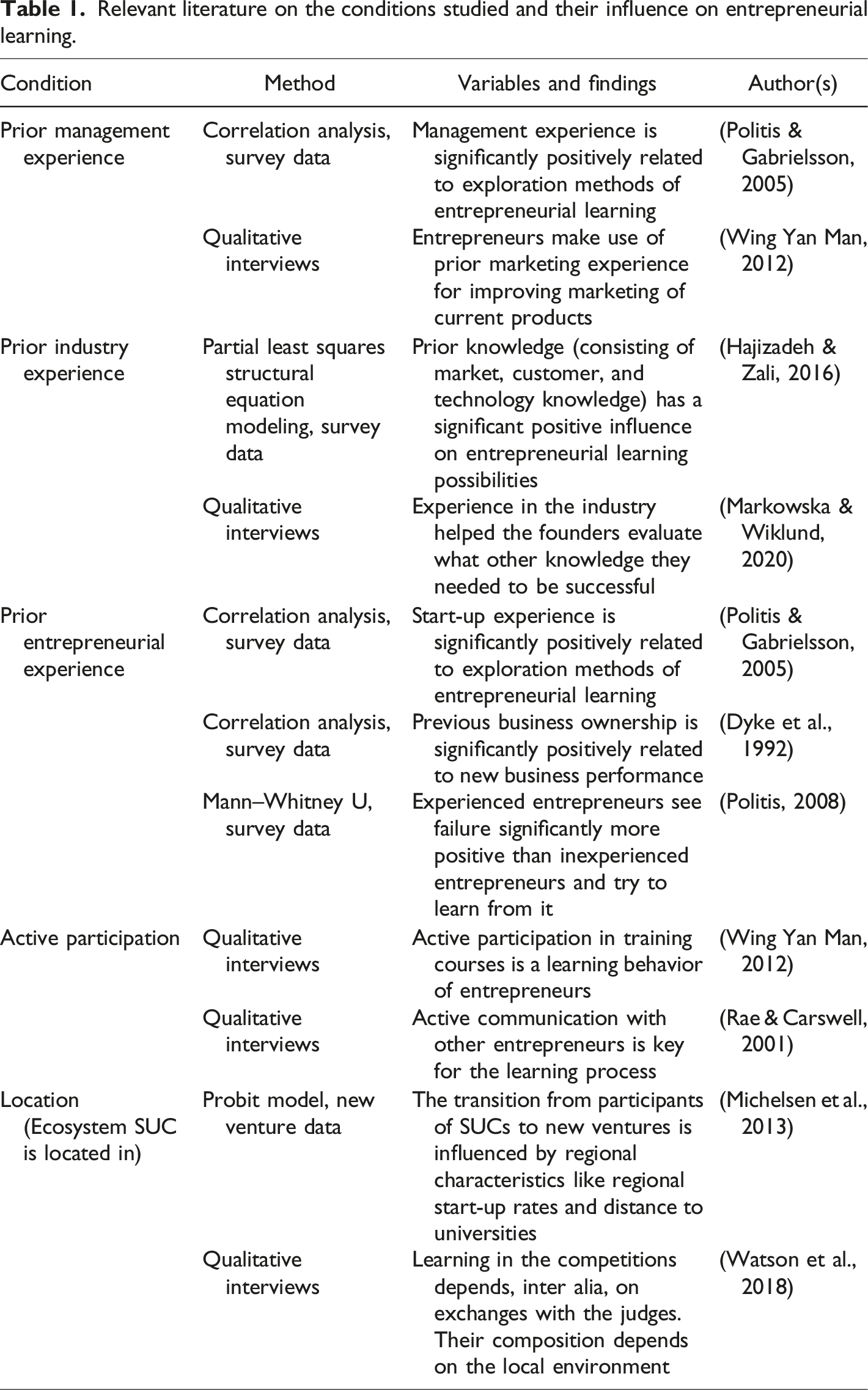
The outcome is subject to regional influence, and a SUC’s learning effects are stronger if it is located in a developed ecosystem. Ultimately, analyzing the propositions generates a set of conditions that builds a profile of an entrepreneur who learns a lot through participation in a SUC. This is the appropriate field of application for configurations theory. It was originally used to develop the optimal profile of a high-performing firm (Ketchen et al., 1993; Vorhies & Morgan, 2003) but has been successfully applied to instruments similar to SUCs as well (Hughes et al., 2007). Configurations theory can be operationalized using QCA (Albort-Morant & Oghazi, 2016). The previous studies on prior experiences of founders primarily examine its influence on new venture performance and survival. An overview of the conditions used to analyze our propositions, as well as studies that examine the influence of the respective condition on the learning behavior of entrepreneurs, is shown in Table 1.
Relevant literature on the conditions studied and their influence on entrepreneurial learning.
Methods and Data
Qualitative Comparative Analysis
We investigate our propositions using QCA (Rihoux & Ragin, 2009; Schneider & Wagemann, 2012). This is a set-theoretic method that examines the relationships between the outcome of interest (the perceived learning effects for the winners of the SUCs) and all possible combinations of states of its predictors—the so-called conditions (Ordanini et al., 2014). QCA sees cases as combinations of attributes manifested by their set-memberships (Fiss, 2007). While it was originally developed for the political sciences in the 1980s (Rihoux & Ragin, 2009), it has gained attention in management science (Fiss, 2007; Ordanini et al., 2014) and has recently become popular in entrepreneurship research for investigating complex phenomena (Douglas et al., 2020; Kraus et al., 2018; Lehner & Weber, 2019; Leppänen et al., 2019; Muñoz, 2018; Roundy et al., 2018; Şahin et al., 2019; Vedula & Fitza, 2019).
The QCA methodology assumes a complex causality and enables researchers to exhaustively explain the phenomenon being investigated (Legewie, 2013). Due to its ability to generate new insight into the complementarities and substitutes in configurations (Fiss, 2007; Kraus et al., 2018; Rutten, 2020), QCA is the appropriate method for analyzing our propositions regarding entrepreneurial learning in SUCs. Because our propositions suggest multiple as opposed to binomial possible outcomes, we apply an fsQCA (for example, an entrepreneur could have interactions with one team, another could have interactions with five other teams, and another could have no interactions despite attending all coaching sessions). Thus, the set-membership can be anywhere between zero and one (Schneider & Wagemann, 2012). The process of assigning the set-membership to individual cases is called calibration (Schneider & Wagemann, 2012).
Studies that use fsQCA to examine entrepreneurship mostly use quantitative data (Beynon, Battisti, et al., 2021; Beynon, Jones, et al., 2021). In this paper, the fsQCA is based on qualitative interview data. This allows for studying the cases in a more comprehensive way while focusing on contextual details (Tóth et al., 2017). This is particularly suitable for analyzing learning as an outcome of participation in an SUC, as learning effects are perception-based and highly influenced by the context; thus, they have few quantitative anchor points that can be easily measured (Tóth et al., 2017). While the benefits of analyzing qualitative data using fsQCA are clear, some pitfalls also exist. Previous studies have been particularly criticized for opaque calibration of interview data (Basurto & Speer, 2012; de Block & Vis, 2019; Tóth et al., 2017). To our knowledge, no fsQCA with interview data has previously been undertaken in the research on entrepreneurial learning. Thus, we devote particular attention to transparently explaining the calibration process and the analysis.
Sample
Overview of the Sample.
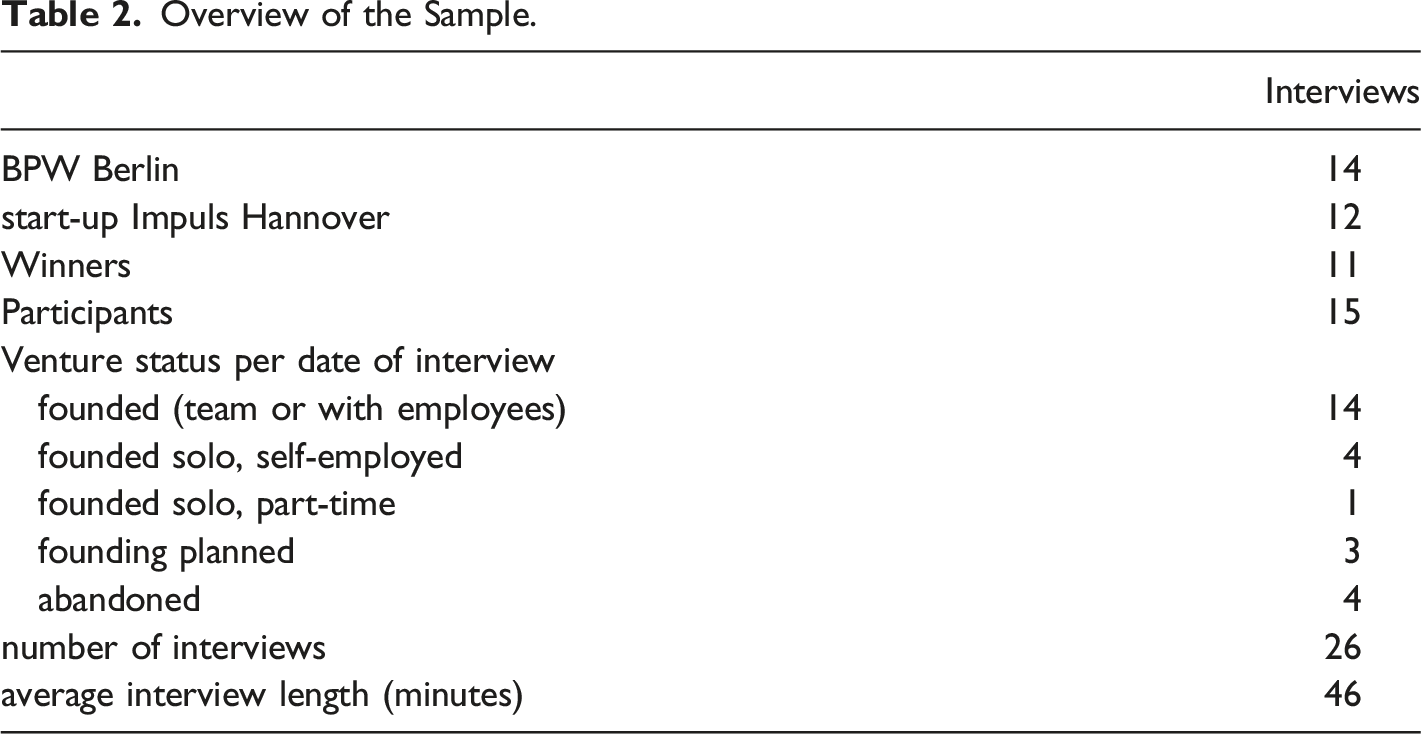
We selected SUCs in two German regions for two reasons. First, considering entrepreneurs of only one SUC would raise the risk of identifying conditions and structures that are unique to that particular SUC. Second, entrepreneurship and entrepreneurial knowledge are influenced by regional factors. To account for these factors and assess Proposition 3, we selected comparable SUCs in different regions. One SUC is the BPW in Berlin—Germany’s start-up hotspot (Kritikos, 2016), constituting a vibrant, world-class entrepreneurial ecosystem (Florida & Hathaway, 2018). The other SUC is the start-up Impuls in Hanover, a city with a strong industrial past (e.g., Volkswagen Nutzfahrzeuge, HANOMAG, Continental) but a rather weak entrepreneurial culture, despite its strong university and technology environment (Hesse & Sternberg, 2017). Both SUCs are publicly funded and comparable in their organizer, age, structures, application procedures, additional coaching, and prizes.
Overall, the sample includes a wide range of entrepreneurs in both regions. Four winners had closed their business by the interview date. Two others had not yet founded their ventures and were otherwise employed. One had not yet founded the initial venture but had founded another. One was self-employed part-time. Four were self-employed full-time. Fourteen had founded a venture that remained active and had co-founders or employees. The entrepreneurs’ businesses ranged from self-employed physiotherapists to teams of engineers and software developers. The venture size ranged from self-employed to 11 employees.
Coding and Calibration
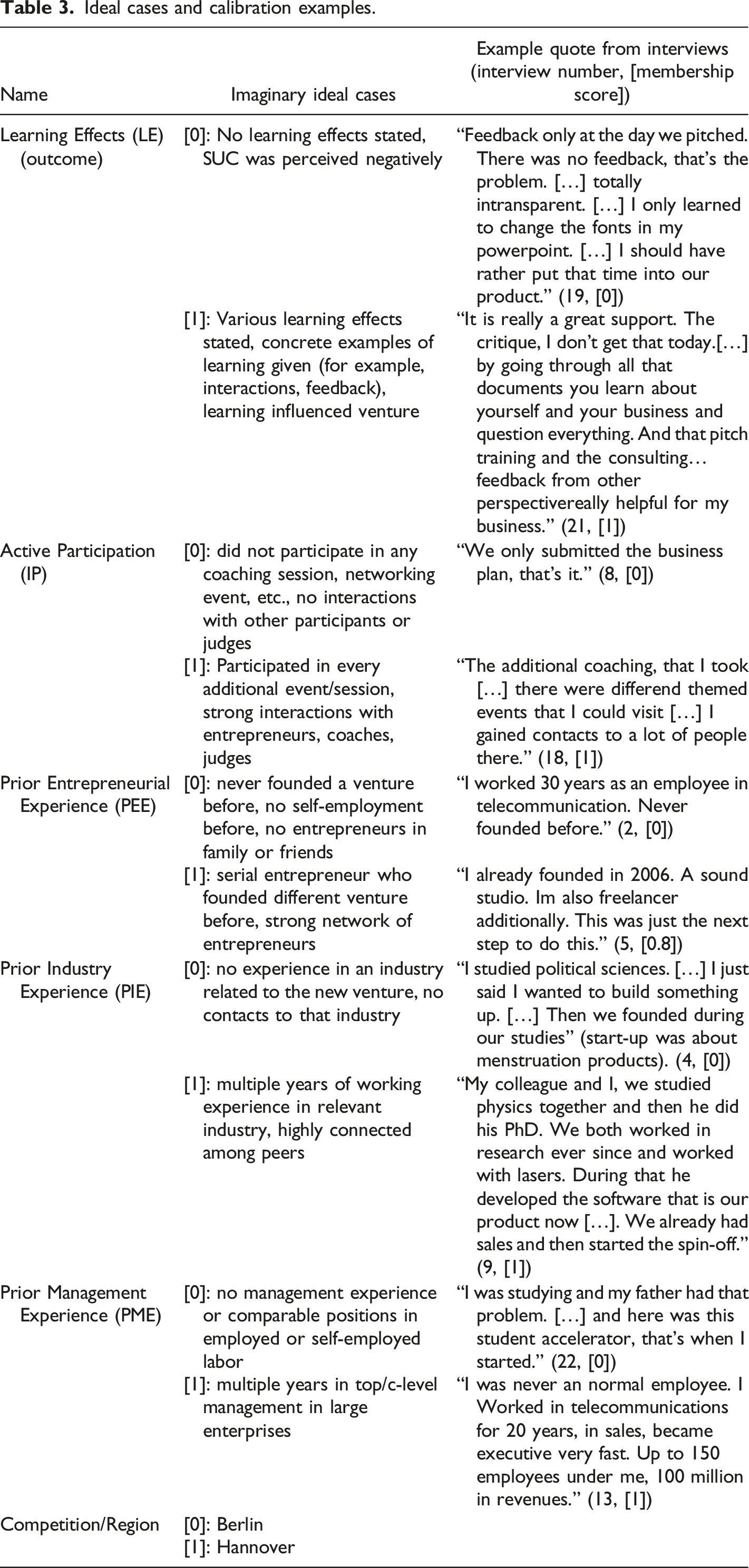
To commence the analytical process, we applied the procedure by Basurto and Speer (2012), which was developed for fsQCA, particularly with qualitative data. Thus, we first developed a list of preliminary measures of the outcome and conditions. While the outcome consists of all statements the participants made regarding learning, the conditions consist of statements concerning the propositions. The list that was conducted with this procedure can be changed, enhanced, or reduced during the fsQCA process (Basurto & Speer, 2012). Based on the preliminary list of measures, we developed an initial coding scheme. Then, a structuring content analysis was applied to gain information on the conditions (Basurto & Speer, 2012). This method facilitates the analysis of interview data by applying deductive codes (based on the preliminary measures) and complementing them with inductive codes that are based on the material and consist of newly discovered information (Kuckartz, 2016). The coding scheme includes codes regarding the structure of the SUCs and the participation and had a particular focus on the effects on the participants (e.g., awards, networking, “force” to focus on improving and rethinking the business model, public relations and marketing effects, start-up atmosphere, learning effects). By extracting the quotations for each code and comparing them across cases, we found no biases in the responses for specific conditions (Basurto & Speer, 2012).
Next, we defined the precision of the fuzzy sets, along with their values. Because the interviews contain significant details on the entrepreneurs’ backgrounds, we selected six-value fuzzy-sets. Thus, for each condition, one out of six values between 0 and 1 is assigned to each case: fully out [0], mostly out [0.2], more out than in [.4], more in than out [.6], mostly in [.8], and fully in [1].
Ideal cases and calibration examples.
Analysis and Findings
Analysis of Necessary Conditions
Analysis of necessary conditions.
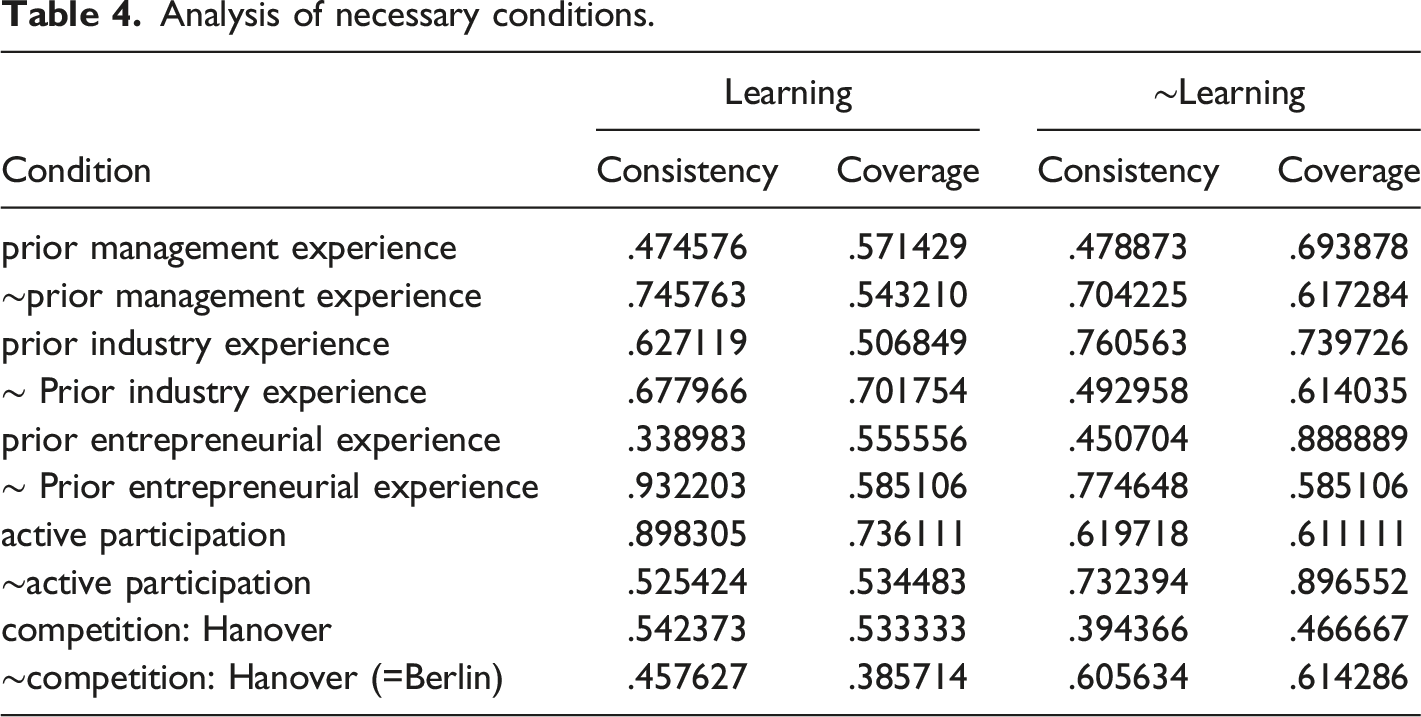
With a consistency of .93, the absence of prior entrepreneurial experience is the only necessary condition for learning in a SUC. However, this condition also received a relatively high (.77) consistency for the absence of the outcome. This is perhaps because exactly half of the interviewees had no prior entrepreneurial experience, and the other half was calibrated at .2 or higher based on their interviews (see appendix for all membership scores). The consistency of .89 for active participation closely approaches the required threshold. All other conditions rank lower, indicating that they are not necessary for the outcome.
Table 4 also shows that being in one competition and not in the other (Hanover vs. Berlin) is not relevant for the outcome. We verified this finding by examining relevant codes in the interview data. While we found strong information on the influences of each local entrepreneurial ecosystem on entrepreneurship in general, the interviewees’ statements regarding learning through the competition were similar for both regions. Thus, we decided to exclude that condition from further analysis. Researchers may do this in an iterative process during a QCA (Rihoux & Ragin, 2009).
Truth Table
In QCA, all logical combinations of conditions and the outcome can be displayed in a matrix using Boolean algebra: The truth table (Rihoux & Ragin, 2009). It has 2k rows, where k is the number of conditions used (Schneider & Wagemann, 2012). In our study, it has 16 rows. For each row, cases are assigned that fulfill the respective conditions: having a membership score higher than .5 for the conditions and a membership score of less than .5 for the negated sets (indicated by a tilde sign) (Rihoux & Ragin, 2009; Schneider & Wagemann, 2012).
For example, the notation ∼IP*∼PEE*∼PIE*PME describes the logical combination of no active participation (AP), no prior entrepreneurial experience (PEE), no prior industrial experience (PIE), and prior management experience (PME). A case that is attributed to that particular truth table row would thus have membership scores of <.5 for IP, PEE, and PIE and a membership score of >.5 for PME.
Truth table.

The next step is to check for configurations that are consistent subsets of the outcome and those that are not. The consistency of each configuration (a row in the truth table) is calculated as mentioned previously. A configuration can be considered as sufficient for the outcome if its consistency measure statistically exceeds a minimum threshold (Ordanini et al., 2014). In line with QCA literature, we apply a consistency threshold of .75 (Kraus et al., 2018; Yoruk & Jones, 2020).
Analysis of Configurations
Results of the complex solution of the fsQCA.
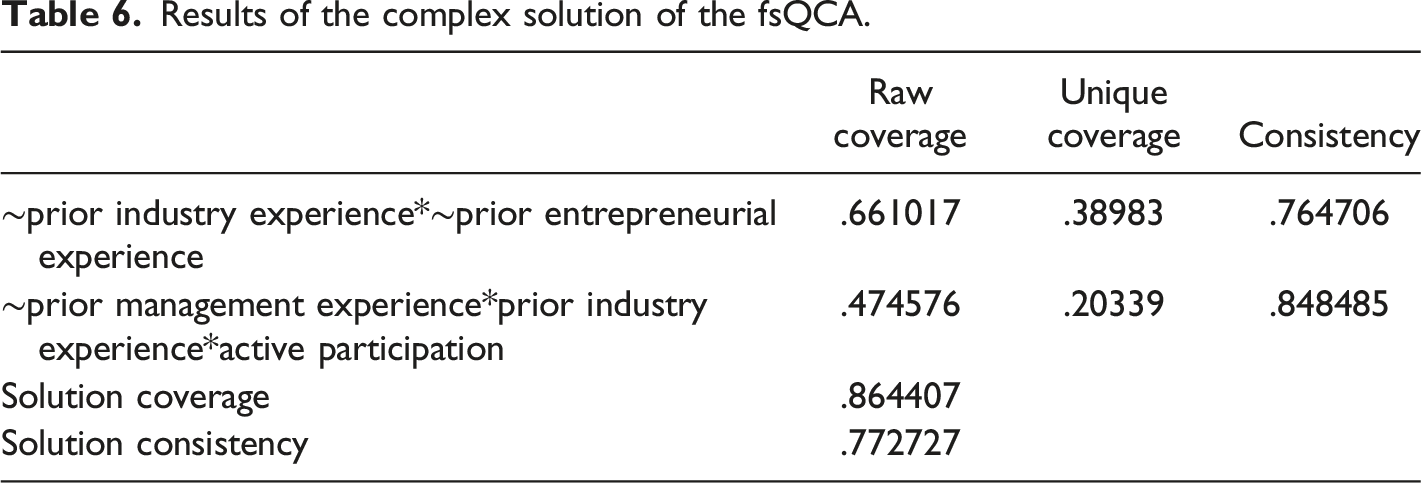
The second solution for learning requires the absence of prior management experience, the presence of prior industry experience, and active participation in the competition’s additional coaching and network events. This solution’s raw coverage of .47 indicates that roughly half of the participants with no prior management experience (but with industry experience and active participation behavior) learned from the competition.
The overall solution coverage (over .85) shows that a high degree of membership in the outcome is explained by the configuration terms. The solution consistency (over .75) supports the model’s strength. It measures the degree to which membership in the solution is a subset of membership in the outcome.
The results of the analysis of necessary conditions, as well as the results of the fsQCA intermediate solution, merit further attention. One strength of QCA with qualitative data is that it enriches the findings with quotations and interprets them in light of case knowledge. We add illustrative quotes to show typical cases for the configurations and necessary conditions.
The results presented in Tables 5 and 6 illustrate that the findings are partially contradictory to Proposition 1, which asserts the positive influence of all prior experience types on the learning effects. This contradiction was already indicated by the fact that the absence of prior entrepreneurial knowledge was a necessary condition for achieving learning effects through the SUC. However, the strength of the QCA is in finding configurations of conditions that accomplish the outcome. The absence of both entrepreneurial knowledge and industry experience predicts learning effects.
Entrepreneurial knowledge may hinder the learning effects because the feedback on the submitted business plans and pitch decks is based on common business knowledge for assessing such documents. An experienced entrepreneur may write several business plans in his or her life and understands accounting and business forecasting from previous businesses. This can be illustrated by case seven, the founder of a software start-up that performs simulations. This entrepreneur previously owned a music studio and had been a freelancer. He knew what he could achieve with a given input of work and thus assessed participation in the SUC critically: ‘Well, there was the prize money, even though it wasn’t much. The amount of work for that… we could put that into sales than we would have earned more […] You get an award. That’s it. Do you have good products or services for the client… that’s important and not what award you have won.’ (Interview 5)
As we know, entrepreneurial activity is significantly correlated to overconfidence (Koellinger et al., 2007). This may also explain our findings—persons who have been entrepreneurially active before may evaluate their own knowledge as more important or correct than that of others and they may take feedback in the SUC less seriously: ‘It is a lot of show and many people who have no idea of starting a business or how to run a business.’ (Interview 5)
We have to keep in mind that this person won prize money and an award in that SUC. While the absence of industrial experience—combined with the absence of entrepreneurial experience—leads to the outcome, the presence of industrial experience also leads to learning if combined with active participation and the absence of managerial experience. This is interesting, in that the same condition combined with other conditions leads to a different outcome. The following quote illustrates such a case: ‘We went to the coach again with our whole plan and then we reduced it to its essentials […] so you brought the whole business model on point and that was definitely the big advantage. […] So that coaching was really intensive and achieved a lot. Just because he was an external observer and had no connections to the industry, it was ideal.’ (Interview 22)
This entrepreneur founded a start-up for herd management for farmers. He had prior knowledge in the industry from working on his parents’ farm. He also actively participated in several coaching sessions, as the quote indicates. His prior knowledge was enriched by an outside perspective. This was only achieved through active participation in the additional coaching sessions.
By comparison, a founder who had industrial work experience and did not participate in additional coaching sessions made the following statement: ‘I only learned to change the fonts in my Powerpoint.’ (Interview 19)
This person wished for more specific feedback. Other entrepreneurs who had industrial experience but did not participate actively said something quite similar: ‘The feedback on the business plan didn’t really help us because it was basically too good, and they had no idea of the technology.’ (Interview 8)
Both of these participants also had no managerial experience, as the set of conditions (Table 6) indicates. Based on fsQCA and the interview data, we suggest that persons with industry experience but no managerial experience and no active participation expected precise feedback on their business, based on their business plan and pitch. They were uninterested in basic business knowledge as provided by coaching and thus were not participating actively. The competitions, whose judges are often business consultants or employees of local entrepreneurship support organizations (Stolz, 2020; Watson et al., 2018), might be unable to provide such industry-specific feedback. This is frustrating for the participants that do not attend the additional coaching sessions that cover general business topics. These participants thus feel that they have learned little.
This finding supports Proposition 2, which states that active participation would help achieve learning effects. The analysis of the necessary conditions and the configurations demonstrate this (Tables 5 and 6). This is also supported by some cases that are close to ideal imaginary cases: they had the highest membership scores for active participation and very low scores for all types of prior experience. Interestingly, these cases are very similar regarding other information we gained from the interviews. For example, cases 3, 18, and 21 are all women who founded their ventures alone or with one partner, with little prior experience, very active participation, and high learning outcomes. We interpret this as a group of very motivated women entrepreneurs who wanted to learn as much as possible: ‘There was a lot. I was the geek. I attended all events. Found it extremely helpful. […] I often talked to the coaches again after an event and we looked at specific things that I wanted to improve.’ (Interview 3)
We found no support for Proposition 3 because the raw interview material, as well as the analysis of necessary conditions, did not support regional differences or differences between the competitions regarding the learning effects for participants.
Discussion
In this paper, we use fsQCA based on qualitative data to reveal why learning effects in SUCs differ among participants. QCA in general is increasingly used in entrepreneurship research (for a literature overview see Kraus et al., 2018). Its applications are often based on quantitative statistics, for example, on a country or state level (Beynon, Battisti, et al., 2021; Beynon et al., 2019). Other studies use survey data (Albort-Morant & Oghazi, 2016; Del Sarto et al., 2020; Rey-Martí et al., 2016; Roig-Tierno et al., 2015). While these contributions using QCA can enhance research on entrepreneurship (Douglas et al., 2020), QCA with qualitative data is rarely used, although some contributions have included qualitative data (see e.g., Yoruk & Jones, 2020). This is surprising, in that QCA with qualitative data has been discussed and applied in other disciplines (Basurto & Speer, 2012; de Block & Vis, 2019; McAlearney et al., 2016; Rantala & Hellström, 2001). By using data from 26 in-depth interviews of participants at two SUCs, we show the strengths of fsQCA with qualitative data and identify different outcomes of learning in SUCs that are influenced by the presence or absence of certain conditions, including prior experiences. Our results are limited due to a relatively small n. However, one strength of fsQCA is the detailed examination of studies with small numbers of cases (Beynon et al., 2020). Previous contributions have theoretically argued that SUCs provide strong learning environments (Passaro et al., 2017; Stolz, 2020). Empirical studies emphasize learning, although prior experiences and individual participation patterns have not been analyzed further (Gailly, 2006; Klinger & Schündeln, 2011; Russell et al., 2008; Watson et al., 2018). Our analysis shows that the learning outcomes of SUCs are diverse and dependent on conditions such as prior entrepreneurial experience and active participation. The complexity of this phenomenon—and the strength of qualitative-based fsQCA as an appropriate research method—is supported by our finding that the presence of prior industrial experience hinders learning outcomes if prior entrepreneurial experience is present. If the presence of prior industrial experience is combined with active participation and the absence of managerial experience, the learning outcomes are accomplished.
Our findings provide novel insights on SUCs and highlight the importance of configurational approaches for understanding entrepreneurial learning (Hughes et al., 2007). A qualitative approach to investigating this phenomenon was selected intentionally. However, this limits the generalizability of our findings. While we examined two SUCs and considered potential regional differences, finding no effect on the learning outcome, SUCs in other countries or other types of SUCs may function differently. We focused on entrepreneurs that were at least nominated for prizes. While this gave us the opportunity to achieve sufficient homogeneity for a QCA sample (Rihoux & Ragin, 2009), it limits our findings to entrepreneurs that had a minimum level of quality in their application documents. However, the learning outcomes differ strongly in our sample and we interviewed winners who learned nothing, so we argue that our findings still provide important insights.
Calibration is a critical process in QCA because it determines the results (Rihoux & Ragin, 2009; Schneider & Wagemann, 2012). We adapted approaches from methodological papers on QCA from social sciences to mitigate potential pitfalls in the calibration process (Basurto & Speer, 2012; de Block & Vis, 2019; Tóth et al., 2017). By constructing imaginary ideal cases for the extremes of set-membership, and by providing quotations for associated cases, we have pursued maximal transparency. Still, the calibration procedure is limited to our case knowledge.
We argue that our findings and the use of this particular approach add relevant information to research on SUCs (in particular) and policy instruments for entrepreneurship (in general). As Douglas et al. (2020, p. 15) report when describing the implications for fsQCA for entrepreneurship research, “A better understanding of the heterogeneity of entrepreneurial phenomena may lead to more focused prescriptions for policy action on multiple fronts, rather than a ‘one-size fits all’ approach. For example, it may be a more productive use of public funds to support would-be entrepreneurs who exhibit particular configurations, rather than support a wider array of individuals.”
Conclusion
Using fsQCA, our paper investigates configurations of conditions that explain the strong differences in learning outcomes for winners of SUCs. Due to our application of fsQCA to interview data, we were able to enrich this finding through case knowledge and quotations. We demonstrate that the absence of prior entrepreneurial experience is a necessary condition for learning as an outcome of participation in a SUC. Based on the interviews, we interpret this as follows: participants with prior entrepreneurial experience are more self-confident regarding their ideas or businesses and tend to ignore feedback. Our finding seems logical, considering that SUCs are aimed at an early stage in the entrepreneurial process—more experienced entrepreneurs may already have knowledge at that level. Furthermore, active participation was found to be important for learning in a SUC (close to necessary: consistency of .89; applied threshold of .9).
We found two configurations of conditions that lead to the outcome. The first is the absence of prior industry experience and prior entrepreneurial experience. This supports the previous finding. The second configuration is the absence of prior management experience combined with the presence of prior industry experience and active participation. Interestingly, prior industry experience appears in both configurations but changes the effect on the outcome if combined differently. Based on the interview data, we interpreted this as follows: entrepreneurs with strong industry knowledge often expected feedback to be on their technical level or to advance their product or service. However, SUCs are aimed more at feedback regarding entrepreneurial or business aspects, which generated disappointment for these participants. However, active participants realized their lack of knowledge on concrete entrepreneurial topics and tried to gain that knowledge by attending additional coaching sessions and having lively interactions.
While limited in generalizability (because our qualitative data come from only two competitions), our findings still provide important findings for stakeholders in SUCs and for research on entrepreneurial learning. Nascent entrepreneurs should gain information on the goals of the SUC prior to attending the competition. If it is aimed at a broad range of entrepreneurs at early stages, participation is likely to have only little positive impact for participants with entrepreneurial experience. Also, the active participation in additional events is crucial and should be considered by experienced entrepreneurs, even if they think this will not help them, the findings show that it does.
Policymakers could add complementary events to provide best results for different target groups, for example, for entrepreneurs who are still at an early stage in their venture, but who have experience in industry or entrepreneurship. Also, competitions with higher hurdles, but also higher rewards could be a solution to support those entrepreneurs at later stages. From the point of view of an organizer of a SUC, ensuring quality feedback of the coaches, and also including some technical experts (not only business professionals) as coaches could help. Some participants criticized the lack of technical (e.g., engineering) feedback.
Further research should include prior experience of (potential) entrepreneurs in researching other types of entrepreneurship support events, for example, hackathons, pitch competitions, or student business plan competitions. In addition to the empirical results, the paper provides a starting point for further use of the fsQCA method to analyze policy instruments for entrepreneurial learning. By using interview data to conduct the fsQCA, we faced various pitfalls that have been mentioned in the literature. We have aimed for maximum transparency regarding calibration and analysis, thus demonstrating how future research could apply fsQCA in this context.
Footnotes
Declaration of Conflicting Interests
The author(s) declared no potential conflicts of interest with respect to the research, authorship, and/or publication of this article.
Funding
The author(s) disclosed receipt of the following financial support for the research, authorship, and/or publication of this article: This research is supported by Niedersächsisches Ministerium für Wissenschaft und Kultur (76202-17-3/17).
