




Abstract
Universities have made significant investments in entrepreneurship programs for decades, but the scope, relevance and usefulness of entrepreneurship education are still questioned. This study aims to explore the meaning of effectiveness as it relates to entrepreneurship education in a grounded and holistic sense, recognizing both the range of stakeholders involved in the design, delivery and experience of entrepreneurship education and the underlying complexity of the issue at hand. Two World Café events, a method designed to elicit grounded knowledge, were organized to seek insights from a diverse range of stakeholders. Results confirm and illustrate the complex nature of effectiveness in entrepreneurship education. The purpose of specific educational initiatives, diverse audiences’ expectations and contextual factors must be considered in any meaningful attempt at identifying effectiveness. Findings also revealed a consensus that effectiveness relates to creating a transformational process, which leads to a shift in attitudes towards entrepreneurship. This shift prepares students for careers that go beyond the launch of a new venture. The role of time lags in assessing effectiveness was also identified. We suggest an agenda for future research and practical implications.
Keywords
Introduction
The number of universities offering entrepreneurship education has grown rapidly all over the world in recent decades (Bauman & Lucy, 2019; Jones et al., 2017; Kuratko & Morris, 2018; Wenninger, 2019). This upsurge reflects the widespread consensus among researchers, educators and policymakers that entrepreneurship is crucial for economic development (Baumol, 2002; Dhaliwal, 2017; Kirzner, 1985; Sousa et al., 2019). Governments all over the world, including in Britain, recommend universities to encourage entrepreneurship and design their courses accordingly (Kirby, 2004; Packham et al., 2010; Rideout & Gray, 2013).
The Quality Assurance Agency for Higher Education (2018), the UK’s Quality Assurance Agency for Higher Education, defines entrepreneurship education as “the application of enterprise behaviours, attributes and competencies into the creation of cultural, social or economic value. This can, but does not exclusively, lead to venture creation” (p. 7). This definition is not restricted to commercial entrepreneurship. It encompasses various types, among them social, green and digital entrepreneurship, and intrapreneurship. Universities engage in teaching interventions that aim to stimulate entrepreneurial attitudes and behavior among students (Ilonen & Heinonen, 2018; Packham et al., 2010). Educators apply various methods, such as case-based teaching (Finney & Pyke, 2008), simulations and games (Fox et al., 2018), prototyping (Noyes, 2018), unfamiliar contexts to probe concepts (Decker-Lange, 2018; Junqueira & Cruz, 2019), competitions (Brentnall et al., 2018; Chandler & Broberg, 2019), action learning (Mukesh et al., 2019), and digital learning (Sousa et al., 2019). The aim is not only to learn about entrepreneurship but also to learn for entrepreneurship in terms of entrepreneurial skills and competency development. Some universities pursue learning through entrepreneurship. Students run their own real enterprises, supported by educators and coaches. The Finnish Team Academy model is a case in point (Brentnall et al., 2018; Tosey et al., 2015). These efforts reflect the hopes that knowledge, skills and competencies in entrepreneurship help students make better career decisions and enhance their employability (Bauman & Lucy, 2019; Chandler & Broberg, 2019; Dhaliwal, 2017; Gibb, 1996; Nabi et al., 2018).
However, the effectiveness of entrepreneurship education is still underexplored (Fayolle, 2015; Rideout & Gray, 2013). It is unclear what effectiveness means in relation to entrepreneurship education because the purpose of entrepreneurship education itself differs across initiatives and stakeholder groups (Dicker et al., 2019). Because of the lack of agreement on definitional terms and despite the high investments in entrepreneurship programs, the practical relevance and usefulness of entrepreneurship education are subject to ongoing scrutiny (Gibb, 2002; Kuratko & Morris, 2018). Similarly, Neck and Greene (2011) suggest moving away from the idea of “a” specific pedagogy for entrepreneurship education. They offer a framework within which “teaching” entrepreneurship is regarded as teaching a method. The same logic could be applied to the issue of effectiveness within entrepreneurship education if we had a fuller appreciation of different perspectives on entrepreneurship education effectiveness.
To achieve this, we apply the World Café method. This participatory action research approach is “a simple yet powerful conversational process that helps people engage in constructive dialogue, build personal relationships, foster collaborative learning, and discover new possibilities for action” (Tan & Brown, 2005, p. 83). To our knowledge, this is the first application of this method within the context of entrepreneurship education. First, this qualitative method allows us to explore different stakeholders’ understandings of entrepreneurship education effectiveness in a grounded and holistic sense. Second, our study probes the initiatives of British universities in delivering entrepreneurship education, because their variety suggests that there is no single best way to teach entrepreneurship. Finally, we outline implications for future research, teaching and educational practice.
Literature Review
Significant work has been done to understand the methods, pedagogies and outcomes of entrepreneurship education. Guided by Fayolle and Gailly’s (2008) teaching model framework that recommends asking “What?”, “For whom?”, “Why?”, “How?”, and “For which results?”, we review the extant literature and formulate three research questions which together seek to provide a more holistic understanding of entrepreneurship education effectiveness.
Assessing Entrepreneurship Education Effectiveness
Alongside varying attempts at identifying the purpose of entrepreneurship education, educators are still grappling with its effectiveness; indeed, the two issues cannot be separated. Possibly the most common rationale for entrepreneurship education is the stimulation of entrepreneurship understood as new venture creation for the purposes of economic growth and development (Miyasaki, 2014). Rauch and Hulsink (2015) who acknowledge that entrepreneurship education effectiveness may be measured in different ways, nonetheless point to this premise. A focus on successful business start-up would on this basis appear appropriate.
However, it is now recognized that the purpose of entrepreneurship education is not solely about preparing students for business start-up. It is sometimes related to the management of small firms (Politis, 2005), or to the development of entrepreneurial skills and competencies that can be applied within existing organizations (Kuratko & Morris, 2018; Ustav & Venesaar, 2018; Williams, 2019). It can be extended to something more akin to “the life skills necessary to live productive lives” (Neck & Corbett, 2018, p. 10), because everyone may benefit from displaying enterprising characteristics (Gibb, 2011; Wiklund et al., 2011).
It is also possible to distinguish between hard and soft measures of effectiveness. For example, Nabi et al. (2017) apply this distinction in their review of the impact of entrepreneurship education. On the one hand, many studies have focused on a change in students’ attitudes, skills and competencies or entrepreneurial intentions. As these are intangible changes, they are regarded as soft impacts. The hard impacts, on the other hand, relate to actual business start-up and/or business performance. Effectiveness may then relate to the achievement of soft measures (e.g., improved attitudes towards venture creation) before hard measures (e.g., actual venture creation) are achieved.
“Soft” measures of effectiveness are most frequently assessed in studies of entrepreneurship education (Nabi et al., 2017). Many studies refer to abilities and motivation as dimensions of effectiveness. Ability-related indicators are, for instance, knowledge directly relevant to the entrepreneurial process and the launch of new ventures. Another example of an ability-related indicator is provided by Bauman and Lucy (2019) who report that students who had attended an entrepreneurship course were more innovative than students who had not been trained in entrepreneurship. Indicators for entrepreneurial motivation are, amongst others, a positive attitude towards entrepreneurship, entrepreneurial self-efficacy, and the intention to set up a business. Most of these soft measures of effectiveness align with models of entrepreneurial intentions such as Ajzen’s (1991) Theory of Planned Behavior which focuses on attitudes towards entrepreneurship, subjective norms and perceived behavioral control, or Shapero’s (1984) model of the entrepreneurial event with its focus on perceived feasibility, perceived desirability and propensity to act.
Entrepreneurship programs aim to enhance entrepreneurial intentions and foster positive perceptions of entrepreneurship among students. However, Hahn et al. (2017) show that the relationship between exposure to entrepreneurship education and entrepreneurial learning is curvilinear. Beyond a certain threshold, entrepreneurship education “hurts” entrepreneurial learning, possibly because some students faced with a growing awareness of the reality of the challenges inherent in business start-up then decide it is not for them (Nabi et al. 2018).
Differences in gender and social environment are important contingencies in considering the effectiveness of entrepreneurship education (Martin et al., 2013; Nabi et al., 2018; Packham et al., 2010; Santos et al., 2016; Shinnar et al., 2014). Nabi et al. (2017) and Ilonen and Heinonen (2018) suggest the inclusion of indicators related to emotion-based and mindset approaches because entrepreneurship is an emotional endeavor (Souitaris et al., 2007). The role of emotions is further highlighted by Nabi et al. (2018), who show that participants in entrepreneurship education programs demonstrate higher levels of inspiration than non-participants.
Overall, the findings regarding entrepreneurship education effectiveness have been inconclusive so far (Nabi et al., 2018; Rideout & Gray, 2013). One possible reason is the broad range of indicators used and, related to that, the different notions of entrepreneurship education effectiveness, not least different stakeholder perceptions of its purpose and outcomes. This lack of clarity leads to our first research question: What is entrepreneurship education effectiveness? This question goes beyond Fayolle and Gailly’s (2008) “What?” of entrepreneurship education but also encompasses elements of “Why?”, “For whom?” and “For which results?”.
Entrepreneurial Learning and Skill Development
Entrepreneurship education aims to foster entrepreneurial learning. It exposes students to activities that help them develop entrepreneurial preparedness. This competency encompasses the confidence to be able to fulfil entrepreneurial tasks based on the accumulated learning and experiences that individuals use in the process of starting a new venture. It includes personal and business skills that are needed to discover entrepreneurial opportunities and run a business (Cope, 2005; Neck & Greene, 2011).
In his seminal contribution, Johannisson (1991) adopted an action-based view on entrepreneurial learning, i.e., the “combination of vision and action” (p. 78), encompassing three levels of learning. First, know-why competencies refer to values, motives, and attitudes (e.g., perseverance). Second, know-how competencies relate to practical skills (e.g., vocational skills). Subcategories of know-how are how to use networks effectively (know-who) and entrepreneurial intuition (know-when). Third, know-what competencies involve factual knowledge (e.g., legal facts), or propositional knowledge. Johannisson considered “know-what” less relevant to entrepreneurial careers than “know-why” and “know-how”, though “know-what” is less challenging to teach than the other categories.
Building on Johannisson’s conceptual framework, more recent work has distinguished between theoretical learning (e.g., know-what and know-why) and practical skills (e.g., know-how and how-who) (Nabi et al., 2010). Nabi et al. (2018) show that entrepreneurship education enhances entrepreneurial learning and inspiration, but its effect on entrepreneurial intentions is only marginally positive. They distinguish two categories of entrepreneurial learning: the theoretical understanding of the entrepreneurial process (e.g., the factors involved) and practical skills and competencies. The latter includes, for instance, financial planning, business research, group work, and creativity. The authors conclude that the development of skills does not necessarily increase the students’ entrepreneurial confidence, as they might perceive challenges more realistically. Depending on a student’s personality, the acquisition of skills, especially financial planning, might act as a deterrent and decrease entrepreneurial intent if this provides the student with a more realistic understanding of the challenges involved in setting up a business.
Chandler and Broberg (2019) support the positive impact of entrepreneurship education on skills development, which several scholars consider as its most important outcome (e.g., Elmuti et al., 2012; Kirby, 2004). Using a university new venture competition, Chandler and Broberg (2019) demonstrate that students who have received entrepreneurship education show more entrepreneurial skills and competencies than students who have not attended such training.
Entrepreneurship programs pursue different objectives (Chandler & Broberg, 2019; Elmuti et al., 2012; Morris et al., 2013). For instance, “entrepreneurs differ from other economic agents in their higher capability to identify opportunities” (Muňoz et al., 2011, p. 278) in the presence of high uncertainty (Morris et al., 2013). Universities in the U.S. have emphasized this skill and demonstrated the conducive effect of entrepreneurship education on its development (e.g., DeTienne & Chandler, 2004). Referring to British universities, Jones et al. (2017) reveal that entrepreneurship programs provide a wide range of content, potentially leading to the acquisition of a diverse set of entrepreneurial skills and competences.
In summary, although the impact of entrepreneurship education on students’ skills development has been analyzed for decades, findings referring to this relationship remain fragmented (Muňoz et al., 2011). Furthermore, entrepreneurship programs vary concerning their objectives and content. This leads us to our second research question. It addresses the “How?”-aspect in Fayolle and Gailly’s (2008) teaching model framework, and will provide us with a more holistic sense of the meaning of effectiveness, specifically how it is achieved: How do entrepreneurship programs and courses enhance students’ skills and competencies?
Entrepreneurial Education Ecosystems
New strands of literature have emerged around entrepreneurship education ecosystems (EEEs) relying on university-industry-government collaboration. Belitski and Heron’s (2017) research is relevant in this regard as they examine the critical enablers of EEEs. An EEE is a system of interrelated stakeholders (e.g., students, universities, businesses, government agencies, etc.), which affects the transfer and commercialization of knowledge. Its goal is to utilize the knowledge exchange between university, industry, and government to enhance entrepreneurship education and facilitate spin-offs. EEEs can be optimized by, for example, the creation of infrastructures, networks, technology transfer offices, and centers for entrepreneurship.
Entrepreneurship education is embedded in a context of actors (Jones & Matlay, 2011; Wraae & Walmsley, 2020) that may provide opportunities, resources and networks to experiment with business ideas (Bauman & Lucy, 2019; Johannisson, 1991; Padilla-Angulo, 2019; Preedy & Jones, 2017).Gibb (1996), Kirby (2004), and Rae et al. (2012) highlight the need for business schools to prepare students for an entrepreneurial career and become involved with the local business community. They act “as the interface organization between the relevant stakeholder environment and the student” (Gibb, 2002, p. 141). Souitaris et al. (2017) argue that entrepreneurship students can utilize various “free” resources that their universities provide to prepare and engage in business activities. There are different kinds of support such as advice from lecturers and technology transfer officers, networking events that enable them to contact practitioners and investors, access to proprietary databases and new technology, physical infrastructure (e.g., for meetings), or seed funding. However, research on the extent to which extracurricular initiatives contribute to students’ entrepreneurial learning, is limited (for exceptions, cf. Padilla-Angulo, 2019; Preedy & Jones, 2017). This leads us to our third research question that extends the “How?”-aspect emphasized by our second question. It also addresses Fayolle and Gailly’s (2008) “What?”-question and adds a contextual dimension in terms of “Where?” students are exposed to entrepreneurship education to their framework: What wider support and initiatives prepare students to engage in entrepreneurship?
The three research questions aim to provide a holistic appreciation of what entrepreneurship education effectiveness means and how its understanding depends on the views of diverse stakeholder groups within the British entrepreneurship education ecosystem. A grounded approach, such as the World Café method, is suitable to capture and make sense of varying stakeholder perspectives.
Methodology
We applied the World Café method in three steps (Drew & Guillemin, 2014) and according to seven principles (Prewitt, 2011; Steier et al., 2015). Step 1 “meaning-making through participant engagement” refers to the design of World Café events for data collection. In line with the first principle – Set the context – in May and July 2018, the authors organized two World Café events at two different universities on the outskirts of and in central London with fifteen participants each. This number is above the minimum of twelve participants recommended (Ritch & Brennan, 2011). We invited graduate entrepreneurs from these and other British universities, students and PhD students, academics with responsibilities as educators, teaching directors, program directors, and directors of student experience from universities across the UK, representatives of the National Association of University and College Entrepreneurs (NACUE) and Enactus UK (a community of student, academic and business leaders dedicated to entrepreneurship and social innovation), and staff of university-based enterprise and entrepreneurship teams. Among those who accepted our invitations to the first event were students and PhD students (27%) and academics (53%). The number of academics was lower in the second event (38%), where we also had project managers of university-based enterprise teams and alumni officers (23%) and a representative of NACUE but no students among the participants. Graduate entrepreneurs accounted for 20% of the participants in the first event and 38% in the second event.
Applying the second principle – Create a hospitable stage – we created a café-like environment with tables for small groups of up to five people, covered with paper tablecloths for notes, index cards, sticky notes, and an assortment of colored pencils (Steier et al., 2015). Tea and coffee were provided as well as a buffet lunch with opportunities for networking. To enable meaningful knowledge exchange, the third and fourth principles – Encourage everyone’s contribution and Connect diverse perspectives – were applied. In line with the fifth and sixth principles – Listen together and notice patterns and Share collective discoveries – conversation clusters were formed at each World Café event. Each cluster sat around a table with a nominated host who engaged them with a question. Participants decided freely on whether, how and when to contribute. A World Café comprised three rounds of conversation. Each round focused on one of our research questions. There were breaks between each round. We changed the conversation clusters and evenly distributed the participating graduate entrepreneurs at the tables in each round. Although academics constituted the largest group at each event, they did not dominate the discussions. The aim of the World Café is not to achieve statistical generalizability but to scope different perceptions of an issue.
As researchers, we acted as participant observers. Our participation helped develop an insider perspective on what was happening at the tables (Bryman & Bell, 2015; McKernan, 1996). We introduced each round with a brief overview of the rationale behind the guiding question before we allocated the participants and started the conversations at the tables (up to 20 minutes). The participants jotted down ideas on the tablecloths or noted them on index cards or sticky notes that could be grouped and regrouped on the tables. After the first round of conversation, three graduate entrepreneurs presented their ventures and entrepreneurial journeys. In line with the seventh principle – Analyze and share results – the hosts or volunteers from each table briefly summarized the ideas of their groups and shared them with all participants after each round. In a concluding plenary discussion, we recapitulated the main insights from the World Café.
The tablecloths were used for data analysis in Step 2 “meaning-making through researcher-driven engagement” (Drew & Guillemin, 2014). We used thematic analysis according to the procedure suggested by Braun and Clarke (2006). First, we familiarized ourselves with the collected data. We complemented them with our field notes. Second, we generated initial codes based on the research questions. Third, we searched for themes and recurring ideas (Bryman & Bell, 2015). Fourth, we reviewed the themes by comparing them with complementary expert interviews (McKernan, 1996) with two educators from different universities, a director for entrepreneurship at a London-based university, and a graduate entrepreneur. Fifth, we refined the themes that had emerged and, finally, documented our findings.
In Step 3 “meaning-making through re-contextualization” (Drew & Guillemin, 2014), first, we synergistically positioned our findings towards the literature to demonstrate how they complemented previous research (Ridder et al., 2014). Second, in June 2019, a separate session was organized with entrepreneurship researchers and educators to participate in a reflective exercise drawing on photos of the tablecloths as subject to discussion. They reflected on what knowledge and ideas were being deployed and how they were to be interpreted.
Results
The Effectiveness of Entrepreneurship Education
In the first round, we asked the participants to elaborate on what entrepreneurship education effectiveness is. All the participants reflected on the purpose of entrepreneurship education, agreeing that the aims, scale and type of program or course must be considered. Purposes range from the creation of a new venture to the development of or change in a student’s entrepreneurial mindset, thinking, intention, motivation, orientation or awareness. Other purposes are the acquisition of entrepreneurial knowledge and skills or getting students ready for business in terms of helping them to join a small enterprise or a family business or work as a consultant or a freelancer. From a pragmatic viewpoint, the purpose can also be that students complete a pathway or a module or obtain a degree in entrepreneurship, with effectiveness very clearly relating to the extent to which these outcomes have been achieved.
Some participants suggested that, instead of asking whether a new venture has been launched, effectiveness could be evaluated based on the students’ individual reflections on what they have learned in an entrepreneurship module. For instance, based on the activities that students have completed, they often start thinking about how they may use their newly developed entrepreneurial skills in their future careers. According to an interviewee, this indicates a change in perceived self-efficacy. Moreover, the scalability of venture ideas was raised as a potential indicator of effectiveness. However, entrepreneurship students rarely consider it.
During both events, one of the key findings was that the definition of entrepreneurship education effectiveness depends on which audience is asked, how this audience defines entrepreneurship, and what type of entrepreneurship is addressed (e.g., commercial, social, intrapreneurship, working as a freelancer, or lifestyle). Some participants stressed the need to consider different time frames because entrepreneurship can be a career option that is considered many years after graduation. Other suggestions referred to the extent to which students’ needs are met or whether the outcomes of entrepreneurship education are in line with the Quality Assurance Agency for Higher Education standards.
The interviews brought the students’ background as intervening factors to the fore. For example, students for whom an entrepreneurship module is compulsory are not necessarily interested in starting a venture. They just want to complete and pass the module. Conversely, students for whom the module is optional may have a personal interest in studying entrepreneurship, such as the desire to be well prepared to join their family’s business or turn a business idea into action after graduation.
Overall, these findings reflect a unified understanding of effectiveness as a transformational process that leads to greater “entrepreneurial preparedness” (Cope, 2005) which includes skills, competencies and attitudes towards entrepreneurship. This also prepares them for different career paths that include but are not limited to setting up a new venture now or in the future, possibly many years after graduation.
Enhancing Students’ Skills and Competencies
In the second round, the participants reflected on entrepreneurial skill development and the role of programs and courses. They discussed a broad set of entrepreneurial skills. Among them are practical skills (such as pitching, securing resources, organization and people management, accounting, taxation, regulation and compliance, planning and strategizing) and soft skills (such as communication, listening skills, negotiation, coping with stress, uncertainty and dynamism, self-effectuation, resilience, self-confidence, creativity, flexibility, agility, (self-) reflection and (self-) assessment). The participants considered learning from real entrepreneurs’ successes and failures as sources of inspiration and guidance for the decision of whether students feel able to pursue a career as an entrepreneur and take the associated risks. Based on “role models” in the classroom, students learn how to turn theory and academic knowledge into practice and enhance their employability.
Particularly the academics among the participants highlighted the need to teach theories. To emphasize their applicability in the business world, the invitation of entrepreneurs as guest lecturers – among them alumni who had become successful entrepreneurs – was suggested. An important topic in this round was the issue of how universities can overcome the perceived theory-practice divide. Across both events, university-based entrepreneurship education was criticized as too theoretical. Reasons given for the emphasis on theory were a lack of an entrepreneurial culture at universities and budgetary constraints that could be used to fill gaps in faculty members’ practical skills in entrepreneurship. Participants discussed reflection and self-reflection on academic concepts, such as entrepreneurial traits, as a way to overcome this divide and stimulate entrepreneurial thinking. They noted that students across faculties and programs should be targeted and given the opportunity to experiment and think like entrepreneurs. All students should be taught, for example, how to pitch, sell, present and network. Suggested course contents were entrepreneurial traits and behaviors, idea generation, opportunity identification, market research, growth and exit strategies, entrepreneurial finance and funding strategies, cashflow management, human resources, leadership, people management, social skills, and ethics.
Across the World Café events, the participants did not favor a particular teaching format. Still, they reflected on the usefulness of diverse approaches, among them case studies with or without scenario planning requirements, problem-based learning, experiential learning, teamwork, formats fostering creative thinking, innovation and interaction, simulations, individual long-term projects, activity-based learning, and student consultancy work. Students should be allowed to pursue their own variants of entrepreneurship (such as commercial, social or corporate entrepreneurship). An interviewee summarized the set of competencies to be acquired as opportunity, recognition and creativity because these aspects help students develop the adaptability and flexibility that they need to cope with uncertainty in the business world. These aspects are not only vital for future entrepreneurs. Employers also ask for graduates who can adapt to changing conditions and conceive of creative approaches to business.
Although assessment is a crucial component of course design, only a few participants considered this aspect during one of the World Café events. They stressed the need for tailored assessments, among them summative assessments at the end of a course and formative assessments focusing on ongoing learning processes. For example, students could use the feedback from previous assignments in a module to work on their subsequent assignments. Markers could then evaluate whether students have reflected on their lecturers’ comments and suggestions and what they have learned from them. Expanding upon this point, according to two interviewees, entrepreneurship education should place entrepreneurial learning processes and the ability to reflect on what has been achieved in a course at center-stage.
There was widespread agreement that any efforts in entrepreneurship education should help overcome student anxiety and foster motivation. This was seen as a precondition for skill development. The participants recommended initiatives that aim to encourage students to take risks in a safe environment and build a community of like-minded people.
Wider Support and Initiatives
In the third round, the participants discussed extra-curricular initiatives and support. They suggested advisory groups, consultancy, mentoring, coaching, one-to-one training sessions, and entrepreneurship clinics as mechanisms to provide support and prepare students for entrepreneurship. They emphasized the need for seed funding and recommended combining this with financial education. Financial advice and funding opportunities were intensely discussed during both World Café events. The participants agreed that access to angel investors and venture capital, banks, government grants, sponsors, and alumni donations were beneficial in supporting student entrepreneurship. Similarly, they emphasized the need for physical infrastructure, including IT and meeting places for students interested in setting up their own ventures. Some participants suggested free advice on legal issues, accounting and taxation and free business cards for entrepreneurship students to facilitate their networking activities.
Competitions and exhibitions emerged as effective initiatives to raise awareness of entrepreneurship among students. Likewise, social media campaigns and blogs, skills training, hackathons, entrepreneurship clubs and networks, field trips and off-site visits were suggested. Some participants recommended the involvement of alumni from entrepreneurship programs or entrepreneurs in residence as mentors and university-based incubators. Some participants also stressed the role of innovation centers and science parks near universities. These initiatives should not be viewed as isolated mechanisms. Instead, self-sustained ecosystems, including partnerships of universities with local businesses, local enterprise partnerships (LEPs) and councils, should be established. The participants considered the role of local businesspeople as gatekeepers between universities and enterprises. For example, top-level senior managers could be useful in encouraging entrepreneurship among students. Unused retail space in local communities could be offered to entrepreneurially minded students to experiment with their business ideas.
Some participants went beyond the headline question and discussed whether and how initiatives could help create awareness of entrepreneurship among students who have not yet been exposed to entrepreneurship education. From these participants’ perspective, initiatives should target students across the university. They stressed the importance of building long-lasting networks among students from different faculties. For instance, professional skills training, events, workshops, boot camps, and training days for everyone can create an entrepreneurial spirit among students across faculties and foster cross-disciplinary teamwork combining students from, for example, business, engineering and design.
Student ambassadors could help spread the word and explain why the development of entrepreneurial skills might be useful. Other potentially inspiring mechanisms include TV programs, motivational online videos, blogs, MOOCs (massive open online courses), or tech tools and apps on how to run a business.
Discussion
This study confirms the complexity of entrepreneurship education and the assessment of its effectiveness. We employed the World Café methodology to gain a multi-stakeholder perspective on this issue, drawing not solely on educators but also on other “key players” in the entrepreneurship education ecosystem. Rather than aiming at statistical generalizability, we endeavored to scope a wide range of views on the nature of entrepreneurship education effectiveness. Thus, our starting point was to draw on the potential inherent in the World Café methodology as a means to access the views of an audience comprising different stakeholders, thereby allowing an exchange of knowledge and the creation of new insights based on the interaction between them. We have taken this grounded approach to explore the issue of entrepreneurship education effectiveness and its meaning within the entrepreneurship education ecosystem. The first column in Table 1 summarizes our results related to the three research questions that helped us explore the issue of effectiveness. The second column includes examples of previous studies reporting related findings, indicating synergistic positioning (Ridder et al., 2014). The third column suggests pathways for future research. The fourth column outlines practical implications for entrepreneurship education. The subheadings in the table mirror our three research questions that are discussed below. These questions reflect the issues that Fayolle and Gailly (2008) consider as key to make sense of entrepreneurship education, and by extension, we argue, its effectiveness. Our findings regarding the first research question relate to “What?”, “Why?”, and “For which results?”. To some extent, they also highlight the “For whom?”-aspect. Referring to the second research question, the results address “How?” entrepreneurship education is delivered. The findings regarding our third research question extend the “How?”-issue and add some suggestions capturing the “What?”-aspect and elaborating on “Where?” students are exposed to entrepreneurship education.
Findings and Implications.
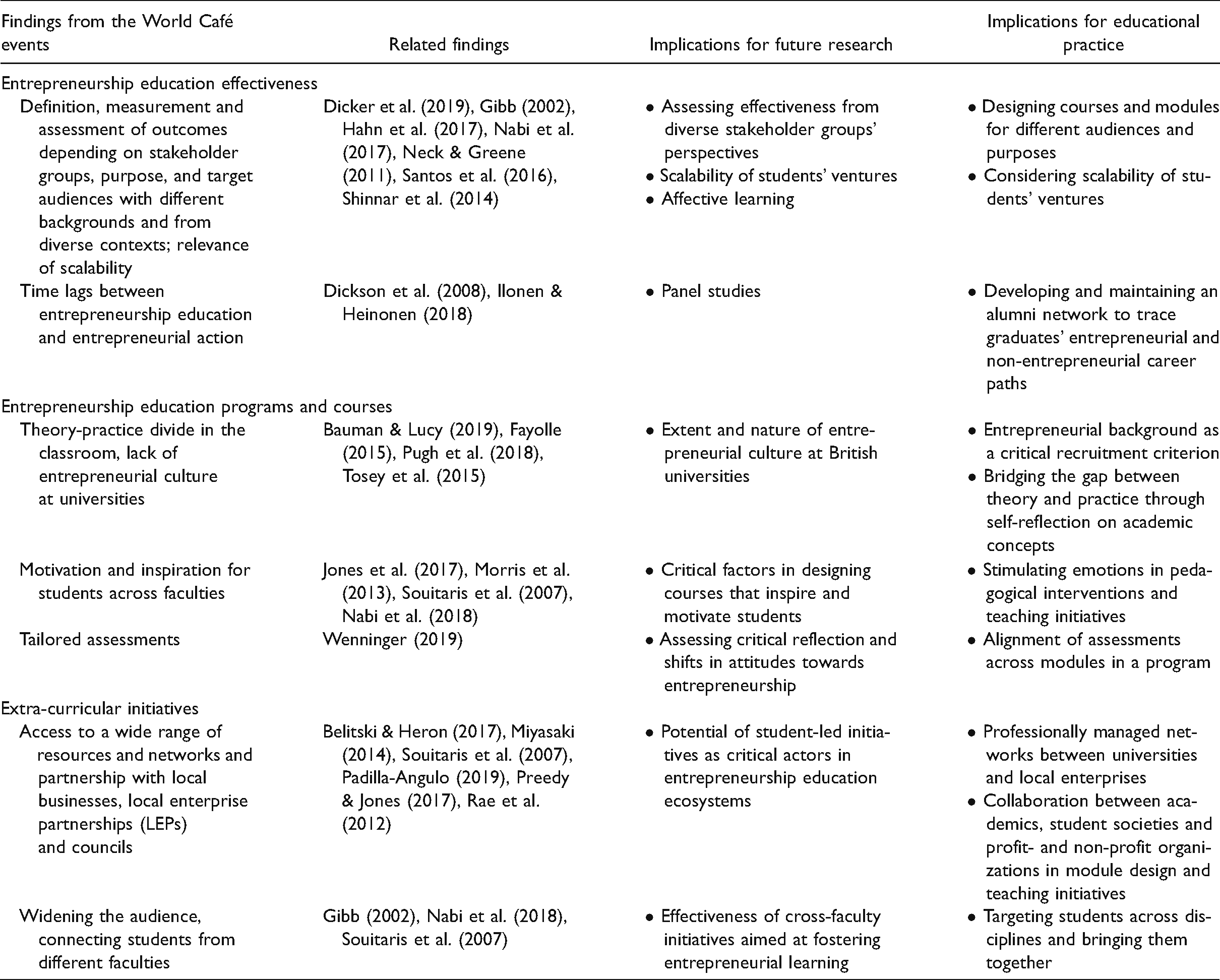
Entrepreneurship Education Effectiveness
The World Café method confirmed that effectiveness depends on who is asked, how entrepreneurship is defined, and what type of entrepreneurship is pursued. The study also identified that effectiveness depends on the nature of the indicators chosen, but also the timeframe, e.g., timing, single or repeated measurement. This result, first, points to the purpose of entrepreneurship education, which differs across stakeholders. The degree to which different stakeholders’ understanding of purpose varied, with implications for assessment of effectiveness, underpins the complexity of the issue, leading to continued debates between educators, policymakers, researchers, and not least students.
Thus, second, we suggest that any effectiveness measure needs to take into consideration different audiences (Dicker et al., 2019; Gibb, 2002; Kuratko & Morris, 2018). The impact of the student background and the regional context has been demonstrated previously (e.g., Hahn et al., 2017; Santos et al., 2016; Shinnar et al., 2014). Our findings also support Neck and Greene’s (2011) claim that students, though enrolled in the same modules, differ in their goals and hence in their expectations regarding the outcomes of entrepreneurship education. Universities could design offerings that cater to different audiences’ aspirations (e.g., students intending to launch businesses in the region or to revitalize the growth of family businesses in distant countries). For example, they could offer short optional modules providing hands-on advice for would-be entrepreneurs that foster practical skills. More theory-focused modules may foster students’ entrepreneurial thinking and its application in various contexts, strengthening their employability. Universities may also consider offering courses for specific audiences, such as entrepreneurship for next-generation family business owners.
Third, exposure to entrepreneurship education may have an impact on behavior many years after the completion of a module or program (Dickson et al., 2008). Longitudinal studies that do not survey students several times during a single module (e.g., Shinnar et al., 2014) but involve the collection of panel data of graduates following the years after graduation could be revealing. These panel data could capture graduate entrepreneurs’ and non-entrepreneurs’ experiences during and after their studies. A well-developed alumni network that helps trace graduates’ career paths could be useful in this regard.
Our findings reflect the wide range of outcomes that indicate effectiveness, most notably new venture creation (e.g., Miyasaki, 2014; Wenninger, 2019). These indicators have been reviewed by, for example, Nabi et al. (2017). Our results indicate that many start-up ideas lack scalability. Previous studies rarely discuss whether the businesses that students launch can be scaled up. The failure to do so risks endangering the positive employment effects attributed to venture creation. Entrepreneurship educators should acknowledge scalability as an essential indicator of entrepreneurship education effectiveness and for evaluating venture ideas. It may be useful to connect the concept of scalability to international entrepreneurship, as it explores the opportunities and challenges of international expansion. Apart from that, the findings illustrate that inspiration and emotions, possibly triggered by learning from success and failure, affect the effectiveness of entrepreneurship education. This insight has been discussed by, for example, Souitaris et al. (2007) and Nabi et al. (2018), but Ilonen and Heinonen (2018) claim that affective learning outcomes are still under-researched.
Entrepreneurship Education Programs and Courses
Skill development is a crucial element of effectiveness (e.g., Morris et al., 2013; Nabi et al., 2018). The question of how entrepreneurship programs and modules enhance students’ skills and competencies triggered a conversation about a theory-practice divide at British universities among some participants. Criticism that teaching approaches are too theoretical, faculty lack entrepreneurial skills, and universities are not entrepreneurial is widespread. For instance, Fayolle (2015, p. 699) complains that entrepreneurship education “lacks qualified and experienced scholars”. However, “actually making universities think and act entrepreneurially is a challenge, compounded by the lack of definition or consensus about what an entrepreneurial university is” (Pugh et al., 2018, p. 1836), and the pressure on academics to prioritize publications in highly-ranked academic journals (Osterloh & Frey, 2020). A new insight generated by the workshops was that self-reflection on concepts may help in bridging the gap between theory and practice and stimulate entrepreneurial thinking. Our findings thus bring an interesting avenue for future educational research to the fore. As a practical implication, universities may consider an entrepreneurial background as a critical criterion for the recruitment of educators in entrepreneurship programs.
Suggested course contents, teaching approaches, and the need to help students think and experiment like entrepreneurs confirm the results from previous studies (e.g., Brentnall et al., 2018; Kirby, 2004; Morris et al., 2013). The claim that teaching efforts and pedagogical interventions should help students overcome anxiety touches upon the rarely addressed need to consider affect and emotions (Keller & Kozlinska, 2019; Nabi et al., 2017; Souitaris et al., 2007). More research is warranted that highlights how courses can integrate inspiration and motivation to instill enthusiasm for entrepreneurship among students. This would help educators understand how they can stimulate emotions in their pedagogical interventions and teaching initiatives.
Our findings echo Wenninger’s (2019) claim that a tailored assessment design can support students’ entrepreneurial learning. Future research could highlight how critical reflection and potential shifts in attitudes in entrepreneurship can be captured and assessed. Moreover, assessments are often not aligned across modules. This impedes formative assessments of how students change their attitudes and how their skills and competencies evolve during their studies. Educators may consider aligning the contents, learning outcomes and assessments of their modules in a program, so that they build on each other.
Extracurricular Initiatives
The participants recommended many support mechanisms and extra-curricular initiatives that had been studied previously. The importance of the local environment was highlighted. This finding points to a pertinent issue for British universities. Research, teaching, and knowledge exchange at universities contribute to the economic development of the regions in which they are located (Pugh et al., 2018; Rae et al., 2012). This relationship is not unidirectional. Our findings illustrate that university-based entrepreneurship education benefits from linkages with local private and public organizations. Still, they are not yet enough despite the increasing popularity of entrepreneurship education ecosystems (Belitski & Heron, 2017). Student-led initiatives, such as student enterprise groups and societies, may be beneficial in establishing and strengthening relationships with local, regional and even national economic and political actors (Padilla-Angulo, 2019; Preedy & Jones, 2017). Their potential as critical actors in entrepreneurship education ecosystems should be examined in future research. As a practical implication, a collaboration between academics, student societies and profit- and non-profit organizations in module design and teaching initiatives may be beneficial. Ideally, this network of collaborations should be led by a manager (e.g., a university representative) who is solely responsible for this task and has control over a budget.
Our findings support the claim to target students across disciplines (Gibb, 2002; Souitaris et al., 2007). They go beyond the existing literature by emphasizing the perceived need for cross-faculty student networks that could provide a foundation for promising start-ups. This insight may complement the notion of entrepreneurship education ecosystems in which the relevance of intra-university networks has remained underdeveloped to date. Future research could analyze factors that influence the effectiveness of cross-faculty initiatives aimed at fostering entrepreneurial learning. Another new finding was the idea to offer entrepreneurial students unused retail space in local communities. This suggestion would benefit not only universities, students, and graduates but also the regional economy. It could also enrich the notion of entrepreneurship education ecosystems.
The relationship between entrepreneurship education and an increase in entrepreneurial intentions is not inevitable, although in certain circumstances, entrepreneurial intentions may decrease (Nabi et al. 2018). A realistic understanding of the start-up process will assist those students who do go on to start businesses.
For those who do not intend to set up a venture, or who may delay start-up, having gained a more realistic appreciation of entrepreneurship may be regarded as a good thing in itself. As Neck and Corbett (2018) suggest, even where the purpose of entrepreneurship education is quite narrowly defined as venture creation, the skills and competencies gained in preparing students for this, will stand students in good stead. They will help students, irrespective of whether they ultimately start a business or not.
Conclusion
To our knowledge, this is the first documented application of the World Café method in an entrepreneurship education study. We have demonstrated its strength in engaging diverse stakeholders who may not necessarily meet at other occasions for a productive conversation. Our findings illustrate that the World Café setting and the combination of participants with different backgrounds create opportunities to exchange existing knowledge and explore ideas and actions to be taken. This co-creation of knowledge helps find new ways to enhance the effectiveness of entrepreneurship education. Nonetheless, the method has limitations.
First, our data rely on a small sample of participants. To enable meaningful conversations, the number of participants in World Café events must be limited. This method generates subjective data that reflect individual experiences and attitudes. It serves to explore meaning and how this meaning is co-created among stakeholders. Consequently, the generalizability of the findings is limited but offset by a rich and detailed picture of the phenomenon under investigation. This can serve as the basis of further theory development and testing with larger samples.
Second, the design principles (e.g., Prewitt, 2011) may be applied in different ways. For example, the principle to create a hospitable space depends on the organizers’ potentially culturally bound understanding of what “hospitable” means. Moreover, although the same questions and instrumentation are used across events, these are not fully replicable, because their participants have different abilities and backgrounds. The emphasis of the method is more on the process of conversation and the interaction that stimulates the exploration of ideas and action points than the strict adherence to a script (Steier et al., 2015).
Third, the purpose of the World Café is not to disentangle or to compare attitudes of different stakeholder groups. To this end, a survey would have been more helpful (Dicker et al., 2019).
While not offering generalizable results, the World Café method can nonetheless lay the foundation for quantitative studies that seek to offer generalizations. For instance, its use in a series of events referring to the same topic could allow for the subsequent application of a grounded meta-analysis. This method could serve as a strategy for uniting the results of these events and transforming them into hypotheses that may be tested in future quantitative studies (e.g., Stall-Meadows & Hyle, 2010). Another option is cross-impact analysis (e.g., Ceric, 2016). Our World Café events have revealed a range of factors that our participants considered crucial for entrepreneurship education effectiveness. The direction and strength of relationships between these factors could be used to create scenarios making predictions regarding entrepreneurship education effectiveness. The scenarios could be tested in simulations or experimental studies.
We end the paper on the note that while our study has underlined the complexity of evaluating entrepreneurship education effectiveness, as a means to foster entrepreneurial thinking, its wider benefits will persist.
Footnotes
Declaration of Conflicting Interests
The author(s) declared no potential conflicts of interest with respect to the research, authorship, and/or publication of this article.
Funding
The author(s) disclosed receipt of the following financial support for the research, authorship, and/or publication of this article: This work was completed thanks to the internal seedcorn funding from Royal Holloway, University of London (Research Strategy Fund 2018 and Knowledge and Organizational Learning (KOL) Research Theme Group) and the University of Westminster.
Ethical Approval
This study did not require ethical approval from the institutions.
Informed Consent
Participants provided informed consent verbally or through email before attending and participating in this study.
