




Abstract
The new venture creation process is essentially different from the process of managing an established business. Scholars suggest that many current mainstream teaching methods and tools used in entrepreneurship education (EE) are rooted in classical economic theory and do not fully address the specific nature of new venture creation. They also point at a shortage of native EE methods and tools developed specifically for the early-stage new venture creation process. We respond to this challenge through (a) a careful scrutiny of one of the most popular EE tools—the Business Model Canvas and (b) a novel and native EE Experiential Pattern-Matching method to support and complement the Business Model Canvas (and other similar EE tools). We advance our theoretical understanding of experience-based learning in EE settings by embedding the Experiential Pattern-Matching method into a Dynamic Experiential Process Framework that assists entrepreneurship educators in developing effective curricula and improving individual- and team-based learning throughout the educational process of new venture creation.
Keywords
Since its inception, entrepreneurship education (EE) has sought to gain legitimacy by differentiating itself from other business disciplines (Béchard & Grégoire, 2005; Neck & Greene, 2011). By embracing experiential learning pedagogy, the entrepreneurship discipline emerged as a forerunner in the deployment of hands-on new venture creation educational processes (Hägg & Kurczewska, 2020; Neck & Corbett, 2018; Pittaway & Edwards, 2012). Despite this development, entrepreneurship pedagogy today still draws on classical economic and management theories ill-suited to address the dynamic nature of the new venture creation process (Hägg & Gabrielsson, 2019; McMullan & Long, 1987; Townsend et al., 2018). Among others, Berglund et al. (2018) and Fayolle (2013) have called for a more critical stance toward adopted concepts and tools that are all too often taken for granted and routinely applied by entrepreneurship educators in the context of new venture creation modules. Moreover, scholars have been urging entrepreneurship educators to “uncover entirely new methods for experiential learning and the design of curricula around experiences” (Morris & Liguori, 2016, pp. xiv–xxii).
In order to effectively respond to these calls, we anchor our definition of entrepreneurship as “the performance of the process of becoming” (Anderson, 2005, p. 592), and we demonstrate that existing EE tools are insufficient to capture the experiential nature of this process. We achieve this through a critical review of the Business Model Canvas (BMC), which is a framework frequently referenced by entrepreneurship educators (e.g., Berglund et al., 2018; Bodnar et al., 2018; Bruton, 2016; Grossman, 2016; Günzel-Jensen & Robinson, 2017; Rideout & Gray, 2013). We make the bold claim that, due to its popularity, the BMC has become immune to questioning or criticism. Our in-depth analysis of Osterwalder’s (2004) PhD thesis and his subsequent Business Model Generation book (Osterwalder & Pigneur, 2010) reveals that this business model ontology is at odds with the experiential nature of the process of becoming. We suggest that implementing the BMC ontology in educational settings during the early stages of a new venture creation process may (a) undermine entrepreneurship educators’ ability to guide their students throughout the process and (b) compromise EE students’ learning experience surrounding the distinctive nature of the new venture creation experience.
We propose a novel Experiential Pattern-Matching (EPM) method to resolve the shortcomings of the BMC (and similar educational tools) in the early stages of a new business venture. By drawing on insights from the wider dual-process discussion in psychology and education, we suggest that our method enables entrepreneurship educators to better tease out, capture, and incorporate students’ personal experiences and aspirations throughout the new venture creation learning process. Furthermore, we propose a Dynamic Experiential Process Framework (hereafter referred as Framework) that provides entrepreneurship educators with an improved understanding of the ways EE curricula can better incorporate experiential patterns throughout the phases of new venture creation.
We contribute to the development of EE by introducing the EPM as a native EE teaching method that fulfills the need to design new pedagogical means required to uncover the experiential nature of entrepreneurship. Furthermore, we contribute to the development of novel EE curricula by positioning the EPM—an essential precursor and complement to existing EE tools—within a Framework that acts as a navigation guide useful in untangling the structured and unstructured aspects of the process of becoming.
The rest of this article is structured as follows: First, we introduce the reader to the experiential nature of entrepreneurship and the goal of EE in triggering and facilitating that experience. Second, we point at the shortcomings of the BMC in supporting new venture creation learning experiences. Third, we introduce our EPM method via a thought experiment to resolve the challenges associated with implementing the BMC during the early stages of a new venture. Fourth, we present our Framework. We conclude this article by discussing the theoretical value of our contributions to EE literature.
Theoretical Background
Entrepreneurship as an Individual Learning Experience
Entrepreneurship is a process of learning, and a theory of entrepreneurship requires a theory of learning. (Minniti & Bygrave, 2001, p. 7)
Entrepreneurship is frequently associated with the creation of new ventures (Alvarez & Barney, 2007; Forbes, 1999; Gartner, 1988; Shaver & Scott, 1991). However, when scholars talk about entrepreneurship, they typically refer to how someone thinks, plans, conspires, and acts in pursuit of opportunities and related desires and aspirations (Gartner et al., 1992, 1994; Krueger & Brazeal, 1994; M. H. Morris et al., 2012). In line with this view, we adopt a perspective on entrepreneurship as “the performance of the process of becoming” (Anderson, 2005, p. 592). This transformative process, however, is not limited to a specific time or place. As noted by Anderson (2005), the process may have started during childhood; it might have begun with a passing thought; or it may have taken decades to gather the necessary resources—both physical and mental—for the sake of the entrepreneurial pursuit (see also Cornelissen et al., 2012; Kurczewska et al., 2020; Sarasvathy, 2001).
There is no general recipe, ideal age, situation, or specific circumstances that makes a successful entrepreneur. Indeed, Fiet (2001) states, “entrepreneurial success (understood as above-average profits) is typically an individual accomplishment. If it could be fully described, it would be imitated, which would result in average returns” (p. 9). The establishment of a new venture requires some readiness to confront the unfamiliar and do whatever is needed to take an idea or hunch and realize it despite the obstacles and uncertainties (Gartner & Vesper, 1994). To illustrate this process, Kuratko (2005) applies Booker T. Washington’s stirring words: “Success is to be measured not so much by the position that one has reached as by the obstacles which have been overcome while trying to succeed” (p. 591).
While entrepreneurship research has moved beyond describing entrepreneurs as unique people with powerful and mysterious gifts (Baumol, 2010; Griffiths et al., 2012), it remains that individual entrepreneur(s) play a central role in new-business creation (Kurczewska et al., 2020; Kyrö, 2006; Neck & Greene, 2011). Each individual entrepreneur possesses a unique bundle of personal life experiences, preferences, networks, motivations, goals, aspirations, and numerous other characteristics (Baron & Ensley, 2006). Scholars posit that the feasibility and desirability of new venture creation may, in addition to external influences, be affected by personal factors such as gender, age, level of education, life stage, work experience, the presence of role models, and other vicarious experiences. As such, the differences between two entrepreneurs may be wider than the ones between an entrepreneur and a nonentrepreneur (Athayde, 2009; Cope, 2005; Grégoire et al., 2015; Krueger, 1993; Peterman & Kennedy, 2003; Reuber & Fischer, 1993). Therefore, each individual (potential) entrepreneur can be considered as unique (Cope, 2005; Krueger & Brazeal, 1994; M. H. Morris et al., 2012).
Crucially, entrepreneurship is, more often than not, a team effort (Harper, 2008; Schjoedt et al., 2013), and any (entrepreneurial) team is a synergistic and vibrant combination of the qualities of its individual members. We understand the term team as: “(a) two or more individuals who; (b) socially interact (face-to-face or, increasingly, virtually); (c) possess one or more common goals; (d) are brought together to perform organizationally relevant tasks; (e) exhibit interdependencies with respect to workflow, goals, and outcomes; (f) have different roles and responsibilities; and (g) are together embedded in an encompassing organizational system, with boundaries and linkages to the broader system context and task environment” (Kozlowski & Ilgen, 2006, p. 79).
Because of the diversity of entrepreneurial motivations and expected outcomes within a venture team (Neck & Greene, 2011), it is essential to recognize and effectively address these differences on both the individual and team levels. Such differences determine the individual’s specific goals and their preferred means of achieving them. For example, some may consider entrepreneurship as a process of continual innovation and creativity (Kuratko, 2005), while others may be happy just to replicate others’ successes (Griffiths et al., 2012). Some may want to generate value for a better world (Blenker et al., 2012; Günzel-Jensen & Robinson, 2017; Sarasvathy & Venkataraman, 2011; Shepherd & Patzelt, 2011), while others may only be interested in personal and financial gains (Neck & Greene, 2011). Some may be growth-oriented, while others may prefer to keep their ventures small (Xu & Ruef, 2004). Some may be interested in quick gains, while others may possess a life-long orientation. This broad variety demonstrates the richness and versatility of the experience of being and becoming an entrepreneur (Griffiths et al., 2012).
Entrepreneurship Education as a Facilitator of the Individual Learning Experience
According to Minniti and Bygrave (2001), “entrepreneurs learn by updating a subjective stock of knowledge accumulated on the basis of past experiences” (p. 5). If EE students can be thought of as prospective entrepreneurs, we can expect them to have a set of psychological characteristics similar to those of established entrepreneurs (Sexton & Bowman, 1984). Providing students with the opportunity of experiencing the process of becoming in educational settings may significantly enhance their understanding of that process and its relevance to their desires and aspirations (DeTienne & Chandler, 2004).
Just as with entrepreneurs, EE students have different backgrounds, ages, genders, social statuses, interests, motivations, goals, desires, and aspirations. Some of them may want to change the world, while others may simply want to pass the course. Some may already be experts in a specific field, while others may simply be motivated novices (Krueger, 2009; Neck & Greene, 2011). Even when gathered around a shared educational experience, they remain unique individuals (Cope, 2005). As with entrepreneurs, the measure of students’ success should not be based on objective results but rather on their subjective (individual and team) experiences throughout the learning process (Kuratko, 2005; Matthews, 2018).
Although today’s EE pedagogy includes some traditional approaches, such as lectures and case studies, there is growing consensus that experiential learning—through the experience of creating real ventures—may enhance learning outcomes (Aulet et al., 2018; Hägg & Gabrielsson, 2019; Pollack et al., 2018; Reid & Koester, 2018; Vuola et al., 2018). Scholars suggest that starting a venture within EE can provide students with the equivalent of what John Dewey (1938, p. 51) calls an “educative experience” (Clark et al., 1984; Hägg & Kurczewska, 2020; Hills, 1988; Honig, 2004; Jones & English, 2004; Krueger, 2009; Kuratko, 2006; Mitra, 2002; Neck & Greene, 2011; Plaschka & Weisch, 1990; Rideout & Gray, 2013; Shepherd, 2004; Solomon et al., 2002).
An educative experience is much more than simply learning by doing (Krueger, 2009). As Dewey (1938) states, The belief that all genuine education comes about through experience does not mean that all experiences are genuinely educative . . . For some experiences are miseducative. Hence the central problem of an education based on experience is to select the kind of present experiences that live fruitfully and creatively in subsequent experiences. (pp. 25–28)
To illustrate this statement, we scrutinize the BMC—a teaching tool commonly used by entrepreneurship educators (Berglund et al., 2018; Bodnar et al., 2018; Bruton, 2016; Grossman, 2016; Günzel-Jensen & Robinson, 2017; Rideout & Gray, 2013). Due to its popularity, the BMC has become immune to questioning or criticism (see De Reuver et al., 2013; Euchner & Ganguly, 2014; and Günzel & Holm, 2013 for scarce and broad instances of critical views on the BMC).
Through an in-depth analysis of Osterwalder’s PhD thesis (2004) and his subsequent Business Model Generation book (Osterwalder & Pigneur, 2010), we identify that his business model ontology—rooted in classical economic theory—has four major mismatches with the process of becoming (i.e., start-up reality). We suggest that introducing the BMC too early during the initial stages of the venture creation process could severely undermine the ability of entrepreneurship educators to provide their students with effective and educative experiences. We elaborate on these mismatches in more detail here.
Four Mismatches Between the BMC and the Process of Becoming
Mismatch A: Centrality Versus Absence of the Human Actor
Throughout the history of entrepreneurship research (e.g., Anderson, 2005; Baron & Markman, 2000; Baumol, 2010; Fiet, 1995; Huang & Pearce, 2015; MacMillan et al., 1985; Mason & Stark, 2004), scholars have unanimously agreed that the most important engine of venture innovation has always been, and will remain: the entrepreneur. Osterwalder’s (2004) empirical findings also back this central notion. His interviewees indicated that ontology can abet innovation, but “you still need the creativity of the people” (q.42) (Osterwalder, 2004, p. 137). However, despite the centrality of the individual actor in the initial version of Osterwalder’s ontology, it was surprisingly excluded from the final BMC framework (cf. Osterwalder, 2004, p. 44 with Osterwalder & Pigneur, 2010, p. 44).
Mismatch B: Multi- Versus Unidimensional (Economic) Goals
Osterwalder designed the BMC model in line with the classic economic perspective, which emphasizes customer value creation with the purpose of transforming that value into profits (the same could be said about related EE methodologies and tools such as Design Thinking). Osterwalder (2004) defines the business model as “a representation of how a company buys and sells goods and services and earns money” (p. 14). He further describes it “as an abstract conceptual model that represents the business and money-earning logic of a company” (Osterwalder, 2004, p. 15).
This economic approach, with the customer at the center—and the profit and loss account at its foundation—may very well explain the logic of existing businesses, but its relevance is questionable during the initial phases of new venture creation in educational settings (Aulet et al., 2018). Relying solely on the BMC might confine the motivation of its users for starting a venture to: (a) serving customers’ needs and/or (b) generating financial profit. The multiplicity of other potential motivations behind the new venture creation process remains overlooked by the BMC.
Mismatch C: The Process of Becoming Versus Established Businesses
Describing the purpose of business models in general, and his work in particular, Osterwalder (2004) indicates the increasing need for the “coordination of a large number of stakeholders, such as partners, strategists, business process designers and information systems staff” (p. 3) within large established organizations. His case study of the Montreux Jazz Festival (est. 1967) as well as most of the examples he used in his PhD thesis (2004) and his Business Model Generation book (2010) are based on successful, long running, and well-established businesses. In effect, the median founding year of Osterwalder’s (2004, 2010) 114 case companies was 1965—or nearly 50 years since they were founded (see Appendix for the full list of the companies and their founding years). Business models are suitable for Osterwalder’s case companies since they have been in existence for many years. In these cases, business modeling is based on decades of experience, market knowledge, established customer relations, and extensive partner networks providing them with an opportunity to experiment with renewing and expanding their existing building blocks or developing new ones—such as through spinoffs.
Evidence suggests that it is often premature for a nascent venture to replicate the structures and practices of long-established business enterprises (George & Bock, 2011; M. Morris et al., 2005). This is explained by the agile nature of new venture development within the unique constraints of the emergent entrepreneurial environment.
Mismatch D: Action Plan Versus Puzzle
The mechanism of Osterwalder’s BMC (and related EE tools and methodologies such as the Lean Startup) is typical of classical economic theory in that it purports that rational choices can be made among known available alternatives (Simon, 1972). To validate their choices of alternatives in all of the nine boxes of the BMC, users must either know perfectly or test one-by-one all the alternatives and be capable of performing the required calculations—namely, “to set the derivative of profit with respect to quantity equal to zero and to solve the resulting algebraic equation” (Simon, 1972, p. 163). Crucially, Osterwalder and Pigneur (2010) provide a list of alternatives for each box of the BMC that can produce anywhere between 2,494,800 and 99,792,000 business model combinations. It would be, therefore, unrealistic to expect any new venture team to knowingly process such mind-boggling numbers of alternatives.
Furthermore, during the initial phases of venture creation, uncertainty and risk could be applied to any box of the BMC—or even to all of them. Therefore, completing the BMC with any measure of confidence—and indeed, purpose—is much more challenging for nascent ventures than it is for existing organizations. Osterwalder’s (2004) own empirical findings provide additional support for our claim. Indeed, he states, executives of very small companies have mixed opinions concerning the use of the business model ontology, particularly in applying it to their firms. Though not completely reluctant to the use of the ontology they feel that the business model of their company is already sufficiently clear. (p. 138)
In summary, we suggest that the four mismatches we have identified earlier limit the effectiveness of the BMC during the initial stages of the new venture creation process. To address these four mismatches, we developed an EPM method that recalls the individual actor to the core of the entrepreneurial experience. This method takes into account individual and team experiences, motivations, goals, and preferences. This is important because it provides a frame for entrepreneurship educators to constructively guide and trace the individual- and team-based learning during the initial stages of the new venture creation process. The EPM method is not designed as a replacement for—but rather as a necessary precursor to—the BMC. Whereas the BMC stimulates the economic rationales for venture-related decisions, the EPM aids in unlocking the underlying assumptions, expectations, goals, and aspirations of each individual team member toward the creation of a new venture. The EPM also provides a comprehensive approach to capture and combine the aforementioned factors in an open, transparent, and equitable manner. In the following section, we describe the EPM method by means of a thought experiment.
Thought Experiment: The EPM Teaching Method for New Venture Creation Courses
Overview and Validity of the Thought Experiment
Discussed in depth in the seminal work The Laboratory of the Mind: Thought Experiments in the Natural Sciences (Brown,1991/2011), thought experiments are considered as a valuable medium for developing conceptual understanding. They find their origin in ancient Greek times, and later, most notably during the Renaissance period (i.e., Galileo’s thought experiment on falling bodies). The tradition of using thought experiments continued throughout the contemporary history of modern science (e.g., Newton’s bucket, Einstein’s light beam and elevator, and Schrödinger’s cat experiments).
Today, thought experiments are considered as illustrative approaches and learning tools in a variety of research and educational contexts (physics, mathematics, law, nursing, theology, sociology, sustainability, etc.). For some examples of thought experiments in entrepreneurship research, see the works of Sarasvathy (2001) on effectuation, Dew and Sarasvathy (2007) on entrepreneurial innovation, and Krueger (2017) on entrepreneurial intentions.
We resorted to using the thought experiment approach in this article due to the dearth of empirical research on the deployment of the BMC during the early stages of the new venture process—the closest extant work being a single study of two SMEs, which found that the BMC “is suitable for mapping purposes of current activities, but not suitable as a ‘paradigm’ or framework to follow when outlining strategies for the future” (Frick & Ali, 2013, p. 142).
A New Venture Creation Thought Experiment: Harry, Larry, and Sally’s Lunch Delivery Service
In this thought experiment, we unpack the process of teaching a typical “New Venture Creation” university-level course. The guiding assumptions of our Thought Experiment are as follows: (a) This is a university-level new venture creation course. (b) The food delivery venture idea is Harry’s, and we make no assumptions about how, when, and why Harry came up with it. The venture idea is only meant for illustrative purposes and does not speak for its viability or innovativeness. (c) In this thought experiment, we make no assumptions regarding the following characteristics of the new venture team members, namely, about their: (i) prior venture creation experience; (ii) prior experience of working together; (iii) motivation levels to transform their idea into a venture; (iv) knowledge of, or expertise in, their venture; (v) innovative potential; and (vi) age, gender, cultural, and other (e.g., financial, social) differences.
You have divided your students into groups and assigned them the task of producing innovative ideas, which are meant to be transformed into business models, and eventually implemented in practice. One of these groups comprises Harry, Larry, and Sally. Together, they decide to adopt Harry’s idea of a lunch-delivery service.
The aim of this educational exercise is to replicate the initial “idea-to-business-model” phase of venture development considered critical for new ventures (Davidsson, 2015; Dimov, 2017; Kier & McMullen, 2018). At this stage, more often than not, the entrepreneur(s) operate(s) in the absence of complete knowledge about the market’s state or the expected demand—let alone the actual potential of his/her/their product (Sarasvathy, 2001). Most new startup ventures are informationally opaque since they lack the track record and data needed to decide whether the business prospects are economically viable or even feasible (Berger & Udell, 1998; Mason & Stark, 2004). At this stage, Harry, Larry, and Sally have little to lose, and hopefully much to gain, from the forthcoming learning experience.
Unpacking the Process of Becoming
By contrast with Osterwalder—who identified the nine elements of the BMC by tracing them from the management business modeling literature where each element was “mentioned by at least two authors” (Osterwalder, 2004, pp. 44, 129)—the EPM method we propose relies on an ontologically different tradition. It draws on insights from psychology’s dual-process discussion of experiential processes and their critical role in planning and decision making (see Bargh, 2014; Chartrand & Lakin, 2013; Custers & Aarts, 2007; Dijksterhuis & Nordgren, 2006; Epstein, 2003; Evans, 2008; Gigerenzer & Gaissmaier, 2011; Haidt, 2001; Kihlstrom et al., 2000; Lazarus, 1991; Phelps, 2006).
The dual-process perspective is recognized as the dominant paradigm in the study of social, personality, cognitive, and clinical psychology (Frankish & Evans, 2009; Groves & Thompson, 1970; Nisbett & Wilson, 1977; Smith & DeCoster, 2000). Dual-process psychologists classify cognitive processes into experiential (also: intuitive, heuristic, implicit, automatic, unconscious, associative), and analytical (also: rational, explicit, controlled, conscious, rule-based) processes. This processual distinction was first discussed by Aristotle but has since been debated by scholars such as James (1890/1950), Freud (1920/1952), Piaget (1926), Dewey (1922), Vygotsky (1934/1987), Neisser (1963), and Sloman (1996). The same distinction has also been referred to in (a) economics: prospect theory (Tversky & Kahneman, 1973, 1974), (b) sociology: cultural analysis (Nisbett et al., 2001), (c) education: experiential learning theory (D. A. Kolb, 1984; A. Y. Kolb & Kolb, 2005), (d) drama: Stanislavski’s system (Stanislavski, 1936), as well as (e) evolutionary educational psychology (Geary, 2002). This topic has also been addressed in entrepreneurship in terms of causation and effectuation (Sarasvathy, 2001). For additional insights into the dual-process discussion, see Evans (2008); Frankish and Evans (2009); and Kihlstrom et al. (2000).
We designed the steps of the EPM method in a way to promote and support the exchange of experiential knowledge among team members during the initial stages of venture creation. Through a process of teasing out each team member’s assumptions, goals, and plans, and by stimulating communication among team members, we aim to facilitate the formation of a collective understanding and heightened motivation toward the attainment of individual- and team-level aspirations. Of note, we developed and piloted the EPM method between 2014 and 2020 with students, educators, and entrepreneurs in the contexts of universities, high schools, academic conferences (Annual Meeting of the Academy of Management and Australian Centre for Entrepreneurship Research Exchange conference), and one international startup acceleration event. EPM sessions ranged from 2 to 20 hours of instruction depending on the format and various other factors, such as the teaching context, numbers and levels of participants, team compositions, complexity of venture ideas, and venture development stages. We shall elaborate on the practical deployment of the EPM method in a separate method paper.
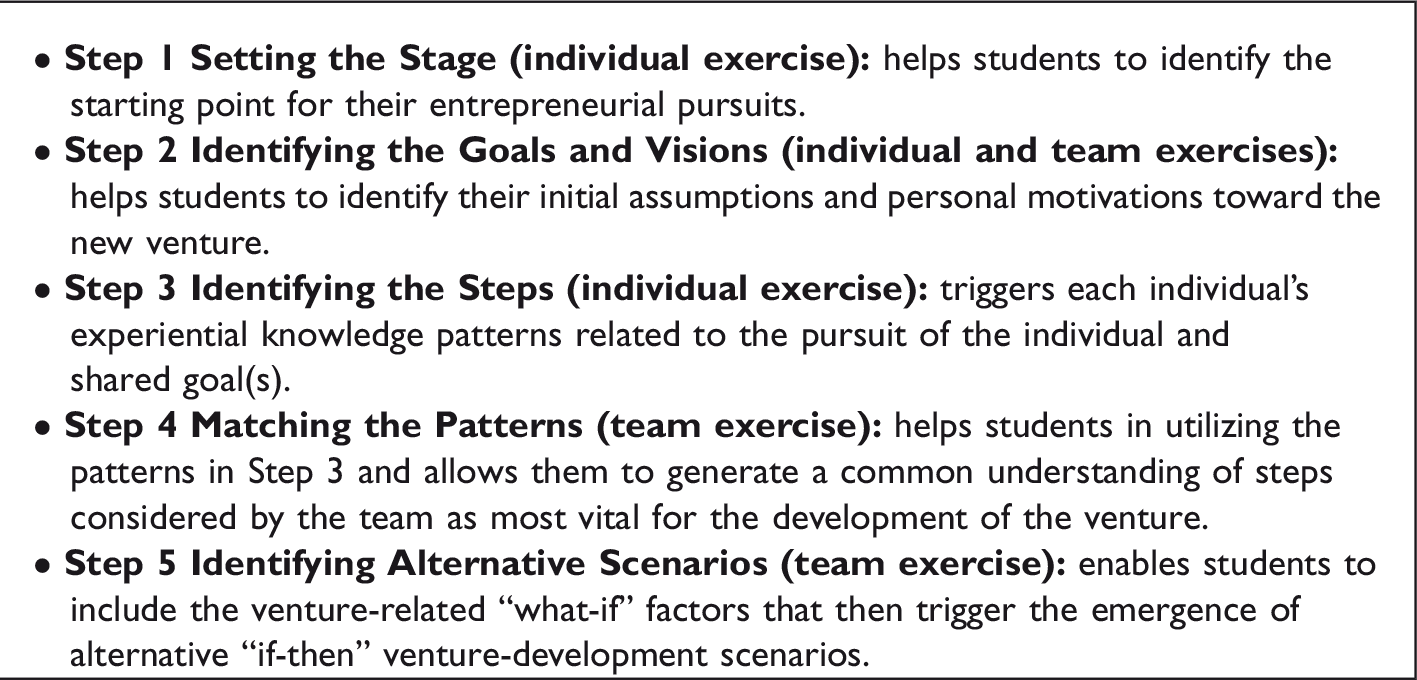
As pointed by D. A. Kolb (1984), “(l)earning is best conceived as a process, not in terms of outcomes” (p. 26). We propose that this novel structure provides students and educators with traceable evidence about the individual and teamwork dynamics throughout this process. By incorporating individual experiences and corresponding motivations, goals, and aspirations into the learning experience, the EPM offers educators a way to analyze and evaluate the actual process of the venture creation experience rather than just its outcome. In the next section, we will describe each step of the EPM method in more detail.
Step 1: Setting the Stage—Individual Exercise
Each of Harry, Larry, and Sally need a pen and a sheet of blank A4 paper. They are asked to write down on the left-hand side of their sheet the answer to a simple question: “What is the single most important element that your venture CANNOT survive without?” Our experience indicates that, despite the apparent simplicity of this question, rational interference can make it very challenging for our team members to produce an answer. The answer is, surprisingly, quite simple. At this stage, a venture can survive without resources, customers, and revenue. However, the venture cannot progress without the presence of at least one motivated actor driving it. This simple exercise highlights the centrality of the human actor in the venture-creation process, which was depicted in the initial version of Osterwalder’s (2004, p. 44) ontology but later removed without any explanation from the BMC’s final version (Osterwalder & Pigneur, 2010, p. 44).
The purpose of this exercise is to emphasize that it is not the business model, accessibility to finance, customer feedback, or projected revenue that are driving the venture-creation process, but rather the motivation and combined efforts of each of Harry, Larry, and Sally. As indicated by numerous scholars who describe the initial stages of the venture-development process, even seasoned investors do not place their faith in ideas, business models, or technology but rather in the people behind them (Cornelissen et al., 2012; Gartner et al., 1994; Huang & Pearce, 2015; Martens et al., 2007; Seo & Barrett, 2007). Scholars stress on the importance of interpersonal chemistry or, as portrayed by one business angel, “the smell of the people. The intangible feeling that this person has what it takes to be a success” (cited in Mason & Stark, 2004, p. 240). Dual-process scholars suggest that this is not some form of magic but rather the outcome of intelligent pattern-matching processes that rely on prior individual experience. They describe this intangible feeling as an expression of emotional mimicry (Chartrand & Lakin, 2013; Frith & Frith, 2012; Hess & Fischer, 2013; Heyes, 2011) that plays the role of a “social glue” (Bargh & Morsella, 2008, p. 76), resulting in a sense of belongingness, inclusiveness, and mutual interest.
Without an actor, there can be no problem, no opportunity to solve the problem, no business model, and no venture. Helping Harry, Larry, and Sally to realize that they are the starting point for their venture-creation experience sets the stage for the subsequent steps of the EPM method.
Step 2: Identifying the Goal(s)—Individual and Team Exercise
The process of opportunity identification and development is not limited to a set time or place. The aspiration may have emerged already in childhood; it could have come from a passing thought, or the courage and physical and mental resources may have taken decades to gather (Anderson, 2005). Describing the rational side of venture creation, Baron et al. (2016) warn start-up entrepreneurs against setting unachievable goals “given the new ventures’ resources and the highly competitive, rapidly changing environments they often face” (p. 56). By contrast, dual-process scholars point out that setting challenging goals lead to a superior performance when compared to limited or less ambitious goals, such as specific but easy-to-attain goals, vague goals like promising to do your best, or even setting no goal at all (Custers & Aarts, 2010; Dijksterhuis & Aarts, 2010; Latham, 2016; Papies & Aarts, 2016). The opposing nature of these suggestions indicates that goals need to be both personally relevant and challenging enough to trigger a personal motivation to pursue them while being justifiable enough to help sustain that motivation.
For the sake of clarity, we divide this step into four substeps. The first two concentrate on individual and team goal(s)/outcome(s) of the venture. The remaining two steps uncover and shed light on the individual visions and aspirations based on the potential attainment of the desired goal(s)/outcome(s).
(2a) Individual Exercise: Harry, Larry, and Sally need to imagine the desired result of their venture-creation pursuit and state it on the right-hand side of each one’s individual sheet. A suitable question for this exercise would therefore be: “What do you consider to be a successful outcome of your venture?”
(2b) Team Exercise: Let us assume that Harry’s idea of a successful outcome is that the venture should become a highly profitable food-delivery service within 3-to-5 years’ time. By contrast, Sally’s venture outcome is instead more down-to-earth—she wants the venture to be successful enough for her to pay off her student loan and might consider switching to regular employment if it does not pay her bills by the time she graduates. Larry has no specific venture outcome in mind; he simply wants to get rich. After everything has been put in writing, and after each of the team members have shared their individual goals, Harry, Larry, and Sally now have the opportunity to clarify and align their initial assumptions and motives (e.g., intrinsic/extrinsic, causative/effectuative) for their joint venture-creation pursuit.
(2c) Individual Exercise: We can shed light on the motivation of an individual by taking into consideration their specific venture-related short-term goals. In the long term, however, other factors (such as the individual’s wider values) must be considered because they impact which future aspirations the individual will strive for in relation to their venture-related goals (Bargh et al., 2001; Bargh et al., 2012). In order to uncover the often unclear underlying assumptions and motives related to the goal (Chartrand & Lakin, 2013; Custers & Aarts, 2007, 2010), students are guided to concentrate not on the desired outcome itself, but on its possible aftermath (we suggest using the back side of the same individual A4 paper for this purpose). A suitable question for this exercise would therefore be: “Imagine that you have reached your desired venture outcome. What will you do next?” The purpose of this question is to trigger Harry, Larry, and Sally to make the connection between the meaningfulness of their common venture creation goals and their personal future aspirations. In this way, the aspired new venture-creation outcomes become a means through which to attain a desired psychological state (Bargh & Morsella, 2010)—on both individual and team levels.
(2d) Team Exercise: Individual visions of a possible future are personal and therefore reveal each team member’s preferences and aspirations about the possible role this venture creation experience could play in their entrepreneurial and personal lives. As such, shared individual visions serve as a medium for the alignment of expectations between team members and mitigate against potential misunderstandings and team conflicts.
Step 3: Identifying the Steps—Individual Exercise
At this stage, each individual team member should reflect on the actions they consider are most important toward reaching the venture’s goal(s) agreed in Step 2b. For example, the guiding question for Harry may be: “What steps are needed to reach the commonly deliberated venture outcome?” He should then concentrate on the major actionable steps and arrange them along a timeline in a sequential order by concentrating only on the major milestones. The broader the steps and the fewer they are, the easier it will be to achieve the purpose of this exercise. Furthermore, one individual’s goal (e.g., Sally’s: to pay off her student loans) may be considered as a step on the way to achieving another team member’s goal (e.g., Harry’s: to achieve a highly profitable business). The purpose here is not to develop a definitive action plan or model, but rather to trigger and tease out Harry’s (and each of his team member’s) individual experiential knowledge.
Broad steps are easily absorbed when subsequently integrated (Hermans & Hermans-Jansen, 2001; Mishara, 1995). If Harry thoroughly applies this instruction throughout the line he drew on his sheet of paper, the smaller steps he generated will naturally merge into larger ones, thus resulting in fewer but more important steps. By absorbing small tasks into larger steps along the line, Harry will have generated his action pattern.
Key to this and the remaining steps of the EPM is the notion of priming, which, according to the dual-process literature, is generally understood as being a stimulus or stimuli that can induce nonconscious social behavior in support of a motivation or a goal. In the context of the EPM method, priming “serves to increase working memory capacity and improve performance” (Bargh et al., 2012, p. 598) toward the achievement of commonly agreed venture goal(s)/outcome(s) and the related individual aspirations.
For the sake of priming, the name of each step should not be considered a goal in and of itself, but rather as a starting point for the next step (Latham, 2016; Stanislavski, 1936). As such, unlike in the BMC’s configuration of boxes, the designations of Harry’s imaginary steps should include action verbs (e.g., “I will <action verb> … in order to <action verb> … in order to <action verb> … in order to reach <Harry’s desired goal>”).
Step 4: Matching the Patterns—Team Exercise
A certain interdependence—rather than resemblance—between members constitutes a team (Aulet et al., 2018; Lewin, 1943). At this stage, Harry, Larry, and Sally are asked to share their individual action patterns and discuss their similarities, differences, and gaps. Harry, Sally, and Larry are then guided to align their venture development scenarios and discuss the desired roles of each team member and their contributive interdependence within a commonly agreed action pattern. A larger sheet of (A3) paper would be most suitable for this exercise.
Step 5: Identifying Alternative Scenarios—Team Exercise
Now that the team members (in Step 4) have collectively agreed on the major steps of the new venture creation process, they are ready to incorporate “what-if” deviations from the chosen action pattern by adding alternative development steps using the “if-then” principle of experiential pattern matching (Kihlstrom, 1987; Simon, 1987). This team effort enables Harry, Larry, and Sally to (a) generate alternative venture scenarios, (b) develop a more flexible and inclusive attitude toward the achievement of a common goal, and (c) deploy a more resilient and dynamic plan designed to better withstand emergent adversities.
It is important to note that each individual step in the action pattern can be developed further (substeps) by using the same techniques described in Steps 3 and 4 earlier.
The outcome of the entire exercise (see Table 1) is a functional and inclusive venture-development action pattern that takes into account the most personally significant actions toward meaningful and commonly agreed goal(s). By implementing the EPM method, we expect Harry, Larry, and Sally to be better prepared to generate a functional business model that most resembles their individual- and team-level experiences and aspirations.
Overview of the EPM Method and Its Relation to the Four BMC Mismatches.
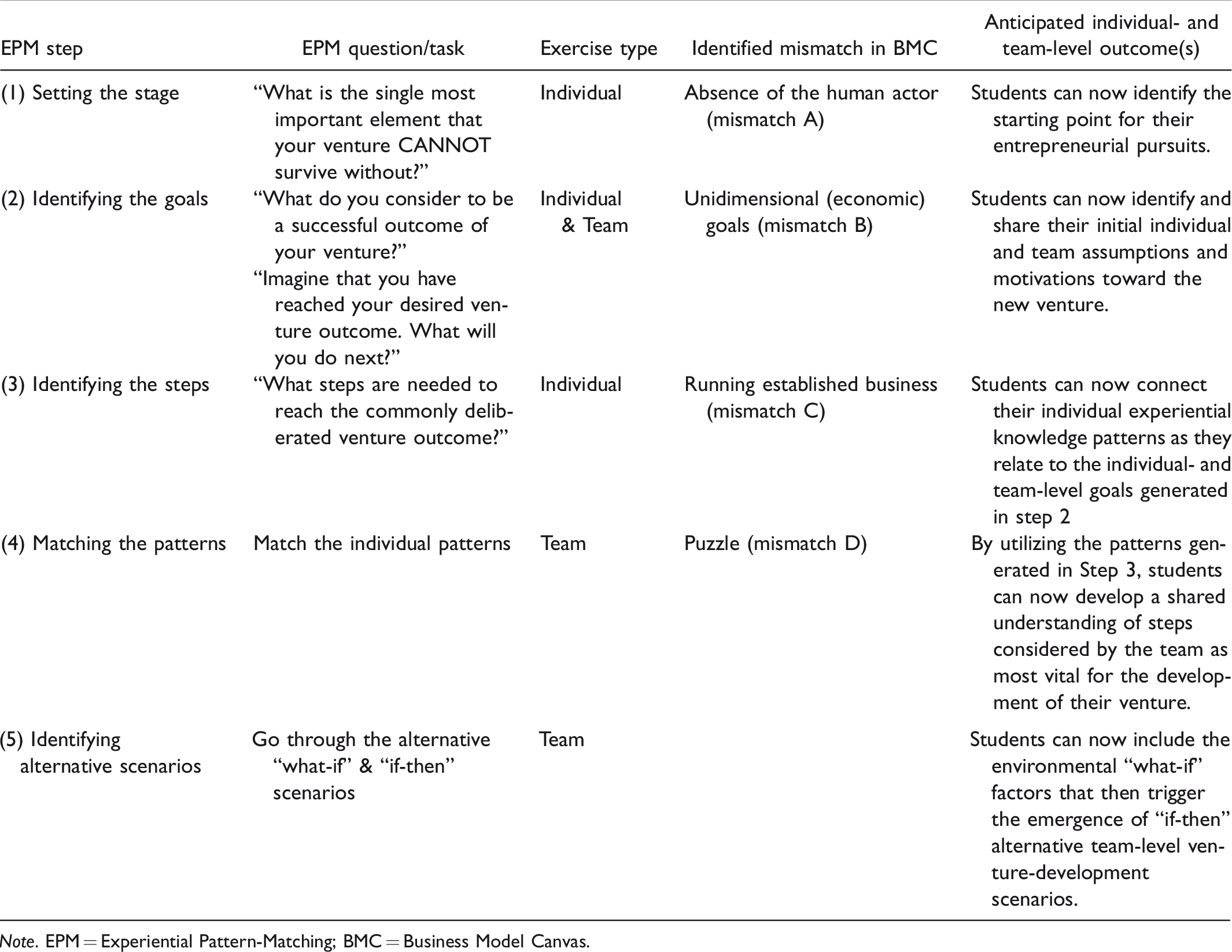
Note. EPM = Experiential Pattern-Matching; BMC = Business Model Canvas.
The ways in which the steps of the EPM relate to the mismatches we identified between the BMC and the early stages of new venture creation process are as follows:
Step 1 addresses the mismatch of the BMC in relation to the absence of the human actor in the early new venture creation process. This first step creates awareness and motivates the concerned individuals and their team to take stock of their fundamental relevance to the venture. Step 2 addresses the incomplete classical economic perspective in relation to new venture process goals and outcomes. This step helps to promote an optimal understanding of individual- and team-level perspectives toward creating a commonly agreed upon goal(s) and their co-contributive imaginations of a possible or many possible outcomes and visions. Step 3 addresses the problematic deployment of the BMC in the context of new early ventures. Ventures in the idea-to-business model stage might not be able to apply the same business model strategies as those implemented in mature organizations. To address this challenge, our method triggers and activates the unique individual- and team-level experiential knowledge in order to relate these experiences to the openly shared and commonly agreed upon goals identified in Step 2. Steps 4 and 5 address the multiplicity of the possible alternatives within the BMC. Step 4 prepares the users to concentrate on the action steps they identified as being the most significant toward achieving the common goal(s). Due to the uncertainty of the entrepreneurial process, Step 5 acts as a safeguard allowing our team to pivot and generate alternative action scenarios in the face of emergent changes.
By implementing all the five steps of the EPM, we claim that the team is ready to make use of the insights from Osterwalder’s book and other business modeling literature to supplement and advance their joint venture-development patterns. We can expect Harry, Larry, and Sally to be much more familiar with their individual- and team-level stocks of experiential knowledge and the combinations of possible action patterns. At this stage, the team is able to take full advantage of extraneous business models and tools to complement rather than to supplant their individual and team inputs. We now propose a Framework where we clearly position the EPM method into the overall new venture creation process in educational settings.
Discussion
Entrepreneurship education continues its quest to differentiate itself from other business subjects. However, EE pedagogy remains reliant on classical economic and management theory—modified to suit the context of new venture creation. Recently, calls have emerged for a more critical stance toward adopted concepts in EE.
In order to tackle these knowledge problems, we subject the BMC—one of the most popular management-inspired learning tools—to a close scrutiny; and we unveil its shortcomings as it relates to the process of becoming. We identify the following challenges in using the BMC in EE new venture creation modules: (a) Absence of the human actor, (b) Unidimensional (economic) goals, (c) BMC as tool designed for established businesses, and (d) the BMC as a puzzle, too complex for planning early-stage new business ventures.
To address these challenges, we developed a novel EPM teaching method. Anchored in the dual-process discussion in psychology, the EPM method provides entrepreneurship educators with the means to better match the individual and team experiences and aspirations of students with the inherently experiential nature of the new venture creation process.
Based on our early empirical findings, we suggest that the EPM method (a) invokes curiosity about—and sparks communication surrounding—the underlying individual and team motivations for the entrepreneurial pursuit, (b) provides a frame for the entrepreneurial team to construct an action plan that incorporates each team member’s personal experience, (c) helps to identify salient team-level steps toward goal achievement in a visual and action-oriented manner, (d) supports and clarifies the process of role distribution, and (e) encourages reflexivity and resilience through the generation of alternative venture-development scenarios. In addition, the EPM method (f) enhances individual- and group-level sense of belongingness, inclusiveness, and mutual interest, (g) enables the students to recognize the contributive interdependence of their personal experiential knowledge and assists them to develop a common action pattern toward their venture related goal(s) and individual aspirations. Furthermore, the method (h) helps to identify the gaps in team knowledge and possible misalignments between the goals and aspirations within the team, thus providing a basis for a reflective elaboration of these issues. Lastly, it (i) empowers students to reflect on the impact their venture-creation experience might have on their lives by creating a link between venture-related goals and their individual aspirations.
We now propose a Framework that displays the vibrant interaction between the EPM method and current mainstream EE tools traditionally deployed during the new venture creation process. We claim that this Framework is a key theoretical contribution to EE literature because it addresses our knowledge gap surrounding the little known interaction between experiential and analytical cognitions—or in the words of Morris and Liguori (2016, p. xix) “the confluence of unreasonable thinking and focused discipline”—throughout the educative new venture creation experience. It also fulfills calls within EE research (Berglund et al., 2018; Fayolle, 2013; Morris & Liguori, 2016) to propose substantive advancements to existing methods of teaching entrepreneurship.
Specifically, the Framework (see Figure 1) fulfills two functions within the new venture creation process in educational settings: (I) it positions the EPM method as an essential precursor and complementor to analytical EE tools (e.g., BMC) and (II) it serves as a troubleshooter to the main educational new venture creation phases of ideation, planning, and implementation (Neck & Greene, 2011; Rideout & Gray, 2013).
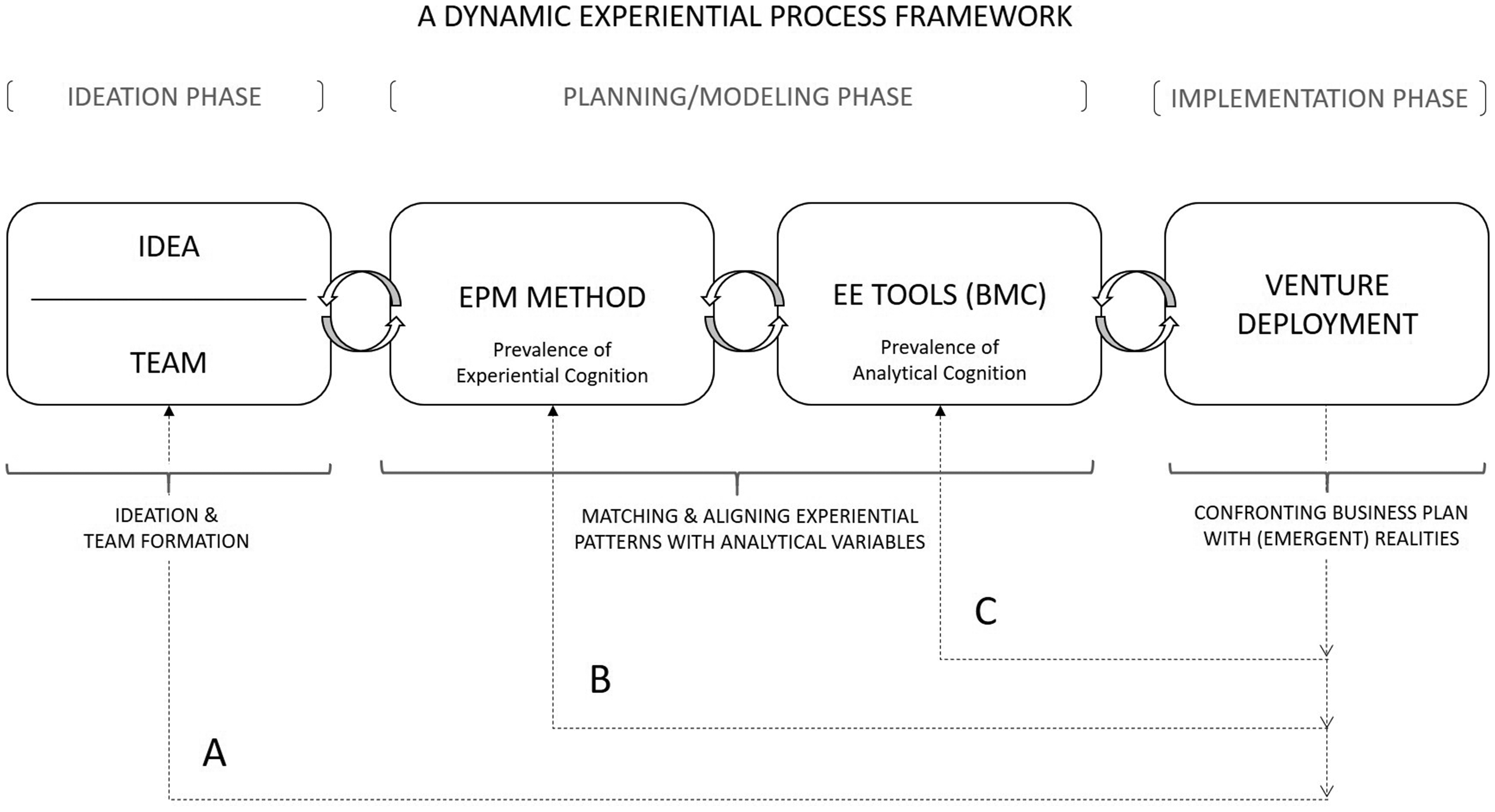
A Dynamic Experiential Process Framework. EPM = Experiential Pattern-Matching; EE = entrepreneurship education.
Function I: EPM Method as a Precursor and Complementor Within the Framework
One of the main features of this Framework is that it positions the EPM method prior to traditional analytical EE tools. As discussed in the earlier sections, existing analytical EE tools are, alone, insufficient in capitalizing on the individual and team experiential stock of knowledge. The EPM method fills this gap by enabling its users to recognize the contributive interdependence of their personal experiential knowledge and allows them to develop a commonly agreed action pattern toward their shared goal(s). Furthermore, the EPM method empowers its users to reflect on the effect that their venture creation experience might have on their lives by creating a link between their venture-related goals and their individual aspirations. Moreover, the EPM method design provides a frame to capture individual experiential input, and team-level interaction patterns in a systematic and replicable manner.
Function II: Dynamic Experiential Framework as a Troubleshooter
In its troubleshooting function (see recursive arrows denoted by A, B, and C in Figure 1), the Framework supports the EE venture team in responding to (emergent) changes—whether internal or external to the venture or to the team. Drawing on the case of our thought experiment, we discuss below three hypothetical instances of how the Framework could enable new venture teams to make sense—and take better advantage—of the experiential patterns and analytical variables unique to each team and venture. Because of venture and team uniqueness, we make no absolute claims about how the users could implement the Framework, but, instead, we suggest the Framework as a navigation guide and as a way of untangling the structured and unstructured aspects of the entrepreneurial process.
In Scenario A, Harry, Larry, and Sally might realize that their exact idea has already been successfully implemented by others, and there is little—if any—additional value they could add to it at this point of time. In this instance, we advise our trio to go back to the drawing board with the purpose of rethinking and realigning all aspects of the venture: idea, goals, and team composition.
In Scenario B, our student team may have lost (or gained) a team member—thus altering the team-level entente to a point where a realignment is needed. In the case where Larry suddenly decides to drop out of the venture, we recommend that Harry and Sally repeat the EPM process in order to reassess the combined stock of their individual experiential knowledge and to readjust the role division between them. This might even lead Harry and Sally to critically assess whether they must seek out one (or more) team member(s).
In Scenario C, an external influence may push the team members to rethink their emergent business plan. In one such instance, a potential angel investor decides to withdraw a minor financial pledge she had previously made to the venture. Our trio views this as an unsubstantial externality and believes that the venture can still move forward with their initial idea and action plan, however, with some adjustments (i.e., search for a more cost-efficient subcontractor, or any other type of change in the venture’s cost structure). In this scenario, we suggest that they revise the BMC in light of this emergent externality. Conversely, the team could perceive an externality as substantial—such as losing a major financial pledge from a potential angel investor. Without this money, Harry, Larry, and Sally cannot meet the original budget they set for an essential customer payment feature of their food delivery mobile app. If the team concludes that this threatens the viability of their venture, we recommend that they repeat the entire Framework (Scenario A).
Conclusion
Calls have been made within the EE community to uncover new experiential learning-based methods and incorporate them into EE curricula. This is important because today’s entrepreneurship pedagogy still draws mainly on classical economic and management theories that—alone—are insufficient to address the dynamic nature of the new venture creation process.
We respond to these calls through a critical review of one of the most popular EE tools—the BMC and we explain how it can be at odds with the experiential nature of the process of becoming. We propose the EPM as a novel and native EE teaching method that informs a Framework for entrepreneurship educators to constructively guide and trace the individual and team-based experiential learning during the initial stages of new venture creation process. The EPM method builds on insights from psychology’s dual-process discussion. It does not aim to replace the BMC and similar EE tools; instead, it serves as a precursor and complementor to such tools at the start of the new venture creation educational experience. We suggest that once student teams implement the EPM method, they will be better prepared to discuss and justify their choices as they relate to the various dimensions of their business plan. Later, student teams could use the EPM method iteratively, periodically, or as (emergent) changes materialize whether internal or external to the new venture. We claim that the EPM method is adaptable, replicable, and traceable, and that it is agnostic to culture, age, gender, and level of education. It could also provide a means to facilitate and capture individual input as well as the temporal nature of team evolution and dynamics in a systematic and repeatable manner. However, large-scale empirical work is needed to validate our claims.
Furthermore, we integrate the EPM method into a Framework that provides entrepreneurship scholars and educators with a deeper understanding of the role the EPM method could play in EE curricula throughout the different phases of new venture creation.
We, therefore, take this opportunity to call on the readers of the Entrepreneurship Education & Pedagogy journal, as well as the broader EE community, to join us in undertaking a sizeable empirical study in the aim of validating the EPM method. We propose that empirical evidence gathered through joint large-scale, multimethod studies is likely to provide the EE community with further insights on the benefits and applicability of the EPM method, as well as its interaction with other classical economic and management tools throughout the distinctive and educative process of new venture creation.
Footnotes
Appendix
List of Osterwalder’s (2004) and Osterwalder & Pigneur’s (2010) Case Companies and Their Founding Years.
Declaration of Conflicting Interests
The author(s) declared no potential conflicts of interest with respect to the research, authorship, and/or publication of this article.
Funding
The author(s) disclosed receipt of the following financial support for the research, authorship, and/or publication of this article: The first author wishes to thank the following funding bodies for their valuable support: Hanken Support Foundation, Niilo Helander's Foundation, Paulo Foundation, Yksityisyrittäjäin säätiö, and Foundation for Economic Education.
