




Abstract
This account of practice focuses on an augmented Customer Development methodology which the author adopted for a module in a Master’s program in Entrepreneurship at a Swedish business school. The article details the techniques underlying this augmented methodology, and the journey toward its implementation. By conceptualizing “hypotheses” as testable statements linking together blocks of the Business Model Canvas, and “assumptions” as students’ assessments of the contents of each block at the outset of the process, the author provides a more pedagogical as well as a more scientifically and theoretically consistent model. Its effectiveness was assessed through discussing these changes with students who had recently taken the course prior to the author’s appointment as teacher. Adaptations such as this could provide an effective method for teachers who want to update an existing course, or who have recently been appointed to a new course focusing on practical aspects of entrepreneurship. Alternatively, it could help to inspire teachers who wish to augment course content to draw more on coherent theory building and good scientific practice, as are most often suited to Master’s level studies, but without radically altering the lesson plan, syllabus or reading material.
I received my PhD in Sweden in April 2017 in the subject area of innovation, entrepreneurship and the management of intellectual assets. Five months later I secured a position as a contract lecturer at a Swedish university’s business school. I was employed to teach in two Master of Science programs, one focusing on Innovation Management, the other on Entrepreneurship. The subject matter I was to teach for the duration of my two-year contract was generally aligned with my PhD studies. However, one course stood out in my first year in this role as particularly challenging to take on.
In Spring 2018 I was appointed to teach a course entitled “Methods for Practical Entrepreneurship” (MPE1) 1. This was the first course in the “flagship module” of the Master in Entrepreneurship program, and had recently been extended from a 15 ECTS credit course stretching over two periods to a module containing three 7.5 ECTS credit courses stretching over three periods. While I was teaching only the first of the three, MPE1 would cover the basic approach for the two that came after, MPE2 and MPE3, making it critical for the students in terms of understanding and progression within the module.
The focus of the course was on utilizing aspects of Osterwalder’s Business Model Canvas (Osterwalder, 2004; Osterwalder and Pigneur, 2010), along with the Customer Development (Blank and Dorf, 2012) and Lean Startup (Ries, 2011) methodologies, 1 to give students a glimpse of the “real world” of entrepreneurship within their studies. These related methodologies are widely accepted and widely practiced by business schools around the world, especially in the USA (cf. Felin et al., 2019). The course consisted of several teams of students working with “idea providers,” who were most often entrepreneurs residing at the university’s business incubator.
The primary learning objective (Anderson and Krathwohl, 2001) involves knowledge and understanding, in this case by demonstrating the ability to utilize theoretical knowledge and hands-on tools and methods to address issues related to venture creation and the incubation process. This learning objective combines theory with practice (i.e., hands-on tools and methods) in order to achieve the goals of the course. This combination of theory and practice is well documented as something that is difficult to a balance in the context of entrepreneurship education (Kyrö, 2018), and constituted a major challenge for me as a teacher taking over this course. To elaborate: while preparing for the course and reading through the literature, I noticed many inconsistencies in the treatment of scientific terms such as “theory” and “hypothesis.” This lack of consistency prompted me to alter the delivery and content of the core methods taught in the course. In order for the course to fulfill the standards of a Master of Science program, I felt that change was needed. Indeed, while widely accepted in many entrepreneurship curricula around the world, these Lean Startup methodologies have met with scrutiny in recent literature on management, organization theory and entrepreneurship, not least concerning their use of assumptions and hypotheses (cf. Camuffo et al., 2019; Ladd, 2016, 2019; Leatherbee and Katila, 2020; McDonald and Eisenhardt, 2019).
What follows is an account of how I came to augment the methods taught in the course, and the adjusted the structure of a core assignment that was heavily practice-oriented to be more balanced between theory and practice through a more scientific approach. After reading this account of practice, I am hopeful that entrepreneurship educators, and students, will gain insight, knowledge and understanding concerning the motivations, merits and potential problems involved in augmenting a course’s content to improve its scientific quality. Moreover, researchers may gain insight and understanding about the currently expanding area of theory versus practice in entrepreneurship education, particularly concerning Customer Development and Lean Startup methodologies.
Entrepreneurship education: A balancing act
Entrepreneurship education has become a global phenomenon, and universities have played a large role in its development over the last decades (Fayolle, 2018; Katz, 1994; 2003; Nabi et al., 2017; Pittaway and Cope, 2007). What started as an American business school phenomenon has spread in earnest to the European continent and, while in many ways European entrepreneurship curricula differ, the surge in interest in entrepreneurship education at the policy level has been consistent, as exemplified by legislation and recommendations in the European Union (European Commission, 2002, 2006; Hoppe, 2016; Lackéus, 2015; Landström, 2020). Yet there is a lack of consensus concerning several core components of entrepreneurship education design and process. To some extent, this stems from the ambiguity surrounding what entrepreneurship is, how it should be defined and what the key components of the phenomenon are (Shane and Venkataraman, 2000). Another layer of complexity concerns entrepreneurship education itself: its goals, purpose and design. Much of this complexity is rooted in the dilemma of how to balance theory and practice (Kyrö, 2018; Martin et al., 2013; Zaring et al., 2019). While entrepreneurship education has largely been practice-oriented (Hägg and Gabrielsson, 2020), recent studies have shown that entrepreneurs who test their ideas more scientifically often create better performing ventures (Camuffo et al., 2019; Leatherbee and Katila, 2020; McDonald and Eisenhardt, 2019). Much of this comparative success is attributed to the founders employing a more balanced approach to theory and practice (Felin et al., 2019)
The module
The MPE module is preceded by a course entitled “Assessing Entrepreneurial Ideas”, (AEI), during which students are given two external projects from the university business incubator. These projects are screened by the incubator’s business coaches, along with several teachers from the Master’s program, to ensure a good fit with the course in terms of theory, practice and pedagogy. This approach has much in common with accounts in the literature on surrogate entrepreneurship in incubators (Lundkvist, 2014). During AEI, students evaluate ideas and ventures in terms of key resources, stakeholders, and opportunity identification and exploitation. This evaluation also may include financial assessment as well as an assessment of the value of intellectual property, both tangible and intangible.
Following AEI, students select one of the two ideas for the course MPE1. During MPE1, they learn the Customer Development methodology in the context of the Business Model Canvas. 2
The latter is a tool developed by Osterwalder (2004) which acts as a sketchpad for entrepreneurs to experiment with and test different aspects of their evolving business model. It includes nine boxes to fill in: key partners, key activities, key resources, value propositions, customer relationships, channels, customer segments, cost structure and revenue streams.
Following MPE1, students are given a choice for how to proceed into MPE2 and MPE3: 1) they may continue working on the idea from MPE1, or 2) they may submit their own business idea for evaluation. Regardless of which option is chosen, they continue to apply the Customer Development methodology learned in MPE1 for the duration of MPE2 and MPE3. This constitutes the backbone of the coursework, while additional modules in the last two courses shift toward a more flexible, topic-based structure. For instance, MPE2 and MPE3 provide a greater focus on team dynamics, the diffusion of innovations and ideas, scenario planning, the importance of networks and other topics such as guerilla marketing strategies, which are integrated into the Customer Development project work that is ongoing throughout.
The problem with the customer development process
The Blank and Dorf Customer Discovery process focuses on four stages: 1) stating a hypothesis, 2) testing a hypothesis, 3) testing a product concept, and 4) verification. This describes an iterative cycle through which the Business Model Canvas blocks can be tested and verified in terms of their fit with the reality facing an entrepreneur or manager. The idea of testing and verifying hypotheses is used repeatedly throughout the Customer Discovery methodology, as well as the closely related Lean Startup methodology. However, both are quite similar in their treatment of the key concepts involved, namely that of hypotheses. [H]ypothesis is just a fancy word for “guess.” (Blank and Dorf, 2012: 156) The precision of argumentation is lost by intermittently referring to guesses, assumptions and hypotheses as being interchangeable. The methodology produces an inconsistent process flow in terms of what is to be tested, and how. The methodology lacks a coherent theoretical approach, which is arguably a necessity if it is to have a place in the curriculum of a higher education institution.
Moreover, further problems become manifest when one tries to apply hypothesis testing to the Business Model Canvas. The Customer Discovery methodology advocates viewing the content of each block of the Business Model Canvas as assumptions, guesses or hypotheses to be tested. While the responses that are often inserted into these blocks may be at times more or less based on established business practice, they may well be mere assumptions if the venture has not developed sufficiently. They are not, however, testable hypotheses, something that is needed for any pivoting process to be validated.
Certainly, there are alternatives in such a situation (of which I was aware at the time). There are a number of actions that could be taken by a teacher taking over a course when that teacher finds that certain aspects are in need of a change. One could go to the course syllabus and redesign it, change the reading, the concepts, etc. There are also other similar concepts that are used in the context of this type of entrepreneurship education that could be applied. 3 However, making a change of this kind can be a lengthy process, and needs to be done far in advance of the delivery of a course. In this instance, I had only a matter of weeks.
The solution: The MPE augmented customer discovery methodology
During previous years of the module, the Customer Discovery methodology had been applied exactly as specified in Blank and Dorf (2012). In the weeks prior to the start of my MPE1 course, I conducted a personal communication with some second-year student representatives who had recently taken the course. They confirmed my suspicions to a degree when they expressed frustration about not understanding what they should be testing, what was known, what was unknown, and how the tests might be performed. After completing the augmented method for use by students (which is discussed below), I went back to the same student representatives to obtain an evaluation of my new design. I first discussed again with them their understanding of the method they had learned, and the role of and difference between hypotheses and assumptions, before demonstrating and contrasting that method with my augmented method. They indicated to me that they believed the augmented method was a positive change for the course.
Thus, in order to clarify the relationships between assumptions, hypotheses and the Business Model Canvas blocks, I decided to “pivot” the conceptual underpinnings of the methodology by changing how this key terminology was used and the type of testing the students would perform on the course.
In my augmented methodology, Business Model Assumptions constitute the initial “filling in” of the Business Model Canvas that matches the first iteration of an idea, or the introductory stage of business modeling occurring in an established organization. This involves filling in all blocks of the Business Model Canvas, as well as the target market size (in accordance with Blank and Dorf, 2012: 69). This is visualized in Figure 1.
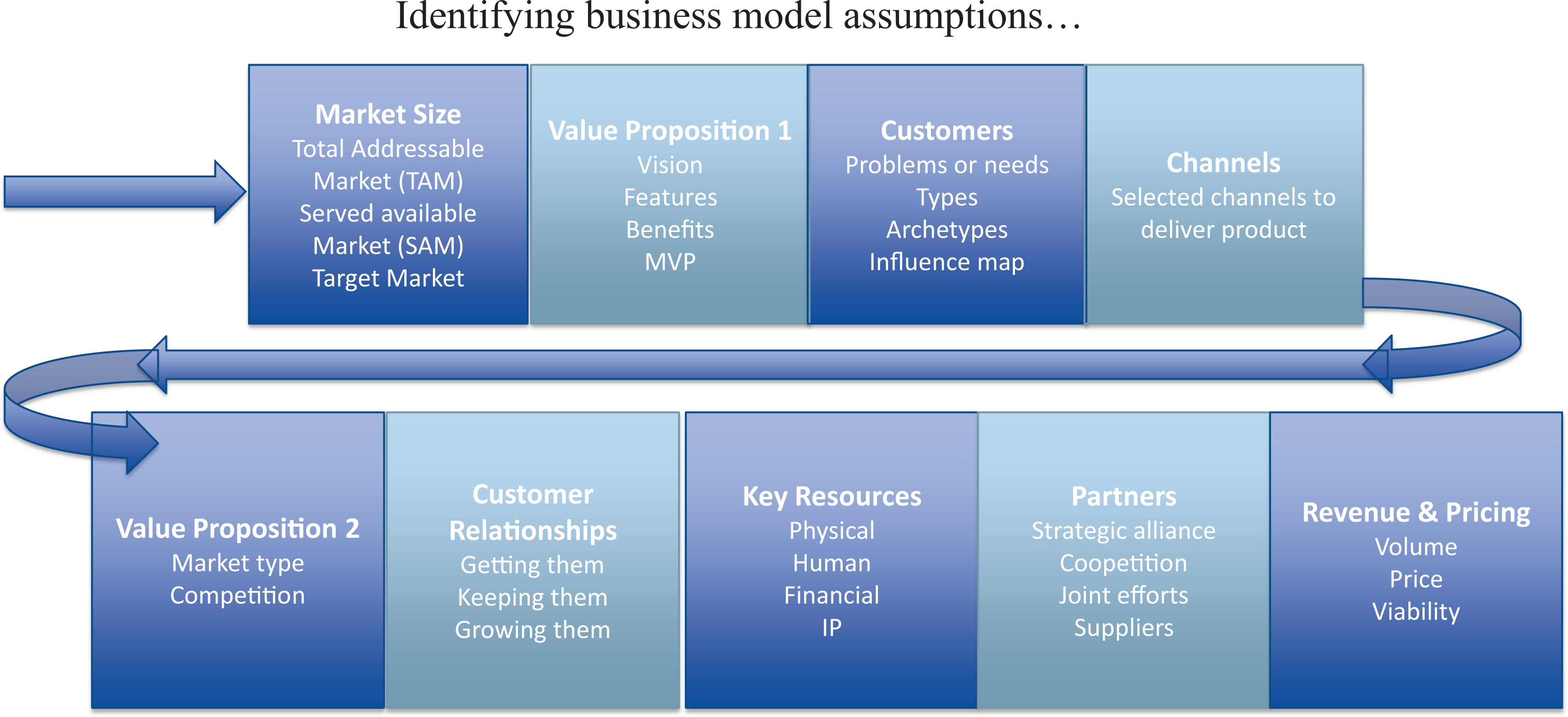
Ordering of blocks, adapted from Blank and Dorf (2012: 69).
The market size estimation (total, served and target) is combined with the Business Model Canvas, as per Blank and Dorf (2012). The “order of operations” for hypothesis testing in Blank and Dorf (2012) is also utilized. This constitutes moving from market size estimation to Value Proposition 1 (vision, features and benefits), then on to the customers, channels, Value Proposition 2 (market type and competition), customer relationships, key resources, key partners, and finally revenue and pricing. The assumptions are simply the students’ estimations of what goes into the blocks of the Canvas. These are based on their own knowledge from discussions with founders (in the case of external idea providers) and educated guesses.
Business Model Hypotheses, on the other hand, are the researchable statements a student makes in order to test and verify the links between the different blocks and segments in the Business Model Canvas. Above all, these must be converted into a testable formulation. Figures 2 and 3 outline the initial steps of such a process and the full cycle.
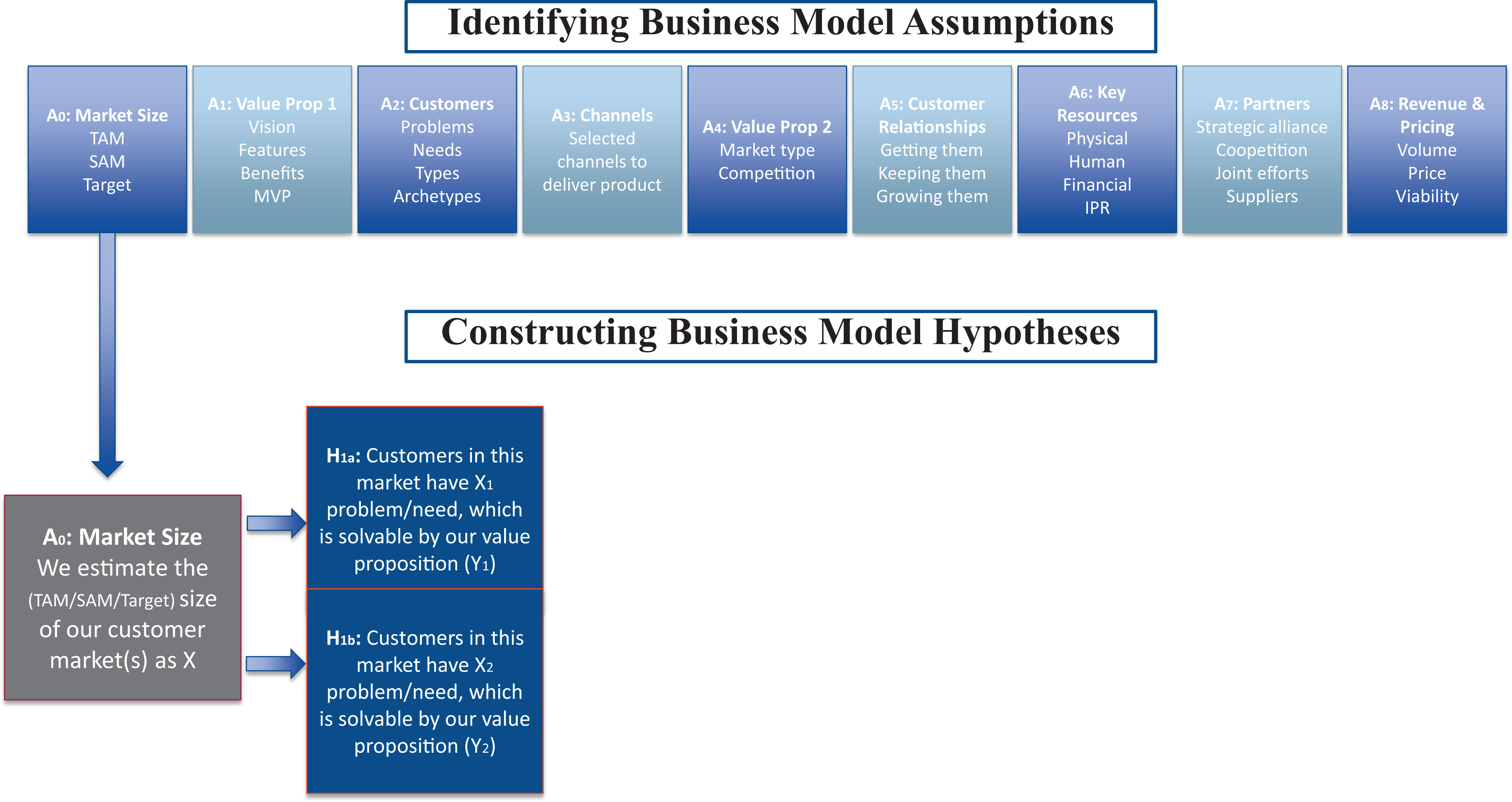
Initial hypothesis development, adapted from Blank and Dorf (2012: 69).
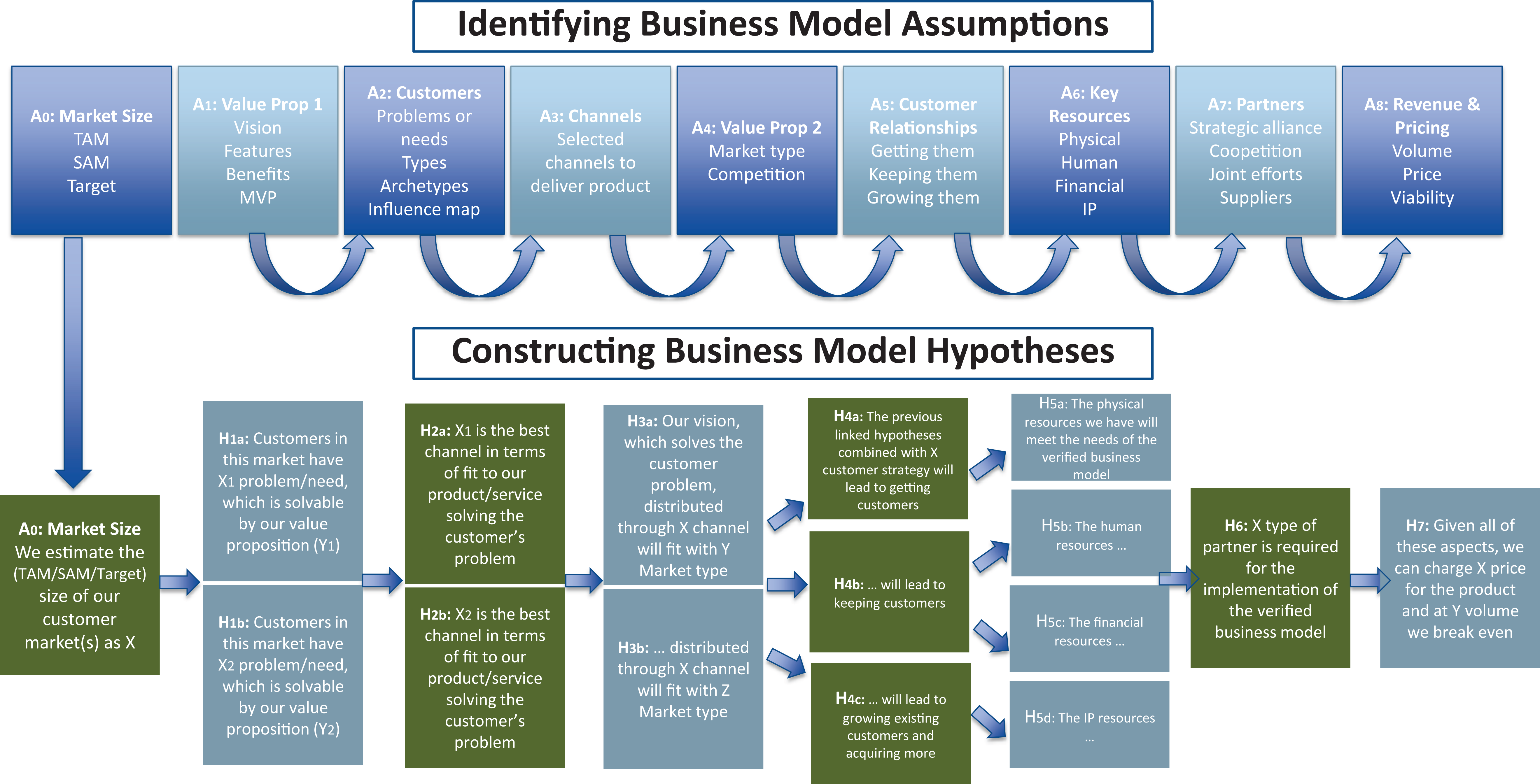
Example of full hypothesis development, adapted from Blank and Dorf (2012: 69).
Moving from top left to top right in Figure 2, one can see the stepwise progression through the different assumptions made about the business using the Canvas. This occurs in the order specified by Blank and Dorf (2012). The lower portion of Figure 2 shows that, given the assumption that the market size has been estimated as what we can call X, one can construct one or more hypotheses about how the market size, given by X, contains customers, who have a problem or need Xn. A testable hypothesis formulation is then given by Hij. This is exemplified as H1a and H1b. The main point of this exercise is that hypotheses in this methodology are not contained within the blocks of the Canvas, but are rather the testable linkages between different blocks; i.e. the proposed effect one might have on the other. This is formulated as the problem or need Xn being solvable by the value proposition Yn.
The augmented method I devised is expandable to all the linked blocks in the Canvas in Figure 3 (signified by the curved arrows), and numerous hypotheses may be generated and tested throughout the Canvas until all linkages have been verified. In my model, each hypothesis that is validated is carried forward to the next block as a baseline assumption. The formulation can be seen most clearly in H4a, “the previous linked hypotheses combined….” What this indicates is that these prior links have been tested and verified by the student, meaning that they may treat the whole chain (in this case H1 → H2 → H3 → H4) as a single independent variable in the latest hypothesis.
Worth noting, however, is that the MPE1 course aims to educate the student on how to use the method, and does not include the objective that all blocks and all hypotheses should be verified by the end of the course, as there is simply not time for this in the 7.5 ETCS course.
The next step in the process is operationalizing the general hypotheses Hij above into falsifiable hypotheses, such that they can make observations and test the outcomes so that:
[A specific repeatable action] will result in [expected measurable outcome]. For example: Of every 100 potential customers interviewed, 20 will experience the problem/need, and will view our value proposition as the solution.
This step is carried out by way of simplified experiments, which are defined in the context of MPE1 as the specific repeatable action above. It may be conducted using surveys, interviews, testing of a minimum viable product and a variety of other student-selected methods.
The verification of the Business Model Canvas comes in overarching stages based on the outcomes of these hypotheses. If a test fails, the students must then pivot as per Blank and Dorf (2012) by either cycling back to an earlier hypothesis in the Canvas, or testing another variant of the hypothesis that failed. Overall, I argue that this process is more structured, and lends itself well to student learning about the Canvas, hypothesis testing, and how to iteratively solve customer discovery challenges.
Recommendations for general practice
The use of hypothesis terminology in entrepreneurship courses in higher education institutions is problematic if it is not well grounded (Ladd, 2016, 2019). I argue that, in the context of higher education, the term hypothesis, and the scientific methodology it represents, is still useful if its use is more consistent with its scientific and statistical application, rather than being equated with a guess. e is more consistent with its scientific and statistical application, rather than being equated with a guess. At the time of implementation of my augmented methodology, it was not possible for me to change the course literature. The result was an augmentation of the popular method that did not alter the use of the particular course material. This augmentation is what has been described in this account of practice.
The main rationale behind this augmented method is that it encourages a heightened degree of scientific practice and understanding regarding the idea of hypothesis testing, with the ultimate aim of creating a more scientifically consistent approach to business model testing and pivoting. While this brand of testing did not at the time stem from any recommendations in literature, 4 I have adapted a method that retains the core message of the Customer Discovery methodology, yet also retains the appropriate theoretical rigor necessary for a course at Master’s level in a higher education institution. For the reasons above, I recommend that practitioners and teachers in entrepreneurship education consider performing a similar modification of the methodology.
In addition, this style of augmentation of a key concept in course literature, which does not involve any major changes to assignments or to the books and articles required for the course, could be ideal for new teachers appointed to an already developed course with some rough edges concerning the fulfillment of learning objectives. It may be especially relevant for teachers who are taking over a course or module temporarily, and are not satisfied with the method used in instruction or how certain concepts are communicated to students. Putting one’s own stamp on the learning material as an educator was important for me in this process, and gave me greater motivation to deliver content to my students that I was not entirely familiar or comfortable with at the outset.
In order to assess or communicate the intentions and expected outcomes of this type of change, my recommendation would be to conduct a debriefing session with students who have taken the course prior to changes, and explain thoroughly what the intended modifications are. This I think is more effective than illustrating for current students (working with the augmented model) how things “used to be done.” Also, current or new students will not have gone through the process and, I would argue, will not be able to reflect on the benefits of an augmented model in the same way as those who were part of the original methodology, since they will not have experienced it first-hand, and therefore will not be able to reflect on the challenges the experience yielded.
By conceptualizing hypotheses as the bridges between the different blocks of the Canvas, rather than being bound within the blocks themselves, students are given a more resilient means of navigating the Customer Discovery process which is so pivotal in the early stages of entrepreneurial design. A recent article by Felin et al. (2019: 5), in which they critically evaluate the Lean Startup and related Customer Discovery methodologies, summarizes my view of what this account of practice describes in action: Our point is not to undermine the power of well-crafted experiments, nor is it to suggest that vast time spent composing theories in some entrepreneurial ivory tower is a fruitful path. Rather, our point is that a well-composed theory elevates the nature and impact of experiments—enabling the composition of critical experiments, experiments that permit unique and clearer conclusions about a startup theory’s merits. Paradoxically, the end result may be faster pivots and, above all, more productive ones.
Potential “pitfalls” to avoid
Finally, it is worth highlighting some areas that may be problematic in implementing this approach. In my experience, the in-class lecture during which I communicated the hypothesis testing for the first time was challenging. While the idea is quite simple, it was hard for some students to grasp the notion of applying an augmented version of a model that they had just recently been introduced to. This especially concerned the information in Figures 2 and 3. The lecturer needs to take time in walking students slowly and pedagogically through the different hypotheses trajectories.
Another caveat is that the more one deviates from the course material, the more one becomes the central figure in ensuring the student’s understanding of the tasks at hand. By augmenting the model, lecturers might inadvertently move the burden of proof from the literature to themselves. This can result in some time inefficiency in ensuring that the students understand and can carry out the coursework in a satisfactory way.
Footnotes
Declaration of conflicting interests
The author(s) declared no potential conflicts of interest with respect to the research, authorship, and/or publication of this article.
Funding
The author(s) disclosed receipt of the following financial support for the research, authorship, and/or publication of this article: This work was supported by the Swedish Research Council under Grant VRDNR 2017-03360.
