




Abstract
Whereas entrepreneurship research has made advancements to establish and distinguish itself as an academic area, entrepreneurship education has developed more modestly. In this article, we introduce the Heptalogical Model as a conceptual foundation for entrepreneurship education, pedagogy, course and program development, and external engagements with entrepreneurial venture partners. The model is the product of years of utilization in the instruction of thousands of learners worldwide by diverse instructors at multiple institutions and application in hundreds of outreach consulting projects with entrepreneurial ventures. Grounded in the conceptual history of entrepreneurship theory and education, the Heptalogical Model offers a distinct approach that is not person or venture-centric. Its logic clarifies how many kinds of entrepreneurs and ventures develop, evolve, and perform in practical ways. The model is amenable to the radical diversities of entrepreneurial phenomena across sectors, industries, and cultures.
Entrepreneurship courses are among the most popular offerings at many business schools worldwide. Yet, despite growing popularity and high practical relevance, entrepreneurship education (EE) has yet to fully distinguish itself conceptually from other disciplines (Neck & Corbett, 2018). In this article, we contribute a conceptual model of entrepreneurship that has strong and distinct utility in EE settings. We refer to the model with Greek derivations hepta and logical because it comprises seven (hepta) principal elements in a systematic array (logical). The Heptalogical Model emerged and developed over the course of 15 years of application in EE settings by many different faculty members at a range of institutions instructing thousands of undergraduate, graduate, and professional students. The mix of environments represents different national and local cultures, delivery modalities, curricular and noncurricular programming, geographic locales, and industry sectors.
Various institutions have utilized the Heptalogical Model. They include a large private American university with a nationally ranked entrepreneurship program founded in the 1980s, where the model served as conceptual foundation of the courses. That institution’s urban identity, major metropolitan presence, and first-generation and immigrant profiles of its students constitute one of the most diverse student bodies in the country. After graduation, a very high proportion of those students become entrepreneurs or join entrepreneurial ventures. The model is also currently utilized for EE in a number of universities in Southeast Asia, including the institution of the third author. As well, the Heptalogical Model has served as the conceptual foundation for entrepreneurship coursework in the graduate program of a Middle Eastern higher educational institution serving MBA students from across the Arab States of the Gulf. That coursework has entailed outreach consulting projects with entrepreneurial ventures in the Kingdom of Bahrain and Saudi Arabia and has yielded several entrepreneurship case studies (e.g., Alawi et al., 2018).
The Heptalogical Model also served as the conceptual foundation of development and delivery of the primary entrepreneurship seminar in the online MBA program at one of America’s largest public universities. The institution in question offered the first fully-online MBA program at a Carnegie R1 institution. The first run of the course served 252 degree-seeking students worldwide, including medical doctors, lawyers, retired military officers, and a host of different entrepreneurs. The model has since been offered online via the institution’s online learning partner and has attracted thousands of learners worldwide. The model has guided workshops, courses, and hundreds of team consulting projects in higher education settings across industry sectors and strategic orientations. Finally, the model currently serves as the conceptual foundation for an undergraduate major and graduate program at a large public university in the Southeastern United States.
The purpose of this article is to introduce the Heptalogical Model as a conceptual foundation for EE settings. Compared with competing models, its framework has distinct features that have emerged from a substantial track record of EE application and impact. These features enable the model to resolve some important problems facing EE. First, it is extremely adaptable in its application. It can be innovated upon and applied in very different ways that are appropriate and effective in different local contexts. Second, it has a deep conceptual grounding that is unique to the entrepreneurship area but applicable to many different practical cases. Finally, the Heptalogical Model does not implicitly or explicitly typecast entrepreneurs or stipulate what individual entrepreneurs or ventures should do. It assumes no meaningful or reliable ranges for those variables. Thus, the model is minimally prescriptive and it is amenable to the radically uncertain novelties of entrepreneurship.
In what follows, we offer a brief historic illustration of EE in university and other settings, introduce the framework of the Heptalogical Model, undertake an intensive examination of its seven stages, and finally, summarize its principal implications and contributions.
Historical Background
As a topic of higher business education in colleges and universities, entrepreneurship is relatively new. The first seminars on small business management and entrepreneurship appeared in American universities in the late 1940s and early 1950s (Cooper, 2003; Landström, 2005). Myles Mace developed the first entrepreneurship course at Harvard Business School in 1946 to 1947, entitled The Management of New Enterprises, which is still a foundation of the curriculum. In the early 1950s, Peter Drucker developed the first entrepreneurship course at New York University. These two courses were the bellwethers of a long expansion in EE in the second half of the 20th century (Cooper, 2003; Katz, 2003; Kuratko & Morris, 2017; Landström, 2005; Murphy, Liao, & Welsch, 2006; Vesper, 1985). In the early 1970s, the University of Southern California offered the first entrepreneurship concentration. A few years later, Babson College made entrepreneurship a core offering across all of its programs.
Student and donor interests in EE have grown along these innovative foundational lines over the decades, and those interests remain strong today. In the past 50 years alone, the number of entrepreneurship degree programs in U.S. colleges and universities has increased fivefold, and the number of entrepreneurship classes has increased 20-fold (Morelix, 2015). The interest has extended more recently to high schools, which are the key channel partners of universities and function effectively as suppliers of students. In 2009, there were 19 high school systems in the United States with EE guidelines and five systems with curricula that included required entrepreneurship courses. Six years later, those numbers had increased to 42 and 18, respectively (Junior Achievement, 2015). Moreover, with the advent of highly innovative online learning platforms such as Coursera, Khan Academy, and others, EE is no longer limited to university settings. The area of EE is poised for continued growth and relevance.
Apace of these historic developments, much has changed in practical and conceptual terms since the 1940s. The population of individuals who choose to become entrepreneurs and therefore enter higher education programs is tremendously diverse, at least compared with the level of student diversity in earlier years. The varying worldviews and cultures heralded by this diversity affects sensemaking profoundly in entrepreneurial settings. As well, entrepreneurial ventures regularly adopt a range of different technology-enabled structures and operational processes to make impact in different environments in new ways that were not previously possible. The stages through which entrepreneurial ventures evolve are understood from a greater number of different perspectives, compared with the era in which Mace and Drucker offered their foundational seminars. These kinds of historic developments have influenced the conceptualization of entrepreneurship. In turn, the evolving conceptualizations of entrepreneurship have influenced its history and pedagogy over the decades.
Thousands of universities and learning organizations around the world offer tens of thousands of entrepreneurship courses and programs. This milieu of activity reflects the diverse needs of innumerable individuals, organizations, communities, and markets. Like any topic area, entrepreneurship is challenging to teach across such a rich spectrum of settings. Thus, it is important for EE to utilize a generalizable conceptual foundation to help explain concepts reliably and effectively.
Conceptual Background and Review of Model Stages
The Heptalogical Model (see Figure 1) complements and synthesizes many of the influential conceptual frameworks that have historically informed EE (Afuah, 2014; Neck & Corbett, 2018; Osterwalder & Pigneur, 2010; Ries, 2011; Sarasvathy, 2001; Shane & Eckhardt, 2003; Stevenson & Jarillo, 1990; Timmons, 1994). The overarching EE paradigm that has emerged from this field offers rich illustrations of how individuals behave and how firms operate when they undertake entrepreneurial activity. The basic elements of the paradigm include individuals, ventures, and environments. The principal components are opportunities, resources, teams, customers, and the relations among them. A level of functional balance between these elements is important, and the balance is governed by behaviors entailing creativity, communication, and leadership by founders and founding teams. This functional state drives better venture performance and higher levels of innovation activity based on individual and firm-level actions, which are guided by a level of vision that goes beyond the limited and alienable resources currently possessed.
The Heptalogical Model extends this overarching paradigm by also acknowledging the importance of the unlimited and inalienable resources one does not currently possess. Resources, individuals, and teams are still germane to all seven stages. Yet, so are knowledge, experience, values, and talent. The model also reframes and redefines key elements (e.g., opportunities and customers) to better accommodate the generation of different value denominations (i.e., economic, social, and natural). Its conceptualization recognizes that entrepreneurial ventures are especially dynamic organizations. Thus, there are no standard forms of creativity, communication, or leadership that will always have the same effect on entrepreneurial performance. In fact, balance is not always a desirable organizational state because, in entrepreneurial settings, individual and firm behaviors, resources, and conceptual elements manifest and interrelate differently over time and across settings.
The Heptalogical Model is thus designed for relevance to the many unique ways that different people can and do choose to undertake entrepreneurship. Such diversity calls for a compound definition with two parts. The first part of the definition is the resolving of a social or market problem via a venture concept based on the integration of an idea and an opportunity. The second part of the definition is the mission-based growth and adaptation of a venture concept in the form of an organizational model with a view toward venture development via strategic planning and forecasting. These two definitional parts are based on the distinct logics of uncertainty and risk, which correspond, respectively, to the earlier three stages and the latter four stages of the Heptalogical Model.
In the following sections, we survey the seven stages with a view toward their unique contributions to the whole. The model begins with a social or market problem from which an entrepreneurial opportunity emerges. Then, it distinguishes opportunities from ideas and emphasizes how these two elements interact. The schema of the second and third elements leads to the venture concept, which is a basic transaction illustrating what the venture does as it serves a market or community. The venture concept heralds the second part of the framework and becomes oriented for growth and adaptivity in light of a venture mission. This stage explains not what an entrepreneurial venture does quantitatively, but why the venture does it, and in qualitative terms. In the framework’s sixth step, the model, an entrepreneurial venture evolves and adapts via a diversified cast of transactions. The model’s final stage entails planning and forecasting the future. This stage is where a traditional business plan fits. However, this stage is still compatible with Lean Startup (Ries, 2011) and other approaches that are common among more nascent ventures, where organic adaptation and incremental growth can offset the need for detailed business planning.
The progressive nature of the Heptalogical Model is one of its definitive aspects. The seven stages build on one another such that earlier stages are necessary but not sufficient for ensuing stages to occur. The seven elements each provide unique contributions to the whole with a developmental logic. When errors or failures occur at a given stage, it is attributable to deficiencies at an earlier stage and not to deficiencies at the stage in question. As such, although not drawn in the model for the purpose of parsimony and theoretic simplicity, feedback loops can and do occur at and across all seven stages for error correction and learning. New social or market problems can emerge as a result of activities at any of the model stages and effectively spin off into new venture cases that can also be described by the model. In the following subsections, we illustrate and examine each of the model stages in turn.
Stage I: Social or Market Problem
A principal foundation of epistemology holds that the growth of knowledge and learning are based on the deductive correction of error. In practical terms, problems call for solutions, and effective solutions cannot be developed without first having problems (Popper, 1965, p. 222). Problems precede solutions. Ancillary errors and problems emerge from effective solutions, which account in turn for more discoveries of still newer errors and problems. Therefore, learning occurs via the active correction of error. This logic takes the form of conjecture and refutation, or trial and error, and it helps explain the learning and creative activities of artists, scientists, and scholars. The functional role of error applies to the activities of entrepreneurs as they engage uncertain environments via attempts to grow resources, adapt, and make an impact (Schumpeter, 1942). In this way, entrepreneurship starts with problems and active attempts to resolve them.
Stage I of the Heptalogical Model thus describes contexts in which individuals perceive problems and inefficiencies. It is not necessary for the perception of a problem to be universal, as perceptions can vary widely across diverse perspectives and contexts. Indeed, what some people define as a problem may not be a problem for others. However, the requirement is for some people—the more people the better—to perceive a problem. This stage makes for interesting learning outcomes, because many aspiring entrepreneurs think first about cases of success, not problems and failures, when considering launching a new venture. It is important not only to study cases of successful ventures but also to examine ones in which ventures have failed. Once students realize that problems come first, and the attempt to create solutions comes second, it can have a powerful effect on how they understand entrepreneurship. It can change how they think about where and how to launch a new entrepreneurial venture. For aspiring entrepreneurs, it can drive a paradigmatic shift away from selling solutions and toward fixing problems. 1
There are many ways to discuss social and market problems. At a macrolevel, periods of economic blight and postdisaster regional recovery have always been accompanied by surges in entrepreneurial activity. The U. S. Great Depression in the 1930s was one of the most intense periods of new venture formation rates in the nation’s history. When the city of Chicago was largely destroyed by fire in 1871, what followed was a famous period of intense entrepreneurial activity. 2 The same principle applies to the aftermath of the Japan Tōhoku earthquake and tsunami in 2011, which was followed by unprecedented levels of social enterprise activity. In studying poverty solutions in the Yiwu region of China, Wu and Si (2018) described how the inefficiencies of the socioeconomic structure generate many opportunities for entrepreneurs seek creative solutions to problems. Indeed, the problems of poverty, poor education, and high crime rates in communities generate opportunities for social entrepreneurial activity, just as market-based inefficiencies generate opportunities for more traditional entrepreneurship. The Heptalogical Model aligns with this principle across cultural settings and other kinds of contextual boundaries.
At a microlevel, entrepreneurial activity also begins with problems. For example, innovations as basic as mobile telephone protective covers are designed to resolve the problem of fragile devices breaking when they are dropped. The firms that produce the protective covers are usually not the same firms that produce the mobile telephones. However, those firms still made those entrepreneurial discoveries based on a problem. One simple way to explain this Stage I of the model to students is to describe a piece of furniture, such as a chair or a table, that is unstable and wobbly. One can sense a problem, but one does not yet know the source of that problem. Therefore, one has not yet recognized an opportunity to do something about the problem. The source of the problem may be a loose bracket, uneven fittings, glue that lost its adhesion, a protruding nail or screw, or something else. Not until one identifies the source(s) of the problem can one begin to recognize an opportunity to fix the problem with novel ideas and approaches. Stages I and II convey this principle, which describes entrepreneurial discovery in logical terms (Murphy, 2011).
It is worth emphasizing that a problem may not be perceived in the same way universally. For some perceivers, a given problem setting may be unproblematic. It is important that the perception is a shared experience; a number of people should perceive the problem. As one reviewer of this article pointed out, for some people it would be a stretch to regard an ice cream shop as an entrepreneurial venture that solves an important problem. To be sure, not everyone sees ice cream shops as a solving legitimate, important problems. However, some people do. What matters here is that the desire for ice cream, or the unfulfilled need for an experience involving ice cream, is shared by a number of people. As a precursor of opportunity, the greater the number of people who perceive such a problem the better.
The subjective and social aspects of Stage I have a special kind of harmony with Stage V (mission) because both of these elements relate to an underlying and original purpose. In the Heptalogical Model, this association is indicated by the stages being depicted with the exact same shape. During lectures, the link is worth foreshadowing when describing Stage I. The narrative information that is instrumental to educating others about a social or market problem is almost identical in character to the qualitative information that effectively conveys a venture’s mission.
At Stage I, problems underlie the opportunities (Stage II) that are necessary, but not sufficient, for the formulation of new ideas (Stage III). Problems are germane to the errors that yield opportunities to formulate ideas and create value. Indeed, errors can function as a discovery engine when the costs associated with them are bounded (McGrath, 1999). The Heptalogical Model holds that entrepreneurship begins with problems, no matter if the context is economic, social, or natural. There is an unlimited range of microlevel problems in all kinds of macrolevel social and market settings. Entrepreneurship is a constructive response to these aspects of those settings.
Stages II and III: Opportunities and Ideas
The next two stages of the framework, and the interaction between them, are especially vital and fundamental parts of the Heptalogical Model. Failure to delineate these two stages and differentiate them from one another has been described as one of the most common reasons entrepreneurial ventures fail (Brooks, 2009, p. 37). The model’s two-part categorization of opportunities and ideas conceptualizes the critical boundaries of early-stage entrepreneurial action. It builds upon and extends the notion of pattern recognition (Baron, 2006) and enabling factors (Davidsson, 2015) in entrepreneurship, while casting opportunities (Stage II) as essential ingredients of entrepreneurship (Shane & Venkataraman, 2000). However, unlike so much research in this paradigm, the Heptalogical Model does not profile types of people or prescribe correct kinds of actions. Instead, it presupposes that entrepreneurship admits an unlimited range of different types of people and actions. The logic holds that many criteria for entrepreneurial venture performance do not yet exist. This existential state is the result of a patently novel level of uniqueness. By the same token, many jobs that today’s entrepreneurship students will eventually occupy or create do not exist. Effectively preparing students for jobs that do not yet exist is one challenge facing higher education. The area of EE embraces that challenge at a level that is definitive.
To this end, it is time for EE to extend its paradigm in distinct new directions. The notion of the relentless pursuit of opportunity “without regard to resources currently controlled” (Stevenson & Jarillo, 1990; Timmons, 1994) leads to the complementary notion of “with regard to resources not currently controlled” (Chell, 2007). Not all entrepreneurial activity is the same. Sometimes the core purpose of entrepreneurship is to prevent certain outcomes from occurring, especially in social enterprise settings. Technologies, concepts, information, and languages exist today that did not exist when earlier models of entrepreneurship were introduced. Entrepreneurs utilize new kinds of resources to facilitate action in powerful ways. Therefore, in some cases, an entrepreneur does not control certain resources but can still benefit from them, or find it necessary to abide by them. Entrepreneurship is a domain of tremendous practical diversities, and Stages II and III of the Heptalogical Model align with these distinct aspects.
When an entrepreneur senses a problem in a market or social setting, he or she does not immediately understand the full source of that problem. At first blush, it is more of a subjective hunch than an objective experience. However, experience with the problem over time enables him or her to begin to detect certain reliable empirical aspects of the problem. These empirical aspects are merely parts of the problem; often peripheral in relation, and always an incomplete sampling of the whole context. There is no standard formula for the nature of these elements. What defines them is merely that they are empirically reliable and can be ascertained similarly by different individuals. Moreover, they exist whether someone perceives them or not. They give Stage II of the Heptalogical Model an objective cast and serve as building blocks of opportunity.
These building blocks of opportunity have the character of being disconnected from one another. They serve a functional role as enabling factors (Davidsson, 2015). Therefore, Stage II (see Figure 1) shows three elements (X, Y, and Z) that are external to its boundary. The number of these elements is arbitrary. The point is that they are objectively present but disconnected from one another. What is missing is a novel way to coordinate them. This coordination is a potential means to resolve the underlying problem (Stage I), and it comes from the entrepreneur’s idea (Stage III). Therefore, the elements that make up the opportunity provide an enabling context for the formulation of an entrepreneurial idea.
The Heptalogical Model of Entrepreneurship.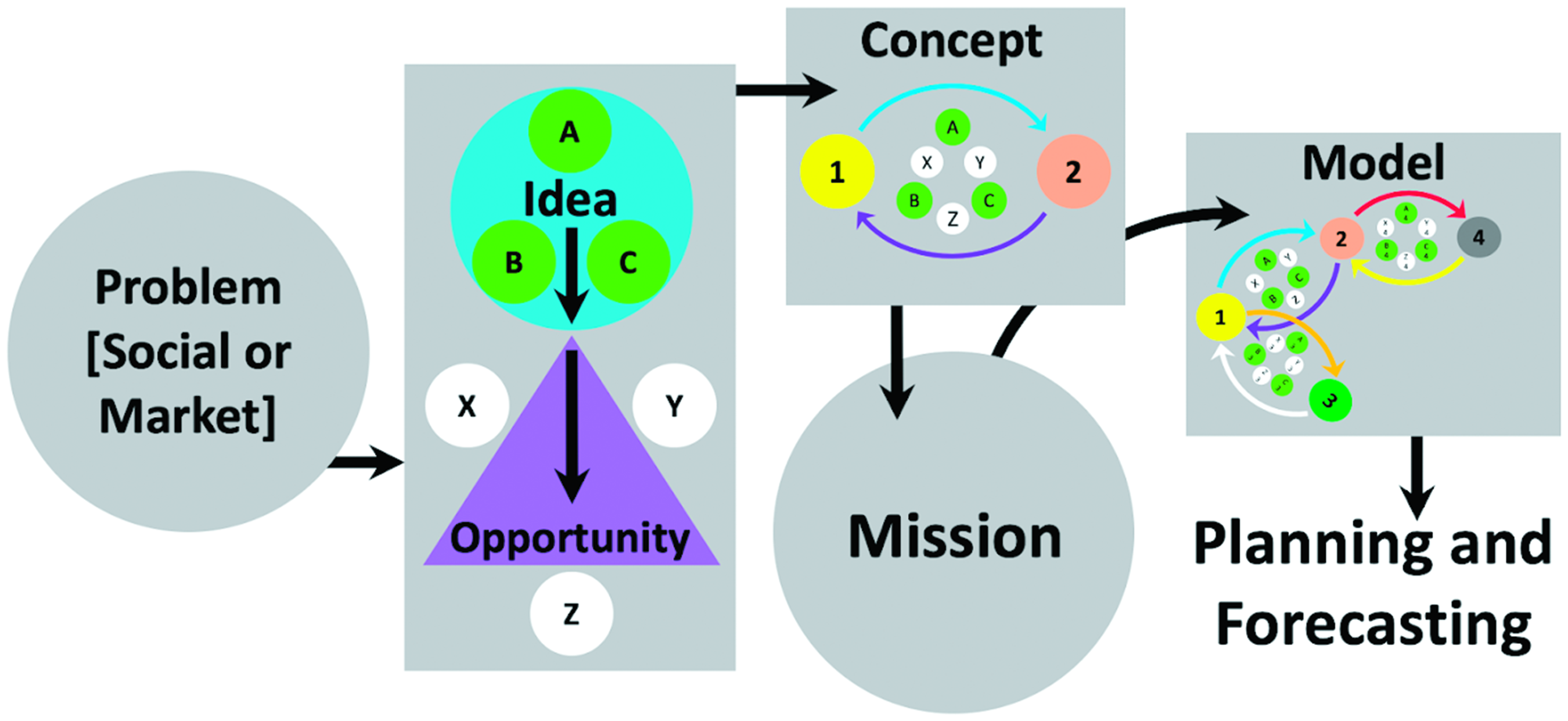
The idea makes up the other part of this nexus. Ideas are ontologically independent of people. As such, the Heptalogical Model features an opportunity-idea nexus, which is different from an opportunity-person nexus (Shane & Eckhardt, 2003). The extension of prior theory generates many pedagogical affordances. For instance, as ideas and people are ontologically independent, it is possible for many different kinds of people to formulate ideas in relation to an opportunity: Bad people can have good ideas; good people can have bad ideas. The emphasis is on ideas, not people, which avoids the conceptual limitations of person-centric views. It also creates greater affordances for communication in entrepreneurial settings, where it can be important to be simultaneously highly critical but wholly impersonal. This method of communication is an important learning outcome for entrepreneurship students.
Keeping with this theme of the Heptalogical Model, the idea (Stage III) is conceptually and sharply opposite from an opportunity in many ways. The objective elements of an opportunity are perceivable by different individuals. By contrast, an idea is initially a highly subjective notion formulated by one individual as a means to coordinate those objective elements. As Stage III illustrates, Elements A, B, and C are depicted internally to the circle, unlike the external positioning of Elements X, Y, and Z around the triangle at Stage II.
Entrepreneurial ideas relate to an opportunity similarly to how supply relates to demand, or how a tool relates to an item in need of repair. The idea effectively fills the gaps between the elements of an opportunity. This integration of idea and opportunity is tantamount to value creation. At this juncture, before moving on, let us consider a detailed practical example for greater definitional clarity.
The case of Calyx and Corolla provides examples of opportunities, ideas, and the interactions between them. Known today as Calyx Flowers, the well-known floral business was examined as an entrepreneurial venture in one of the most famous case studies ever published by Harvard Business School (Salmon & Wylie, 1991). Founder Ruth Owades sensed a problem in the floral industry in the late 1980s. It has always been known in the floral industry that time is an enemy to floral products. The perishability generates dissatisfied customers, necessitates expensive refrigeration systems in shops, and requires costly special delivery services. Owades’ observations of this overall problem eventually led to the identification of an opportunity. The objective and measurable elements of the opportunity included air freight service providers, ground-based distribution systems, flower growers, end users, customers, the telephone system, and the Internet. Those elements existed whether she perceived them or not and could be perceived similarly ways by others. The critical point is that the elements were not coordinated with one another in the context of the larger problem. Stage II represents an opportunity in this way. The elements of opportunity thus set the stage for an idea to coordinate them as a means of resolving the underlying problem.
Owades’ idea was known initially only to her. As such, unlike the opportunity, it was subjective. She envisioned a website service and telephone number that customers could use to place orders. The operators of the website and a telephone call center would utilize a web-based operational network of growers and delivery services to ship flowers to end users. By coordinating the objective elements of the opportunity in this novel way, her subjective idea promised to generate value through efficiency gains that would translate into market value. Unlike the existing industry model, new customer orders would route directly to growers in the operational network. The growers would ship flowers directly to end users via the same operational network. It would thus save operational time and reallocate it to the end-user experiences with the product. Time, as an enemy of the product, was converted into an ally of the business. With growers shipping flowers directly to end users, it would extend the period that end users could enjoy the flowers. Thus, Owades’ idea (Stage III) contributed coordination at Stage II. The result mitigated the effects of time and perishability (Stage I). In Figure 1, Stage III thus depicts the coordinating elements (A, B, and C) which, in this example, were the website, telephone call center, network connections with growers, and delivery services. As will be shown in a later section, this integration is a necessary precursor for the venture concept (Stage IV).
The arrows within the idea-opportunity portion of the model (Stages II and III) are headed in a direction that is opposite to the larger model’s progression. The depiction represents two distinct aspects of entrepreneurial phenomena. First, one tends to bring ideas to opportunities. An opportunity is objective. It tends to precede subjective ideas in entrepreneurial settings. It is natural and realistic that an entrepreneur should bring an idea to an opportunity, and not vice versa. Indeed, there is also an element of “swimming against the current” or “going against the grain” in entrepreneurial settings, suggested by the opposing direction of the arrows. Second, entrepreneurship often embraces the logic of “ready, fire, aim” and the nature of trial-and-error. Failures and errors often occur from the misapplications of new ideas. However, those failures and errors have also resulted unexpectedly in successful entrepreneurial ventures.
Indeed, Stages II and III are conceptually rich. They are the most vital parts of the Heptalogical Model when it comes to entrepreneurial outcomes. Parsing them from the other model stages with a rectangular boundary illustrates their joint dynamic and their importance.
In the Heptalogical Model, opportunities and ideas represent the functional dichotomy of business and creativity in entrepreneurship. Whereas opportunities pertain to measurable aspects of the external environment (business), ideas pertain to the personal and novel aspects of entrepreneurs themselves (creativity). This two-part categorization makes for transformational learning outcomes with undergraduates, MBA students, and international executive seminars across cultures. The primary learning outcome is a better understanding of the distinction between opportunities and ideas and the interrelation among them. The interrelation persists throughout the life of a venture, even to the extent that it can influence future revenues (external or sales or opportunity) and costs (internal or development or idea). Maintaining conceptual relevance across model stages is important because it helps resolve knotty issues incurred by entrepreneurial ventures. For example, the causes of financial troubles in entrepreneurial ventures can be very hard to diagnose definitively. Are they due to high costs or low revenues? From both? It is usually an impossible question ex post because it is impossible to prove that costs have been minimized, or that revenues have been maximized. Stages II and III contribute an ex ante foundation for describing these important aspects of growth-laden entrepreneurial phenomena.
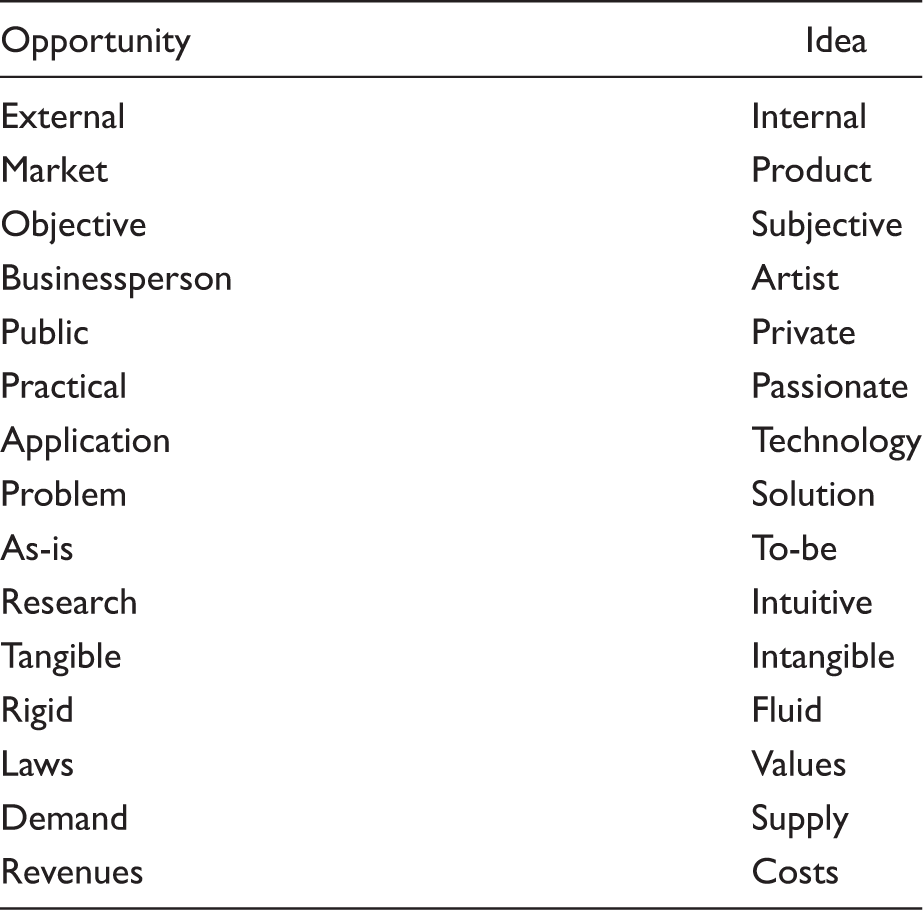
This part of the Heptalogical Model also offers pedagogical affordances. In classroom or online learning settings, presenting Opportunity and Idea as two columns to students makes for an engaging brainstorming exercise. Students can identify many possible word-pair elements that fit each category in metaphorical ways. It stimulates an engaging discussion that yields a deep understanding of the interrelation between Stages II and III. Table 1 presents a typical result of the exercise. The items in the opportunity column tend to be external and objective, whereas the items in the idea column tend to be internal and subjective. In each row, the paired items yield conceptual opposites. Figure 2 shows actual whiteboard results of the exercise from an entrepreneurship seminar, which took place during a two-part lecture focusing on opportunities and ideas.
3
Actual whiteboard from in-class discussion of Stages II and III of the Heptalogical Model in an MBA entrepreneurship seminar. Typical Results of a Brainstorming Exercise and Discussion of Stages II and III of the Heptalogical Model.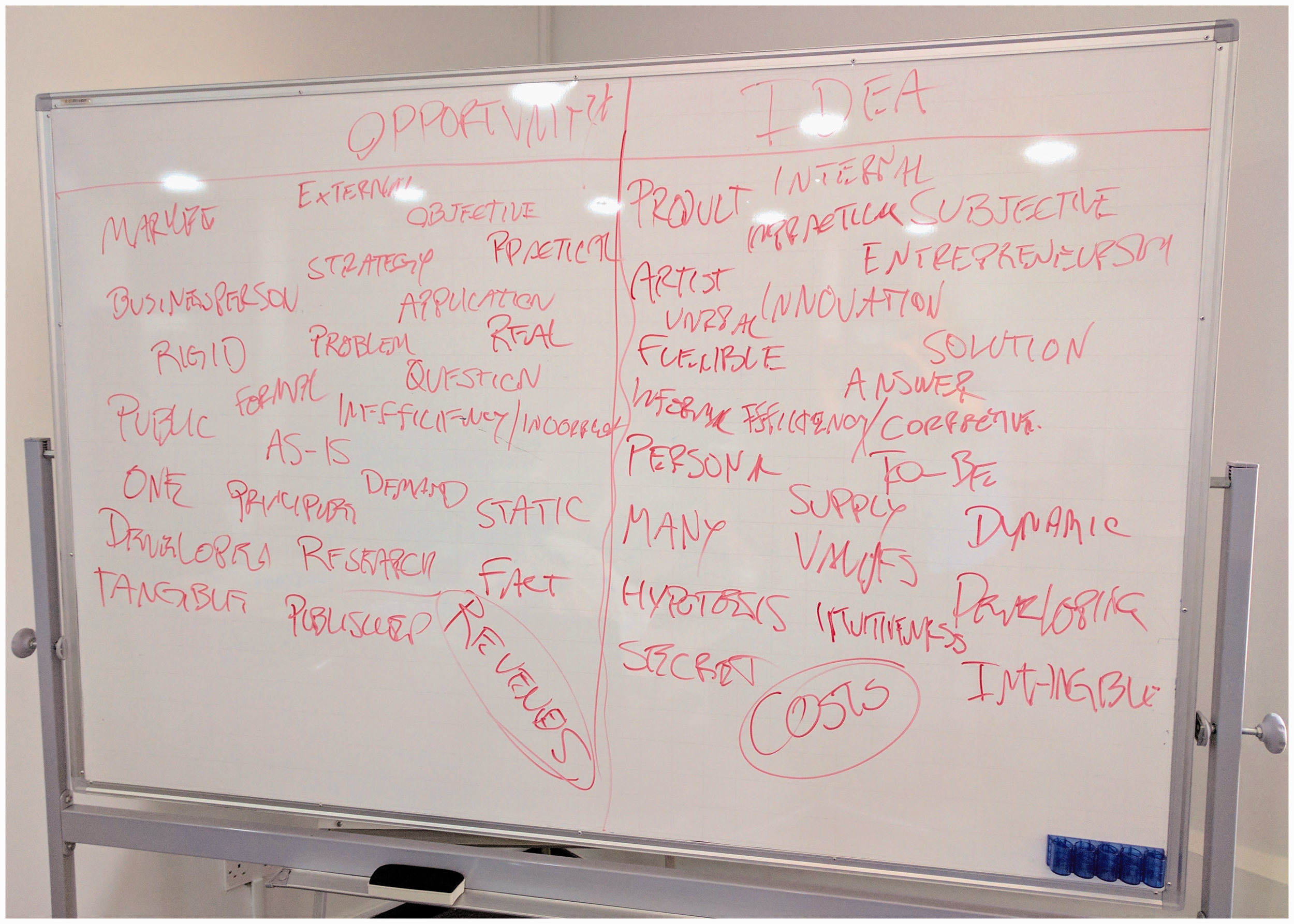
Stage IV: Concept
With a defined opportunity and a formulated idea, it becomes straightforward to begin thinking about what an entrepreneurial venture will actually do to generate value in a highly specific context. Stage IV of the Heptalogical Model shows the concept of how an entrepreneurial venture generates value, makes money, or makes social impact. It is the underlying mechanism by which a venture serves a market or constituency. It involves a core transaction and a feedback loop around the integrated elements of the opportunity and the idea. At Stage IV as shown in Figure 1, the “1” and “2” indicators are arbitrary and merely represent parties to the transaction. One of those parties is the entrepreneurial venture. The other one represents constituents, customers, or other partners necessary for the basic transaction. Stage IV describes how the venture serves its market or social environment along and what the venture receives in return. In other words, it describes what the specific venture does and how it generates value. When applied to a venture case, Stage IV is case specific. It allows for great operational diversity and does not prescribe how operations should be carried out in a general sense.
Once an entrepreneur or an entrepreneurial team has identified an opportunity in the environment and developed an idea about what to do in relation to it at Stages II and III, then Stage IV becomes clearer. As illustrated earlier, an idea is formulated in creative response to gaps that exist between elements of an opportunity with a view toward innovative applications. This dynamic interaction forms a venture concept that represents the union of opportunity and idea. As shown in Figure 1, this stage of the model shows a transaction between two parties around the unified elements (i.e., X, A, Y, B, Z, and C) of Stages II and III.
Stage IV is amenable with the most popular practical tools for entrepreneurs. Two examples are the Business Model Canvas (Osterwalder & Pigneur, 2010) and Afuah’s (2014) Business Model Innovation approach. Just as Stage IV integrates internal or subjective elements of Stage III and external or objective elements of Stage II, these practical tools make similar internal and external integrations between capabilities or market segments, resources or customers, and other distinctions. It is also amenable to well-known venture cases. For example, Taobao offers a well-known example. The concept of Taobao derived from the integration of an external opportunity (faster Internet speed, richer consumers, and online access) with an internally stimulated idea (online marketplace and unified business model). Those two stages, in turn, derived from the underlying problem (Stage I) of huge numbers of Chinese customers seeking greater shopping access to quality products at lower prices. Stage IV unites the opportunity and idea and clarifies how Taobao resolves market problems by serving the market with a unique approach composed of elements from Stages II and III.
As another example, when Amazon.com launched in the mid-1990s, the concept entailed selling books to customers over the Internet and receiving payment via credit cards. This concept also reflects the earlier stages of the Heptalogical Model (i.e., problem, opportunity, and idea). The problem at Stage I stemmed from a lack of physical capacity in bookstores, which resulted in customers not finding the books they wanted to purchase because those books were not in stock. The opportunity (Stage II) entailed the supply of books available from publishers, the Internet, and credit card information. The elements were objective and measurable, to be sure, but not connected with one another. The Amazon.com website and its point-of-sale system were elements of an idea (Stage III) that connected those elements in a novel way. At that point, the concept of selling books to customers via the Internet becomes very clear. The Heptalogical Model’s conceptual power comes from its progressive nature. When an opportunity and an idea are clear, it is straightforward to define the basic transaction that heralds the concept (Stage IV).
Of course, since their founding, Taobao and Amazon.com have grown and adapted enormously. The full story of both cases remains to be seen. The latter stages of the Heptalogical Model, especially Stage V, helps describe this larger story. Entrepreneurial phenomena entail an evolved context of growth and is rooted in the resolving of problems. As such, as noted earlier, an entrepreneurial mission (Stage V) relates to the problem (Stage I). The mission explains why a venture does what it does. Because it is values-laden, it promotes venture adaptation and change even as the concept maintains stability at the venture’s operational core.
Stage V: Mission
Quantification and empiricism are important to entrepreneurship activity because of the need to measure venture performance effectively. However, because entrepreneurial action stems from subjective motivations and values-laden purposes, and because venture growth and adaptation frustrate the assumptions of static existence and statistical reliability, the Heptalogical Model has a distinct qualitative component at Stage V. This component entails a narrative component that explains the purpose of an entrepreneurial venture. It promotes a humanistic understanding of why an entrepreneur and her or his venture team are motivated to engage the problem that stimulated them to become entrepreneurs.
This stage of the Heptalogical Model, as noted earlier, has a special association with Stage I. A venture’s purpose and the values of its founder(s) are more amenable to qualitative narrative illustrations than they are to more quantitative approaches. Stages I and V allow for this important element, but Stage V is where the narrative becomes strategic. The Heptalogical Model utilizes a sui generis component to convey the unique qualitative underpinnings of an entrepreneurial venture. As noted, a mission goes beyond describing what an entrepreneurial venture does in order to convey why an entrepreneurial venture does it. This distinction is common when describing entrepreneurship in business settings and in the popular press and media.
It may seem surprising for the mission stage to come after the concept stage. The reason for this ordering reflects the “ready, fire, aim” aspect of entrepreneurial action. Similar to the directions of the arrows in Stages II and III, as noted earlier, this ordering engineers a feedback loop into the model to promote venture evolution. As entrepreneurs act based on incomplete knowledge, they correct errors as they manage a venture for growth and evolution. These trial and error behaviors are essential to venture learning and growth. The venture’s mission (Stage V) guides these learning behaviors as the venture engages its environment (Stage IV).
Huawei offers a rich example. When the mission and purpose of Huawei is discussed publicly and described in annual reports, it always includes the language, “connecting all people and all things to become an enabler and driver of the intelligent world” and thereby “enriching life through communication” (Huawei, 2018). Such a narrative statement is qualitative and imprecise, but it is geared appropriately to maintain relevance across a diversity of new market offerings from the company. It puts a concept into context. It generates feedback as operational activity can be evaluated with respect to the venture’s purpose. A mission serves as a guidepost for strategic decisions whether a firm's operations are aligned with it or not.
The most powerful venture missions relate clearly to human and social values. This character is bolstered by a special relevance to the original problem that the venture intends to resolve. Stage V places the entrepreneur’s values when he or she first perceived the problem (Stage I) into an organizational context. The mission is thereby values-laden. As such, it serves to clarify not only what a venture does but also what it will not do. An entrepreneur can learn much by delineating what their venture will not do. In practical terms, one can facilitate better performance by not pursuing problems and opportunities that do not fit the venture’s mission. Because it is preceded by the venture concept, the mission is informed and shaped by entrepreneurial action. This familiar logic of “ready, fire, aim” promotes strategic adaptivity in the context of trial and error. It enables social entrepreneurial ventures in particular to generate multiple forms of value.
The guidance that comes from a clear mission is instrumental to Stage VI of the framework, the model, because it influences the strategic decisions that restructure and transform an entrepreneurial venture as it grows and evolves. These decisions entail the introduction of new products and services and the entering of new markets and communities.
Stage VI: Model
As entrepreneurial ventures grow and evolve over time, they make changes to existing products and services. They also introduce new offerings and launch new operations in new markets and different communities. These forays derive from mission-based extensions of a venture concept in response to environmental change. The performance of each extension derives in part from how the market or community receives it.
A complex business model can evolve as a result of simple operational activities over time. The process is evolutionary. A model (Stage VI) achieves developmental coordination as a result of a strong mission (Stage V). Moreover, as the external environment changes over time, a venture with diversified operations becomes easier to manage because a diverse set of operations has greater robustness. Compared with a single core operation, diversified operations lend an organic and adaptable character. Because all of its eggs are not in one basket, it is more robust to unexpected external shifts. A strong mission enables the model to subsume multiple venture concepts in this way. It also enables interdependence. Each concept incurs its own trajectory but still contributes to overall adaptation via coordination with the whole. A mission can also have a force multiplier effect on value generation because it creates synergies. Guided by the values and purpose that define its mission, venture evolution remains grounded and maintains clarity and focus despite environmental uncertainty.
We can again consider Amazon.com and Taobao for examples of Stage VI. As noted earlier, Amazon.com was founded in response to a capacity problem in the industry. This opportunity led to the idea for a website and the concept of finding and purchasing books online and receiving them in the postal mail. Given that the original problem was related to capacity, solving this problem became part of the venture’s mission as a tacit matter of principle. In this way, the mission explains why a venture does what it does. Moreover, it provides guidance. As Amazon.com evolved, it introduced different offerings that extended the original venture concept. Those new venture concepts differ from the original concept, but they still reflect the same underlying mission. The original Kindle digital book reader is a simple product example. It related to Amazon.com’s mission not because it involved books but because, like the original concept, it also solved a capacity problem via technology. Whereas a person may only be able to transport 5 to 10 physical books at once, the Kindle enabled one to carry hundreds of digital books at once, similarly to how Amazon.com’s original venture concept added enormous capacity to bookselling. Other offerings introduced by Amazon.com in subsequent years have generated value in similar mission-related terms even though they seem different from the core venture concept (e.g., offering smaller bookstores new channels to market, sales of products other than books, and innovative delivery methods). The model stage of the Heptalogical Model describes ventures growing larger in this way, but it also describes an entrepreneurial venture adapting to a changing environment.
A strong mission serves as a guidepost. It offers a values-laden and purpose-driven framework for evolving in new directions despite external uncertainty. The resultant diverse range of operations establishes a deeper connection to the environment, which improves overall strategic focus and enhances capacity for responding to errors. These strategic affordances enhance a venture’s planning and forecasting capabilities, which the last stage of the Heptalogical Model addresses.
Stage VII: Planning and Forecasting
Entrepreneurial venture business planning entails multiple schools of thought that can conflict with one another. Whereas more traditional approaches to entrepreneurship view business planning as essential, some more progressive approaches (e.g., Ries, 2011) view business planning in a more organic way. That is, the venture growth stems from a larger number of smaller, frequent strategic and operational moves. It is a process of continuous innovation. This approach does not require a large-scale road map or blueprint before entrepreneurial action takes place. When it comes to nascent ventures and early-stage startups, which are the norm among university students, the Lean Startup and Business Model Canvas approaches are perfectly appropriate. These approaches do not easily describe formal business planning.
Traditional business planning is typically required in cases involving venture capital (VC) deals in which large investments by lead investors and co-investors with the intention of minimizing financial risk. To be sure, there are varying perspectives on the value of traditional business planning, but it is worth noting that VC deals almost always require them. Moreover, once an entrepreneurial venture is receiving serious VC attention, it is almost certainly no longer nascent. Its operational history offers the requisite data to formulate a business plan with the kind of strategic forecasting that VC firms require in order to close a deal.
It does not matter whether the case in question is a nascent project or a growing, successful venture. Planning and forecasting regarding the future are easier if the preceding stages of the Heptalogical Model are clear and defined. For an early-stage venture, articulating one’s expected circumstances over the next few years is also a kind of planning and forecasting. For a more mature enterprise, understanding of a market comes from the opportunity (Stage II), and the formulation of new products and services comes from the idea (Stage III). A VC firm will want to understand the market and the product thoroughly. It will also require a clear delineation of how the venture serves the market to make money or generate impact (Stage IV). Moreover, if a venture has grown and evolved to the point that it has a set of diverse offerings guided by a strong mission, the profile of varying performance levels across the model enable a rich view of performance that aids forecasting tremendously.
In the field of finance, it is usually easier to forecast performance for a defined and coordinated set of investment vehicles in the context of a fund than it is to predict the performance for a single one. The portfolio principle makes it easier to take defensible positions and articulate arguments regarding expected future performance. That same logic applies to entrepreneurial ventures at Stage VII of the Heptalogical Model, and it is underpinned by the mission-based diversification of Stage VI. All told, the natural progression of the seven stages gives the whole model a logical ordering that draws from many parts of the entrepreneurial phenomenon. It provides a well-grounded foundation for strategic planning and forecasting.
Discussion
Much like the ventures it helps describe and explain, the Heptalogical Model is an evolutionary framework and the product of years of many applications and trials and errors. The model reflects direct and sustained interactions with hundreds of practicing entrepreneurial ventures of many types and across different industries and communities. It has been shaped by thousands of learners who have asked questions and offered critical comments. It has guided many team outreach engagement projects. The model is currently utilized in entrepreneurship courses at in multiple countries. Students and entrepreneurs have provided feedback after learning experiences involving the Heptalogical Model, sometimes 7 to 8 years later, to attest how it has helped them as entrepreneurs. Its name is the product of an open discussion online with 30 current and former students at multiple institutions and 28 practitioners worldwide. 4 In this final section, we digest some of its key contributions and implications for the field of EE.
Competing Models
The Heptalogical Model does not depose other models of entrepreneurship from the academic literatures or the popular press. Approaches explaining the same phenomena include the effectuation process (Sarasvathy, 2001), lean startup (Ries, 2011), and other models (Timmons, 1994) reviewed. As noted earlier, the Heptalogical Model is in harmony with those approaches as it shares their eschewing of causation. Yet, it extends those approaches by emphasizing a fully deductive logic. The Heptalogical Model similarly outlines a process of incremental steps, feedback, and growth and adaptation that are common among other models. However, it synthesizes those models more squarely into the realm of EE with an approach that does not implicitly or explicitly describe types of people or firms.
Because the Heptalogical Model does not regard individuals and ventures as units of analysis, the framework is not focused on prescribing entrepreneurial action. Instead, it focuses on a logic that sets the stage for the myriad courses of action that individual entrepreneurs choose to undertake. The model is thus theoretically geared to depict fuller diversities of growth and adaptation while being practical enough to apply to actual entrepreneurial cases.
Logical Stage Progression
It bears repeating that the Heptalogical Model’s stages are progressive. In other words, each stage is necessary but not sufficient for the subsequent stage to occur. The model’s feedback mechanism involves addressing errors at a given stage by attending to earlier stages—not to the stage in question. For example, if a venture concept is not clear, then it means earlier stage(s) of the Heptalogical Model (i.e., problem, opportunity, or idea) is or are not yet adequately defined. These aspects make for a more holistic depiction of the logic of entrepreneurial action, rather than a mechanistic process-oriented model with maximal feedback loops. Feedback affordances exist throughout the model, but especially between Stages III and II and between Stages V and IV, for reasons articulated in those sections of this article.
An important holistic aspect of the model is the general nature of its stages. There are no highly specified topics here, such as launch or exit, which one usually finds in entrepreneurship textbooks and process models. Such practical topics have different meanings and function differently across cultural settings. Yet, they are still described effectively by the Heptalogical Model because of its strong conceptual grounding. When considering the activities that lead to a venture launch or exit, the model can be applied naturally. For example, in our experience, venture launch fits best around Stages IV and V and it is underpinned very effectively by the preceding stages. Similarly, venture exit fits best in Stage VII, as an exit is usually a carefully planned strategic objective for entrepreneurial ventures.
Holism, Growth, and Time
The Heptalogical Model aligns with the temporally bound nature of entrepreneurial ventures. It has long been said that entrepreneurial ventures must be researched longitudinally to be properly understood because growth must take place over time. Aside from serving as a research paradigm, educators have found this developmental aspect of the Heptalogical Model to be useful. Students often struggle to conceptualize the uncertain and mysterious power of exponential growth, which can occur at Stage VI of the Heptalogical Model.
5
They also do not usually appreciate the organic nature of entrepreneurial ventures, which benefit from trials, errors, and adaptations more so than established organizations do. The temporally bound nature of the model also facilitates diagnostic capacity for working with organic entrepreneurial ventures in external projects. The model has been used many times to analyze entrepreneurial ventures without sacrificing a holistic understanding, which is an important step toward identifying more precise operational issues in need of attention. Figure 3 presents an example of such an application.
6
Actual blackboard schematic applying the Heptalogical Model to an entrepreneurial venture client in an undergraduate student consulting team meeting.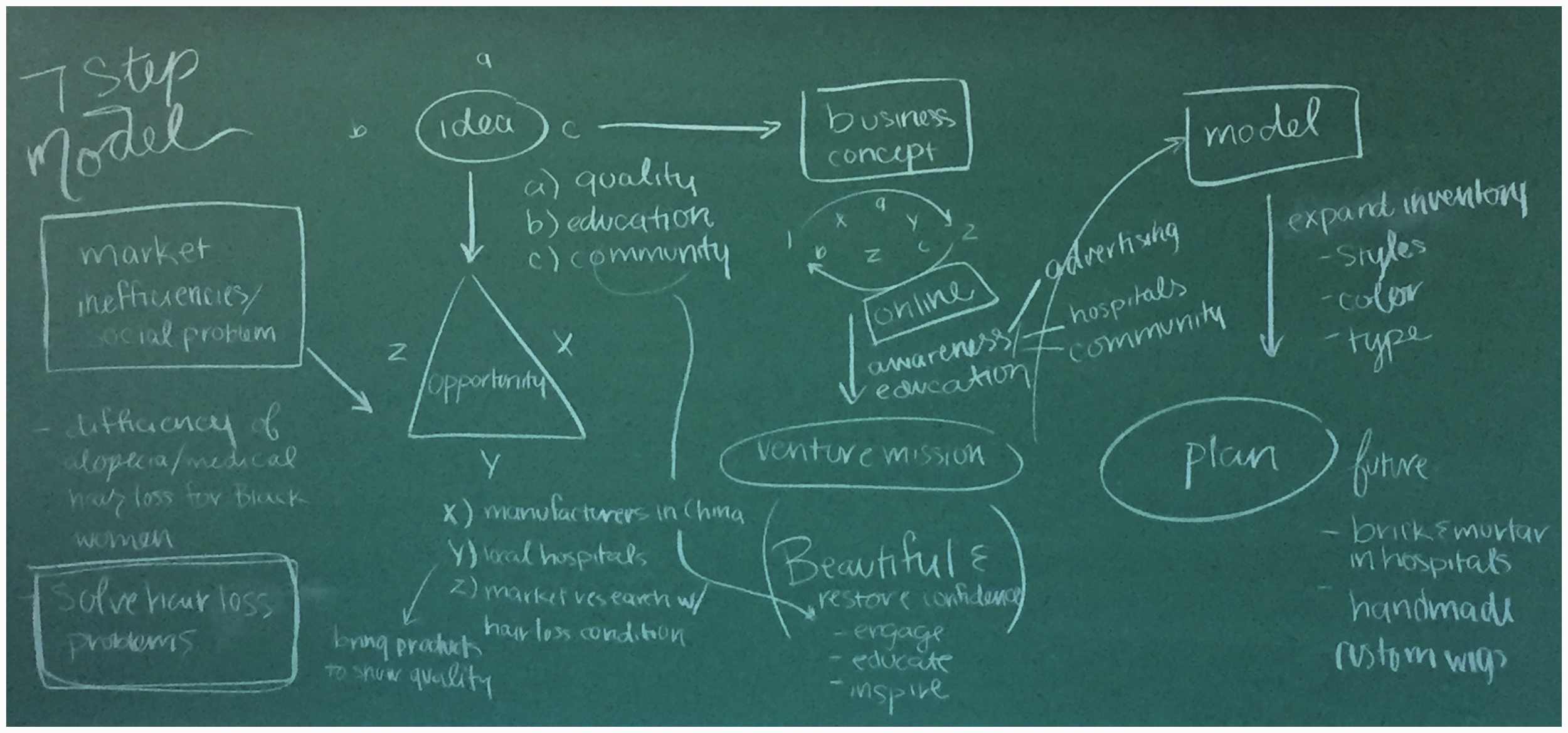
Uncertainty and Risk
The Heptalogical Model helps demarcate uncertainty from risk. As noted earlier, the entrepreneurial elements described by earlier stages of the model (prior to Stage IV) tend to entail uncertainty, whereas the latter stages of the model are more amenable to risk. 7 Clarifying these two concepts and formally situating them with respect to one another is an important aspect of the entrepreneurial mindset that university programs intend to inculcate in students. A mastery of uncertainty and risk is instrumental to stronger strategic and entrepreneurial decision-making.
At the earlier stages of the model, uncertainty is germane. The range of possible entrepreneurial outcomes and the nature of the outcomes themselves are utterly unknown. Such a profound lack of information is part of the definition of uncertainty (Hayek, 1945; Mises, 1949). By contrast, risk entails a range of possible outcomes that are known. In risky situations, then, the question centers on which of those outcomes will occur, instead of what those possible outcomes are. Unlike uncertainty, risk allows for the utilization of probability distributions to help predict an outcome from a set of given outcomes. Because the latter stages of the model involve measurable operations and the event history of a going concern, those stages are amenable to the logic of risk.
Aspects of strategic management become more salient in the latter stages of the model as well, especially when it comes to business planning. This relevance helps demarcate the distinct domain of entrepreneurship from the field of strategic management, where competitors and other formal aspects of the organizational environments. The Heptalogical Model is designed to be theoretically distinct from models that derive from other areas in the domain of business studies.
Venture Diversity
When considering the many different kinds of entrepreneurial ventures that exist across industries, contexts, and cultures, it is clear that the performance goals of such ventures can vary dramatically. Whereas some ventures intend to grow to enormous sizes and transform whole sectors, others intend to become lifestyle businesses, improve life in a small community, contribute to civilized society, or perhaps achieve stable operations and nothing more. The Heptalogical Model can help describe all such ventures.
Early-stage nascent ventures are unable to avoid the need to grow. At the outset, they will incur the challenges that are a natural part of venture emergence and growth. Some of these ventures never lose their growth orientation. However, other ventures may eventually settle into more stable forms of operation marked by harmony and adaptivity, instead of growth. For this reason, similarly to the model’s treatment of uncertainty and risk, growth is relevant to earlier stages of the model, whereas adaptivity becomes relevant at the latter stages. If an entrepreneurial venture intends to lose its growth orientation as it becomes more robust, it is important to acknowledge that the environment will still change around it. That is why an adaptivity orientation becomes more important at later stages, even if the growth orientation subsides as part of the venture’s mission. Stage V can describe venture adaptation as readily as it can describe venture growth.
Avoiding the Stereotyping of Entrepreneurial Individuals
The Heptalogical Model does not address the exact nature and qualities of individuals or teams that should undertake an entrepreneurial venture. The logic of the model avoids the empirical levels of analysis issues that plague empirical management research (i.e., micro, meso, and macro). Yet, the fact remains that individuals and teams are important to entrepreneurial activity. In our experience, the model is useful for engaging this topic area in the following way. Depending on the cultural context or industry setting of an entrepreneurial case, certain individuals and teams are more or less appropriate in certain roles. One can broach this topic at any stage of the model. Indeed, based on the specific problem (Stage I) and mission (Stage V) of a given entrepreneurial case, the venture team might vary dramatically in terms of the best team composition. In this way, the model avoids an essentialist treatment of individuals or teams. It makes its most powerful intellectual contributions when it is applied to specific venture cases.
The Heptalogical Model offers no conceptual affordances for the stereotyping of entrepreneurial individuals. The framework has nothing to say generally about what type of entrepreneurial individuals make the best entrepreneurs. It assumes that all types of people can undertake entrepreneurship if they choose to do so. The notion that there is a type of person more generally capable of being an entrepreneur, which has appeared in entrepreneurship research and in the popular press, is incorrect. That view is an artifact of the common behaviors that individuals tend to undertake in entrepreneurial settings (i.e., taking risks, bold actions, going against the grain, and extreme motivation). Such behaviors are multiply determined by the interactions of infinitely varied personological characteristics interacting with patently unique and layered situations. The tendency to stereotype individuals plagued leadership research in the mid-20th century. It is an error that entrepreneurship research and pedagogy will do well to avoid. This notion that anyone can pursue entrepreneurship bears emphasis not only because it facilitates more powerful ways to explain entrepreneurship but also because it is an important message in EE settings with diverse student audiences.
Pedagogical Utility
With examples and discussions, each stage of the Heptalogical Model can support a 75- or 90-minute lecture with university students or entrepreneurs. It is useful to emphasize the importance of individuals and teams in such lectures. For example, Stage I of the model can guide a discussion of community or market problems in the same geographic location in which the lecture is occurring. Longtime and experienced members of a community or market are often more familiar with such problems, but it is often the outsiders who have more objective viewpoints required to identify opportunities to address such problems.
At Stages II and III, illustrating and discussing measurable and objective elements of the external environment (opportunity) can make a problem in a market more actionable. In turn, brainstorming about possible technology applications and unique approaches (ideas) in relation to the opportunity is easier when the problem and opportunity are well defined. These explanations can generate breakthrough insights into team-building that can be vital for aspiring entrepreneurs. It is important to emphasize relevant experiences and knowledge for the entrepreneurial case in question and to avoid general statements about types of individuals who make better entrepreneurs or what might work best in all situations.
The Heptalogical Model is useful for explaining entrepreneurial action across many kinds of boundaries and contexts. It facilitates the development of individual entrepreneurship seminars. It also serves as a ready guide for developing of sequences of entrepreneurship programs in which specific classes reflect different stages of the Heptalogical Model. The rule holds that when earlier stages are not defined clearly, it is difficult to have meaningful discussions about subsequent model stages. This progressive logic has been cited frequently by students as one of the most valuable learning outcomes of the framework. The difference between opportunities and ideas, and the implications of failing to understand that difference, is another learning outcome cited frequently by students who have learned entrepreneurship in seminars based on the model.
The Heptalogical Model has also demonstrated utility in explaining entrepreneurial phenomena across delivery modalities and over time for many populations of students and entrepreneurs. It lends clarity to complicated discussions of growth, error, risk, and uncertainty. Those aspects of entrepreneurship are easily conflated without a strong conceptual foundation that incorporates them formally into context. In conclusion, we offer this model as a framework for EE activity and utilization by all entrepreneurship educators—using it in part, as a whole, or modifying it however they wish—in ways that add value to their high-impact entrepreneurship seminars and programs. 8
Footnotes
Declaration of Conflicting Interests
The author(s) declared no potential conflicts of interest with respect to the research, authorship, and/or publication of this article.
Funding
The author(s) received no financial support for the research, authorship, and/or publication of this article.