




Abstract
As militarized landscapes proliferate globally, it is timely to ask: what exactly constitutes a militarized landscape, and how might we intervene in the scholarship on military-environment relations to better understand their key features. In this introduction to the special theme issue on Militarized Landscapes, we invite readers into these questions. We first define militarized landscapes as socio-ecological landscapes that contribute to or are transformed by political hostilities, preparation for conflict, and outright war, as well as those that are militarized for explicitly environmental ends. To make sense of the vast and growing literature on military-environment relations, we then outline what we see as its six major themes: environmental harm caused by military activity, environmental security and resource conflicts, green militarization and green wars, nature's militarization and weaponization, ecological militarization or military environmentalism, and finally ecological restoration. Building from here, we turn to the contributions of the special issue, showing how they chart novel insights across these themes. These come together around the distinct and expanding spaces of militarized landscapes, the diverse slate of actors building and maintaining them, how people and nature survive and resist these landscapes, their afterlives, and finally questions of methods, or how to study and chronicle militarized terrains.
Keywords
Introduction
On a warm September evening in 2023, a sunset hike through Boise's Military Reserve – a 734 acre urban protected area – brought Lunstrum in contact with a group of hungry but well-fed mule deer. This high desert habitat at the foothills of the Rocky Mountains is home to abundant wildlife, much of it indifferent to hikers and mountain bikers traversing the rolling hills. What makes the Military Reserve distinct from other nearby protected areas is its explicit military history, still embodied in its name. As a former Army training ground for Fort Boise used extensively for artillery practice, the Army Corps of Engineers engaged in lengthy study that wrapped up only in 2024 to ensure all unexploded ordinance had been removed.
The hike was largely unremarkable – deer and other wildlife routinely traverse the reserve. But the timing of the hike caused pause for reflection. It was a needed break from preparing for an upcoming workshop on military landscapes we were holding at Boise State University. The workshop brought together 17 scholars ranging from graduate students to senior professors to explore dimensions of militarized landscapes across the globe and across different time periods. The indifferent deer and their habitat were a good reminder of some of the key environmental features of military landscapes we would explore in the workshop. These spaces take diverse forms, some explicitly violent and environmentally destructive, and others – like the Military Reserve whose military activity prevented housing developments – actively or tacitly protective of habitat. And resting beneath even the most tranquil post-militarized landscapes lie vexing histories. Fort Boise, after all, was a key military site that helped expel the Shoshone, Bannock, and Northern Paiute Peoples to distant reservations to enable colonial settlement, creating new and exclusionary socio-ecological relations and realities in the process.
As we write this introduction, many of the militarized tensions and related environmental transformations we examined in the workshop continue apace while others intensify – from ICE confrontations in Minneapolis and other U.S. cities to the bombing of Iran, decimation of Gaza, and what is now protracted conflict in Ukraine – many having direct links to the environment. If the Minnesota cold interfered with militarized activities, interests in natural resources, land, and seaports drive many contemporary conflicts. Military landscapes, in short, both linger and grow, making this special issue nothing if not timely.
The special issue brings together five stellar contributions from the workshop. In this introduction, we chart what we see as the key themes across the literature on military-environment relations. We then lay out how the contributions advance these debates, particularly by offering insight into the spaces of militarized landscapes, the diverse actors building and maintaining them, how they are survived and resisted, their afterlives, and finally questions of method, or the diverse ways in which we come to study, know, and chronicle these militarized terrains. We define militarized landscapes as socio-ecological landscapes that contribute to or are transformed by political hostilities, preparation for conflict, and outright war, as well as those that are militarized for explicitly environmental ends. This captures how military activity harms or otherwise alters the environment; how environmental resources and interventions – including environmental protections – are entangled with military activity and conflict; and how these dynamics produce distinct militarized landscapes. Core to this definition of militarized landscapes is an understanding of the environment or nature as the more-than-human features of the world, including the flora, fauna, fungi, and bacteria, as well as landforms, weather patterns, and broader ecological processes.
Military activity and the environment: Key themes across the literature
To situate the articles of this special issue within ongoing scholarly debates, we begin by outlining major themes in the literature on military activity and the environment, or how military activity impacts or otherwise meets up with or engages more-than-human creatures, processes, and concerns. Militarized landscapes, in short, are the landscapes that emerge from these interactions (Biggs, 2018; Pearson et al., 2010). Because military-environment relations have received substantial scholarly coverage across diverse lines of inquiry, we have distilled the central insights down into six core themes, noting there is substantial overlap across these (Figure 1).
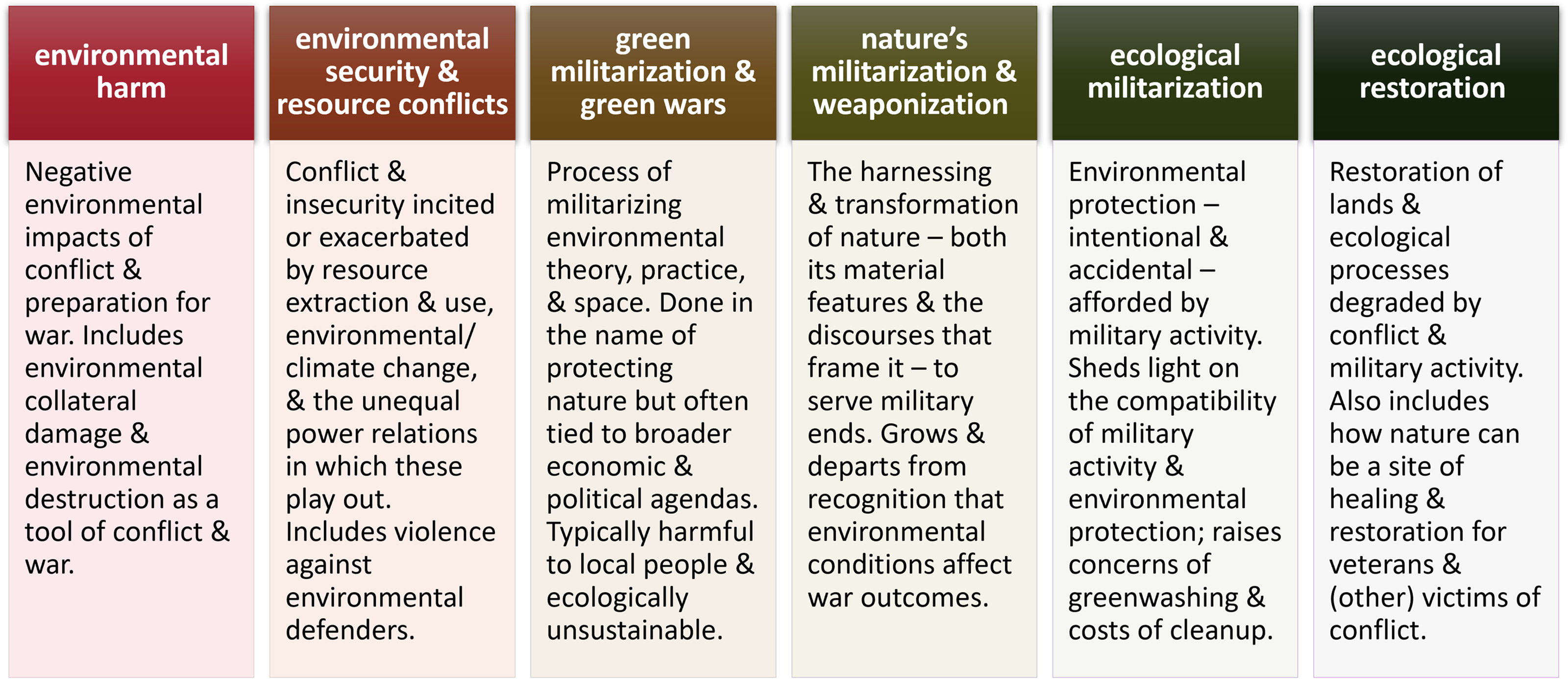
Six major themes across the literature on military activity and the environment.
Beginning with environmental harm, current and foundational scholarly debate richly chronicles the negative environmental impacts of conflict, military training, and weapons testing. This encompasses both environmental collateral damage and environmental warfare or ecocide, that is, environmental destruction as a tool of war (Zierler, 2011). The literature charts how conflict shapes social, technological, and intellectual systems, as well as their socio-ecological consequences (Brady, 2012; Brady, 2025; Hamblin, 2013; Kreike, 2021; Russell, 2001). Reflecting these core themes, there continues to be substantial interest in the impact of military activity on the environment in general (Pereira et al., 2022) and on biodiversity and climate in particular (Bolton and Minor, 2021; Gaynor et al., 2016; Payne and Swed, 2024).
These insights are joined by a parallel debate that examines environmental (in)security and resource conflicts, particularly how these may be incited or inflamed by natural resource demand, extraction, and depletion, on the one hand, and environmental change – especially climate change understood as a “threat multiplier” – on the other hand (Homer-Dixon, 2010; Makki et al., 2025). Critical work, moreover, shows how these conflict dynamics unfold within a context of highly unequal power relations of winners and losers, undercutting assumptions that “nature” by itself invites tension and conflict (Hartmann, 2014; Le Billon, 2015; Makki et al., 2025; Selby et al., 2024). We add here a growing body of work on militarized violence against environmental defenders, mainly Indigenous peoples who defend their resources and territories against environmental destruction and theft (Estes, 2019; Menton and Le Billon, 2021; Scheidel et al., 2020).
Related scholarship on military-environment relations charts the global expansion of green militarization or green wars whereby states, NGOs, and other partners militarize environmental theory, practice, and space to protect nature. This work recognizes, however, that these efforts are often simultaneously tied to broader political and economic goals such as the consolidation of state power over territory or resources or generating profit. While much of this work focuses on the militarization of biodiversity conservation and protected areas, for instance as a response to the illegal wildlife trade (Ashaba and Marijnen, 2025; de Jong and Butt, 2023; Duffy et al., 2019; Lunstrum, 2014; Lunstrum et al., 2025), additional work looks at the militarization of protected areas in the context of the global “war on drugs” (Ybarra, 2017) and of forests as a response to climate change (Corredor-Garcia and Vega, 2024). This work, moreover, underscores how green military buildup is profoundly harmful to local, often vulnerable communities and, in relation, how it is ecologically unsustainable, as militarized responses alienate the very communities conservation and broader environmental protection need for their long-term success (see references above).
An overlapping debate examines nature's militarization and weaponization, or how military interventions work to harness, manipulate, and control nature as tools of war and military preparedness (Heefner, 2025). This includes at its core how military actors physically exploit or alter nature – e.g., plants, animals, weather patterns, environmental processes – for military ends. This is often enabled by parallel efforts to shape how we think about or understand nature, whereby military actors explicitly “adopt discourse that frames nature both as a military asset and as a set of problems to be overcome through military means” (Bigger and Neimark, 2017: 14; also see Hamblin, 2013; Kosek, 2010; Mitchell, 2002). We see these insights as both growing and departing from earlier scholarly work and broader recognition that ecological and environmental conditions affect the outcomes of war (McNeill, 2010) by showing that nature can be actively employed and even transformed to fulfill war-related goals.
Scholarship on ecological militarization, also called military environmentalism, examines diverse forms of environmental protection playing out across current or former military sites, from theaters of conflict to military bases. This includes intentional forms of protection as we see across many military-to-wildlife (M2W) conversions along with environmental protections on military bases (Dudley, 2012). It equally includes accidental, unplanned, and even ironic environmental protection, for instance, as with the Korean Demilitarized Zone (DMZ), which is ecologically rich in part because it is too dangerous for human development and habitation (Brady, 2019; Havlick, 2018; Kim, 2022). While this work sheds light on how military activity and environmental protection may ostensibly be compatible, more critical voices expose how these forms of military environmental protection enable greenwashing and can mask the actual costs of cleanup (Coates et al., 2011; Havlick, 2018).
A growing body of work on militarized landscapes also charts the social, political, and ecological promises and complexities of ecological restoration. At its core are investigations into how military actors and civilians restore lands and ecological systems degraded by conflict and weapons testing (Burger et al., 2020; Havlick, 2018). With a strong and welcome focus on the healing of ecological processes, this work also draws attention to how restoration can exacerbate social injustices and inequalities and must balance often competing social and ecological goals (Havlick, 2018; Nardi and Runnström, 2024). While often not framed as ecological restoration, we add here the growing body of literature that examines how greenspaces like national parks and other public lands can be sites of post-conflict healing for people, especially veterans experiencing post-traumatic stress disorder (PTSD) (Havlick et al., 2021). These insights can also extend to adjacent debates on environmental peacebuilding that examine the role of collaboration over natural resources and environmental protection as paths toward de-escalation and peace building (Ide et al., 2022). This opens space for thinking about nature not only as an object but also a vehicle of restoration and healing.
Taken together, this literature on military activity and the environment reinforces that militarization is a socio-ecological relation (Faxon this issue; also see Ahmed et al., 2025, Kreike, 2021). Reflecting this, militarized landscapes – as landscapes that result from these military-environment encounters – are profoundly socio-ecological landscapes. We now turn to the articles of the special issue. We show how they advance key themes that span these core debates on military-environment relations (Figure 2) to further our understanding of militarized landscapes as socio-ecological landscapes.
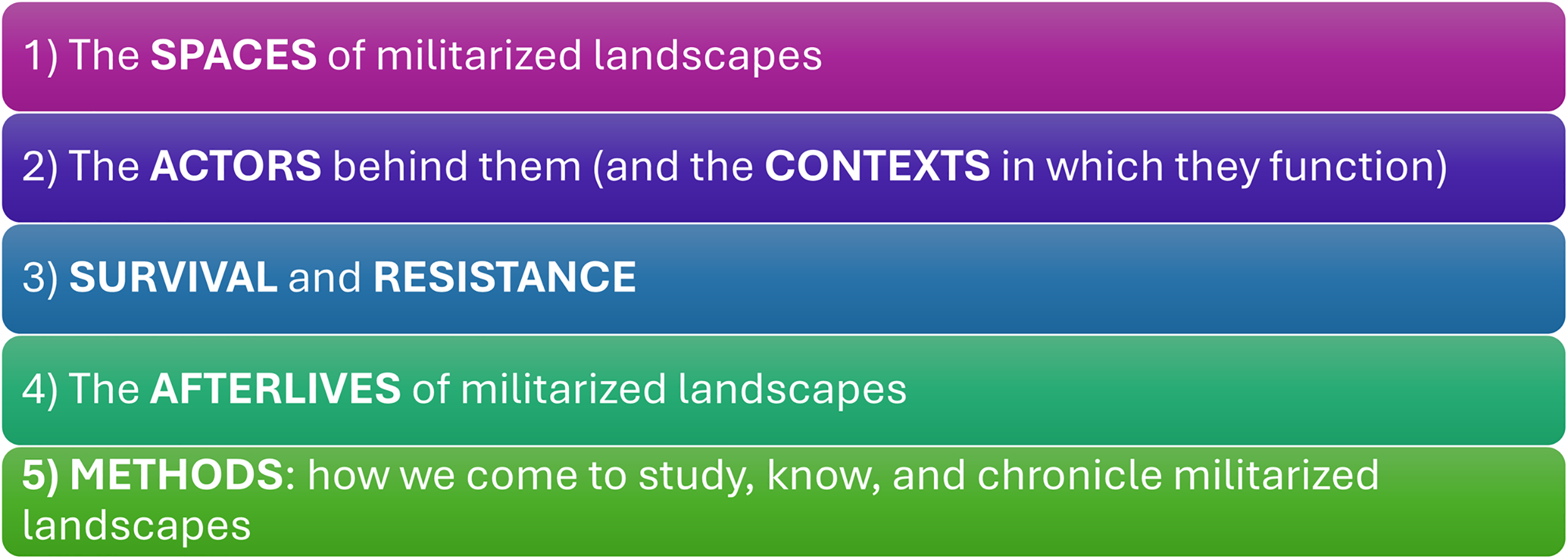
Overarching themes of the special issue that expand our understanding of militarized landscapes.
Themes of the special issue: Charting novel directions
Spaces
While there has long been a strong focus on the environmental impacts of war within conflict zones, a topic making global headlines with the conflict in Ukraine (Rawtani et al., 2022), scholarship has underscored that the where of militarized landscapes must extend beyond the formal battlefield while also not leaving this behind (Davis, 2007: Charrière this issue). The contributions of the special issue speak to this in important ways. Both Faxon and Aijazi bring our attention to sites of protracted military activity in the mountainous borderlands of Myanmar and India and of Kashmir respectively. While distinct, these conflicts share a key feature: both are borderland conflicts, highlighting borderlands as an important site of conflict. If the Kashmiri borderlands spanning India and Pakistan experience conflict as belligerent nations fight over this space, the borderlands of Myanmar and India are however both a space of conflict (on the Myanmar side) and support and survival (on the India side), underscoring the complex, even contradictory, role of borderlands as militarized landscapes.
The contributions of Charrière and Raybung and Toman examine sites of preparation for conflict. Reinforcing that these sites can experience even more environmental harm than actual theaters of conflict, Charrière draws our attention not to terrestrial sites of weapons testing, which receive the lion's share of interest, but rather lakescapes, what she defines as “a dynamic and hybrid socio-natural formation shaped by past and present military activities.” Through a comparative study of munitions testing in Lake Michigan in the U.S. and Lake Neuchâtel in Switzerland, Charrière examines how, as munitions fall to the lake bottoms, they remain active in their hidden state. Raybung and Toman, advancing our understanding of ecological militarization, turn to U.S. Department of Defense (DOD) military bases, which are bound and highly regulated sites that are at once spaces of military training and environmental protection. Reflecting this, natural resource managers must confront these dynamics to implement the Endangered Species Act (ESA) on-base.
Faxon asks us to consider militarized landscapes as embedded within and produced through networks that include mobile resources and actors. It is the characteristics of these networks – what they circulate, how, and why – that give rise to the conflicts in question but, even more so for Faxon, strategies for survival, a point we return to below. In calling for a spatially unbound understanding of militarized landscapes, Faxon advocates for stronger engagement across literatures on military landscapes, borderlands, and migration networks. Ruamcharoen, presenting a novel case of nature's militarization and weaponization, asks us to consider an overlooked space. He shows how the U.S. military after WWII was left frustrated by how tropical climates harmed equipment – from clothing to electronics – needed for deployment. In working to understand these impacts to prevent or bypass them, they used the logic of climate analogs to simulate tropical environments back home, leading to the development of weatherproofed goods. This was part of a strategy of “permanent military readiness,” that is, the ability to successfully deploy anywhere. Through this work, militarized landscapes came to include the physical environment surrounding equipment. These interventions, moreover, were inseparable from a militarized discursive mobilization of space, namely a discourse of the tropics as exotic and dangerous, as “environmental other to temperate zones in the wake of European and American imperial expansion,” reflecting another key characteristic of nature's militarization.
Taken together, the contributions show that the spaces of militarized landscapes are at once local and cross-border, terrestrial and aquatic, bound and networked, material and discursive, somewhere and potentially anywhere.
Actors
Across these diverse spaces of militarization, the articles draw attention to the rich slate of actors building and maintaining them. While Charrière and Faxon point to more classic actors – soldiers and munitions testers – Rabung and Toman, Ruamcharoen, and Aijazi bring in a broader cast. For Rabung and Toman and Ruamcharoen, this includes natural resource managers and scientists. Raubung and Toman chart how natural resource managers, including biologists working for the U.S. military, implement the ESA on DOD lands. Reflecting pushback against their work, especially in light of DOD concern that the ESA is encroaching on already sparse training and testing grounds, the authors show that natural resource managers engage in a complex process of negotiation to ensure their environmental work aligns with military goals, resulting at times in militarized forms of conservation. Ruamcharoen turns to military and civilian scientists who seek to better understand dynamics of the natural world, here the biophysical characteristics of certain climates like the tropics, in order to control them. Ruamcharoen underscores, more broadly, that the knowledge of the natural world gained or produced by military actors is key to its militarization. Aijazi brings in a different set of military actors: Pakistani soldiers deployed to defend their territory through ecological restoration. While on the surface, their interventions may appear as straightforward efforts of restoration, Aijazi shows how these are better understood as acts of green militarization and ecological state territorialization to achieve a sense of order, domination, and control.
The actors across these diverse militarized landscapes, moreover, do not fully act of their own accord. Here, the articles highlight the broader contexts that shape their behavior, which of course include (geo)political hostilities, war, and preparation for conflict (all articles). Aijazi, Ruamcharoen, and Faxon additionally highlight imperialism and (post)colonialism as drivers of conflict that shape individual and collective action and incite new socio-ecological relations. Raybung and Toman, moreover, show that DOD natural resource managers work under thick layers of bureaucracy, underscoring that militarized landscapes – often understood as chaotic and unruly – can be profoundly bureaucratic landscapes.
Survival and resistance
Militarized landscapes are not merely experienced, they are in important ways survived and resisted. Faxon addresses this in her study of how refugees who fled Myanmar's 2021 military coup carry socioecological relations – to land, agriculture, livestock, and each other – with them as they cross into India. They experience “interlinked landscapes of danger and sanctuary and everyday practices of cultivation.” These are “resistant ecologies” that tap into more-than-human relations that help remake life and livelihoods as survival strategies. In this way, and while perhaps not her explicit intent, Faxon also advances debates on ecological restoration, particularly work that sees nature as a site of healing during or after conflict. She shows how refugee communities heal and survive through engagement with nature as agriculture, which allows not only social reproduction but also connections to their communities and former lands and ecological relations as they build new lives. Nature here is doing the restoring, rather than being restored.
If Faxon draws our attention to survival, Aijazi highlights resistance. He shows how even in the face of intensive long-term conflict, Kashmiris resist, and they do in partnership with nature. They employ “unruly ecological practices” including flower bombing where they deliberately scatter seeds on public lands to disrupt (performances of) military control. Aijazi shows how the militarized terrain is in fact co-produced where everyday ecological acts – such as foraging, planting, and seed dispersal – provide paths for alternative futures. Just as the militarization of Kashmir is ecological through the tree plantation campaigns, so too is local resistance.
For Ruamcharoen, it is not people who are unruly but environments themselves. Rather than chronicling a seamless process of military control over ecological relations, in many ways the goal of the climate analogs program, Ruamcharoen shows that the more-than-human processes of weathering and decay defied human management. This was a clear shortcoming of the climate analogy framework and one military scientists came to understand. This is not, then, a story of “top-down technocratic hubris” but one in which “the elements” actively shape and even resist military logics and objectives. While less their central focus, the other contributions also offer important insights into survival and resistance. Charrière shows how environmentalists and recreationists pushed back against lakescape munitions testing to protect and reclaim these spaces, and Raybung and Toman illustrate how environmental resource managers actively negotiate DOD bureaucracy to ensure the survival of endangered species. When placing the articles in conversation, we see how survival and resistance are both human and more-than-human.
Afterlives
What happens when active militarization ends? As the articles in this special issue reveal, the socio-ecological processes that shape militarized landscapes do not cease when conflicts resolve or peace-time military activity ends. Instead, they continue to transform the spaces and actors in new and important ways, producing afterlives that merit documentation and analysis in their own right. In some cases, like Boise's Military Reserve described in this introduction, the site's martial character is all but relegated to memory. Its afterlife exudes life, providing critical open space in one of the fastest growing urban areas in the United States, allowing plants and animals, humans and non-humans, wild and domesticated, room to grow and breathe. If its name ever changes, its history could be fully obscured, overwritten by the hiking and biking trails, the deer and coyotes, the syringa and sagebrush.
The articles here present insight into various other forms and stages the afterlives of militarized landscapes might take. Like the Military Reserve example, several of Charrière's study sites are in the final phases of transitioning away from active military use. While they may no longer serve as testing sites, the shells and unexploded ordnance remain, posing potential threats through explosion or toxic contamination in the water and larger ecosystems. The afterlives of these militarized lakescapes prioritize recreation over weapons testing, but their militarized past will continue to shape their futures as local managers must provide education about remnant danger lurking in the waters and along the shores. The bureaucratic structures and management requirements surrounding the DOD lands explored by Raybung and Toman suggest these sites may follow a similar trajectory from heavily militarized to (simultaneously) educational and recreational. Here, the afterlives are not just written on the land itself, but also in the laws and regulations that governing authorities enact.
Ruamcharoen turns attention not to the afterlives of militarized landscapes per se but the afterlives of the enduring scientific frameworks and knowledge they generate. Reminding us that these afterlives follow unforeseen and even ambivalent paths, he writes: “Methods for understanding how man-made materials decompose and weather away may now carry relevance in light of contemporary environmentalist concerns about overflowing waste and persistent pollutants such as plastics that follow in the wake of American-style consumerism. Despite their unlikely partnership, the military may have surprisingly much to teach us about rot and decomposition.”
The afterlives of active sites of conflict are even less predictable. It is unclear whose vision will prevail in Kashmir: the regimented forests planted by Pakistani troops or the “unruly” flowers sown by locals in protest of military control. As Aijazi artfully demonstrates, it is not just the political future of the region that is at stake, but also its environmental afterlife. Similarly, Faxon points to the shifting nature of land and resource use in the Myanmar-India borderlands where sanctuary spaces enable refugees to maintain “linked intergenerational and international spaces, where relations to land are trans-planted and transformed.” As intergenerational spaces, these have interwoven prior-lives and afterlives, and, as in Kashmir, these militarized afterlives are not yet settled. Should the refugees return to their homes in Myanmar, what will become of the sanctuary spaces they settled and remade?
Methods
The special issue also reinforces the importance of diverse methods and research designs needed to study militarized landscapes, uncovering how they unfold, expand beyond their borders and initial intentions in both environmentally harmful but at times healing ways, and how they are lived, survived, transformed, and resisted. Scholars note a host of challenges working in militarized landscapes, from physical danger, lack of access to (often restricted) data and militarized spaces themselves, subjects who may be too scared or otherwise unwilling or unable to engage, lack of baseline data, challenges in grasping the complicated causes of conflict and related environmental change including the ecological and socio-political-economic contexts in which they unfold, time lags between conflict and environmental change (in both directions), and the problem of data quality (Nordstrom and Robben, 1995; Selby et al., 2024).
Despite these challenges, the special issue articles stubbornly push ahead, primarily through qualitative methods. Charrière and Ruamcharoen utilize historical methods, as read through their rich footnotes and bibliographies. The authors act as detectives, wading through primary sources drawn from military and nonmilitary archives, law and legislation, newspaper articles, and official reports, to stitch together the histories of militarized landscapes – in both cases, military testing sites – lest they be forgotten. Rabung and Toman take us onto contemporary DOD bases, spaces typically closed off to the public. They engage in participant observation, including observation done while assisting with biological fieldwork, and semi-structured interviews with natural resource managers to open up these spaces, and the complexities of ecological protection happening within them, to their readers.
Faxon and Aijazi employ ethnographic methods of living alongside the survivors and resisters of militarized conflict to offer thick descriptions of both landscape transformations and what conflict, survival, and resistance look like on a day-to-day basis, what Faxon captures as “landscape as method.” Faxon works through semi-structured interviews, informal conversations, and in-depth participant observation, complemented by simply being present through laughter, tears, meals, and accompanying friends on cross-border visits to witness the borderland dynamics of militarized landscapes and networks firsthand. Aijazi, while paralleling the ethnographic rigor of Faxon, turns method on its head. He writes: “Sustaining accountable relationships with interlocutors has reshaped my methodological commitments toward emergent, relational practices, such as cooking, eating, cultivating camaraderie.” While framed differently, this also characterizes the richness of Faxon's embodied work where, similar to Aijazi, the line between data collection and human connection blurs to indistinction. Taking the contributions of the special issue together, we see that different militarized landscapes not only pose vexing methodological challenges, they require creative points of entry and engagement to overcome these.
Conclusion
We close by inviting our readers into the special issue to explore military landscapes as profoundly socio-ecological spaces. These are landscapes that are generative of or transformed by political tensions and (preparation for) conflict and that equally include landscapes militarized for environmental ends, while recognizing such efforts are deeply entangled with political and economic interests. The contributions of the special issue engage with the major themes in military-environment scholarship by offering novel insights into the distinct and expanding spaces of militarized landscapes, the diverse slate of actors building and maintaining them, how people and our more-than-human counterparts survive and resist these spaces, their afterlives, and the diverse methods needed to understand and document such vexing terrains. We hope this introduction and collection inspire further research that expands our collective understanding of the forces generating militarized landscapes, their impacts, and paths toward more just and sustainable alternatives.
Highlights
We define militarized landscapes as landscapes where conflict alters the environment and where environmental interventions are entangled with military activity.
Major themes across the military-environment literature include environmental harm, environmental security, green militarization, nature's militarization, ecological militarization, and ecological restoration.
The special issue contributions chart novel insights across these themes around questions of space, actors, survival/resistance, afterlives, and methods.
We invite further research on the forces generating militarized landscapes, their impacts, and paths toward more just and sustainable alternatives.
Footnotes
Acknowledgements
The authors thank the participants at the 2023 workshop on Militarized Landscapes at Boise State University for generating such a rich conversation on militarized landscapes and the broader relationship between military activity and the environment. We thank Boise State University's College of Arts and Sciences’ Humanities and Social Sciences Initiative, School of Public Service, and Division of Research and Economic Development for financial and logistical support in hosting the workshop. We also thank the authors of the 5 articles in the special issue for seeing this through and for their stellar scholarship.

Ethical approval
This work did not require ethics approval.
Funding
The authors disclosed receipt of the following financial support for the research, authorship, and/or publication of this article: The 2023 Militarized Landscapes workshop received financial support from Boise State University (see above). The writing of this article did not receive financial support.
Declaration of conflicting interests
The authors declared no potential conflicts of interest with respect to the research, authorship, and/or publication of this article.
Data availability statement
There are no publicly available data associated with this article.