




Abstract
Tsetse flies and wildlife-disease reservoirs have long been targeted for spreading trypanosomiasis, an infectious parasitic disease that affects multiple organs in humans and livestock. In Zambia, large-scale conservation promotes closer coexistence between people, livestock and wildlife, renewing concerns: how can people live with dreadful pathogens? This article explores the shifting stories that cast tsetse flies variously as epidemic villains, guardians of wilderness, and awkward neighbours. It aims to unravel the imaginaries, technological and spatial assemblages underlying tsetse stories to understand how they shape disease control and encounters with tsetse. Drawing on archives, entomological literature and interviews with local farmers in southwestern Zambia, the study moves between science, fiction, and local narratives to examine tsetse stories of the 20th and 21st centuries in Zambia (and beyond). It highlights how these stories shape the fears and possibilities of living with tsetse, between eradication and coexistence. Overall, the article shows that vulnerabilities to trypanosomiasis are produced and responded to in political assemblages, and asks: what kinds of multispecies worlds do we want to narrate and inhabit?
Introduction
“People with nature”: the promise of a harmonious coexistence between humans and nonhumans in landscapes that support both the flourishing of biodiversity and human societies is a new paradigm for nature conservation (Mace, 2014). But what if closer coexistence with nonhumans means more exposure to threatening diseases? What about coexisting with undesired, “awkward” or even dangerous others (Ginn et al., 2014)?
In the world's largest terrestrial transboundary conservation area, the Kavango-Zambezi Transfrontier Conservation Area (KAZA) in southern Africa, growing and increasingly mobile wildlife populations are expected to coexist with people. But as transboundary conservation is rewilding this human-populated landscape, the spread of pathogens carried by wildlife raises concerns (Penrith and Thomson, 2012; SADC, 2008). Trypanosomiasis, a human and livestock disease transmitted through the bite of the tsetse fly (specifically Glossina morsitans in this region), is stirring up such fears. Trypanosomiasis is caused by trypanosome parasites, which affect the blood, immune and nervous systems. In southern Africa and southwestern Zambia, most trypanosome species infect nonhuman animals. In cattle, trypanosomiasis may lead to weakness, weight loss, infertility and, if left untreated, death. In this region where many people depend on cattle, the loss to herds caused by trypanosomiasis is a particular concern for local farmers worried about their livelihoods and for policymakers interested in local development. It has been targeted since the colonial period by repeated and intensive disease-control interventions. These include in southern Africa the management and even culling of wild animals, which are often associated with the presence of tsetse flies and act as reservoir hosts for trypanosomiasis. Parallel to the scaling-up of transboundary conservation within KAZA since 2011, Zambia has been targeted in recent years together with neighbouring countries by a regional aerial insecticide-spraying campaign to eliminate tsetse flies. The latest aerial spraying occurred in 2014 in southwestern Zambia.
Narratives about diseases and vectors carry societal anxieties, project common imaginaries onto territories and shape social transformation. The African continent, and indeed the entire “Third World”, have been framed as infectious underdeveloped zones (Wald, 2008). However, catastrophic narratives about outbreaks and biosecurity threats often mask the structural political and economic choices that have produced vulnerability to diseases (Lachenal, 2014). This article focuses on the narratives about the disease trypanosomiasis and its vector the tsetse fly in southwestern Zambia and southern Africa to highlight what underlying possibilities for coexistence and vulnerabilities to disease are produced along with these stories. It delves into the tsetse stories that come and go among the entomologists and others scientists and practitioners mandated by the government and international organisations, and among the local populations in southwestern Zambia and the wider public. These stories cross time: they have roots in the tales of European travellers and hunters of the nineteenth century and early colonial expertise, and ramifications in the contemporary narratives around tsetse and trypanosomiasis in Zambia. Exploring stories in the contexts of science, fiction and accounts of people's experience on the ground, the article identifies common imaginaries and anxieties that circulate regarding tsetse in relation to people and nature and how they materialise in human-tsetse interactions and the landscape. In doing so, it aims to reveal the assumptions and political choices behind tsetse stories that produce vulnerability to trypanosomiasis within spatial and technological human-tsetse assemblages between eradication and coexistence.
Multispecies assemblages are understood as open-ended spatial, temporal and social gatherings of entities, spaces and material-semiotic processes working together. This article focuses on assemblages of tsetse narratives with imaginaries, knowledge and technologies of tsetse control and the spatial relations they imply between people, livestock, tsetse, trypanosomes and wildlife. Here the multispecies assemblage as analytical framework allows us to zoom in on how stories and imaginaries emanate from political, economic and knowledge structures and work together with social and spatial transformations that materialise in the lives of local farmers and the landscapes of southwestern Zambia. 1
The study combines archival and ethnographic research conducted in 2022 and 2023 in Zambia. It draws on colonial and postcolonial archives on tsetse and trypanosomiasis control in Zambia and the wider region, from the National Archive of Zambia (NAZ) in Lusaka, internet archive, and the archive of the Veterinary Department's Tsetse Control Unit (TCU). It also draws on ethnographic research conducted by the author in the Sesheke, Mulobezi and Kazungula districts in southwestern Zambia from September to November 2022, accompanied by a practitioner from the TCU based in Sesheke, who participated in the latest tsetse-control interventions in the region. Semi-structured interviews were conducted with local residents (mostly farmers) in three areas – within the 2014 aerial tsetse-control spray block; at the edge of this block, close to the Sichifulo Game Management Area (GMA) bordering the Kafue National Park; and outside of the block where no spraying took place, within the Mulobezi GMA (Figure 1). Interviews were conducted in Silozi or Tonga, assisted by a translator, and later transcribed (including written translation).
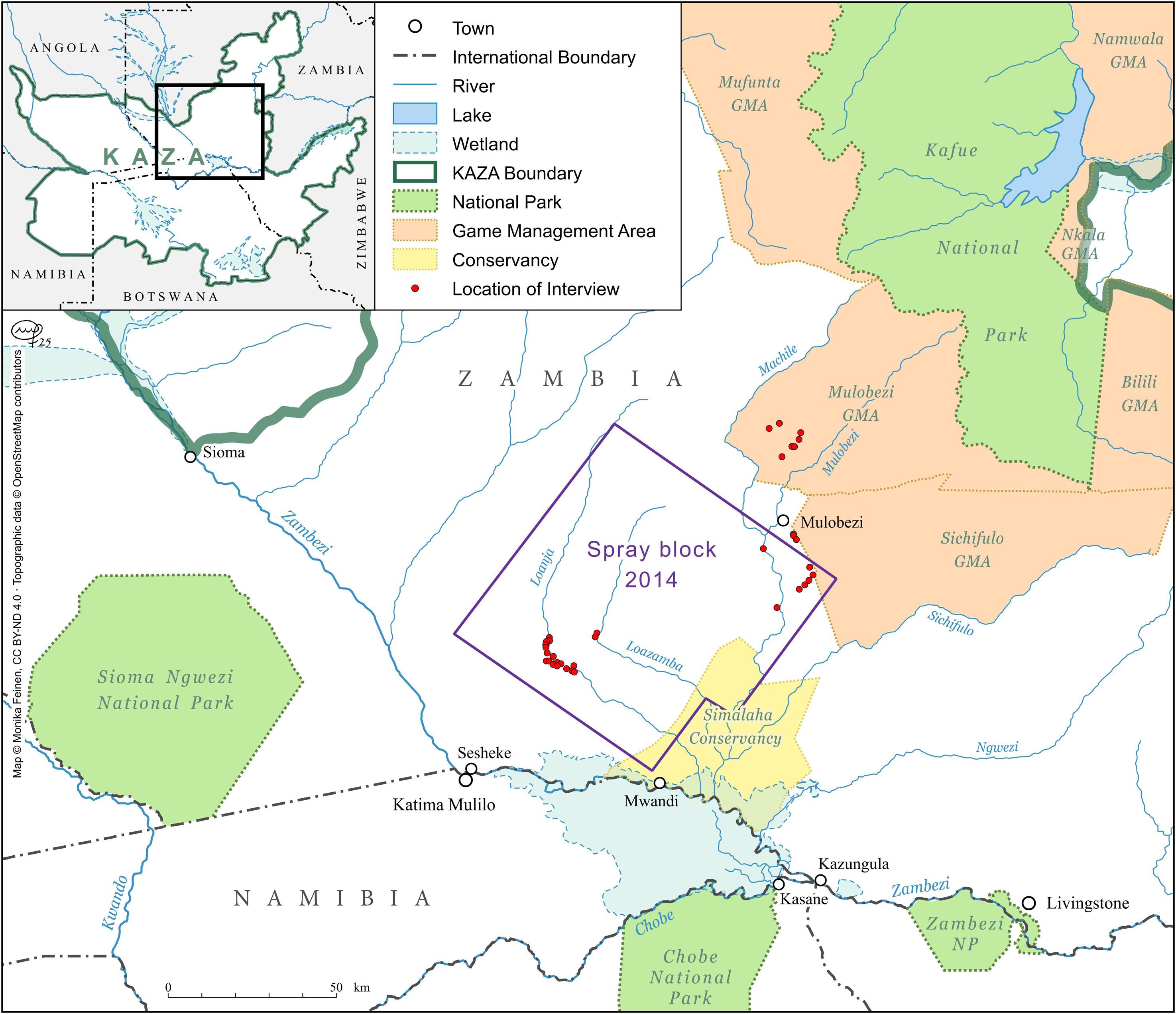
Map of the insecticide-spray block of 2014 and interview sites in southwestern Zambia.
The article begins by situating this study at the intersection of narratives from the political ecology of disease and the multispecies literature on coexistence with pathogenic nonhumans. The article then moves on to examine three stories: first, tsetse as an epidemic villain, linked to dreams of eradication; second, tsetse as a guardian of wilderness and an ally for nature conservation; and finally, tsetse as an awkward neighbour, between control and coexistence. Eventually, the article shows that these stories underpin different multispecies assemblages – exclusionist, separationist, and mutualist – that feature different possibilities and ways for people to share worlds with tsetse flies, trypanosomes, livestock, and wild animals. It foregrounds that these spatial and technological assemblages have political implications because they are shaping disease vulnerability and control.
Pathogens and insects between science, fiction, and local encounters
From Kafka's metamorphosis to apocalyptic bug invasions, insects have nurtured imagination in science-fiction literature and movies, between fascination and fear (Budde, 2014; Hogue, 2009; Rehling, 2013). Likewise, killer pathogens breaking out of human control and spreading across the Earth feature prominently in end-of-the-world stories, reflecting societal imaginaries (Menadue, 2020). How do these imaginaries shape humans’ cohabitation with insects and pathogens?
Anthropologists and others have explored the framings of insects and mammals as reservoirs and vectors of diseases, and their links to specific regimes of knowledge, practices and technologies of zoonotic disease control and human-environment relations (Kelly et al., 2019). Christos Lynteris (2019) shows that modern epidemiology puts the epidemic blame on nonhumans – such as malarial mosquitoes, pestiferous rats, or rabid dogs – framed as “epidemic villains” for bringing and spreading new pathogens into human worlds, reflecting on nonhumans as agents of epidemic imaginaries. As argued by James Fairhead (2018), categories of thoughts are embedded in social and technological orders. Disease control in epidemics enacts particular relationships between humans and pathogenic animals (Keck, 2025).
At the intersection between fiction and science, in the case of Ebola, Frédéric Keck (2015) argues that fictions around mutant viruses and viruses as enemies shape disease management. The tsetse fly also inspires imaginaries, as shown by historian Luise White (1995), who describes the “narratives of blood and bugs” in colonial Northern Rhodesia (now Zambia) in the 1930s. She highlights how colonial science and African rumours epitomise different visions of human-tsetse-animal relations and disease control in shared landscapes. Fictions about diseases mirror scientific knowledge, but they also provide a space for reflection on the societal issues surrounding them (De Paolo, 2014). Studying fictions reveals the shared imaginaries and anxieties that are projected onto diseases, pathogenic agents and territories (Wald, 2008).
This article focuses on tsetse stories to explore how vulnerability to trypanosomiasis is imagined and enacted in space, technologies and strategies of disease control. It links to the political ecology of diseases, which investigates how narratives manifest and reproduce power imbalances. Power anchored in insect-related knowledge is deployed through disease-vector control enacted upon lands and people (Beisel et al., 2013). In the case of trypanosomiasis, European colonialism in Africa disrupted precolonial practices of coexistence with tsetse flies and shaped interventions for tsetse control and eradication (McCord et al., 2013). British tsetse and trypanosomiasis policies appropriated and controlled African landscapes and populations under the auspices of science (Hoppe, 2003; Mavhunga, 2018). The contemporary management of tsetse and trypanosomiasis remains caught up in politics and competition between organisations, as well as in conflicting knowledge and practices (Scoones, 2016). In Zambia, different narratives around tsetse control demonstrate conflicting priorities between poverty alleviation, nature conservation, agricultural development and human and veterinary health (Grant et al., 2015).
Going beyond a political ecology focused on narratives, this article sheds light on the material and spatial assemblages in which tsetse stories are embedded, and aims to expand the literature on the politics of multispecies coexistence. Gareth Enticott and colleagues have shown that different approaches to biosecurity enact different “versions of diseases” (Enticott et al., 2012: 327), so that living with diseases becomes an option when biosecurity adapts to dynamic local social-ecological conditions (see also Mather and Marshall, 2011). Multispecies literature questions how humans share their lives with “awkward creatures” (Ginn et al., 2014) – repulsive or dangerous nonhumans. In the Anthropocene, with its wave of species extinctions, Deborah Bird Rose and Thom van Dooren ask (2011: 1) “what hope could there possibly be for (…) the unloved others, (…) the disliked and actively vilified others, those who may be specifically targeted for death?”. As Uli Beisel and colleagues point out, insects, and particularly disease vectors, are “uncomfortable companions” (Beisel et al., 2013: 10) tied into ambivalent relations with humans, which may vary from coexistence to eradication, to instrumental relations. They show that insects are agents of social change: their encounters with humans generate knowledge and practices that reshuffle social and environmental orders. Literature on mosquitoes and their control highlights coexistence with vectors as a technoscientific challenge in unruly living systems where the limits between the biological and the social are blurred (Opitz and Folkers, 2025; Shee et al., 2025). In Mosquitopia, authors reflect collectively on the historical conditions that shaped the spread of mosquitoes, their control, and peoples’ vulnerability to mosquito-borne diseases (Hall and Tamïr, 2022). They invite us to immerse ourselves in mosquito worlds to reassess human vulnerability to disease and human-mosquito coexistence.
In contrast to studies focused either on the politics of disease-control interventions or on multispecies interactions on the ground, this article investigates human-tsetse interactions in the context of their wider political assemblages of imaginaries, narratives and technologies. By reading fiction together with scientific accounts and local encounters, this research not only asks how tsetse flies are framed, whether coexistence with tsetse is possible and what would this look like. It also explores how imaginaries and materialities (such as technologies or everyday encounters with pathogens) assemble and interact in the politics of knowledge and disease control, and shape human vulnerability to disease. The methodological combination of archival and ethnographic research allows the distillation of scientific and fictional narratives and their imbrications in disease-control strategies and local encounters. At the intersection of political ecology and multispecies studies, this contribution thus aims to explore how vulnerability to disease and coexistence with disease vectors is produced within political human-tsetse assemblages manifested in tsetse stories.
The epidemic villain: eradicating an insidious threat
Around the 1920s, entomologist Professor Meyer-Maier brought back giant tsetse fly eggs from the Lake Tanganyika to Germany – ignoring the warnings of the local population. One night in his work-room, giant tsetse flies hatch from their eggs and escape through the window into the German town, under the professor's eyes: 2
“A creature was crawling out, a creature as big as a police dog – a frightful creature, with wings – a muscular body, and six hairy legs with claws. It crept slowly, raised its incandescent head to the light and polished its wings with its hind legs.” (…)
“‘These giant flies may propagate and multiply in the manner of the housefly. And in that case, due to their strength and poisonous qualities’ continued Professor Meyer-Maier, ‘the whole human race will perish in a few weeks.”
– Excerpts from the story “The eggs from Lake Tanganyika” (see the cover page: Figure 2), published in July 1926 by the German-American author and filmmaker Curt Siodmak in the science-fiction magazine Amazing Stories (Siodmak, 1926: 347, 348).
In the nineteenth century, European hunters and explorers travelling across the African continent reported their encounters with a blood-sucking fly that killed their horses and oxen with its “poisonous bite” (cf. travellers’ accounts reported in Austen, 1903). Soon, the tsetse fly was identified by European scientists and colonial administrators as the biggest “scourge” (Austen, 1903) of the African continent, and a major barrier to its development. In these narratives, the tsetse fly emerged as a monstrous creature, whose monstrosity lay in its threatening facility to kill through a simple bite. When it became clear in the early 1900s that tsetse-borne parasites could also kill humans, eliminating the vector became a priority. In southern Africa in the first half of the twentieth century, the control of Glossina morsitans mainly targeted its habitat, through vegetation clearing, and its source of food – wildlife – through indiscriminate and massive shootings. In the absence of better knowledge about disease transmission and of better control methods, it became reasonable to kill animals and plants for tsetse and trypanosomiasis control. 3
The framing of tsetse as a threat that was difficult to control turned tsetse into an “epidemic villain” (Lynteris, 2019), blamed and targeted as the spreader of a dangerous disease. This justified the recourse to extreme control methods like indiscriminate wildlife culling to eliminate the threat, at least locally, before it killed too many humans and livestock, if not to eradicate it from the continent – at that time an unachievable goal. Stories like Siodmak's amplify the monstrosity of the fly, inspired by the fears of tsetse relayed by scientists and colonial administrators, and by the expanding field of entomology.
In Zambia, the first Game and Tsetse Control Department (GTCD), created in 1940, combined wildlife elimination with bush clearing and the resettlement of local populations in the 1940s and 1950s. For the colonial administration, tsetse control was a blind fight against a complex problem and an elusive enemy (Lacan, 2024). Baffled by the unknown reasons for tsetse fly reinfestations in areas where it had been successfully eliminated, the director of the GTCD Vaughan-Jones reported in 1943: “without the full perspective (…) the only practical approach to the problem is to chop off the Medusa's heads as and when they threaten the Territory's economic interests”. 4 The monstrosity of the tsetse fly – here a mythological Medusa – resided not only in its dangerousness but also in its elusiveness.
The possibility of a total eradication of the tsetse fly – at the national or even continental level – only became tangible from the 1950s as the use of insecticides developed into a new control method. In post-Second World War southern Africa, insecticides were “presented as human mastery over nature, the deployment of technology to conquer a scourge that lay in the way of a colonial vision of modernization” (Scoones, 2016: 61). This hope fitted the global impulse toward disease eradication that grew after the Second World War under the lead of the new World Health Organization and its ambitious global campaigns against infectious diseases (Stepan, 2011). As Stepan argues, eradicationism – the faith in the absolute suppression of disease to zero – reached its heights in the 1960s based on considerable trust in science and technologies. Aerial spraying of insecticides revolutionised tsetse control: because this technology was so successful at killing the flies, it made the goal of a total eradication of tsetse and trypanosomiasis appear achievable (see also McCord et al., 2013). 5
Zambia's first aerial spraying was done in 1968 by the national government in Senanga, at the southwestern corner of Zambia. Endosulphan was spread by aeroplane to stop the growing population of Glossina morsitans advancing towards the north-east. 6 The spraying operations had “striking” 7 results: subsequent surveys did not find any flies left in the area. But soon, the fly started to encroach back from the Sioma-Ngwezi Game Reserve towards the Zambezi river. Cattle began dying massively, and the Veterinary Department “feared” the uncontrollable “advance” 8 of the fly, leading to two successive spraying campaigns by the mid-1970s. 9 Despite short-term successes, the insecticides could not halt constant tsetse reinfestations in the long run. Worse, these reinfestations were difficult to detect: monitoring required logistically and financially demanding surveys to catch tsetse flies and sample blood from cattle herds.
By 1984, the Veterinary Department observed that G. morsitans had spread so far from the Sioma Ngwezi National Park and from the Kafue National Park on the other side of Zambia's Western Province that it suspected that the two “fly belts” had met. 10 However, it lacked funding for spraying and depended on cattle drugs to contain the disease. By the mid-1980s, the tsetse fly was suspected of continually “spreading”, “encroaching” and “infesting” more areas: “the fly situation was alarming”. 11 These reports portray the tsetse fly as an insidious threat, continuously and invisibly colonising territories, beyond the control of the Zambian Veterinary Department. Tsetse control appeared to be an impossible task, never complete and continuously demanding more costly interventions. With a government unable to cope, the dream of eradication slipped away.
Despite deflated hopes, eradication continues to inspire. Since 2000, the ongoing Pan-African Tsetse and Trypanosomiasis Eradication Scheme (PATTEC) under the African Union aims to eradicate the tsetse fly at the continental level (see Scoones, 2016). As part of PATTEC, Angola, Botswana, Namibia and Zambia have collaborated in a regional eradication project, coordinating spraying across their shared borders. This was justified by the higher prevalence of trypanosomiasis associated with the presence of wildlife in local national parks. 12 After successful aerial spraying in Botswana and Namibia in 2001, 2002, and 2006, and to avoid tsetse fly reinfestations, the Zambian-Angolan border was sprayed with deltamethrin in 2009, followed in 2014 by more spraying further east in Zambia (Figure 1). 13 Catherine Grant shows that, at that time, the tsetse unit of the Zambian Veterinary Department saw aerial spraying as the most effective method to unleash the productivity of tsetse-infested zones and alleviate poverty (Grant, 2014: 9, 12).
Spraying was received very positively by the local farmers who faced tsetse flies on the ground.
14
One resident of the 2014 spray block, in the severely affected Lusinina area (Sesheke district), described considerable losses of cattle to tsetse until the spraying released his family and neighbours from this burden: “Seeing cattle dying one by one until [the government] came, [the cattle] got finished” (…); “[tsetse] was here within the village and in the bush, when you walk, you have to carry leaves…”; “yes, they were very many, very many, very many”; “[cattle were] attracting [tsetse] very much, dogs also they were dying, even goats yes, all livestock, let's say, that died.” “the impact of spraying; it was much [sic] successful” “yes the spraying, then after that [the government] came and try to see whether [tsetse] is still around but they discovered that it has finished.” – October 2022, excerpts from interview LUS18.
In both areas, tsetse control was widely understood to be a task for the government. Local farmers indicated no local vernacular methods against tsetse or trypanosomiasis. Beyond giving preventive and curative drugs to their livestock, they could only wait for the Veterinary Department to spray or apply other control methods. Most felt dependent on the government to protect them and called for it to resume tsetse control. 16 This is hardly surprising, as spraying has long been undergovernment control since the colonial era and remains beyond the logistical capacity of local populations.
The farmers’ fears of tsetse reinfestation echo the imaginary around a monstrous fly as an elusive enemy that has pervaded the discourses of entomologists and veterinarians, and even science fiction, for over a century. The farmers’ enthusiasm towards aerial insecticide spraying also reflects the hopes triggered by the belief that vector eradication could provide a total solution. For them as well, aerial spraying featured as a “techno-fix” (Huesemann and Huesemann, 2011) applied from above, solving at once complex and alarming situations. This technology-from-above is imbricated in a certain social order (Fairhead, 2018), in which farmers are vulnerable and dependent on government interventions to save them. The story of the tsetse fly as an epidemic villain calls into being an exclusionist multispecies assemblage where coexistence between people and flies is so dangerous as to be intolerable. This assemblage draws on colonial fears and imaginaries, and fits into a modernist epidemiology anchored in the faith in technologies and scientific progress (Lynteris, 2019) that remains in the hands of a political and scientific elite.
The second narrative we are interested in revolves around the tsetse fly as an “agent of wilderness”: a threat powerful enough to keep “nature” out of the reach of “encroaching” people and their livestock.
The guardian of wilderness: tsetse for conservation
[Podcast presenter]: “[tsetse control scientist] Paul explains that when he looks down at the creature biting its skin, sure! He sees a gnarly little bugger that he's literally in the business of trying to kill, but when he zooms out, when he looks at the map of the national parks in Africa, he can’t help but to wonder if many of those green spots on the map were able to stay protected because of the tsetse fly, or, you know, our human fear of it?” (…) [Paul]: “Tsetse fly is considered the guardian of the savannah.” – excerpt from the episode “The Guardian: Tsetse Fly Defenders”, posted 2022 by the educational podcast Terrestrials on strange earthly creatures and phenomena (Radiolab, 2022). Recently I heard an extraordinary revolutionary statement made by one [traveller] (…) that the presence of tsetse fly had to a great extent been the saving of Africa, in that it had spared the whole country being over-run with stock with consequent denudation and accelerated, progressive desiccation. Who knows that he may not be right? (Pitman, 1934: 102).
With aerial insecticide spraying spurring hopes for eradication in the late 1960s, this narrative resurges. 19 An article published 1976 by W.E. Ormerod, protozoologist at the London School for Hygiene and Tropical Medicine, warned against the ecological consequences of trypanosomiasis control in the Sahel (Ormerod, 1976). This concern is relayed by Matthiessen and Douthwaite (1985: 207) who urged for careful state-controlled land-use planning, as recommended by the FAO (Matthiessen and Douthwaite, 1985; see also Reid et al., 2001 on tsetse control leading to agricultural expansion).
In a later publication, Ormerod argues against an “Africa without tsetse” and goes as far as to suggest that tsetse should be introduced intentionally, as an ally for conservation: “I would like to be able to advocate the ‘sowing’ of tsetse in special areas which need protection. (…) I believe that the operation would be practicable and beneficial from the ecological stand point but unfortunately it would not at the moment be ethical” [because of the absence of effective and safe trypanosomiasis medicine]. (Ormerod, 1990: 460). “The best solution to tsetse infestations in cattle grazing areas would appear to [sic] eradicate flies (…). However, the removal of tsetse over large areas is likely to drastically affect land use patterns and may have unintended negative consequences. These mostly concern an increased risk of land degradation and the difficulties involved in the preservation of forest and game reserves and National Parks.”
20
These GMAs like the one we are hunting in here is being maintained wild because of the tsetse fly. The tsetse fly here, for the domestic animals, carries a sleeping sickness – if you bring a domestic animal here within like two weeks, those animals will fall sick of sleeping sickness and eventually die, which has been a big salvation for a lot of Africa, and us included here. – Video “Fragile Ecosystem Threats” (PATROL, 2024). “Encroachment [in]to wilderness areas of Africa increases the epidemiology of trypanosomes…” (Kasozi et al., 2021: 9); or “the coexistence of human communities and wildlife poses risks of outbreaks of various zoonoses. In the gazetted wildlife zones, there should be no mixing of domestic animals with wild trypanosomiasis reservoirs.” (Kasozi et al., 2021: 9).
Beyond the academic sphere, the framing of conservation areas and wildlife as threatening trypanosomiasis reservoirs also prevails among local farmers in western Zambia. Whether within the 2014 spray block in Lusinina, at its edge in Mulanga/Situmpa, or within the Mulobezi GMA, local residents clearly associated the presence and movements of the tsetse fly with those of wildlife in and around conservation areas.
22
For example, a farmer in Mulanga worried about an ongoing tsetse fly reinfestation from conservation zones towards their villages: “…the tsetse fly bites these animals in the park [Kafue National Park/ GMA] and these animals come around here in our village and on top of that the tsetse fly that bites the animals in the park also flies to our village and bites our animals too.” (…) “There is no longer a specified location where tsetse flies are found; this is because of the movement of wild animals that move all around now and these are the ones carrying the tsetse flies with them” – translated from Silozi, October 2022, MUL1.
In these perspectives, the tsetse fly remains strongly associated with wildlife and conservation. Conservation zones are identified as its home, where people and their livestock are exposed to trypanosomiasis; and its spread is connected to wildlife and conservation expansion. In the farmers’ views, the tsetse fly is thus a part and an agent of a conservation apparatus, steered by the government and NGOs, that impacts and constrains their lives. This is the other side of the coin of the story framing tsetse as a guardian of wilderness.
Rooted in a conservationist stance, this story supports a separationist multispecies assemblage, where people and civilisation should remain physically separate from the wild embodied by fauna and pathogens. In this assemblage, NGOs and governmental agencies are in charge, engineering the landscape into conservation zones distinct from settlement zones, working to keep people out of protected areas, thereby impacting local livelihoods. This narrative, however, is at odds with another story – one that tries to understand the tsetse's point of view, and even considers coexistence with the fly.
The awkward neighbour: from dark empathy to coexistence
Too late, I realize that my prey was infected with acute trypanosomiasis, that I involuntarily ingested hundreds of trypanosomes in the blood, and that I was, in a rare twist of fate, still susceptible to trypanosomes. (…) I am an involuntary vector and powerless host of undesirable guests that are ensuring their survival at my expense. (…) I could easily have lived out my life without ever becoming infected by these parasites. Over 90% of my fellow flies never cross paths with a trypanosome and remain healthy during their entire life cycle. – excerpt from the handbook “100 days in the life of a tsetse fly” (Charbonnier and Launois, 2012: 26, 30).
“Knowing a fly”, its habits, its aversions and attractions – in short, immersing oneself in its “intimate life” (Mavhunga, 2018: 67) – has been a recurring goal of colonial tsetse control (see also Tilley, 2004). In A Monograph on the Tsetse-flies published 1903, Ernest Edward Austen recorded all observations made on the “habits” and “life-histories” of the tsetse of different species, what they “dislike”, or what they are “fond” of. Knowing how the fly lives – which plant species it prefers to rest, hide or reproduce in; which wildlife species it prefers to feed on; what directs its flying movements, etc. – has been paramount in the attempt to design methods to kill it. Based on tsetse flies’ behaviour and ecological affinities, tsetse traps were developed from the 1930s across the continent (Zululand, Southern Rhodesia, Tanganyika or in the Gold Coast, in current Ghana), and tested on Glossina morsitans and other species to fit their specificities. Drawing on “attraction studies”, the traps experimented with dark colours to attract the flies, mimicked the shape of tsetse's targets – humans, cattle, or even sheep and goats – or refuges, and, by the early 1970s, used animal smells as olfactory stimuli (Mavhunga, 2018: 91–116).
In the 1980s, “odour-baited insecticide treated targets” were developed in Zimbabwe and Zambia,26 and first used in Western Zambia in 1986 (Barrett and Okali, 1998). These traps are made of dark blue and black sheets diffusing an animal-like smell and treated with insecticide. When the tsetse flies land on the sheet, which they interpret as a large mammal, contact with the insecticide kills them. This technology is designed so that “tsetse flies think a target is a cow”, as described in a booklet produced in 1993 by the Zambian government and consultants to educate on targets. The booklet presents an illustration comparing a large dark target with a cow, with the caption: “A target looks a bit like a cow. It has the same size as a cow and also a black colour of a cow. Because of the liquid in the bottle and the plastic bag, the target smells like a cow. Tsetse flies think a target is a cow”. 27 This target technology follows the approach “Know your foe” advocated by the entomologists Stephen Torr and Glyn Vale (2015). This art of killing is what Keck (2015) calls a “cynegetic relation”, or what Bubandt and Willerslev (2015) call “dark empathy” (also Dekker, 2022): immersing oneself in other creatures’ perspectives, bodily experience and worlds, the better to kill them.
The Senanga West Tsetse Control Project funded by the Netherlands deployed odour-baited targets in Western Zambia from 1986 onwards. They were maintained there until the 2000s. 28 While aerial spraying in the 1970s had failed due to insufficient funding, these targets, aligned as barriers to catch a maximum number of tsetse flies and prevent their spread, were highly successful in eliminating G. morsitans from entire areas. 29 In contrast to spraying, odour-baited targets are more cost-effective and exert continuous control over tsetse populations. The development of this method reflected a wider shift in Zambian tsetse-control policies in the 1990s, away from large-scale top-down and ‘once-and-for-all’ eradication technology (like aerial spraying), towards more localised, decentralised and participatory approaches. The Regional Tsetse and Trypanosomiasis Control Programme (RTTCP) involving Zambia, Zimbabwe, Mozambique and Malawi, which started in 1986 with the aim of eradicating tsetse, shifted in its second phase (1992–1999) from eradication to control (Grant et al., 2015). From the 1990s onwards, the Zambian government encouraged the privatisation of tsetse control to lower its costs, by relying on specialised companies and trained individuals. It also supported participatory programmes – including on the Zambezi and Kwando rivers in Western Zambia – involving local communities in target production and maintenance to decrease vandalism and make tsetse control more cost-effective (Barrett and Okali, 1998). 30
Localised, decentralised and low-key control methods opened up new possibilities for living with the fly and coping with its presence at the local level. As tsetse scientist John Hargrove (based in South Africa) argued (2003: 1): “the development of improved methods of bait control had suggested to many socio-economists that such methods could be used on a relatively small scale by local communities, in self-help policies of ‘living with tsetse’”. This paradigm shift reflects a wider debate between eradication and control, which was particularly heated in the 1990s and 2000s. Pro-eradication experts continued to place hope in technological progress 31 and argued that “once-and-for-all” eradication was more cost-effective in the long run (see Kasozi et al., 2021; McCord et al., 2013; Rogers and Randolph, 2002; Scoones, 2016). In contrast, control advocates argued for a more realistic approach fitting the financial and technical capacities of most African states. Instead of eradication, control offered a tolerable way to coexist with tsetse flies.
The creation of the Kavango-Zambezi Transfrontier Conservation Area (KAZA) in 2011 suggests a strengthening coexistence paradigm in Zambia and the wider region (Lacan and Dittmann, 2026). As transboundary conservation has become pivotal for regional development, KAZA actively promotes closer coexistence between people and wildlife (KAZA, 2022). At the same time, holistic global health approaches like OneHealth are calling for integrating human, animal and ecological health, supporting the adequation of disease management with conservation. OneHealth is becoming increasingly popular in Zambia (see Grant, 2014; Mubemba et al., 2022; Mulenga et al., 2022). In a discussion in September 2022, the Director of the national TCU pointed out that total eradication of tsetse for trypanosomiasis control is not feasible in Zambia, because of large conservation areas. The Kafue National Park in KAZA, in particular, is too vast to be entirely sprayed with costly insecticides, making complete tsetse elimination and the prevention of its spread from conservation zones impossible.
What, then, does “coexisting” with the fly look like in a conservation landscape? This is what the people living in the Mulobezi GMA near the Kafue National Park are experiencing. In interviews, farmers emphasised that the tsetse fly was present in the area and would continue to be because of the proximity of the park and wandering wildlife. To cope with the threat of animal trypanosomiasis, they treat their cattle regularly with prophylactic drugs (isometamidium chlorine Samorin®) which keeps their cattle alive and able to reproduce. Most farmers, however, complained that the drugs were expensive and only available in far-away veterinary stations.
Still, tsetse was not framed as a big issue by the Mulobezi GMA residents. In October 2022, several families had been settling into the area over the previous years, and several farmers explained that they would not move out because of the fly: access to land was more important. Farmer Zori 32 indicated that, when they came to settle in his village in 2019, they were not deterred by the presence of tsetse, because they “were able to survive just like that”. 33 Another resident, Oras, explained that rearing cattle in the area is “manageable; all that is needed is good care for the cattle and protection from tsetse flies”. 34 For Mona, in the next village: “even if [tsetse] increases [in the area], we will stay, we just have to find means of dealing with it”. 35 For these farmers, the tsetse fly is an “awkward” neighbour (Ginn et al., 2014); not a pleasant one, but one they can cope with and tolerate.
Recent scientific work strengthens the grounds for imagining coexistence with the fly. Studies disentangle disease from tsetse by investigating trypanosomiasis transmission from the body of the fly itself. Only 1 to 5% of tsetse flies that feed on trypanosome-infected organisms become infected and transmit the disease. Tsetses’ vulnerability to infection is probably influenced by the presence of bacteria in their own bodies (Weiss et al., 2013). A recent study in the Kafue National Park showed that the tsetse flies (G. morsitans and G. pallidipes) which harboured the bacterial symbiont Sodalis glossinidius in their guts were more likely to host trypanosomes (Kallu et al., 2023). This confirmed the association between Sodalis and trypanosomes in G. morsitans centralis observed in 2014 in two sites of Western Zambia, 36 where this research also took place (Mbewe et al., 2015). These studies displace the “epidemic blame” (Lynteris, 2019) from the fly to the symbiont (and the trypanosome): the fly becomes a rare and “involuntary vector and powerless host of undesirable guests” (Charbonnier and Launois, 2012: 26).
More research suggests that protecting tsetses’ well-being is important for the health of people and their livestock. Two recent studies by the director of Zambia's TCU Kalinga Chilongo and colleagues (Chilongo et al., 2021a, 2021b) highlight that the degradation of tsetse habitat by humans increases the flies’ stress levels, and thereby possibly their vulnerability to trypanosomes (see also Mweempwa et al., 2015): “the findings in this study suggest that within a tsetse belt, spatial variation in levels of tsetse habitat degradation, particularly the kind that is associated with human activities, could give rise to spatial variation in the prospects for manifestation of stress such as that associated with a significant reduction in sources of blood meals (i.e., hosts) (…). In turn, this could entail spatial variation in levels of fat reserves in tsetse flies and hence variation in levels of tsetse susceptibility to trypanosome infection—and consequently to spatial variation in the prevalence of trypanosome infection in affected tsetse-infested areas…” (Chilongo et al., 2021b: 305)
This story is thus intertwined with a scientific endeavour to immerse ourselves in the tsetse fly's perspective. This has first resulted in technologies of killing that exert a localised and decentralised control over tsetse, in which local communities play a greater role. More recent science makes coexistence with tsetse appear more achievable by disentangling it from trypanosomiasis. In the context of policies that increasingly prioritise holistic public-health approaches like OneHealth and large-scale transboundary conservation like KAZA, another sort of multispecies assemblage seems to be rising: one fine-tuned and negotiated at the local interactional level between humans and insects, nonhuman mammals and microbes. As the immunity and well-being of the tsetse fly becomes important for livestock and human health, tsetse's epidemic villainy disappears. This radical paradigmatic change prefigures a mutualist multispecies assemblage, where people and livestock could live alongside the tsetse fly as an “awkward” but tolerable neighbour – one they need to accommodate or even care for to achieve a healthy coexistence.
Tsetse stories between science, fiction, and local encounters: a concluding discussion
Tsetse stories are concomitant and overlap. The narrative of the tsetse fly as an elusive epidemic threat is linked to the idea of tsetse as guardian of wilderness: they are two radical expressions of a vision that distinguishes between tsetse and the wild on the one side and humans and civilisation on the other. If the coexistence paradigm seems to be currently on the rise with the advent of KAZA and holistic health policies like OneHealth, it also results from the practical shortcomings of the eradication paradigm, which prompted a turn towards control. Finally, the story of the tsetse fly as an “awkward neighbour” hints at possibilities for living with tsetse, but in modes of coexistence that are more or less lethal for the fly (varying from killing it with targets to protecting the fly's immunity to trypanosomes) and which might still depend locally on keeping people out of its habitat, to avoid causing disturbance and stress to the fly.
These stories are fluid: they come and go across time periods, and among different people and registers – academic articles, practitioners’ reports, testimonies of local residents, novels and podcasts. In fact, these boundaries are so porous that registers blend together. The scientific tale “Diary of a tsetse fly” gives a fictionalised account from the tsetse's perspective, based on entomological science. The podcast “The Guardian: Tsetse Fly Defenders” involves an entomologist and a biologist educating auditors about tsetse and telling a surprising story of an insect that “might hold the solutions to some of our planet's biggest problems” (Radiolab, 2022) by encouraging nature conservation. The story “The eggs from Lake Tanganyika” is described by the science-fiction magazine editors as “the best scientifiction story so far for 1926”; they further advertise that “the science of entomology presented in this story is excellent, and will arouse your imagination” (Siodmak, 1926: 347). The boundaries between science and fiction are blurred. Science draws from and also fuels emotional imaginaries around the tsetse fly and how we humans relate to it, and relays these stories.
Tsetse stories are not just forms of knowledge and discourses: they epitomise and enable different worlds, in which humans and tsetse relate and interact in space and materially in different ways. It is useful to analyse fictions because they magnify the assumptions about tsetse flies that underly human-tsetse assemblages and that make them appear as givens. Reading them together with scientific and practitioners’ reports that shape tsetse control allows us to discern the assumptions that inform political choices and infuse disease-management strategies. In particular, these assumptions concern the vulnerability of humans and animals to the disease.
In each of our stories, vulnerability to trypanosomiasis is imagined and addressed in disease control in different ways, based on different ideas of human-tsetse spatial relations. These spatial assumptions manifest particularly strikingly in the visualisations accompanying the stories. For example, in our first case, the illustration for “The eggs from Lake Tanganyika” (Figure 2) makes the fear of a monstrous insect immediately visible: the fly is represented with a perspective from below that emphasises its size and its mobility as a flying insect, making the difficulty of controlling it visually evident. Visualisations like this drawing are a powerful way of conveying emotional ideas at first glance. Like fictions, they work as a kind of magnifying glass to reveal assumptions.
The view of the tsetse fly as an elusive threat from below is entangled with the framing of tsetse flies as vectors, copiously used in scientific and practitioners’ reports. Because it is difficult to know exactly where tsetse flies are, entire zones where they are found are considered to be under threat of their presence – the so-called “fly belts” – and monitored anxiously to detect their “advance”. Vulnerability to trypanosomiasis is envisioned as vulnerability to a mobile, elusive and uncontrollable vector.
The “fears from below” call for a strong interventionist response “from above”, like the one visualised in the map of the 2014 spray block in Zambia (Figure 1). The spray block, as an undifferentiated whole, epitomises an eradicationist approach that applies one powerful treatment – a techno-fix – across entire areas, independently from tsetses' social-ecological entanglements on the ground. This approach is eradicationist because it is scalable: spraying can be applied over larger areas without changing its fundamental design (Tsing, 2012) until all tsetse flies are killed, anywhere and everywhere. This scaling, however, requires a lot of work (see also Opitz and Folkers, 2025): to be effective, aerial spraying must be conducted regularly and involves the mobilisation of massive funds. There is a tension between the technocratic goals of making entire ecosystems tsetse-free and the difficulty of containing and controlling the agency of tsetse flies (Shee et al., 2025).
Beyond tensions, the eradicationist approach also produces new vulnerabilities. Large-scale and costly spraying as a means of disease management concentrates agency in the struggle against trypanosomiasis in the hands of mandated experts and governmental leaders, and leaves local farmers helpless. The story of tsetse as an epidemic villain is thus entangled in an exclusionist assemblage, structured in imaginaries from below and from above that call for the eradication of tsetse flies as dangerous and elusive disease vectors. This assemblage engulfs technologies like aerial spraying that materialise these assumptions and produce social orders in which experts and governments remain in control and local farmers on the ground are vulnerable to a moving, invisible vector.
In the second story, framing tsetse as the guardian of the African savannah, vulnerability is envisioned and produced as an eminently spatial problem. This narrative relegates tsetse flies to the domain of the “wild” and assumes that sharing landscapes and contact with tsetse flies is the crux of people's and their livestock's vulnerability to trypanosomiasis. This separatist assemblage calls into being a world in which people and “wilderness” can both exist, but in physically separated territories with no or limited contact. It is visualised in maps of conservation zones and tsetse-control areas that are used for planning and implementing disease control and nature conservation. In control strategies, this vision materialises into a fragmented landscape in which “buffer zones” create physical distance between the “wild” and the human worlds and make their boundaries less porous. In this assemblage, disease management departs from the faith in technology and science as techno-fix, and defends an alternative approach of “working with nature”. If still a threat, tsetse becomes an ally (to conservationists) instead of a villain. Its ability to repel humans is instrumentalised for conservation.
Again, new vulnerabilities are produced within this separationist assemblage. The association between wild animals and tsetse flies assumed by local farmers, and their concerns regarding the creation and expansion of local conservation projects, highlight their vulnerable position in the face of a conservation agenda controlled by governments and NGOs. For local farmers, the expansion of conservation zones and the mobility of wild animals, along with tsetse flies, spilling out of these zones becomes a threat. Conversely, for conservation planners and disease managers, the “encroachment” of human activities into zones of wilderness are factors of disease vulnerability. Behind the story of tsetse as a guardian of pristine nature stand national and international conservation and veterinary agendas that assume that people and wilderness cannot live well together.
Finally, the narrative of tsetse as a neighbour shifts away from a physical separation between people and the disease vector, to envisage shared lives in shared landscapes. The story is embedded in a wider propensity to think of conservation and health in holistic ways. Again, it is intertwined with particular technologies for interacting with tsetse, like targets or trypanosomiasis medicine, rooted in low-key and continuous control that allow people to deal with or tolerate the presence of tsetse flies. Scientific knowledge and stories that are immersed in tsetse worlds shift the blame away from the insect towards symbionts and trypanosomes as other culprits. This shift makes coexistence conceivable and possible in a mutualist multispecies assemblage.
In this assemblage, vulnerability no longer results from the spatial contacts between people and tsetse, or from the insect's uncontrollable mobility. Vulnerability lies instead in tsetse's relations with other organisms in its external environment and within its own body. In this assemblage, visualisations are more difficult to find, and less telling – in fact, I did not come across any visualisation of the tsetse's perspective. In this case, fiction rather than visualisation allows us to immerse ourselves in the tsetse's perspective, as in the “Diary of a tsetse fly”. Through fiction, another vulnerability is foregrounded: this time, people's and their livestock's vulnerability to the disease is shared with that of the tsetse to trypanosomes.
This article has shown that tsetse stories are not just representations; they come with assemblages of knowledge and technologies that underly, enable and enact their imaginaries (Fairhead, 2018). These assemblages incorporate different spatial and social realities: they materialise into fragmented landscapes that separate people from the “wild”, or coexistence landscapes where people live alongside nonhuman animals and tsetse. Behind tsetse stories hide assumptions that are often left unquestioned, yet these form the basis of how vulnerability to disease, and disease management, are conceived and acted upon. This article foregrounds that different vulnerabilities to disease are produced in different political assemblages, from which different disease-management decisions emerge.
Playing with the multiple genres of fictional and academic writings, and drawing upon discursive materials from different sources, this article highlights their resonances and the imaginaries they convey, the assumptions they hold, and their political implications. With this article, anthropological writing too becomes a means of relaying tsetse stories. It carries a certain responsibility in highlighting the possibilities of worlds and multispecies living that come with these stories and the politics they carry. Tsetse stories thus make us wonder: what kind of multispecies world do we want to narrate and inhabit?
Highlights
Tsetse flies have been framed as epidemic villains, wilderness guardians or awkward neighbours in Zambian conservation and disease control
Narratives from fiction, science and local experiences underpin, foster and foreclose social and technological orders that form different multispecies assemblages
Three multispecies assemblages are identified: exclusionist, separationist and mutualist
These three multispecies assemblages foreground different possibilities for people to share worlds with insects, pathogens, livestock, wildlife
Different vulnerabilities to trypanosomiasis are produced in these multispecies assemblages and shape disease control and the politics of multispecies coexistence
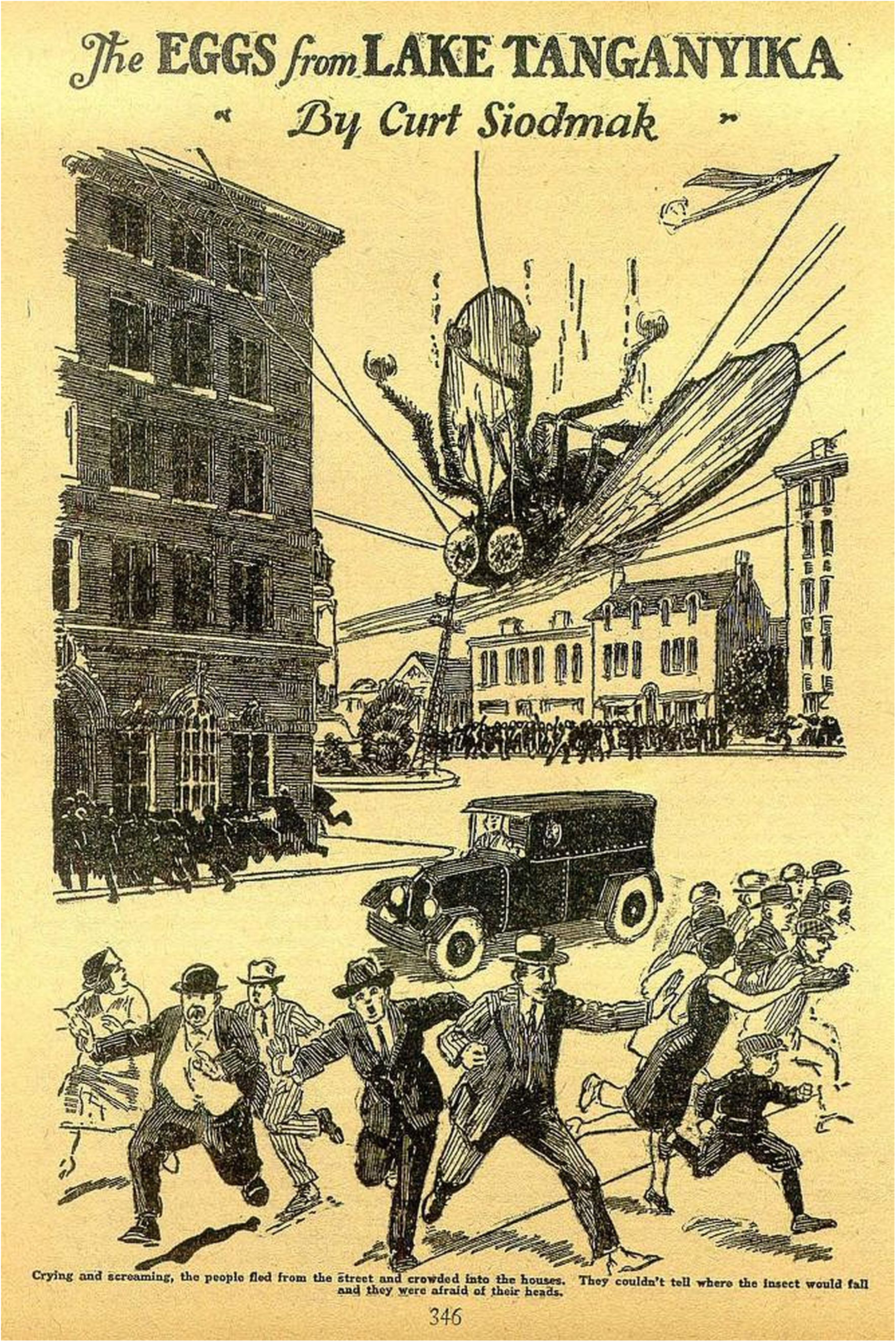
Cover page of the story “The eggs from Lake Tanganyika” by Siodmak in Amazing Stories (July 1926).
Footnotes
Acknowledgments
This research has relied on the crucial assistance of the Tsetse and Veterinary Control Unit at the Zambian Veterinary Department, for research in their archives and on the ground in western Zambia. It is also indebted to the National Archives of Zambia for its support. I am grateful to all research participants in Lusinina, Mulanga, Situmpa and the Mulobezi GMA for taking the time to share their insights.

Ethical approval and informed consent statements
This research has received an ethical clearance from the University of Zambia Directorate of Research and Graduate Studies (REF NO. HSSREC-2022-SEPT.-013) and has met with the approval of the Ethics Committee of the University of Cologne. Interviews were conducted after obtaining written informed consent from the participants.
Data availability statement
Data obtained from the National Archives of Zambia (NAZ) is subject to restricted access, but can be consulted upon compliance with the permit requirements of the NAZ. Anonymised interview data can be accessed by making a direct request to the author.
Funding
The author disclosed receipt of the following financial support for the research, authorship, and/or publication of this article: This research has received funding from the European Research Council under the European Union's Horizon 2020 research and innovation programme (grant agreement number 101020976).