




Abstract
This article unites recent writing in extinction studies with work in political ecology, justice theory and museum studies to explore qualitative, cultural approaches to extinction. I examine the role of storytelling and the power of narratives in addressing nonhuman extinction. Analysing the case study of a permanent gallery on extinction, evolution and biodiversity loss – the Survival Gallery of the National Museum of Scotland – I utilise a more-than-textual approach to narrative analysis. This paper explores the diverse ways in which the gallery relates stories of ‘natural’ extinction to the contemporary anthropogenic ‘Sixth Mass Extinction’. The Survival Gallery narrates a remarkably complex compilation of extinction stories, but the gallery’s narrative avoids areas of conflict or controversy, obscures justice concerns and ultimately presents a problematic depiction of a universalised humanity. Using this analysis of museum extinction storytelling, the paper contributes to emerging conceptualisations of multispecies justice frameworks. The article explores the possibilities and challenges of museum storytelling in grappling with complicated pasts and envisioning potential futures of survival, coexistence and flourishing. The paper concludes by considering how a multispecies justice approach to narrating extinction (and other entangled ecological-social phenomena) might flourish within and beyond museums.
Introduction
It is unsettling to come face to face with a dodo. Dodos, like any extinct animals (and their remains and simulacra) are ‘as dead as a dodo’. They are dead as individuals and species. They represent what Deborah Bird Rose (2004) described as ‘double death’: the erasure of both future and past generations, of individual and collective descendants and ancestors.
When you walk into the Survival Gallery of the National Museum of Scotland, the first object you see is a dodo. The model stands atop a wooden base and stares into the distance. This model is crafted in such a realistic manner that it almost looks alive, and, if not alive, like a real stuffed bird. Above the bird’s head, a label titled ‘As dead as a dodo’ describes the dodo as ‘an icon of extinction’. It is an odd yet fitting choice of specimen to introduce an exhibition on survival – the dodo is best known for its failure to survive. In an interview, the gallery’s curator used the same phrase – ‘icon of extinction’ – in explaining why this animal was at the gallery’s entrance. 1 He said that the museum chose the dodo because ‘it kind of heralds the period when modern extinctions began, when Europeans started traveling around the world.’
The dodo immediately connotes a fateful sense of extinction, loss, maladaptation and connections between the onset of European colonisation and global ecological damage. ‘As dead as a dodo’ and ‘going the way of the dodo’ have entered the vernacular as references to death and obsolescence. The dodo is a tragicomic figure. It is at once imagined as too ‘fat, stupid and slow’ [model caption] to avoid extinction at the hand of European settlers and mourned as the first species driven extinct by ‘modern’ humans. (Notably, Freeman (2011) argues standard representations of dodos as inept birds whose demise was inevitable are based on incomplete, contradictory, obscured and biased evidence.) From Carroll’s (1865) Alice’s Adventures in Wonderland, to Quammen’s (1996) The Song of the Dodo, the ubiquitous dodo symbolises the course of ecological and wildlife histories since the 17th-century. It is the canary in the coalmine of anthropogenic destruction. Its extinction is seen as the inevitable outcome of human interaction with nature.
Seeing a dodo, then, is unsettling. The affective experience of looking a (simulated) dodo in the eyes is discomforting and confusing. It evokes particular collective memories, histories and narratives. I argue that part of what feels unsettling about looking at a dodo is that it brings up thorny questions about justice. As icons of extinction, dodos elicit broader ideas about the injustice of extinction. But justice for whom? About what?
In this article, an attention to forms of (in)justice informs my analysis of museum storytelling about extinction. Examining the ways in which extinction produces stories, and stories produce particular experiences of extinction, I narrow in on a particular site of extinction narration: the Survival Gallery, a permanent gallery of the National Museum of Scotland. I show how this gallery tells the entwined stories of evolution and extinction and frames these within our present moment of planetary peril, the anthropogenic extinction crisis. Visitors come face to face with extinct and endangered animals, as well as with stories about extinction, biodiversity loss and the course of human history. This article elucidates the extinction narratives the Survival Gallery imparts, analysing the ways in which the gallery does – and does not – engage with issues of social, environmental and ecological justice. Like gazing at a taxidermied or modelled extinct animal, tackling these issues can be deeply unsettling. It involves considering different perspectives, incompatible demands and ethically hazy – and even problematic – terrain. In the conclusion, I speak to these complexities of extinction with reference to multispecies justice and to the possibilities and challenges of museum storytelling in grappling with complicated pasts and envisioning potential futures of survival, resilience, coexistence and flourishing.
Although focused on one museum gallery, this article speaks more broadly to current attempts within and beyond academia to grapple with the contemporary global anthropogenic extinction event: the Sixth Mass Extinction. Seeing extinction as far from simply the loss of species, scholars in the newly emerging field of extinction studies reveal the ways in which extinction produces as much as it destroys – although this production may not be positive. Whilst relationships, stories and functions are lost in extinction, new presences, stories, and relations are produced (Mitchell, 2016; Parreñas, 2018; Price, 1999; Rose, 2012; Whale and Ginn, 2017). These productions are not only immaterial or representative of the ghosts of extinguished individuals and their species, but also may include the material remains – and even material returns – of such beings. Conversations about extinction, storytelling and ethics have also produced the concept of ‘extinction narratives’ (see, for example, Jørgensen, 2017a, 2017b; Rose et al., 2017; Turner, 2007). In the context of narratives of absence and presence of species on the brink of extinction, Jørgensen (2017a: 56) argues that ‘extinction events become real to us through the stories we tell’.
My analysis is based on observational fieldwork; complete transcription of the labels and other texts in the gallery; thick description of the materials, texts and audio-visual components of the gallery; and a semi-structured, go-along interview with the gallery’s curator. 2 I build on and contribute to recent methodological interventions, including the concepts of ‘narrative geography’ (Ryan et al., 2016), ‘lively ethography’ (van Dooren and Rose, 2016) and ‘thick description’ of animal-objects (Baker, 2014). This article’s approach to museum narratives might be described as both more-than-textual and more-than-representational, arguing that embodiment, affect and non-representational analyses cannot be siloed from storytelling, narratives and representation. 3 In short, museum narratives are not merely representational; they are affective and embodied experiences with consequences. In the Survival Gallery, the visitor experiences the narrative by literally walking through it. My subsequent analysis mirrors that experience. 4
Narrating extinction: the Survival Gallery
As discussed earlier, the Survival Gallery opens with a dodo display case and a label titled ‘as dead as a dodo’. It describes the dodo as an icon of extinction and uses the dodo’s iconicity to launch into a narrative about ‘Survival’. 5 This narrative consists of two main storylines. One is of natural extinction and evolution, the other of unnatural anthropogenic extinction; the dodo serves as a symbol for both. Given the dodo’s dubious honour as an icon of extinction, it is unsurprising that the National Museum of Scotland is not alone in uniting the dodo, modern natural history and extinctions. From its global presence in temporary exhibitions, to the permanent display of the ‘Oxford dodo’ at the Oxford Museum of Natural History, the dodo is ubiquitous. 6 An online description of a dodo display at the American Museum of Natural History describes the bird as ‘a lesson in extinction’.
Yet the dodo is not the only ubiquitous image of extinction – extinction itself has a certain omnipresence in museum exhibitions about animals and natural history. Past and present animal life cannot be discussed without being haunted by the spectre of anthropogenically driven extinction. Taxidermy and other zoological specimens are important tools of museum storytelling about extinction. Animals like the iconic dodo gain metaphoric potency as they are placed in the past, outside of modernity – and are unable to return the human gaze (Berger, 2007 [1980]). The inability of animals to return human gazes is made starker still in the context of museum exhibitions, which are unlikely to contain live animals. (The Survival Gallery displays no live animals.) Instead, museums often contain ‘animal-objects’ (Wehner, 2017), such as taxidermy, bones, skins and other whole or partial remains. Wehner argues that preserved animal-objects prompt reflection on how we represent nonhuman nature and understand ourselves.
An animal-object is all the more unsettling because of its dual role as an individual and a representative of its species. Museum animal-objects all have unique biographies – each is an individual. Whether animal-objects are whole, life-like individuals represented in realistic dioramas (Morris, 2012; Tunnicliffe, 2013), or partial trophies visually narrating the story of their own deaths (Poliquin, 2012), they have the power to hold multiple stories and provoke responses. Haraway’s (1984) influential analysis of natural history museum taxidermy observes the ways in which taxidermy can narrate and uphold power structures and colonial–patriarchal ways of knowing. Yet animal-objects can also disrupt standard narratives, prompt enquiry about human–animal relations, create new stories and catalyse affective responses (Baker, 2014; Kalshoven, 2018; Lanham, 2018; Patchett, 2017; Patchett et al., 2012; Poliquin, 2012; Robin, 2009). 7 Although animal-objects are unsettling, they also are more than just deadness displayed – despite their inability to fully tell their own stories. 8
For the curator, the Survival Gallery is intended to tell a particular story and to address both sides of extinction: its ‘naturalness’, and the fact that ‘modern’ extinctions represent something outside of ordinary eco-evolutionary processes. In its opening texts, the gallery mirrors the curator’s description, linking processes of thriving and dying to survival and adaptation. It adds: ‘what we do to the world around us affects these processes dramatically and threatens the survival of life as we know it’.
As you walk into the gallery, this text and the dodo opposite it greet you. This exposition immediately sets the tone for the exhibition to follow as simultaneously scientific, educational, morally serious and ominous. The tone of the gallery begins in a studiedly neutral emotional mode but builds into despair and horror, and finally, naturally but potentially misleadingly, hope and optimism. These narrative modes mirror the two main forms of extinction narratives identified by Heise (2016): first, the individualising, elegiac, tragic narratives that focus on the last individual(s) of species, and, second, narrative forms invoking massive scale, or a ‘numerical sublime’ representing a contemporary take on the genre of epic. Both narrative forms are present in the gallery narrative that follows the dodo model, and both evoke affective responses.
Science versus culture: evolution and extinction
The dodo entry-point provides exposition for the narrative being relayed, establishing what is natural about evolution and extinction – and laying the groundwork for the unnatural part of the story. For the curator, it was important that visitors realise ‘evolution and extinction are complementary processes’. As we stood at the gallery entrance, he mentioned that he was staunchly opposed to including creationism or intelligent design in the exhibition, explaining that they wanted to keep this gallery ‘purely scientific’, and that non-scientific life origin ideas could be ‘dealt with in the other galleries, the world culture galleries’. As the curator envisions it, this separation between culture and science is necessary to communicate the scientific nature of extinction and evolution.
Although the desire to separate scientific knowledge from other forms of knowledge is understandable, particularly in a time of vast public scientific misunderstanding (notably, around anthropogenic climate change), this effort faces practical challenges. As seen in Figure 1, the gallery has multiple access points besides the official dodo entry, and I observed that many visitors enter the gallery from a cultural gallery about artistic representations of the natural world. The cultural and the scientific bleed into each other in this museum. Across the institution, one can find ‘scientific’ objects in cultural galleries, and ‘cultural’ objects in scientific galleries. People do not experience the museum or the world outside the museum in neat divisions between science and culture. This article shows that even a story ‘purely’ of evolution and extinction involves many ‘unscientific’ elements. Beyond the practical challenges of separating the ‘cultural’ and the ‘scientific’, there is a more fundamental, epistemological problem. As current scholarship in extinction studies suggests, the binary division between ‘cultural’ and ‘scientific’ is not tenable and promotes incomplete understanding of the ways in which the ecological and the social are always, already entangled.
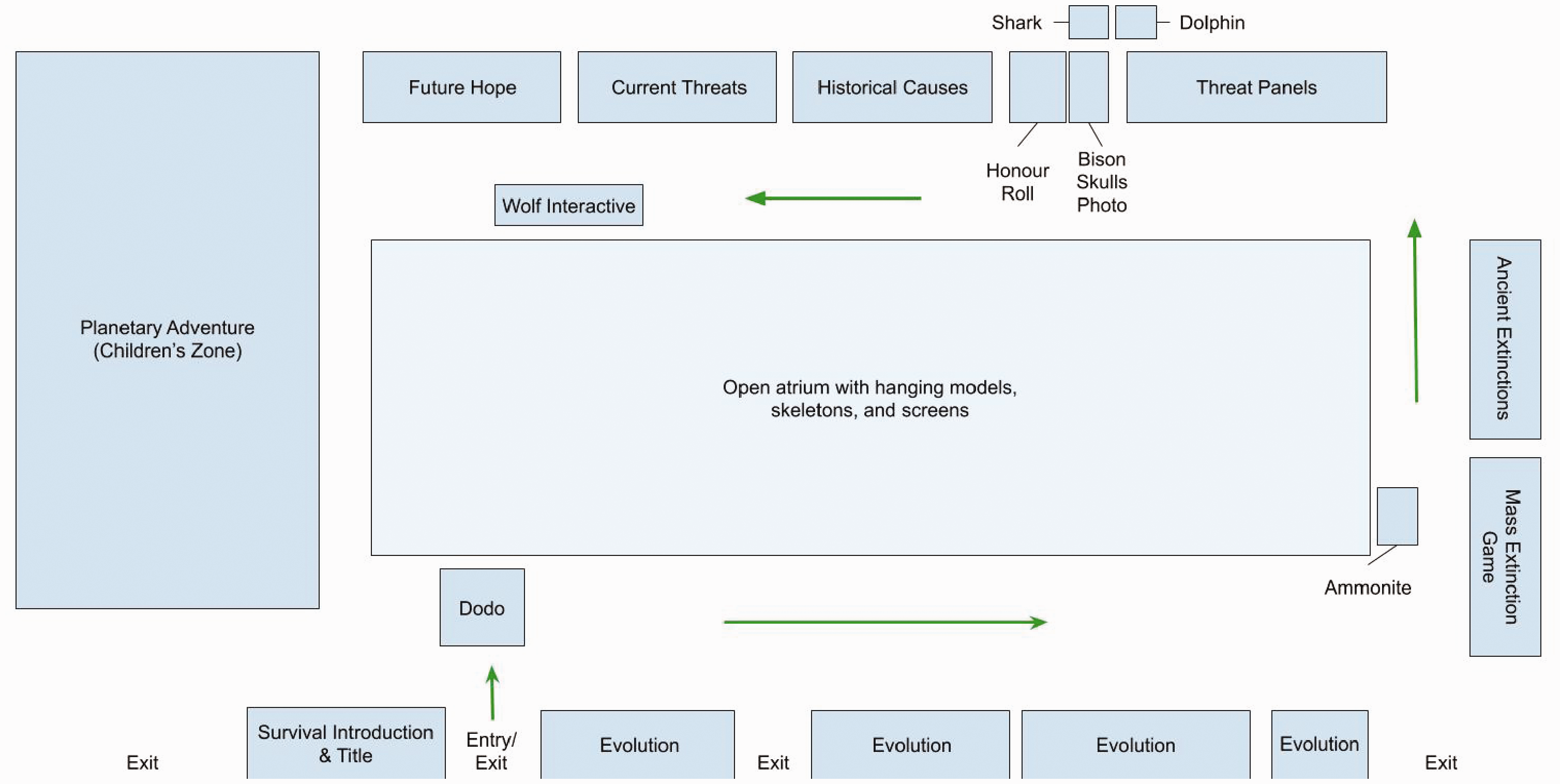
Map of Survival Gallery (graphic by author).
‘Natural’ versus ‘unnatural’ extinctions
The evolutionary portion of the Survival Gallery starts the narrative en medias res, or in the middle of a story of natural balance between the processes of species emergence and death. The gallery then proceeds into a linear and chronological narrative about interruptions of this balance. As the gallery literally turns a corner, discussion of mass extinction begins. A large interactive display about prehistoric mass extinctions leads into the first glass display case about extinction. The text introducing the display case is the first mentioning humans and containing human-related specimens.
The displays describe the causes of extinction as ‘dramatic global events or smaller-scale local factors’, including climate change, interspecies competition and natural disasters. At this point, humans enter the story through short descriptions of human evolution and Palaeolithic hunting of mammoths. This exhibition case provides a pivotal turning point in the gallery’s narrative: the transition from natural to unnatural extinctions. On the far left, a panel titled ‘In harmony with nature?’ reads: Humans have never lived in harmony with the natural world. Since the earliest times, wherever people have travelled they have caused many extinctions, especially on islands. For example, New Zealand, Madagascar and many Pacific islands have lost hundreds of species because of the activities of human colonizers.
9
Yet this panel is not simply a radical manifestation of nature–culture dualism, or of anti-human sentiment. By arguing against the idea of a previous, idealistic harmony with nature, the text positions itself against tendencies to over-romanticise the past and people associated with the past, particularly Indigenous people. As the curator noted in our interview, …human-caused extinctions are not a recent phenomenon … But it’s the rate of extinction which has increased recently … …there’s a commonest, kind of romantic assumption that before we settled down and grew crops and cut down trees, that we lived in harmony with nature. But there’s very little evidence for that … the idea of extinction is fairly modern … And so if we’re not going to destroy everything, we’ve got to take a conscious decision not to do it, because we know what those impacts are now; we can’t say, ‘oh, we don’t know what’s going on’…
10
A universalised human threat
After introducing humanity as an unnatural villain (if accidental and perhaps unwitting), the Survival Gallery turns again. The third wall focuses on the causes of, and potential solutions for, anthropogenic extinction. This section starts with a series of panels about anthropogenic threats towards species and biodiversity. The panels discuss climate change, tropical deforestation, pollution, poaching and overfishing. Each includes an orange circular plate with a ‘true or false question’, which can be lifted to reveal the answer.
Introducing these threat panels, a label titled ‘Human impact’ ominously states: ‘People have always had an impact on other species and natural environments. However, the ever-increasing impact of today’s huge and expanding human population has brought us to the brink of the next mass extinction’. After listing examples of human actions, the text concludes: ‘The scale of this impact is unprecedented. Our activities are bringing about catastrophic global changes, which could affect our own future survival’. This text represents a transition point in which prehistoric anthropogenic extinctions are differentiated from modern anthropogenic extinctions on the basis of scale and rate. Importantly, the ultimate driver the text identifies is population growth. In a rather neo-Malthusian framing, it describes the sheer number of humans as driving extinction.
Envisioning human population growth as the driver of our anthropogenic extinction event, and of our global environmental crisis, may seem reasonable at first glance. Indeed, a quick review of scientific, popular and even philosophical discussions of anthropogenic extinction yields a similar conclusion: that we, humanity, are nature’s relentless enemy (Cafaro, 2015; Cafaro and Primack, 2014; Kolbert, 2014; Wilson, 2016a, 2016b). This general ‘we’ of humanity thus becomes a greater threat as it grows through global human population growth.
Human population growth is not, however, as straightforward a driver of ecological degradation as is often assumed. Sustainability researchers have long observed that consumption more strongly predicts increased CO2 emissions than population growth (Satterthwaite, 2009). Although the gallery in this section does identify ‘ever-increasing impact’ and consumptive activities as major problems for biodiversity and the planet, it frames these issues within the umbrella concern of population growth. The gallery misses the opportunity to directly address rising consumption and environmental impacts amongst populations which are not growing rapidly, such as the UK and the US. In addition, environmental rhetoric’s common focus on reducing population growth has been heavily critiqued for both its social injustices and its inaccuracies (e.g. Hendrixson et al., 2020; Rosales, 2008). Some narrative opportunities are, thus, avoided or excised, to focus on the dominant story of unnatural extinction, its drivers and its potential mitigants.
This section of the gallery also raises an important issue: that of the universal, homogenous human ‘we’. Using a universalised ‘we’ has fundamental flaws. 11 The universalised threat of ‘ourselves’ obscures inequality amongst humans in responsibility for, and impacts of, ecological degradation (Dunaway, 2008). Critiques of environmentalism’s universal ‘we’ note that it obscures the ways in which certain groups of people, institutions and nations are more responsible for, and more affected by, environmental degradation (Dunaway, 2008; Malm and Hornberg, 2014; Pulido, 2018; Yusoff, 2018).
Critical race theorists, amongst many others, have argued that the narrative of the human species (and its universal, novel existential threat) acts to crowd out alternative axes of justices (Braidotti, 2019; Pulido, 2018; Whyte, 2018; Yusoff, 2018). As the collective of humanity, ‘we’ do not all experience environmental problems identically or even similarly, nor are ‘we’ all responsible in identical ways. As van Dooren (2011a) observes, all humans may be implicated within multispecies relationships, but the specific relationships and their complications are particular. Pulido (2018) further observes that, although analyses of the Anthropocene have rightfully critiqued the use of a universal ‘we’ and universal ‘Anthropos’, these critiques often are vague and euphemistic about who this ‘we’ does and does not – or should or should not – encompass. She calls for more direct attention to the integral role of racism in the emergence of what we might call the Anthropocene, rather than vague denunciations of the universal ‘we’.
Yet even those scholars who acknowledge the problems of a universal ‘we’ struggle to avoid using it, pointing to the difficulty of writing about ecological issues in ways that acknowledge particularity and collective responsibilities (see, for example, Garlick and Ginn (2016) on van Dooren (2014)). This rhetorical tendency is common in extinction studies. Although using such a ‘we’ invokes a needed sense of collective responsibilities and impacts, its incautious use risks erasing differences within the collective of humanity. We may all be experiencing extinction and other environmental crises together, but the ‘we’ of humanity is not, and has not been, a unitary, homogeneous whole. Critiques of the universal, homogenous ‘we’ reveal the ways in which extinction must be understood within postcolonial legacies of intertwined ecological and social histories (see, for example, Nixon, 2017; Paravisini-Gebert, 2014; Parreñas, 2018; Sze, 2015; Taylor et al., 2015; van Dooren, 2017a).
Using ‘we’ more carefully in extinction storytelling may allow us to pay closer attention to the ways in which political and economic inequity, racism, (neo)colonialism, imperialism and ecological debt amongst nations intersect with issues of extinction and biodiversity loss. Although avoiding the universalising tendencies of the word ‘we’ may not be entirely possible, attempting to qualify and particularise ‘we’ and human characters in extinction stories is vital. Not only is such an attempt an important way to better understand the social complexities affecting ecological phenomena, but so too does attempting to understand nuance, particularity and social differences enable telling more socially just extinction narratives. Although ‘we’ are embedded in multispecies relations that shape our experiences of extinction, these relations are not universal.
Scale and loss: individual and species-level thinking
After passing the population-focused threat panels, the next displays visitors see are amongst the grimmest in the Survival Gallery. Models of a dolphin entangled in a net and a bloody shark dangle from above. A label describes dolphins drowning as bycatch by the thousands each year. Another label titled ‘In the soup’ describes the bycatch of approximately 20 million blue sharks (near threatened), adding: ‘11 million are caught for shark fin soup, with the rest of the shark often thrown away’. Just beyond these models is a print of a 19th-century North American photograph: two men atop a staggeringly large pile of bison skulls. This photo is famous amongst environmental historians and Indigenous and critical race scholars as a clear indication of the entangled horrors of the purposeful extinction campaigns against both Indigenous peoples and bison in the violent taking of the American frontier (e.g. Isenberg, 2000). Any discussion of this eco-social history, however, is avoided in the exhibition. A list of species is superimposed over this image. The list, titled ‘Extinctions Roll of Honour’, names mammal and bird species that have been driven to extinction in modern history. 12 It is a provocative trope, suggestive of military or otherwise historical commemoration of named or unnamed individuals. Yet, unlike traditional commemorative monuments, this ‘Honour Roll’ intends to shame as much as honour.
Together, the tortured shark and dolphin and the list of modern extinctions printed over an image of human cruelty and waste serve as a clear indictment of modern human history’s ravaging effects on the nonhuman world (particularly animals). Yet there is more happening in these pieces. Here, the gallery begins to engage with different scales of storytelling within its overarching narrative. The gallery interacts not only with collectives (primarily species and populations), but also with individual animals.
Beyond these models, the gallery uses taxidermy specimens in three successive display cases to allow visitors to connect with individual animals. Some of these animals have personalised stories and are posed in ways that make them seem almost alive. For example, it is possible to make ‘eye-contact with’ a collared Iberian lynx posed in mid-prowl, or with a giant panda against a tree trunk. A quagga is accompanied by text describing it as the only quagga ever photographed alive. This text calls the specimen a ‘she’; the curator described the lynx specimen as a ‘he’ named ‘Zeus’. Elsewhere, the gallery uses the pronoun ‘it’ to describe species and their individual members, but with certain specimens, a sense of individual subjectivity emerges. We begin to see that those experiencing extinction are beings, not simply numbers. Acknowledging the individual pain and death involved in extinction moves the gallery into a more elegiac narrative mode (Heise, 2016), which is mirrored by an audio-visual projection that routinely plays haunting piano accompaniment.
The gallery’s emphasis on individuals, particularly with the only photographed quagga and with a discussion of Martha (the last passenger pigeon), resonates with the idea of the power of the ‘endling’ (Jørgensen, 2017b), in which an individual animal’s story operates at both personal and collective scales. Similarly to Heise’s (2016) discussion of the emotional impact of singular, elegiac narratives of last individuals of a species, Jørgensen (2017b) specifically examines the emergence of the term ‘endling’. Jørgensen (2017b: 136) argues that the concept, which entered public consciousness through a museum exhibition, can ‘make the narrative personal while retaining the universality of extinction’. For Jørgensen and Heise, these individual ‘endlings’ provide personalised, emotional connections to biographies of extinction.
In addition to ‘endling’ stories, the gallery includes examples of individual animal biographies that stand-in for the horrors of extinction writ large. Focusing on the individualised injustices of extinction relates to a major ecological justice concern raised by extinction studies scholars. Scientific conservation and extinction discourses’ emphasis on collectives (species, populations or statistics) inevitably erases individual-level suffering, violence and meaning (Chrulew, 2011; Parreñas, 2018; Srinivasan and Cochrane, 2020; Srinivasan and Kasturirangan, 2017; van Dooren, 2010, 2014). Observing that scientific conversations often emphasise numbers, statistics, percentages and population-level effects, van Dooren (2010, 2014) urges attention to the individually felt experience of pain within the collective process of extinction that are obscured by these emphases on collectives. The models and individualised biographies of specimens allow a personal, affective connection with the more intimate impacts of extinction.
Ecological justice concerns regarding the individual welfare of invasive and non-native species have long been noted, as have the problems inherent in classifying ‘native’, ‘invasive’, ‘introduced’, ‘alien’ and ‘non-native’ species (Chew and Hamilton, 2011; Srinivasan and Kasturirangan, 2017; van Dooren, 2011b). So too, though, do target species face potential injustices regarding individual welfare. van Dooren (2014) further describes conservations’ ‘regimes of violent care’, in which caring for individuals and species may coincide or conflict. Captive breeding and other conservation interventions can harm individuals, whilst caring for their species (Chrulew, 2011; Parreñas, 2018; van Dooren, 2014). Chrulew describes these individuals as ‘overloved’ (2011: 139).
A particularly vivid example of the individualisation of extinction and the pain it entails is in the second display case. Below a taxidermied Tasmanian devil, a label titled ‘Devil disaster’ shows a gruesome image of a tumour-stricken individual and describes the plight of the species as follows: … Facial Tumour Disease is a cancer spread by aggressive animals biting each other, resulting in entire populations being wiped out in 12-18 months. It was first recorded in 1996, but had wiped out 60% of the total population by 2009. The facial tumours prevent feeding and cause the devils to starve to death three to five months after they appear …
The individualised horror of extinction, however, appears to be a major motivation behind the ‘Extinctions Roll of Honour’. The curator described war memorials as inspiring the honour roll: ‘we really wanted to give some sense of the magnitude of loss, even in quite a short period of time. And even though that’s only mammals and birds, I think it has been very powerful … and also the image behind the stack of bison skulls, people are absolutely horrified, it’s an amazingly powerful image’. 15 In this statement, the curator identifies horror as an affective response evoked by both war memorials and the gallery’s extinction honour roll. Moreover, the honour roll combines magnitude with the particular species that this massive biological loss entails. 16 Like a war memorial with the names of soldiers who died en masse, the extinction honour roll combines small scales with hauntingly enormous ones.
The extinction honour roll, however, operates at a wildly different scale than the individual taxidermy specimens and models. Despite being based on war memorials, which commemorate individual soldiers, the honour roll memorialises species. Species are collectives; their extinction comprises the multiple deaths of individuals. Although the honour roll allows for the particularity of a species within the much larger collectives of ‘biodiversity’ or ‘animals’, it overlooks the ways in which extinction is experienced by individuals.
This tension in negotiating between individuals and collectives manifests in one of the most poignant displays: an empty shell of the extinct Partula snail is all that remains of an animal whose captive breeding effort failed. The curator described this specimen as ‘one of the most dramatic exhibits’, adding ‘…despite our best efforts, it did become extinct. I think that’s very powerful – a tiny little shell of something which is lost forever’. This specimen is indeed powerful and symbolic – but its individuality is lost when it is seen as representing its species’ death, and not also its own.
Whether it is the painful death of an individual animal, or the loss of local knowledge once held by a community of individuals who existed within webs of relationships, extinction is not a phenomenon affecting only abstract collectives. Although the honour roll attempts to match the individual particularity of war memorials, it fails to do so because it remains at the collective, species scale. 17 The moments in which individual stories emerge within the overarching narrative thus become points of exception. Moreover, the honour roll contributes to a troubling overarching narrative: one of a homogenous, collective humanity at war with nature.
Extinction histories and inheriting colonial legacies
The Survival Gallery’s overall commitment to narrating a story at the scale of species – with moments of tension or contradiction – is also apparent in its discussion of the human species. After setting the scene, negotiating scale and establishing the character of humanity, the gallery returns to a chronological and linear narrative format with three successive display cases. A label titled ‘A history of modern extinctions’ introduces the display case directly following the honour roll: Modern extinctions caused by human activity date from around 1600, when European nations started to explore the world by sea. Some Europeans simply wanted to increase their knowledge of the world, but most set sail in search of opportunities to trade, expand territories and exploit natural resources. Since then, the activities of Europeans and the animals that travelled with them around the world have had an ever-increasing impact on native plants and animals, causing thousands of species to become extinct.
Yet this moment of exception is short and easy to miss. The gallery quickly moves its overarching narrative back to a universalised human agent of extinction. The second display case transitions into the late 20th- and early 21st-centuries, grouping specimens by their contemporary threats, including ‘habitat loss’, ‘pollution’, ‘hunting and persecution’, ‘alien predators’, ‘diseases’ and ‘hybridization’. This display case (and that preceding it) features sepia and black-and-white backgrounds, as well as partial specimens, including hunting trophies. These partial animal-objects – bones, fragmented skeletons and the like – are deeply unsettling. The combination of texts, specimens and backgrounds in these cases inspires a sense of horror and grief. A textual panel titled ‘Human greed and global change’ introduces the second case, stating: As global human populations rapidly increase, increasingly sophisticated technologies are used to encroach on and threaten natural habitats. Human-made environments damage the natural systems that regulate the air, soil and water on which all life depends. Extinction rates may now be 1000 times greater than the normal background rate. If we do not change our ways, we will threaten our own survival. Life will continue, but we may not be here to see it.
Political ecologists have long noted that biodiversity conservation is not a neutral activity and always involves geopolitical, social and ecological choices that intersect with systems of power. Classic analyses have traced connections between conservation and displacement (Adams and Hutton, 2007; Agrawal and Redford, 2009), erasure of human histories to imagine uninhabited wildernesses (Adams and Hutton, 2007; Cronon, 1996), violence and human rights violations (Brockington et al., 2006; Duffy, 2016) and portrayals of local peoples as ignorant and as primary threats due to their visibility (Igoe and Brockington, 2007).
Although most of the current political ecology literature focuses on social impacts of biodiversity conservation, biodiversity loss and extinction also have eminently social impacts (United Nations, 2019). One primary impact is altered ecosystem functions and services (Cardinale et al., 2012). Additionally, economic inequality has been linked to higher levels of biodiversity loss (Mikkelson et al., 2007). Political ecologists and others also argue that economic growth, inequality and ‘differential responsibilities’ between nations are intimately entwined with both justice and biodiversity issues (Iles, 2003; Lindsey et al., 2017; Rosales, 2008). Neither the social impacts of biodiversity loss and extinction nor the social impacts of efforts to mitigate these ecological issues are acknowledged in these museum cases.
Instead, the universalised humanity of the ‘threats’ display case maintains its prominence in the final display case, titled ‘Saving our future?’, which states: Although there are many threats to the natural world, there is much that has been done and can be done to ensure that There are many conservation success stories both at home and further afield that give
Absent from this display case, however, is any discussion of controversies and potential harms of these mitigation techniques. Neither ecological justice nor environmental justice concerns appear. Instead, the final display case opts for a more positive – and incomplete – vision of future restoration. This narrative choice mirrors Turner’s (2007: 59) observation that standard extinction narratives exist within a binary of ‘peril’ and ‘recovery’, but that ‘genetics-based stories’ play a significant role ‘in opening up the apparent dead end of extinction’. As Turner notes, de-extinction and other genetically focused extinction stories provide an opportunity to avoid the tragic ending of extinction – and to avoid grappling with the stories and choices that led to that apparent extinction. 19
Another aspect of extinction that is lost in this positive end-note narrative strategy is that bringing a species to the brink of extinction does entail real losses. One key way in which extinction can be understood to constitute a form of ecological injustice is through the loss not only of a species but of animal cultures and communities (Garlick, 2019). Extinction studies scholars point to loss of shared memory, of generational landscape change, of individual health and wellbeing and of particular relations as injustices of extinction – and near-extinction (Garlick, 2019; Parreñas, 2018; Rose, 2004; van Dooren, 2014). Even if species are brought back from the brink, their stories are more complex than the simple binary of decline-and-recovery suggests.
Although there are certain challenges in presenting complex and controversial issues in the medium of a natural science museum gallery, it is vital to engage this complexity. As Taylor et al. (2015) and van Dooren (2017a) argue, it is impossible to avoid inheriting intertwined wildlife, environmental and social histories. The question becomes how to inherit these ‘biocultural’ legacies responsibly from ‘within a time of colonization and extinction’ (van Dooren, 2017a: 203–204). These difficult biocultural histories are always unsettled – and unsettling. Yet we cannot reckon with these histories without doing the work of grappling with them. This work must involve engaging with complexity, contradiction and confusion of these inheritances, instead of silencing them, or briefly alluding to them before turning away.
By deliberately and explicitly connecting European exploration and colonisation, as well as later imperialism, to extinction and broader ecological degradation, the Survival Gallery takes an excellent step towards acknowledging the complex ecological and cultural histories it is attempting to inherit and represent. Although this is a necessary and important first step, I argue that it is necessary to go farther. It is important to connect settler colonialism and extinction, as well as environmental destruction and ‘greed’ (and, implicitly, capitalism), but it is not enough. It is also essential to unpack the ways in which these historical legacies continue to reverberate in the present – and to unpack who the ‘we’ truly refers to in each extinction story. Is it a truly universal we? Perhaps there is a universal ‘we’ that can refer to humanity’s collective encounter with extinction and endangerment. But even if ‘we’ all are involved in the overall phenomenon of extinction, we are also all involved in particular ways, through particular relationships, communities and histories.
Furthermore, the very fact that the curatorial staff could not create the Survival Gallery without mentioning colonialism indicates that it is impossible to separate ecological and cultural histories. The story of modern extinction cannot be told without cultural, social, economic and geopolitical histories of colonialism, imperialism, exploration and exploitation. Stories of extinction are not ‘purely’ scientific and cannot be told from a ‘purely’ scientific lens. Moreover, the inseparability of social and ecological issues and histories indicates the intertwined nature of social, environmental and ecological justice(s).
Conclusion: multispecies justice in an age of extinction
As shown by the contributions of recent extinction studies, political ecology and justice scholarship, extinction is not simply a scientific challenge. How we tell stories about extinction matters. Narrating extinction responsibly requires embracing different perspectives and acknowledging conflicting demands.
Yet as van Dooren (2015) notes, simplified scientific stories have certain conservation efficacy, which should not be discounted. Museums face the challenge of balancing narrative depth and complexity with narrative simplicity and efficiency. Although addressing this conundrum is not easy, I believe oversimplified storytelling is not the answer. Tackling the social and ecological challenge of extinction and biodiversity loss demands moving past binary divisions between humans and nature, science and culture. It demands complex interdisciplinary storytelling.
Oversimplified narratives about extinction obscure these many forms of justice. By reducing the history of extinction to a singular story of universal human responsibility and destructiveness, the Survival Gallery erases issues of social, cultural, political and economic differences amongst humans. Extinction storytelling can and should be more socially just. Social injustices, however, are not the only justice issues neglected by oversimplified narratives. Despite being the arguable focus of extinction storytelling, ecological justice can also be ignored, particularly in terms of individual welfare and ‘unloved/overloved’ individuals and species. Narrating extinction therefore requires a multifaceted approach to justice, incorporating social, environmental and ecological concerns.
A new justice framework – that of multispecies justice – has only just begun to be conceptualised, defined and debated. In its most simple definition, multispecies justice may be described as a framework that considers both environmental justice (environmentally linked justice issues affecting humans) and ecological justice (those affecting nonhumans) (Celermajer et al., 2020; Heise, 2016; Lorimer, 2015). Environmental and ecological justice theories often run in parallel without direct engagement with each other (Schlosberg, 2007). Multispecies justice theory attempts to bridge this gap and to address the limitations of using either in its respective silo.
Lorimer (2015) and Heise (2016) independently offer useful definitions of multispecies justice. Lorimer (2015: 193) argues that the ‘hybrid’ status of wildlife necessitates a new ‘multispecies model of justice’. Lorimer’s model of justice includes an attentiveness to the unevenness of the ‘we’ of humanity, implicitly acknowledging social justice issues (2015: 184). Heise (2016) similarly and independently develops her own concept of ‘multispecies justice’, with more explicit attention to social difference and social justice. Heise (2016: 167) describes multispecies justice as considering ‘ontological differences between species’ and ‘cultural differences in divergent understandings of justice’ amongst humans. Heise seeks to draw multispecies ethnography and political ecology perspectives into conversation and to maintain awareness and sensitivity towards both cultural differences and species differences.
By implicitly or explicitly bringing together human and nonhuman justice issues, many recent works in extinction studies lean towards a model of multispecies justice (see, for example, Dawson, 2016; Heise, 2016; Parreñas 2018; Rose et al., 2017; van Dooren, 2011a, 2014, 2015, 2017a). Whilst these works do not attempt to flatten out differences between justice for nonhumans and justice for humans – and most are quite careful to make this tension clear – their interest in considering both forms of justice as entangled phenomena suggests that the field of extinction studies may provide fertile ground for continuing to conceptualise what a multispecies form of justice might be.
The varied forms of injustices of extinction illustrate the significant analytical potential of a multispecies justice framework for extinction. I argue that this multispecies justice should not equate nonhumans to humans, but rather evoke a perspective shift that allows better visualisation of the interconnections and tensions between social and ecological issues. Multispecies justice also requires the challenging of other divisions, particularly the nature–culture and science-humanities binaries. This justice framework necessitates working across disciplinary and ideological silos. Extinction and its injustices require new modes of storytelling that consider – without suggesting false equivalencies amongst – all subjects of justice.
There are hints of a multispecies justice perspective in the Survival Gallery – but these hints are overshadowed by the dominant, simplistic, scientific narrative separating and vilifying humans. The moments when the gallery pauses to consider individual welfare of animals, or to acknowledge the relationship between European colonisation and ecological exploitation, or to question common narratives about environmental history, are moments of quiet contradiction. Instead of making these moments exceptions, the gallery could embrace these complexities, tensions and confusions. Complexity and conflict need not be negative. Instead, they can represent nuanced and thoughtful storytelling.
A multispecies justice approach to narrating extinction past, present and future requires this level of complexity and a commitment to listening to conflicting stories, instead of silencing them. Critiquing a museum exhibition for not embracing a multispecies justice narration approach is easier than envisioning alternative modes of narrating. What, then, might a more just exhibition look like? The following four suggestions are drawn from my analysis of other museum strategies and utilise institutions similar to the National Museum of Scotland (in terms of language, mission and resources).
First, a multispecies justice approach to museum narration would require narrative strategies to make engagement with social history, inequality and justice issues unmissable. One of the key moments where the Survival Gallery approaches a multispecies justice mode of storytelling is its label about the relationships between biodiversity loss and colonialism. This label is easy to miss – it is a single, small label of just a few square inches lost amid the overarching narrative of a universal human ‘we’. It is surrounded, both materially and figuratively, by a different narrative. Instead of inserting one small text within a broader narrative, a museum might first consistently narrate (instead of inserting small moments of contention), and, second, ensure that messages about entangled social and ecological histories are striking. They should be unmissable. An excellent example of what we might call ‘multispecies justice museum storytelling’ utilises these techniques. In 2019, curators at the Bristol Museum decided, after student enquiries, to place black veils over extinct and endangered specimens in the museum (Morss, 2019). This visual was striking. In addition, the curators add new, re-contextualised labels about the specimens’ histories within the context of histories of biodiversity loss, violence and colonialism (Morss, 2019). In this curatorial intervention, the museum sparked new conversations through startling but low-budget changes in the way they presented their collections.
Second, museums may investigate and openly discuss institutional histories, including the biographies of their own specimens. A recent example is the Grant Museum of Zoology. In an exhibition titled ‘Displays of Power: A Natural History of Empire’, the museum researched its own collecting activities. 20 This investigation linked individual animal-objects’ biographies with institutional histories of collecting, natural history and colonial and imperial science. Relatedly, in my interview with the Survival Gallery’s curator, I learned more about the history of the specimens on display and about how the gallery was developed with the idea of bringing out specimens from backrooms and hidden drawers. Outside the interview, I also learned that the curator’s own research on dodo natural history was instrumental in revealing that the standard image of the dodo as ‘fat, stupid, and slow’ is inaccurate (Freeman, 2011). The curator also co-authored a noir-style graphic novella about extinction; in this piece published by the museum, a dodo detective investigates histories of extinction (Kitchener and Charlesworth, 1993). Highlighting and revealing the personal stories that exist behind-the scenes within institutional histories would add depth and unique interest to the gallery. Discussing institutional history would also be an opportunity to investigate the relationship between the museum, Scotland and extinction histories. As the National Museum of Scotland, this museum should be well-suited to explore its own, rather than a homogenised global, history. A few items begin this work, including a taxidermied Scottish wildcat and an interactive game about wolf rewilding, but the institution could benefit from further engaging with both its own national and institutional histories.
Third, it is essential to avoid simplistic binary narratives of people versus nature. Such binary narratives are unjust, inaccurate and ultimately unhelpful and even disillusioning. Interrupting this dichotomy requires interrupting a related long-standing division within museums: natural versus cultural history. As this article has shown in the context of extinction, it simply is not possible to disentangle social/cultural and scientific/ecological/natural histories. Instead, museums can look to innovative ways to curate narratives that embrace entangled eco-social histories. For example, a relatively new permanent exhibition in the Natural History Museum of Los Angeles titled ‘Becoming Los Angeles’ bilingually narrates the city’s history through both environmental and social lenses. At no point does the narrative transition from natural to cultural history; from the earliest time periods discussed, both natural and cultural histories are part of the city’s stories. 21
Fourth, museums must be open to change, collaboration and public engagement. 22 This is by no means a new call, and museums have often been at the vanguard of these endeavours. Changing the approach to one’s collections need not be a costly investment in new materials, but rather involves a reorientation of perspective. A good example is the Cambridge University Museums’ ‘Bridging Binaries’ initiative (Bull et al., 2019). This effort trains volunteers across multiple museums to provide free, public, interpretive programming about the previously under-acknowledged (or utterly obscured) LGBTQ+ histories of their collections.
These are practical suggestions that speak to the ways in which museums are well positioned to contribute to crafting new stories about extinction – stories that promote more just and sustainable futures. In an age of unprecedented levels of extinction, museums may not appear the most pressing topic. Yet museums can be powerful storytelling agents, and can reach broad, public audiences. Recent museum studies scholarship increasingly recognises museums as narrative spaces (e.g. Francis, 2015; Newell et al., 2017). Museums may participate in multispecies justice conversations and may craft narratives and provide spaces for members of the public to craft their own narratives. Furthermore, museums can build links between deep-seated binaries (e.g. natural-cultural) through material storytelling (Newell et al., 2017). Furthermore, museums do not just tell stories about extinction, they are also characters within extinction histories. From egregious treatment of Indigenous peoples to active participation in exterminating nonhuman species through ‘collecting endeavours’, or from reinforcing colonial–masculinist–eugenicist visions of the natural world to refusing to repatriate specimens or artefacts, museums do not always play benevolent roles in either social or ecological histories (Giblin et al., 2019; Haraway, 1984; Newell et al., 2017; Robin, 2009). Although contemporary museums often are involved in social justice efforts (Newell et al., 2017), and biological conservation and archives (Drew, 2017; van Dooren, 2017b), they also are embedded within particular histories and inherit particular legacies. 23
The concept of multispecies justice is still nascent, and further transdisciplinary conversations are needed to help it gain epistemological and practical vitality. It is also crucial to explore more deeply the ability of museums to contribute in a critically aware manner to multispecies justice and to examine with the same care visitor perspectives, experiences and contributions to narrative production in museum spaces. Finally, further research might question emphases on survival and begin to look towards resilience and flourishing. In this time of haunting declines, tragic deaths and overwhelming extinctions, storytelling within and beyond the walls of museums may be a powerful method of promoting multispecies survival, resilience, flourishing and justice.
Highlights
Examines extinction narratives and museum-based extinction storytelling through the case study of a gallery at the National Museum of Scotland Theorises multispecies justice as a framework that does not equate ecological and social justice concerns, but instead visualises their entanglements Critiques narrative approaches that avoid and obscure tensions, complexities and justice issues Argues that storytelling within and beyond museums may be a powerful method of promoting justice in a time of extinction
Footnotes
Acknowledgements
I would like to thank my MSc Supervisor Emily Brady and my PhD Supervisor Philip Howell for their advice and feedback. I also am grateful for the comments of the anonymous reviewers, as well as the support and feedback of editor Rosemary Collard. Special thanks also to Andrew Kitchener, Eric Laurier, Susan Lascher, the University of Edinburgh School of Geosciences, the National Museum of Scotland, the Avangrid Foundation Scholarship, and the Gates Cambridge Scholarship.
Declaration of conflicting interests
The author(s) declared no potential conflicts of interest with respect to the research, authorship, and/or publication of this article.
Funding
The author(s) received no financial support for the research, authorship, and/or publication of this article.
