




Abstract
Contaminated landscapes are incommensurable and have complex histories. If not visibly obscured by redevelopment, remediation, or even by ecological growth and rewilding, these landscapes often serve as a reminder of past industrial legacies that have since left the land. Beyond what is immediately visible, contaminated spaces can be places of refuge, recreation, and even care and kinship. The Pine Street Barge Canal (PSBC) site, a 38-acre superfund site with surrounding brownfield parcels in Burlington, Vermont holds many toxic worldings. While the site is unique, this case study dives deep into the toxic world through in-depth interviews, site observations and an online survey. The PSBC case study provides insight into dominant toxic worldings that demonstrate economic visions of redevelopment upheld by techno-scientific boundaries of legally defined definitions of remediation and brownfield redevelopment procedures. While these legal definitions and technical orderings are presumed in capitalist economies, is there room for care and healing? Is there room to rethink how to deal with the trouble of contaminated landscapes? This case study investigates techno-economic toxic worldings, and holds them up to light against alternate worldings based in care, scientifically proven, yet legally unsupported bio-remediation methods, and participating in cleaning, caring, living, and using land that has been deemed otherwise unused, unproductive, and unsafe. The PSBC site, despite being a superfund site with surrounding brownfield parcels serves as refuge for unhoused individuals, a research landscape for a scientific research group, and provides recreation with a more-than-human connection promoted by a non-profit. Yet these alternate methods lie submissive to legally established policies and procedures, unable to find support. As a truly incommensurable landscape, the PSBC site hints at what new futures of remediation and reuse can look like for contaminated spaces, while asking, how do we deal with the trouble of toxic contamination?
Keywords
Introduction
A walk down Pine Street in the South End of Burlington, Vermont, does not easily reveal its industrial heritage. The strip has coffee shops, bakeries, a lamp store, weekly farmers markets, and a great deal of artist studios. Beyond a three-storied brick building, named for its industrial legacy, Maltex Cereals, is suddenly a large strip of wild, nestled between Lake Champlain and the Burlington Arts District. This stretch of wild is the Pine Street Barge Canal superfund site (PSBC). One entrance requires a shimmy past a fence that leads you to a mowed field, brownfield parcel 453, awaiting redevelopment. Another entrance is found in the corner of the Maltex parking lot, leading you through dense wetlands; It is not unusual to run into a deer just within few feet of this urban brownfield.
Walking through the site, there is sometimes a slight stench – fumes surfacing up from the depths of the recovery wells that contain non-aqueous phase liquid (NAPL). Workers pump NAPL out of the recovery wells on a semi-frequent basis, presenting visible proof of the careful attention this site needs. Beavers, foxes, turtles navigate the landscape rich with invasive plant species and mature trees. It is equally home to the unhoused individuals from their makeshift shelters as well as the bikers and walkers on the popular bike path adjoining the property. These 38-acres of superfund-designated land categorized under long-term performance monitoring, with surrounding brownfield parcels may be quiet, but it is far from stagnant, it is moving, growing, recovering, and constantly reconfiguring (EPA, 2021; McVarish et al., 2001). This site presents a hybridized landscape that is visually confusing as both toxic and non-toxic, alive and dead, used and unused; See Figure 1.
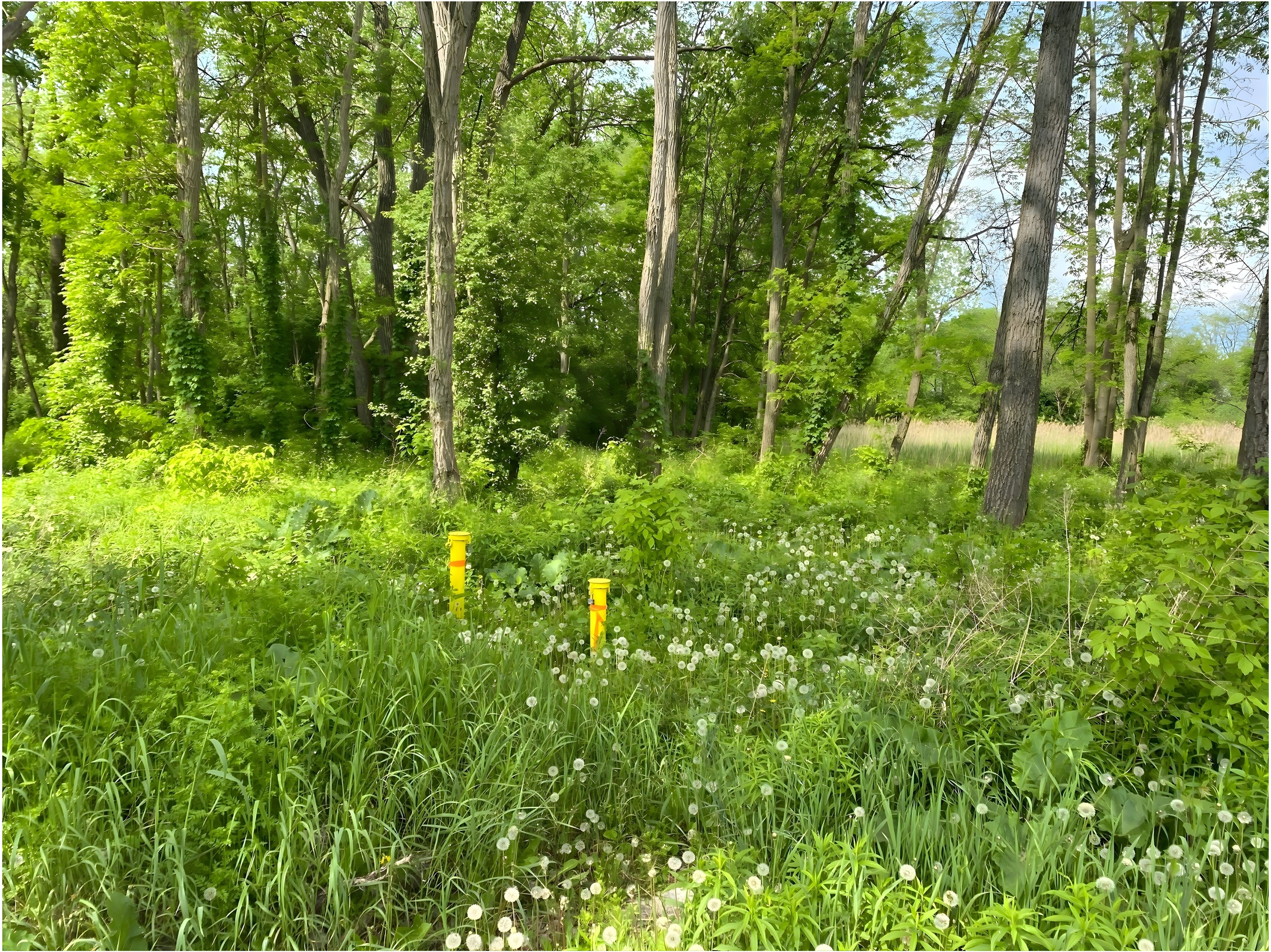
Parcel 501 from pine street with residual monitoring wells, June 2024.
Compared to other contaminated sites in Vermont (e.g., Bond, 2021), and across the United States (e.g., Taylor, 2014) - this site, as it stands today, is not a judicial fighting ground, instead, its public deliberations and activism surround its proposed reuse. The PSBC site was shuttered in 1966 and was designated as a superfund site in the 1980s. Its reoccurring redevelopment opportunities resurface municipal politics, creating tension as different stakeholders discuss potential futures of the site. This site holds multiple socializations, despite its designation as a hazardous waste site. The PSBC site holds intermingling valuations as a source of cultural pride, a source of contaminated blight, and a source of diverse urban wild. Its dynamic valuations include both technoscientific methods of brownfield remediation, expectations of economically viable redevelopment, as well as non-traditional methods of bioremediation, restorative care, and healing. In this paper we explore multiple categorizations of socializations or worldings existing at the site, two techno-economic worldings, a community-based worlding, and an alternate worlding based in bio-remediation and restorative care. The PSBC site is a unique place to observe hybrid relations and associations surrounding the valuations of contaminated spaces. It is in categorizing and critically examining toxic spaces that burgeoning ways to deal with the trouble of toxic contamination can be discovered.
Through the case study at the Pine Street Barge Canal superfund and brownfield (PSBC) site, this study explores the toxic worldings or the social constructions of toxic spaces and our relations with toxic wastelands. Toxic worldings, first used by Chen (2012), elaborated both by Nading (2020) and Geissler and Prince (2020), urges investigation beyond the technical and ecological, to the social, cultural, epistemological, ontological intertwinings of toxicity in our world, in our bodies, the resulting toxic harm, and the corresponding toxic care. Based on document analysis, in-depth interviews with key informants, and surveys of residents neighboring the PSBC, this study asks how different actors conceptualize toxic spaces, socialize and live with toxic harm, and shape alternative practices of toxic care. This study demonstrates a multiplicity of toxic worldings that are seldom considered within superfund and brownfield remediation and redevelopment that yield new forms of relationalities and practices of care. Below we provide the theoretical framing of toxic worldings, followed by an orientation to the site, the methodologies used in the study, and our study results.
Toxic worldings and the constructed knowledge of toxicity
Chen (2012: 196) popularized the phrase “toxic worlding” in an investigation of animacy within metals, toxins, and toxicity. Chen sees toxicity as another expression, or scapegoat, for ableist, sexist, racist, anti-queer systems. This echoes key themes in Liborion and Lepawsky's Discard Studies (2022), on the incommensurable inequities based in systems of discarding, seeing waste and wasting as a technique of power. Chen differentiates how toxicity stands in direct contrast to purity and problematizes the dualistic framing of purity as the desirable moral objective, whereas toxicity is seen as dirt (Douglas, 1980), or waste/wasting (Liboiron and Lepawsky, 2022), toxicity becoming a qualifier that taints bodies and landscapes. Chen attributes the popularization of the word toxic to Rachel Carson's Silent Spring, a book typically attributed to the start of the modern environmentalist movement. Now the word is used widely in pop culture, citing conversations around toxic political climates, toxic relationships, and the famous Britney Spears song, Toxic. Chen (2012) notes that these are social and scientific constructs, with intentions for othering, which leads to oppressive systems of violence and harm.
Historically, privileged bodies structure contaminated spaces, through the boundaries of pure and impure, safe and unsafe (Balayannis, 2020), dead and alive (Chen, 2012) that can be cordoned off, wastelanded and sacrificed for the sake of capitalistic growth and progress (Voyles, 2015). The boundaries that we create based on the positivist technoscientific framings gives us just a partial view of toxic relations. Hence to have a more realistic understanding of our toxic world, we need to be conscious of how we understand and know the toxic world, the very features of its epistemology and ontology. Feminist STS scholars recommend assembling situated knowledges of toxicity and toxic worldings corralled from pluralistic perspectives, multiplicity of local knowledges, relationalities to offer a richer account of the world (Haraway, 2016; Keller, 1982; Tsing, 2015; Voyles, 2015).
Toxic chemicals are everywhere, in food, water, air, our blood, brain, in placenta, yet it is a highly abstract term. While toxicity is experienced in the situated biologies of bodies and ecologies, its global pattern of harm is socially induced, linked to capitalistic and rationalist worldviews that promote privatization and acquisition of land and resources, extractivism and exploitation, self-interest, competition, othering and white supremacy, colonialism, and neoliberal profit maximization (Liboiron et al., 2018; Liboiron and Lepawsky, 2022). Nading (2020) emphasizes that toxicity is incommensurable, as each place and instance, is highly unique with its own sociocultural historical background and can result in varying degrees of toxicity and harm. Toxic worldings urges us to investigate the social, cultural, epistemological, ontological, ecological, technical intertwinings of toxicity in our world, in our bodies, alongside the resulting harm and care. Nading (2020) explains toxic worldings as both the process of being affected and learning to affect. He pushes us to understand the toxic worlds beyond the techno-scientific framing and to respond to the “crises of objectivity.” He encourages an embodied investigation engaging queer, feminist, decolonial and/or antiracist research to help reconstruct toxic worlds based in systems of toxic care (Nading, 2020: 211). Geissler and Prince (2020: 4) note that, “if we humans and our non-human companions are irrevocably mixed up with toxicants in our basic substance, then the necessary struggles against systems of toxic violence should be coextensive with a careful search for acceptable forms of living ‘with the trouble,’ cultivating ‘matters of care.’” How do we live with the trouble? Haraway (2016: 1) uses trouble as a way to describe our “disturbing times, mixed-up times, troubling and turbid times,” advising us to both make and settle trouble by finding kinship, cutting the bonds of the Anthropocene and Capitalocene. “Matters of care,” as explained by de La Bellacasa (2017) comes from relational matterings of kinship, alliance, and ultimately, a labor of love. This paper and case study is positioned within these scholarly works to explore what it means to live in a toxic world. Employing the toxic worldings methodology, we muddy the binary and reductionist renderings of contaminated sites. There are many worldings that exist at the PSBC site that offer a glimpse into our complex toxic worlds and the ways we imperfectly engage within them.
Understanding the pine street barge canal superfund site
To meet the growing demands of a bustling lumber industry, the Barge Canal was dredged in 1868 (EPA, 1998). Excess saw dust was used to infill the wetland areas and uneven terrain, all in order to make the site more amenable to the lumber industry. From the 1860s to the 1890s the lumber business and the port not only created jobs, opportunities, wealth, and economies in Burlington but established a wider trading network across the channels of Lake Champlain (Fay, 2022; Hanson, 1993; McVarish et al., 2001) (See Figure 2).
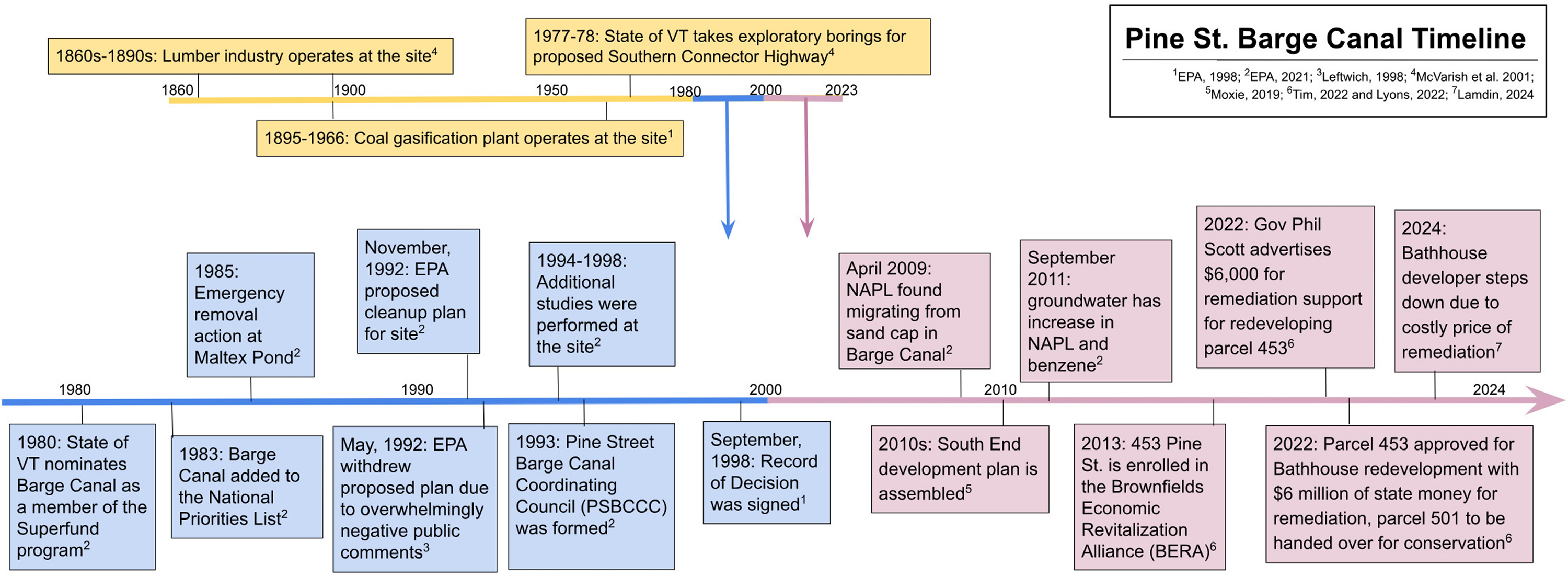
Historical timeline of the PSBC site and its remedial activity, 1860s-2024.
After the logging industry collapsed due to over-extraction in the 1890s, Burlington Gas Works began to operate a coal gasification plant at the site in 1895. This plant served local demands for lighting and heating, using coal gas to produce electricity. This facility continued to produce a valuable source of electricity, despite a worker recording in a logbook an “oily substance” found floating at the top of the Barge Canal in 1926 (EPA, 1998). This plant dumped vast amounts of coal tar into the wetlands and accompanying soil and operated until 1966. This contamination was evident into the 1970s and 80s, with oily leaks found in the Barge Canal, turning basin, and at its worst, in Lake Champlain (EPA, 1998; McVarish et al., 2001). It was not until the Southern Connector highway was proposed, a “yellow brick road that would lead commerce and cash into the lakeside city…” that “the state's fledging Department of Environmental Conservation had begun to realize that there might be a problem at the site.” (Hanson, 1993).
The site was nominated for the Superfund list in 1980, the same year the Comprehensive Environmental Response, Compensation, and Liability Act (CERCLA) was passed and became a superfund site in 1982 (EPA, 1998). The remedial action plan 1 for the site was released in 1992 by the Environmental Protection Agency (EPA). This came under a lot of public opposition, as the proposed plan was believed by the Lake Champlain Committee to be an unseemly “boiler cap plate” that would degrade the wetlands and Lake Champlain, destroy its aesthetic quality, and restrict reuse of the site. The plan was withdrawn later that year (Leftwich, 1998: 19).
Given the wider public opposition, a coordinating council was formed with local stakeholders. This Pine Street Barge Canal Coordinating Council (PSBCCC) found that what was most important to their remedial action plan was a “Vermont solution” (Leftwich, 1998: 26) that was “intrinsic,” complementing the PSBC's natural landscape. The PSBCCC wanted to prevent damage to the wetlands, protect Lake Champlain's aesthetics, protect human and environmental health, and ensure the possibility of future activity at the site (Leftwich, 1998). The PSBCCC chose a remedial strategy focused on containment, which included capping the contamination and placing institutional controls to promote safety at the site.
To promote reuse at the site, the remedial action plan included shrinking the original 80-acre study area to the 38-acre superfund site that exists today (EPA, 1998). The boundary change meant the less-contaminated parcels, including 453 would become a brownfield site, which with containment, can become safely re-used, while the superfund site would remain restricted by its denser contamination and subsequently stricter regulation (Leftwich, 1998). In 2022, a $6000 state grant and endorsement from the state of Vermont stirred-up the interest of two developers, one for a bowling alley and another for a Nordic Spa Bathhouse. The bowling alley bowed out in 2022 due to challenges at the site (Lyons, 2022; Tim, 2022). The Nordic Spa Bathhouse bowed out in 2024, due to remediation costs being several million over the promised state funding, which at this time rose to $6-million towards remediation of the site (Lamdin, 2024). Such a redevelopment will require advanced engineering, building techniques and technologies to contain the risk and obscure the toxicity at the site, and a redevelopment has not been able to successfully accomplish these challenges, due to the financial bill of these projects.
Methodology
This research is informed by documentary analysis, interviews, and anonymous surveys, as well as the authors’ personal experience of the site. Golitz is a scholar in critical environmental studies. Her curiosity in the PSBC site stems from habitually visiting the South End of Burlington, enamored by its industrial-artistic aesthetic that hosts many local coffee shops, farmers’ markets, and art festivals. Panikkar lives in the neighborhood next to the PSBC site and has widely examined environmental inequities in the state. The PSBC site was a natural choice to examine, as a well-socialized contaminated space under consideration for redevelopment. We conducted documentary reviews, which included governmental reports, neighborhood reports, historical surveys, and local media articles on the history of the South End of Burlington, Vermont and the PSBC site. These were supplemented later with interviews (n = 15) and survey data (n = 87), conducted between October - December 2023.
The interviews were conducted with a variety of stakeholders including city, state governmental officials (4 interviews); community members (2); bioremediation researchers (2 people, 3 interviews); landowners and developers (3); environmental consultants (2); and a non-profit group. This research was approved by the University Institutional Review Board, and consent was obtained for the interviews and survey responses. Interviewees were codified and will remain anonymous. Interviewees were asked individualized questions that pertained to their roles and involvement at the site, their goals for the site, challenges towards use or re-use at the site, conceptions of contamination, remediation, and reuse at the site. Each interview was thematically coded on NVIVO qualitative methods software by key topics and each participant was categorized by their relation to the site.
The survey was conducted using Qualtrics online survey software and distributed through an online neighborhood forum and the local non-profit mailing list between October 10th to November 15th, 2023. This survey was broken into three parts: 1) background information and respondents’ experience at the Barge Canal, 2) respondents’ perceptions of the Barge Canal site, and 3) how respondents think contaminated land should be used. The survey questions were thematically coded on Excel spreadsheet and analyzed through Excel's Pivot Tables to examine frequencies and descriptive statistics to provide crucial insights into how survey respondents perceive and engage with the PSBC site. Additionally, many quotes from the open-ended questions have been used in this paper.
The survey yielded 87 responses total, but all questions were optional, so not every respondent answered each question. 59% of the respondents live in the five sisters neighborhood surrounding the PSBC site, the rest have either visited the PSBC site or have moved away from the neighborhood. 67% of respondents that lived in the neighborhood, have resided in the neighborhood for 6 + years. 62% of the respondents were on the mailing list of the local non-profit working on PSBC site that promotes conservation at the PSBC site, and 39% of respondents have participated in events hosted by this non-profit, hence the survey responses might be biased towards the non-profit environmental perspectives that promote conservation and rewilding of the site. The data is presented responsibly to account for this bias. Together, interviews with historical and media documentary reviews and surveys, we present a nuanced picture of how the social, cultural, ecological, and technical perspectives intertwine at the PSBC site.
Results
Contaminated sites are incommensurable landscapes. The PSBC in particular stands out from typical brownfield and superfund sites, separated by its ongoing local interaction and participation. Leftwich (1998), in her investigation into the Superfund process in the 1990s, found six key traits that distinguishes PSBC from other superfund sites: (1) the residents surrounding the site do not represent under-represented, low-income, or minority populations; (2) human risks were not as present at the site as ecological risks; (3) the location is high profile; (4) Vermont is an environmentally aware state; (5) the residents surrounding the site are highly educated and participate in public policy decisions; (6) the formation of the second remediation plan was decided by a coordinating council that was highly untraditional. The survey we conducted captured some of the traits Leftwich emphasized, such as the neighborhood surrounding the site is largely white, older and educated. The survey respondents were primarily women (57%), most respondents over 65 years of age (48%), and were mostly college educated (40%) with 34% having a master's degree as their highest level of education. This long-standing community interest with the site is evident from the 1993 article Insight on the News by Gayle Hanson written during the remediation process, capturing the community's exhaustion with the EPA: “But if that notion of 175,000 cubic yards of coal tar sludge creates an image straight out of Creature from the Black Lagoon, the reality is that for years the barge canal was a local playground. Its fish were caught and sold at local markets for Sunday supper. It was a place for boating and bathing. In that time, residents recall only one incident, in which a person claimed to have fallen into the canal and gotten boils as a result.” (Hanson, 1993). “Of course, as a kid, I didn't understand it. I didn't know what that was. And, you couldn't go in it, but you could go, we'd walk up the tracks and watch the guy pulling the levers, and, you know, they would pull one lever. And the flame would shoot out of it. I mean, as a young kid, it fascinated me.”
As time went on, the local connection with the site has changed, as its uses changed from a lumber yard and port to a coal gasification plant to now a barricaded superfund site. Despite the erection of a partial gate at the entrance of parcel 453 (Figure 3), the site is still used and experienced in different ways by the unhoused population who camp there, or the community residents who recreate. They see the PSBC site in a myriad of ways as our survey responses noted: “A location that needs revitalization,” “A natural treasure on the lake, kind of a secret place,” “An area of former industrial waste that the city of Burlington has not found a proper solution or use for,” and a “funky place, nice land to walk around. Fun to skate around. Kind of oily/stinky, but I saw a massive turtle!” The site therefore has a complex history that holds a variety of socializations that is defined by its socio-cultural, ecological, legal, and toxic history. Below we present four worldings, 1) the ways the state and regulatory agencies know the PSBC site, 2) the ways the developers interact with the site and mediate economically viable futures, 3) alternate toxic worldings that proposes bioremediation and restoration of the site, and finally, 4) the hybridized community centered ways of knowing and comprehending the site.
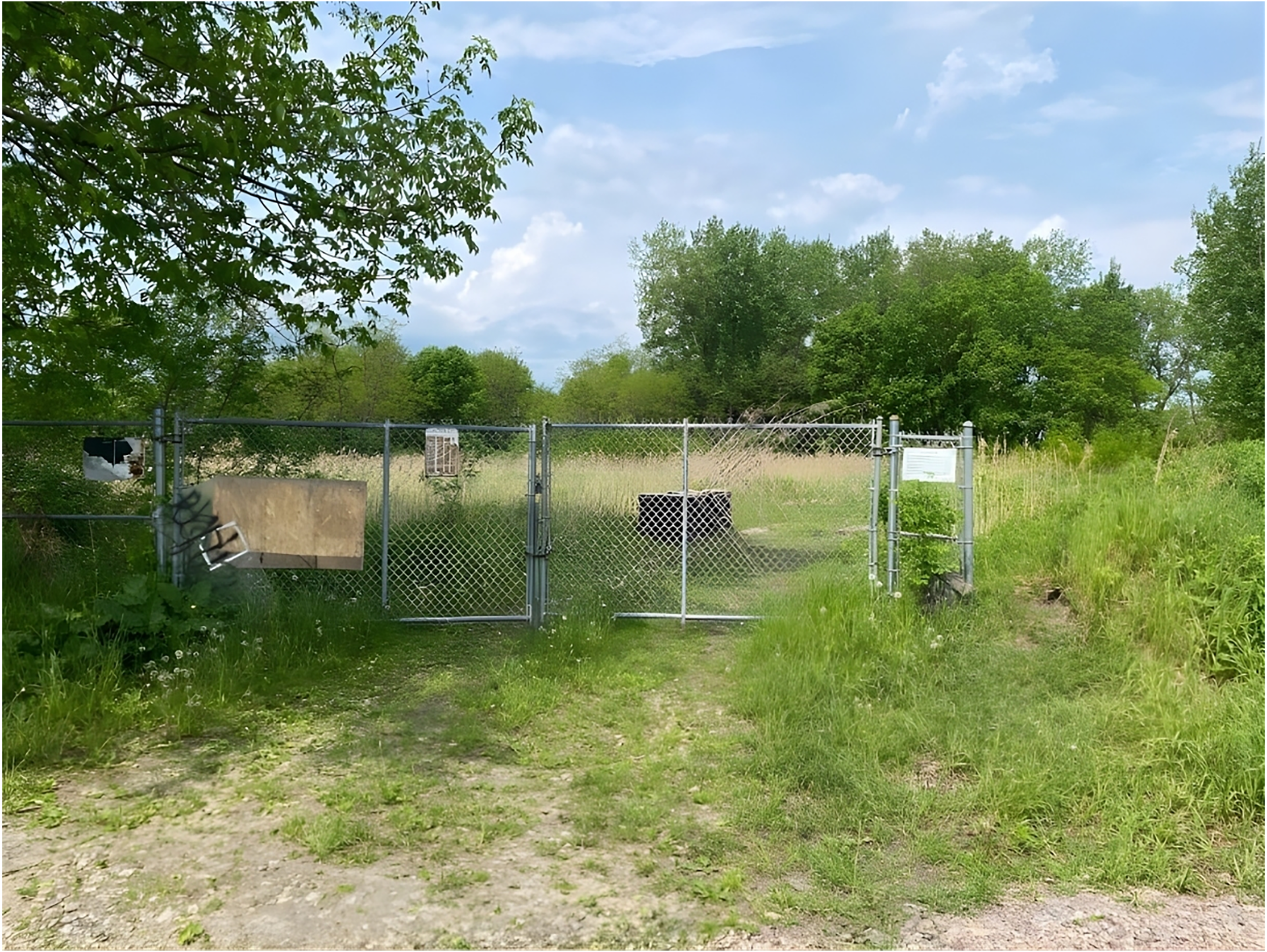
Entrance at brownfield parcel 453 with footpath alongside the locked gate that individuals use to walk through the site, June 2024.
Regulatory and technoscientific worldings of PSBC site
Superfund and brownfield sites are regulated by federal and state established standards based on evidence-based science. Regulation is mediated through technoscientific experts which include environmental consultants, governmental engineers, Environmental Protection Agency (EPA) designated site employees, and others who are in charge of governing and regulating the site. Of the 15 interviews we conducted, five were regulatory experts. Regulatory experts are often hired to manage the site as well as to deal with the brownfield remediation and redevelopment in a particular state ordered way, as one interviewee said, with an “obligation to protect the general health of the public,” a sentiment expressed by all five officials interviewed. Their desired uses for the site were mediated based on their regulatory obligations, which means technoscientific protection of the remedy (including upholding institutional controls, regular testing, pumping of the residual wells, not disturbing the implemented caps) at the site, and promoting safe use of the site to protect human and ecological health. They expressed “interest in preserving the integrity of the remedy and the protection of the lake.” These concerns are scripted through rules, regulations, and liability. Specific education and training are required to manage and carry out these tasks, as elaborated by a technical expert. The epistemological and methodological lens assigned to and explored by these regulatory experts is rigid and does not allow for much discovery and investigation beyond scripted behaviors and beliefs.
All technoscientific experts referred to the toxic contamination at the site as risks to be managed according to the public health safety standards and regulatory guidelines set by the federal government and the Vermont Department of Health. “There are select contaminants that are above regulatory criteria at the site that present an unacceptable risk according to the Department of Health in Vermont, who establishes those criteria for the Agency of Natural Resources.” The technocratic understanding of toxicity at the site is deciphered through monitoring and analyzing the risks at the site and regulating and containing those risks by the governmental and regulatory bodies. This was echoed throughout other interviews, where the risks and the definition of risks were defined by data measurements that determine safe versus unsafe levels of different contaminant loads, the thresholds of risk, and permissible levels of toxic pollution. As new boundaries are defined within this technoscientific system, revisions are made to toxicity standards leading to statements such as the following, from the EPA's report of the PSBC superfund site (2021: 32): “On January 19th, 2017, EPA issued revised (less carcinogenic) cancer toxicity values and new non-cancer toxicity values for benzo(a)pyrene. Benzo(a)pyrene did not have non-cancer toxicity values prior to January 19th, 2017, … The non-cancer effects of benzo(a)pyrene were not evaluated in the past due to the absence of non-cancer values”
It is within this technical jargon and changing measures of toxicity that Benzo(a)pyrene behaves almost as an actor, taking on new value and meaning within toxic contamination, all while not changing its chemical form. Chen (2012) positions toxins itself as inanimate, but toxicity as animate, and hence toxicity as a socially constructed narrative, one that emerges through capitalist and colonial formations (Liboiron, 2021). Such systematic and technical approaches to manage the risk, through monitoring and data driven approaches, are also not necessarily used to best address the issue of toxicity but to better manage, contain, and obscure toxicity within spaces and to prevent boundary crossings. This means that these boundaries between safe and unsafe are not only managed but reinforced within the bounds of scientific and technical specifications to contain and obscure.
Containment-based remediation strategies are not failproof, especially those with technically complex terrain, such as the wetlands at the PSBC. In April 2009, NAPL containing coal tar migrated through the sand cap at one end of the canal. Peat soils in wetlands, decay over time, releasing methane. The NAPL was found attaching itself to these methane bubbles, escaping through the sand cap and into the Barge Canal's waters. The cap was redesigned in February 2011, with a high-permeability layer, reactive core mat to capture this escaping NAPL (EPA, 2021). Another incident happened in September 2011, where groundwater was found to have an increase in dissolved benzene and NAPL. To address this, a 200–300-foot vertical barrier was constructed and NAPL removal and groundwater monitoring wells were installed. This was completed in February 2014 (EPA, 2021). The contamination moves and flows with the site's hydrology and natural ecological processes, allowing the contamination to betray the bounds of these traditional remediation methodologies.
Remediation is conventionally mediated through a scoop, dump, build or cap model, as described by an official. During the proposed and now canceled redevelopment at the brownfield adjacent to the PSBC site, the soil would have been scooped up and moved to a landfill, 2 with special attention towards leaving the existing caps unharmed. Balayannis (2020) highlights the fact that this model of remediation solely obscures contamination, either by moving the contamination from the contaminated site to a landfill (a site designated worthy of contamination), or by capping contaminants to hide them from what is classified as unsafe space. This ‘spectacle’ of decontamination is one that obscures harm, reinforces and furthers economic, capitalistic, and industrial goals within our societies.
The 453 Pine St site is a challenging site to redevelop, its remediation requires three specific risks to be addressed, according to a technical expert interviewed: maintaining the hydraulic head, controlling the compression of the site or the condensation or off gassing of the volatile organic compounds, and preventing direct human contact with contaminated soils. The technical expert explained the risk of compressing the site through the metaphor of a “jelly doughnut.” They elaborated, the entire PSBC site can be seen as a “jelly doughnut” of contamination due to the nature of its soft peat soils, but negligent or un-cautious development could possibly squish the jelly doughnut, releasing non-aqueous phase liquid (NAPL) containing coal tar into the Barge Canal and ultimately Lake Champlain. Stabilizing these risks require creative solutions. The Nordic Spa redevelopment efforts were accounting for the risk of compression by placing borings that dig through the peat soils to sturdier grounds, like toothpicks through a jelly doughnut, ensuring that no coal tar is released. It is through creative technoscientific methods, such as these borings and others, that redevelopment will be ensured, supported, and, ultimately, legitimized.
Despite existing within the technoscientific boundaries of contamination, technical experts may hold alternate views beyond their technical expertise, even if, they exhibit limitations in expressing their alternate interests. In interviews with technical experts, questions that started with “How do you feel…” or “What would you change about …” was met with “I am not allowed to say” or “that is outside the scope of my job.” However, it was not uncommon for them to occasionally break from this identity and say something ‘off the record,’ that supports holistic approaches as opposed to technical and economically mediated options. It is through these ruptures of boundary crossing where real breakthroughs and insights occur where we can begin to understand a world beyond the techno-deterministic space.
Economic worldings of the PSBC site
Western capitalistic models of land are seen as a resource and commodity to be developed for economic use, benefit, and monetary growth. Brownfield redevelopment embodies this very logic, in revitalizing the economic potential of this post-industrial wasteland through redevelopment. These are relationships typically informed by developers, landowners, government employees who help with economic development and revitalization of brownfield sites. Out of 15 interviews, 5 interviewees were economic developers tasked with redevelopment.
These relationships built on seeing the land as potential for economic development, tend to see the contamination as a challenge for redevelopment, one that places restrictions on use. A city official tasked with aiding the re-use of the site said, “How do we feel about contaminated land? It makes it – I mean, it's a challenge. It's definitely a challenge.” The developer of a brownfield adjacent to the PSBC said that the redevelopment process has been complex, costly, time-consuming, and not straightforward. An owner of an adjacent brownfield parcel said that contamination brings down the value of land, another landowner echoed that there is a stigma with the site that has challenged the sale of the land and redevelopment, as the interviewee desired. This interviewee continued that the stigma was reduced when the PSBC brownfield parcel 453 was endorsed by Governor Howard Dean and the EPA secretary at the time. All of these conceptions speak to the restrictions to developing contaminated land. It highlights the complexity of redevelopment at the site, the time-consuming nature of these projects, the stigma attached to it, and the loss of financial value of the land.
Within the context of brownfield redevelopment, the developers have to navigate the constraints posed by the regulators but still operationalize reuse of land that is both economically viable, and socially valuable. The constraints come with a plethora of restrictions posed by toxicity itself that require expertise to navigate the potential uses and socialization at the site. The range of purity sought within these toxic-socializations is also hard to contextualize and is relative, uneven, dynamic, unpredictable, and sometimes unachievable (Balayannis, 2020). Conceptualizations of purity are designed around meeting the goals of protecting public safety and health. Once the goals of purity are reached, its economic potential can be pursued.
While economic-driven actors prioritize economic incentives in redevelopment, they also need to take into consideration social needs. The landowner we talked to in the South End was interested in supporting local vendors, as well as promoting fun spaces for people in Burlington to enjoy; the director of a non-profit expressed interest in redevelopment projects that will add aesthetic value to the South End. 3 Beyond these priorities, an issue that is often overlooked is that of the houseless individuals that camp on the land would be displaced with redevelopment. 4 The housing crisis and houselessness in Burlington is a major issue, the rental vacancy rate is 0.05% (Harness, 2023) and Vermont ranks fourth in the nation for homelessness (Berlin, 2024). While camping is illegal in public spaces in Burlington, the lack of sheltered housing for those in emergency and unhoused situations leaves camping along the waterfront as a last resort for many (Bendavid, 2025; Guber, 2025). The PSBC site being along the waterfront and railroad tracks, becomes another refuge for those without formal houses.
Within the Vermont brownfield-to-redevelopment structure, social value can be held, and sometimes is only exercised, within the potential for redevelopment. In the Vermont brownfields handbook (Vermont Department of Conservation, 2023), there are calls to remediate brownfields for the revitalization of Vermont downtowns, but there are no formal justice considerations made. The handbook states its commitment to economic development and public health, 5 but these initiatives do not address common justice issues, such as gentrification and the removal of unhoused individuals (Taylor, 2014). When an official from the Community and Economic Development Office was asked, in an interview, about moving houseless individuals off the land for the PSBC redevelopment, they said that there is a department dedicated to housing, so it is not within their departments’ scope or funding to deal with the displacement of houseless individuals. While redevelopment creates great promises for economic revitalization, it can only be effective if all social needs are taken into account.
Restorative worldings of the PSBC site based on bioremediation
While technoscientific regulatory and economic-centered toxic worldings exist as the dominant models, alternate non-dominant worldings exist that adopt more-than-human actors in site remediation and revival that are crucial to explore. Plants, animals, fungi alike inhabit and engage more intimately with the site and its contamination. MycoLab, is an entity that has been advocating for the conservation of Parcel 501 and operating at the site integrating conscious social action, with an eye towards introducing holistic myco and phyto-remediation and restoration practices. MycoLab 6 is the community branch of MycoEvolve, a grassroots service group offering ecological resilience services through earthworks and research. 94% of the Mycolab's work at this site has been volunteer. Outside of the PSBC site, they provide services for clients, facilitate educational programs for local schools and organizations, and conduct research on Myco-Phytoremediation Restoration Project at Shelburne Farms.
Attending to the more-than-human relations, Mycolab aims to cultivate a healing relationship with the land that is scientifically grounded. Drawing from the intervenor's principle, found in Permaculture, they prioritize being accountable to our predecessors’ actions and doing our best to reconcile the damages done, “people who are part of the system that create imbalance are responsible for fixing it.” Their socialization with the contaminated landscape at the PSBC site is one based on facilitating care, healing beauty, and protection, assisted with more proactive bio, myco, and phytoremediation strategies, so that natural attenuation already in process can continue uninterrupted. Their socialization with the land can be seen as a reciprocal response where, attention to care attempts to blur the divide between biological and metaphorical toxicity, where both natural spaces and more than humans are seen as equal social and mobile actors that affect and change the landscape of the PSBC (Nading, 2020: 214). This is a key difference between current mainstream bio-remediation efforts, which bypasses biochemical opportunities for interspecies assisted repair. This alternate, interdisciplinary scientific worlding addresses the neglect of wastelanded landscapes and attempts to reintegrate and socialize these sites into society by enhancing care and healing of the site, exploring the collaborative potential between human and beyond human based on an understanding of contamination as inseparable from our human-ecological ecosystem.
Mycolab's work at the PSBC site is impressive. Through 18 community science events and other visits, they have logged 214 research grade species of the total 384 observations at the site on iNaturalist. 7 Among these are five species of concern including: black-crowned night heron (Nycticorax nycticorax), double-crested cormorant (Nannopterum auritum), hairy beardtongue (Penstemon hirsutus), white ash (Fraxinus americana) and green ash (Fraxinus pennsylvanica). They have held 14 ecological restoration workshops, removed 2 acres of non-native species manually and planted 1.5 pounds of native wetland seeds that enhance riparian filtration process (Jones et al., 2010; Naiman et al., 1993) stormwater management, and nutrient regulation (Bhowmik, 2022; EPA, 2021; McVarish et al., 2001). They identified bio-attenuating species on the site: Irpex lacteus, Acer spp, Quercus spp, Pleurotus pulmonarius, Poplar sp., Macrophytes that have potential bioremediation capacity. They also designed a viable remediation pilot successional studies that could take place at the site with accompanying curriculum. Additionally, they have facilitated six projects and hosted a panel with local, state-recognized indigenous members.
Despite these remarkable efforts, the group has yet to garner municipal and governmental support for their bioremediation efforts at the site. They advocated for phytoremediation and conservation at the site to the Burlington Conservation Board (BTVCB), which was not fully taken into consideration. They also struggled to find support navigating city politics, which prohibited the conception of their bio-remediation pilot. The group has stopped working at the PSBC site due to lack of receptivity, hoping that MycoLab's legacy will be recognized and the work continued at some point in the future. Their proposal for bio-remediation has routinely struggled to be accepted within the regulatory world of superfund and brownfield remediation, which is codified as scoop, dump, build or cap.
Despite peer-reviewed literature backing its legitimacy as a technical science, bio-remediation research at Superfund and Brownfield sites has not gained legal legitimacy because of constricting federal laws regarding hazardous waste management. Dominant, mainstream, technoscientific remedial science models exclude the ways in which natural systems attenuate contamination. Yet chemical attenuation is occurring at PSBC site via biological remediating species metabolizing contamination. MycoLab ecological inventories have found 8 White rot fungi such as Phoenix Oyster (Pleurotus pulmonarius), and Common crust fungus (Irpex lacteus) and Turkey Tail (Trametes versicolor) on the site, which have been shown to degrade Polycyclic Aromatic Hydrocarbons (PAHs), Polychlorinated Biphenyls (PCBs), and Total Petroleum Hydrocarbons (TPHs) (Byss et al., 2008; Chun et al., 2019; Njoku et al., 2016). Additionally, trees such as willow (Salix spp.), poplar (Populus spp.), maple (Acer spp.), as well as grasses like Common Reed (Phragmites australis) that hyperaccumulate heavy metals are also present at the PSBC site (Azzarello et al., 2011; Ebbs et al., 2003; Jiang et al., 2018; Yu et al., 2006). MycoLab researcher noted that this natural attenuation process could be expedited by gathering strains of these species and growing them out in larger populations and re-introducing them in successional pilot trials to break down the complex array of toxic compounds left at the site from the coal tar manufacturing plant. The researcher concluded that due to regulatory red tape surrounding remediation practices, lack of governmental support for bioremediation efforts, and eco-literacy on restorative land practices, it is hard for MycoEvolve's solution-oriented strategies to gain credence at the site.
Community-based hybrid toxic worldings
There are different narratives and relationalities that exist within the community around the PSBC site (see Figure 4). Some residents see the idea of redevelopment as beneficial – redevelopment offering economic potential and value, despite the site's contamination: “It's not doing much now, but I am encouraged by the plans to develop something on it,” and “It is an area of prime real estate in the city, whose clean-up has never been properly invested in… It is a giant loss of value for residents of the city.” These values exercise a relationship that is built on seeing the contamination at the site as a challenge towards redevelopment and re-use but also as a source of economic potential and value. To the residents that live close to the property in the highly sought after and desirable Five Sisters’ neighborhood and surrounding South End, this means an interesting business opportunity at the site which also has the potential to increase the value of their property and desirability of the neighborhood.
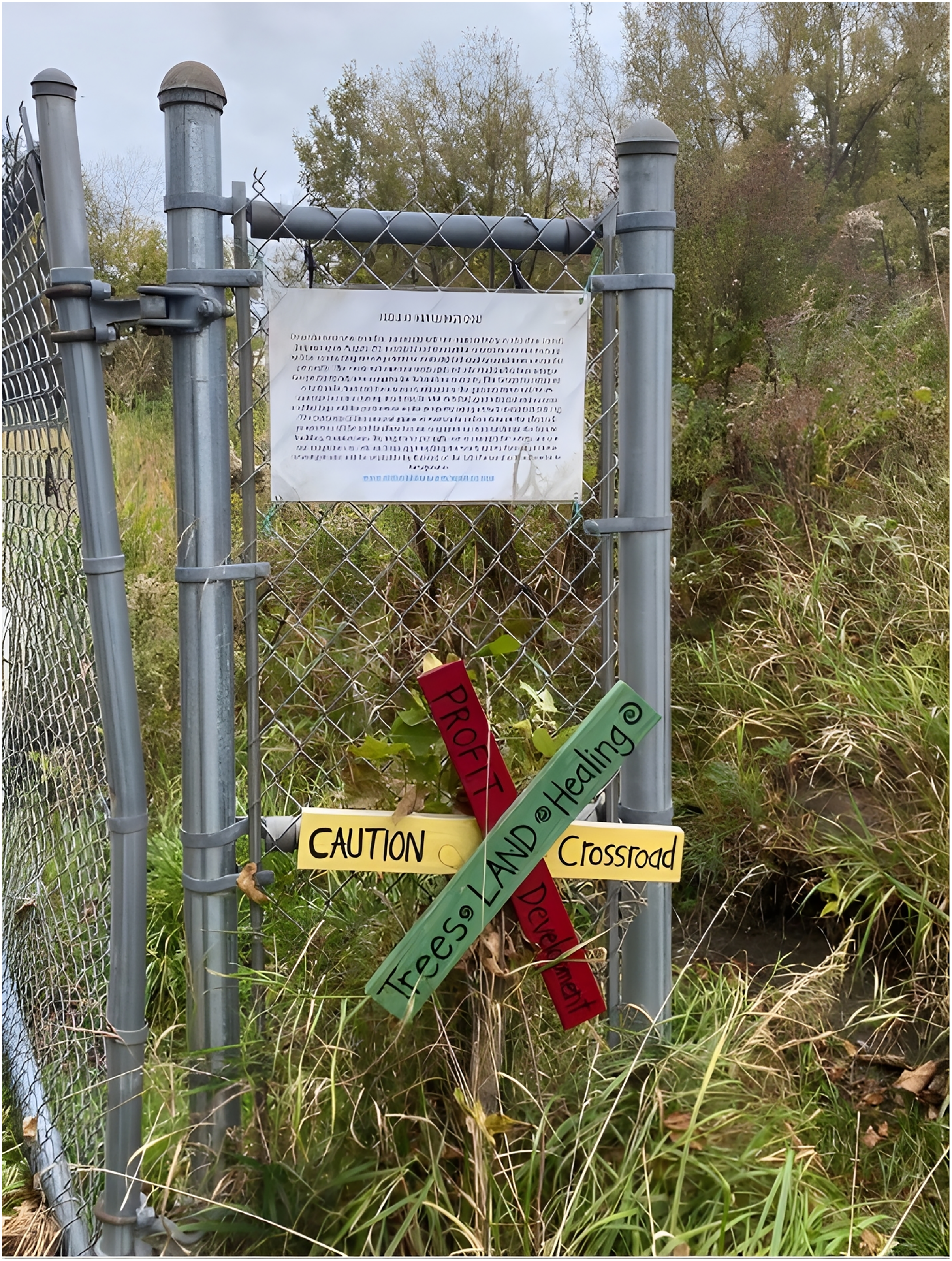
Artwork on the gate at parcel 453, October 2023. The art wheel has three signboards: “Caution Crossroads,” “Profit Development,” and “Trees, Land, Healing.
Whereas the non-profit group, Friends of the Barge Canal, has been advocating for more-than-human socialization with the PSBC landscape, valuing rewilding of the PSBC site. They believe in taking responsibility for the industrial contamination and emphasize caring for the neglected landscape to gain a deep connection with human and natural community. As part of this mission, they host clean up days, walks, and talks. They have been rallying support for conserving the natural areas of the PSBC, both parcels 453 (brownfield) and 501 (superfund). In an interview with a community member, the interviewee shared that without the Friends of the Barge Canal, they would know nothing of the PSBC site, including its natural value, contamination, and history.
Altogether those on the Friends of the Barge Canal mailing list, prioritized rewilding over economic development. The survey responses of those on the mailing list described the PSBC site as a place of natural, rewilding beauty, as well as seeing parcel 501 as ripe for Recreation, Conservation, and Open Space (RCO) Burlington zoning. 85% of those on the mailing list saw the possibility for RCO positively, with only 9% seeing RCO neutrally. In comparison, only 53% of those not on the mailing list saw RCO zoning of the site positively, and 33% of those not on the mailing list saw RCO neutrally. Additionally, 52% of the survey respondents viewed the PSBC positively, whereas 72% of respondents on the mailing list ranked the PSBC as positive. This demonstrates the strong influence community engagement has on the perceptions of the PSBC site. The Friends of the Barge Canal has garnered support to ensure continued recreational, cultural, and conservatory use of the site, and continues to do so.
Those who engage and socialize with the PSBC site and the soils, according to the Vermont Department of Environmental Conservation (VT DEC) and EPA, engage and socialize with unknown levels of contamination. The awareness of contamination and its industrial history in some cases are not known to all, yielding different kinds of socializations at the site. The landowner of a brownfield parcel adjacent to the superfund site spoke of hearing people joke about the superfund site as a “superfun” site, as many people ice skate at the Barge Canal, get drinks next door to the canal, or shop at the Farmer's Market nearby the PSBC site. Those who socialize with the land through recreation and positive valuation do so based on an admiration of the natural, wild, and green space value the landscape provides, while assuming that the contamination is not much of a present problem for recreational activities. Those who viewed the PSBC site positively, attributed their positive evaluation to the richness of biodiversity, its wildlife, and its natural qualities, not contamination. They saw the PSBC site as an antithesis to development and busy-ness of Pine St and the South End. This site, while contaminated, exists beyond its toxic boundaries, as community members socialize with the land through trash clean-up days, invasive species removal, and dog walking at the site. A state employee commented on the community work saying that if these community members were employed by the state, they would have had to complete Occupational Safety and Health Administration hazard-worker training, a 40-h training to be certified to work on contaminated sites. Community members, however, are not privy to these training benefits but rather navigate the contamination on their own terms.
Unhoused individuals engage and socialize with contamination on a frequent basis at the site. Walking through the PSBC site it is not uncommon to find encampments especially in the summer, as encampments are typically abandoned in the winter. The community members involved in the post-encampment clean-up days have found a great deal of tarps, tents, and personal items including children's toys, people's diaries, and used needles strewed throughout the trees which some community members call the ‘Kahuna,’ an area located beside where the coal gasification plant laid (see Figure 5). Many of the individuals who live at this site were described as under different stages of the addiction cycle, as well as one individual who the community members identified as quite friendly and living at the site nearly year-round. We, however, never encountered him. Due to safety concerns, and recent decisions from the developers and city officials to move these individuals off this land, we were unable to engage and survey these individuals and understand their connection to the landscape and if they perceived the risks at the site differently.
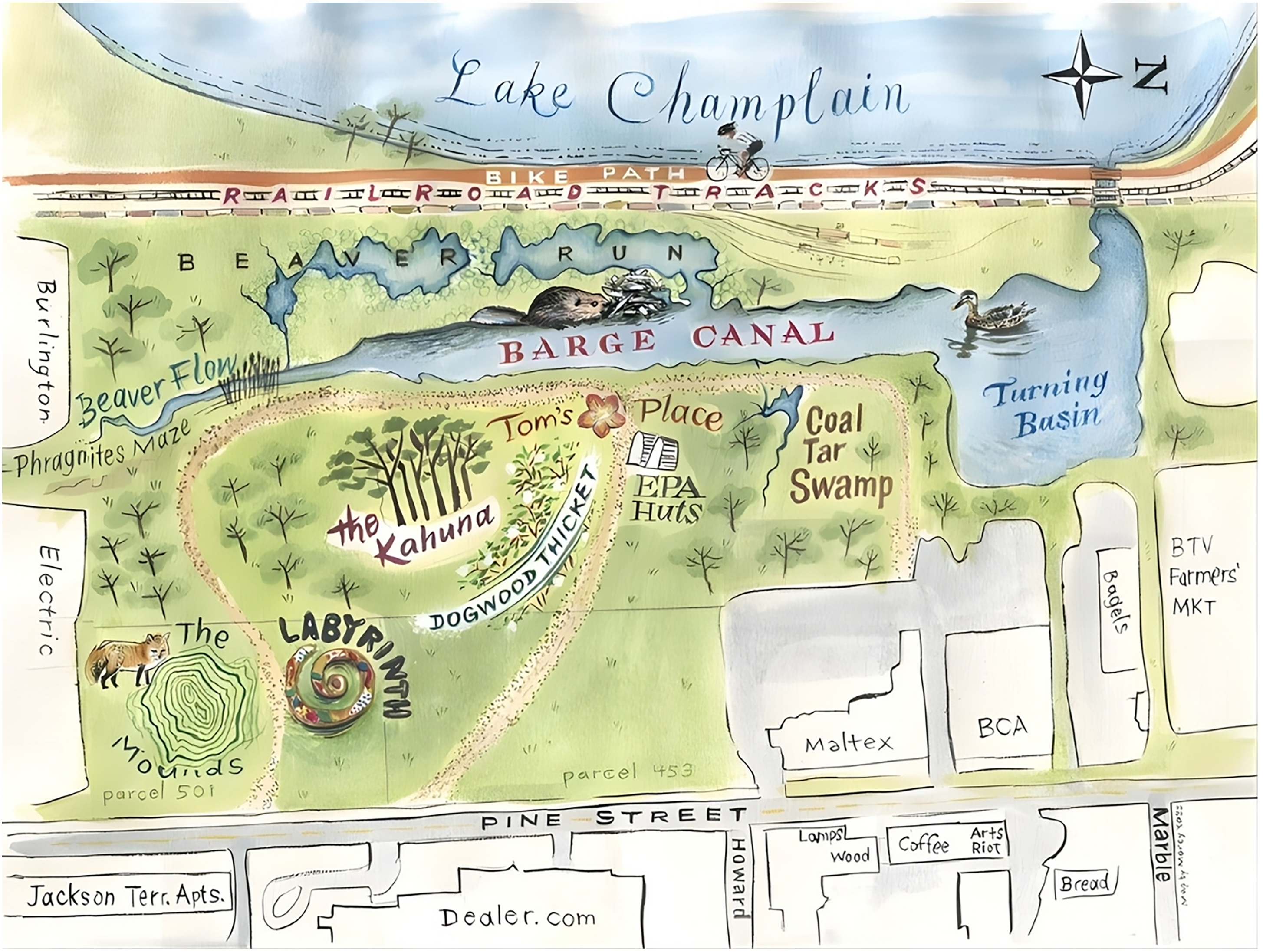
The Friends of the Barge Canal depiction of the PSBC site landscape (artist: Marcy Kass; map courtesy of the Friends of the Barge Canal).
The survey also revealed that some community members do not visit the PSBC site because of its toxicity and other perceived risks as well: “It's dangerous for many reasons including toxic waste, homeless people, and other dirty things.” Others noted risks to the site as “poison ivy, sharps and other human debris,” noting that these “encampments that leave trash & needles” and “homeless encampments with heavy drug use, needles on the ground” leave “an awful lot of abandoned junk out of the woods.” While community members and redevelopers alike share concerns, however justified, with the unhoused population at the site – the truth is, these individuals are disenfranchised with little space to go in Burlington. 9 Though contaminated, this site provides a refuge, a place to stay, to live, to keep their things – the PSBC becomes a home to people that have not many other choices. Burlington shelters are above capacity and operated on a nightly lottery (Brouwer and Lamdin, 2023; Flanders, 2024; Lamdin, 2023), and even the city has recognized the waterfront is the only option for living (Bendavid, 2025).
These surveyed remarks highlight common perceptions of contaminated, disenfranchised spaces, and the perceptions of what is categorized as dirty and unsafe. Narratives of harmful, dirty, and dangerous are common outside perspectives among campsites like these. Gerrard and Farrugia (2015) speak to how homelessness is a blemish on the social relations of capitalist societies – seeing houselessness, much like seeing trash, or contaminated land, makes many laypeople uncomfortable. This is because it is perceived as awkward, uncomfortable, and in reality, destroys our perception and value of capital. Yet, it is no accident that unhoused populations find themselves on contaminated land, on abandoned, toxic sites, on railroad tracks that release toxic chemicals (Goodling, 2020). This is a giant public health issue, having unhoused individuals stay on this land. Finding shelter, or non-contaminated spaces, for these individuals is a social justice concern. Additionally, “public safety” is used, and frankly weaponized, to justify moving these individuals off public lands, out of view, and dismantling communities built over time (Goodling, 2020). Ultimately, it is within these broken systems people become treated like pollution, like waste (Bonds and Martin, 2016). Neglected from the mainstream view is the fact that unhoused individuals create communities and homes at these locations, no matter how contaminated, because these “unused” spaces become safe spaces for the unhoused to go (Rose, 2017). The PSBC becomes another example of the challenges that come with disenfranchised places, and the complex social-cultural relations that lay across contaminated landscapes.
Despite the designation of the site as a superfund site, the narratives around the site are not straightforward, they intermingle and hybridize within social settings. This hybridity was evident among many of the survey respondents who see the PSBC site as both 10 : 40% of the respondents saw the site as both a natural and contaminated space, 27% of respondents saw the site only as a natural site, and only 20% of respondents saw the site solely as a contaminated landscape and its industrial past. Those responses that saw the site as both natural and contaminated, often contextualized it as “an interesting environment where wildlife has returned to a very polluted place,” “a wooded toxic area near my house,” or “an area near the lake that has been destroyed by contaminants.” These small descriptions demonstrate how this binarized thinking of clean versus dirty, pure versus toxic, in reality, do not exist as a binary, but instead can exist at the same time and space. This dissolves the arguments that the PSBC site is solely contaminated, solely vacant, and awaiting its redevelopment. In regulatory and traditional remediation frameworks, toxic is dangerous, an affront to human and biological health, but something that can be contained, and therefore made safe enough. In reality, these spaces are complicated, hybrid, containing not just contamination, but wildlife and people too.
Yet there is more tension here. In many of the open response survey questions, the natural elements of the PSBC site are seen as pure, and in direct contrast to redevelopment or to the contamination. These viewpoints reiterate nature as pure, as clean, as areas that should be protected from humans, and untouched by humans. This binarized thinking and assumption of natural spaces as pure disregards the utter complexities of our world – and disregards the role of humans in positive, beneficial, and harmonious relations with the earth. Roles that through colonial acts of violence have become obscured in favor of economic, exploitative relationships with natural resources (Liboiron and Lepawsky, 2022; Taylor, 2014). How should we reckon this divide of the human from nature? How do we address the reality of toxic contamination in our natural systems, in our contiguously human and more-than-human bodies? Should we leave room to unify and seek to not parse our contamination from its counter, but find ways to harmonize the two to find a resolution to restore land from harm and harmful practices? This section demonstrates the complex and imperfect relations that we find ourselves engaging with, all to deal with the trouble of toxic contamination.
Discussion: Living with the trouble
Toxic worldings highlight the social embeddedness of toxins, that toxicity exists not in a vacuum locked in space but coexist and are dynamic in its relationality and engagement with air, water, land, human interactions and are in turn transformed by these exchanges. The results demonstrate the multitude of ways individuals “liv[e] with the trouble” (de La Bellacasa, 2017). Living with the trouble can take many forms, it could mean containment, remediation, economic revitalization, it could mean ecological restoration by mushrooms and other plant allies, cleaning invasive species, teaching classes, or it could be taking a walk or ice skating, or even living on the land as a refuge. This research allows us to reimagine human involvements with contaminated landscapes, based on matters of care, as explained by de La Bellacasa (2017) as relational matterings of kinship, alliance, as a labor of love, not just those based in capital satisfaction. It raises the question: how do we make meaning of toxic landscapes? Who is embedded or forgotten in these definitions?
Legal and regulatory bodies dictate remediation through a rigid technoscientific lens, where toxicity is made invisible. Balayannis (2020: 773) describes remediation as a spectacle that “works to both embody and obscure the social relations of production, to the extent where the object is reduced to appearance; the image becomes the object. The spectacle obscures, distracts and depoliticizes.” Through this spectacle of risk removal, hazardous waste sites are made viable for reuse for further economic development. This type of remediation science is built on the idea of erasing the harms of toxic contamination, through activities of digging, scooping, and ridding the laced soil to other areas or by obscuring the contamination by sealing and capping it. This can be seen at the PSBC site, through Vermont's Brownfield Economic Revitalization Alliance, where technoscientifically defined lines distinguish between what is clean and unclean; inhabitable and uninhabitable. This binarized thinking is regulated through the narratives of contamination – what is dirty, what is clean, what is usable and unusable, and what counts as a valid form of remediation, leaving no room for interpretations, of the complexity and hybridity of nature.
These binaries of clean and toxic are for the benefit of economic systems, and even with good intentions, may fall short of providing true relationships based in healing and care. The economic worlding at the PSBC site, adhere to the social-cultural construction of U.S. capitalist society where social meaning and value can only be added through economic revitalization of the site. Systems and structures that exist around state-led Brownfield programs or legally defined remediation protocols ensure that sites 11 cannot be re-used until the land undergoes remediation according to the regulatory protocols. The State of Vermont believes that brownfield redevelopment “revitalizes and strengthens Vermont's towns and communities” (Vermont Small Business Development Center et al., 2006: 5). There is an emphasis on economic growth, building community pride, all while protecting public health and the environment. On the flip side, this means that sites without economic redevelopment are “vacant” (EPA, 2021: 5), and “underutilized” (Greenman-Pedersen, 2016: 7), as the PSBC site was described in the EPA's, 2021 five-year report and in the 2016 Area Wide Plan for South End revitalization. This land, dis-integrated from human use, can be revitalized and returned to meaning and resume its status as a usable, viable parcel of land. The economic valuing of land as a resource can similarly create binaries of useful, resourceful, and profitable versus dispensable, sacrificial, wastelands or brownfields.
This land is perceived as dis-integrated from human use, but humans are still found on the landscape, as a casual day visitor, or as an unhoused individual finding refuge among the landscape. What, in the eyes of the EPA and City of Burlington, is a vacant and unused space, is in fact, vivacious, teeming with biological life, naturally attenuating species. Systems based on capital-driven economies have been found to be inadequate when attempting to remedy systems of toxic harm (Nading, 2020). Yet, the state believes that through economic re-integration of these contaminated landscapes, environmental and social issues can be addressed. However, scholars have made abundantly clear that without addressing systemic injustices, traditional remedial systems will never truly and adequately address environmental injustices (Dibble and Owusu-Daaku, 2023; Nading, 2020; Taylor, 2014). This speaks to the systems of harm that have chronically plagued the remediation model within the United States. Could there be room for healing, kinship, and restorative care within the updates of remediation?
The model of scoop, dump, fill, and build is one approach to living with the trouble. But other models exist that forefront kinship, and restorative care. MycoLab, the bioremediation research group, promotes a hybridized view of the PSBC landscape, one based in care, and in kinship with the non-human agents that attenuate to the trouble of contamination. They utilize ecological principles to meet remediation clean-up goals using peer-reviewed, evidence-based scientific data. However, industrial remedial systems based in systems of capitalist economies and growth inhibit other methodologies and voices of remediation of plant-based remediation, rewilding, myco-remediation that attenuate towards environmental and social repair. By dismantling the binaries of toxic and safe, grassroots research institutes such as MycoLab undertake toxic care. It is within this friction between socio-economic interests and human and more-than-human intertwinings that we can begin to find clarity on the systems we inhabit, moving towards alternate scientific systems based in toxic care rather than capitalist goals.
Remediation centered on economic revitalization have long been the dominant narrative at the PSBC site, nevertheless, our interviews and surveys show great support for cultivating a healing and caring relationship with the site. Community members engage with the site physically, mentally, and emotionally to make new meanings and relations. There is considerable stigma attached to contaminated sites and superfund or brownfield sites, just 3% of the survey respondents viewed contamination positively. However, 52% of the survey respondents viewed the PSBC positively. By accepting the fact that this site is a hybridized landscape, there is room for healing and care. And by pushing beyond binarized thinking of what counts as pure and clean, we can begin to reckon with contamination through holistic methods.
This worlding, perhaps unusual compared to other superfund and brownfield sites, demonstrates a vision for reclaiming contaminated spaces through de-growth, non-capitalist modes of attention and valuation. One way we can begin to understand toxicity and toxic worlding is through pluralistic approaches and especially by incorporating non-technical, community-based, and embodied experiences, reasoning, attention, feelings, and intuitions (Liboiron et al., 2018; Nading, 2020). These worldings cannot and should not be neglected. It is through care, bioremediation, education, careful relational practices, and hybridizing approaches, and even imperfect methods, that risks can be understood, explored, and addressed at the site. This paper portrays a detailed landscape of different kinds of toxic socializations that offer new ways of understanding our toxic legacies. It is through techno-scientific, regulatory, systematic, and epistemic change, and discussion, that we can begin to see a move towards a caring attenuation of our toxic intertwining.
Conclusion
A single site can contain multiple worldings. It can contain regulatory remedial science technologies to contain, mitigate, and remediate risks, or be redeveloped for socioeconomic gain. Or it can advance bio-remedial restoration practices, or community-based relational practices of knowing and enacting care of toxic sites. How do we mediate a balance between these different ways of knowing, keeping in mind some hold more legal support and power than others? This case study demonstrates that toxic sites, while unused in the eye of capitalist systems, can be a place of healing and care. It challenges us to recognize our epistemological and ontological limitations and embrace complexity to gain a better understanding of environmental realities. Living with the trouble appeals to deconstructing and un-obscuring toxic substances, and at the same time attuning and responding to toxic worlds with care, both subjectively and objectively. Toxic worldings offers toxic care as a response to witnessing the toxic harms of the world, and the PSBC site offers a manifestation of this.
Highlights
By observing a unique case study, we find that:
Conceptualizations of toxicity and wastelands are dynamic, pluralistic and are captured non-comprehensibly by traditional methods of brownfield remediation. Methods of remediating contaminated land through techno-scientific, economic methods are promoted while innovative ways based in care are disintegrated. Through understanding our dynamic relationships with toxicity and wastelands, we can discover better ways of dealing with toxic troubles.
Footnotes
Acknowledgements
Thank you to Jess Rubin, restoration ecologist and educator of MycoEvolve and MycoLab, for her expertise on bio, phyto, myco-remediation techniques and informing us on the work that they are doing at the PSBC site and beyond, assisting us in portraying this reformative work that their group does.
Consent to participate
This study engaged participants in the Burlington South End to explore perceptions of the Barge Canal site as well as their future aspirations of the site using in-depth in person interviews and online surveys. The study participants were notified of the research objectives prior to seeking consent. Verbal consent was obtained from each participant at the time of the interviews and informed written consent was used for online surveys. Confidentiality is an integral part of the study; no identifying information of the participants are used in the study.
Consent for publication
Our informed consent detailed confidentiality of identifiable information in any publication. All participants gave verbal consent to partake in the study. Participants who expressed interest in seeing the draft before publication, have reviewed the draft and have approved it. The co-authors have looked at the final version of the paper and have given consent to publish as well.
Data availability statement
You can obtain the de-identified data from the corresponding author for those interested in this research. Due to the sensitive nature of these in-depth interviews, it will not be shared with a public repository.
Ethical considerations
This research was approved by the Institutional Review Board at the University of Vermont (Study #: STUDY00002764). An IRB exemption was given to do this study which entails interviews, online surveys, and site observations.
Funding
The authors received no financial support for the research, authorship, and/or publication of this article.
