




Abstract
As climate risks intensify globally, managed retreat is increasingly proposed as a necessary response to community displacement. Yet without explicit attention to equity and justice, such initiatives risk perpetuating historical and contemporary injustices. Drawing on Māori submissions to government policy-making processes regarding Aotearoa New Zealand's National Adaptation Plan (NAP) and the Inquiry into Community-based Retreat and Climate Adaptation as well as interviews with Māori involved in adaptation policy or projects, this paper examines how Māori frame climate adaptation through an Indigenous Climate Justice (ICJ) lens. Using Critical Discourse Analysis (CDA), our analysis identifies Māori demands spanning seven interconnected justice dimensions: procedural, distributive, recognitional, restorative, epistemic, multi-species, and intergenerational.
Our findings reveal that Māori envision adaptation not merely as hazard management but as a profound opportunity to rectify colonial injustices, redistribute resources equitably, and embed Māori self-determination (rangatiratanga) in governance frameworks. Māori voices strongly critique conventional decision-making processes as inadequate and exclusionary, stressing the necessity of genuine partnership under Te Tiriti o Waitangi (Treaty of Waitangi), integration of mātauranga Māori (Māori knowledge systems), and meaningful recognition of Indigenous authority and values. Managed retreat, in particular, is reframed as an opportunity for restorative action—returning land and governance authority, healing environments, and supporting Māori-led adaptation plans that maintain cultural continuity and intergenerational well-being. We argue that climate adaptation in settler-colonial contexts must explicitly centre Indigenous rights, knowledge systems, and worldviews to avoid reproducing colonial patterns of injustice. Māori perspectives from Aotearoa New Zealand thus offer a transformative vision of climate adaptation—one grounded in restorative, collaborative models that prioritise Indigenous sovereignty, ecological integrity, and intergenerational flourishing for human and more-than-human communities alike.
Keywords
Introduction
Climate change is reshaping landscapes and communities worldwide, displacing people and threatening the ways of life of diverse cultures (Ajibade and Siders, 2021). Many countries are considering, or already implementing managed retreat (planned relocation from vulnerable areas) as an adaptation strategy (Doberstein et al., 2020). However, without attention to justice, relocations can deepen the inequalities they are intended to address (Ajibade, 2019). In settler-colonial contexts such as Aotearoa New Zealand (henceforth Aotearoa), the stakes are particularly high for Māori and other Indigenous peoples (Bodwitch et al., 2022).
In Aotearoa, Māori (tangata whenua, people of the land) were guaranteed tino rangatiratanga (undisturbed chieftainship, often translated as self-determination) over their lands (whenua), waters (wai), and other taonga (treasures) under Te Tiriti o Waitangi (the Treaty of Waitangi) in 1840 (Orange, 2015). Yet, over the following decades, the Crown routinely violated this founding agreement, confiscating large tracts of Māori land, launching military operations against iwi (tribal groups), destroying Māori economies, undermining Indigenous governance, and suppressing the Māori language (Anderson et al., 2015). These colonial injustices inflicted intergenerational harm, leaving Māori with enduring socio-economic disadvantages widely attributed to the legacy of dispossession (Jackson, 1993; van Meijl, 2020).
Climate change is also inseparable from colonial histories and ongoing structures of dispossession. In Aotearoa, Māori continue to experience the legacies of land confiscation, cultural suppression, and marginalisation, which shape present vulnerabilities and adaptation challenges (Bailey-Winiata et al., 2024; Boast and Hill, 2010; Jackson, 1993; Martin et al., 2024; van Meijl, 2020). Without a decolonial lens, adaptation policies such as managed retreat risk reproducing injustice by undermining Māori rangatiratanga and weakening ties to ancestral lands and waters (Johnson et al., 2023, 2024; Yumagulova et al., 2023). Indigenous Climate Justice (ICJ) reframes climate change as a struggle not only over emissions and impacts but also over sovereignty, self-determination, and kinship obligations across human and more-than-human communities (Gansworth and McGregor, 2025; Jones et al., 2024; Nursey-Bray et al., 2022; Reed et al., 2024; Whyte, 2020b).
We acknowledge the tensions of employing a “justice” framework, which historically emerged within Western thought (Abe et al., 2024). Yet, it is important to recognise that environmental justice originated in the Black American civil rights movement as a challenge to environmental racism, and was from the outset, anti-racist, anti-colonial, and community-led (Bullard, 1999; Pulido and De Lara, 2018). Indigenous peoples developed their own Indigenous environmental justice frameworks, grounded in their distinct ontologies and values, to address the impacts of colonisation on their lands, governance systems, and ways of life (McGregor, 2018; Whyte, 2021b; Winter, 2019). Māori scholars and iwi organisations have in turn articulated justice as inseparable from tino rangatiratanga, whakapapa, and kaitiakitanga (Heke and Rewi, 2025; Watene, 2025; Watene and Drydyk, 2016; Yumagulova et al., 2023). Our use of ICJ is therefore not a form of conceptual colonisation but a deliberate articulation of Indigenous scholarship that connects Māori worldviews with global Indigenous movements for climate justice (Bliss and Temper, 2018; Correia, 2024; Gilio-Whitaker, 2019; Kaleb et al., 2020).
Grounding our work in this lens, we explicitly centre Māori and other Indigenous voices and theories when analysing climate adaptation and managed retreat (Harcourt and Awatere, 2022). Māori environmental philosophy understands humans as kin with Papatūānuku (Earth Mother), Ranginui (Sky Father), and all living beings, bound together through a shared whakapapa (genealogy) and mauri (life force) (Winter, 2021). From this vantage point, true climate justice entails restoring balance and reciprocity in these relationships (Mead, 2016). Indigenous scholars remind us that decisions must honour obligations not just to present-day citizens but also to ancestors, future generations, and more-than-human relatives (Poelina et al., 2023; Winter, 2023).
As Leanne Betasamosake Simpson (2017) writes, an Indigenous approach “braids” together kinship with land, future generations, and non-human beings into a unified ethic of good relations. Aotearoa has begun to reflect such ethics in law: the Whanganui River Treaty settlement (2017) recognised the river as a legal person – “an indivisible and living whole” – with its own Te Pou Tupua (dual guardians, one appointed by Whanganui iwi and one by the Crown). This unprecedented arrangement acknowledges the river as an ancestor and formalises Māori kaitiakitanga (guardianship), exemplifying a form of recognitional and relational justice for Indigenous worldviews in environmental governance (Ruru, 2018b).
In practical terms for managed retreat, this relational worldview means land is not simply property to abandon or commodify, but a living relative to whom reciprocal responsibilities bind people (Moewaka Barnes et al., 2018). Relocation plans that ignore this relationality risk violating Māori rights and perpetuating colonial harms under the guise of disaster management or climate adaptation (Yumagulova et al., 2023).
We argue that fundamentally reframing climate adaptation and managed retreat through an Indigenous climate justice lens is necessary and overdue. In practice, the specific context of Aotearoa requires upholding Te Tiriti (Treaty of Waitangi) partnership in climate policy and respecting Māori rangatiratanga at every decision-making level. Yet to date, Māori voices have often been sidelined in national climate responses, for example, the Climate Change Response (Zero Carbon) Act (2019), enacted under a progressive government (Labour-Green-New Zealand First coalition), ultimately omitted any reference to mātauranga Māori (Māori knowledge systems) or iwi authority (Parsons and Crease, 2024). This illustrates how even well-intentioned legislation can fail to honour Indigenous partnership. Leading Māori and other scholars have long critiqued such gaps, noting that prevailing adaptation frameworks, shaped by Western notions of risk and efficiency, render Indigenous governance systems and knowledge invisible (Lyons et al., 2020; Yumagulova et al., 2023). In recent work, Māori health scholar Rhys Jones and colleagues (2024) and Māori philosopher Christine Winter (2021) outline justice approaches grounded in Indigenous philosophies, pushing back against colonial paradigms. Their work aligns with international Indigenous scholars such as Kyle Powys Whyte (2020b), Deborah McGregor (2018), and Zoe Todd (2016), who call for environmental policy to move away from Eurocentric thinking and instead centre on Indigenous worldviews and rights of self-determination.
We understand what justice demands in adaptation by integrating Indigenous concepts of time, kinship, and responsibility (Whyte, 2021b; Winter, 2019). For instance, recognising non-linear, time (conceived as a spiral), intergenerational time horizons, and the ethic of seven-generation stewardship (Park et al., 2023; Winter, 2023) transforms how we approach long-term resilience and relocation planning across generations. Likewise, embracing more-than-human kinship entails expanding the notion of justice to include the well-being of ecosystems and other species as part of the community (Dudgeon and Bray, 2019; Whyte, 2020a).
These theoretical shifts have concrete implications. They imply that managed retreat or relocation should not proceed without Indigenous consent and leadership, that cultural continuity (for example, language and community life) must be safeguarded, and that the voice of te taiao (the natural environment) itself should be heard in decision-making (Bryant-Tokalau, 2018).
In recent decades, the Crown's Waitangi Tribunal and Treaty settlements process has attempted to provide some restorative justice for iwi by investigating historical grievances, acknowledging Treaty breaches, and compensating for a fraction of what was lost (Wheen and Hayward, 2012). Many modern settlements also establish co-governance arrangements as a form of cultural redress. For example, the Waikato-Tainui Raupatu Claims (Waikato River) Settlement Act (2010) created the Waikato River Authority with equal numbers of iwi and Crown representatives jointly responsible for the river's restoration (Paterson-Shallard et al., 2020). This innovative model reflects the principles of a Tiriti partnership approach. It embodies procedural justice through shared decision-making power and recognitional justice by affirming Waikato-Tainui's role as kaitiaki of their ancestral river. While such co-governance remains constrained by Crown sovereignty (full rangatiratanga is not returned), it marks a step toward balancing power and integrating Māori values into environmental governance (Parsons et al., 2021). These examples show how climate adaptation governance could move beyond token consultation to genuine partnership, aligning with ICJ's procedural, recognitional, and restorative justice (Siders, 2022) dimensions.
We approach this research from complementary insider–outsider positionalities. One author identifies as Māori and the other as Sri Lankan migrant (tauiwi) (Wang, 2023), reflecting different lived experiences in Aotearoa. We acknowledge that our perspectives shape the research, while committing to decolonising methods by privileging Māori knowledge, values, and tino rangatiratanga throughout. We uphold Te Tiriti o Waitangi principles (Wheen and Hayward, 2012) and honour shared obligations to land, community, and future generations. This positional stance informs our analysis and ensures our centring of Indigenous aspirations and leadership in climate adaptation discussions.
In this paper, we synthesise these insights into a conceptual framework. Drawing on Jones et al.'s (2024) ICJ tool, we expand its dimensions to include epistemic justice, multi-species justice, and intergenerational justice – elements emphasised by Māori philosophers (Watene, 2025; Winter, 2021) and other Indigenous scholars (McGregor, 2018; Whyte, 2020a) but often overlooked in mainstream discourse. Our framework is grounded in kaupapa Māori principles (Smith, 2013; Stewart, 2016) and global Indigenous philosophies (Abe et al., 2024; Poelina et al., 2023; Whyte, 2020b), guiding our analysis of adaptation policies in Aotearoa. We contend that explicitly foregrounding ICJ is necessary for adaptation, including managed retreat, to be equitable, culturally appropriate, and sustainable for Māori and other Indigenous communities. The next section outlined this expanded model of ICJ, setting the stage for our analysis of climate adaptation and managed retreat policy and planning in Aotearoa.
Conceptual framework
We took inspiration from Jones et al.'s (2024) policy tool and created a diagram (Figure 1) that illustrates the seven interconnected dimensions of ICJ that underpin our analysis. ICJ builds on conventional climate justice – corrective, distributive, procedural, recognitional justice (Amorim-Maia et al., 2022; Siders, 2022; Sultana, 2022a) but centres Indigenous knowledge systems, values, and worldviews (Watene and Fritsch, 2024; Winter, 2023). The five dimensions identified by Jones et al. (2024) – relational justice (restoring kinship relations to land, waters, and peoples), procedural justice (Indigenous self-determination and participation), distributive justice (fair allocation of burdens and benefits), recognitional justice (valuing Indigenous knowledge, laws and authority), and restorative justice (redressing colonial harms) – are all encompassed in our framework. We expand this model by explicitly adding epistemic justice (legitimising Indigenous knowledge systems) (Cifuentes, 2024), intergenerational justice (obligations to ancestors and descendants) (Winter, 2021), and multi-species justice (honouring kinship relations with all human and more-than-human beings) (Celermajer, 2024), dimensions emphasised in Indigenous scholarship (Abe et al., 2024; Whyte, 2021b) but often overlooked in mainstream adaptation discourse (Adger et al., 2006; Chu and Cannon, 2021; Holland, 2017).
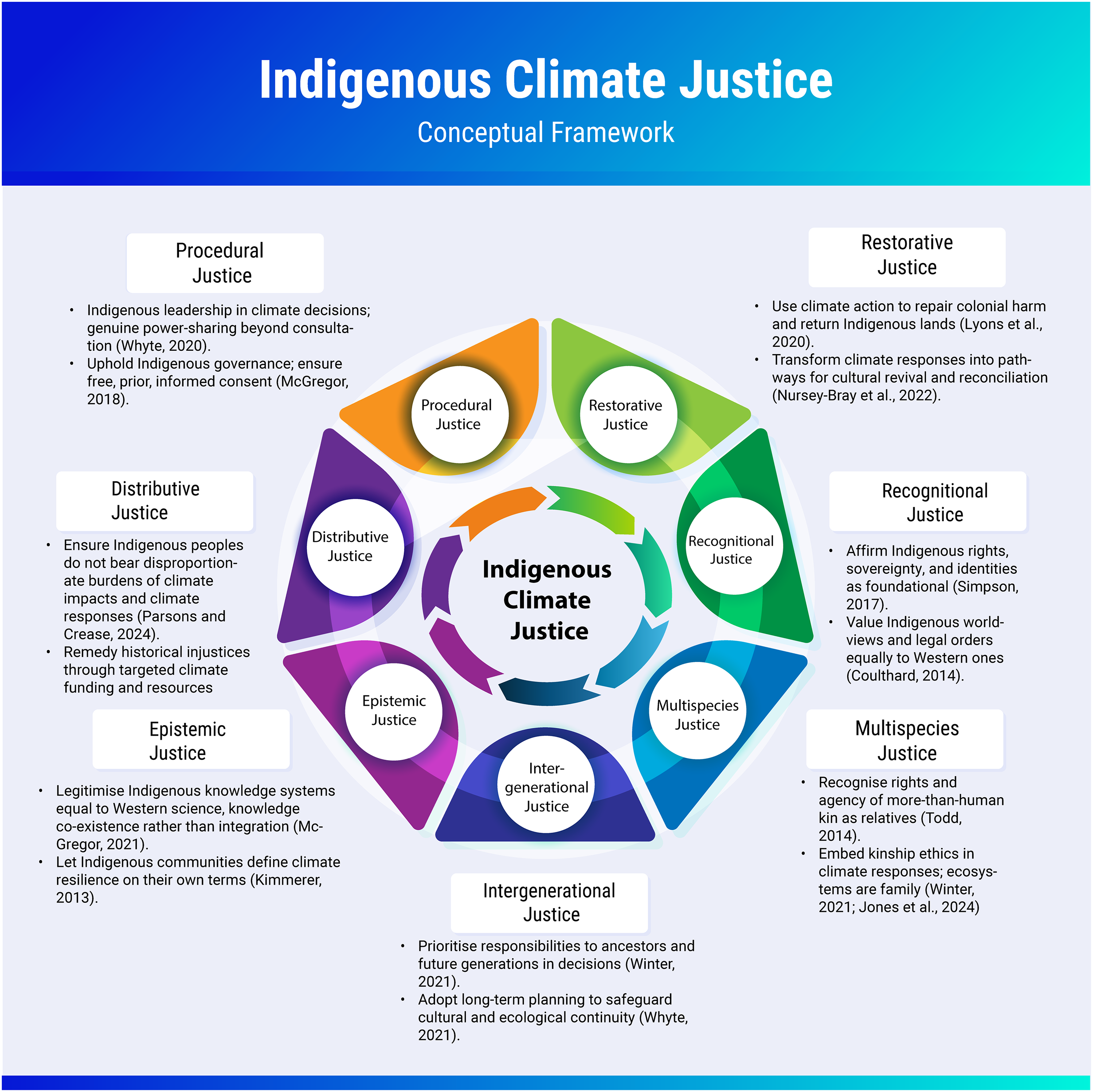
Indigenous Climate Justice (ICJ).
Central to ICJ is a kinship ethic: policies must restore and protect the deep relationships between people, lands, waters, and all living kin (Dudgeon and Bray, 2019; Watene, 2023). In practice, relational and multi-species justice require recognising rivers, forests, soils, plants, animals, and supernatural beings (like taniwha) as living relatives with rights and agency (Winter, 2021). For example, Aotearoa New Zealand's recognition of the Whanganui River and Te Urewera (a forested mountain range) as legal persons embodies this ethic, granting these ecosystems political standing and human guardianship (Magallanes, 2018; Winter, 2023). From a Māori perspective, Papatūānuku (Earth Mother), Ranginui (Sky Father), and all iwi (tribal) relations must be honoured. Managed retreat plans should protect customary fisheries (ngā kai a Tangaroa), forests (te wao nui a Tāne), and traditional food-gathering sites (mahinga kai) so that both human and more-than-human kin can thrive (Muru-Lanning, 2010; Wehi et al., 2020). In short, adaptation must sustain cultural connections to place and biodiversity, rather than treating nature as expendable (Heke and Rewi, 2025). Figure 1 summarises definitions of relational and multi-species justice with illustrative examples.
Equally vital are knowledge, recognition, and participation. Epistemic justice (Byskov and Hyams, 2022) requires that Indigenous ways of knowing (e.g., mātauranga Māori/Indigenous knowledge systems, oral histories, genealogies) inform climate planning (Cifuentes, 2024); This includes co-producing research and projects with Indigenous communities (Blackett et al., 2022), using Indigenous languages in decision forums (Chiblow and Meighan, 2022), and incorporating Indigenous mapping and story-work in risk assessments (Buell et al., 2020; Hill et al., 2020). Closely related, recognitional justice demands respect for Indigenous legal systems and values; adaptation strategies must embed concepts such as tikanga Māori (Māori legal system) and key principles such as kaitiakitanga (guardianship) as central, not peripheral (Dionisio and Macfarlane, 2021). Procedural justice complements these knowledge-based principles by ensuring that Indigenous peoples lead and consent to decisions affecting their lands (Lajoie-O’Malley et al., 2023; Merino, 2018). In practice, this means free, prior, and informed consent, meaningful co-governance, and transparent processes, not token consultation (Moore et al., 2017; Townsend and Townsend, 2020). In the context of retreat planning, procedural justice implies that Indigenous nations or Māori iwi and hapū (tribes and sub-tribes) set priorities for relocation or in-situ adaptation, using their own timeframes and criteria, rather than being treated as passive stakeholders (Adeyeye et al., 2019; Smith, 2020).
Finally, the framework addresses equity, restitution, and time. Distributive justice requires that Indigenous communities do not shoulder disproportionate costs of climate impacts and adaptation measures (Johnson et al., 2024). Instead, resources and benefits (funding, infrastructure, economic opportunities) must offset historical and current inequities (Waldmüller, 2021; Yumagulova et al., 2020). Restorative justice calls for repairing colonial harms through measures such as adaptation or relocation – for example, compensating for lost ancestral lands or more-than-human kin, and using retreat to restore degraded ecosystems and revitalise language, culture, and kin networks in existing or new places (Makey et al., 2021; Yumagulova et al., 2023). Importantly, an intergenerational justice lens insists on protecting the well-being of future generations (human and more-than-human) (Hourdequin, 2025; Winter, 2021). Adaptation plans must secure opportunities for children, grandchildren, and descendants, preserving sacred sites, culturally important livelihoods, and environmental health over multiple generations (seven or more) (Nursey-Bray et al., 2022). Decisions are evaluated not only by immediate gains but by long-term cultural continuity and ecological integrity. For Māori, this means a kaitiaki (guardian) ethic that treats future kin as rights-holders to be honoured today (Heke and Rewi, 2025).
These dimensions overlap and reinforce one another: ICJ is inherently holistic. For example, restoring lost lands (due to colonial dispossession) to an Indigenous community (restorative justice) simultaneously heals intergenerational trauma and renews kinship relationships (Scobie et al., 2024; Waretini-Karena, 2017). Recognising tribal sovereignty – mana motuhake (Mutu, 2020; Paora et al., 2011) – (recognitional justice) underpins epistemic justice by ensuring Indigenous knowledge systems are included and empowered. Likewise, safeguarding rivers and forests for the future (relational/multi-species and intergenerational justice) constitutes distributive and restorative justice for both ancestors and descendants (Winter, 2023). In practice, this means evaluating adaptation not just by the number of houses moved but by whether people keep control of their landscapes and waterscapes, maintain cultural connections and languages, and ensure more-than-human kin gain a voice in governance (Heke and Rewi, 2025; Nursey-Bray et al., 2022).
By foregrounding procedural, recognitional, distributive, restorative, epistemic, multi-species (relational), and intergenerational justice, our expanded ICJ framework offers a multi-dimensional lens rooted in te ao Māori (the Māori world and worldviews) and global Indigenous thought. This holistic framework structures the following analysis: we next apply these seven dimensions to assess whether Aotearoa's adaptation and managed retreat policies uphold ICJ.
Methodology
This study is framed within an ICJ paradigm and decolonising research philosophy (Smith, 2013). Adaptation is inherently political and connected to colonial history (Lyons et al., 2020). In line with Indigenous adaptation scholarship, we emphasise that adaptation policy must address historical injustices and respect Māori self-determination. Our analysis therefore supports Māori priorities and Treaty-based rights, explicitly drawing on Māori concepts of health and well-being (hauora) and guardianship (kaitikaitanga) to interpret adaptation challenges.
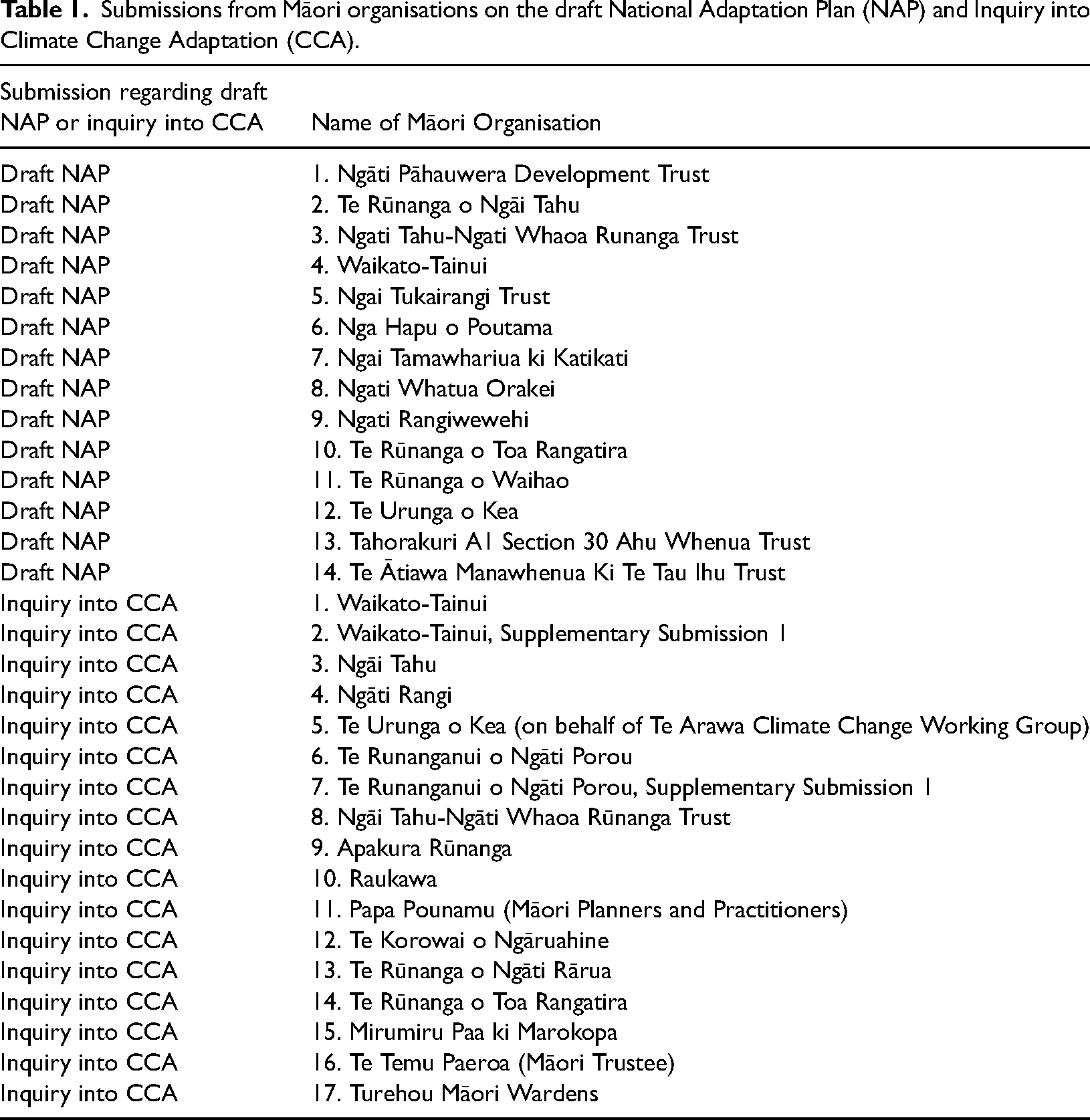
Our analysis relies on two complementary qualitative data sources. First, we examined written submissions by iwi, hapū, and other Māori groups to two national climate adaptation policy processes: the Climate Adaptation Select Committee inquiry (2023–24) and the draft National Adaptation Plan (NAP) consultation (Ministry for the Environment, 2022). These submissions (see Table 1) are rich Māori-authored texts conveying community-held values, priorities, and concerns. Because each submission represents the voice of an iwi or hapū collective, analysing them foreground Māori framings of risk, responsibility, and justice in adaptation.
Submissions from Māori organisations on the draft National Adaptation Plan (NAP) and Inquiry into Climate Change Adaptation (CCA).
Although these documents were produced for official government consultations, they are far from state-defined data. Each submission was authored by iwi, hapū or whānau (extended family) – not by the Crown (New Zealand Government) – and thus carries collectively held values, grievances, and aspirations expressed in a public forum. Indigenous communities have long engaged colonial institutions strategically; much like historical Māori petitions to government, today's submissions speak truth to power (Whittaker and Watson, 2019) by countering state narratives and asserting Māori worldviews (Bargh and Jones, 2020; Harris, 2004). We therefore read the submissions as consciously crafted expressions of Māori perspectives on climate adaptation, managed retreat, and ICJ (Bryant et al., 2017; Cretney et al., 2025). They are not monolithic: the variety of submissions reveals shared themes alongside diverse local priorities. Echoing Bargh and Wagner's (2019) analysis of Māori submissions on mining, we interpret these texts as deliberate performances of Māori voice intended to influence Crown policy while affirming Māori rights and authority (Bargh, 2013; Bargh and Jones, 2020).
We acknowledge that these submissions are inherently political, and their formal nature can constrain what is expressed. Iwi, hapū, and whānau often tailored their language strategically for a Crown audience, which may mask more radical viewpoints or internal nuances. Thus, we do not treat the written submissions as a complete or unfiltered picture of Māori climate politics. Critical reading is essential: we consider what Māori advocates say (the content of their claims) and how they say it (the performative framing and tone).
This approach situates our method in scholarship on Indigenous political representation and strategy. For instance, Coulthard (2014) warns that working within state frameworks can reproduce colonial power, yet other scholars note that engaging official processes is often necessary for survival, resistance, and resurgence (Dhillon, 2022; Parsons et al., 2021). We approach the submissions as strategic assertions of Māori agency rather than neutral testimonies, honouring the deliberate intent with which iwi, hapū, and whānau navigate Crown systems (Bargh, 2013; Hayward and Wheen, 2016).
Māori communities have long engaged colonial institutions strategically, much like nineteenth and twentieth-century petitions to government (AJHR, 1871, 1883; Best, 1909; Department of Maori Affairs, 1915; Te Koro, 1908). Adopting this decolonial ethos, privileging Indigenous voices and priorities, means that analysing Māori-authored submissions (with appropriate context) is itself an act of centring mātauranga Māori in the research (Kerr and Averill, 2021; Ruru, 2018a). Even though a settler-colonial state consultative context shapes the submissions, they offer invaluable insights into ICJ by illustrating how Māori communities publicly negotiate power, assert mana (authority and sovereignty), and pursue justice within (and against) colonial structures (Belgrave, 2014; Johnson, 2025; Jones, 2016).
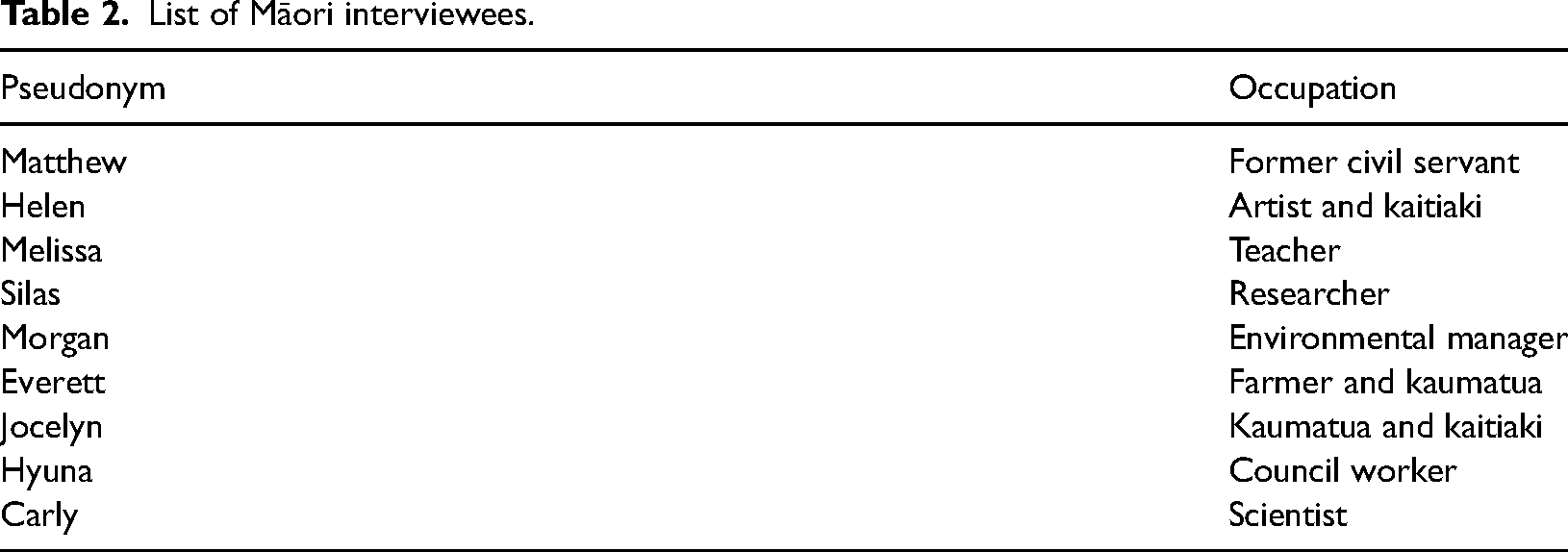
In addition to the submissions, we conducted ten semi-structured interviews with Māori professionals and kaumātua (elders) working on climate adaptation issues (see Table 2). These interviews, undertaken as part of a larger climate adaptation project, explored participants’ direct experiences of climate impacts, their perspectives on adaptation and retreat, and the cultural values guiding those views. The conversations provided rich contextual insights and helped us interpret the written submissions beyond what the documents alone revealed. To protect confidentiality, we do not name individuals or specific iwi; we use pseudonyms and general role descriptors (e.g., “an experienced environmental manager”) when presenting quotations. This approach respects the collective nature of Māori knowledge-sharing and ensures individual privacy.
List of Māori interviewees.
We analysed the written submissions and interview transcripts using critical discourse analysis (CDA). CDA examines how language reflects and shapes societal power relations (Fairclough, 2013; Leipold et al., 2019). It has been used in climate research to uncover assumptions underlying policy narratives (Calliari, 2018) and by Māori scholars to reveal colonial framings (Jackson, 2015). In practice, we closely read each text and coded for recurring metaphors, key terms and notable omissions related to adaptation and justice. For example, we noted concepts such as “resilience”, “risk” or “community” were invoked, and how Māori values such as manaakitanga (reciprocal care) or kaitiakitanga (guardianship) appeared or were silenced. Through CDA, we traced points of contestation and agreement across the texts, uncovering underlying frames – whether dominant (e.g., market-driven solutions) or Indigenous (e.g., guardianship).
Our analytical process was collaborative and reflexive. The Māori author led the interpretation of te reo Māori terms and cultural concepts to keep the analysis grounded in Māori epistemology while the non-Māori author offered a critical outsider perspective to question assumptions. We regularly discussed our coding and interpretations to check each other's understanding and reflexivity (Saldana, 2016). This iterative, team-based approach ensured that our analysis stayed rooted in an Indigenous worldview and did not inadvertently privilege Western frames. Ethical and cultural considerations guided every stage of this research. We obtained approval from our institution's Human Ethics Committee (UAHPEC/23594). We present findings in aggregated form and attribute quotes using group identifiers or pseudonyms and generic titles (e.g., “environmental manager”), rather than real names, to preserve the interviewee confidentiality (as per our ethics requirements). Ultimately, our methods sought to uncover power structures in adaptation policy while affirming Māori voices and their mana (Smith, 2013). For readers unfamiliar with Māori terms, a glossary is provided in the Supplementary Materials.
Findings
While we draw on these categories for analytical clarity, we stress that Māori submissions and interviews emphasised holistic principles such as whakapapa, rangatiratanga, and kaitiakitanga that cut across multiple dimensions. For example, whakapapa appeared not as a discrete claim but as a unifying ethic linking intergenerational responsibility, recognition of cultural identity, and kinship with more-than-human relations. Similarly, calls for tino rangatiratanga in adaptation governance were both procedural and recognitional, while also restorative of historical injustices (Ngāi Tahu submission; Waikato-Tainui submission).
Using these dimensions is a strategic method to communicate Māori concerns in a way legible to policymakers and academics, while our analysis remains grounded in Indigenous philosophies. As McGregor (2018, 2021) and Whyte (2020b, 2021a) emphasise, ICJ demands centring Indigenous knowledge systems and relational responsibilities rather than reducing them to Western categories. Our framework reflects this by treating the justice dimensions as overlapping and interdependent, ensuring that Māori claims are not fragmented but instead present a coherent, kin-centric vision of climate justice. In this way, ICJ is both a communicative tool and a decolonial intervention: it organises without erasing Indigenous worldviews and exposes how adaptation policy must transform to uphold Māori authority, knowledge, and relationships with whenua and wai.
Māori perspectives on adaptation and managed retreat reveal a holistic vision of ICJ encompassing seven interconnected dimensions: procedural, distributive, recognitional, restorative, epistemic, multi-species, and intergenerational justice. These themes emerged from our analysis of Māori submissions to the draft NAP, the parliamentary inquiry into Community-led Retreat and Climate Adaptation, and interviews with Māori leaders, elders, and practitioners. Notably, the submissions were strategic – Māori advocates framed their claims in language invoking Crown obligations (e.g., Te Tiriti o Waitangi partnership, international Indigenous rights). In this section, we integrate key findings and analysis for each ICJ dimension, supported by direct quotes from submissions (identified by iwi or organisations) and interviews (by pseudonyms and roles). Additional material from submissions is included in the Supplementary Materials, as space limits prevented longer quote in the paper. These findings illustrate how Māori reframe climate adaptation as a decolonial, kin-centric justice project. Rather than treating adaptation as a technical exercise in risk management, Māori understand it as an opportunity to uphold Indigenous rights, restore relationships, and ensure the well-being of all kin (human and more-than-human) across generations.
Procedural justice
Procedural justice concerns were paramount among our Māori participants. Every iwi and hapū submission insisted on being treated as a genuine Treaty partner in adaptation decision-making rather than another stakeholder. Many criticised the Crown's consultation on the draft National Adaptation Plan (NAP) as tokenistic; as Te Rūnanga o Ngāi Tahu observed, it was “not in the spirit of Te Tiriti partnership” for the Crown to relegate Māori to generic public forums. One interviewee similarly noted that even under a progressive government, a recent climate policy consultation offered “no co-design” and treated “Māori people… just one group amongst many” – comparable to a local hobby club – which “doesn’t reflect at all the idea of being a Treaty partnership” (Melanie, iwi advocate, referencing the Zero Carbon Act process (New Zealand Parliament, 2019)).
In place of token engagement, Māori contributors called for co-creation: the involvement of iwi and hapū from a project's inception through co-design, co-management, and implementation. This expectation flows from Te Tiriti o Waitangi obligations and the United Nations Declaration on the Rights of Indigenous Peoples, which affirm Indigenous peoples’ right to a decisive voice in matters affecting them (United Nations, 2007). Submissions highlighted how current processes systematically exclude Māori. For example, Waikato-Tainui pointed out that because Māori are more likely to rent and less likely to own homes than Pākehā, any retreat plan geared only toward property owners inherently sidelines Māori input. Similarly, Te Rūnanga o Waihao stated that the draft NAP “is not speaking our reality”, urging an authentic co-design approach with mana whenua rather than perfunctory outreach. Participants further noted that short consultation timeframes, inaccessible technical information, and inadequate support for Māori engagement compound this procedural inequity by limiting communities’ capacity to shape decisions.
Māori voices were unequivocal that climate adaptation and managed retreat must be designed with Māori, not for Māori. As Te Rūnanganui o Ngāti Porou argued, community-led initiatives should empower hapū to lead and tailor climate responses within their own rohe (territories). Waikato-Tainui insisted on explicitly recognising tino rangatiratanga (self-determination) in decision-making, meaning ultimate authority over relocation rests with iwi, rather than the Crown or local councils. Many submissions invoked the principle of Free, Prior and Informed Consent (FPIC), asserting that Māori communities have the right to give or withhold consent to any actions affecting their lands and lives. One interviewee explained that this requires moving “from consultation to consent” – i.e., government must secure Māori approval, not just feedback – encapsulating a common refrain that adaptation be “by us, for us,” developed by Māori rather than imposed top-down.
These demands are underscored by historical memory: Māori fear a centrally dictated retreat could become “another wave” of dispossession, repeating the trauma of past raupatu (land confiscations) and forced removals. Thus, they insist on the right to refuse or reshape any relocation plan lacking their full consent. Even where managed retreat is necessary, it should occur in genuine partnership. Māori want structural guarantees of shared governance – for example, dedicated iwi seats in decision-making bodies or co-management of adaptation programs – to balance power. In short, who decides and how decisions are made is at the heart of climate justice for Māori. Procedural justice is non-negotiable: without Māori leadership and consent, any adaptation policy will lack legitimacy and risk perpetuating injustice.
This emphasis on Māori self-determination in adaptation planning echoes Indigenous environmental justice scholarship, which holds that self-determination is a prerequisite for just outcomes (Jayawardena, 2024; Paora et al., 2011). Around the world, Indigenous peoples assert their status as nations with decision-making authority in policy-making, not merely stakeholders (Boron and Markey, 2020; Frost, 2019; Whyte, 2023). Our findings exemplify this stance. By grounding their claims in Te Tiriti o Waitangi, Māori are directly challenge the Crown to decolonise climate governance and recognise iwi rangatiratanga (authority). Procedural justice, in this context, means honouring Tiriti rights and Indigenous governance authority (O'Sullivan, 2024; Pirini and Morar, 2021). Honouring procedural justice in Aotearoa requires upholding Treaty guarantees of Māori governance authority (Orange, 2015; O'Sullivan, 2024). This goes beyond symbolic inclusion; it requires genuine power sharing, enabling iwi and hapū to determine their own climate futures.
Māori submissions also offered insight into what such power-sharing could look like in practice. Many advocated iwi- or hapū-led adaptation planning at the local level, aligning with best practices of collaborative governance observed elsewhere (Denny and Fanning, 2016; Poelina et al., 2019) and reflecting co-management arrangements already operating in parts of Aotearoa (Parsons et al., 2021). These Indigenous-led approaches safeguard communities against climate adaptation becoming another tool of dispossession. International examples provide cautionary tales: when external authorities forced Indigenous relocations – as seen with the Isle de Jean Charles resettlement in Louisiana and projects in Panama and Mexico; the results included procedural injustices, loss of lands and livelihoods, and weakened cultural cohesion (Apgar et al., 2015; Felipe Pérez and Tomaselli, 2021; Jessee, 2020, 2022). Māori are determined to avoid such outcomes, explicitly invoking these global lessons to justify a decolonial approach to climate adaptation.
Crucially, Māori advocates stress that procedural justice is inseparable from restorative justice for past wrongs: meaningful Māori participation today requires addressing the historical power imbalances that have long excluded them (Bargh and Van Wagner, 2019). Consistent with their status as tangata whenua and Treaty partners, Māori articulate a decolonial model of climate adaptation governance by insisting on decision-making through true partnership and consent. Their vision challenges the settler-state to transform its policy processes fundamentally and stands as a powerful example of Indigenous climate justice.
Distributive justice
Māori voices emphasised that distributive justice in adaptation must address deep-rooted inequities created by colonisation. Many submissions pointed out that climate change exacerbates existing inequalities, with Māori often facing disproportionate risks. For example, Te Korowai o Ngāruahine noted that 86% of Māori households in their rohe (region) lie in flood-prone zones; a direct legacy of dispossession and relegation to low-lying, marginal lands. Research confirms that this colonial history makes Māori communities more vulnerable to climate impacts (Johnson et al., 2022, 2023). As one study concluded, the most significant hazard for many Māori is not a flood (or any other extreme event) but colonisation itself, which devastated – and continues to undermine – Māori health, well-being, and cultural continuity (Parsons and Fisher, 2022). In other words, today's climate risks cannot be separated from historic land dispossession and marginalisation. Similar patterns are seen globally, as Indigenous peoples often face heightened hazards linked to colonial land policies.
Nearly all Māori submissions urged that adaptation policies prioritise vulnerable Māori communities so they do not shoulder unfair costs of climate mitigation and adaptation. A common demand was substantial, long-term funding for Māori-led adaptation, to avoid “double jeopardy”, where Māori face greater climate threats and must also pay to address them.
Several iwi cautioned that funding formulas must not penalise Māori for exercising their rights; for instance, by punishing iwi for keeping land under collective tenure or prioritising environmental kaitiakitanga (guardianship). In short, “fair” allocation must account for the structural inequities of colonisation. Treating everyone the same now would cement injustice, given the vastly unequal starting positions between Māori and Pākehā. Māori continue to experience worse outcomes in poverty, housing, and health than non-Māori (Bécares et al., 2013; Kawharu, 2015), so distributive justice requires targeted support for those most burdened. Some drew parallels to global climate justice: just as wealthy nations owe aid to vulnerable countries, a settler government like Aotearoa owes dedicated support to Indigenous communities disproportionately harmed by both colonisation and climate change.
Māori experiences of climate vulnerability today cannot be separated from colonial history of land dispossession and marginalisation (Parsons et al., 2019). Similar patterns appear internationally, such as Holifield's (2012) study of the St Regis Superfund site on the Leech Lake Reservation in Minnesota (USA). Holifield found that creating reservations not only imposed uneven risk burdens on Indigenous peoples but also excluded Leech Lake Band of Ojibwe from environmental impact assessments. Māori and international examples highlight that achieving climate adaptation justice requires integrating material redistribution (land, resources, protection) with recognition-based justice (honouring Indigenous rights and knowledge).
Importantly, Māori envision distributive justice not only as avoiding additional harm, but as creating positive outcomes. Many argued that a well-planned managed retreat could be an opportunity to improve housing, infrastructure, and livelihoods for Māori, rather than merely an exercise in loss. For example, Ngāti Rārua's submission advocated using adaptation projects to ensure whānau are re-housed in better-quality homes surrounded by restored ecosystems that sustain people and their non-human kin. In essence, equity for Māori means remediation and enhancement to counteract past and present disadvantages – a restorative approach to distribution.
Some submissions suggested concrete measures, such as making surplus Crown land available for relocating Māori communities, rebuilding marae and homes to higher standards, and investing in local economic development as part of adaptation. As one submitter put it, “the goal should be climate adaptation that leaves our people better off than they were, not worse”. This future-oriented vision of fairness – ensuring Māori end up better off – was shared across iwi.
Māori concerns about inequity are reinforced by lived experience with disasters. In interviews, participants recounted how recovery efforts often bypassed Māori. For instance, Silas, a researcher and kaitiaki (guardian), noted that after major storms, “we don’t benefit financially” from government recovery funds; instead, Māori communities “largely had to help themselves”. He observed that predominantly Pākehā regions, with well-insured property owners, received swift, well-funded government support. By contrast, Māori communities in places like Tai Tokerau were left to shoulder rebuilding with minimal assistance. Such disparities fuel calls for proactive redistribution; Māori want resources directed first to those who need them most, not last. As another interviewee explained, iwi and hapū should be “fairly resourced” through grants or other funding so they can implement their own solutions on a “level playing field” with non-Māori entities. Without deliberate efforts to rebalance resources, many fear adaptation could deepen poverty and inequality; for example, if only wealthy (often non-Māori) property owners receive generous buyouts while Indigenous communities are neglected.
These findings highlight that equity is central to climate justice and challenge policymakers to redefine “fairness” through an Indigenous lens. Classic environmental justice defines distributive justice as the fair allocation of benefits and burdens (e.g., equal treatment) (Bullard, 2018; Schlosberg, 2003). Māori perspectives affirm the importance of fair sharing but insist that true fairness must be defined in light of historic and structural inequalities (Reid et al., 2019; Russell et al., 2023). Treating everyone identically without acknowledging colonisation's ongoing effects only perpetuate injustice.
Climate justice scholars likewise argue that genuine equity may require giving more support to those historically harmed, aligning with Indigenous calls for restorative measures (Rice et al., 2022; Sultana, 2022a). Walker's (2009) notion of “remedial equity”, actively redressing past harm, reflects this idea. Overall, Māori submissions and interviews demand an intentionally redistributive approach to adaptation. Rather than a “colourblind” adaptation (Hardy et al., 2017) that privileges already-advantaged (often Pākehā) communities, Māori call for equity-driven policies that level the playing field and repair legacies of discrimination, colonial violence, dispossession, and neglect (Cannon et al., 2023; Tremblay, 2020). This reframing of distributive justice situates Māori not as another stakeholder, but as Treaty partners entitled to a fair share of resources and opportunities in adaptation (Johnson et al., 2022), commensurate with the injustices they have endured.
Recognitional justice
Underlying Māori demands for power and resources is the need for greater recognition of te ao Māori – Māori values, culture, identity, and authority. Māori submitters and interviewees stressed that recognising their status and rights is not secondary but foundational for all other aspects of justice. In practice, the Crown and society must acknowledge Māori as mana whenua (people of the land with authority over their territories) and honour Te Tiriti o Waitangi, including upholding Māori mana motuhake (sovereignty), in adaptation. Nearly every iwi and hapū submission urged the government to “give effect to Te Tiriti”. For example, Ngāti Rārua insisted that any policy be “fully consistent with … the Crown's responsibilities to iwi and hapū under Te Tiriti”, and Ngāti Whātua Ōrākei likewise argued that any relocation affecting their area must respect their rangatiratanga (self-determination rights). Māori ask the state to treat them as true Treaty partners with distinct rights, not merely as stakeholders living in hazard zones.
Recognitional justice for Māori also means respecting Māori knowledge systems, cultural values, and relationships with te taiao (the environment). Submitters pressed for adaptation strategies to validate and incorporate core Māori concepts such as whakapapa (genealogical connections between people and land), kaitiakitanga (guardianship obligations), and manaakitanga (reciprocal care). These concepts reflect a Māori worldview in which land is not mere property and people are not isolated individuals, but part of an interdependent family stretching across generations. Many warned that one-size-fits-all policies ignoring this identity would be inappropriate. They argued that a generic “managed retreat” model designed for the wider New Zealand public will not work on Māori land, where ancestral marae and urupā (burial grounds) endow the landscape with sacred significance. Te Rūnanga o Waihao asked: “How can adaptation protect our cultural identity for future generations, while at the same time honouring the identity of past generations?” This question highlights the cultural continuity at stake: even if climate change forces physical relocation, Māori must be able to remain Māori, carrying their culture, honouring tūpuna (ancestors), and maintaining identity wherever they go. In practical terms, this could mean keeping communities close to their ancestral rohe when relocating, transplanting marae to new sites, and preserving access to sites of significance. Adaptation efforts must accommodate Māori as a people with enduring ties to specific places and traditions, rather than treating everyone as interchangeable citizens.
Māori interviewees reinforced this theme. For instance, one kaumātua (elder), Everett, introduced himself by emphasising continuity and obligation: “I am mana whenua; my ancestors have been here since 1350… It is my obligation to uphold tikanga Māori values and the wellness of the whenua, the moana, and the people.” Everett's words exemplify recognitional justice: he affirms his identity, authority as mana whenua, and duty to care for his land and community. This perspective also highlights intergenerational responsibility, linking past (ancestors) and future generations through actions in the present. It shows that recognising Māori identity is inseparable from acknowledging their enduring relationship with place and kin.
In the climate justice literature, recognitional justice entails respecting Indigenous peoples’ dignity and identity (Whyte, 2017b). Our findings illustrate this principle in Aotearoa's settler-colonial context. By centring Te Tiriti in their adaptation demands, Māori seek more than symbolic affirmation – they seek structural recognition of their rights and authority in law and policy. For instance, a submission by Papa Pounamu [Māori planners and practitioners] to the inquiry urged a “Tiriti-centric” adaptation framework, echoing scholarly arguments that recognising Indigenous peoples as true partners, rather than mere stakeholders, is essential for justice (Jones et al., 2014).
Moreover, we found that recognition and participation are deeply intertwined. Māori cannot exercise self-determination in adaptation decisions (procedural justice) unless their mana and authority are first recognised as legitimate. If the state fails to recognise Māori rangatiratanga in climate decision-making, it perpetuates the colonial denial of Māori governance rights. Thus, recognition is a prerequisite for achieving the other justice dimensions. By documenting Māori demands in this context, our study offers a concrete example of recognitional justice: acknowledging past injustices and affirming present Māori agency, knowledge, mana, and expertise (Fisher and Parsons, 2020; Mutu, 2020). Recognitional justice is especially salient in Indigenous climate justice: without recognising Indigenous peoples’ unique status and worldviews, adaptation efforts risk erasing what matters most to those communities. In Aotearoa, any climate adaptation or managed retreat policy must explicitly uphold Māori Treaty rights, mana motuhake, and knowledge systems as foundational (Bell, 2024; Hayward, 2011; Jackson, 1993). Such an approach – grounded in Te Tiriti partnership and cultural recognition – could be a model for other countries seeking to uphold Indigenous rights in climate planning.
Restorative justice
Because history weighs heavily on the present, Māori also emphasised restorative justice, framing adaptation as an opportunity to right past wrongs. Nearly all Māori submissions to the government's climate adaptation plan began by recounting how colonisation's injustices have left their communities especially vulnerable to climate impacts today. These include the mass dispossession of Māori land (over 95% lost), the degradation of ecosystems under colonial stewardship, and intergenerational harms from economic marginalisation and racist policies. As one iwi, Te Urunga o Kea, wrote, that the NAP “should seek to do its part to address the weight of injustices perpetrated against tangata whenua, including the dispossession of 95% of their lands and the intergenerational impacts of colonisation, racism and poverty which are being exacerbated by climate change.” Given this history, many fear a poorly designed managed retreat could become “another wave” of dispossession rather than a remedy. Numerous submissions explicitly warned that relocating Māori communities without full consent would recall past land confiscations (raupatu) and forced removals. For example, Waikato-Tainui, an iwi that lost most of their territory to nineteenth-century raupatu, flatly rejected any policy that might force them off their remaining land. They argued that being moved to another tribe's area would “mean [the] loss of Waikato-Tainui cultural identity”, firmly asserting their right to stay on or near their ancestral whenua. Such fears of dislocation and cultural loss underscore that climate adaptation policy must repair, not repeat, the injustices of colonisation.
Māori voices insist that managed retreat and adaptation policies must not replay colonial patterns but actively repair past and present injustices. In practice, this means adaptation should restore Māori land rights, authority, and well-being. One interviewee, Heidi, described how a litany of past laws “legislated… against Māori”, systematically stripping away land and power. She and others argued that undoing these injustices requires returning decision-making authority alongside land. Several iwi submissions stressed that any relocation plan must go hand-in-hand with initiatives to strengthen and rebuild Māori communities, economically, socially, and culturally, rather than simply moving people and leaving them to fend for themselves. For instance, multiple submissions proposed concrete restorative measures such as using surplus Crown or public conservation land to resettle displaced Māori communities, rebuilding marae (community meeting houses) and housing to higher standards, and investing in local economic development as part of adaptation. Waikato-Tainui even suggested that a truly just adaptation could allow some at-risk Māori settlements to avoid retreat entirely, if they so choose, by pursuing alternatives such as restoring wetlands or building innovative flood protections. Where relocation does occur, Māori argue the focus must be on making their communities whole again; for example, providing equivalent replacement lands, funding to rebuild homes and marae, and keeping hapū (sub-tribes) together. In short, the goal is to ensure that adaptation remedies historical wrongs and improves Māori futures, rather than imposing new losses.
Critically, Māori see ecosystem restoration as integral to restorative justice. Healing land and waters damaged by colonial exploitation is part of healing the people. For example, Te Rūnanga o Toa Rangatira wrote, “first and foremost, climate change plans and strategies must address historical and contemporary environmental degradations to build true resilience and restoration”. In other words, the well-being of Māori communities and their environments is inseparable – both were harmed by colonisation, and both must be regenerated through adaptation. Some submissions further demanded “land back” and co-governance of lands and waters as part of climate adaptation. For instance, making degraded public conservation land available for iwi to restore and inhabit would not only provide safer ground for climate-threatened communities to relocate, but also begin to remedy past confiscations by returning land to its traditional kaitiaki (guardians). Yet participants observed that the government's current adaptation plans only weakly address these restorative goals. Many expressed disappointment that the final NAP lacks concrete commitments to remedy past Te Tiriti (Treaty) breaches or to return governance of degraded whenua (land), wai (water), and moana (seas/harbours) to mana whenua for restoration. Māori continue to press for far more decisive action: not just returning land, but also honouring existing Treaty settlement agreements, including iwi as partners in governing national parks and waterways, and investing in ecosystems revival as essential components of a just adaptation.
These emphases significantly expand conventional climate justice theory by foregrounding adaptation as part of an ongoing anti-colonial struggle. A small but growing body of scholarship argues that adaptation in settler-colonial states must address the legacy and ongoing realities of colonisation (Lyons et al., 2020; Nursey-Bray and Palmer, 2018). Our findings lend empirical weight to that claim, showing Māori explicitly linking climate impacts with colonial harms. In line with Sultana's (2022b) concept of “climate coloniality”, Māori submissions detail ways climate change and climate policies could reinforce colonial structures. For instance, if the Crown ignores Te Tiriti in making relocation decisions, it perpetuates colonial patterns under the guise of adaptation.
The insistence by Ngāi Tahu that the Crown carry responsibility for any losses on lands returned via Treaty settlements is particularly noteworthy. It challenges the state to honour historical agreements even under new climate stresses, effectively linking adaptation with reconciliation obligations (Livesey, 2019; Palmer and Watene, 2018). Connections can also be drawn to international climate debates on loss and damage (Boyd et al., 2017), with Māori arguments echoing calls for climate reparations by grounding them in a local Treaty context (Almassi, 2022; Mantyka-Pringle et al., 2015).
Furthermore, Māori proposals go beyond monetary compensation; they include restoring relationships with land and waters. This resonates with Indigenous scholarship that defines sustainable ecological restoration as encompassing material and intangible repair – returning land and native biota, recognition of sovereignty, and enabling cultural revival – rather than just payouts (Dickson-Hoyle et al., 2022; Moreton-Robinson, 2015). Māori perspectives therefore highlight the need to reframe adaptation as a form of redress: a just adaptation or relocation process should remedy historical land injustices, not create new ones (Bronen and Cochran, 2021; Ruru, 2013). This perspective injects a reparative, decolonial ethic into adaptation discourse, reminding policymakers that justice requires confronting the past. From an Indigenous standpoint, adaptation is not only about managing future risk but also about healing historical wounds so communities can be truly resilient moving forward (Arbon and Rigney, 2014; Carter, 2018).
Epistemic justice
Closely tied to recognition of Māori rights is recognition of mātauranga Māori (Māori knowledge systems). Māori voices in this study highlight epistemic justice – essentially the question of whose knowledge counts in adaptation – as a crucial dimension of climate planning. Time and again, Māori communities insisted that mātauranga Māori guide adaptation policy alongside Western science on an equal footing. Many expressed frustration that while the draft NAP referenced a Māori risk framework (Rauora), it gave little detail on how Māori values or expertise would shape policy. In response, interviewees such as Melanie and Silas called for genuine power-sharing and co-production of climate knowledge. Melanie argued that “the Māori knowledge base… should be the base from which [Aotearoa] should be activating” its climate responses, demonstrating that Indigenous knowledge must be the foundation of adaptation efforts, not an afterthought.
Participants cautioned that adaptation initiatives often still treat Indigenous knowledge as a mere “add-on” – a box to tick (perhaps by quoting a proverb) – rather than allowing it to reshape the fundamental approach. Heidi criticised policymakers for “misconstru[ing] the wording of mātauranga Māori” by cherry-picking “tiny little bits … out of this massive Māori knowledge system” and reducing them so outsiders miss “the big picture”. Instead, Māori interviewees and submitters advocated designing adaptation strategies from a kaupapa Māori epistemology – essentially asking, “What does climate adaptation look like through a Māori lens?” – and building from there. They offered concrete examples: using Māori environmental indicators (e.g., the behaviour of native species or specific seasonal celestial cues) to predict hazards; reviving customary land-use practices (such as seasonal fishing and foraging calendars) to enhance ecosystem resilience; and drawing on elders’ memories of past climate events to inform plans. These examples show how Indigenous knowledge can generate innovative, place-based climate solutions grounded in centuries of experience.
Another key theme was validation and respect: Māori want government agencies and scientists to trust and value Māori observations and insights, rather than dismiss them in favour of “technocratic” models from elsewhere. For instance, if a hapū (sub-tribe) identifies an inland site as spiritually and ecologically suitable for climate-related resettlement – perhaps based on spiritual connections or long-held knowledge of past environmental changes – that insight should carry as much weight in planning as an engineer's recommendation. In other words, Māori knowledge should be treated equally authoritative in adaptation decision-making.
These calls for epistemic justice in adaptation echo growing literature on Indigenous knowledge in climate action. Scholars have argued that including and co-producing climate knowledge with Indigenous communities is critical for mitigation and adaptation. For example, Brugnach et al. (2017) and Dorji et al. (2024) show how collaboratively integrating Indigenous and scientific knowledge can strengthen climate responses. More broadly, McGregor (2015, 2018) contends that revitalising Indigenous knowledge systems is crucial to achieving well-being for Indigenous peoples and their lands.
Our findings reinforce that mātauranga Māori is not just a “nice-to-have” addition; it is fundamental to redefining sustainability and climate adaptation goals, offering different ways of seeing and solving problems. By reshaping adaptation strategies through Indigenous epistemologies, Māori communities are putting into practice what scholars term “epistemic pluralism” in climate policy (Parsons et al., 2019), embracing multiple knowledge systems side by side.
Participants also shared stark examples of what happens when epistemic justice is absent. Māori endured epistemic injustice when their knowledge was ignored, undermined, or treated as inferior. One former Māori civil servant recalled how all references to mātauranga Māori were deliberately removed from the final Zero Carbon Act (2019), even though “it was one of the things that we tried to incorporate” in the draft legislation. He explained that coalition politicians insisted on excluding Māori knowledge; a clear example of how colonial power dynamics sideline Indigenous expertise. Facing experiences like these, Māori are now actively pursuing “epistemic self-determination”: the right to define how knowledge is created and applied in their own adaptation efforts. As one submission put it, government agencies must “learn from Māori on Māori terms”, rather than dictating terms through a settler-colonial lens. This insistence resonates globally, as Indigenous peoples worldwide push for co-production of climate knowledge and research partnerships that respect Indigenous intellectual property rights (Chambers et al., 2017; Latulippe and Klenk, 2020; Traynor, 2017; Veland et al., 2014).
Crucially, achieving epistemic justice is interwoven with procedural justice. Truly including mātauranga Māori in climate planning requires shifting power in decision-making forums to Indigenous peoples. Participants called for knowledge inclusion at multiple scales, from hapū-specific insights to iwi-wide strategies, and critiqued Western biases in current planning. These demands align with Islam et al.'s (2024) observation that effective climate solutions must “make way for repatriating Indigenous knowledges”. Many also emphasised Māori data sovereignty and control over knowledge use, reflecting decolonising methodologies (Smith, 2013). This ensures Indigenous knowledge is not mined or appropriated but applied ethically with community consent and benefit. The Māori submitters and interviewees thus present a compelling case for epistemic justice in climate action. Their perspectives demonstrate that valuing and integrating mātauranga Māori is not only a matter of justice, but also leads to more holistic and robust adaptation outcomes grounded in place-based Māori knowledge systems and worldviews.
Multi-species justice
One of the most distinctive contributions of Māori (and other Indigenous peoples) to climate debates is the principle of multi-species justice: justice must extend to the more-than-human members of the community. Guided by a kin-centric worldview, Māori see humans as part of an extended family, including lands, waters, flora, fauna, and other beings. Accordingly, adaptation must consider the well-being of all living beings, not just people. Most submitters stressed that any managed retreat or adaptation effort should account for impacts on ecosystems and other kin and seek to protect the mauri (life force) of beings. Not only are Māori connected through whakapapa to all beings, including rivers, mountains, and spirits (Watene, 2023), but also hold responsibilities as kaitiaki (guardians) to protect their more-than-human kin, including climate impacts. For example, representatives from Ngāti Porou and Ngāti Kahungunu, in their submission to the select committee, discussed how sea-level rise and coastal erosion threaten not only their marae but also coastal wetlands and fisheries that are tribal taonga (treasures). For them, justice means ensuring those habitats are protected, restored or relocated alongside the people. Another submission from Te Korowai o Ngāruahine emphasised rehabilitating ecosystems as part of retreat, advocating that when a community moves, effort should be made to restore the vacated floodplain for wildlife and for future generations. This reflects an ethic of care for more-than-human kin, the idea that Māori obligations to their family include species such as tuna (eels), kererū (wood pigeons), and other beings with whom they share their rohe (territories).
Māori submissions often linked this multi-species ethic to concrete proposals. Waikato-Tainui's submission stated that “as the health of M[ā]ori and te Taiao [the natural world] are inextricably linked, our wh[ā]nau have advocated since 1840 to maintain their ability to protect, conserve and restore te Taiao”. In other words, Māori must maintain their role as kaitiaki of the environment as a responsibility. Ngāti Whātua Ōrākei similarly argued that “climate change is a symptom of a deeper problem: the disconnect of people with the environment,” and the remedy is to restore that relationship of care and kinship between humans and nature. Te Ātiawa ki Te Tau Ihu Trust put it succinctly: adaptation discussions should include “all living organisms – Koiora (all living communities: human, plant, animal) – in the place which is the subject of management”. In other words, planning for managed retreat must ask not only what happens to human settlements but also to forests, rivers, birds, and other creatures. Submitters gave examples such as prioritising habitat restoration alongside relocation, or translocating culturally significant species (e.g., native plants used for weaving or medicine) to new tribal areas if the original habitats become unviable. The underlying principle is that people thrive when ecosystems thrive, and vice versa. Therefore, a truly just adaptation would protect the mauri (life force) of land and water both as an end itself and as the basis for human resilience. Some Māori even suggested granting legal personhood or special status to specific natural features in adaptation plans (building on Aotearoa's recognition of the Whanganui River and Te Urewera) so that the rights are formally considered.
Māori interviewees also described climate action in terms of healing the environment. When asked what climate justice meant to her, Heidi said, “for me, I think of it in terms of balance and equity… between humans and the environment, humans and each other,” seeing balance with the natural world as inseparable from justice among people. Everett likewise emphasised the interconnected well-being of people and nature: “I have a responsibility… to uphold the wellness of whenua, moana, and people,” linking kaitiakitanga to climate adaptation. Waikato-Tainui gave a practical illustration, writing that their marae are kaitiaki of the environment and take a “holistic integrated” approach to managing flora, fauna, land, air and water as a single system.
For Māori, then, multi-species justice is a fundamental component of ICJ, not an optional add-on. It requires a shift from purely human-centred, technical adaptation measures (such as seawalls) toward approaches supporting ecological regeneration. Ngāti Rangi wrote in their submission that “leaving the dunes alone, or restoring them… provides better protection from climate-induced storm damage than hard structures such as sea walls”. This sentiment encapsulates a preference for working with nature (e.g., strengthening natural buffers) rather than dominating it, benefitting both the environment and people.
By foregrounding multi-species justice, Māori perspectives contribute to a growing global conversation about expanding environmental justice and climate justice to include ecological relationships. Western frameworks, focused narrowly on human welfare, have often overlooked the rights or interests of non-human beings (Dobson, 2003). Indigenous worldviews help fill this gap. Māori do not draw a sharp line between human community and environmental well-being; the two are viewed as inseparable. This aligns with Indigenous scholars such as Kimmerer (2011, 2013) and McGregor (2014) who emphasise reciprocity and mutual responsibility between humans and nature. Such an ethos is increasingly crucial in the age of climate change, where human fate is entwined with that of ecosystems.
Our results show Māori applying this principle to adaptation: justice is kin-centric, meaning policies should honour obligations to rivers, forests, and creatures, not just human citizens. This challenges mainstream adaptation planning, which often treats environmental considerations as secondary or merely instrumental (e.g., valuing wetlands only for their flood protection). Instead, Māori demands reflect “ecological equity” (The Lancet, 2023), ensuring species and ecosystems can adapt and thrive alongside human communities.
The emphasis on multi-species justice also overlaps with recognitional justice: it asks the settler state to recognise Māori relationships with particular species or landscapes as worthy of protection. In practice, multi-species justice bridges Indigenous environmental justice (as both scholarship and protest movement) with initiatives like the global rights-of-nature movement (Barraclough, 2013; Berros, 2021). Decolonising climate governance in this way, by adopting an ecologically centred notion of climate justice (Milanez et al., 2022), could yield benefits for all life, not only Indigenous peoples. In providing a living example of a kinship-based justice ethic in adaptation, Māori perspectives enrich global scholarship and may inspire more inclusive, sustainable adaptation policies that respect the entire web of life.
Intergenerational justice
Finally, an overarching thread weaving through all these themes is intergenerational justice, the commitment to those yet unborn. Māori consistently framed climate adaptation as an obligation to future generations, echoing Indigenous ethics that extend justice beyond the present moment. In te ao Māori, each generation is a kaitiaki (guardian) for those to come, while honouring those who came before. If not addressed justly, climate change threatens to rob future Māori generations of their lands, culture, and prosperity, so today's decisions carry significance for mokopuna (grandchildren and descendants).
Many submissions invoked whakataukī (proverbs) emphasising long-term stewardship. A frequently cited Ngāi Tahu whakataukī goes: “Mō tātou, ā, mō kā uri ā muri ake nei” – “For us and for those after us”, encapsulating the ethic that today's actions must secure the well-being of future generations. For example, Ngāti Tamawhariua ki Katikati argued that climate adaptation must be part of broader efforts to “restore the environment to a level that it can sustain future generations.” The goal is not simply to react to immediate threats, but to leave a healthier, more resilient world for descendants. Ngāti Tamawhariua's submission expressed optimism that by taking courageous action now, “our future generations will have greater skill, knowledge, capacity and resources than we have, so will be better placed to continue the journey we have begun”. This forward-looking faith demonstrates a key point: Māori seek not only to protect rights but also to empower their descendants to thrive.
Concern for future generations was palpable. Te Rūnanga o Waihao raised fundamental questions about cultural continuity in the face of relocation: “Where can we go if we have to leave our whenua? Where can we re-bury our tīpuna [ancestors]?” These are not abstract questions – they involve practical issues such as where a coastal community might rebuild its marae if forced inland, and how ancestral burial grounds can be maintained or relocated as seas rise. From the Māori viewpoint, intergenerational justice requires the government to help answer such questions proactively.
The NAP and select committee submissions urged authorities to support Māori-led efforts to safeguard culturally significant sites for future generations – whether fortifying them in place or moving them with the community. In its submission, Ngāti Apakura envisioned climate adaptation initiatives that ensure “cultural heritage is seamlessly integrated into preserving natural resources… securing a thriving environment for future generations”. Likewise, Ngāti Rangi outlined a vision extending “ki tua o te 1000 tau”, 1000 years into the future, emphasising their responsibility to keep their environment and culture intact for the next millennium. This astonishing time horizon is not hyperbole; it reflects a worldview in which planning for seven generations (or even a thousand years) is a rational extension of duty to family. As one interviewee put it, many Māori view climate adaptation as a “future ancestors” issue, making choices by considering how their descendants will remember them and how those future people will live with the outcomes we set in motion today.
This long-term orientation means that short-term trade-offs are often deemed acceptable to Māori if they secure the community's survival and flourishing in the long run. For instance, the immediate costs or disruptions of managed retreat might be endured if they ensure mokopuna will have a safe homeland and an intact culture. Conversely, short-sighted policies offering quick fixes but compromising the future are considered irresponsible.
Many interviewees criticised the government's short electoral and funding cycles, contrasting them with Māori aspirations for enduring, intergenerational stewardship. Everett articulated his duty to past and future generations: “I have a responsibility for the people who came before me and who come after me.” Morgan, an environmental manager, lamented that politicians plan only for 5- or 10-year spans, whereas iwi plan for 50, 100, or more years ahead. This suggests that mainstream climate governance timeframes are misaligned with Indigenous expectations.
Māori often noted that adaptation efforts must respect whakapapa, the continuity of lineage through time. If a coastal hapū relocates inland, elders stressed the importance of staying within their rohe and carrying their histories, names, and ceremonies to the new place, so grandchildren of the current generation still know who they are and where they come from. In other words, safeguarding cultural identity for future generations is just as crucial as protecting physical assets. In Māori eyes, successful adaptation will be measured by whether their people in 100 years can still live as Māori, connected to their culture, lands (even if shifted), and heritage.
This strong intergenerational focus reinforces what ICJ scholars have long noted: Indigenous communities often conceive climate justice on extended temporal horizons far beyond Western policy cycles (Whyte, 2017a, 2021b). Māori philosopher Winter (2021) reminds us in Subjects of Intergenerational Justice, that Māori view time as a spiral where past, present, and future generations co-exist and remain interconnected. Winter (2021) advocates a transformative approach that replaces a competitive, human-centred model of justice with an inclusive, cyclical understanding of responsibilities.
This new framework calls for kaitiaki (guardians) to represent ecosystems and their long-term well-being, potentially engaging in national and global climate policy as legitimate advocates for ecosystems’ rights and futures. Ultimately, Winter (2021) highlights how a Māori-inspired “econtological” approach can decolonise intergenerational justice theory, and, we add, climate justice theory – by fundamentally shifting how justice is conceived across generations, emphasising collective, ongoing relationships rather than discrete, competitive interests bound by linear perceptions of time.
The Māori perspectives here align with the well-known principle of considering the “seventh generation” (Kimmerer, 2013; Park et al., 2023), a concept in many Turtle Island Indigenous traditions, and give it local form through whakapapa and whakataukī. Our study offers a concrete demonstration of how this principle is invoked in policy discourse. Māori submitters proposed 100-year and even 1000-year planning visions; in doing so, they are operationalising intergenerational justice in adaptation policy and challenging conventional climate governance, which often fixates on 2030 or 2050 targets, to expand its scope.
The climate ethics literature frequently discusses future generations in the abstract; Indigenous perspectives like those of Māori make the issue visceral and immediate by framing future descendants as part of one's family who require protection (Watene and Fritsch, 2024). One implication is that justice is seen as a continuum across time: honouring the past (through restorative justice) and empowering the present (through distributive and procedural justice) are necessary to fulfil obligations to the future. Indeed, the braided approach Māori take, simultaneously addressing historical trauma and future preparedness, exemplifies that justice is multi-dimensional and temporal (Parsons et al., 2021; Winter, 2023). Our findings support scholars who argue that intergenerational justice cannot be isolated from other justice dimensions in the context of Indigenous peoples.
Furthermore, these insights contribute to global dialogues on climate-induced relocation by emphasising cultural continuity over time as a critical measure of success. Research on community relocations in Alaska and the Pacific (Albert et al., 2018; Bertana, 2020) has highlighted the importance of maintaining identity and cohesion for future generations. Māori demands for preserving whakapapa connections and transferring knowledge during retreat offer a model for achieving this in practice.
Relocation, as Māori remind us, is not just a spatial move but a temporal and cultural journey – one that Māori communities have experienced in the past, as Bailey-Winiata et al. (2024) demonstrates, in the wake of disasters such as volcanic eruptions. By centring mokopuna in their strategies, Māori expand climate justice to include future voices. This intergenerational emphasis pushes climate justice theory to be more long-term and holistic. It is a call to remember that the ultimate test of any adaptation plan's justice may be whether it allows Indigenous peoples to survive and thrive as distinct peoples for centuries to come (Spiegel et al., 2020; Whyte, 2018).
In bringing together all seven dimensions of ICJ – from procedural and distributive equity to recognition of rights and knowledge, to repair of historical harms, and to caring for non-human kin and future generations – Māori articulate a comprehensive vision for just climate adaptation. These findings show how Māori communities strategically use policy forums to advance that vision, holding the Crown to account and offering alternative ways forward. The integration of results and discussion here demonstrates that Māori are not merely responding to climate threats but reimagining adaptation as a pathway to Indigenous justice and self-determination.
Conclusion and future directions
This study has highlighted how Māori submissions and interviews reposition climate adaptation and managed retreat as opportunities to advance ICJ. Far from being a technical exercise, adaptation is understood as a relational, holistic, and decolonial project that restores balance between peoples, lands, waters, and more-than-human kin. Our expanded ICJ framework demonstrates how Māori communities frame justice demands in terms of tino rangatiratanga (self-determination), recognition of whakapapa (kinship connections), obligations to mokopuna (future generations), and respect for te taiao (the natural world) – dimensions that extend beyond conventional justice categories. By foregrounding Māori priorities, our analysis challenges the state to honour Te Tiriti o Waitangi and to shift climate governance toward genuine partnership and self-determination.
We acknowledge that employing a justice framework involves tensions, particularly given its Western intellectual genealogy. Yet we reject the claim that this constitutes conceptual colonialism. Environmental justice was born of anti-racist struggle, and Indigenous environmental justice was elaborated by First Nations, Native American, Māori and other Indigenous scholars to express their own ontologies and epistemologies. ICJ, as applied here, is relational, plural, and decolonial; it amplifies Māori voices rather than subsuming them. There is no singular te ao Māori, but multiple iwi and hapū perspectives. ICJ offers a framework that can hold this plurality while engaging with wider debates in policy and scholarship.
We also recognise the concern that the justice categories employed here originate from Western intellectual traditions. Yet it is important to recall that environmental justice itself emerged from anti-racist activism in the Black American civil rights movement and was subsequently extended by Indigenous scholars to articulate distinct ontologies and epistemologies. Indigenous climate justice thus has anti-colonial and anti-racist foundations, not colonial ones. Our use of these categories is therefore not intended to subsume Māori perspectives under Western frames, but to amplify them within policy and academic debates where justice discourse remains influential.
Our contribution is to demonstrate that ICJ is not an abstract aspiration but an existing framework emerging from Indigenous scholarship and practice. It is explicitly anti-colonial, anti-racist, and future-oriented. It seeks not only to prevent harm but also to repair historical injustices and sustain relationships with whenua, wai, and more-than-human kin. By articulating Māori climate justice in this way, we aim to support iwi and hapū demands for sovereignty in adaptation governance and to contribute to international debates on how Indigenous philosophies can transform climate justice discourse.
Through these thematic lenses, our study illustrates how Māori in Aotearoa are reframing managed retreat and climate adaptation as catalysts for ICJ. The findings expand existing theory by showing that Māori weave together multiple justice dimensions – sharing power (procedural), equitable distribution (distributive), affirming rights and culture (recognitional), redressing colonial harms (restorative), valuing Indigenous knowledge (epistemic), caring for non-human kin (multi-species), and safeguarding future generations (intergenerational) – into a unified vision of a just climate response. This holistic, kin-centric perspective challenges conventional adaptation policies to go beyond technocratic fixes and instead pursue transformative, decolonial change. Our research contributes to Indigenous climate adaptation scholarship by providing an empirical case where Indigenous voices drive the agenda, offering insights that resonate beyond Aotearoa. It shows that adaptation, to be successful and ethical, must centre the aspirations of Indigenous peoples, who are often on the frontlines of climate impacts and whose philosophies offer pathways for living well with change.
In the context of Aotearoa's evolving policy landscape (for example, the forthcoming climate adaptation bill), this study identifies both promising shifts (such as greater acknowledgement of Te Tiriti) and persistent gaps, including the lack of co-governance mechanisms and inadequate funding. Addressing these gaps will be crucial to fulfilling the climate justice promises made to tangata whenua.
Future research could build on this work by examining how these Māori justice demands are implemented (or not) in policy and practice over time. Longitudinal studies could track whether iwi-led adaptation plans and Tiriti-based partnerships materialise as legislation is rolled out, and identify barriers or innovations that emerge. Comparative studies with other Indigenous communities – for example, Pacific Island nations facing relocation or Indigenous peoples in Turtle Island – could help discern the universality or distinctiveness of the justice principles identified here. There is also scope to explore community-led adaptation in practice by documenting retreat or resilience projects driven by Māori (or co-designed with government) to assess how well they realise justice outcomes for people, culture, and ecologies. Finally, engaging directly with rangatahi (youth) and future generations would deepen intergenerational insights, ensuring climate strategies remain attuned to those who will inherit the changing world.
Ultimately, this study demonstrates the vital contribution of Māori and other Indigenous peoples to reimagining climate adaptation. By centring Indigenous notions of justice, we gain not only a more equitable framework for managed retreat in Aotearoa, but also a richer, relational paradigm of climate action – one that holds immense value for transforming our collective response to the climate crisis in a way that honours people, place, and future life.
Highlights
Examines Māori conceptualisations of climate adaptation and managed retreat in Aotearoa New Zealand through an Indigenous Climate Justice lens.
Identifies critical gaps in current policies that inadequately address Māori self-determination rights (rangatiratanga) and incorporating mātauranga Māori (Māori knowledge systems).
Highlights Māori demands for restorative adaptation that explicitly addresses colonial injustices and empowers Māori-led governance and decision-making.
Emphasises the necessity of epistemic justice—recognising and deploying Indigenous knowledge systems equally alongside Western science—to achieve effective and equitable adaptation outcomes.
Contributes to international climate justice scholarship by demonstrating how Indigenous frameworks enrich and transform adaptation governance to promote intergenerational and multispecies well-being.
Supplemental Material
sj-docx-1-ene-10.1177_25148486251388972 - Supplemental material for Advancing Indigenous climate justice: Māori perspectives on managed retreat and climate adaptation policy in Aotearoa New Zealand
Supplemental material, sj-docx-1-ene-10.1177_25148486251388972 for Advancing Indigenous climate justice: Māori perspectives on managed retreat and climate adaptation policy in Aotearoa New Zealand by Meg Parsons and Iresh Jayawardena in Environment and Planning E: Nature and Space
Footnotes
Acknowledgments:
We would like to thank Roa Petra Crease who proof read earlier versions of this paper.
Declaration of conflicting interests
The authors declared no potential conflicts of interest with respect to the research, authorship, and/or publication of this article.
Funding
The authors received no financial support for the research, authorship, and/or publication of this article.

Supplemental material
Supplemental material for this article is available online.
References
Supplementary Material
Please find the following supplemental material available below.
For Open Access articles published under a Creative Commons License, all supplemental material carries the same license as the article it is associated with.
For non-Open Access articles published, all supplemental material carries a non-exclusive license, and permission requests for re-use of supplemental material or any part of supplemental material shall be sent directly to the copyright owner as specified in the copyright notice associated with the article.
