




Abstract
Adapting urban sanitation systems to changing climate conditions will require substantial investments. However, there is a gap in understanding the funding strategies for such adaptation measures, especially amid concerns that resilience measures might reinforce existing urban sanitation inequalities. Through cross-case document analysis and complementary key informant interviews, we examined the sanitation adaptation investments in eight cities, focusing on their funding arrangements and social and intergenerational equity implications. Debt financing of sanitation adaptation often relies on repayment through customer bills with only opaque considerations of the affordability for different socio-economic customer groups. The lack of appropriate accounting for the lifecycle costs of resilient infrastructure threatens to mortgage future generations. There is no convincing evidence that ‘greening’ of adaptation financing either shifts or redistributes the financial risk more equitably nor does it make the repayment of the investments substantially cheaper for customers. We conclude that a public sector funding approach is most appropriate to ensure social and intergenerational equity within climate-resilient sanitation systems.
Introduction
Inequitable access to urban sanitation service provision is still prevalent globally, in both the high-income (HIC) and the so-called developing countries (Brown et al., 2023; WHO and UNICEF, 2019). Urban sanitation, often misconstrued as a mere technical issue, is deeply intertwined with socio-political dynamics that shape its funding and equitable service provision. In many low- and middle-income countries (LMICs), colonial legacies underpin decision-making which further exacerbates inequalities in service provision (Biza et al., 2021; McFarlane, 2008; Nilsson and Nyanchaga, 2008).
As urban areas burgeon, so does the demand for sanitation services. Climate change puts additional pressure on often already inadequate and failing systems (Hyde-Smith et al., 2022), and adapting these systems to address the compounding challenges of increasing threats from climate hazards and urbanization will require considerable investments in the coming years and decades (Bigger and Millington, 2020; Fankhauser and Schmidt-Traub, 2011). While numerous cities in HICs face the need for major overhauls of the century-old dilapidated sewerage infrastructures (Andersson et al., 2016; Cousins and Hill, 2021), municipalities in LMICs often struggle with critical gaps in sanitation access and service quality (Brugger, 2021; Mara and Evans, 2018).
However, this demand often contrasts with the priorities set by local governments (McFarlane, 2008; Nilsson and Nyanchaga, 2008). Global financial institutions and private capital lenders’ priorities often focus on creditworthiness, bankability and return on investment (OECD, 2019), and all of these will be driven by political imperatives (Bigger and Millington, 2020; Biza et al., 2021; Rusca et al., 2022). The interplay between these entities has led to rise in financialized models prioritizing profit over equitable service provision (Bayliss et al., 2022; Brugger, 2021; Furlong, 2020). Financialization, defined as the growing dominance of financial actors, institutions and paradigms, has reshaped urban sanitation governance. The focus of urban sanitation provision has progressively moved away from the public welfare paradigm, towards market-driven approaches that have also prevailed in international aid over the last three decades (Bakker, 2005; Brugger, 2021). Although purported to attract investment, the financialization model for sanitation provision has consistently fallen short in addressing the needs of marginalized urban populations, thereby exacerbating inequalities (Bayliss, 2014; Bayliss et al., 2021; Furlong, 2020; Loftus and March, 2019).
In this study, we specifically turn to equity implications of different approaches to financing adaptation of urban sanitation systems in the face of climate change. This is a timely topic; despite the huge health and societal benefits of sanitation (Jeuland et al., 2013; OECD, 2011; Wolf et al., 2023), the urban sanitation sector is notoriously underfunded (Mara and Evans, 2018; WHO, 2022). National budgets for sanitation provision are increasing, but over 75% of countries report insufficient funding to implement their respective national WASH plans and strategies (WHO, 2022), let alone the higher levels of investment required to provide universal access to safely managed sanitation in the face of a changing climate. This is particularly problematic in the least developed countries which have significant gaps in sanitation coverage, small national budgets and high vulnerability to climate change impacts (Dickin et al., 2020). Faced with the persistent gap in sanitation access, service coverage and funding and the looming – though still undefined – additional costs of adaptation, the sanitation sector is increasingly looking at the potential of tapping into alternative funding sources such as green and climate finance (Dickin et al., 2020; ISF-UTS and SNV, 2019; SWA, 2019).
Lacking a single definition, there is a diversity of the funding sources and mechanisms summarized under the concept ‘climate finance’ with vague and overlapping boundaries to related terms such as ‘green finance’, ‘sustainable finance’ or ‘low-carbon finance’ (LSE, 2018). However, the term ‘climate finance’ is frequently linked to international funding commitments made during climate change negotiations, particularly the unmet goal of mobilizing USD 100 billion annually by 2020 from wealthy to less prosperous countries (Timperley, 2021). Consequently, some sources reserve the term ‘climate finance’ exclusively for funds managed by dedicated multilateral climate funds, such as the Green Climate Fund (GCF), the Global Environment Facility (GEF), and the Adaptation Fund (LSE, 2018; UNFCCC, 2022). Other financing related to investments that support climate change adaptation or mitigation measures such as public domestic finance, south-south cooperation, private sector investments (international or domestic), bilateral ODA or funds from multilateral development banks are sometimes more broadly described as ‘finance for climate change’ (LSE, 2018; Mason et al., 2020). We will use the general term ‘climate finance’ for all adaptation-related investments and highlight if we specifically refer to multilateral climate finance.
So far, however, multilateral climate finance plays a limited role in financing sanitation adaptation (CPI, 2019; Dickin et al., 2020; The World Bank, 2017). Analysis by Dickin et al. (2020) showed that sanitation accounted for less than 0.025% of the GCF-approved project budgets as of 2019, and only 3% of ODA funding was related to water supply and sanitation. Even when projects are categorized as related to adaptation, there are questions about the credibility of this assessment (Weikmans et al., 2017).
The limited use of multilateral climate finance for sanitation adaptation may in part arise from two linked challenges; the lack of an agreed set of adaptations that can secure greater resilience for sanitation (Willetts et al., 2022a) and pre-existing socio-spatial and structural forms of inequities in sanitation provision (Brown et al., 2023; Kumar et al., 2021; Van Welie et al., 2018) which risk being aggravated under inappropriate interventions and exclusionary financing mechanisms (Bigger and Millington, 2020; Brugger, 2021; Malloy and Ashcraft, 2020).
Adaptation and resilience are multifaceted concepts with varied interpretations across disciplines. Thus far, there is no commonly accepted definition for these terms in the context of sanitation systems. While the literature on potential technology solutions (e.g. Charles et al., 2010; Sherpa et al., 2014) and planning and programming guidance (e.g., Mikhael et al., 2021; Willetts et al., 2022b) for enhancing the climate resilience of urban sanitation systems is expanding, there is still no set of generally agreed, trackable interventions that ‘secure’ resilience. We use the terms ‘adaptation’ and ‘resilience enhancement’ interchangeably, specifically in the context of sanitation systems. These terms denote actions that strengthen the system's ability to maintain desired functions despite climate-related impacts.
Sanitation inequity contradicts the SDG global target to achieve universal access to adequate and equitable sanitation and to end open defecation by 2030, with a focus on those in vulnerable situations (UN DESA, 2020) and the United Nations Statement of the Human Right to Sanitation (UN CESCR, 2010). In this article, we use the term ‘sanitation equity’ in line with the concept of ‘substantive equality’ as defined by the human right to sanitation (Van de Lande, 2015).
Inequality in sanitation provision is compounded by the fact that climate change-related hazards disproportionately impact poor and marginalized populations (Dodman et al., 2022; Douglas et al., 2008; Hallegatte and Rozenberg, 2017). However, sanitation failures in one part of a city may impact other neighbourhoods or even the entire urban population (Bakker, 2013; Peal et al., 2020), and extreme weather conditions can exacerbate these sanitation challenges (Hyde-Smith et al., 2022). Therefore, it becomes evident that climate-resilient sanitation in cities needs to be as universal as possible (UNICEF et al., 2023). Consequently, this suggests that well-designed climate-resilient sanitation strategies would need to be effective in addressing indirect discrimination of policy and investment and thereby structural inequity in the sanitation system (Grasham et al., 2021; Willetts, 2024; Willetts et al., 2022b). Such strategies are likely to result in a disproportionate allocation of resources to enhance resilience in services for the poorest and most marginalized urban residents (Van de Lande, 2015).
However, a growing body of critical literature on urban resilience and adaptation planning has identified several problematic aspects, including exclusionary practices, urban segregation, displacement, climate gentrification, and spatial disparities (e.g. Anguelovski et al., 2016; Bigger and Millington, 2020; Long and Rice, 2019; Long and Rice, 2021; Onyanta, 2018; Sovacool et al., 2015; Swanson, 2021). These issues raise concerns about the appealing ‘green halo’ (Sörqvist et al., 2015) associated with the climate resilience narrative, which may increase the desirability of a project that is purported to have green or sustainability credentials (Sörqvist et al., 2015). When extended to sanitation resilience, the association of projects with climate adaptation might inadvertently prioritize and legitimize investments that reinforce existing social inequalities, without clear controls.
In financialized water supply and sanitation sectors, it is questionable whether investments in adaptation can be transformed in to financial products capable of extracting value and profits (Christophers, 2018; Loftus and March, 2019; Pryke and Allen, 2019). It is likely that most sanitation adaptation projects (as most adaptation actions) do not directly generate a premium for the service provider; rather they bolster the system's resilience, securing continued service provision (Bigger and Millington, 2020). This raises concerns about the priorities driving adaption investment decisions; if financial returns are favoured over broader societal benefits, it is unlikely that the needs of marginalized populations and structural inequities will be addressed. This directly contradicts the principle that should be at the heart of GCF of redistribution from richer to poorer countries which are particularly vulnerable to the adverse effects of climate change and have less capacity to adapt (Brown et al., 2013; UNFCCC, 2015).
To date, scant attention has been directed towards dissecting the diverse funding strategies for adaptation efforts in the urban sanitation sector and their implications for urban equity. We will focus on socio-economic equity outcomes of sanitation adaptation investments that we understand as the fair distribution of services and service outcomes amongst diverse urban populations and which challenge systemic inequalities by ensuring that marginalized groups are not disproportionately burdened by or excluded from the adaptation investment benefits (Anguelovski et al., 2016). We also explore intergenerational equity, advocating that today's adaptation decisions should not disproportionally burden future generations.
Climate change adaptation of urban sanitation will be paid for by the ‘traditional’ sources of funding of urban sanitation commonly described as the ‘3Ts’ – taxes, transfers, and tariffs (OECD, 2009; UN Water, n.d.). Household investments are increasingly recognized as a fourth substantial funding source (Danert and Hutton, 2020). Since many service providers do not operate on a full-cost recovery basis (Furlong, 2021), international financing often draws from general taxation. Consequently, projects not explicitly benefiting disadvantaged populations may still incur costs to them through reduced public spending elsewhere. Therefore, it is crucial to assess how sanitation adaptation investments impact service quality for specific population groups.
Our research builds upon the scholarship of financing (Roelich, 2015; World Bank, 2011) and financialization (Bayliss, 2014; Cousins and Hill, 2021; Klink et al., 2019; Williams, 2021) of urban infrastructure adaptation. We critically map the funding realities of past and ongoing projects for adapting urban sanitation systems to climate change. Central to our inquiry is the question: How is equity addressed in investments aiming at adapting urban sanitation systems to climate change?
Methods
This study investigates the extent to which social and intergenerational equity considerations are integrated into investments that address climate adaptation of urban sanitation infrastructure and their associated financing structures. To achieve this, we employed cross-case analysis methods utilizing a combined approach incorporating case-oriented and variable-oriented analysis techniques (Miles and Huberman, 1994).
Case selection and mapping process
For the selection of case studies, we adopted an iterative and structured approach that involved an initial web search, consultations with experts in water and sanitation climate adaptation and a structured scoping review of existing documentation of sanitation adaptation projects. We aimed to capture a broad spectrum of adaptation measures, spanning all components of the sanitation chain, including containment, emptying/transport, treatment and disposal/end-use. We included examples of both sewered and non-sewered sanitation to reflect the diverse realities of urban sanitation across different contexts (Strande et al., 2023). Geographically and socio-economically we included examples from cities in LMICs and HICs. Our selected cases encompass projects in cities across North America, Europe, Africa and Asia, providing a diverse mix of socio-economic conditions and governance structures. This geographic and socio-economic diversity was critical in ensuring that our analysis could account for a wide range of adaptation contexts and strategies. However, the limited availability of detailed case documentation of LMICs sanitation adaptation cases led to a disproportionate representation of projects from HICs, particularly the United States. Furthermore, we purposefully selected projects with diverse approaches to financing sanitation adaptation investments as identified during our scoping review.
The mapping of funding realities focused on identifying and analysing financing mechanisms used in these projects. Leaning on existing research about financing infrastructure adaptation to climate change (Roelich, 2015), we systematically documented the source of initial investment funds, the financing structures in place and the ultimate sources of income that sustain these investments (Table S1).
Data sources and coding
The study design was desk based, involving an initial scoping review and subsequent structured document analysis. This analysis encompassed various sources such as peer-reviewed research, legislative and planning documents, reports, public statements and media coverage related to each case study. Seven key informant interviews (KIIs) with ten individuals representing funding agencies, utilities and municipalities complemented the data collection and analysis. Table S2 lists the interviewed key informants. Our documents and interview transcripts analysis employed a deductive and inductive thematic analysis. The coding process was guided by established evaluation criteria adapted from research on sanitation subsidies. These criteria can be summarized as follows: (1) (Projected) impact on the resilience of sanitation services: Does the investment contribute to increased climate resilience of the sanitation system? (2) Scope: Who and what was targeted by the investment into the sanitation system? (3) Consideration of social-economic and intergenerational equity/justice: Did the financial approach consider socio-economic and intergenerational equity? The detailed criteria are given in Table S3.
Evaluation framework for equity considerations
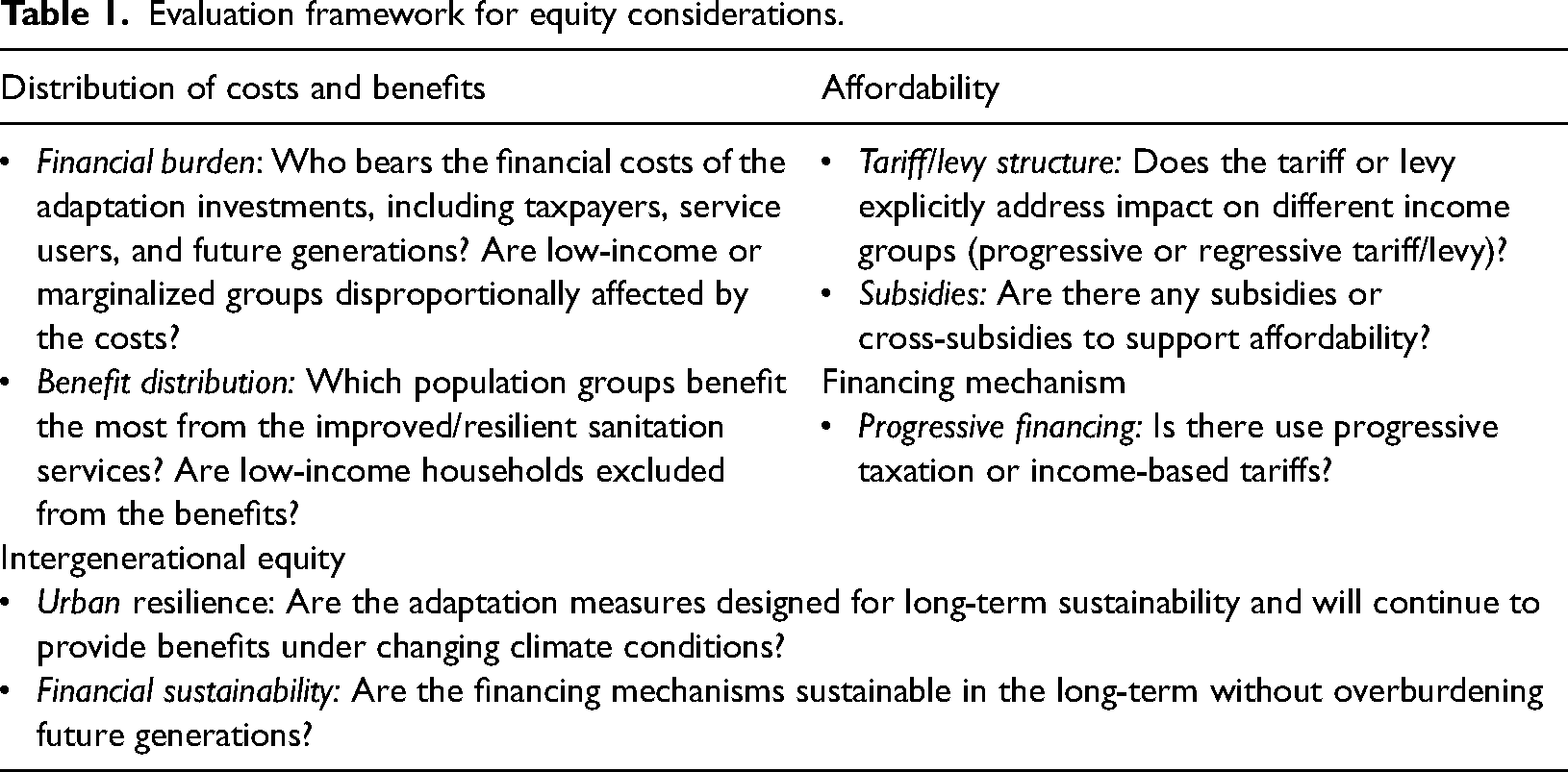
For the evaluation of the socio-economic and intergenerational equity, we focussed on distributive equity considerations (Reckien et al., 2017; Schlosberg and Collins, 2014) and used the evaluation framework outlined below (Table 1).
Evaluation framework for equity considerations.
Ethics statement
The University of Leeds’ ethics committee reviewed and approved the research before conducting the KIIs (MEEC 21-032) in October 2022. Written consent was obtained from all interviewees.
Limitations
Our review is not exhaustive and does not capture ALL sanitation adaptation measures within individual city contexts.
This article focuses on funding realities of climate adaptation measures rather than efficacy or cost–benefits compared to alternative adaptation options, which have been subjects of other studies (e.g. Allen and Pryke, 2013; Christophers, 2018; Loftus and March, 2019).
Results and discussion
Table S1 provides an overview of the main characteristics of the selected investment cases.
Characterization of the different cases
Emergence and governance of the investment cases
In cross-case analysis, we must navigate the tension between case uniqueness and generalization and transferability (Miles and Huberman, 1994). Adding depth to the overview presented in Table S1, we give more details about the emergence of the project and relevant governance aspects that influence the financing choices and conditions.
The Thames Tideway Tunnel (TTT): The TTT – also known as ‘super sewer’ – is an upgrade of London's combined sewer system designed to intercept combined sewer overflows (CSOs) into the River Thames, which are already excessive and are forecast to increase because of climate change. The project was conceived to prevent legal repercussions against the UK Government for violating the EU Urban Water Treatment Directive (Grafe and Hilbrandt, 2019). Unique in its institutional context, the water sector in England has been fully privatized (e.g. Bakker, 2003). The CSOs into the Thames in London are the responsibility of Thames Water (TW), the UK's biggest water company. TW was privatized in 1989 and is currently owned by a consortium of international investment funds (Grafe and Mieg, 2021). In the early 2000s, TW became overleveraged under its former private equity owners and unable to bear the costs of the TTT (Bayliss et al., 2022; Espinoza and Plimmer, 2017). Consequently, Bazalgette Tunnel Ltd (BTL), trading under ‘Tideway’, was created as a special-purpose company with an offshore holding structure to deliver, design, build, commission, maintain and finance the TTT while keeping it separate from TW's balance sheets. Tideway uses mainly debt financing – loans and green bonds, including a 35-year loan from the European Investment Bank of over GBP 700 million (Loftus and March, 2019; Tideway, 2017; 2022a; 2022b) – to fund the TTT. Notwithstanding the complex implementation and project financing set-up, the costs of the TTT will be borne by TW's wastewater customers through an added levy on their bills (Grafe, 2020; Grafe and Mieg, 2021).
US cases: In contrast to the privatized water sector of the United Kingdom, the Massachusetts Water Resources Authority (MWRA), Miami-Dade Water and Sewer Department (WASD), and San Francisco Public Utilities Commission (SFPUC) District of Columbia Water and Sewer Authority (since 2010 known as DC Water) are owned by municipal or regional public entities.
Boston Deer Island Wastewater Treatment (WWTP) and Washington DC Clean River Project (CRP): The Clean Water Act's water quality standards have forced many municipal water wastewater utilities to upgrade their conveyance and treatment infrastructure. In the late 1980s, the Boston Deer Island WWTP plant was due for an overhaul to comply with the federal Clean Water Act. As part of the upgrade, essential parts of the WWTP were raised based on sea-level rise projections derived from climate modelling (Walton, 2021). Similarly, the CRP in Washington DC emerged from a lawsuit and was designed to reduce frequently occurring combined sewer overflows into the Potomac and Anacostia Rivers and Rock Creek. This issue has become a significant contention point between the DC Water, the National Environmental Protection Agency (EPA) and local civil society groups (Christophers, 2018; Rycerz et al., 2020).
Connect 2 Protect (C2P) and Commercial Corridors (CCP) septic-to-sewer conversion Miami: Miami, Florida, has been described as ‘ground zero’ for climate change and sea-level rise in America (Grunwald, 2014). Miami-Dade County is located 2 m above sea level, and the coast of South Florida has already experienced 0.3 m of SLR since 1870 (Anand, 2021). Pollution of Biscayne Bay through nutrients leading to fish kills has been a longstanding issue, with climate change and sea-level rise adding urgency (Brasileiro and Harris, 2020). Although most of the County's properties are connected to sewer systems, there are still about 120,000 septic tanks, 9000 of which are vulnerable to compromise or failure under current groundwater conditions. This number is projected to increase due to climate change and sea-level rise, with seepage threatening the shallow and porous aquifer, the primary drinking water source for Miami-Dade County (Miami-Dade County, 2022). The two initiatives aim to convert 13,000 vulnerable and failing residential (first phase C2P) and 1000 commercial (CCP) septic systems to the sewer system. The cost to convert all 120,000 septic tanks in Miami-Dade is expected to cost over USD 4 billion (Miami-Dade County, 2020).
San Francisco's Sewer System Improvement Project (SSIP): The SSIP aims to alleviate environmental and public risks posed by the combined challenges of climate change, ageing infrastructure and seismic threats (amongst others) (SFPUC, 2021). The goal of the SSIP is to ensure that San Francisco's sewer system can handle increasing demand, reduce the risk of overflows and backups and improve water quality in San Francisco Bay and the Pacific Ocean (SFPUC, 2022a; 2022b).
Financing of the four US investment cases involved revenue or general obligation bonds (including green bonds), government loans and grants and direct household investments. Repayment of the costs principally relies on customers’ wastewater tariffs, with taxes playing a secondary role. Bond investors receive regular interest payments over the bond's life, and the principal is returned to the investor when the bond matures. In simplified terms, revenue bonds are backed by customer tariffs (the specific revenue created through the investment), while general obligation bonds are linked to investments that do not create a specific income and are therefore backed by general taxation, such as property tax. Unlike many other countries, the United States has a well-developed sub-national bond market, and bonds issued by municipalities or public authorities are tax exempt for the investor, meaning that the interest payments are income tax exempt (KII 2; Ramseur, 2018). Since the federal government (and sometimes state government) forgoes its right to tax the investor on their capital gains from bonds, the general taxpayer implicitly repays part of the investment. Further, the taxpayer picks up the costs of federal and state grants and loans (if they are provided at preferential interest rates). An essential form of US federal government assistance is EPA's Water Infrastructure Finance and Innovation Act (WIFIA) loans (Ramseur, 2018). However, state and federal funding is limited and has substantially decreased over the last four decades (Cousins and Hill, 2021; Netusil and Kousky, 2021).
Deep Tunnel Sewerage System (DTSS) and NEWater, Singapore: Singapore experienced rapid development of its infrastructure in the late twentieth century to match its hyper-industrialization. However, limited water supply and rapid population growth mean its long-term water security is at risk (Da and Hong, 2018). Singapore's DTTS and NEWater wastewater reclamation investments are separate but interconnected initiatives to address this. Their financing model is determined by Singapore's special standing as a city-state with a single public water and sewerage service provider, the Public Utility Board (PUB), which is also responsible for water resources management (The World Bank, 2018). It is dominated by direct government investments and repayment through taxes; however, two of the four operational NEWater treatment plants were constructed under a design–build–own–operate (DBOO) model (The World Bank, 2018).
As is symptomatic for the Zambian water sector, the Lusaka Sanitation Program (LSP) relies heavily on external funding. Implemented by Lusaka Water and Sanitation Company (LWSC), the LSP is mainly funded by the bilateral and multilateral financing institutions and development partners as well as the Zambian Government (GRZ). The LSP has evident characteristics of a sanitation development programme and extends the target population's service coverage and quality. The scope of the LSP includes rehabilitation and expansion of sewer networks, upgrade, rehabilitation and extension of WWTPs, and non-sewered measures covering construction of improved flood-resilient household latrines and construction of faecal sludge (FS) treatment facilities, as well as on capacity development and support of LWSC for improving and formalizing the provision of FS emptying services (Gerlach et al., 2020).
The Sponge City Programme (SCP): The SPC in Wuhan is a flood resilience and urban drainage programme implemented through different departments within Wuhan Municipality (Dai et al., 2018). Initiated by the Chinese government in 2015, sponge cities aim to manage water by naturally absorbing, storing and purifying rainwater. China is a unitary country where local governments implement the central government's decisions (Dai et al., 2018). While the central government provides initial funding for sponge cities, it covers only a portion of the total costs. The subsidy is staggered, partly performance based, and depends on the administrative tier of the city (Griffiths et al., 2020). The government encourages and incentivizes municipalities to attract private investments, including public–private partnerships (PPPs) and bank loans (Liang, 2018). However, Dai et al. (2018: 588), point out that ‘[w]hile using the English-language abbreviation PPP, China defines the non-government partner as ‘social capital’ instead of ‘private capital’, which opens the door for state-run firms […].’
In summary, the governance systems of the selected cases vary significantly, from fully privatized models to municipally owned entities and from direct government investments to complex financing structures. In later sections, we will explore how these governance systems influence financing choices and their implications for urban sanitation equity.
Components of sanitation chain targeted by adaptation measure
The selected adaptation cases primarily address environmental pollution risks. These risks arise from the release of untreated sewage during extreme rainfall events (London, Washington DC and San Francisco), groundwater pollution from failing sewered and non-sewered sanitation infrastructure (Lusaka and Miami-Dade) and inadequate wastewater treatment during extreme weather events combined with sea-level rise (Boston and San Francisco) all of which will worsen as a result of climate change (Christophers, 2018; Feifel and Gregg, 2021; Loftus and March, 2019).
Except for the investments in Lusaka and Miami-Dade, all of the measures focus solely on centralized sewered sanitation systems (Figure 1); therefore, the sanitation chain's containment element is irrelevant. The LSP aims to enhance Lusaka's underperforming sanitation infrastructure and services. Beyond environmental pollution mitigation, the LSP is anticipated to benefit public health significantly. It aims to reduce groundwater pollution, faecal contamination in living areas and protect urban infrastructure like roads and buildings from flash floods. In addition, it offers more climate-resilient latrines for low-income households (Gerlach et al., 2020; Mikhael et al., 2021). Still, the bulk of the investment is spent on extending and upgrading the (centralized) sewerage and wastewater infrastructure, excluding the majority of people living in low-income (peri-urban) areas (Kappauf et al., 2018).
List of investments analysed for the components of the sanitation chain targeted and main elements of the adaptation measure.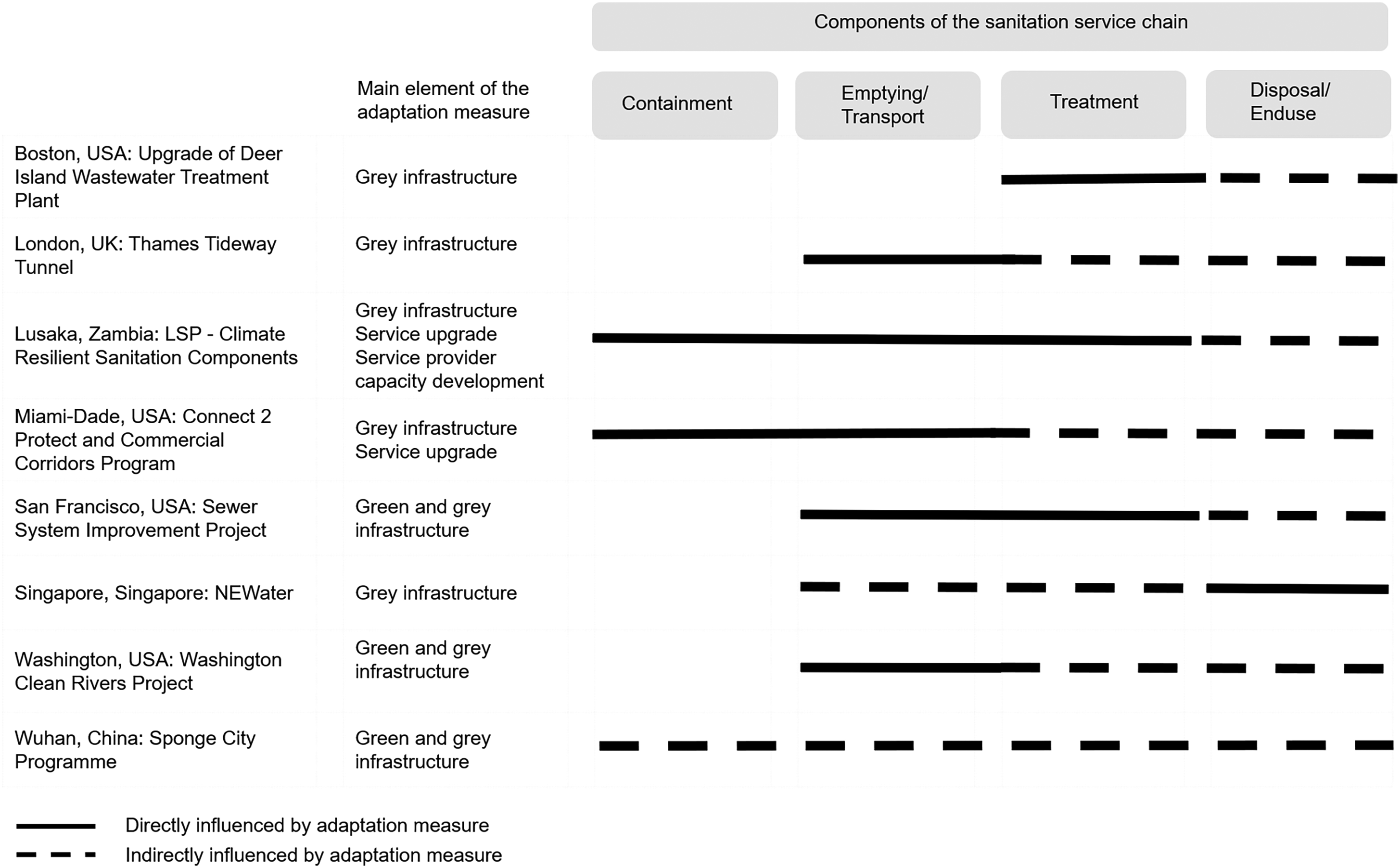
In San Francisco, the citywide Sewer Systems Improvement Program (SSIP) encompasses three subprograms: treatment plants, collection systems and land reuse (SFPUC, 2018), effectively covering the entire sanitation chain.
The Sponge City Programme (SPC) in Wuhan is geared towards enhancing flood resilience and stormwater management. The SPC's primary focus is safeguarding urban populations and infrastructure rather than adapting the sanitation system. Given Wuhan's rapid urbanization and significant alteration of its natural drainage system, the close ties between drainage and sanitation are evident. The city is served by combined and separate sewer systems (Oates et al., 2020; Peng and Reilly, 2021).
Finally, in Singapore, the driving force behind the Deep Tunnel Sewerage System (DTSS) is the potential for wastewater reclamation (NEWater). This initiative aims to shield the population from water scarcity, propelled by a political desire for greater national self-reliance and reduced reliance on imported drinking water from Malaysia (Biswas and Joo Hee Ng, 2021).
Urban resilience or reputational enhancement?
After having provided a comprehensive background on each case in the preceding sections, this section focuses on examining how the selected measures have incorporated climate change considerations in their design and implementation, which is crucial for ensuring sustainable benefits for future generations (Table 1). In addition, we explore whether patterns of ‘climate urbanism’ – the growing tendency among policymakers and experts to adopt the language of ‘climate friendliness’ and ‘climate resilience’ to further their objectives (Long and Rice, 2019) – are evident in some of the cases.
Undoubtedly, climate change has direct negative impacts on urban sanitation systems. These can be categorized as damaged sanitation infrastructure, disrupted services and inhibited system efficacy (Hyde-Smith et al., 2022). However, investing in sanitation is crucial for sustainable urban futures and has benefits that extend far beyond climate change adaptation (McFarlane, 2019). It is, therefore, not surprising that none of the selected cases cite climate adaptation as the sole motivator for investments in the sanitation system. However, beyond this, we suggest that climate adaptation is, in some cases, a label intended to bolster the reputation of the investment.
For instance, the LSP focuses on improving and extending sanitation services in Lusaka to protect public and environmental health; adaptation or resilience to climate change is a side product of a generally improved and more resilient sanitation system. There is no evidence that the nature of the sanitation interventions proposed under the LSP vary materially from those which had previously been supported by the project's funding agencies and no evidence is provided to show that the infrastructure is more resilient to climate change than potential alternatives. Nevertheless, AfDB and GIZ have prominently branded their components of the LSP implementation as ‘climate resilient’ (AfDB, 2015a; AfDB, 2022) or ‘climate friendly’ (Gerlach et al., 2020; GIZ, n.d.), respectively. The World Bank, which finances almost identical components to AfDB, does not reference climate resilience in their project description (KII 4). The AfDB project title, Climate Resilient Sustainable Infrastructure Project (AfDB, 2022), therefore, seems to exemplify the use of ‘green’ or ‘resilience’ labels to add legitimacy to an investment (Sörqvist et al., 2015; Vale, 2014).
In countries with ageing sanitation infrastructure (such as the United States and the United Kingdom), the impacts of climate change are only one of the factors causing combined sewer systems to struggle with extreme rainfall. Urban populations in cities like London have multiplied since the original design of their wastewater systems. Research has shown that by-products of urban development, such as an increase in impervious surface covers, have similar effects on the frequency of sewer spills as changing rainfall patterns (Tait et al., 2008). In addition, the lack of preventive maintenance is a known problem within the sanitation sector worldwide (Mara and Evans, 2018).
The Clean River Project (CRP) in Washington, DC, and the TTT in London were initiated in response to the century-old sewer infrastructure not meeting contemporary environmental conditions and legislations. Both projects’ tunnel designs relied on historical rainfall data (Betancourt, 2021; Thames Water, 2013). There is no direct reference to climate change adaptation in the 54 legacy commitments of the TTT (Tideway, 2021). Tideway has stated that due to uncertainties in future rainfall patterns, designing the tunnel to handle all potential conditions would be impractical and overly expensive (Tideway, 2021). The future performance of the tunnel has been tested against UKCP09 climate projections (Thames Water, 2013). Tideway acknowledges that the tunnel will see more use as rainfall increases with climate change, leading to a slight rise in spill frequency and volume (KII 5). Critics of London's TTT have long argued that the ‘super sewer's’ massive grey (mainly) stormwater detention is an outdated approach and specifically might not be sustainable given the uncertainties of future climate conditions (Loftus and March, 2019; TBGE, 2016). More recently, Tideway has increasingly emphasized its efforts to reduce the carbon footprint of the TTT construction. However, it would be inaccurate to suggest that the climate change narrative was used to legitimize the infrastructure decision. However, bringing in a more climate change-related narrative likely facilitated the (partly retrospective) ‘greening’ of the Tideway finance (which we will discuss towards the end of the next section).
The impacts of rising sea levels on infrastructure are relatively easy to predict (Walton, 2021). Thus, coastal cities can attribute threats to their sanitation infrastructure more decisively to the impacts of climate change. The decision to raise critical parts of Boston's Deer Island WWTP in response to sea-level rise projections is often cited as one of the first examples of climate-informed (wastewater) infrastructure designs (e.g. EPA, 2021; Feifel and Gregg, 2021). Miami-Dade County has based the septic-to-sewer programmes on quantifications of the increased risks for failing septic systems from sea-level rise. The San Francisco Sewer System Improvement Project (SSIP) explicitly refers to climate adaptation in its Level of Service declaration. It pledges to ‘[build] facilities with climate change design criteria to respond more effectively to the rising sea level and other impacts’ (SFPUC, 2021).
While the adverse effects of climate change on sanitation systems are undeniable, the motivations behind investments in selected cases vary. Resilience programmes can be used as a demonstration of government strength and ambition. The high-tech wastewater reuse investment of the NEWater/DTSS in Singapore is clearly building not only urban resilience against water scarcity but also political, decreasing dependencies on importing drinking water from Malaysia (Biswas and Joo Hee Ng, 2021). Similarly, the high-profile SCP builds flood resilience (even though there are surprisingly few published evaluations of the programme) but also reflects China's ambition to position itself a global leader in science and technology (Zevenbergen et al., 2018). However, concerns exist about the context-specific appropriateness of the SCP's top-down ‘one-size-fits-all’ approach, especially when applied to cities in diverse climate zones (Li et al., 2017).
Our analysis of the consideration of climate change effects in each of the cases reveals a mixture of genuine resilience-building efforts and strategic labelling. We will return to these underlying motivations as we look deeper into equity considerations and the potential ‘greening’ of finance.
Societal benefits or financial burden?
So far, we have broadly described sanitation adaptation across multiple case studies. With this background, a deeper exploration of socio-economic and intergenerational equity implications is possible.
Distribution of benefits from the adaptation measures
As previously discussed, most of the cases are multipurpose projects, complicating the exploration of the question of who benefits and how? Our analysis in this section emphasizes the direct positive outcomes of the interventions, which include ecosystem protection, public health improvements and enhanced service provision quality and efficiency (Figure 2). However, we recognize that these benefits are not uniformly distributed, particularly among marginalized and underserved populations. Our categorization draws on direct and indirect references from the reviewed documents and interviews and the evaluation criteria set out in Table 1. Where there are no references, we have employed the authors’ judgement based on the nature of the measure.
Characteristics of benefits and beneficiaries of the adaptation measures.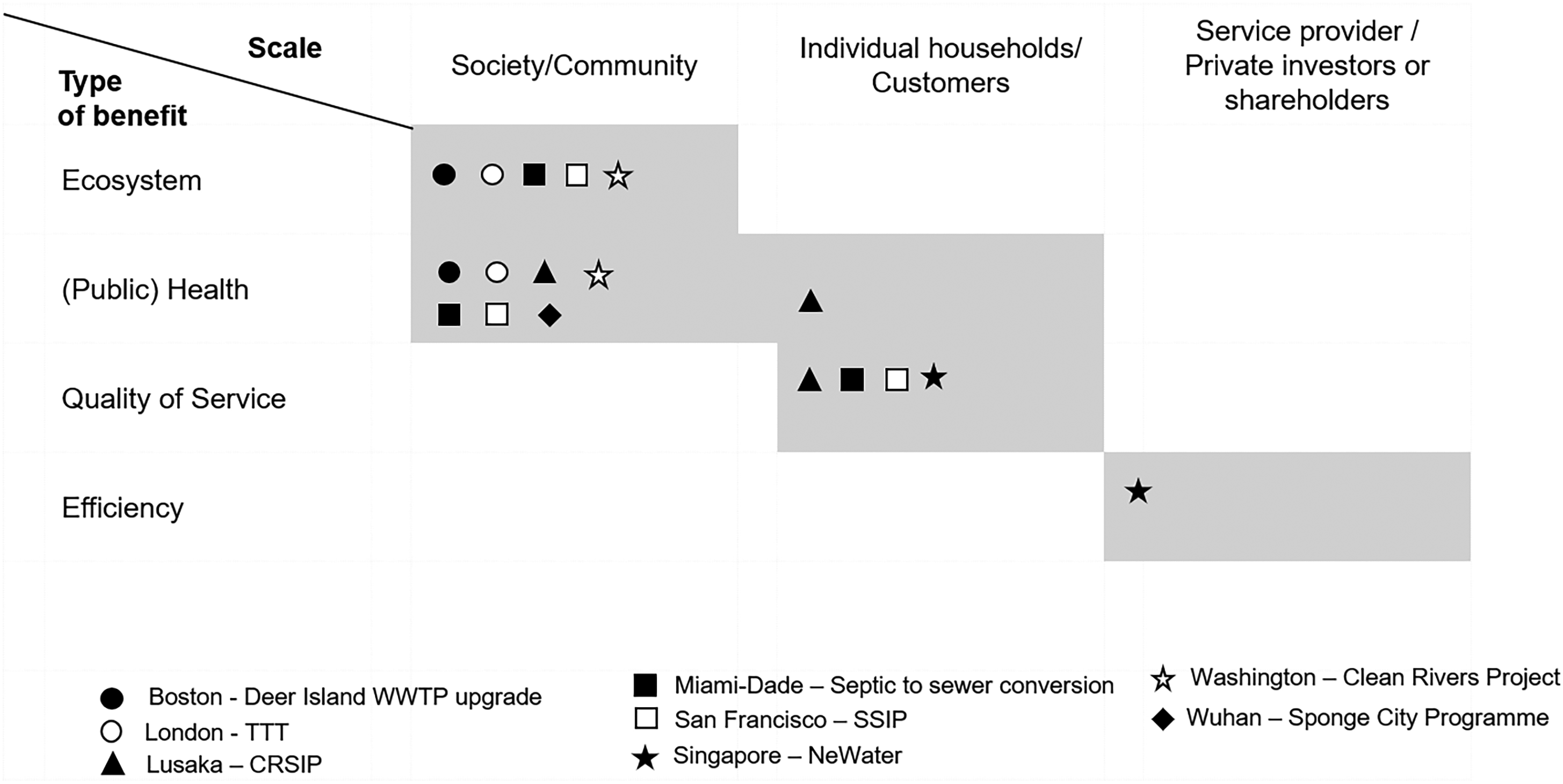
In dense urban settings, the failures of the sanitation systems, which will be exacerbated by climate change (Hyde-Smith et al. 2022) often lead to severe public health implications, disproportionally affecting low-income and marginalized communities (Brown et al., 2015; Brown et al., 2023; UTS-ISF, 2023). One could assume that any improvements to sanitation systems will reduce the burden on the most vulnerable and reduce inequality. However, improvements in sanitation systems, while being recognized as a ‘medical advance’ on a societal level (Ferriman, 2007), do not necessarily equate to equitable benefits distribution (Biza et al., 2021; McFarlane, 2008; Rusca et al., 2022), particularly in cities with complex and fragmented sanitation systems (McFarlane, 2019; Peal et al., 2020; Van Welie et al., 2018). For example, the design of most selected cases was on centralized and sewered sanitation, which inherently results in unequal distribution of benefits. Those who are not connected to the sewered system, and who are arguably more vulnerable to the impacts of climate change, do not benefit from the schemes. Despite claiming to be specifically targeted at Lusaka's urban poor population (AfDB, 2015b), only a fraction of the LSP's USD 300 million investment will benefit the majority of low-income households that rely on non-sewered sanitation and decentralized faecal sludge management services (Kappauf et al., 2018).
Another example of the imbalance in impacts of climate change is in relation to urban flooding, which disproportionately affects marginalized urban residents (Dai et al., 2018; Oates et al., 2020; Zhang et al., 2018; Dodman and Satterthwaite, 2008). As such, one might anticipate that well-targeted sponge water retention measures would lead to positive social equity outcomes. However, studies underscore the potential negative social equity repercussions of urban (green) flood mitigation infrastructure, including displacement and gentrification (Shokry et al., 2020). The SCP assessment criteria do not comprehensively evaluate the social equity outcome of the proposed interventions (Wang and Palazzo, 2021). Regrettably, the authors could not obtain conclusive data on the social equity outcomes of SCP infrastructure in Wuhan.
There are some examples of benefits accruing to individuals, e.g. the DTSS is explicitly designed to increase the efficiency of wastewater transport for PUB's NEWater wastewater reuse (PUB, 2023). The increased water security through the NEWater wastewater reclamation will benefit the quality of service for all customers and households. However, many of the benefits associated with the selected cases did not accrue to individuals, but to communities and society more broadly. This includes principally the environmental benefits of ecosystem protection (a feature of all US adaptation cases and the TTT in London, UK), and the public health benefits of reduced disease and improved water quality. This raises questions of equity relating to whether individuals should pay for such societal benefits through individual tariffs (Lo et al., 2019).
In the next section, analysis shows that the distribution of financial risk falls short of adequately accounting for the vast societal benefits of the selected investment cases.
Distribution of financial risk of investment
In the United States cases, all water and wastewater service providers have received federal or state funding. However, the fact that the general taxpayer will shoulder a (relatively small) proportion of the repayment should not distract from two crucial overarching trends. First, US federal water and wastewater funding has seen a significant decline, dropping more than four-fold and shifting from grants to subsidized loans from 1980 to 2017 (Netusil and Kousky, 2021: 3). Second, this reduction in public funding for basic infrastructure is not unique to the United States. It mirrors a global trend observed in both LMICs (e.g. Goodfellow, 2020; Williams, 2021) and HICs (e.g. Pryke and Allen, 2019).
Various scholars have scrutinized water and sanitation investment models based on debt refinancing largely by securitising household revenue streams (Allen and Pryke, 2013; Bayliss et al., 2022; Furlong, 2020). Water and sanitation services operate in monopolized markets of an essential good where consumers cannot opt-out or switch providers, providing secure and reliable revenue streams over time (Allen and Pryke, 2013; Bakker, 2003). However, as discussed in the previous section, few benefits accrue directly to the households paying the additional costs.
Furthermore, because of the size of the investments and the nature of the infrastructure coupled with the historical financialization or privatization of service provision (Loftus and March, 2019) customers of sanitation upgrading or adaptation projects usually experience tariff increases for the financing of the measures years before any benefits can be felt – as has been the case for the TTT in London, the CRP in Washington or the upgrade of the Boston Deer Island WWTP (Christophers, 2018:, KII 1; Grafe, 2020). In this context, the financing scheme of the TTT has been criticized for transferring the construction risk from the implementer to the customers and, ultimately, the government (Espinoza and Plimmer, 2017; Grafe and Hilbrandt, 2019). Over the last decades, SFPUC in San Francisco has had to massively invest in their ageing water and wastewater infrastructure, which means that over half of the monthly customer bill is related to debt service (KII 2). As Furlong (2020, 2021) pointed out, mounting debt obligations of water and sanitation service providers form substantial components of – but are often overlooked in the debate around – 'cost-recovering’ tariffs (see affordability discussion in the next section).
In the fully privatized English water sector, the UK Government has not directly contributed to the costs of the TTT; however, since the Government has acted as a guarantor and thereby (at least partly) insulated the investors from the financial risk, Tideway has received advantageous financing conditions (Tideway, 2017). Tideway emphasizes that the risk of the Government having to step in is diminishingly low (Lea, 2016), and the authors do not generally disagree with governments backing up investments in societal benefit. However, the TTT case is characteristic of the financialization of water infrastructure focused on extracting rents from customers at every stage of the securitization process (Loftus and March, 2019; Pryke and Allen, 2019). In this context, as an ultima ratio, the UK taxpayer would bail out private investors who received substantial dividend pay-outs during construction (Bowles et al., 2021; Hughes and Byatt, 2012). TW will lease the TTT upon completion, but Tideway will remain the asset owner responsible for maintenance. Consequently, TW customers will pay Tideway over the entire lifetime of the tunnel (KII 5).
The DTSS/NEWater construction in Singapore and the SCP in Wuhan, China, exemplify large-scale government sanitation adaptation investments with some elements of PPPs. Under the Significant Infrastructure Government Loan Act of 2021, Singapore's government assumed financial risk for Phase 2 of the DTSS/NEWater projects, allowing borrowing up to SGD 90 billion (Tan, 2021). The DBOO concession contracts which were used to build two of the four currently operational NEWater treatment plants transferred the responsibility and risk of designing, constructing, owning and operating the plants on the private consortia that secured the contracts the other NEWater plants are owned and operated by PUB (Joseph et al., 2024). By contrast, the Chinese Government encourages SCP municipalities to shift some financial risk to the private sector. Yet, despite labelling state-owned company investments as ‘PPPs’, the financial burden still falls on taxpayers (Dai et al., 2018).
Consideration of socio-economic equity and affordability
In most analyzed cases, the investments will be paid back through customers’ water and wastewater bills. Consequently, the socio-economic equity of the adaptation measure is mainly determined by the affordability of the tariff for different income groups. As Furlong (2020) points out, the downward flow of infrastructure debt to individuals and households without proper recognition of different financial capacities can devastate the less fortunate; their regressive nature makes utility fees a ‘form of structural inequity’ (Beecher, 2020).
In the early 1990s, steep tariff increases due to the Deer Island WWTP investment caused shock and public pushbacks (KII 1). While service providers such as DC Water or SFPUC claim that they strongly consider the affordability of their repayment arrangements for their respective sanitation adaptation (DC Water, 2017; SFPUC, 2021), the concrete considerations of their customers’ different socio-economic status and financial capacities remain vague.
In the United States, the Environmental Protection Agency (EPA) issued guidelines for water affordability based on median household income as a reaction to concerns over the impact mandatory investments to meet the Clean Water Act requirements would have on water tariffs in the United States (EPA, 1997). These guidelines have been criticized for inadequately protecting low-income households from overburdening water bills (Cardoso and Wichman, 2022; Jones and Moulton, 2016). They are now being revised to address the regressive nature of water bills better (EPA, 2022; Zhang et al., 2022). The EPA guidelines are not legally binding, leaving service providers to develop support programmes within their specific legal and regulatory frameworks. For instance, the SSIP's Level of Service criteria include a focus on ratepayer affordability, defined as keeping bills below 2.5% of average household income (SFPUC, 2021); this approach may not adequately protect low-income households, especially in cities like Boston, Miami, San Francisco, and Washington DC, known for high-income disparities (Holmes and Berube, 2016; Rezal, 2022).
Cross-subsidies refer to a pricing mechanism where one group of customers contributes to part of the costs of providing services to another group (Evans et al., 2009). However, in many US states, strict limitations on cross-subsidies have been implemented. While intended to promote fair pricing, these limitations can create challenges for utilities trying to maintain affordability programs at the provider level (UNC EFC, 2017). For instance, many utilities cannot use existing customer tariff revenues to expand services (Harris, 2021) or to support low-income customers (KII 2). These limitations affect the financial strategies of water and wastewater providers for adaptation investments. For instance, there remains uncertainty about how C2P will be financed. Law strictly prohibits the issuance of Revenue Bonds for connecting new customers (Harris, 2021), which applies to the septic-to-sewer conversion under the C2P programme (KII 7). While the CCP is backed by a USD 126 million general obligation bond, funding and repayment plans for C2P are still under discussion. Households will likely bear connection costs, plumbing updates and old septic tank removal (Harris, 2022; KII 7; Miami-Dade County, 2020). Although WASD has obtained state grants to help low-income customers with conversion costs, the extent to which this funding will be sufficient remains uncertain (Harris, 2022).
The massive tunnel structures constructed in London or Washington are not required due to the volumetric increase of sewage but are managing stormwater. In 2009, DC Water changed its approach from charging its customers to repay the investment from sewerage fees to an impervious area charge added to all private and commercial customers’ water and wastewater bills (DC Water, 2017). The charge is based on impervious surface per property and therefore follows a polluter pays principle (O’Cleireacain, 2012) but has been criticized for its fairness in terms of creating artificial boundaries for the distribution of costs and consideration of social equity (Cava, 2017; Kennedy, 2017; O'Cleireacain, 2012).
There remains ambiguity if and how the state-owned ‘PPP’ partner of the SCP in Wuhan will receive a return on its investment (Dai et al., 2018). The NEWater/DTSS project in Singapore represents a large-scale resilience programme largely publicly funded through general taxation over multiple generation (Da and Hong, 2018). PUB charges customers an increasing block tariff. To address equity concerns, particularly for larger households, they implemented a four-tier system where families with more than two members are allocated a higher volume in each tier, while the rates for all tiers stay consistent (The World Bank, 2018).
Meanwhile, there are also voices critical of cross-subsidies in financialized water sectors. In the United Kingdom, the regulator obliges water companies to set up social tariffs for disadvantaged customers; thus, ‘social policy is reduced to small cross-subsidies between households while the millions paid to directors and billions paid to shareholders are considered to be the work of the market’ (Bayliss et al., 2021, p.493). A recent systematic review found that in 2019/20, up to 20% of households in England and Wales experienced water poverty (Sylvester et al., 2023). Bakker (2001) highlights a concerning shift in water policy in England and Wales: from prioritizing ‘social’ equity, which considers the customer's ‘ability-to-pay’, to ‘economic’ equity, emphasizing service price recovery. Notably, there is no reference to specific affordability considerations in the 54 legacy commitments of the TTT (Tideway, 2021) despite London's pronounced income inequality compared to the rest of the United Kingdom (Greater London Authority, 2023).
Regarding affordability, the LWSC negotiated with the Government that cost recovery for the non-sewered components of the LSP would not be feasible, and therefore, these components should be funded by grants (KII 4). However, there are wider implications for the distribution of the financial risk of the LSP, which are deeply intertwined with the politics of water tariff setting in Zambia and external debt financing. We will discuss this in broader detail in the next section.
Intergenerational equity and justice of the different financing approaches
Sanitation infrastructure has a long design life, and the environmental and public health benefits are enjoyed by multiple generations (Ashley et al., 2005). Climate change is human-made, caused by past and present generations’ actions and affecting future generations’ lives. Consequently, investments in sanitation infrastructure have to navigate tensions of intergenerational equity.
There are different ways through which municipalities, service providers and governments can spread sanitation investment costs over multiple generations. Commonly, this can be done by issuing bonds with different maturities (issuing bonds is a crucial part of the financing of all the selected adaptation cases in the United States and for the TTT) or by taking on long-term loans that will be paid back over multiple decades (KII 1, KII 6). Typically, 30 years is considered a long bond maturity period. Still, DC Water went even further in reflecting the longevity of sewer infrastructure and issuing the so-called century bonds with a maturity of 100 years (DC Water, 2014). For the second phase of the DTSS, the Singaporean Ministry of Finance defended the Government's decision to finance through borrowing (which is not a usual approach in Singapore) by referring to the multi-generational benefits of the infrastructure, which justifies the spread of costs over multiple decades (Tan, 2021).
However, despite the multi-generational benefits of sanitation adaptation, long-term borrowing for expensive infrastructure projects also comes with the threat of unfairly mortgaging future generations. First (as established earlier), repayment of debt-financed investments through customers’ bills is regressive and offers limited opportunities for a fair distribution of the financial burden of large investments from a socio-economic equity perspective (Beecher, 2020). With dwindling public funding for water and sanitation infrastructure (Netusil and Kousky, 2021), the policies of full-cost recovery currently push US municipalities towards a ‘burgeoning crisis’ of water unaffordability (Mack and Wrase, 2017). From an intergenerational equity perspective (Adger et al., 2009), it is highly questionable if the costs of retrofitting or redesigning sanitation systems to (human-made) future climate can be fairly recovered through future water tariffs.
Second, particularly for the fast implementation of prestigious projects, there is a concern that the financing approach does not adequately consider the lifecycle costs of the investment. For instance, there is a concern that funding needs for operation and maintenance (O&M) costs are neglected in the rapid development of the SCP (Dai et al., 2018; Li et al., 2017; Liang et al., 2020).
In LIMCs, the financing of climate adaptation for sanitation systems must be contextualized within the broader discourse of global climate justice. Currently, only a small share of climate finance is directed towards the sanitation sector. Most focus on mitigating greenhouse gases rather than adaptation (Dickin et al., 2020; Mason et al., 2020). Our research indicates that sanitation climate adaptation often takes place within multipurpose projects. This complicates the process for these projects to satisfy the climate finance eligibility criteria, such as ‘additionality’ and having clearly attributable climate change relevant impacts (Dickin et al., 2020). Our analysis of the Lusaka Sanitation Program showed that external grants, or transfers, have a minimal role in funding climate adaptation within conventional sanitation improvement projects. This trend is unlikely to shift even with increased climate fund allocations to sanitation programs. It is worth noting that the (unmet) pledge of wealthy nations to annually provide USD100 billion to less affluent countries for climate adaptation and mitigation by 2020 is primarily in the form of loans (Roberts et al., 2021; Timperley, 2021). Consequently, climate loans add to the sovereign debt burden of countries like Zambia.
The Zambian government (GRZ) has accepted foreign currency grants and loans for the LSP, which are then allocated to LWSC. While LWSC has secured fixed interest rates and local currency repayment terms with the GRZ, its current water tariffs fall short of covering capital investment costs. LWSC is sceptical about its ability to repay the LSP investments to the GRZ (KII 3; KII 4), implying that the government may have to shoulder this deficit. The GRZ, however, is already facing soaring costs of external debt and has cut back on public spending to serve its obligations to foreign lenders (Inman, 2022). Without sufficient fiscal space for necessary investments in improving sanitation coverage (The World Bank, 2020), the GRZ has few good options to pay for climate adaptation of sanitation systems.
Impact of green or outcome-based financing structures on risk distribution and equity
Currently mainly used in HIC, green bonds and impact bonds come dressed as ‘innovative financing mechanisms’, but as Netusil and Kousky (2021: 3) point out, ‘these simply spread costs over time and still need an ultimate funding source’. In most cases, we analyzed and found that the income for repaying any project-related debt is predominantly from households via their monthly water bills.
Our findings support the critical concerns that green and climate bonds often neither shift nor redistribute the financial risk more equitably nor do they make the investments considerably more affordable for wastewater customers compared to more traditional financial tools (Bigger and Millington, 2020; Cousins and Hill, 2021; García-Lamarca and Ullström, 2020; Karpf and Mandel, 2018). Contested claims that the issuance of ‘green’ or ‘climate’ bonds results in lower borrowing costs and eases the financial risk of debt finance from utilities and public authorities (Dorfleitner et al., 2022) could not be confirmed for any of the cases where green debt played a role. Several KI confirmed that the benefits are rather ‘reputational’ (KII1; KII 5; KII 6). In fact, the differences between ‘green’ and regular ‘vanilla’ bonds are minor, and the regulation of the green bond market is weak (KII 2; Christophers, 2018; Jones et al., 2020). In the case of Tideway, bonds were retrospectively declared as ‘green’ (Tideway, 2021), which will not make the repayment of the bonds any cheaper to TW's customers but shows that the benefit of green bonds is mostly with fund managers trying to ‘green’ their portfolios (Christophers, 2018; García-Lamarca and Ullström, 2020).
Given that green and climate bonds have already become mainstream, the most ‘innovative’ financing mechanism for sanitation adaptation we could identify is the Environmental Impact Bond (EIB) issued by DC Water (Bafford et al., 2017; DC Water, n.d.). Designed to shift part of the financial risk from the utility and, ultimately, the wastewater users towards the investors, it is based on a pay-for-success contract which ‘reward investors for the performance of green infrastructure in reducing runoff’ (Cousins and Hill, 2021: 583). Christophers concludes that the EIB has neither ‘comprehensively transfer[red] risk away from DC water and its ratepayers’ (Christophers, 2018: 156) nor has it been a cheap form of finance for DC Water.
Our analysis has shown that debt financing via municipal bonds (particularly green bonds) is important in financing sanitation infrastructure adaptation. Notwithstanding persistent financial and political obstacles (Banga, 2019; Gorelick, 2018), there are increasing examples of issuing green municipal bonds in LMICs (Hilbrandt and Grubbauer, 2020; Otek Ntsama et al., 2021). For the case of sanitation investments and from an equity perspective, however, we also need to ask who benefits from bond financing in a city? Traditionally, bonds are well suited to raise money to finance large-scale infrastructure, which is associated with predictable returns of investments (Roelich, 2015). For sanitation systems and specifically for the task of making them more resilient to uncertain future climate risks, bond finance might favour investments into large-scale centralized systems (Jones et al., 2020). Particularly in cities with fragmented sanitation systems, investments in (climate adaptation of) sanitation might be directed to measures that might be expensive but are ‘easier’ to fund (such as investments in sewer systems and treatment plants) even if this excludes populations relying on decentralized systems and thus could reinforce existing (sanitation) inequality (Brugger, 2021; Williams, 2021).
Conclusion
Our analysis synthesizes and interrogates a variety of examples for past and ongoing climate adaptation efforts of urban sanitation systems, focusing on financing approaches and their implications for equity.
While it is widely accepted that climate change adaptation will add to the costs of providing effective sanitation services, labelling sanitation investments as ‘climate adaptation’ does little to grow a ‘magic money tree’ resolving the funding gap in urban sanitation. In all the cases we examined, the costs of ‘climate-resilient sanitation’ were paid for by the traditional sanitation funding sources: tariffs, taxes, transfers and household investments. In most cases, the financial burden of ‘increased resilience’ was transferred to users (via tariffs), mostly without improving service levels.
We tried to establish the specific ways how these investments targeted climate adaptation of sanitation systems, with particular attention to how they address existing inequalities and future equitable distribution of burden and benefits. However, disentangling ‘adaptation’ or ‘resilience’ from ‘good design of effective infrastructure’ is challenging, particularly given the lack of agreement on what renders sanitation resilient. While there is a growing consensus that governance systems and institutions are at least as important as infrastructure in withstanding and recovering from climate shocks (Willetts et al., 2022b), our findings show a lack of focus on non-infrastructure elements in the projects examined.
The value of ‘green’ or ‘climate’ labels for investment finance – beyond ‘greening’ the investors’ portfolios – remains unclear. Experience from HIC contexts has shown that certifying investments as ‘green’ or ‘climate-relevant’ (e.g. by issuing ‘green’ or ‘climate bonds’) does not substantially shift or ease the financial risk of the investment – which is often borne by sanitation service customers. In our understanding, climate finance pledges have not fundamentally changed the conditions attached to money flowing between richer and poorer nations. Thus, ‘greening’ these flows may be counterproductive for countries negotiating for meaningful global climate justice.
In many high-income cities, ageing sewer systems require significant upgrades due to changing demographics, urbanization, modern environmental legislation, and climate change. However, public spending on urban sanitation has declined or virtually ceased in many places. As Barraqué (2020: 2) notes: it is tempting to pass drainage and stormwater costs onto the sewer bills, in particular where sewer systems are combined; but it is not legal: costs related to rainfall control should be covered by housing or land taxes, and there should be a transfer from the general budget to the sewer budget.
The ‘full-cost recovery’ paradigm, emerging from neoliberal discourse and the financialization of the sector, leads to debt financing by service providers, predominantly recouped through regressive customer tariffs (Beecher, 2020). In cities without universal access disadvantaged and unserved populations may end up subsidising the exclusionary system twice: indirectly through taxes that support the service providers’ debt and directly through out-of-pocket expenses for self-provided sanitation services, including pits and tanks and emptying services (Andres et al., 2019).
Climate-financing for sanitation shows no sign of shifting this trend as repayment still relies on primarily on regressive customer fees. None of the selected case investments includes multilateral climate finance. Although grant finance is available under GCF-supported investment programmes, the eligibility barriers for sanitation adaptation projects remain. The majority of finance provided through the multilateral climate funds is still in the form of repayable loans (Roberts et al., 2021; Timperley, 2021), a trend that extends to broader sources of climate finance, such as green or climate bonds, and has been particularly criticized in the context of adaptation finance (Timperley, 2021). Given that most climate finance is offered as debt, and the evidence from our cases show that repayments largely depend on household charges, it could be argued that without substantial reform, climate finance may not alleviate – and could even exacerbate – the regressive impacts of the sanitation current funding paradigm.
Given the widespread benefits of effective sanitation systems for public health, general welfare, and their contribution to climate resilience, we contend that the costs associated with climate adaptation in sanitation should be covered in a way that is attentive to equity and explicitly counters inequalities. Drawing parallels to other sectors such as energy (Owen and Barrett, 2020) public sector borrowing funded through general taxation emerges as a viable and more equitable strategy for financing climate adaptation measures. There is little evidence that any but the public sector would secure equitable allocation of such funding to ensure that the most marginalized benefit from investments into climate-resilient sanitation.
This is not a revolutionary suggestion. In the Netherlands, for example, water usage is charged via metered tariffs, reflecting its status as a commercial service. Conversely, sewage collection and wastewater treatment, flood defence and drainage are funded through various forms of taxation. This differentiation in charging mechanisms is based on the principle that sewage management is not regarded as a commercial service but as essential for public health (a point also poignantly made by Bakker, 2013) and thus funded through a housing tax. Similarly, drainage, flood control and water quality management are regarded as common-pool goods, financed by a family tax (Barraqué, 2020). A recent World Bank assessment on global public spending in the water sector also states that relying solely on user fees for cost recovery in the sanitation sector is often ineffective and that the numerous positive externalities of sanitation service on society level merit ‘that the costs of the service should be borne more broadly than by just its direct paying users’ (Joseph et al., 2024: 245).
Advocating for a public sector approach to sanitation includes cities in LMIC and encompasses both sewered and non-sewered systems (Gambrill et al., 2020). In cities (often located in LMICs) with incomplete and failing sanitation systems, climate adaptation of sanitation cannot happen in isolation but must happen within climate-resilient citywide sanitation planning. However, there is a concern that the many forms of climate debt finance might favour highly engineered centralized solutions for reasons such as costly proposal preparation to the climate funds, technology biases and lack of awareness of decentralized and non-sewered solutions, requirements of minimum bond size, and bankability of projects (Banga, 2019; Dickin et al., 2020; Jones et al., 2020; SWA, 2019). As a result, smaller projects, e.g. for decentralized faecal sludge management with potentially stronger focus on marginalized population groups, might be excluded from some types of climate finance - a replication and reinforcement of the existing funding bias. Recognizing that the global responsibility for past and current greenhouse gas emissions is unevenly distributed is essential. With many LMICs struggling with limited fiscal capabilities and rising external debt obligations, sanitation adaptation funding strategies must reflect principles of global climate justice and must not further limit countries’ long-term capacities to provide basic services for their population.
We argue that this is only likely to happen if there is a refocus on finance from public sources, which are more inclined to recognize the social and environmental value of resilient sanitation. Public financing tends to prioritize those most in need and offers a more ‘patient’ form of capital. This aligns with the arguments made by McDonald et al. (2021) regarding the importance of public banking in water supply and sanitation funding.
In summary, expecting private capital to ensure equitable climate adaptation is unrealistic because of the misalignment in expertise, outcomes and timescales (McDonald et al., 2021). Public funds (taxes and transfers) remain the most appropriate funding source to account for the social and intergenerational equity within climate-resilient sanitation systems. While the specific mechanisms may vary – potentially including public banking as suggested by (McDonald et al., 2021) – there is a clear mandate within the UNFCCC climate finance framework for cross-subsidization. The framework requires that less-developed countries benefit from financing provided by high-income countries in a way that does not further disadvantage them. Echoing Ross and Francey's (2018) findings on the funding needs for the Sustainable Development Goals’ improved sanitation access targets, we argue that enhancing climate resilience in sanitation for lower-income countries in and equitable manner necessitates a significant increase in transfers. A similar argument could be made for within-country cross-subsidization between richer areas and the less well-served areas that are inevitably more vulnerable to climate change impacts.
Highlights
Climate-resilient sanitation is paid for by the traditional sources of sanitation funding: tariffs, taxes, transfers and household investments.
The lack of appropriate accounting for the lifecycle costs of resilient infrastructure threatens to mortgage future generations.
Debt financing of sanitation adaptation often relies on repayment through customer bills with insufficient considerations of affordability for different customer groups.
‘Greening’ of adaption financing neither redistribute the financial risk more equitably nor does it result in cheaper investments.
A public sector funding approach is most appropriate to ensure social and intergenerational equity within climate-resilient sanitation systems.
Supplemental Material
sj-doc-1-ene-10.1177_25148486241287446 - Supplemental material for Blinded by the ‘green-halo’? Equity in financing climate adaptation of urban sanitation
Supplemental material, sj-doc-1-ene-10.1177_25148486241287446 for Blinded by the ‘green-halo’? Equity in financing climate adaptation of urban sanitation by Leonie Hyde-Smith, Katy Roelich, Anna Mdee, Zhe Zhan and Barbara Evans in Environment and Planning E: Nature and Space
Footnotes
Acknowledgements
First and foremost, the authors would like to thank the ten key informants who offered their time and expertise during the interviews for this research; their valuable insights were crucial for the completion of this study. Conversations with Katrin Bruebach, John Matthews, Lucy Oates and Andrew Sudmant supported the identification of key informants and helped to further focus the study. Jamie Bartram and Ruth Sylvester provided constructive feedback to drafts of this manuscript. Finally, we express our gratitude to the anonymous reviewers and the editor who provided valuable suggestions that improved the quality of the manuscript.
Declaration of Conflicting Interests
The authors declared no potential conflicts of interest with respect to the research, authorship, and/or publication of this article.
Ethical considerations
The University of Leeds’ ethics committee reviewed and approved the research before conducting the KIIs (MEEC 21-032) in October 2022. Written consent was obtained from all interviewees.
Funding
The author(s) disclosed receipt of the following financial support for the research, authorship, and/or publication of this article: This work was supported by the UKRI Engineering and Physical Science Research Council (EPSRC) (grant number EP/S022066/1) through a PhD studentship received by the first author (L.H.-S.) as part of the EPSRC Centre for Doctoral Training in Water and Waste Infrastructure and Services Engineered for Resilience (Water-WISER).

Supplemental material
Supplemental material for this article is available online.
References
Supplementary Material
Please find the following supplemental material available below.
For Open Access articles published under a Creative Commons License, all supplemental material carries the same license as the article it is associated with.
For non-Open Access articles published, all supplemental material carries a non-exclusive license, and permission requests for re-use of supplemental material or any part of supplemental material shall be sent directly to the copyright owner as specified in the copyright notice associated with the article.
