



Abstract
This paper examines the socio-technical and socio-ecological dimensions of water storage across scales in Nairobi, Kenya. The city's piped water supply has historically struggled to keep up with growing demand, resulting in a heterogeneous waterscape that features a multitude of storage arrangements, from massive dams to small jerry cans. Using qualitative methods, including household and expert interviews in different neighborhoods, the study unravels multiple scales and types of water storage, tracing water's journey from natural reservoirs in the Aberdares to large dams, intermediary storage tanks, and finally household containers. It identifies storage as a critical yet under-researched component of urban infrastructure, highlighting its role both as an enabler of diverse supply and access, and as a (re)producer of the inherent inequalities of place-specific infrastructure configurations. However, by proposing and applying storage as a multi-scalar analytic, I advocate a non-problematizing, non-normative understanding across scales that recognizes the stabilizing, disrupting, and creating capacities of any storage arrangement. Ultimately, I argue that integrating a pragmatic, multi-scalar recognition of storage into the planning, design, and governance of urban infrastructure offers opportunities to enable more equitable and sustainable waterscapes.
“Nyrobi has with great judgment been selected as the site for the principal workshops … There is a fairly good supply of water but a reservoir and tanks will have to be constructed.” (Molesworth, 1899: 23)
Since its colonial origin as a railway depot in 1899, the city and residents of Nairobi have been tasked with storing a ‘fairly good supply of water’ in reservoirs, tanks, and many other storage arrangements. Although climatic conditions provide ample precipitation, the city's waterscape has always been one of great inequality. Throughout its history, many residents have relied on themselves to ensure access to basic services, while governments have struggled to keep up with population growth and increasing water demand (Kimari, 2019; Akallah, 2022). The aging water network and the always-insufficient storage capacities of the utility, as well as the intermittency and unreliability of piped supply, are met with various on-the-ground strategies and alternative supply modes, resulting in a highly heterogeneous infrastructure configuration and the emergence of a “storage city” (Kasper and Schramm, 2023) full of water tanks, so-called super drums, jerry cans and various other ‘containers’ that plaster Kenya's capital.
Quotidian or minor water storage at the household or building scale is common in cities around the world (e.g., Acevedo-Guerrero, 2022; Alba et al., 2022; Shah, 2024). Typically, storing water in or around domestic spaces results from a lack of direct piped supply, intermittent or unreliable network supply, insufficient pressure, use of non-network modes such as tankers or rainwater harvesting, cultural reasons, quality concerns, or individualized water treatment (Slavik et al., 2020). But domestic water storage is often only one of many interrelated ways in which urban residents secure their supply, and water storage at larger scales – from the community and neighborhood to the municipal and regional – remains an obligatory backbone of most waterscapes; massive dams, smaller reservoirs, water ‘naturally’ stored underground, community ponds and tanks, etc. (Bishara et al., 2021; Cornea et al., 2016; Randle, 2022). As Li et al. (2023) have shown however on a global scale and specifically for the African continent, actual per capita water storage in dams and reservoirs has been declining in the twenty-first century; and Nairobi seems to be no exception, as its population has more than doubled since the late 1990s, but its large-scale water storage has definitely not. Yet, storage at all scales is crucial to any urban waterscape but the different yet interrelated scales of storage – from dams to tanks to jerry cans – are rarely discussed together. Less even so in a way that does not simply problematize some, especially more quotidian, forms. This provides an unexplored avenue for using storage as a multi-scalar analytic for understanding situated waterscapes, and thus for further theorizing about the “storage city” and about the “tool power” (Meehan, 2014) of myriad storage arrangements as stabilizing, disrupting, and creating parts of infrastructure configurations.
The elaborations in this paper are largely based on qualitative research in Nairobi between 2021 and 2024. Here, the starting point was to “delve into household dynamics and practices” (Fragkou, 2025) and to appreciate mundane storage artefacts as a “fresh entry point into the intricacies of quotidian infrastructuring” (Kasper, 2024: 1871). To do so, I conducted 34 ‘enriched’ household interviews (Dowling et al., 2016) in English and a research assistant conducted a further six in Swahili. Each interview involved a visit to the household, documentation of their infrastructural situation, and a semi-structured interview with one household member. In 22 cases, there were also informal conversations with other household members or people connected to the household, e.g., partners, neighbors, or house helps. After identifying potential respondents through pre-existing contacts, snowballing, social media, and the support of two research assistants, interviewees were selected purposefully to include a range of socioeconomic, infrastructural and architectural realities. Of the 40 semi-structured interviews in total, 24 were with female respondents, with most of the interviews/visits conducted in four purposively selected neighborhoods: eight in the historically central, dense and vertically rising Eastleigh area with its overburdened water grid; eight in the informalized Kibera with very few direct and official connections to the utility's network; eight in the affluent and usually well-served Westlands area with a growing number of upscale apartment buildings; and seven in the emerging, heterogeneous suburb of Ongata Rongai with its own water utility but similar water supply problems to Nairobi (see Figure 1). Enriched household interviews were supplemented by observational and informal data gathering, as well as 23 expert interviews with representatives from utilities, government agencies, NGOs, associations, private sector companies, as well as independent plumbers and other technicians. Lastly, this paper draws on data and data points of a mixed-methods study from 2021–22 (see: anonymized). Finally, I reviewed documents, plans and policies of government actors and agencies, as well as media reports, to bring the empirical material into context.
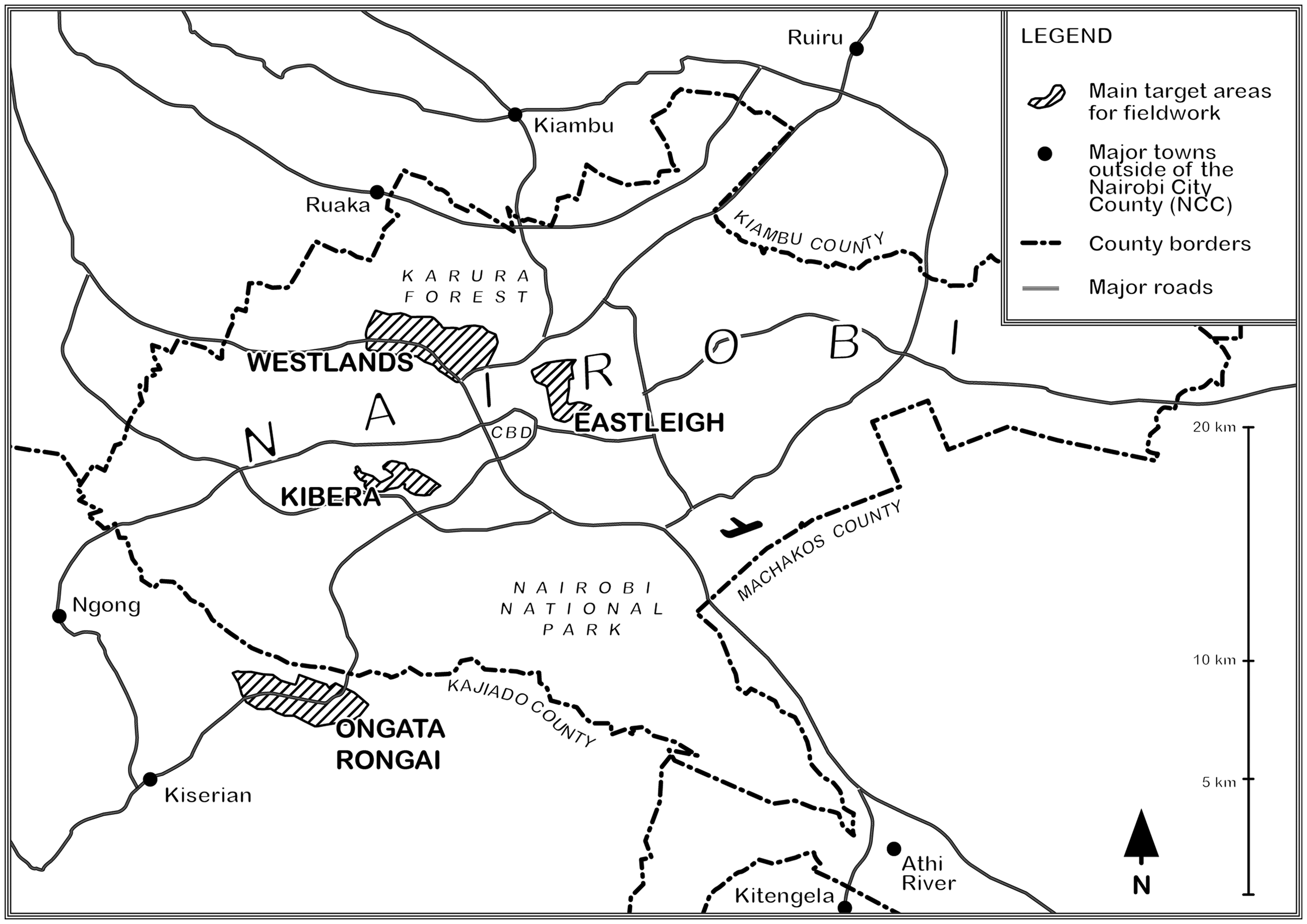
Map of the Nairobi City County (NCC) and main target areas for fieldwork. Map by author based on Google Maps.
Storage as a multi-scalar analytic
Juxtaposed with the invaluable literature on infrastructural flows, circulations, and other kinds of movement, infrastructures of storage have long been understudied (Millington, 2018; Randle, 2022). Yet, any kind of movement and flow depends on moments, spaces, and technologies of slowed circulation, stoppage, and storage, which are not only “consistent with the internal logic of capitalism” (Simpson, 2019) but also crucial elements of infrastructure networks. Relatedly, the everyday storage of water by households in cities with inadequate or intermittent networked water supply is de facto infrastructure, ensuring citywide flow and circulation (Acevedo-Guerrero, 2022; Millington, 2018). Moreover, as Randle (2022: 2287–2288) has pointed out in reference to US reservoirs, water storage facilities in or for cities “can be understood as sites that produce space by enabling uninterrupted water circulation.” But not all of these sites are equally prominent, instead “storage is often located in marginalized spaces, or centralized in ways that make it less visible to consumers” (Bize, 2017: 1). Recognizing the importance of various (water) storage arrangements in the co-production of urban waterscapes and infrastructure configurations, we are challenged to take seriously storage as an analytic for urban and infrastructure research. This does not mean abandoning the “city of flows” (Kaika, 2005), but rather enriching it conceptually and empirically. To do this, I draw on literature from two strands of research: One, often inspired by science and technology studies (STS) and/or postcolonial critique, research on the everyday, socio-technical, and minor parts of heterogeneous infrastructure configurations; and two, the field of urban political ecology, concerned with the urbanization of nature as well as socio-ecological power relations that play out at multiple scales, from the body to the city to the planetary.
Water storage as a problematized, socio-technical hybrid of the everyday urban
Emerging from research on large technological systems and from STS-inspired infrastructure studies, urban-infrastructural articulations are now widely recognized as socio-technical, place-specific, and dynamic hybrids or configurations. While the technological parts of infrastructure (pipes, antennas, protocols, roads, etc.) are critical to ensuring the delivery of basic services, urban residents – with their quotidian labor, everyday practices, and vernacular knowledge – are equally important in shaping and stabilizing urban infrastructures (Andueza et al., 2021; Furlong, 2016). Moreover, in the wake of the ‘southern turn’ in urban studies (McFarlane, 2008), infrastructural settings in many cities – such as Nairobi – are also recognized as assemblages of diverse modes of supply and access, multiple technologies, a fluid spectrum of (in)formalities, and many actors involved, as opposed to idealized but rarely occurring fully centralized and universal networks (Dakyaga et al., 2024; Smiley, 2020). When such infrastructural heterogeneity is coupled with the unreliability of yet-existing grids, “storage facilities crop up at the household level to manage the uneven supply of, say, electricity or water” (Bize, 2017: 1). Various batteries, buckets, gas cylinders, tanks, and other containers then play mediating and stabilizing roles, and thus “ease the pressure on the network rather than disrupt its regime” (Jaglin, 2016: 191). These capabilities are the result of the inherent “tool power” (Meehan, 2014) that resides in technological artefacts – e.g., storage containers – as active parts of the ongoing making of (urban) infrastructures, embodying and entangling social relations, shaping spaces and rhythms, holding power, and exuding politics (Loftus, 2006; Shove, 2016). However, the “social life of storage” (Bize, 2017) is not only thingified, but rather “a socio-technical hybrid of human storage practices – in short, storing – and its artefacts” (Kasper and Schramm, 2023: 2405). Water storage practices are often highly routinized behaviors and hard-to-break habits that require multiple activities beyond filling containers, such as regular cleaning, operating pumps, and interacting with plumbers (Burt and Ray, 2014; Kundu and Chatterjee, 2021). Notably, gender may play an important role here (Acevedo-Guerrero, 2022; Sarkar, 2020), and containers of different sizes and materialities may be used for different types of water and may have cultural or religious meanings (Cornea et al., 2016; Lavie et al., 2020).
Yet, much of the literature on small-scale water practices, particularly in southern cities, largely problematizes domestic water storage. Many texts mention health concerns around stored water, and there is ample evidence that water quality in household containers deteriorates significantly due to organic or inorganic contamination and/or due to design/material flaws or alleged mishandling by users, including lack of regular cleaning (John et al., 2013; Manga et al., 2021). In addition, as Acevedo-Guerrero (2022) has demonstrated, household water storage can be a “a place of fertility” for virus-carrying mosquitoes. Other concerns include leaks and overflows, the burden of additional investments and recommended treatment equipment/procedures, and the social impacts of water storage as a highly individualized response to water supply issues that affect broader communities (Furlong, 2016; Schwarz, 2021; Slavik et al., 2020). In light of the often-unequal waterscapes in which household storage is prevalent, many have pointed out how small-scale, everyday water storage is both a signifier and an additional catalyst of infrastructural inequalities (e.g., Dakyaga et al., 2024; Shah, 2024), since the types and sizes of water containers are usually highly dependent on financial and spatial resources, homeownership, and many other factors.
Large-scale water storage and the urbanization of nature
Arguably, “water management systems built around the idea of holding water in reserve are ancient” (Randle, 2022: 2284). But the urbanization of nature – that is, the taming and provisioning of nature(s) in form of water, energy, and other resources for the urban – reached new dimensions with industrialization and early modernity, so much so that the ‘modern’ city is often hardly possible without large tracts of land that we flood with water for later use in cities. And all of these major storage arrangements, as Bijker (2007: 109) notes for dikes and dams, are “thick with politics.” This is particularly the case for massive, man-made water bodies, as Kaika (2005) shows for the dams and reservoirs of nineteenth-century London and 1930s Athens. Similar accounts from around the world highlight the often contested, brutal, and displacing expansion of infrastructures into urban hinterlands: For example, the massive and iterative expansion of New York City's upstate reservoirs, mostly in the early twentieth century (Sante, 2022); the highly contested Narmada dam projects in three Indian states since the 1980s (Nilsen, 2008); and – explained in more detail below – the legally flawed construction of the Thika Dam north of Nairobi, also known as the Ndakaini Dam, in the 1990s.
Certainly, large-scale dams, reservoirs and other artificial water bodies can serve multiple functions; for agriculture (Ogilvie et al., 2019), for flood control and flow management (Bijker, 2007), and, of course, for electricity generation (Mahanty et al., 2024). In addition, communities or non-utility organizations may also use reservoirs and tanks of moderate size to secure or manage supply (Bishara et al., 2021; Cornea et al., 2016). However, the supply of water for use and consumption in contemporary cities is yet dependent on massive storage facilities, whether of a more classical infrastructural form, such as dams, or in the form of natural and/or groundwater storage, which has itself become an area of intervention and so-called environmental infrastructuring (Perry and Praskievicz, 2017). Regardless of the specific form or technology, large-scale water storage usually serves the purpose of sustaining “the existing socioeconomic order of things, including the existing economic and cultural patterns of water use” (Kaika, 2005: 164) and thus stabilizing (power) relations; while also holding the potential for adaptation and change (Randle and Linville, 2024). Relatedly, the rich literature on urban political ecology reminds us that infrastructural configurations and their various parts are always a terrain of constraining as well as enabling power relations that – in the words of Swyngedouw (1996: 14) – “swirl out and operate at a variety of interrelated geographical scale levels.”
Storage as a multi-scalar analytic
In light of the above, it seems promising to study urban infrastructures through the lens of water storage by utilizing storage as a multi-scalar analytic. From a socio-technical and heterogenous understanding, everyday water storage is a compelling entry point to explore wider relations, infrastructural inequalities, and a “variegated geography of power” (Meehan, 2014: 222), but the fluidity of water also calls for a multi-scalar perspective (Foli, 2024). Water storage itself occurs at multiple scales and with multiple containers in which “water is stored in order to manage peaks and troughs in demand at the next point in the ‘supply chain’” (Shove and Chappells, 2001: 53). But researching water storage at various scales should not become just be descriptive exercise only, but rather a search for logics, orders, and processes. Moving beyond the usual problematizations of (some) water storage – e.g., as a health hazard, or as an interim solution, or as a highly politicized tool of urban expansion – we need to ask what shapes situated storage arrangements at multiple scales, what stories these arrangements tell us, and what role storage plays in larger configurations, relations, and ecologies. To illustrate this for Nairobi, I trace the city's water supply from one storage scale to the next. While inspired by ‘follow the flow’ approaches (e.g., Meilinger and Monstadt, 2022), this paper takes scalar jumps rather than gradual movements through the city's waterscape; beginning with terrestrial water storage in forests and underground, to the dams in Nairobi's hinterland, to the city's many intermediary tanks, and finally to all the small tanks, super drums, and jerry cans that co-constitute Nairobi's “storage city” (Kasper and Schramm, 2023).
Water tower, aquifer, and dams: The history and status of large-scale water storage in the wider Nairobi area
Nairobi was founded by the British colonizers in 1899 as a railway depot because of the area's character as a ‘place of cold water’ 1 , largely fed by three main rivers, the Mathare River, the Nairobi River, and the Ngong River (see Figure 2). Today, however, these heavily polluted rivers play a negligible role in the water supply, while the city receives most, though not all, of its water from several dams and reservoirs north of Nairobi that feed the pipes of the Nairobi County Water and Sewerage Company (NCWSC), the municipal utility responsible for the Nairobi City County (NCC). Yet, before reaching any man-made structures, all water originates from two ‘natural’ places: the Aberdares Mountain Range and, more generally and broadly, the Nairobi Aquifer System (NAS). Unfortunately, for both the Aberdares and the NAS, the future of their water storage and (re)production capacities is under threat.
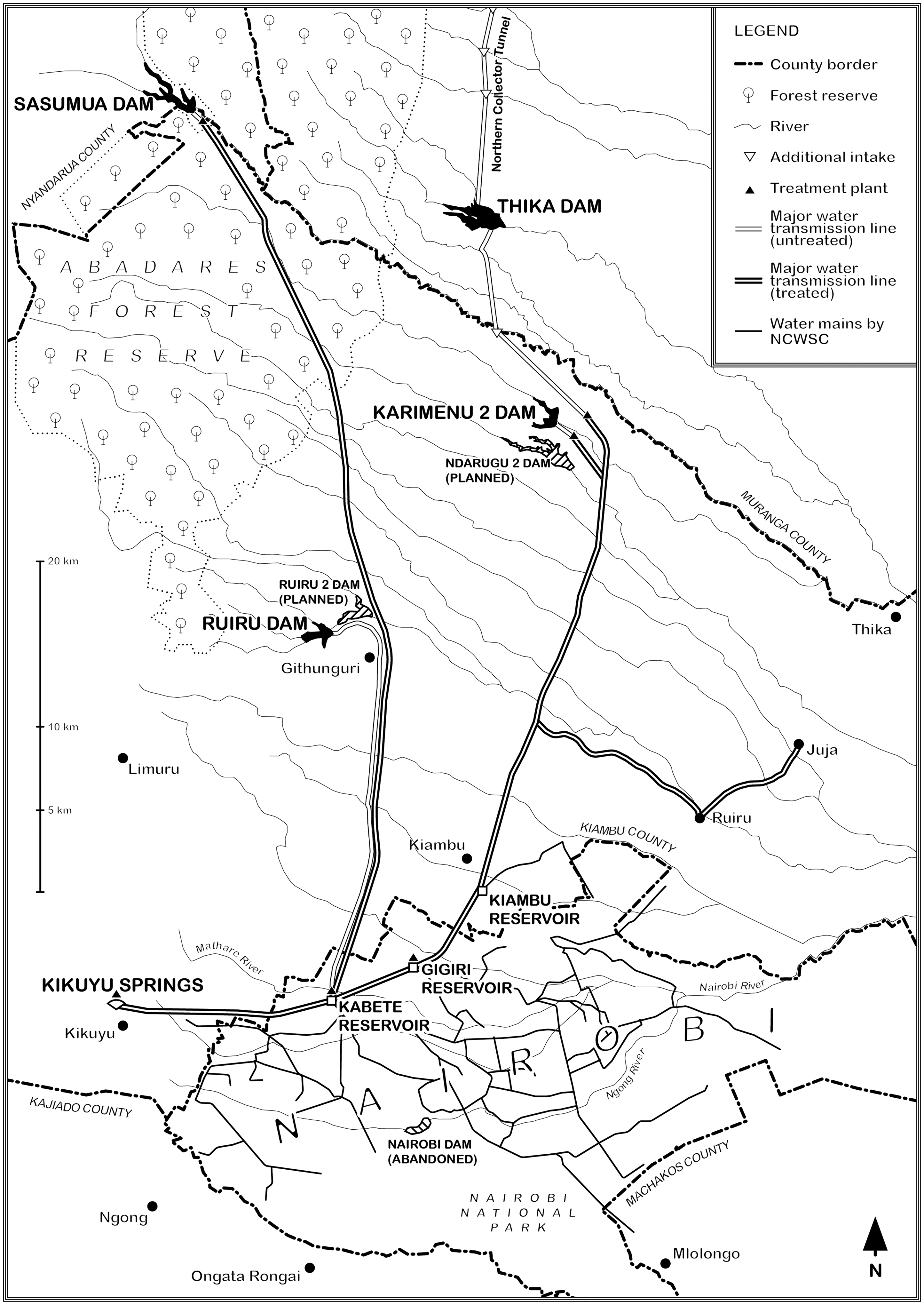
Schematic map of the major dams, reservoirs, and transmission lines for Nairobi's piped water supply. Map by author based on the following sources: AWSB and Aquaclean, 2016; AWSB and ESC, 2016; AWSB and GIBB, 2014; AWWDA, n.a.; Mutono et al., 2022; GoogleMaps; Syagga and Olima, 1996.
At least 90% of all piped water in Nairobi has its origins in the Aberdares Mountain Range with its demarcated forest reserve (Akallah, 2022; see Figure 2). Partially gazetted as a so-called water tower, the Aberdares attract, store, and ultimately release the majority of the water later consumed in Nairobi. Due to their elevation, topology, geology, and tree cover, the Aberdares not only receive some of the highest annual rainfall in Kenya, but also filter and store much of this water for continuous, slow release into the NAS and the many rivers that feed Nairobi's major dams. Yet, their hydrological function is threatened by ongoing deforestation, anthropogenic climate change, and unsustainable water extraction, including diversion to dams. While comprehensive studies of hydrological impacts are currently lacking, reports and studies, as well as accounts from local communities and experts, point to changing, less regular rainfall patterns and falling local levels of groundwater (Gichua et al., 2020; Kilonzi and Ota, 2019; Mwangi et al., 2023). So much so that the Kenyan government is now “investing in nature and building “green infrastructure” upstream of gray infrastructure” (Schmitz and Kihara, 2021: 132), namely on-farm water storage pans to enhance the water security of small-scale farmers and, to a lesser extent, to increase water infiltration, supporting natural water storage in the soil and deeper strata.
Some water from the Aberdares and other areas then seeps into the aforementioned NAS and is stored underground, particularly at “fault lines/zones, impounded lakes and wetlands, and flood plains” (Oiro et al., 2018: 874). With NCWSC largely relying on river-fed dams and reservoirs, water stored in the aquifer plays however a rather marginal role in utility supply, despite a recent increase in state-sponsored boreholes (interview, NCWSC, 2021; Schramm et al., 2023). Yet, according to interviews with the national Water Resource Authority (WRA), the NAS – particularly some of its parts below the NCC – is experiencing highly unsustainable abstraction rates. While they have always been part of the city's waterscape (Akallah, 2022), the number of private boreholes in Nairobi has skyrocketed since the introduction of a citywide water rationing program in the 2000s that is still in effect today. Officially, there are over 8000 licensed boreholes in the city, mostly serving individual compounds or estates, especially but not only in the more affluent parts of Nairobi, and largely in addition to, not as a complete substitute for, piped supply (interview, WRA, 2021). Unofficially, there are likely many thousands more that are neither licensed nor monitored, and thus, water levels in parts of the NAS have fallen massively, with more and more boreholes running dry. Current abstraction rates combined with reduced recharge have resulted in “a groundwater-level decline of 4 m on average over the entire aquifer area and up to 46 m below Nairobi [and] a net groundwater storage loss of 1.5 billion m³” since the 1950s (Oiro et al., 2020: 2635). If this trend continues or even accelerates – which seems likely given Nairobi's growth and foreseeable shortfalls in piped supply – groundwater abstraction from the NAS will reach its hydrological breaking point by mid-century (interview, WRA, 2021). While in other geographies of the planet the preservation and artificial recharge of natural water reservoirs – i.e., the environmental infrastructuring of water storage – has become part of supply-side water management strategies and imaginaries, efforts to appropriately recharge natural water storage bodies, such as aquifers, exist only rudimental for the wider Nairobi area, i.e., as the aforementioned on-farm water storage pans.
Conversely, the largely technical effort of large-scale water storage has been part and parcel of Nairobi's waterscape since its earliest days, starting with a small dam in 1900, followed by the Kabete Reservoir with treatment plant in 1938, and then the Ruiru Dam, which was constructed in the 1940s (Nilsson, 2016; Nyanchaga, 2016). All of these colonial infrastructures largely benefited the city's mostly white economic elite and tell a “story of constant search for more water to supply the ever-thirstier city” (Nilsson, 2016: 492), which continued with the 1950's constructions of the later abandoned Nairobi Dam south of the informalized settlement of Kibera and the still operational Sasumua Dam more than 60 kilometers north of Nairobi in what is now Nyandarua County (see Figure 2). After Kenya's independence in 1963, the Sasumua Dam was slightly expanded, but – because most of the city's grid-supplied water flowed through the aging Kabete Reservoir, where it was treated – the “capacity of the Kabete scheme had become critically insufficient [and] water shortages became increasingly common almost throughout the 1970s and the early 1980s” (Nyanchaga, 2016: 114), as some of my older interviewees vividly remember: “By the 90s latest, everyone had to have a tank because you couldn’t rely on it [piped supply] anymore.” (resident interview, Westlands, 2022) “We need to implement more projects to get more water and then also do more storage, so that we are able to serve the population by maybe 2030 … Whatever we are giving [now] is not reliable.” (interview, AWWDA, 2021)
All projects, whether already in operation or in the pipeline, are once again impacting local communities by requiring the resettlement of many hundreds of families and disrupting the livelihoods of many more, and all of them – in addition to being severely delayed – have been facing resistance from local residents as well as publicly raised claims of lack of public participation, unclear communication, and missing compensations (Clerk of the National Assembly, 2023; Kamau, 2023; KBC, 2021). Moreover, with international investors and corporations involved – such as Deutsche Bank, China Exim Bank, and the French-owned Sogea-Satom – these projects also represent the ongoing financialization of water supply in Nairobi and Kenya (cf. Williams, 2021). Especially since – after years of lobbying and on the heels of opening the NCT and Karimenu 2 Dam – AWWDA, as the developer of all this infrastructure, has only recently been granted the right to become a bulk water supplier (interview, AWWDA, 2021; Capital Business, 2024), selling water to affiliated utilities, instead of ‘just’ being a non-revenue-generating state agency. Given that Nairobi's current water supply is already based on “a system of service provision increasingly oriented towards value extraction and commercial viability rather than basic needs and rights” (Williams 2021: 1889), it remains to be seen how future investments in large-scale infrastructure will shape not only the large-scale storage arrangements with their socio-ecological relations in Nairobi's hinterland, but also the many other yet smaller storage arrangements, to which we turn in the following.
On corners, towers, rooftops, or underground: The many intermediary water tanks of Nairobi
When we continue to follow the water and its various storage points from the dams towards the NCC, we first reach various utility reservoirs, such as those in Kiambu and Gigiri, or the aforementioned Kabete Reservoir (see Figure 2). From those three reservoirs the water is piped to more but usually smaller reservoirs, used by NCWSC to manage flow and gravitational pressure throughout the network – e.g., for water rationing – not so much for longer-term storage (interview, NCWSC, 2022). Elsewhere in the world, communities or non-utility organizations may also use reservoirs and large tanks to secure or manage water supply as a commons, but in Nairobi, there are rather few intermediary water storage arrangements – not utility, not really individual – that do not serve mainly privatized or commercial purposes. Nevertheless, all water tanks of the city, which sit somewhere between water sources and households, play a crucial but charged role in the city's waterscape, whether they are located on street corners, on small towers and rooftops, or underground.
The semi-public tanks of water points
With only three-quarters of households in Nairobi having some form of direct access to piped water (interview, NCWSC, 2022), 2 many depend on other sources. Moreover, even those with access to the network often have to supplement the intermittent or inadequate supply: “Sometimes you just have to buy water from the vendors” (interview, Eastleigh resident, 2022). Thus, particularly in informalized settlements with few grid connections, water points can be found on every other corner, and they are the main water source for 86% of households in Kibera (Kasper et al., forthcoming). 3 Not only is the importance of water points similar for other informalized settlements in Nairobi (Chakava et al., 2014; Sarkar, 2022), but they have also become a ubiquitous feature of dense, low-to-middle income residential neighborhoods with multi-story apartment buildings. Walking through the streets of Eastleigh and other burgeoning neighborhoods, water points are a common sight and 20% of households in Eastleigh rely on them as their main source of water and a further 27% uses them at least regularly (Kasper et al., forthcoming). Throughout the city and within neighborhoods, the specificities of water points can vary widely however: They draw water from the grid officially, or unofficially, or from a borehole; there are points run by NCWSC, others by youth groups or NGOs, but many are simply small private businesses. What the majority of water points in Nairobi have in common, however, is their reliance on water tanks, which tend to be polyethylene-based, black, cylindrical containers of many thousands of liters that are simply placed on the ground or put on built structures (see Figure 3). Polyethylene tanks are often a prerequisite for setting up water points, as they allow water points to be less dependent on the intermittent and unreliable nature of piped supply, whether official or not, or on other sources that are rarely consistent either. Thus, beyond and because of their detrimental role in water access, these tanks represent a significant reservoir of hydraulic power. Those owning or managing these tanks and their outflow wield considerable authority over other residents, determining who gets water under which conditions.
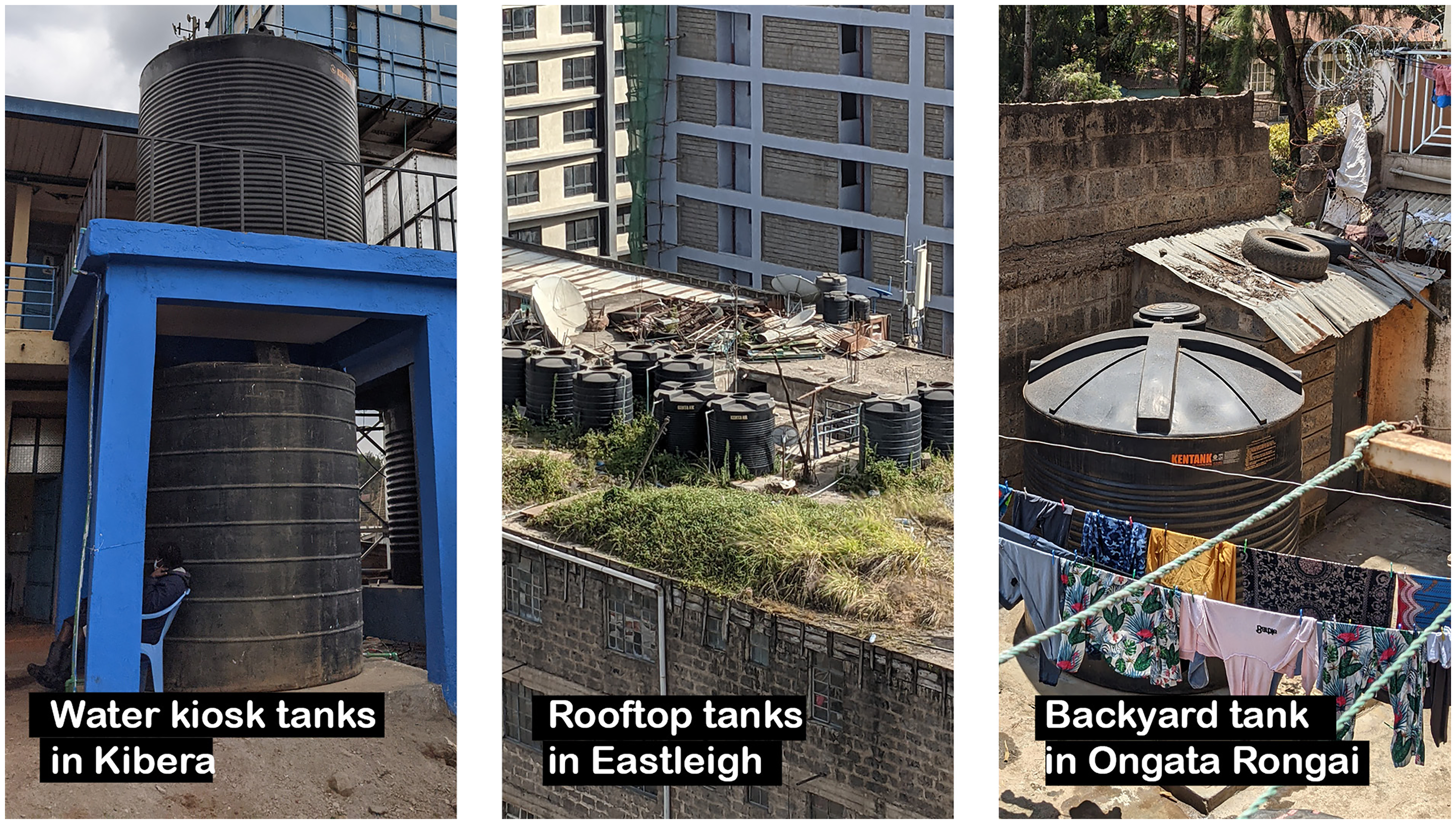
Water tanks in Kibera, Eastleigh, and Ongata Rongai; photos taken by author (2021/22).
The towering (metal) tanks of boreholes
As discussed, boreholes have become highly common and, in some instances, they are used to serve infrastructurally marginalized areas in Nairobi (Chakava et al., 2014) but – as has been the case since colonial times (Akallah, 2022) – boreholes and their recent increase are largely driven by real estate developers, property owners, and homeowners. Today, it is hard to find a large-scale property development, especially an upscale one, without a borehole (interview, Cytonn, 2023; interview, private property developer, 2023), and boreholes have also become popular for all types of residential compounds, from affluent Westlands to dense and central Eastleigh to slum upgrading projects such as Canaan Estate in Kibera (see Figure 4). In many cases, boreholes are a retrofit solution for eroding, networked supply, and may serve not only a single property but also provide an additional income stream for the owner by selling excess water. Again, specific arrangements vary, but no borehole functions without storage: “So, you pump during the day, you have to store the water in an overhead tank, and then you can use the water anytime you want” (interview, Davis & Shirtliff, 2021). Since it is not sensible to turn on a borehole pump for every single use of water, and since borehole water in Nairobi should to be treated before use (interview, WRA, 2021), all boreholes have massive storage tanks of up to 100,000 liters and more, usually towering above the actual borehole. Unlike most other water storage tanks, which since the 1980s have typically been made of imported polyethylene (interview, Kentainers, 2023), most borehole tanks are cubic steel tanks because they can withstand the pressure of that much water better than polyethylene tanks. However, borehole towers with polyethene tanks, which tend to be less expensive, can also be seen, especially in the low-to-middle income suburbs of Nairobi (see Figure 4). Ultimately, while the actual borehole and its pump are critical to accessing water from the NAS, the many thousands of licensed and unlicensed boreholes in Nairobi can only supply water to urban residents because of their tanks.
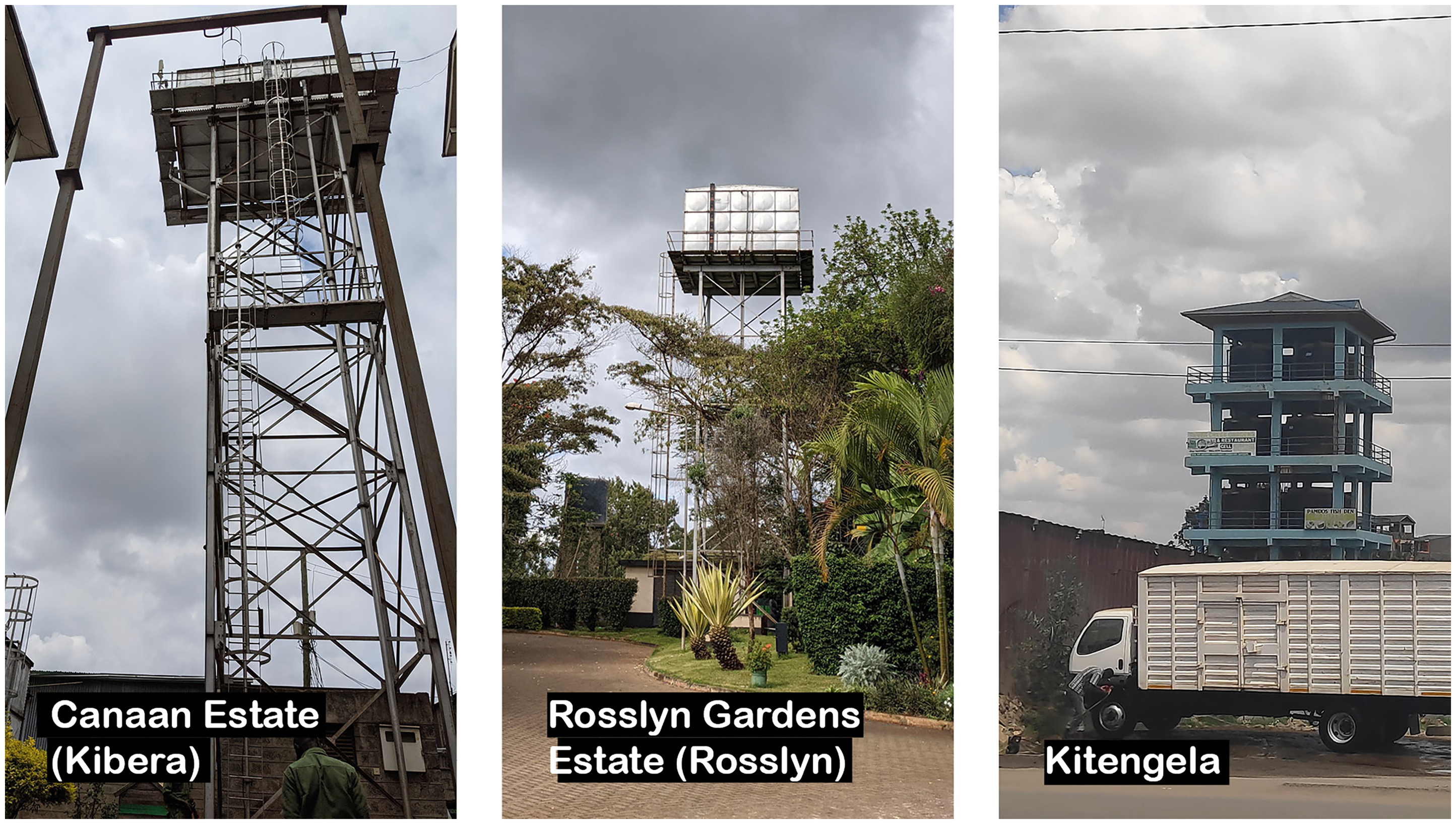
Borehole towers in Kibera, Rosslyn, and Kitengela; photos taken by author (2022).
The underground and rooftop tanks of single buildings or compounds
While the tanks for water points and boreholes represent non-networked water supply, even water piped from NCWSC dams and reservoirs to grid-connected households is usually stored again before it actually reaches taps or faucets. Given the intermittent nature of the grid supply for virtually any connection,
4
with water coming through the pipes for only a few, often nightly, hours two or three days a week (if at all), water tanks for residential compounds and buildings are a common necessity. Developments built in recent decades often have underground cement tanks (interview, Zima Homes, 2022; interview, private property developer, 2023), although some use polyethylene tanks that are either buried in the ground or simply placed in yards, gardens and other common areas. These tanks are then typically fed through metered connections and some property owners install additional booster pumps to draw more water from the network than the base pressure would provide: “They are doing it illegally … You get these fellows pumping direct, interfering with the flow. They are using the big pressure machines, so we cannot compete with them we just wait let them finish.” (interview, Eastleigh resident, 2022) “The water is not okay … The plot owner has installed small tanks underground, and he has as well erected water tanks on the roof. So, when the water comes it flows into the small underground tanks from where [the care taker] pumps it to the rooftop tanks. That water is not always clean because the tanks are not washed at all … We use the water from the rooftop tanks until it is depleted. Then we just have to wait until the next time the water is pumped up. Now, when it depletes between before the water comes again, you have to buy water.” (interview, Eastleigh resident, 2022)
Tanks, super drums, and jerry cans: The universality and heterogeneity of domestic water storage in Nairobi
While the many intermediary tanks are critical to ensuring supply across Nairobi, households deploy, invest in, and maintain even more water storage arrangements. The specific reasons for storing water at the household level vary, but usually it is the lack of a direct connection to the household, intermittency of supply (from the grid and/or from the building's own tanks), low pressure from the grid, or the (additional) use of off-grid supply such as water delivery or rainwater harvesting. Typically, and throughout Nairobi, each household has an idiosyncratic combination of immediate and/or long-term reasons for storing water themselves, as well as an idiosyncratic set of artefacts, practices, and actors involved, which – as with water supply and access in Nairobi in general (Kasper et al., forthcoming) – may vary from building to building and even from household to household. The heterogeneity of domestic water storage in Nairobi is juxtaposed by its undeniable universality, but there are further nuances that deserve attention. These nuances are identifiable at every household and, in the following, I present three vignettes that may not fully represent the multiplicity of storage arrangements but signify paradigmatic articulations in different geographic, architectural, and socioeconomic settings.
Tanks, pumps, and pipes in Ongata Rongai
I meet Edith and her husband Matthew at their single-family home in the growing suburb of Ongata Rongai, just outside the NCC (see Figure 1). Along the dirt road lined with other single-family homes that leads to their home, workers from the local water utility, Oloolaiser Water, are laying new pipes. 6 The water supply to Edith and Matthew's home has been incredibly unreliable ever since they moved here with their three children in 2008. Now Matthew shows and explains to me – with visible pride and incredible attention to detail – their arrangement of three polyethylene water tanks outside their house (the largest in the front yard, two smaller ones in the back), an additional tank in the attic, two pumps, and countless pipes (see Figure 5). Additionally, they have two water dispensers in the house, for which they buy purified water in cannisters since they do not drink tap water due to quality concerns. They have gradually invested in and, with the help of plumbers, installed more and more tanks and ancillary infrastructure; including one tank just for rainwater harvesting because “the best preparation you can make is to harvest rain water and store it in big tanks. Otherwise, there is no schedule, you will not know whether water will come or not for the next three weeks.” Unsurprisingly, individual homeowners in and around Nairobi, like Edith and Matthew, are an increasingly important target group and market for Kenya's water tank manufacturers. During Matthew's tour, Edith repeatedly makes little jokes about his obsession with the tanks and pipes, and she reveals how he and his friends often chat and brag about the number, sizes, and brands of their water tanks. Later in my fieldwork, I will hear similar stories about how water tanks are a common topic of conversation among male homeowners in Ongata Rongai and other suburbs. While many water-related practices, especially in low-income areas of Nairobi, are often the domain of women, the technicalities and investments of water storage can be heavily dominated by men. At one point, Edith – who has heard Matthew's explanations at least one too many times – interrupts him impatiently and leads us inside for some chai, we sit down and our actual conversation begins.
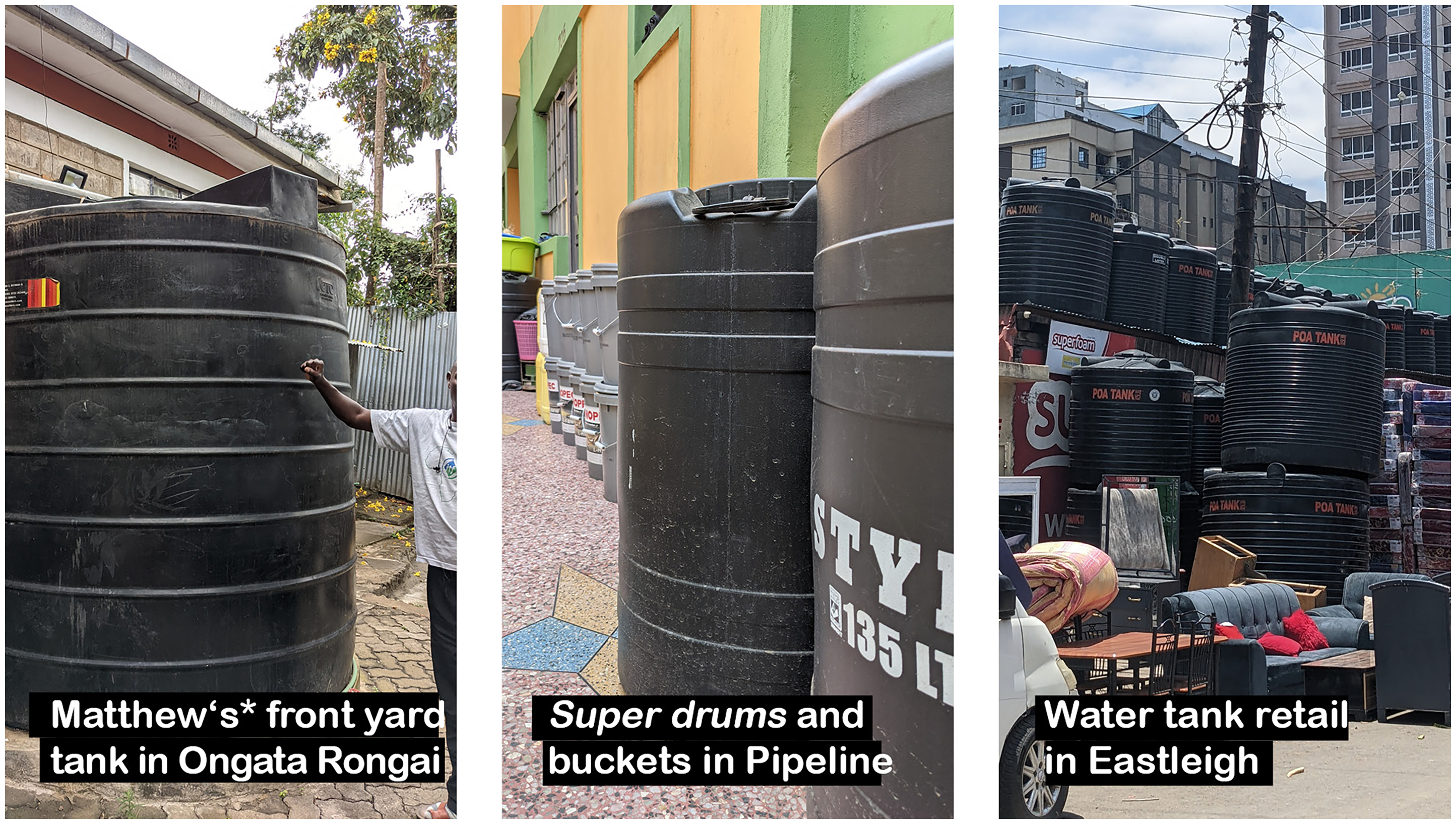
Various water storage and tank situations in Ongata Rongai, Pipeline, and Eastleigh; photos taken by author (2021/22). (* name changed.).
Locking your super drums and jerry cans in Eastleigh
Before meeting Julius in central Eastleigh, I take some time to stroll around the area, spotting many elevated boreholes in backyards and coming across a shop selling all sorts of household goods lined up on the street; assorted furniture, mattresses, water tanks of various sizes produced by Poa Tank (see Figure 5). Sales points and advertisements for water storage containers of all kinds are a common sight in Nairobi, and they speak to the universality of water storage needs across the city; even, or perhaps especially, in central, grid-connected neighborhoods like Eastleigh, which is not only a major retail and commercial hub and residential area, but also has a long history of infrastructural neglect. The worsening water situation was a major reason for Julius and his small family to recently move from their apartment in Eastleigh to Outer Ring Road after more than ten years: “There's a water crisis here … It's not enough. You have to buy jerry cans … And then you don't have enough space to store those jerry cans.” Many in Eastleigh and other dense areas full of apartment buildings can relate. Even if your building has its tanks, the limited supply from the network (and the common reluctance of property owners to buy additional water, i.e., from bowsers) forces many tenants to invest in and fill their own storage containers; usually super drums of 100–250 liters and small jerry cans, but also all sorts of other buckets (see Figure 5). You can fetch additional water yourself or have it delivered by handcart, but where to actually store it, where to put your water containers, is a common conundrum in the often small apartments. When Julius and his family lived in Eastleigh, they had several jerry cans and two super drums: “One for drinking water was inside the house [apartment] and the other for washing and toilet water was outside.” Keeping water and containers outside, in common areas such as corridors, can then become a contentious situation, and Julius, like many others, has stories of neighbors stealing water or whole containers: “You have to buy a chain and a lock, and then you lock, even the jerry can.” Rather than helping each other out amidst water supply issues, individual water storage in apartments buildings in Eastleigh and elsewhere can often be a source of tension and suspicion as everyone struggles to secure water for their households.
The many uses of and efforts around water containers in the small homes of Kibera
Somewhere in Kibera's kijiji (village) of Kianda, I am sitting with Agnes and her neighbor Miriam in one of the countless mabati (iron sheet) homes of one of Nairobi's largest informalized settlements. Dimly lit by a single light bulb and separated by sheets, the small space also stacks in just one corner nearly a dozen of 20-liters, yellow jerry cans, mostly repurposed cooking oil canisters. Some in Kibera have the financial and spatial capacities for super drums but Agnes as well as Miriam both do not have one. No matter with or without a super drum, virtually every household in Kibera stores all their water at home, usually indoors, since virtually no one has a direct connection but relies largely on water points: “I just buy from someone who gets his water from kanjo 7 or from anywhere he finds … Also, even when rain comes, we fetch from the rain. Just putting a basin out.” Most water storage artefacts in Kibera are thus more than just sedentary containers but are rather used as multiple devices to fetch, to harvest, to share, and to store. Yet, in addition to the opaqueness and untreated nature of most water sources, domestic water storage is a key reason for concerns around water quality and health hazards. NCWSC and some NGOs I talked to claim that the way people store water in Kibera and elsewhere is actually the main reason for contamination with organic and inorganic matter. Aware of that, however, Agnes, Miriam, and the many others I talked to in Kibera all have rigid cleaning routines for all their containers – way more regular than the cleaning of large storage tanks in more affluent areas – and stored water is usually used up quickly: “Some people even have 50 jerry cans … But even that 50, it even not lasts a week … Then, when we want to go and buy another water, we wash them using a scoring pad and soap.” Agnes and Miriam say that dirty water is the problem, not storage, and most people in Kibera boil or otherwise treat their water before consumption. However, access to and adequate storage of potable water remains a critical issue in Kibera, and both access and storage are – in Kibera's current water configuration – entirely dependent households’ super drums and jerry cans.
As all three vignettes show, domestic water storage and the need to care for it is universal throughout the city. Among my respondents, there are a few exceptions in up-market rentals for which the property management takes over all responsibilities. But, especially in these homes one would find purified water canisters for drinking water supply that are purchased and stored, and the alleged reliability of water supply in up-market rental housing is not always guaranteed, as Carol – who has just moved to Westlands – reports: “I don’t think there has been any week when I did not call the water guys … Every apartment has two tanks, one on the bottom and one on top … Luckily, we have an automatic pump … I had to put this up myself, though.” (interview, Westlands resident, 2023)
Stabilizing, disrupting, creating: Discussing the multiple tool power of water storage across scales
As all the different storage arrangements – from the Aberdares to the jerry can – show, before any water reaches anyone in Nairobi, all of it – whether it comes from the dams, through boreholes, or from any other source – has been stored in multiple, often intermediary ‘containers’ of different sizes and materialities, situated somewhere on the fluid spectrum of infrastructural responsibilities, between the broader public, the communal and the private. In particular, the multiple water tanks of boreholes, water points, buildings, and some households play an important role in ‘buffering’ (Schwarz, 2021) the mismatch and arrhythmia between supply and demand. Tanks – especially the many polyethylene ones – are thus one of the most integral artefacts of the city's waterscape, but the myriad of micro-containers at the household level as well as all the labor, time, care, and investments of urban residents in using and maintaining them, are equally important in “holding the city together” (Kasper, 2024). All these socio-technical and socio-ecological assemblages of containers, water(s), materialities, and human involvements are nonetheless also indicators of socio-spatial stratification, infrastructural inequalities, and socio-ecological alterations. Here, using storage as a multi-scalar analytic helps us to explore and theorize less normatively what all these storage arrangements actually do to their related urban spaces and wider ecologies. Building on Randle's (2024: 6) observation that “storage assemblages order landscapes,” often far beyond their original sites, I argue that, across scales, the “tool power” (Meehan, 2014) of socio-technical and socio-ecological water ‘containers’ is expressed in three effects that shape the relations in which each storage arrangement is enmeshed in, namely stabilizing, disrupting, and creating:
Looking at the stabilizing, disrupting, and creating capacities of water storage arrangements, it becomes clear that these are also nodes where socio-economic power is enacted and relational power indifferences between different actors become visible. In Nairobi, this has largely benefited the already affluent class while only providing the bare minimum to marginalized populations. But instead of primarily problematizing water storage arrangements, an appreciation of their diverse, sometimes confusingly antithetical tool powers might help to rethink how dams, reservoirs, tanks, super drums, and jerry cans can be deployed and incorporated more thoughtfully into infrastructural plans and imaginaries.
For a ‘pragmatic turn’ to storage
Using storage as a multi-scalar analytic provides valuable insights and a new perspective for understanding situated yet heterogeneous urban waterscapes. For Nairobi, the inability of utilities and the state to store and release enough water through large dams and reservoirs affects and even creates storage arrangements further downstream. In a never-ending attempt to compensate for this inability, the necessary urbanization of nature keeps disrupting Nairobi's hinterlands. Moreover, even based on the projections of the current master plan for water infrastructure (AWSB, 2011), Nairobi's population growth and water demand will continue to outpace its water storage projects. With little choice and little government enforcement, urban residents, property owners, and the private sector thus deplete the ‘natural’ water storage beneath their feet through tank-enabled boreholes, with consequences for larger ecologies and the water-infrastructural futures of Nairobi. Water storage by vendors, property owners, and individual households also plays a significant but ambiguous role in stabilizing the inequalities of supply and consumption that characterize Nairobi's contemporary waterscape, as storage arrangements are not merely technical solutions, but are deeply embedded in everyday urban life and socio-ecological to political relations in Kenya's highly commodified water economy. Here, the key value of storage as an analytic is to better understand and nuance these relations – and thus, by extension, the larger waterscapes they are co-constituting – by expanding on the largely flow-based, metabolic readings of urban political ecologies and their infrastructures with insights into place-specific expressions of the variegated tool power of storage at multiple scales. Doing so may not only “reveal entanglements and relations typically obscured in analyses more focused on flows, circulations, and movement” (Randle, 2024: 8) but provide distinct entry points – such as dams, tanks, and jerry cans – for further research on urban infrastructures, their geographies, qualities, and consequences, including unequal supply and access, heterogeneity, hydraulic extractivism, and commodification.
Yet, the heterogeneity of domestic water storage in Nairobi also illustrates how residents actively shape infrastructure through their daily practices and investments, which represent both adaptation strategies and manifestations of infrastructural inequality, but also offers possibilities for intervention if we acknowledge the diverse tool power of storage arrangements. After all, “the water order is not fixed, but in flux, constantly generative of new technologies and possible alternatives” (Meehan, 2014: 222). Small-scale water storage must therefore not (only) be a problematized interim solution on the way to an idealized, universal and 24/7 network coverage, but it can help us to discuss and rethink “how forms of solidarity can be established across heterogeneous provisioning systems” (Alba et al., 2022: 18). Rather than treating water storage as a mere technicality in infrastructure planning, or as a supposedly irrelevant or even counterproductive household activity, we are challenged to use storage not only as a multi-scalar analytic, but also as a multi-scalar guide to nuance and expand “technology as a space of possibility” (Schramm and Ibrahim, 2021). Planners, policymakers, and utility officials must recognize the capacity of water storage arrangements to stabilize, disrupt, and even create socio-technical and socio-ecological relationships and networks far beyond their immediate surroundings. More so, new designs and approaches are needed that are rooted in and adapted to the storage realities of cities like Nairobi. Such a ‘pragmatic turn’ (Jaglin, 2016) towards storage involves recognizing how different scales of storage interact and influence each other, from the household to the large dams and groundwater reservoirs that are so rarely visible in our everyday urban lives. We are thus tasked with further considering and utilizing the potential of communal or common water storage to disrupt and challenge problematic hydraulic configurations in Nairobi and elsewhere. Asked more broadly: How may thinking through and incorporating water storage at multiple scales help create just and sustainable urban futures? Trying to answer this question might provide us with an enormous range of possibilities for further research, design, policy, planning, and the many major and minor forms of infrastructuring.
Highlights
Case study of Nairobi's “storage city”: Draws on qualitative fieldwork to illustrate how variegated storage arrangements - from dams to jerry cans - reflect and reproduce urban conditions.
Multi-scalar approach to water storage: Analyzes water storage across scales - from natural reservoirs to household containers - revealing its critical role in ensuring water supply in Nairobi amidst infrastructural inequalities.
Storage as stabilizing, disrupting, and creating agent: Identifies water storage's “tool power” in stabilizing infrastructure, disrupting social and ecological systems, and creating emergent socio-political dynamics.
Implications for urban infrastructures: Advocates for integrating small- and large-scale storage into the planning, design, and governance of urban (water) infrastructures to envision just and sustainable waterscapes.
Footnotes
Acknowledgments
This article was only made possible by the generosity of many Nairobians, from so-called technical experts to ordinary residents, some of whom are quoted in this article with changed/anonymized names, but all of whom influenced the empirics and analysis of this work in different but crucial ways. I am immensely grateful for the invaluable time, expertise, and perspectives they shared. The recruitment and interviewing of respondents were supported and in part conducted by Cynthia Chepkemoi and Kate Owino, to whom I am deeply grateful for their professional and gracious collaboration. The importance of my supervisors, Sophie Schramm and Jon Silver, in influencing my dissertation project cannot be overstated. Drafts of this article have been presented in various stages at the KRITIS conference on “Urban Circulations” in Darmstadt (2022), the workshop on “Questioning Urban Future-Making in Times of Disrupture” in Berlin (2023), and several times during the doctoral colloquia of the International Planning Studies (IPS) research group of the Department of Spatial Planning at the Technische Universität Dortmund. I would like to thank the organizers and participants of all these events for their support and productive comments.
Data availability statement

Declaration of conflicting interests
The author declared no potential conflicts of interest with respect to the research, authorship, and/or publication of this article.
Ethical approval and informed consent statements
Informed consent was obtained verbally prior to participation in the interviews. Each respondent had reached the age of consent at the time of the interview. Because some respondents did not wish to be identified by name, all names in the text have been changed or anonymized.
Funding
The author disclosed receipt of the following financial support for the research, authorship, and/or publication of this article: This work was supported by the Deutsche Forschungsgemeinschaft, (grant number 468099064).