




Abstract
This paper examines local imaginaries of coal within the mining communities of Upper Silesia in southern Poland, offering a grounded perspective on how coal-shaped visions of a good life emerge from lived, material experiences. Drawing on the concept of bounded imaginaries, we shift focus from dominant national narratives to locally held, non-expert visions engendered by coal's material presence. Our analysis of ethnographic and historical evidence demonstrates that the material experience of coal and mining labour fosters a bounded imaginary with two interrelated dimensions: one centred on people, the other on the Earth. The people-centred dimension reveals how local visions of the good life enabled by coal are rooted in supportive and stable communities that care for their social environment. In the Earth-centred dimension, the meaning of the good life is grounded in respect for natural resources’ role in sustaining human societies, an awareness of the fragility of human life, and an ethos of sufficiency. Both dimensions stem from engagement with coal's materiality, revealing visions of a good life that are not readily accessible to those without tangible experience of coal. We argue that such imaginaries hold transformative potential for shaping socially just energy transitions that are attuned to local needs and aspirations. In Upper Silesia, where coal phase-out is gaining momentum through Just Transition Funds, these bounded imaginaries can further inform emerging models of distributed renewable energy production driven by local communities. Rather than dismissing attachments to coal as relics of the past, this paper shows how the lived experiences and material entanglements of coal communities can be mobilised generatively in designing post-coal futures. By foregrounding the material roots of local imaginaries, our findings contribute to broader debates in energy social science about the importance of place-based visions, experiential knowledge, and care in driving just transitions.
Introduction
Over a century of industrial mining, coal has symbolised Poland's national wealth and energy security (Kuchler and Bridge, 2018; Lis, 2020; Rabiej-Sienicka et al., 2022). At its extraction peak in the 1970s during the communist era, Poland was the world's top coal producer, with its electricity generation almost entirely dependent on this resource (Jaros, 1975). The material properties of coal – its solidity and abundance – helped forge the powerful imaginary of ‘black gold’ as a bedrock of the nation's prosperity, progress and stability (Kuchler and Bridge, 2018). However, as Kuchler and Bridge (2018) observe, since the 1990s and the collapse of communism, this coal imaginary has gradually diverged from the material realities of Polish coal mining. Depleting resources, low-quality coal, and EU environmental regulations on carbon dioxide (CO2) emissions have made the industry increasingly unprofitable, prompting government bailouts and rising coal imports (Brauers and Oei, 2020; Lisowski, 2013; Lisowski, 2018; MAP, 2023). The share of coal (both hard coal and lignite) in Poland's electricity mix reached a record low of 48% in September 2024 (Pandera, 2024: 2). Domestic hard coal production, concentrated in Upper Silesia in southern Poland, dropped to 49 million tonnes in 2023 – the lowest since WWII – forcing Poland to import 19% of the coal used for electricity (Forum_Energii, 2024). Moreover, efforts to extract the remaining coal reserves at deeper levels come with mounting risks and dangerous working conditions, including heightened rock mass temperatures, and the potential for seismic activity and methane hazards (Sobczyk, 2022). Despite the work being highly mechanised today, it still requires human labour, and fatal accidents continue to occur to this day (Baca-Pogorzelska, 2009; Scislowska, 2024).
Yet, the enduring national imaginary of Poland that ‘stands on coal’ (Kuchler and Bridge, 2018), albeit increasingly on life support, keeps the country captive in suspense about its future energy development, making it challenging for local imaginaries of coal to extend beyond mining communities and effectively influence the just transition pathways by incorporating the visions of good life held by energy-producing regions While coal remains deeply significant to local communities, not only as a strategic domestic resource but also as a co-producer of social and cultural meaning, these nuanced interpretations of a good life are largely absent from national transition plans, which tend to prioritise energy security and economic competitiveness (MKiŚ, 2021). However, recent studies suggest that the distinctive social fabric of Polish mining communities may provide a valuable foundation for imagining and constructing a post-coal future (Dańkowska and Sadura, 2021; Jędrysik, 2021; Sadura, 2021).
As the phasing-out of coal advances, communities in coal regions such as Upper Silesia must come to terms with the significant loss of a resource that has shaped their social structures and cultural practices for generations (Allen, 2021; Lewin, 2019; Nowakowska et al., 2021; Tarasova, 2024). Research on energy-producing communities highlights the significance of meanings sutured around hydrocarbons (Lahiri-Dutt, 2016; Lahiri-Dutt, 2017; LeMenager, 2014; Smith, 2019b), cautioning against the pitfalls of undermining coal's role in shaping local visions of good life and social order, which can lead to injustices of certain transition policies (e.g., Ajl, 2021; Ajl, 2023; Bouzarovski and Tirado Herrero, 2017a; Bouzarovski and Tirado Herrero, 2017b), underrepresentation of coal communities (Grubert and Skinner, 2017; Smith, 2019a; Smith and Tidwell, 2016; Tidwell and Tidwell, 2018), and a renewed attachment to coal and carbon-intensive industries (Lewis, 2024). Engaging with these communities to understand their aspirations, concerns, and cultural values sutured around coal materialities could aid developing transition strategies that are not only technically and economically feasible, but also socially equitable and culturally sensitive. Suppressing these voices, on the other hand, could foster resentment and despair, potentially leading to adverse social and political consequences (Allen, 2021; Tarasova, 2024; Żuk and Żuk, 2024).
It is, therefore, crucial that transition efforts acknowledge both the risks involved and the deeply embedded social and cultural ties to coal, ensuring that regional policies are responsive and attuned to the lived realities of affected communities. This awareness, at least nominally, appears to inform key documents guiding the regional transition in Upper Silesia, such as the Territorial Just Transition Plan (TPST, 2022 ), the ‘Silesia 2030’ Development Strategy for the Province of Silesia (SRW, 2020), and the Low-emission Economy Policy for the Province of Silesia: Regional Energy Policy until 2030 (RCAS, 2020). All these documents emphasise the necessity of a tailored, context-sensitive approach in this heavily industrialised region with diverse attachments to coal. Local authorities proudly report that Upper Silesia was allocated the highest amount of the Just Transition Funds (JTF) out of all European transition regions (9 billion PLN), and that the regional transition is gathering significant pace, with 90% of the funds distributed as of April 2025 (UMWŚ, 2025). JTF was established in 2021 by the European Commission and represents EUR 19.7 billion in EU financing for regions in transition, a significant gesture considered by Frans Timmermans (Executive Vice-President for the European Green Deal) a ‘pledge of solidarity and fairness’ (European-Commission). The local government indeed recognises it as such by highlighting that, thanks to the JTF, ‘the Silesian Province is gaining real tools to rebuild its economy – not by returning to the past, but by leaping into the future’, and that the ongoing ‘transformation is not a loss, but an opportunity for a better life and sustainable development’ (UMWŚ, 2025). In shaping this envisioned ‘better life’, however, we consider it pertinent to investigate the existing visions of the good life to ensure that values and desires of coal-dependent communities are not overlooked and neglected. The objective is not to uncritically preserve the residues of the past, but to mobilise these legacies in generative ways that help shape a post-coal future.
In this paper, we explore local imaginaries of coal in the context of the coal mining communities of Upper Silesia. Drawing on research into sociotechnical imaginaries (STI), and specifically studies examining bounded imaginaries (e.g., Chung et al., 2021; Mutter and Rohracher, 2022; Smith and Tidwell, 2016), we seek to move beyond the preoccupation with nation-state STIs and contribute to the growing body of research into locally held, non-policymaker non-expert visions of good life engendered by the first-hand experience of natural resources (e.g., Burnham et al., 2017; Delina, 2018; Delina, 2021; Eaton et al., 2014; Jasanoff and Simmet, 2021; Levenda et al., 2019; Marquardt and Delina, 2019; Schelhas et al., 2018). In our deployment of the concept, we are particularly motivated by its focus on the role of the material conditions of energy-producing labour in shaping context-sensitive imaginaries (Smith and Tidwell, 2016).
Our aim in foregrounding the bounded imaginary based on connections to specific materialities of coal in Upper Silesia is to identify local visions of a good life. We argue that these visions offer alternatives to the national imaginary which sidelines the material reality by sustaining the out-of-date idea of coal as a prosperity-enabling domestic resource. We, therefore, tap into a broader call in social science energy research to counter the unification of diverse regions in transition and uncover the transformative potential of locally-specific visions of desirable life and social orders co-produced with energy systems (Glück, 2018; Jonek-Kowalska, 2024; Measham et al., 2024; Nowakowska et al., 2021). We argue that such bounded imaginaries can be mobilised productively to shape transformation pathways catered to the needs and values of local communities, particularly within the context of Upper Silesia's just transition initiatives aimed at fostering inclusive and sustainable regional development (RCAS, 2020; SRW, 2020; TPST, 2022; UMWŚ, 2025).
Empirically, this paper is based on 27 in-depth, semi-structured interviews, three months of ethnographic fieldwork in Upper Silesia conducted between March and May 2023, and the analysis of historical materials and media coverage drawn from desk research conducted since 2021. The archival material was sourced from the Silesian Digital Library (ŚBC, 2025) and comprises regional and union newspapers. The fieldwork included participant observation of various local initiatives in the regional capital of Katowice and several mining towns in the province, such as events organised by neighbourhood groups in mining communities, open lectures, protests, and exhibitions. The in-person interviews took from an hour up to two hours and were conducted with the residents of Upper Silesia categorised as current or former mining industry workers (n = 10), environmental activists (n = 8), queer activists (n = 5), Silesian activists (n = 3), and academics (n = 1).
The paper is structured as follows. In Section 2, we situate our work within the scholarship on STIs and materialities. In Section 3, we provide a brief overview of the dominant STI of coal in Poland. In Section 4, we present the evidence from the empirical material to elucidate the bounded imaginary of coal in Upper Silesia. We conclude our paper in Section 5.
Imaginaries and their relationship to materiality
Since its introduction by Jasanoff and Kim (2009, 2015), an increasing number of studies have employed the concept of STI to explore collectively held visions of desired energy futures (Kuchler and Stigson, 2024). We find the analytical lens of STIs useful in capturing three dimensions of envisioning energy futures. Firstly, as Jasanoff (2019: 22) elaborates, this approach elucidates how ‘people's hopes and desires for the future […] get bound up with the hard stuff of past achievements,’ encompassing both material and normative infrastructures. Secondly, it allows us to understand how imaginaries, in turn, produce ‘a sense of belonging to a particular kind of collective’ (Jasanoff and Simmet, 2021: 3). Thirdly, it also registers the multiplicity and diversity of STIs that ‘coexist within a society in tension or in productive dialectical relationship’ (Jasanoff, 2019: 4).
Most STI researchers have, to date, focused on how national imaginaries are shaped and sustained by the state's institutional apparatus and public performances (Kuchler and Stigson, 2024). This is particularly evident in studies on national STIs in Poland where coal remains deeply entrenched in the country's political imagination concerning national energy policy (e.g., Berling et al., 2024; Kuchler and Bridge, 2018; Lis, 2020; Rabiej-Sienicka et al., 2022). For example, Kuchler and Bridge (2018) illustrate how coal, often framed as ‘black gold’, has long been regarded as a guarantor of national stability and prosperity – a legacy stemming from its post-war role in rebuilding the country. They observe that coal's perceived abundance and accessibility continue to reinforce its dominance in the national imagination, despite its decline due to resource depletion, the unprofitability of the mining sector, and rising CO2 emissions. Other researchers highlight how Poland's energy policy prolongs coal's legacy by rebranding it as ‘clean.’ For instance, Rabiej-Sienicka et al. (2022) note that the dominant vision for the energy system relies on maintaining the status quo, using so-called clean coal technologies with minimal diversification. Similarly, Berling et al. (2024) argue that Polish politicians have long promoted Poland as an EU leader in clean coal technologies, avoiding meaningful energy diversification.
In this paper, we move beyond the predominant focus on national STIs by engaging with a strand of STI literature that increasingly examines alternative forms of collectively held imaginaries, including local energy visions (Kuchler and Stigson, 2024). We concur with Tidwell and Tidwell (2018)'s critique of a universal imaginary, emphasising the need to explore diverse STIs while prioritising the lived experiences and cultural contexts of individuals within different communities, rather than relying on generalised, policy-driven, or expert-oriented perspectives. As Strauss (2006) aptly observes, cultural models – mental frameworks through which people interpret the world – vary widely, even within a single society, highlighting the necessity for context-specific research. Hence, Tidwell and Tidwell (2018) advocate for increased scholarly attention to non-policy and non-expert visions of the good life held by often less privileged ordinary people.
Specifically, we draw on the concept of bounded imaginaries, introduced by Smith and Tidwell (2016), who, in their study of two energy-producing communities in the western United States, found that local visions of good society often remain confined to local context and are characterised by the inability to affect policy action due to the lack of political power. At the same time, Smith and Tidwell (2016: 345) extend the argument of Richardson and Weszkalnys (2014) about simultaneously restrictive and generative capacities of resource materialities, showing that ‘[p]eople do not craft visions of a good society out of the cultural ether but take inspiration from the already existing material world, which in turn shapes the potential “futures” they imagine’. The bounded nature of an imaginary can, therefore, derive from the specific geographical, material and sociocultural contexts that shape it.
In this paper, we are particularly concerned with the relationship of locally bounded imaginaries to specific materialities of an energy source and their historical roots. Smith and Tidwell (2016) illustrate that materialities constitute an important component of boundedness, as proximity to resources and familiarity with their material qualities shape context-specific imaginaries of coal and mine labour as enablers of sociality and stability. These authors demonstrate how the elements of the material reality (e.g., overburden stockpiles and open pits) become part and parcel of the participants’ visions of the good life, attesting to ‘the co-production of energy systems, personal senses of self, and community’ (Smith and Tidwell, 2016: 336). Acknowledging that imaginaries are not purely ideational and ‘are always based on past experience in a world that is always constituted both materially and symbolically’, we seek to uncover past and present visions of good life sutured around coal to discern how they can shape future visions (Eaton et al., 2014: 252). For instance, research on mining communities show that local meanings of coal can shape values and social institutions that not only deserve preserving for transitional justice but also contribute to sustainable, post-fossil fuel communities (e.g., Carley et al., 2018; Carr, 2023a; Corwin, 2023). Carley et al. (2018: 136) find that while ‘[c]oal was frequently framed as the common bond – or identity – that held the entire community together’, Appalachian residents accept the energy transition and view their strong social ties and community engagement as key to adaptation.
Some STI researchers focus on how bounded imaginaries can challenge dominant energy visions (e.g., Marquardt and Delina, 2019; Mutter, 2019; Mutter and Rohracher, 2022; Smith and Tidwell, 2016). For example, Smith and Tidwell (2016) highlight how locally bounded STIs, centred on extractive labour, can articulate alternative societal visions. Similarly, Mutter (2019) and Mutter and Rohracher (2022) examine tensions between biogas imaginaries in two Swedish municipalities and Sweden's national electrification agenda. While bounded STIs may have the potential to contest dominant visions, they often struggle to gain broader influence due to entrenched state power and structural barriers (Smith and Tidwell, 2016). On the other hand, Trencher and van der Heijden (2019) argue that tensions between national and local imaginaries can be productive rather than restrictive. Their study on Japan's hydrogen-based energy future reveals a contrast between a national vision of a large-scale centralised system and Fukushima's localised, 100% renewable imaginary. These authors show how Fukushima strategically appropriates the national STI to build credibility and support for its own goals. This process, rather than leading to conflict, fosters complementarities and innovation. Hence, Trencher and van der Heijden (2019)'s findings suggest that local imaginaries can reshape national visions, creating possibilities beyond what local efforts alone could achieve.
In this paper, we focus on the meanings of the good life that emerge from local communities’ engagement with coal. Our primary interest lies in the relationship between locally bounded imaginaries and the materiality of coal, rather than their connection to national imaginaries. In other words, we examine how bounded imaginaries reflect the social order desired by the community, rather than how the community adapts the dominant national imaginary to its needs. Thus, we move beyond framing bounded imaginaries solely in terms of contestation or their inability to drive change. Instead, we argue that local imaginaries of coal can serve as catalysts for regional transitions by transforming local communities into collective agents, united by shared attachments to this resource.
Bounded imaginaries of coal in Upper Silesia
Upper Silesia, one of the EU's largest hard coal mining regions (European-Commission, 2022), is highly vulnerable to the socioeconomic and sociocultural challenges of the impending energy transition. Coal has long been embedded in the region's history, social structures, and communal identity, shaping a distinct work ethos, folklore, and traditions (Allen, 2021; Iwińska and Bukowska, 2022; Rokita, 2020; Szmeja, 2017; Tarasova, 2024; Tomczok, 2022). Recognising this regional specificity, local authorities allocate a portion of the JTF to projects aimed at ‘utilisation of the endogenous potential of mining subregions’ (UMWŚ, 2025). Tapping into the legacy of coal and retooling it to build new pathways towards the future is most visible in the repurposing of post-industrial sties: ‘in projects currently underway, almost 100 ha of land is being reclaimed and adapted for new functions’ (UMWŚ, 2025). In our research, we find that similar potential is stored within a less tangible sphere of local values, desires, and visions of the good life, which prioritise strong communities of mutual care and a mindful use of natural resources based on the principles of sufficiency. We argue, therefore, that the utilisation of the spatial and material sediments of the past should go hand in hand with the re-cultivation of these values which could usefully inform the new organisation of energy production.
In this section, we present ethnographic and historical evidence of a bounded imaginary of coal with two interrelated dimensions: people and Earth. The first highlights coal's role in fostering community bonds and social cohesion, while the second explores its materiality, emphasising connections to the Earth, respect for natural resources, and human fragility. Together, these dimensions capture the local specificity of coal's significance, shaped by its materiality and the labour of mining. Note, however, that we use these two themes to structure our analysis rather than to suggest they function as completely separate categories. Our primary argument in this paper is that mining communities are intimately bound up with coal's materiality which impacts their visions of good life, including social order, labour and culture. As such, drawing a neat separation between the geological and the social would be difficult to achieve.
Coal and people
The bounded imaginary of coal in Upper Silesia can be traced to the beginning of the extraction in the region when a specific social order emerged with hard coal mining, characterised by close-knit local communities, family values, and a strong work ethos (Allen, 2021; Allen, 2022; Szpor and Ziółkowska, 2018). Equally significant to the unique Silesian identity are the numerous regime changes the region has endured, including the communist era, during which coal played a crucial role in rebuilding Poland after the Second World War (Buchowski and Chlewińska, 2012; Rokita, 2020; Szmeja, 2017). It was at that time that the dominant national imaginary of coal established itself by tying ‘coal to dreams of national modernisation, self-sufficiency and independence’ (Kuchler and Bridge, 2018: 6). While uniting Poles in the shared conviction of coal's significance for the survival and development of the country, this grand narrative blanketed diverse meanings of coal which had circulated within Upper Silesia long before the establishment of the communist Poland. In the following paragraphs, we provide empirical evidence of the people-centred dimension of the bounded imaginary where coal features as a social glue. We begin with external associations of Upper Silesia and the significance of coal for the locals, and gradually advance our analysis to explore personal relationships to coal, and eventually bodily entanglements with the resource.
The complexity and intricacy of the historical context, coupled with the distinctiveness of communities that co-evolved alongside hard coal mining, have been the main factors in developing a unique type of locality and communal lifestyle in Upper Silesia. Jędrzej,
1
a retired miner who moved here as a teenager, expressed a strong sense of distinction between Silesia and other parts of Poland. When attempting to pinpoint what constitutes the main difference, he said the following: […] What should I call it? Out there you couldn’t feel the same thing, this sort of a bond, a sort of responsibility and a kind of mutual aid (S23).
2
[…] coming back to my youth, there were more family-like ties in Silesia. Society lived in harmony with each other. Everyone knew about everything. I was born and raised in the old Silesian Familoki. Those were primitive conditions. There were no bathrooms there, the water was on the staircase, the toilet was outside the buildings, but everybody lived in harmony and I can say that I recall those times fondly (S21).
4
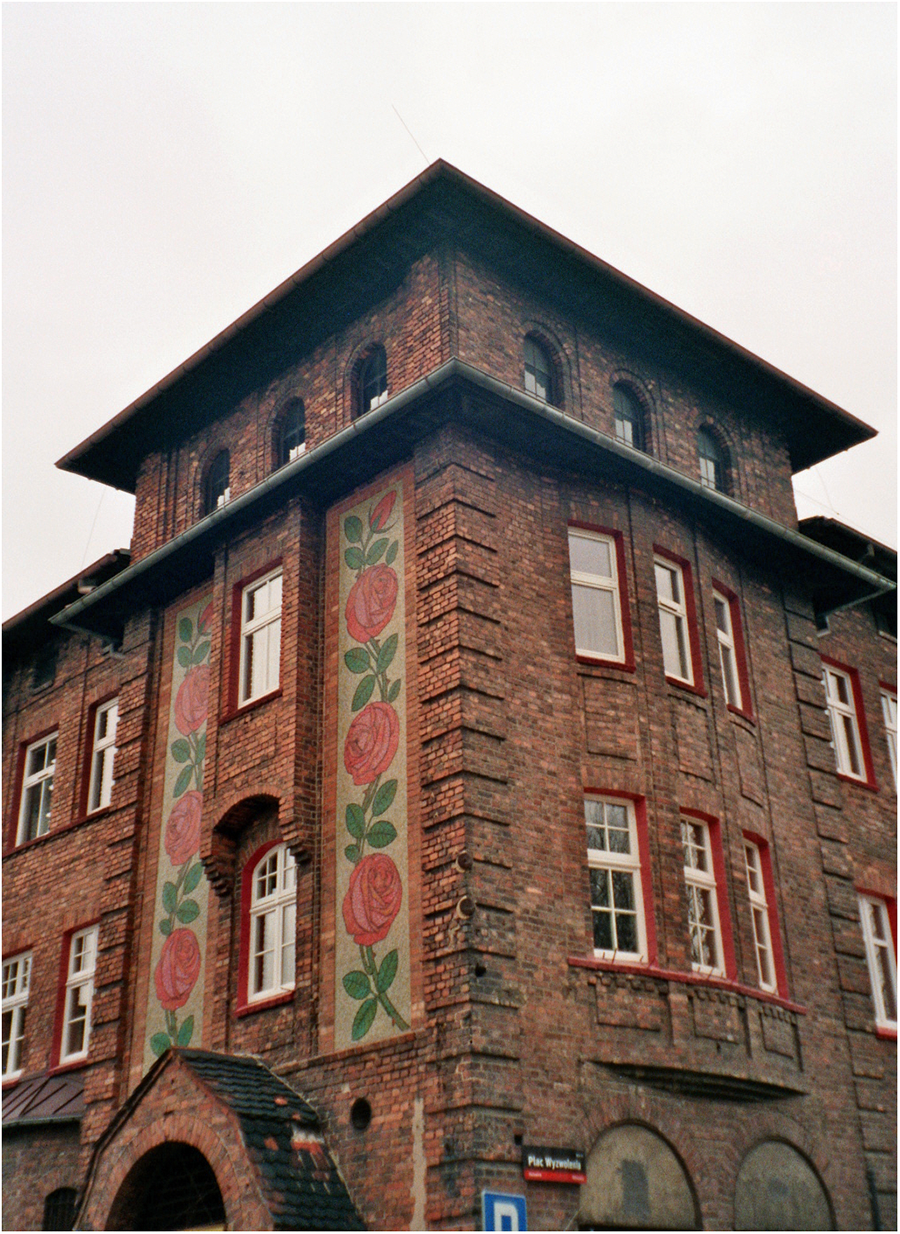
The historic ‘Nikiszowiec’ mining estate in Katowice, Poland. Photograph taken by Lechowicz.
The concern over the potential loss of Upper Silesia's distinctiveness and its autochthonous sense of community is palpable in most conversations with the study participants, extending beyond the workers of the mining industry, who are typically male. Our study also involved nine women, as well as a non-binary person, with no economic ties to the industry. While some of these participants expressed criticism of certain patriarchal attitudes reinforced by the male-dominate mining culture (e.g., S08, S10, S14, S18), they also expressed the wish to cultivate good neighbourly relations (S17), typically-Silesian communities and networks of mutual support (S13), and to celebrate the mining culture and tradition in an inclusive and non-stereotypical way (S18, S05). Monika, a council member in an Upper Silesian town with a strong mining heritage, emphasises the importance of the legacy of coal for local identity and reflects on the omnipresent anxiety over its potential erasure following the coal phase-out: Probably the most difficult thing is that people's symbolic space is being taken away. The space of values [which] should be visible in the public space, because if they are not, we feel bereft. We think about worlds imaginatively, we inhabit the world with our imagination. And then another story comes in, for example, precisely the story that mining is now a no-go because we have climate change. That's not a good story. Because, let's be honest, the world has different demands now. It had different ones then. And this lesson has been learnt. And now we are moving on to another lesson. We are ready for it (S27).
5
As a local politician, an activist, and a proud Silesian, Monika offers insights into coal that the national imaginary fails to capture – coal as a community-binding object that has shaped Upper Silesia's history and culture and stitched the social fabric together. The imaginative framework of coal through which Upper Silesians inhabit their reality, to paraphrase Monika, is a valuable resource for shaping a post-coal future. The way Monika speaks about her community reveals that coal continues to be a crucial building block of the collective in this bounded imaginary. Visions of the good life, shared by the inhabitants, stem from the historical and material reality of coal mining in the region, making coal a material basis that holds the collective together. This is why the impeding discontinuation of this foundational activity is seen by many as an existential threat to their communities.
Indeed, in the popular imagination of Upper Silesian coal communities, mines are often ascribed life-sustaining functions, which can be observed in the ways people draw links between well-organised towns, thriving neighbourhoods, and a local mine. All of the mining industry workers interviewed for this study expressed some degree of affective attachment to their local communities, with nine out of ten indicating a connection to the material surroundings, including the natural environment. In Upper Silesia, a local coal mine is often referred to as ‘a nurturer’ (pol. Żywicielka) (e.g., BiznesAlert, 2015; Krzyk, 2016; Maliszczak-Hanzel, 2022; wPolityce.pl, 2021), which points to a distinct understanding of work in the mining industry as a means to ensure collective well-being (Smith, 2019b). Jarosław, a retired miner and an active union member, emphasised the nurturing, life-supporting function of coal mines, likening them to the beating hearts of small towns that pump life into their veins, implying that closing a local mine can be fatal for the community (S09).
The metaphor of a coal mine as a nurturer has been prevalent in Upper Silesia throughout the region's mining history, appearing not only in everyday language but also in local newspapers and union bulletins (e.g., Bułakowska, 1946; Chromik, 1994; Jurkiewicz, 1962; Twaróg, 1997). The analysis of this archival material reveals that the perception of a mine as a nurturer is often associated with stable employment and the good quality of life it provides. Moreover, several participants stressed the importance of links between a local mine and multiple other industries. Marcin, an active miner in his 30 s, claimed that there are five other local jobs for each miner (S20). Apart from subcontractors and jobs in industries that provide mines with necessary tools and materials, some jobs emerge to cater to the communities that miners create – shops, services, kindergartens, schools, etc. In our conversation, Marcin rhetorically inquired about the future of people working in such employment if miners and their families move away (S20). Tapping into a similar sentiment of negative ripple effects of mine closure, Andrzej, a 65-year-old retired miner, stated: ‘when a mine closes, it is as if a well dried out’ (S21). 7 Therefore, the shared connection to coal translates to care for the community, and a local mine becomes a guarantor of local stability.
In comparing a coal mine to a nurturer, many participants speak not only of the stable employment it ensures for the region but also of strong social bonds and supportive communities co-produced with it (e.g., S05, S09, S16, S19, S21). The metaphor of a mine as a nurturer and a beating heart of Upper Silesian communities encompasses the concrete means of sustaining life in the form of stable employment, housing and good infrastructure, as well as more tender nurturing manifested in a caring sociality and networks of mutual support. Unpacking this metaphor reveals the bounded imaginary where coal and the labour of mining create material conditions necessary for the emergence of context-specific visions of the good life based on strong communities, comradery, and care. It is this distinctive socio-material context that constitutes the boundedness of the imaginary of coal in Upper Silesia. Being rooted in the material and social reality of Upper Silesia is thus the main reason behind its dissimilarity from the nationally dominant imaginary.
Miners are also bound by a shared vulnerability to workplace hazards, which cultivates a collectivist mindset expressed in their care and vigilance for one another. Tomek used the following metaphor to illustrate this: ‘mine is like a living organism […]; each division is like a cell that has its distinct functions’ 8 (S15). All of the interviewed miners confirmed that collectivism and synchrony are integral to their work (S09, S15, S19, S20, S21, S23, S24, S25, S26). Jędrzej, now retired, insisted that despite the hardships and dangers associated with underground mining, he would do it again (S23). He explained that perseverance was ultimately rewarded with the formation of the most valuable relationships: ‘friends, colleagues, on whom you could count, who would help each other’ (S23). 9 Władysław mentioned that it was essential, even for safety, to be good friends with your teammates (S24). Roman emphasised ‘workers’ unity’, explaining that it is ‘natural’ for miners to ‘defend common interests’ (S19). 10 Whereas Ryszard, a retired mine rescuer, spoke of the emotional support miners and rescuers would provide each other after mining accidents, particularly those involving fatalities. He explained that in the absence of professional psychological support during his early years as a rescuer, workers ‘[…] dealt with it […] by going for a beer after work, as a team, to meet and drink and, well, digest it somehow’ (S25). 11 While this particular coping mechanism might not be particularly healthy or effective, it attests to how the shared vulnerability fosters a distinct sense of belonging characterised by a connection to coal forged during the labour of underground mining.
Roman, an ex-miner who quit after eight years of work due to physical and mental strain, describes his relationship to coal and the labour of mining in the following way: I even have coal in my body. Despite not working in mining for years, I have bits of coal that got under my skin. And in a sense, coal as people, tradition and culture; it is important to me. I know that when they will be closing the mine […] where I used to work I will go there to look and say my goodbyes because it is a part of me. Believe me man, when you go down, you leave a part of your soul down there (S19).
12
The shared experience of coal mining and its effects on the human body indeed translates into a sense of togetherness and comradery between miners (e.g., Allen, 2022; Rolston, 2013). A few interviewees pointed out that there are certain distinctive marks by which one can recognise fellow miners on the street or in a pub. The two most typical ones are bald calves caused by high rubber boots and ‘mascara eyes’ (pol. oczy jak pomalowane maskarą) 13 – fine coal dust stuck between eye lashes (S19). When meeting one of the research participants right after his shift, the vivid ‘mascara eyes’ strikingly stood out from the rest of his masculine appearance. The miner, Jurek (S26), confirmed that despite taking a shower after every shift, coal dust consistently accumulates in the eyelashes and cannot be removed. Familiarity with this distinctive mark made it possible to identify off-duty miners throughout the remainder of the research fieldwork in Upper Silesia. Paraphrasing Rolston (2013: 586), these visual signs on the body can be interpreted as the physical manifestations of encounters with the technologies and environments of coal mining. The ‘mascara eyes’ and bald calves symbolise how the physical impacts of coal mining on the body become shared identifiers, connecting the workers and enabling them to recognise one another. In this way, the sooty materiality of coal functions as a medium of connection, facilitating entry into the community of underground miners. Here, coal functions as a transmitter of unique bonds, accessible only through a shared bodily experience. As such, the material component of the bounded imaginary – coal and its physical properties – is essential in sustaining visions of the good life based on comradery, mutual support, and a deep connection to people and the region.
The people-centred dimension of the bounded imaginary of coal in Upper Silesia thus reveals that people's relationship with the materiality of coal and the labour of mining has a crucial impact on the way they imagine the good life. The historical legacy of coal, together with its effects on the physical space and the realm of values and aspirations, intertwines with the continued impact of coal on people, both on a bodily and social level. These socio-material relationships reveal a locally bound imaginary of coal that underpins community cohesion and stability, underscoring the importance of this resource as a lifeline for local livelihoods and aspirations.
Coal and Earth
The deep connection to coal and the appreciation for its power to give and to take away was evident during the interview with Jarosław, conducted in the main building of the mine where he had worked. Recalling a tragedy which took place in the mine – a fire that took the lives of over 70 men – Jarosław shed tears. He reflected: ‘when I hold a piece of coal, I feel human effort, toil, sweat […]. I would compare it to soil – it is the wealth of our Earth, and that is why we should show it esteem’ (S09). 14 Jarosław's observation highlights the multifaceted experience of coal as both a social and a natural object, connecting a piece of coal to humans in a way that seems instinctive to him. In comparison to soil, he evokes the image of coal as a life-sustaining substance whose role in providing fuel for society must be appreciated by maintaining a healthy metabolic equilibrium in the relationships of humans and natural resources. His recognition of coal's significance for human lives translates into a broader respect for the Earth. The reference to touch suggests that this respect is transmitted through experiential knowledge of coal: it is the act of holding a piece of coal that evokes the reflections on the relation of humans and coal. For Jarosław, the bodily experience of mining renders the equation fairly simple: coal extraction demands human labour under life-threatening conditions, and coal, in turn, sustains society. Consequently, he argues that we should respect this natural resource and the planet as a whole.
Similarly, another retired miner and an active union member noted, ‘coal was, is, and will be a very important element of our coexistence on this Earth. But the one thing that scares me is the barbarity of its extraction. […] Extraction for the sake of it, no matter the cost, no matter how much, and what for’ (S23).
15
The use of strong language, particularly the term ‘barbarity’, evokes images of plunder and violent destruction, exhibiting both a form of empathy for the natural environment and a critique of unrestrained profit-driven extraction. In considering coal an important element of human life on Earth, it is implied that the excessive extraction is not only barbarous for the environment but constitutes a form of self-harm by damaging the life-sustaining balance in the relationship with nature. It seems, therefore, that from the perspective of an underground miner, the unbridled extraction attests to a lack of understanding of the care and vigilance required in the labour of mining. What scares Jędrzej is the insatiable extraction that disregards human needs, lacks the consideration of consequences, and does not know sufficiency. Such sentiments are not new and could be observed in Upper Silesia even in pre-WW2 times. For example, in a eulogy published in a workers’ newspaper in 1928, a colleague of the deceased miner reflects: And thus miners, these underground moles, these slaves of hard and poorly paid labour, know neither the day nor the hour of their life's end. A cruel death comes out of the blue, plunges down there into the bowels of our ‘nurturer Earth’ and mows it down mercilessly. This is brought about by the capitalists themselves and their recruiters, who do not care much for safety measures, but rush the worker to ever greater productivity. No wonder thus, that death so unceremoniously prowls our mines (Gazeta_Robotnicza, 1928a).
16
The notion that coal must be regarded with esteem or that its extraction constitutes a form of violence reflects a certain affective attachment to this nonhuman object. Historically, such attachments stemmed from ‘the image of the earth as a living organism and nurturing mother’, which led many mining cultures to develop traditions and rituals based on the ideas of respect and protection for the Earth (Merchant, 1980: 4). While it is generally thought that over the course of the Scientific Revolution, this imagery shifted towards one based on the domination and mastery of nature, the idea of the Earth as a nurturer has not been universally replaced but rather obscured by large-scale industrial narratives of intensive extraction for industrial and economic development (Merchant, 1980). This is indeed the case in Upper Silesia. Local newspapers and workers’ bulletins from early 1900s evoke the image of Earth-nurturer (pol. Ziemia-żywicielka) referring to coal as wealth or treasure pulled out of the Earth (e.g., Bukowiecka, 1911; Gazeta_Robotnicza, 1928b; Kuryer_Śląski, 1918; Orędownik_Śląski, 1921). In some of this archival material, we find comparisons of miners to moles, especially when drawing attention to the harsh conditions of underground mining (e.g., Benisz, 1928; Bukowiecka, 1911; Głos_Ludu_Śląskiego, 1919; Robotnik_Śląski, 1930). Under the communist regime the dominant discourse revolved around rebuilding the nation by growing the industry, and thus the notion of the Earth-nurturer was widely replaced by mine-nurturer (pol. Kopalnia żywicielka), a metaphor evoked still to this day (Goniec_Górnośląski, 1966; Knoll, 1966; Krzykawski, 2009; Luda, 2000; Posłuszny-Kończał, 1994; Ska, 2014). Yet, Tomczok (2022)'s investigation of ‘counterindustrial’ interpretations of coal reveals that literature and art produced in mining regions abounded in depictions of coal as animated matter being brutally ripped out of Earth, despite the communist regime's policies of rampant extraction.
At the same time, in the Silesian folklore, the responsibility of ensuring coal is treated with respect and that its extraction is conducted ethically is ascribed to Skarbek – an underground demon and caretaker of coal who punishes those who disrespect the mine and its resources (Tudzierz, 2019). Similar characters feature in mythologies of other cultures, for example Tío, the devil spirit of mines in Bolivia, to whom tin miners give offerings (e.g., coca or alcohol) as peace offerings or compensation for the exploitation by the mining companies (Nash, 1993; Taussig, 2010). Calls for respect for the Earth and its resources combined with local legends offer a glimpse into mining communities’ criticism of an excessive profit orientation, which exacerbates the dangers of their work. The miners’ embodied knowledge of coal, derived from their tangible experience of mining labour, translates into an imaginary of coal as an integral part of the Earth, deserving respect and careful treatment. The comparison to moles is evoked to criticise the exploitative and dehumanising nature of the underground mining labour, yet it simultaneously paints miners as part of nature and those who truly know the material they work with, and are thus equipped with the care required to navigate through the underground world of coal. In this imaginary, then, miners are seen not only as underestimated experts with access to the experiential knowledge of coal mining, but also as parts of nature responsible for curbing the greed of profit-driven extraction. As such, the bounded imaginary of coal speaks to a deference for the Earth and an ethos of sufficiency, where the community's well-being is sustained through the mindful use of natural resources.
Respect for nature and its resources can be cultivated not only through the fear of risks associated with mining but also through the awe and fascination sparked by interactions with coal. This awe-inspiring dimension of coal can be exemplified by insights from Tomek, an active miner in one of the largest mines in Upper Silesia, who occasionally finds fossils embedded within coal. The interaction with fossilised material embedded in coal prompted interesting reflections: ‘these are remnants of what coal is made of, in a way coal is a legacy of the past, an heirloom […]. Despite being several hundred metres below ground, it [nature] is still present’ (S15). 17 The fascination with the fact that coal is composed of fossilised plant matter – something that existed long before humans – leads Tomek to consider coal an heirloom, putting humans in a family-like relationship with nature. Reflecting on this kinship, Tomek also expressed awe and respect for the vast time scale required for coal to form. The fact that humans fuel their modern societies with the energy of plants from the Carboniferous period makes him experience coal extraction as a unique encounter with nature.
Among the research participants, at least two other miners have encountered fossils during their work (S20, S26). Marcin, for example, recounted with some excitement that his team once found an entire fossilised tree (S20). Jurek, on the other hand, shared that when he first began working as a miner, such discoveries sparked his fascination with the enormous fauna of the geological past. However, he admitted that this sense of wonder has diminished over time because ‘when you’re down there you have to be careful not to knock yourself over with a rod, […] or break a leg, and you don't have time to think about such sentiments’ (S26). 18 Nevertheless, reflections about the fragility and brevity of human life, in contrast with coal's strength and deep geological history, can resurface unexpectedly when danger arises. As Jurek puts it, ‘unless there's a quake or something, a tremor, well then yes, you actually realise that you're so tiny and weak that any reaction would already be too late to do anything’. 19 Here, the awe- and respect-inspiring dimensions of the coal imaginary overlap: the materiality of coal fosters a connection to its different dimensions (e.g., carboniferous fauna, a powerful and dangerous element) but also reveals how its history spans intimidatingly longer than humanity's.
Access to these multifaceted dimensions of coal resulted in a uniquely Silesian phenomenon – miners turning primitivist painters interested in the occult (Hess and Dulska, 2016). The most well-known collective of such artists is the Janowska Group, established in 1946 and mainly comprising miners who worked at the ‘Wieczorek’ mine (Wilk, 2019). Art critics and historians do not doubt that mining had a significant impact on the works of these painters: ‘[t]he specific experiences of the artists associated with mining, mainly working at great depths and the constant threat of danger, prompted in them a certain metaphysical reflection, which they expressed in their works’ (Nalepka et al., 2022: 12). 20 One such artist, Ludwik Holesz, drew inspiration from his work as a miner in the Moszczenica mine in Upper Silesia (Nalepka et al., 2022). During a promotional event for a book devoted to Ludwik Holesz's depictions of Carboniferous forests held at the Upper Silesian Museum in Bytom, a discussion ensued on the painter's knowledge of Carboniferous forests. An audience member suggested that Holesz had a solid understanding of the fauna he depicted, citing his series title ‘When Coal Was Green,’ likely inspired by a 1964 book on coal geology (Jachowiczowie, 1964). The painter's grandson confirmed that Holesz frequently borrowed geology books from the local library, suggesting his curiosity, sparked by fossils in coal, drove him to explore and deepen his fascination with Carboniferous fauna (Figure 2).
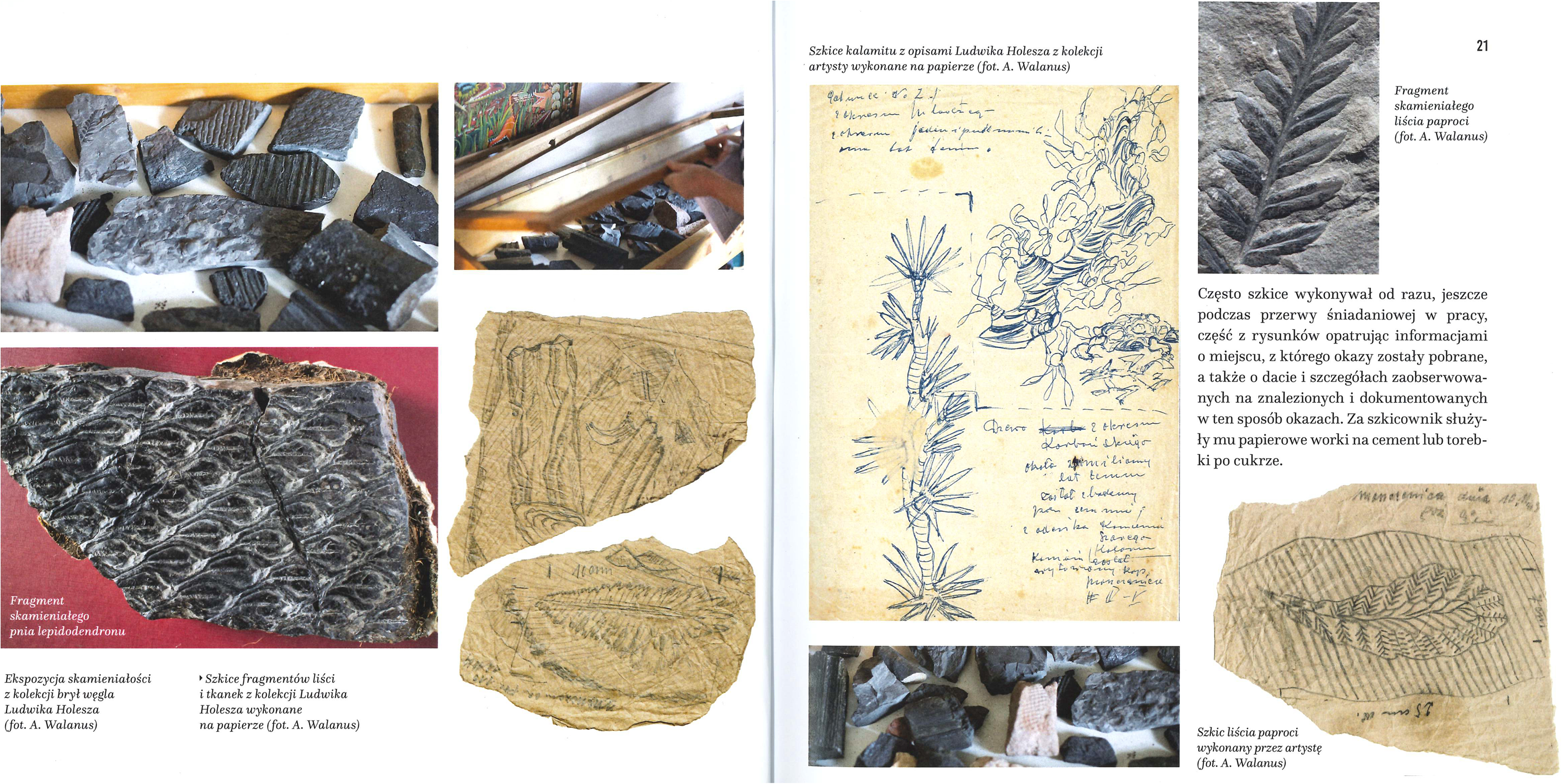
Pages from the book ‘Artistic visions of the carbon forest: the work of Ludwik Holesz’. Reproduced with permission of the Upper Silesian Museum in Bytom.
Paintings of Holesz and other primitivist painters of Upper Silesia reveal how the direct and bodily experience of coal extends its significance beyond that of a mere resource or commodity, fostering a connection to ecosystems that existed long before humans roamed the Earth. In an interview from 1972, Holesz states: ‘it is necessary to pay tribute to coal because people don't think about what went into its creation. Millions of years, thousands of cataclysms….’ (Tomczok, 2022). 21 The bygone greenness and aliveness of carboniferous fauna stand in sharp contrast to the staining soot and toxicity of combusted coal, whereas the immensity of the geological time it took for coal to form makes the speed at which it is being burned by modern societies unsettling. For these reasons, encountering fossilised nature during the labour of mining stirs both fascination and discomfort, triggering a chain reaction of reflections and consequently shaping the imaginary of coal as a reminder of carbon's crucial role in sustaining life on Earth. The phenomenon of Silesian miners turning primitivist painters can be considered yet another evidence of the bounded imaginary of coal, wherein it features as an integral part of the Earth and a transmitter of a proto-ecological consciousness.
This consciousness continues to this day, enabling some present-day miners to acknowledge the damages inflicted by mining and point to the need for collective accountability. When asked how he feels about the environmental destruction caused by mining in the form of mining damages, air pollution caused by burning of coal, and CO2 emissions’ contribution to climate change, Jarosław responded by saying that we should do our best to mitigate these negative effects without neglecting the well-being of humans. He simply stated that ‘we create symbiosis with the environment’ and ‘we should take care of it’. 22 Others cynically hinted at a meaningful mitigation being outside of ordinary people's control, by saying ‘it is all ruled by economy’ (S16), 23 ‘corporations rule the world’ (S26), 24 or sarcastically stating that the ‘extraction is holly’ (S19). 25 The experiential knowledge of coal, in the context of research on mining labour, has been evidenced to lead to criticism of dominant consumption and production models which drive the extraction (e.g., High, 2012; Paltasingh and Satapathy, 2021; Rolston, 2013). In his seminal work, Andrews (2010) shows how the geology of coal conditioned social relations, labour practices and resistance in the mining communities of Southern Colorado. Similarly, in the case of Upper Silesia, the material experience of coal fosters a bounded imaginary of coal as a living element that reminds miners of the fragility of society's relationship with natural resources, critiquing thus their excessive use and promoting a vision of good life based on sufficiency and respect for nature.
These accounts show how coal can evoke respect for the Earth, foster affective attachment to natural resources, cultivate awareness of the fragility and brevity of life, and inspire curiosity and fascination with ecosystems from the deep past. Such alternatives to the dominant imaginary of coal are accessible to those with direct and corporeal experience of the resource. Arguably, then, the meanings of coal which comprise the bounded imaginary in Upper Silesia are difficult to spot in grand narratives constructed around natural resources and their contribution to national prosperity and independence.
Conclusion
In this paper, we sought to explore the bounded imaginary of coal in Upper Silesia, shedding light on local notions of the good life woven around this resource – ones that extend beyond its utilitarian framing as merely a fuel extracted and burned to sustain national economic development and energy security. Through the analysis of ethnographic and historical material, we find that proximity to coal and the entanglement with its materialities foster a distinct imaginary with two overlapping dimensions: one where coal features as a community-binding material and a guarantor of stability and another where it functions as a transmitter of connection to the environment and respect for the fragility of the metabolic relationship with nature. The value of this research, we argue, lies not only in preventing injustice and marginalisation of local voices but also in teasing out visions of the good life, which can be mobilised in shaping energy transition pathways by revealing what matters most to energy-producing communities. Indeed, it is ‘[t]he people whose labour makes increased energy consumption possible [that] have a crucial and unique perspective on the ethical dimensions of energy transitions’ (Smith and Tidwell, 2016: 345). Identifying such local imaginaries can, therefore, prevent the deepening of the divide between the needs of local communities and national priorities.
As such, Upper Silesia's bounded imaginary of coal carries a significant potential for informing the ongoing energy transition in at least two ways. Firstly, the empirical data helps us reveal how common attachments to coal enabled a closely-knit sociality, which constitutes a valuable resource for grassroots organising and a transition based on bottom-up initiatives. Secondly, we witness how bodily knowledge of coal and mining labour engenders a form of empathy for the natural environment and a critique of unbridled extraction resulting from socioeconomic pressures. The participants of our research do not desire excessive consumption, meaningless jobs for international corporations, and erosion of social bonds due to increased individualism and economic emigration (e.g., S09, S10, S15, S23, S26, S27). We thus arrive at the meaning of the good life based on a stable and supportive community which respects the metabolic relationship between humans and natural resources by championing the ethos of sufficiency. In this imaginary, the mechanical extraction and production of a resource to fuel the nation's economic development and sustain energy security is not a priority, and instead we find instances of criticism towards excessive profit-orientation and the emphasis on meeting societal needs.
This vision of the good life – rooted in community and the respect for the fragile relationship between society and natural resources – offers guidance and direction for a just energy transition in Upper Silesia (Nowakowska et al., 2021; Stasik et al. 2020; Tarasova, 2024). Rather than acting as a source of resistance, the bounded imaginary of coal communities in the region contains impulses of transformative potential that can support locally grounded and socially equitable transition pathways. Indeed, it already resonates, at least partially, with the current trajectory of local authorities who are pursuing a shift towards decentralised energy production – largely independent of the national grid, built on a mix of renewable energy sources, and driven by both private-sector innovation and municipalities (RCAS, 2020; SRW, 2020; UMWŚ, 2025). Importantly, this shift away from the centralised energy system is not at odds with the bounded imaginaries of local coal communities. On the contrary, the strong communal bonds and the embedded ethos of sufficiency can effectively serve as cultural resources forming democratic and decentralised energy infrastructures. The rapid spread of individual prosumer installations across Upper Silesia (UMWŚ, 2025) and the emergence of cooperative energy initiatives (Gajdzik et al., 2024) demonstrate the region's capacity to build alternative, community-led energy assemblages.
Given Upper Silesia's tradition of close-knit communities and the emerging evidence of grassroots organisation, we contend that these past-and-future trends should not only be encouraged and supported but strategically cultivated. Such initiatives could prove fruitful in providing affordable electricity, increasing local energy autonomy, and contributing to global reductions in carbon dioxide emissions (Gajdzik et al., 2024). Moreover, the region's embodied understanding of the environmental consequences of extractivism can provide fertile ground for advancing the principle of energy sufficiency, offering a culturally resonant foundation for regional (and national) policies that, as exemplified by France's recent embrace of la sobriété énergétique (Bourliaguet, 2025), prioritise reduced demand and long-term sustainability. Such an approach provides a transition pathway that is not only low-carbon, but also socially just and culturally grounded.
Our findings not only inform the practical dimension of just energy transition processes occurring in Upper Silesia, but also contribute to the scholarship on bounded imaginaries (Chung et al., 2021; Mutter and Rohracher, 2022; Smith and Tidwell, 2016) by emphasising the role of materialities and drawing out the transformative potential of these locally-bound visions of coal. We find that materialities are a key component of bounded imaginaries, as they originate from physical reality and are rooted in experiential knowledge of natural resources, technology and labour. The material-rootedness is, therefore, the main characteristic that distinguishes bounded imaginaries from national ones, which can be far detached from the material reality, as seen in the case of Poland (e.g., Kuchler and Bridge, 2018).
By teasing out the locally-specific meanings of the good life in Upper Silesia, we tap into a broader turn in social science energy research towards uncovering the capacity for care and repair in the communities of carbon industry workers (Carr, 2023a; Carr, 2023b), learning from the labour of coal miners (Corwin, 2023), and ‘assembl[ing] a politics of promise which channels people's need for attachments towards ends which are compatible with stabilising climatic conditions’ (Lewis, 2024). Through our analysis, we find that attachments to coal can point to the desire for stable communities, collective responsibility, and respect for nature. At the same time, we are aware of the problematic role that nostalgia for the past can play in making coal communities receptive to conservative rhetoric, as evidenced in the United States (Mayer, 2022) but also in Upper Silesia which witnessed the rise of influence of far-right populism within the region (Allen, 2021). We want to emphasise, therefore, that in tapping into the attachments to coal, we seek not to promote the uncritical preservation of the past but to build a future on the visions of good life elicited from the entanglements with coal. Much like the decolonial strategies of ‘remembering for the future’ (Campbell et al., 2014), shaping a post-coal future in Upper Silesia should entail a justice-oriented engagement with the coal-related imaginaries of the good life – particularly those centred on local communities of mutual support and the frugal, respectful use of natural resources.
We argue that the elements of a desired social order observable in local meanings of coal and the energy-producing labour can be mobilised generatively in shaping futures without fossil fuels. We, therefore, concur with other researchers of Polish mining communities in emphasising that the close social bonds formed around coal and locally embedded visions of good society represent valuable assets for shaping a post-coal future (Dańkowska and Sadura, 2021; Sadura, 2021; Stasik et al., 2020). The deep sense of community translates into ‘a lot of potential for grassroots social organisation in the communities of the mining districts’ (Dańkowska, as citied in Jędrysik, 2021). While acknowledging that regional policies already exhibit a certain sensitivity to such local values and desires (e.g., RCAS, 2020; SRW, 2020), we see the need for continued support of local communities in translating their visions of good life into solutions that emphasise community ownership, self-sufficiency, and meaningful material provisioning for local neighbourhoods. To this end, the bounded imaginary of coal can inform the design of transformation pathways which would better reflect local contexts and align more closely with the needs and values of communities in transition.
Highlights
Upper Silesia reveals bounded coal imaginaries shaped by lived experience in mining communities
Grounded perspective on how coal-shaped visions of a good life emerge from lived, material experience
Visions of a good life are grounded in stable, supportive, and caring social environments
Ethos of sufficiency emphasising the interdependence of humans and natural resources
Coal imaginaries as potential foundations for decentralised, community-led energy futures.
Footnotes
Acknowledgments
This study was made possible through the generous grant from the Swedish Research Council/Vetenskapsrådet (Project No. 2020-05363) for the research project “Disassembling the power of high-carbon imaginaries”. We would like to thank the research participants for their kindness and hospitality in sharing their thoughts. We thank Gavin Bridge for his generous and invaluable support in sharpening the paper's arguments. We also thank the three anonymous reviewers for their valuable suggestions, constructive comments, and intellectually stimulating provocations.
Author contributions
Kosma Lechowicz: Conceptualisation, Writing – original draft, Writing – review & editing, Investigation, Formal analysis. Magdalena Kuchler: Funding acquisition, Supervision, Writing – original draft, Writing – review & editing, Project administration.
Data availability statement
Data available on request.
Declaration of conflicting interests
The authors declared no potential conflicts of interest with respect to the research, authorship, and/or publication of this article.
Ethical approval and informed consent statements
This study was approved by The Swedish Ethical Review Authority/Etikprövningsmyndigheten (decision no. 2022-07248-01-374261). All of the people interviewed as part of the research gave their informed consent to participate. Most participants gave written consent, with a few people opting for recorder verbal consent only.
Funding
The authors disclosed receipt of the following financial support for the research, authorship, and/or publication of this article: Swedish Research Council/Vetenskapsrådet (Project No. 2020-05363).

Notes
Interviews referenced
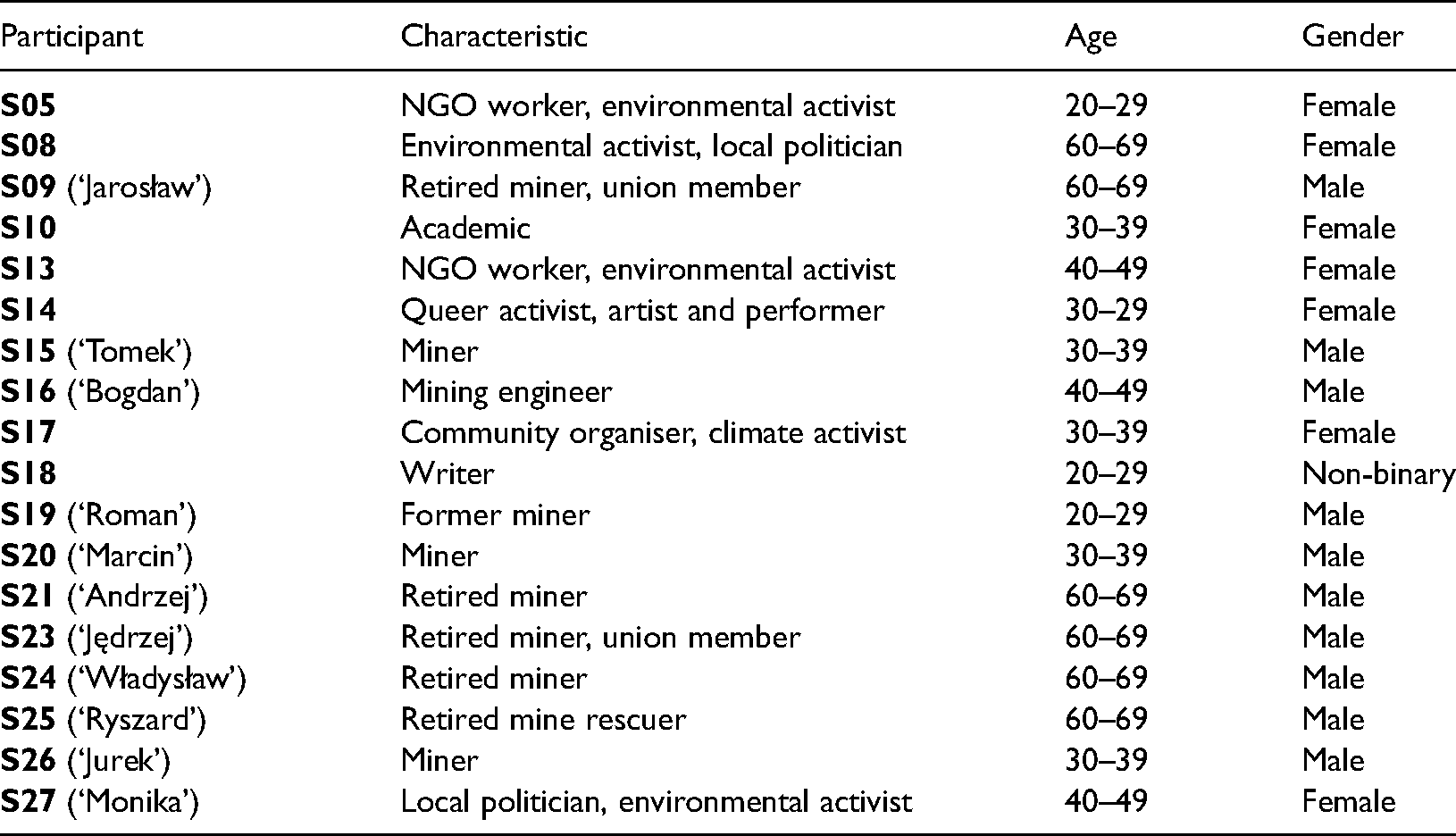
| Participant | Characteristic | Age | Gender |
|---|---|---|---|
|
|
NGO worker, environmental activist | 20–29 | Female |
|
|
Environmental activist, local politician | 60–69 | Female |
| Retired miner, union member | 60–69 | Male | |
|
|
Academic | 30–39 | Female |
|
|
NGO worker, environmental activist | 40–49 | Female |
|
|
Queer activist, artist and performer | 30–29 | Female |
| Miner | 30–39 | Male | |
| Mining engineer | 40–49 | Male | |
|
|
Community organiser, climate activist | 30–39 | Female |
|
|
Writer | 20–29 | Non-binary |
| Former miner | 20–29 | Male | |
| Miner | 30–39 | Male | |
| Retired miner | 60–69 | Male | |
| Retired miner, union member | 60–69 | Male | |
| Retired miner | 60–69 | Male | |
| Retired mine rescuer | 60–69 | Male | |
| Miner | 30–39 | Male | |
| Local politician, environmental activist | 40–49 | Female |