



Abstract
Driven by international policy agendas to restore landscapes, large-scale land-use changes are expected in rural areas, with significant implications for landscape characteristics, land-uses, livelihoods, economies and cultures. It is increasingly recognised that the long-term success of restoration initiatives requires integrating social considerations, yet uncertainties remain over the pathways for achieving this. This paper explores the basis for- and barriers to- a just and sustainable vision of the landscape through a case study of the Affric-Kintail area in the Scottish Highlands, a context in which environmental policy agendas and natural capital investments are driving rural landscape change. Drawing from multidimensional, empirical environmental justice, this paper investigates the diverse justice claims voiced by rural communities. The research highlights a spectrum of justice concerns tied to diverse, contested meanings and practices of just transitions, where we distinguish between socio-technical and transformative approaches to just transition. As a result, our case study points to fundamental structural and socio-economic barriers to realising just transformation in rural Scotland, rooted in vast inequalities in power, wealth and landownership, and a depth of justice concerns around rural landscape transformations which have so far been left aside by restoration agendas and just transition policy discourses.
Keywords
Introduction
In the net-zero climate policy landscape, considerable attention has been paid to the role of land-use change in delivering large-scale sequestration of carbon from the atmosphere as a strategy for counterbalancing emissions in other sectors (Dooley et al., 2018). Land-use change through afforestation, reduced deforestation, peatlands and wetlands recovery and more sustainable forms of agriculture (e.g., changes to livestock grazing) is now a core element of global climate change mitigation. Alongside this, there are significant international agendas which aim to recover nature and to address the biodiversity crisis, notably including the UN Decade on Ecosystem Restoration (2021–2030) and the Kunming-Montreal Global Biodiversity Framework adopted by the United Nations Convention on Biological Diversity, the latter of which has established a goal of restoring at least 30% of the world's degraded ecosystems by 2030 (CBD, 2022). Restoration plans are increasingly being drawn out at landscape scale in seeking ecological connectivity. ‘Nature positive’ actions, and nature-based solutions continue to climb up the international agenda.
Driven by these policy agendas, we can expect to see large-scale repurposing of rural landscapes, with significant implications for landscape characteristics, land-uses, livelihoods, economies and cultures (Newell, 2022), which will involve winners and losers. Without mitigation of trade-offs, the action needed to tackle the climate and ecological crises may be disproportionately borne by marginalised groups in society, while the benefits of green transitions may be captured by powerful groups (Bennett et al., 2019; Larson et al., 2021), thereby supporting and deepening existing power inequalities. It is increasingly recognised that the long-term success of restoration initiatives requires integrating social equity considerations (Löfqvist et al., 2023; Sandbrook et al., 2023). We argue that it is vital for policy-makers to understand the local justice claims forming in response to climate change and restoration plans, otherwise these will generate resistance and pose substantial barriers to the advancement of sustainability transitions (Martin et al. 2020).
While there is a diversity of approaches, goals and paradigms- e.g., rehabilitation, regeneration, rewilding- surrounding the programs and practices seeking to recover nature and ecosystems (Chazdon et al., 2016; Mutillod et al., 2024), this paper centres on landscape restoration plans, practices and initiatives given the prominence of restoration in international policy spheres and scholarship. Restoration tends to be used as an umbrella term for a range of different initiatives (Mansourian, 2018). In Scotland, rewilding has gained traction among NGOs and private landowners as a prominent landscape restoration approach (e.g., Cary and Wartmann, 2024; Deary and Warren, 2017), a context in which environmental policy agendas and net-zero climate targets are driving landscape change in rural areas. The government is supporting tree-planting, peatland restoration and deer management while also encouraging and brokering private investments in natural capital, renewable energy and carbon offsets (McIntosh, 2023). There are a growing number of ‘green’ landowners and speculative private investors, driven in part by the financial incentives from the rapidly growing carbon market. This potentially large-scale landscape change- and concurrent shifts in patterns of land control- brings opportunities but also risks for rural communities in the Scottish Highlands.
Restoration initiatives increasingly place emphasis on the role of people and communities as part of a reimagined nature-based economy, sometimes in the Scottish context linked to calls for ‘re-peopling’ (Martin et al., 2021), and to a just transition framework (Scottish government, 2023b). However, there are key questions around how landscape restoration initiatives would adequately benefit and empower communities and how to ensure responsible ‘natural capital investment’ in a context in which land ownership is both highly consolidated and closely connected to establishment interests. Moreover, rural parts of Scotland face overlapping challenges around depopulation, rising land prices, access to services, a lack of meaningful employment opportunities and a lack of political influence, concerns which must be addressed as part of a just transition. These resonate with wider challenges in rural Europe where there has been backlash to green transition policies, such as the farmers’ protests that swept across Europe in early 2024 to draw attention to the socio-economic struggles they face in the current agricultural system (Mamonova, 2024).
While an emerging area of just transitions research has focused on rural land-use change (e.g., Murphy et al., 2022; Puupponen et al., 2022), alongside some scholarly engagement with debates around multi-species justice in the context of wildlife reintroductions (e.g., Noss, 2020; Stanley et al., 2025; Thulin and Röcklinsberg, 2020), there remains overall limited exploration of the social contours of landscape restoration plans and initiatives from a justice-based perspective. Multiple cases for justice may underpin social conflicts and resistance around sustainable transformations (e.g., Jacobsen and Linnell, 2016; Mason and Milbourne, 2014) and may act as a barrier to a shared vision of sustainability. Moreover, there is a need for enhanced understanding of the forms and pathways through which just transitions could be transformative “in shifting the political economic structures that cause, sustain and deepen injustices” (Ciplet, 2022: 315).
This paper explores the basis for- and barriers to- a just and sustainable vision of the landscape. Responding to Wang and Lo's (2021) call for further empirical analysis of just transitions in practice, our paper explores landscape restoration plans and visions through a case study of the Affric-Kintail area in the Scottish Highlands. Attention is placed on examining the dilemmas and constraints of just landscape restoration, considering who will be included and how, how benefits will be shared, and how livelihoods and non-material aspects will be integrated. Given that movements from below are understood to be the most promising for realising just transformations to sustainability (Kothari et al., 2024) and that rural communities have been under-examined as key actors in the sustainability transition, we focus our analysis on unpacking the possibilities for a community-oriented vision of landscape restoration. Drawing from a multi-dimensional empirical environmental justice framework, we identify a range of key justice claims invoked by diverse actors in relation to landscape restoration in Affric-Kintail and subsequently reflect on what a just transformation of landscape might look like in the Scottish Highlands. By highlighting the importance of land-based inequalities and longer-standing injustices within rural Scottish communities, we also build on critical social science (Markantoni and Woolvin, 2015; Taylor Aiken et al., 2017) and political ecology work (Agrawal and Gibson, 1999; Cooke and Kothari, 2001) on community.
In the following section, we begin by discussing the task of integrating social goals into restoration initiatives and the current understandings of the social conflicts and barriers around pursuing equitable visions of landscape restoration. Subsequently, we turn our attention to the concept of just transition, identifying core distinctions between socio-technical and transformative approaches. This serves as our theoretical basis in this paper in analysing the nature and scope of just landscape restoration in Scotland. We then outline the case study context of the Scottish Highlands and the Affric-Kintail area, focusing on issues of landownership, land reform and emerging restoration agendas, and then detail our methodological approach, based on in-depth interviews and a series of participatory workshops. Following this, drawing from our empirical data, we examine four key strands of environmental justice, before reflecting on the implications of these for realising a just transformation of the landscape in the discussion section.
Social dimensions of landscape restoration
There are growing calls for landscape restoration initiatives to prioritise local communities (e.g., Anguelovski and Corbera, 2023; Erbaugh et al., 2020; Osborne et al., 2021), shifting away from visions of rewilded spaces devoid of people, and to incorporate social goals (e.g., Wynne-Jones et al., 2020). As part of its set of principles to guide ecological restoration, the Society for Ecological Restoration (SER), a prominent international ecological restoration network, highlight the importance of actively engaging a wide range of stakeholders, including local communities, to develop restoration plans and incorporate local ecological and land-based knowledge (Gann et al., 2019). It is understood that a more collaborative approach will improve restoration outcomes across social, economic and environmental spheres and encourage community support for projects.
There is increasingly strong evidence that inclusive and respectful restoration practices- especially those involving local leadership- are associated with improved social and environmental outcomes (Mansourian et al., 2021; Löfqvist et al., 2023; Dawson et al., 2024). Scholars propose that sustainability transitions will not be accepted or successfully achieved without addressing social justice and are likely to be contested and resisted locally if they are perceived to be unfair or illegitimate (Pascual et al., 2014; Martin et al., 2020; Newell et al., 2023). Through their large-scale systematic mapping of resistance movements, Temper et al. (2020) showed that renewable energy projects can be as conflictive as fossil fuel extraction projects.
Despite the calls for people-centred and inclusive visions of restoration, the pathways for integrating social elements into restoration agendas are highly contested and unclear (Martin et al., 2021), with profound challenges to balancing environmental and social goals. As Löfqvist et al. (2023:135) note, there remains a gap between aspirations of equitable restoration and “…the way restoration science and policy are conducted in practice”. Questions linger about who will benefit and how, how initiatives will be governed, whose voices are included in decision-making processes and to what extent communities will be empowered (Holmes et al., 2020; Wynne-Jones et al., 2018). There is a risk that talk of ‘just transitions’ and people-oriented restoration discourses act as a tokenistic response to local criticisms with little underlying substance (Martin et al., 2021).
In the European context, researchers have explored the conflicts forming in response to shifts towards restorative land practices, identifying a range of perspectives, attitudes and narratives across different stakeholders, including landowners, land managers, environmental and rewilding NGOs, practitioners and policy-makers (e.g., Deary and Warren, 2017; Holmes et al., 2020; Murphy et al., 2022; Vasile, 2018). Social conflicts around restoration are often found to be underpinned by broader values and visions of the landscape, notably with contested ideas about the role of people in the landscape, constructions of ‘wild’ landscapes (Hodgson et al., 2018; Leduc and Essen, 2019) and of ‘degraded’ landscapes (Hobbs, 2016). Case studies have shown that, in response to criticisms and contestations, restoration projects can evolve over time in negotiation with communities as implementers seek compromise based on local needs, land-uses, livelihoods, and cultures (e.g., Vasile, 2018; Wynne-Jones et al., 2018).
Power disparities between different social actors play an important role in fostering local divisions over restoration (e.g., Arts et al., 2016; Tanasescu, 2017), contributing to barriers to participation and engagement (Arts et al., 2014; Martin et al., 2023; Takacs, 2020). These participatory deficiencies restrict “whose voices are heard, whose priorities are considered” (Murphy et al., 2022: 152) in the design and implementation of restoration plans. Moreover, while policy-makers and implementers tend to focus on addressing participation or benefit-sharing concerns, other aspects which strongly contribute to local conceptions of justice may be ignored or not adequately recognised, notably the cultural values of the landscape, sense of place and local forms of knowledge (Drenthen, 2009; Murphy et al., 2022). For instance, those living in the countryside may feel strong cultural connections with pastoral landscapes, rather than wilderness, and fear the threat to these from restoration initiatives (Leduc and Von Essen, 2019).
Theorising just transformations towards landscape restoration
There is the potential for the heaviest burdens of green transitions to fall on marginalised communities, along intersectional lines of race, class, gender and across rural-urban divides, leaving concerns that ‘green sacrifice zones’ may be generated across the world (e.g., Brock et al., 2021). In response to these concerns, there is increasing attention to a ‘just transition’, calling for an inclusive, fair and carefully managed shift towards sustainability and for justice concerns to be centred in transition approaches (Morena, Kraus and Stevis, 2020; Newell and Mulvaney, 2013). While having largely focused on the energy sector (Healy and Barry, 2017; Williams and Doyon, 2019) and on urban areas (Bennett et al., 2019), just transition has broadened in scope, meaning and application over the years (Stevis et al., 2020; Wang and Lo, 2021). Emerging research has examined sustainable land-use shifts in rural areas through a just transition lens, including ecological restoration (Anguelovski and Corbera 2023; Osborne et al., 2021), and sustainable and ‘climate-smart’ agriculture (e.g., Murphy et al., 2022; Puupponen et al., 2022). With their higher dependence on natural resources and land, rural areas are exposed both to the impacts of climate change and to the policies to mitigate climate change (Borras Jr. et al., 2022; Mittenzwei et al., 2023).
Our investigation of just landscape restoration draws from an empirical and multi-dimensional approach to environmental justice (Sikor et al., 2014; Schlosberg, 2007), which can aid investigations into the unequal effects of sustainability transitions. Rather than engaging in intractable debates about universalist principles of justice, the key feature of an empirical approach is that it focuses on the justice claims that people make on the ground (Fisher et al., 2018; Sikor et al., 2014). While the approach has universalist elements- for instance respecting diverse knowledge forms- where justice claims are important beyond specific contexts, the empirical approach conceptualises justice as contested, plural and multifaceted. Research has identified the plural justice claims mobilised by different actors in relation to sustainability interventions (e.g., He and Sikor, 2015; Lecuyer et al., 2018; Martin et al., 2014.), including tensions between dominant notions of justice in policy discourses and local perceptions of justice in affected communities.
Environmental justice research has analysed justice claims across different dimensions of concern, typically relating to three interlinked forms of justice: distributive, procedural and recognition (Schlosberg, 2007). Firstly, distributive justice refers to the allocation of environmental harms and benefits, including those arising from sustainability policies and interventions. Secondly, procedural justice highlights the ability to influence and meaningfully participate in decision-making processes, entangled closely with wider power relations. Thirdly, recognition justice is about recognising and respecting the diversity of local values, knowledge and identities. This paper draws on previous empirical environmental justice work to consider justice claims in our case study as these relate to landscape transformations.
Building on the idea of environmental justice as plural and multi-dimensional, we understand that there are diverse meanings, interpretations and practices of just transitions. Ciplet and Harrison (2020) identify a number of ‘transition tensions’ where just transitions are marked by conflicts, contradictions and trade-offs across various sustainability and justice goals. Emerging empirical research has begun to identify the different understandings of justice present in just transitions (e.g., Kalt, 2021; Leino, 2024). Sustainability pathways can be more or less transformative based on their scale, scope and inclusiveness (Stevis and Felli, 2020). Drawing from political economy perspectives (e.g., Newell, 2021; Newell et al. 2023; Scoones et al., 2015), alongside recent environmental justice contributions (e.g., Rodríguez et al., 2024; Temper et al., 2018), we find it helpful to distinguish between socio-technical and transformative approaches to just transition, ranging from minimalist, narrower interpretations of just transitions to transformative solutions which identify the need to restructure political economic systems. It can be suggested that there is a depth- or spectrum- of justice concerns tied to these different approaches, as demonstrated by an iceberg model (See Figure 1) which identifies surface-level issues and more fundamental injustices which may help explain underlying social conflicts around environmental governance.
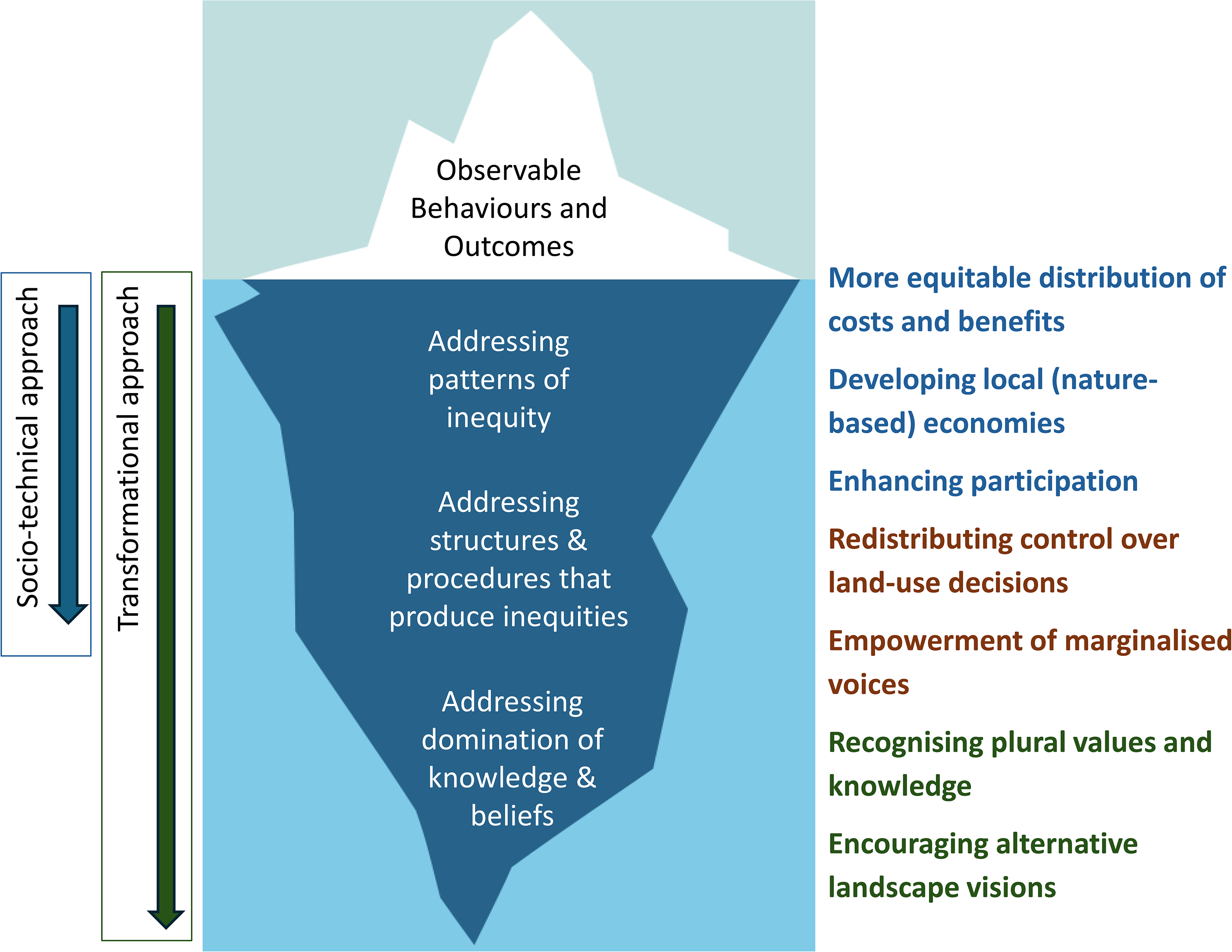
An iceberg model of just landscape restoration.
A socio-technical approach foregrounds the role of technology and the economy in providing solutions to environmental problems, generally assuming that the incentive for change can arise within prevailing socio-economic and political structures, even though this will normally involve disruption to dominant regimes of practice such as fossil fuel economies (Geels 2014; Köhler et al., 2019). Socio-technical ‘just transition’ frameworks therefore advocate fair and inclusive opportunities to benefit from institutional and technical innovations, green growth and green jobs, as viewed in many ‘Green New Deal’ proposals (Newell et al., 2023; Stevis and Felli, 2020).
By contrast, a transformative approach to just transitions emphasises the need for systemic change in achieving sustainability ambitions (Kothari et al., 2024; Martin et al., 2020; Scoones et al., 2015; Temper et al., 2018). In the most extensive and systematic review of transformative change to date, such systemic change is found to require work to address three underlying drivers of nature degradation: the concentration of power and wealth, the prioritization of short-term, material values, and disconnection of people from nature (IPBES 2024). By addressing power inequalities, transformative approaches prioritise empowerment of marginalised voices or local communities in seeking to address this root cause of both social injustice and environmental degradation (Newell et al., 2023; Rodriguez et al., 2024).
The SER promotes an embedded approach to ecological restoration incorporating aspects such as multi-stakeholder collaboration, community wellbeing and sustainable rural economies (Gann et al., 2019). Yet our analysis in this paper remains mindful of political ecologists and environmental justice scholars who argue that these goals are unlikely to be achieved without more fundamental systemic change. Osborne et al. (2021) argue that there has been a tendency for restoration initiatives to inadequately address the underlying drivers of ecological degradation and intertwined social injustices, and thus addressing symptoms rather than causes. Borras Jr. et al. (2022: 6) argue that such failure to address drivers of injustices will lead to increasing social polarisation, legitimising and reinforcing the “dominant visions of the powerful”.
Political economy approaches to just transition (e.g., Newell, 2021; Newell and Mulvaney, 2013; Swilling et al., 2016; Wang and Lo, 2022) have highlighted the uneven outcomes and (in)justices of sustainability transitions, where climate-driven landscape transitions in rural areas are closely entwined with existing social relations, multiscalar power dynamics and unequal access to land (Borras and Franco, 2018; Newell, 2022). A green transition taking place within existing social and economic frameworks may replicate injustices and exacerbate inequalities (Newell and Mulvaney, 2013). In particular, research has highlighted how fair transitions to sustainability are complicated and impeded by dominant neoliberal forms of environmental governance (Ciplet and Roberts, 2017), including carbon markets and persistent ‘green grabbing’ taking place across the world (Fairhead et al., 2012; Franco and Borras, 2019; Klingler et al., 2024). IPBES (2024) has put forward that transformation requires addressing the twinned accumulation of wealth and power, fundamental to the political economy of just transitions.
Distinct from a narrow focus on workers from particular industrial sectors, a transformative approach to just transitions would widen the scope of affected actors, including marginalised groups and others which may lose out from a green transition (Stevis and Felli, 2020). With restoration interventions, local communities are central to considerations of just transitions, where senses of (in)justice around sustainability transitions are importantly tied to place attachments and connections to landscape (Della Bosca and Gillespie, 2018; Devine-Wright and Batel, 2017; Murphy et al., 2022). For its part, environmental justice scholarship has long focused on the impacts of environmental problems and interventions on Indigenous Peoples and local communities, with particular respect to marginalised groups.
However, communities are not monoliths. A body of critical social science literature (Markantoni and Woolvin, 2015; Taylor Aiken et al., 2017; Walker, 2011), alongside political ecology scholarship (Agrawal and Gibson, 1999; Cooke and Kothari, 2001) have demonstrated the heterogeneity of perspectives, interests, values and capacities within communities engaging with sustainability efforts. An orientation to community scale in landscape restoration is not necessarily aligned with a just and sustainable solution. Due to local power imbalances, the benefits of sustainability initiatives may be captured by certain sections of communities at the expenses of others (Fox and Cundill, 2018). There is a need for more fine-grained environmental justice analysis of sustainability transitions that differentiates across social categories such as gender, age, ethnicity and wealth (e.g., Cha et al., 2021) and that is situated in place-based contexts. A transformative approach to just transition must not only confront the unequal power relations between communities and wider actors, but also the power disparities existing within communities.
A transformative approach to just transitions is also distinguished by a more holistic framing of environmental justice. Whilst socio-technical approaches typically advocate for more equitable distribution of costs and benefits and more meaningful participation of stakeholders, a transformative vision draws attention to the interlinked multi-dimensional and intersectional injustices of green transitions, including the societal structures that produce unequal outcomes for different social groups (e.g., Bennett et al., 2019; Martin et al., 2020; Rodriguez et al., 2024). Multi-dimensional justice frameworks tend to incorporate distributive, procedural and recognition aspects (see Schlosberg 2007). A more transformative approach to just transitions would investigate the underlying drivers of these forms of injustice while also being open to including other forms of justice in particular contexts, e.g., restorative justice, multi-species justice.
Land contexts in the Scottish highlands
It is estimated that around half of Scotland's private rural land is owned by 433 landowners, one of the most unequal patterns of landownership in Europe and one which is becoming increasingly concentrated (Wightman, 2024a). This land inequality can be traced back to the Highland clearances, a period in the 18th and 19th centuries during which common lands were enclosed and tenant farmers were forcibly evicted from their land, leading to significant depopulation in the region (Toogood, 2003). Displacing smallholder farming and communal land-use, large-scale sheep and cattle farms dominated the region during this period which were later converted largely to ‘sporting estates’ (Dolton-Thornton, 2021). Since Victorian times, large private estates have centred around recreational deer and grouse hunting, fishing and other leisure pursuits. Such estates are associated with ecologically denuded landscapes- typically species-poor moorlands- and few trees (Lorimer, 2000). Despite some forest recovery since 1945, Scotland also has one of the lowest forest cover rates in Europe (Burton et al., 2018). Since the 1970s, there has been a shift in forest governance from state to private and non-profit actors (Sharma et al., 2023b), including growing corporate investment into Scottish rural land (McMorran et al., 2022) and conservation NGOs which own approximately 2.5% of rural land in Scotland (Glass et al., 2019).
A land reform agenda has developed in Scotland since the foundation of the Parliament in 1999, significantly shaping the policy context in which restoration activities take place (Glenn et al., 2019; Martin et al., 2023). The 2003 land Reform (Scotland) Act enshrined a community ‘right-to-buy’ model, where local communities have right of first refusal if a piece of land is put up for sale and if community interest has been registered in the land or buildings. Further legislative developments have followed in recent years, notably the Community Empowerment (Scotland) Act 2015 which aims to provide a framework for strengthening community participation in decision-making and the Land Reform (Scotland) Act 2016 which gives communities the power to purchase land for sustainable development, and established the Scottish Land Commission, an advisory body. Community woodland has also been supported in Scotland since the 1990s (Logan et al., 2021), with around 200 community woodland groups existing today in Scotland (Community Woodlands Association, 2025). These include both community-owned woodlands and woodlands managed by communities through lease or partnership arrangements with public or private landowners (Ambrose-Oji et al., 2015).
There are growing aspirations in the Scottish government to employ increased accountability and transparency in land-use governance and to regulate the land market to ensure public benefit (McIntosh, 2023). The Scottish Land Commission (SLC) has focused its efforts on promoting and informing responsible land-use governance and types of natural capital investment, in seeking to enhance community benefits and influence, and to provide a foundation for sustainability, for instance its Responsible Natural Capital and Carbon Management Protocol (Scottish Land Commission, 2023) and a toolkit for guiding community benefits from natural capital investment (Scottish Land Commission, 2025). This is partly a pragmatic approach, considering changes to land governance as a more feasible route to land reform than calls for radical land redistribution.
Landscape restoration agendas in Scotland
Restoration and nature recovery form part of the Scottish Government's strategy for delivering net-zero greenhouse gas emissions by 2045, including commitments to “plant 18,000 hectares of new woodland each year by 2024”, “to restore at least 250,000 hectares of peatland by 2030” (Scottish Government, 2018) and to reduce carbon emissions by 31% in the agricultural sector by 2032 (Scottish Government, 2023b). Moreover, Scotland's ‘post-2020 biodiversity strategy’ aims to extend protected areas in the country to at least 30% of the land area by 2030 (Scottish Government, 2020a). With high densities of deer severely limiting tree growth, restoration plans in Scotland typically involve stricter deer controls. Indeed, there are recommendations from the Scottish government's deer management working group to reduce the density of deer populations to below 10 per square kilometre (Scottish Government, 2020b).
There is a long history of financial investment shaping Scottish landscapes. Most notably, the Forestry Commission, the state forestry body established in 1919, historically acquired land for commercial timber production, resulting in widely adopted monocultural conifer plantations still found today (Sharma et al., 2023b). From the post-war period, the Forestry Commission also provided financial incentives to private landowners for woodland planting, notably through tax breaks and grant schemes. This process had accelerated by the 1980s, encouraging the establishment of new forest plantations on cheap, remote lands and resulting in damage to fragile ecosystems and in planting on deep peatlands (Oosthoek, 2013). More widely, the drainage of peatlands in the Scottish Highlands was driven by public subsidies in the post-war period in order to make further land available for agriculture (Helmcke et al., 2025). From the 1990s onwards, driven in part by the growth of community woodland movements, the Forestry Commission underwent a policy shift, directing increasing efforts towards the restoration and expansion of native woodlands (Oosthoek, 2013).
In recent years, investment in the Scottish landscape has been shaped by green finance where the Scottish government provide financial incentives for woodland expansion (e.g., the Woodland Grant Scheme) and peatland restoration, while also actively encouraging and leveraging private investment in natural capital (NatureScot, 2023). A wave of recent land purchases has been driven by anticipated returns from a rapidly growing carbon market and from natural capital investments in Scotland (Robbie and Jokubauskaite 2022; Wightman, 2024b). As a result, land values have risen significantly, with the Scottish Land Commission estimating a rise in the value of ‘tree-plantable’ land by 54% between 2021 and 2022 (McMorran et al., 2022). However, the number of sales of forest and woodland landholdings, especially of larger landholdings, slowed down in 2023, with claims of a possible peak in forestry land values (Wheatley et al., 2024). Restoration initiatives in Scotland are marked by their diversity of ownership, governance and motivations, reflecting that these have been driven by individuals and organisations rather than a formal policy framework (Brown et al., 2011; Deary and Warren, 2017; Martin et al., 2023).
Restoration agendas in Scotland are increasingly being linked to opportunities for community revitalisation and re-peopling, investment in green jobs and the development of a future rural economy drawing from nature-based skills and enterprises (Martin et al., 2021), alongside a range of policy initiatives centred on community empowerment (Martin et al., 2023). The Scottish government's just transition commission seeks to create a “fairer, greener future for all” (Scottish Government 2021). The government's just transition plans for land-use and agriculture are in the developmental stage, aiming to balance various demands on land-use, relating to restoration, climate change, biodiversity, energy generation and food security among others (Scottish Government, 2023a.).
Affric-Kintail case study
We use ‘Affric-Kintail’, to describe a loosely-defined geographical area surrounding the ‘Affric-Kintail way’, stretching from Drumnadrochit in the East to Kintail and the West coast of Scotland. It also corresponds with the indicative area used by Trees for Life, a Scottish environmental NGO, for its ‘Affric Highlands’ landscape restoration initiative. This case study site was selected due to the relatively novel landscape-level approach adopted by the initiative. While estate-level restoration has been well studied, the ambitions to create an integrated approach across scale through a large cluster of landowners, managers and users is relatively novel and under-explored, particularly through a justice lens. The Affric Highlands initiative is a reasonably high-profile project, yet it has not yet been well studied from a social science perspective. This is of particular interest given that Trees for Life has demonstrated intentions as an environmental organisation to integrate social elements into its plans, for instance commitments to community carbon funds (Rewilding Britain, 2024). Moreover, it can be suggested that the Affric-Kintail case is indicative of landscape-level factors across other parts of the Scottish Highlands where there are some initial but not yet mature debates about the social dimensions of restoration.
The Affric-Kintail region is sparsely populated, with 11,670 inhabitants in the indicative ‘Aird and Loch Ness’ area as of 2021 (Scotland's Census, 2022), and overwhelmingly in small towns and villages. The population has steadily increased since 2001, although the average population density remains significantly lower than the Highlands and Scotland average. While there has been out-migration from rural Scotland since the 1950s (Martin et al., 2021), a high proportion of the incoming population to the Highlands in recent years are over 65 (Scotland's Census, 2022). This reflects changing demographics observed in our field site, with many younger people leaving the area in search of employment opportunities.
Covering around 195,000 hectares of land, the area is comprised of around 50 estates, 7 of which cover half of the land area (Trees for Life, 2020). Most of the land in the area is heathland or moorland, reflecting the dominance of large private sporting estates. The area contains or is adjacent to a number of estates owned and managed by environmental organisations (e.g., Trees for Life, RSPB, National Trust for Scotland, Highlands Rewilding), including conservation sites, and private ‘green’ landowners (Trees for Life, 2020). There are significant areas of woodlands, primarily conifer plantations to serve the forestry sector, but also increasingly native, broadleaved woodlands . The area also includes some smallholder farms (mainly cattle or mixed farms), although these have been declining in number (Trees for Life, 2020).
Methods
Research involved extended interaction with a relatively small (n = 30) but diverse group of local stakeholders as part of a longitudinal and co-produced process. This group was initially engaged through exploratory interviews and subsequently participated in a series of deliberative workshops and contributed to the co-production of guidelines for ‘Socially Just Landscape Restoration in the Scottish Highlands’. This group of participants was purposively selected with the intention to represent a range of key stakeholders, including deerstalkers, estate owners, forest managers, environmental NGOs, local action groups and community organisations, and local residents. Participants were initially recruited through preliminary stakeholder mapping of key organisations, landholdings and land users in the Affric-Kintail area. This was then supplemented by recruitment of participants identified through snowball sampling.
Despite our aims to be inclusive, there were nevertheless certain stakeholder groups which were less well represented in our research, notably estate owners engaging in conventional land-use practices and those who are less open to discussions around landscape transformations. Reflecting the demographics of the area, there were other biases in participant selection, including a relatively small number of young people and a higher number of older people and retirees, particularly those from community-based organisations, e.g., community councils. We acknowledge that these sampling biases may have influenced the views and themes identified in our analysis, yet we contextualise our findings within Scotland's land, political and economic debates and in relation to wider ideas around just transitions.
As a first step, in-depth, semi-structured interviews (n = 30) were undertaken. During interviews, participants were asked about their perceptions of previous and expected land-use changes in the area, considering activities including tree-planting, peatland restoration, deer management and natural capital investments, and of ways in which ecological restoration initiatives could be made to work for local communities. This data was supplemented by a small number of interviews with representatives from relevant Scottish public bodies.
Building from the interviews, deliberative workshops were carried out in order to co-develop local visions of the Affric-Kintail landscape. These took place across three meetings in the local area. The workshop group was comprised of participants who had taken part in interviews, alongside several residents who engaged through an open invitation via community councils and social media channels. The aim was to co-develop elements of a shared vision for a just and sustainable future for the landscape. In the first workshops, we employed a Participatory Systems Mapping method (CECAN, 2020), in which stakeholders develop a causal map exploring direct and underlying drivers that constitute challenges to addressing the focal problem of just landscape restoration. For follow-on workshops, we shifted towards envisioning solutions, using a ‘World Café’ format to identify pathways forward for a desired future based on aligning restoration of nature with revival of community, including components relating to community influence on land-use changes, livelihoods opportunities and community benefits from natural capital investments.
Following transcription, the data from the interviews and workshops was analysed through an inductive, grounded process based on identifying and examining justice claims around landscape restoration and land-use change. We were initially guided by the empirical environmental justice framework (Sikor et al., 2014) in identifying what constitutes justice-oriented statements, focusing on claims about different dimensions of justice (e.g., distribution, participation, recognition). Based on this, an open coding of justice-oriented claims and narratives in the data was employed. Subsequently, these were then clustered through categorisation of higher-level justice themes, which are as follows: distribution of land; distribution of benefits from land; community influence on land-use; and recognition of knowledge/identities. In the following section, we discuss the contours of each of these justice claims in turn, each of which can be considered as key elements of just landscape transformation in the Scottish Highlands.
Findings
Distribution of land
The findings highlighted a spectrum of views on the importance of addressing land inequalities as a precondition for just restoration in the Scottish Highlands. Significant debate in our research centres on whether radical shifts in structures of land ownership are needed to realise a just and sustainable transformation of the landscape. While some emphasise the need for a more equitable land system and the increased rollout of community-owned/managed woodlands as part of restoration initiatives, others perceive substantial land reform to be either undesirable or unworkable.
At one end of the spectrum, it is argued that land reform is fundamental for not only pursuing social justice goals but also for effective ecological regeneration in the Scottish Highlands. This perspective foregrounds the role of the deer estates in degrading the environment over the last two centuries and in limiting tree growth in the landscape today. Some of the respondents believe justice would require strong land reform as historical redress for the Clearances, whilst a larger proportion seek more incremental and targeted reform to prevent a small number of large-scale private landowners capturing the financial rewards of restoration practices, carbon markets and rapid land value appreciation. There is also criticism of the rising numbers of ‘green’ landowners which, although land-uses may change, represent a reproduction of existing land inequalities and power structures in rural Scotland. Indeed, one respondent commented that with the historical concentration of power and land around sheep and then deer estates, “…we need to ensure that carbon does not serve to bake in that model once again”. Land reform advocates support increased community ownership of woodlands and one participant remarked that, “carbon sequestration or afforestation or tree planting could happen on small land parcels, it doesn't have to happen in a centralised way”.
At the other end of the spectrum, large landowners in our study insist that land reform is not required in the pursuit of ecological restoration in the Scottish Highlands. Drawing from a pragmatic rationale based on their knowledge of the land, some sporting estates propose that they are well-placed to effectively lead the sustainable transition of the landscape, including managing the co-existence of deer stalking alongside restoration activities. Indeed, one landowner posed the question, “if trees get planted, does it ultimately matter about the system of land ownership?” Additionally, through their economic operations (e.g., tourism), it is claimed that they provide a range of benefits for surrounding communities (e.g., local employment, service provision). These landowners tend to identify finance, rather than ownership, as the main obstacle to restoration.
Some landowners highlighted that, alongside grants (e.g., for woodland creation), carbon financing has the potential to be a ‘game-changer’ in making forest regeneration on their land more financially viable. A number of landowners in our study engage in profitable eco-tourism operations and nature-based businesses. In such a way, financial drivers of restoration and carbon sequestration activities allow opportunities for landowners to both diversify income sources and to proactively respond to land reform debates through re-assertions of green credentials and stewardship claims. Those advocating land reform note that in a system controlled by large landowners and that does not tackle the concentration of wealth and power, a long-term sustainability transition is fragile because of potential changes in landowner and shifting priorities. For instance, one local smallholder enquired, “what happens when the grant money dries up?”.
The majority of stakeholders, including those in the restoration NGO and policy space, are more ambivalent on the role of land reform in landscape restoration. While they recognise power inequalities in the Scottish Highlands, tackling these is not seen as a prerequisite for effective restoration strategies; what is important is how the land is managed, not by whom. This is largely a question of feasibility where significant advances in land reform are viewed as unrealistic in the current political context. This reflects the current tendency in the Scottish government, but also among many environmental organisations, towards seeking compromise with large landowners.
While also encouraging a more diverse pattern of landownership and increased opportunities for community ownership and management of land, the Scottish Land Commission (SLC) is focusing efforts on developing proposals for increasing controls over the procedures and conditions of land governance. As outlined in the SLC's ‘Land Rights and Responsibilities’ protocols (Scottish Land Commission, n.d.) and supported by interviews with SLC representatives, the primary focus of the organisation is on supporting landowners to adopt responsible land management practices, to contribute to a wide range of public benefits and to enhance the transparency of land ownership and of land use. It is being proposed by the SLC that social responsibility and good stewardship principles should be embedded into land management plans.
Alongside regulatory approaches to land-use governance, there are voluntary, partnership-oriented approaches involving state and NGO-led efforts to involve landowners in restoration by framing it as an opportunity rather than a threat. There are also questions of scale where those in the restoration NGO and policy space do not view community woodlands as being the most effective way of achieving restoration at scale, considering the limited capacities of community groups. Given the scale of change needed, importance is placed on encouraging (persuading) and financially incentivising ‘enlightened’ landowners to adapt land practices, rather than alienating them; as one local smallholder argued, “if the economics are with rewilding, they [large landowners] will go with that”. Indeed, if large landowners can be persuaded to turn towards a green agenda, some recognise a significant opportunity to deliver landscape-scale restoration due to the highly concentrated patterns of landownership in Scotland. Thus, this strategy seeks to enact landscape change by working within existing power structures.
Distribution of benefits from land
The majority of stakeholders broadly agreed on the need to connect restoration initiatives with community needs, yet the scope and specific contours of local-level benefits remain unclear. There is potential for premium prices in the carbon market to finance community funds, an idea which is gaining prominence among governmental bodies and environmental organisations. However, concerns were raised that where community benefits from carbon or restoration programs are narrowly defined in financial terms, other locally important factors are ignored or not adequately addressed. There were calls by diverse actors for restoration programs to better incorporate a wider sense of what communities value, which was suggested could include protecting and enhancing land access, local amenities, landscape aesthetics and community wellbeing and solidarity.
Community benefit packages from restoration were often interpreted in relation to the community levies established for wind farms in the area over the last two decades. These have been used for a range of local small-scale community improvements (e.g., community facilities, maintenance of green spaces, affordable housing developments) which address gaps left by the Highland Council in a context of public funding cuts, yet community groups highlighted their limited capacities to effectively manage and disburse these funds locally. Moreover, there are geographical inequalities where some Highlands communities have received substantial funds while others have received little or none. Many community members commented that they did not wish to see this unfair funding system replicated with landscape restoration programs.
Concerns were raised by some community members that community funds could function as compensatory measures in an attempt to gain local consent, meaning that developments or projects are accepted regardless of their social costs, e.g., for access, amenities or well-being. In relation to the impacts of windfarms, one community council respondent reflected that, “…it depends from one place to the next. In one location, it’d be a kiss to death. In another, it’d be less of a problem. There has to be a graduation.” It was noted that other renewable energy infrastructure equally impacted upon rural landscape aesthetics. In particular, electricity pylons and substations connected to the wind turbines impact on this landscape, with an overhead transmission connection and new substation sites planned between Spittal and Beauly, plans which form part of the Scottish Government's net-zero energy drive (SSEN, 2025) Thus, there were suggestions by local communities that planning processes for incoming projects- of whatever kind- should include a more comprehensive and place-sensitive benefit-cost analysis which would assess the local appropriateness of an intervention in particular locations and take into account factors such as community wellbeing.
While there is significant potential for growth of nature-based businesses, notably through ‘added-value’ production and eco-tourism opportunities, some community members expressed caution over the risk of these developments further straining local infrastructure (e.g., traffic congestion) where local services become increasingly oriented towards the demands of visitors. The growth of holiday lets and second homes in some Scottish rural communities has led to a sense of community decline, leading to out-migration from the area, particularly of young people. Despite the ‘right to roam’ policy in Scotland, fears were also voiced over the potential for nature-based business developments to restrict land access in practice at certain sites.
A range of stakeholders called for embedding of community benefits relating to restoration initiatives and nature-based businesses within a wider set of rural development plans which respond to multifaceted social pressures in rural Scotland, relating to affordable housing, employment opportunities, depopulation and service access. In particular, it was understood by local people that there is a lack of meaningful employment across Affric-Kintail communities, resulting in young people leaving the area in search of job opportunities which meet their expectations. Thus, a priority of restoration initiatives should be to deliver better paid, more secure and locally-embedded employment opportunities.
Community influence on land-use
Many community members indicated that there are limited opportunities for direct, timely and meaningful input into decisions about restoration initiatives and policies. Community engagement efforts tend to emerge through a limited range of local consultation events which lack clarity about how community inputs will feed into the design or implementation of the projects. This is linked to timing and perceptions that community consultations have been undertaken by environmental NGOs and private landowners at a stage when the fundamental decisions on the direction of the initiatives have already been determined. As a result, there was an understanding that the forms of community engagement being carried out are tokenistic and not particularly meaningful, subsequently discouraging participation in future consultation events.
Moreover, the findings indicated inadequate engagement by organisations with the breadth of community views on landscape restoration. Notably, some local community members felt that dissenting or critical voices in consultation spaces on restoration projects were not adequately engaged with and that there were limited opportunities to challenge more powerful stakeholders. The inclusivity of community engagement also interacts with local inequalities, as expressed by one local resident: “People who can participate in these discussions are affluent. They can drive to places, they have jobs. Underprivileged people can’t access these schemes…”. Indeed, there are often material barriers to equality of participation in meetings on local developments, reflecting an interaction between procedural injustice and other inequalities.
While smallholders and non-landed residents feel disconnected from what democratic and participatory processes exist on land-use, a relatively small number of large landowners retain significant control over the process of ecological restoration and over the decisions being made on the land. Land-use decisions in the Highlands continue to be primarily determined by the varying attitudes, interests and values of large landowners. With exceptions, there are few concrete, formalised or obligatory measures to engage and involve communities in landscape restoration initiatives. Much of what is done in terms of consultation around restoration remains at the discretion of those controlling land use, although it is worth noting that formalising requirements for landowners to engage with communities is an ongoing area of work for the Scottish Land Commission. Community councils have limited powers to input into land-based decision-making processes, notably without the power to veto decisions made on land-use at higher levels of government (e.g., Highland Council). As a result, the majority of local people who do not control large areas of land evoke a sense of political disempowerment in making their voices heard on land-use changes, with limited avenues for democratic representation.
An alternative pathway through which some communities have sought greater levels of empowerment on land management is through community woodlands. These offer potential in terms of greater decision-making powers and benefits for communities, yet community woodland groups identified several barriers to the long-term sustainability and wider roll-out of these in the Scottish Highlands. In particular, there are financial barriers for communities seeking to purchase woodlands, exacerbated by the rising cost of land. Management and upkeep of community woodlands are constrained by the reliance on a network of volunteers. Further barriers comprise the administrative burdens associated with applications (“so many hoops”) and the lack of technical knowledge held by some communities (e.g., relating to carbon sequestration), and the interest of natural capital financiers in working at scales (to reduce transaction costs) that are simply unrealistic for community operators.
Recognition of knowledge and identities
Whilst prevailing attempts to make transitions ‘just’ tend to focus on financial distribution and community consultation events, these may be inadequate with respect to justice claims bound up closely with people's deeply-held values, principles and identities. Local people's relations to the landscape are often closely connected to their livelihoods, sense of place and heritage, notably incorporating deer stalking, farming, forestry and crofting activities. The legacies of the Highland clearances, with disconnections from land that have never been healed, feed into mistrust of incoming restoration projects and their motivations, amid fears of renewed depopulation, loss of community and restricted land access. Ongoing land inequalities result in many local residents continuing to feel detached from the land and the potential it may hold for local benefits. Subsequently, some people view re-peopling of the land as integral to socially-embedded restoration plans in seeking to revive close connections to the land, while also aiming to reverse the flows of youth depopulation from the area. Rejecting the wildness of the Highlands landscape “romanticised by Victorian filters”, one community woodland member highlighted that “…prior to the clearances, many, many people lived on the highlands landscape, employed in lots of different ways interacting with the land.”
A common criticism of restoration initiatives and policies is that they fail to adequately integrate local experiential knowledge into their visions, plans and policies. There are particular disputes over land-use and ecological knowledge, often revolving around the scope and extent of deer management and tree-planting. Notably, deer estates and communities (e.g., game-keepers) in the area view themselves as ‘stewards’ of the land and as having tended the land sustainably for generations. Some voiced fears over the threats to traditions and cultural identities that they felt was posed by a transition to lower deer populations, particularly gamekeepers’ emotional connections to the deer, but also a sense of place built on the particular, rugged aesthetic of (largely) treeless landscapes. One landowner asserted that “a hill is a precious environment- it should not be seen as a carbon dump”.
Sporting estates consider that their contributions to sustainable land management have been under-valued by the state and environmental organisations and misrepresented as ecologically damaging. They evoke a way of caring for the land which contrasts with the discourses of environmental organisations or policy-makers that they suggest lack an experiential basis or respect for tradition. For instance, governmental targets on deer number reductions per hectare are considered to be arbitrary and divorced of their socio-ecological, place-based contexts. One landowner commented that unlike the way that the term is deployed by NGOs, they engage in “true rewilding”, more grounded in local ecological knowledge. Such claims are strongly contested, with several local community members protesting that landowners are deploying these claims to be defenders of local tradition and heritage, as cynical strategies to assert their moral legitimacy to maintain control of land and to pre-empt being ‘told what to do’ by government. Even if large estate owners are acting to maintain traditions, there is an objection that these are not the peoples’ traditions but nineteenth-century sporting estate traditions that were a product of the clearances.
Environmental organisations and community woodland groups, as well as more recent arrivals to the area including retired citizens and commuters, tend to be more in favour of a landscape restoration agenda, responding to the urgency of addressing biodiversity and climate change crises. They draw from a scientific knowledge base in highlighting the ecological importance of replanting native woodlands, of peatland recovery, and of lower deer numbers in the Scottish Highlands. These priorities are sometimes driven by an ethical imperative to restore native forests that have been destroyed, notably the ancient Caledonian forest, to reintroduce lost species and to leave the land in a better way than they found it. Yet knowledge claims were also made by actors with more longstanding connections to the place. Notably, two small-scale farmers argued that regenerative farming is inadequately recognised, including acknowledging the soil restoration benefits of extensive livestock farming practices, compared to other environmental initiatives in the landscape.
There are some clear and fundamental local conflicts over who holds legitimate claims to landscape knowledge and identity. However, it is also important to note that external representations of these local divisions were strongly rejected. Conflicts are said to be exacerbated by the media which often misrepresents social disputes around land use, in ways that polarise debates over issues such as deer management. Different stakeholders feel that they are labelled according to caricatures of their views on restoration and that their actual views are more nuanced. One environmentalist commented that, “there's an assumption that because I’m all about restoration, I’d want to kill all the deer. But it's not like that…Categories are problematic.” The importance of people being able to speak for themselves- rather than others speaking on their behalf- was indicated to be key in mitigating conflicts and avoiding misrepresentations of different social groups and their positions on landscape restoration.
Discussion: What is just restoration in the Affric-Kintail landscape?
Through our analysis, we have drawn from an empirical and multi-dimensional environmental justice framework (Sikor et al., 2014; Schlosberg, 2007) to investigate ideas of justice in landscape transitions. In Scotland, restoration initiatives and policies increasingly put people at their centre and aim to address the social aspects of landscape restoration (Martin et al., 2023), including through just transition frameworks. However, if social justice is to be central to the practice of landscape restoration (Anguelovski and Corbera, 2023; Osborne et al., 2021; Stanley et al., 2025), it is important to address the range of justice concerns that local people voice, underlying different landscape visions and land-use conflicts.
We suggest that there is a spectrum of justice concerns tied to diverse, contested meanings and practices of just transitions (Ciplet and Harrison, 2020; Stevis and Felli, 2020). These vary in the extent to which they are transformative, ranging from addressing surface-level issues towards confronting fundamental socio-economic injustices and structural barriers. There is a relatively strong just transitions policy discourse in Scotland- including tying land-use transitions to justice principles (Scottish Government, 2023a)- based on calls to integrate social agendas around green jobs, rural economic regeneration, and community empowerment into landscape restoration and net-zero plans. These include prominent aspects of financial distribution and rights to consultation. But as we see in the case of the Affric-Kintail landscape, concerns also include a broader range of contested landscape values, and the current configurations of power that determine whose values and interests are enacted.
In our findings, we have identified a range of fundamental barriers to realising just transition in rural Scotland, rooted in vast inequalities in power, wealth and landownership. Local people's senses of (in)justice around land-use change and landscape restoration relate to highly concentrated patterns of landownership and unequal access to land; the fair distribution of benefits from carbon sequestration and natural capital across Highlands communities; meaningful participation of local people in land-use decision-making; and recognition of plural identities and forms of knowledge around the land. The on-the-ground justice claims found in our study are not being adequately and meaningfully included in emerging policy agendas in Scotland, which have thus far left aside the deeper questions around the transformations of Scottish rural landscapes, as compared to socio-technical approaches (see Figure 2). We suggest that a transformative approach to just transitions is needed to address the fundamental concerns of rural communities and the root causes of injustice and unsustainability (e.g., Kothari et al., 2024; Martin et al., 2020). Our findings highlight in particular the following elements: historical redress; equitable, landscape-level distribution of benefits; widening democratic involvement of communities; recognition justice.
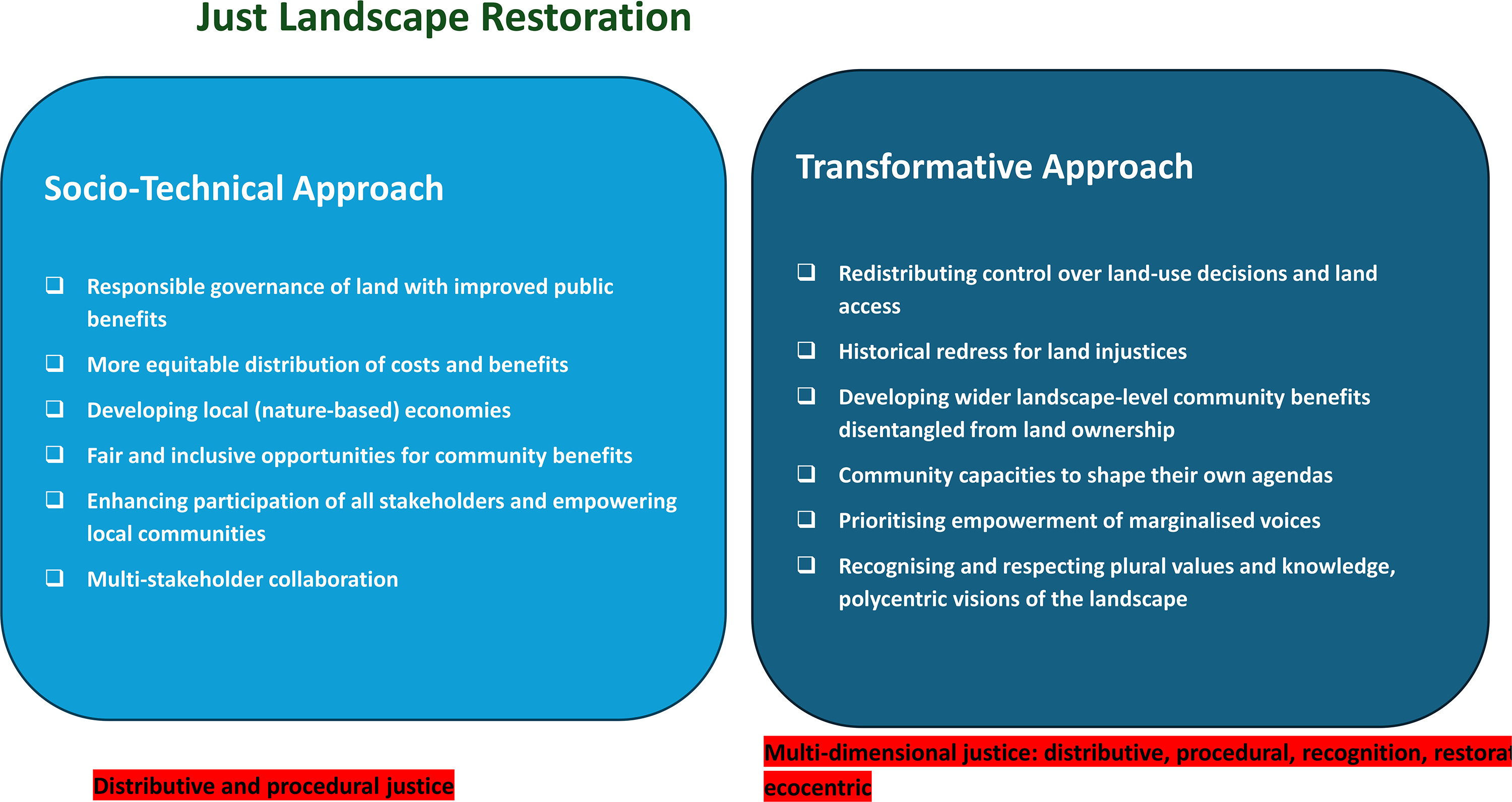
Just landscape restoration in Scotland: A socio-technical approach versus a transformative approach.
Just transition ambitions exist in tension with the neoliberal approach to environmental governance in Scotland whereby in seeking to meet net-zero targets, the government encourages and facilitates private investments into natural capital and carbon offsetting. Financial incentives for land-use change in Scotland provide opportunities for large landowners and private investors to accumulate capital, including multi-generational sporting estates seeking to generate new sources of income, rising numbers of ‘green’ landowners and companies investing in land. As McIntosh (2023) has argued, without careful governance, this new wave of investment into carbon and natural capital markets is likely to reinforce large-scale landownership in Scotland, generating new income streams for estate owners, continuing top-down control of rural land-uses and rising land values, resulting in a deepening of existing power inequalities and further disempowerment of rural communities. These problems converge where land reform and diversifying patterns of landownership are not necessarily strategic for achieving short-term targets for nature recovery and carbon sequestration.
Community-ownership or management of woodlands offer the potential to facilitate the retention of local-level benefits related to restoration or carbon sequestration activities and to enhance local empowerment on land-use decision-making. Yet despite land reform measures since the 2003 act, progress towards community land has been limited and the prevailing trend over the last decade has been of increasingly concentrated patterns of landownership in Scotland (Wightman, 2024a). In a context of rising land values, communities face significant barriers in participating in land purchases or land transfers and in accessing funds, barriers which are unequally experienced across rural Scotland (Markantoni et al., 2018; Sharma et al., 2023a).
Our findings showed the importance of longstanding inequalities around land control as a substantial barrier to a just transformation of the landscape in rural Scotland, where a small number of large private estates hold significant control over land-use decisions and where the ability to benefit from land is strongly linked to structures of land ownership. Political economy approaches to green transformations (e.g., Newell 2021) and combined analytical frameworks of climate justice and agrarian justice (Borras and Franco, 2018; Newell, 2022; Scoones et al., 2024) highlight the importance of addressing land inequalities in sustainability shifts.
Land-based injustices point to the need for historical redress and for restorative justice to be incorporated into a transformative approach to just transitions. In this particular context, the injustices of the Highland clearances reverberate today in shaping local conceptions of what would constitute just landscape restoration. It resonates with similar calls in many parts of the world, for example where territories have been historically lost to settler colonialism (Rodriguez, 2022). We argue that a central element of landscape transformations must be grounded in addressing historical experiences of dispossession from the land and of losing connections to the landscape. Historical redress is an important aspect of justice in and of itself, while also closely bound up with distribution of land-based benefits and with land-based decision-making powers. This aspect has not been thus far adequately captured by just transition literature and policies. We suggest there is a need for ecological restoration initiatives to reflect on the ways in which their programmes may reinforce legacies of historical land injustices.
The potential to finance community benefit-sharing initiatives through premium prices in the carbon and natural capital markets is of increasing interest to a range of parties in Scotland, including policy bodies, NGOs and private landowners. With this in mind, our findings raise questions over the ways in which the benefits from land could be disentangled from land ownership and fairly allocated across Highland communities. Unlike the community funds generated from wind energy, which benefit some communities but not others, a landscape-level approach to benefit-sharing has the potential to address geographical inequalities, albeit with what are expected to be reasonably small revenues, with a recent slowdown in natural capital markets (Daniels-Creasy, 2024; Wheatley et al., 2024). Establishing a fair distribution of benefits from carbon sequestration across rural communities could be facilitated by local councils as well as through new forms of land governance, such as emerging land management plans or Regional Land Use Partnerships.
Whilst getting financial distribution right is important, our case study findings indicate that the range of local needs, notably around land access, local amenities and community wellbeing, cannot be resolved entirely by community funds. Common goals could be achieved if restoration agendas can provide opportunities to address some of the fundamental social challenges facing many Highlands communities, particularly relating to provision of affordable housing, local services, training and sustained, meaningful employment opportunities for local communities. Thus, community benefits could be conceptualised by policy-makers and implementers in a wider, more transformative and long-term sense.
Reflecting wider shifts away from direct questions of land distribution towards land market regulation and land governance, there are moves to instigate more responsible and accountable forms of landownership in Scotland, including stronger commitments to local communities. In particular, the Scotland Land Reform Bill 2024 (Scottish Government, 2024) incorporates proposals for community engagement obligations for large landowners (over 3000 ha). In seeking to address localised concentration of power, the Scottish Land Commission (SLC) has recommended introducing a statutory underpinning for the 'Land Rights and Responsibilities' statement and a ‘public interest test’ for large-scale land acquisitions where landowners would need to demonstrate that their land practices align with wider public priorities. Yet these two recommendations have not been adopted in the Scotland Land Reform bill 2024 (Wightman, (2024c). While negotiations and debates are a core part of the democratic process, land reform proposals nevertheless tend to be watered down due to political compromise in the Scottish parliament, thereby inhibiting a just transformation of the landscape.
Moreover, our findings suggest that the increasing rhetoric of community empowerment in Scotland is not yet reflected in practice. Many attempts at community engagement on restoration initiatives appear to be tokenistic and lacking in the meaningful involvement of local people in decision-making processes, intimating what Arnstein (1969) refers to as ‘counterfeit power’. While ongoing land reform processes provide opportunities for incrementally improving community influence and for increasing the accountability of large landowners, there is an imperative to develop concrete, legally binding measures for community inclusion in restoration initiatives, with the majority of policy frameworks voluntary and guidance-based (Martin et al., 2023).
Aligning with criticisms of Scottish restoration programs as being undemocratic or as lacking in community empowerment (e.g., Arts et al., 2014; Martin et al., 2023), there is a sense that organisations and landowners are not surrendering any significant control over their already clearly-defined agendas. Our case study outlines the need for safe and open spaces for raising views on landscape restoration which challenge more powerful stakeholders and counterbalance established narratives which stereotype groups in these debates. Beyond the practices of individual actors, we highlight wider barriers and limitations to democratic participation in rural Scotland. The SLC is focusing its efforts on guiding responsible governance among landowners, yet more direct political interventions will be necessary to support participatory democracy in the Scottish Highlands. While land reform is an important aspect of just transformation, community ownership of land is not necessarily by itself a solution for more inclusive and empowering forms of land governance.
A transformative approach to landscape restoration would require a move towards more substantial, lasting and widespread participation in decision-making around just transitions through democratic channels and the empowerment of local communities relative to the state and environmental organisations (Kothari et al., 2024; Newell, 2021). While our case study echoes the principles of the SER (Gann et al., 2019) in showing the importance of active engagement with local communities at an early stage of restoration initiatives, we also highlight the need to go beyond typical top-down approaches to participation, defined in Gaventa's (2006) framework as ‘invited spaces’. Rather, a just transformation to sustainability could be based on ‘claimed spaces’, “whereby citizens demand new spaces of participation or construct alternative sites and spaces of representation and participation” (Newell et al., 2023: 51) and where local communities could have the capacity to shape their own agenda around landscape restoration and just transitions.
The case study highlights the importance of less tangible and relational aspects of justice- relating to values, cultural identities and knowledge claims- in shaping people's senses of fairness around- and attitudes towards- landscape restoration programs. As observed in other restoration contexts (e.g., Murphy et al., 2022; Vasile, 2018), diverse perspectives on land-use change cannot be reduced to material interests and distribution of benefits, but are rather entangled with people's senses of identity and deeply-held values. Yet just transition policy discourses in Scotland focus on financial rewards and community engagement, tending to overlook recognition dimensions of justice. Thus, we would suggest that a more transformative approach to just transitions should be widened to include people's values and place-based identities. At the same time, our findings highlight the challenge presented by disputed claims to ‘traditional’ identities. There are particular concerns about emotive claims to stewardship and tradition, in this case from sporting estate landowners who are seeking to strategically respond to land reform movements and to justify their existence in Scotland's unequal land system, as noted by other scholars (Lorimer, 2000; McKee, 2015).
In moving towards a just transformation of the landscape in Scotland, diverse and place-based community needs must be centred, and we need to be wary of ‘community-washing’ present in sustainability initiatives (Ptak et al., 2018). While often characterised as such in policy and NGO-led initiatives (Sharma et al., 2023a), rural communities in the Scottish Highlands are not homogenous. Rather, they are made up of a range of voices, visions and interests, meaning that there are plural, and sometimes contested, visions and pathways for a just transition of the landscape existing within communities, as demonstrated in our case study. With places in rural Scotland made up of uneven power structures, vast wealth disparities and divergent relations to the land and to land-based livelihoods, we can contest the clarity of a community-oriented just transition and discourses of community empowerment promoted in policy and NGO agendas.
In our case study, we see that environmental initiatives can be divisive and actively drive local conflicts, impeding the effective and equitable progression of restoration programs. As with the SER principles (Gann et al., 2019), our findings demonstrate the importance of building dialogue among all stakeholders and of integrating local experiential knowledge of the land into restoration programs and plans. There is a need to recognise and respect diverse voices, perspectives and values in building towards just transitions of the landscape, including of marginalised groups and of people who perceive themselves to be losing out from the transition, through meaningful processes of participation and conflict resolution.
By adopting an empirical, multi-dimensional environmental justice outlook (Sikor et al., 2014) in this paper, we have highlighted the multiple justice claims and concerns mobilised by diverse stakeholders in relation to landscape restoration and land-use change. These reveal some of the deeper drivers of injustice and unsustainability, thereby highlighting the limits and omissions of existing just transition policies and of restoration programs. Responding to the growing calls for social justice to be integrated into restoration plans (Anguelovski and Corbera, 2023; Osborne et al., 2021), we add to discussions around the contested meanings and practices of just transitions (Ciplet and Harrison, 2020; Stevis and Felli, 2020) by highlighting the spectrum of justice concerns addressed by just landscape restoration approaches. As a result, our paper contributes to empirical and conceptual developments around just transformations to sustainability, thereby building on recent environmental justice scholarship (Rodriguez et al., 2024; Temper et al., 2018) and political economy literature (Newell et al. 2023; Scoones et al., 2015).
There is likely to be significant resistance to realising land-use transitions in response to climate and biodiversity crises across rural Europe, without social justice concerns being addressed (Martin et al., 2020; Pascual et al., 2014). While there exist concerns that a more transformative approach to just transition may hinder or delay the rollout of sustainability plans and practices, we suggest that it is a necessary approach in effectively advancing towards just and sustainable futures and in addressing the core drivers of injustice and unsustainability. Scotland is well-placed- institutionally, politically, socio-economically- to advance just transitions to a deeper level. We argue that it is vital to address and transform deep-rooted, protracted social conflicts which underlie contestations over visions of sustainability and of landscape change (Madden and McQuinn, 2014; Temper et al., 2018). Holistic conceptions of just transitions are required which integrate a range of fundamental justice concerns and which centre the needs and perspectives of marginalised groups and communities affected by sustainability plans, enabling alternative visions of the landscape and of socio-ecological relations to emerge.
Highlights
Large-scale land-use changes are expected in rural areas, with uncertainties over social justice implications for local communities.
Explores the basis for- and barriers to- a just transformation of landscape through a case study in the Scottish Highlands.
Distinguishes between socio-technical and transformative approaches to just transition.
Through an empirical environmental justice approach, it contributes to building understandings of the nature and scope of just transformations.
Footnotes
Data availability statement
The data that has been used is confidential.
Ethical approval and informed consent statements
This study was approved by the International Development Research Ethics Committee at the University of East Anglia on Sep 09, 2021 and by the School of Geosciences Research Ethics Committee at the University of Edinburgh on August 10th, 2021.
All participants provided written informed consent prior to participating.
Funding
The authors disclosed receipt of the following financial support for the research, authorship, and/or publication of this article: This work was supported by the JPI Climate- SOLSTICE programme (SOLSTICE Consortium Agreement, 2020-12-1) and the UK Natural Environment Research Council Landscape Decisions Fellowship (grant no. NE/V007904/1).
