




Abstract
Challenging the universality of the Anthropocene Epoch, this article argues for a new conceptualization of the planetary situation focused on the landscape complexities of the Holocene/Anthropocene boundary event. I ground this perspective with a historical and ethnographic tour of Lake Somerset, a water-filled phosphate pit in Central Florida that has become habitat for a colony of endangered wood storks. Displaced from their native Everglades, these storks utilize the lake's spoil-pile islands for their rookery. I argue that Lake Somerset, and the Holocene/Anthropocene transition generally, become legible by attending to processes of creative niche destruction: capital-generating disturbances that irreversibly alter the biophysical structure of space. At Lake Somerset, phosphate mining has locally eradicated the Holocene ecologies that came before and replaced them with pits and piles of mutilated soil that recolonize with invasive plants. The diasporic wood storks exemplify what I call a Holocene fragment––a long-established ecological form that survives in the ruins of the Anthropocene. Utilizing tools of natural history observation, ethnography, and environmental history, I argue that multispecies researchers are uniquely positioned to track the Holocene/Anthropocene transition across the earth's surface––a critical practice for understanding shifting patterns of life and livability in this time of radical change.
Keywords
During my fieldwork, I would regularly go birdwatching at a small neighborhood park in Lakeland, Florida, a sprawling suburban city along the Interstate-4 corridor between Orlando and Tampa. Sandwiched between khaki condominiums, the park is furnished with a tidy lawn, a few trees, and a bench that looks out on Lake Somerset. Fifty feet from the lake's shore is an archipelago of long, linear islands arranged in parallel strips. Lake Somerset is a water-filled pit in the Bone Valley phosphate mining district, one of the oldest and most productive phosphate mining and fertilizer-manufacture zones in the world. The islands are made of overburden: the top layer of earth that a large mechanical excavator called a dragline removes and sets aside to access the phosphate rock. The parallel arrangement of the islands inscribes the path of the dragline as it roved up and down the landscape mining in successive strips (Figure 1). Growing on the overburden islands is Brazilian pepper, an invasive shrubby tree introduced to Florida through the ornamental plant trade. Pepper covers the islands and gives them a blobby, bristly character. Nestled in the vegetation are egrets, herons, roseate spoonbills, and––most abundant of all––the Florida wood stork. Wood storks have made a rookery on these islands (Figure 2).
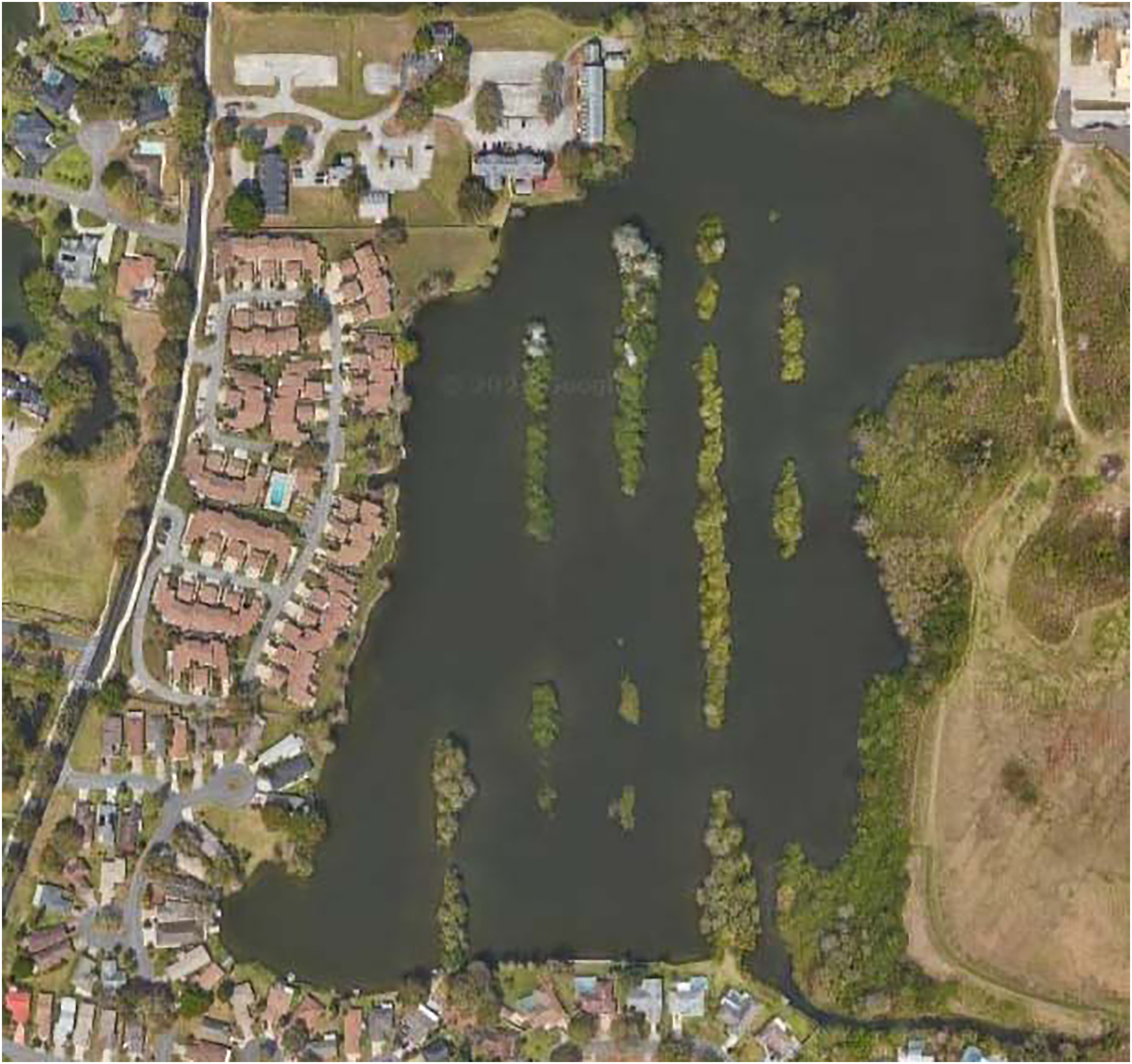
Lake Somerset and its islands. Google ©2023.
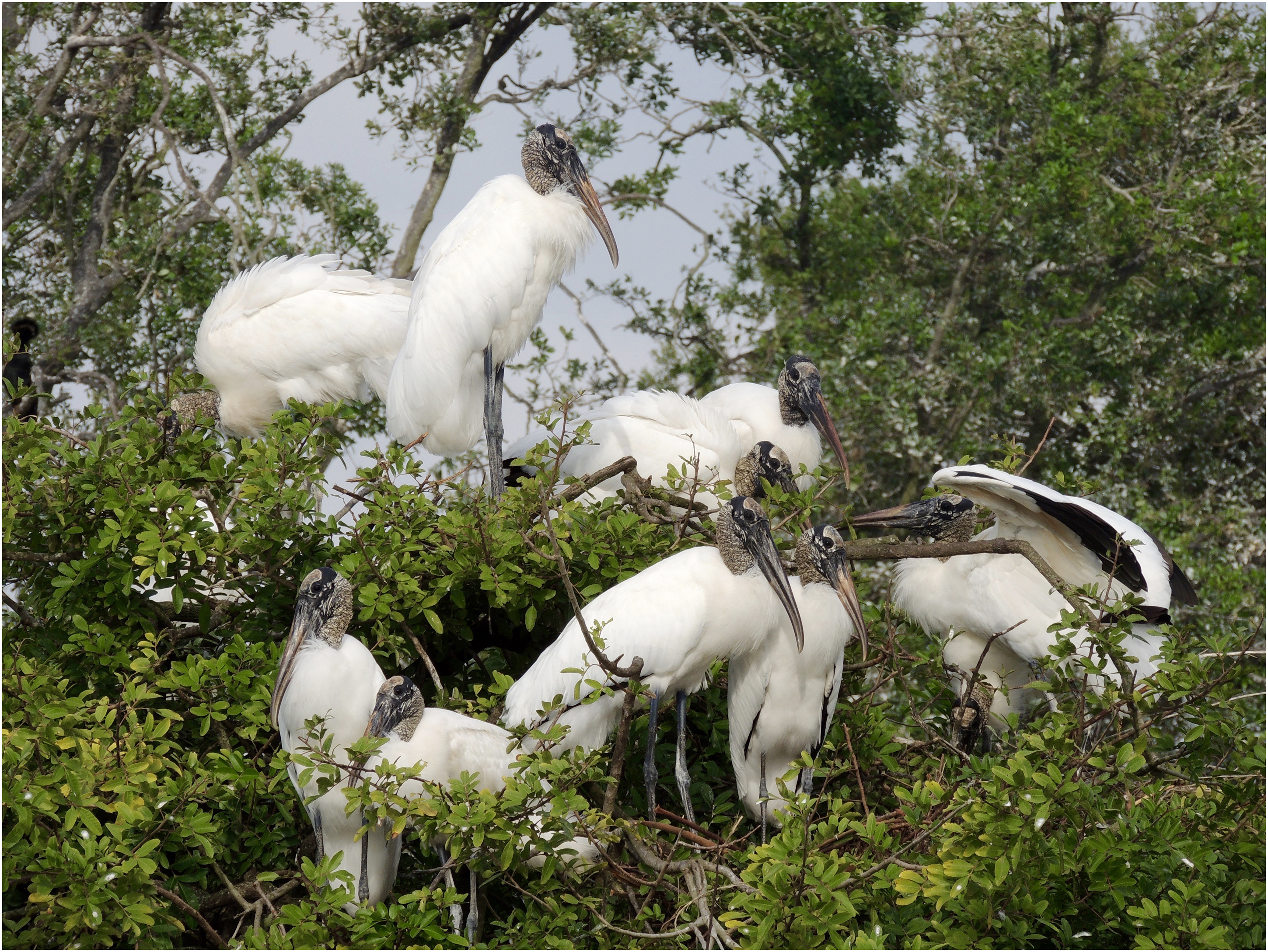
Wood storks in the boughs of Brazilian pepper. Photo by the author.
In March 2020, I meet Reinier Munguia at the Glendale Rd. boat launch. Reinier is the President of the Polk County Audubon Society, and, today, he has agreed to give me a boat tour of Lake Somerset's rookery. Reinier arrives and backs his jeep down to the water. We exchange greetings. In addition to his responsibilities as Audubon president, Reinier coordinates the rescue and rehabilitation of injured wildlife. He apologizes that he might have to interrupt our tour and take a phone call from a volunteer who is having trouble locating an osprey hit by a car. The bird has a broken wing and is currently stranded in the parking lot of a Lowe's––a big box home improvement store. He tells me this is his sixth “emergency” of the day and he is feeling a bit flustered.
Reinier clamps a small electric motor on the canoe and eases the craft into the water. He motors us across Lake John, an islandless phosphate pit that connects to Lake Somerset to the north via a narrow mining channel. Passing through the channel, a surreal waterscape unfolds before us. The linear spoil-pile islands protrude from the lake's pea-green water. (The phosphatic face of the mining void fertilizes blooms of toxic algae.) Cries, clacks, and tweets fill the air. Wood storks fly back and forth from the islands, carrying nesting material in their beaks; they congregate in the condominium owners’ backyards.
As we glide across the water, weaving between the islands, Reinier's mood shifts. Forgetting about the day's emergencies, he delights in the cacophony of bird sounds and the avian dramas playing out before us. Reinier notes that each bird species has its own roosting niche: the cormorants have taken over an oak tree on the northern tip of an island; the spoonbills and tricolor herons reclusively occupy the middle layers of the Brazilian pepper clumps; the wood storks and brown pelicans––the biggest species––occupy the top layer of the canopy. It's early in the breeding season and the storks are building nests and jostling with their neighbors. A few birds have already begun incubating eggs. We watch as a stork uses its long beak to rotate its unhatched young.
Wood storks (Mycteria americana) are a federally threatened species endemic to the mangroves of the coastal Everglades in South Florida. In the 1970s, wood storks fled the Everglades in droves as flood control and agricultural drainage fractured the hydrology of this iconic wetland ecosystem. In their diaspora, some of these storks set up shop in Bone Valley. In 2014, the wood stork's conservation status was downgraded from endangered to threatened under the Endangered Species Act. Bone Valley's pit-lake islands represent one strand of their partial recovery. Although wood storks have been removed from the Endangered Species List, to suggest that Lake Somerset's wood storks are thriving would be misleading. Storks are fledging offspring, but the possibilities for colony expansion are eclipsed by suburban sprawl. At best, these wood storks may be said to be “living in ruins” (Tsing, 2015). To live in ruins is to live in tolerable, potentially damaging but nonetheless good enough conditions for ongoingness. 1 Wood storks are doing okay, Brazilian pepper is doing better. Living in ruins is the story for many creatures of the Holocene who find themselves immersed in a sea of anthropogenic landscape change.
In my research, I investigate the Bone Valley phosphate mining district as a ground zero of the Anthropocene. Often described as a “moonscape,” Bone Valley is an otherworldly mosaic of mining pits, contaminated tailings ponds, and massive chemical plants that turn phosphate rock into commercial fertilizers. As radically transformed as this mining region is, it is also a space in which Holocene ecologies and species can still be found, albeit in fragments. Wood storks are one such fragment. Chipped off the Everglades, forced into diaspora, and made to live in degraded urban-industrial environments, wood storks are finding a foothold in the Anthropocene, however precarious.
How do we make sense of such a condition: a Holocene species living in Anthropocene space? Hasn’t the Holocene been eclipsed by the Anthropocene and its sprawling geographies of rubble, toxins, and weeds? There are, of course, protected wilderness areas that may be considered reservoirs of “Holocene nature,” but they are artifacts of people (the West, no less!) and, therefore, are they not constructs of the Anthropocene too? The whole earth has been humanized, or so the promoters of the Anthropocene hypothesis would lead us to believe. Humanists and social scientists are seduced by the narrative of a fully humanized planet. In a keynote talk at the 2014 American Anthropological Association meeting, Bruno Latour encouraged anthropologists to embrace the gift of the Anthropocene periodization (Latour, 2017). With it, he argued, they might demonstrate the relevance of the discipline to the wider scientific community: Humans have spread out everywhere and, so, anthropological expertise is needed everywhere. If ecologists and geologists are to trace their research objects into the present, they will need anthropology––and the human sciences more generally––to make sense of the most recent developments in earth history.
While I am convinced that humanities knowledge practices are central to a transdisciplinary earth science, I reject the premise that the planet has fully and irreversibly entered the Anthropocene (Steffen et al., 2007). Too new to be a full-fledged epoch with its own historical character and systems properties, the identity of the Anthropocene so far lies with its capacity for disruption. But what, exactly, is being disrupted? And what form does this disruption take? Working within the geologists’ paradigm, the first question has an obvious answer: the Holocene, the relatively short interglacial epoch of the last ∼11,000 years. The question of disturbance is more complicated. In contrast to the K/Pg event in which the Cretaceous earth was leveled in a single asteroid blast, wiping out the dinosaurs and sparking the radiation of mammals, the colonial-capitalist disturbances that extinguish the Holocene are multiple, spatially patchy, historically staggered, and diverse (See Tsing et al., 2019 for a complementary perspective). These disturbances create no-analog ecosystems, but they also fracture long-established natures and naturecultures. Such fracturing is rarely total. When we attend to the incomplete destruction of deep-time ecologies, it becomes more and more difficult to accept the Anthropocene as a new planetary universal. We need not throw out the geological calendar altogether; instead, we must open our research and political imaginations to the landscape complexities of the Holocene/Anthropocene boundary event (Caple, 2017).
Holocene in fragments
In this article, I argue that the Holocene/Anthropocene boundary event is the most precise characterization of the current planetary situation and that multispecies researchers can play a leading role in its study. In my formulation, Holocene and Anthropocene are ways of naming micro-to-macro ecological formations with very different historicities. Holocene ecologies are long-established, emerging out of deep-time evolutionary relations and unevenly shaped by humans over the interglacial period of the last 11,000 years. Anthropocene ecologies are historically new, arising from the irreversible disturbances of colonial-capitalist systems. In the current boundary event, Holocene and Anthropocene worlds coexist, overlap, and entangle. They do not come together in a balance of forces or a Manichean struggle but in a lopsided dynamic of erasure and feral emergence: the Holocene––in all of its biocultural diversity––is dying a patchy death as the Anthropocene––with its heterogeneous ruins––expands at an accelerating pace.
This notion of the Holocene/Anthropocene transition reopens humanist critiques of the Anthropocene. Much of the early criticism focused on the term's prefix, Anthropo–. Scholars interrogated the figure of Universal Man in earth scientists’ characterizations of the new epoch and correctly pointed to the disproportionate environmental violence of the West, European colonists, and high-consuming capitalist societies. With these critiques came a proliferation of alternative names for the Anthropocene––e.g., Capitalocene (Moore, 2017), Plantationocene (Haraway, 2015), and Westernocene (San Román and Molinero-Gerbeau, 2023)––as well as debates about when to date the Anthropocene (Lewis and Maslin, 2015) and the political meanings of doing so (Davis and Todd, 2017).
Less attention has been paid to the term's suffix and the construction of epochality that subtends the Anthropocene hypothesis. Epochs have a double life. On the one hand, they are used as calendrical units that neatly organize earth history and nest within larger time units (e.g., Quaternary period and Cenozoic era); on the other, they are used to name planetary formations with distinctive climatic and biotic identities that persist over time. While I encourage a focus on the phenomenal dimensions of epochality, I am not against periodization. Periodization is useful for narrating the crises and periods of relative homeorrhesis that pattern planetary history. But an overemphasis on periodization risks reifying the earth as a total system that abruptly shifts from one planetary state to another. While there can be abrupt shifts in the Gaia system (as in the K/Pg event), the majority of earth's major transitions––including the current one––are more protracted (Brannen, 2017). Irrespective if the crisis is slow or fast or has singular or multiple causes (Collard, 2018), planetary transitions are messy, both in their temporal unfolding and actualization in ecological space. The focus on periodization and its politics has blocked what is arguably a more productive formulation: to see the planet as in the midst of a spatially patchy and accelerating transition in which colonial-capitalist humans both destroy the Holocene and proliferate the Anthropocene. When we face the uneven-age mosaic of ecosystems and land uses that tiles the earth surface, a tidy temporal division between an all-Anthropocene or all-Holocene system appears absurd.
In any case, the question of periodization has stalled, at least for the moment. In 2024, the Subcommission on Quaternary Stratigraphy rejected the proposal to formalize the Anthropocene as a geological epoch (Witze, 2024). Formalizing the epoch may have had positive political effects, but its rejection may ultimately push researchers to move beyond periodization and toward more substantive discussion of the Anthropocene qua event (Gibbard et al., 2022). 2 As Zoe Todd remarked: “[The rejection] is actually an invitation for us to completely rethink how we define what the world is experiencing” (quoted in Witze, 2024).
Going forward, I posit that the core challenge of Anthropocene studies is to describe the Holocene/Anthropocene boundary event and its materialization across time and space. This requires a focus on disturbance. Anthropocene disturbances are geographically varied, and their genealogies can always be deepened. The detonation of the atomic bomb is predicated on the Industrial Revolution, which in turn emerged out of European colonization and, before that, the Neolithic Revolution. 3 Whichever Anthropocene turning point you latch onto, the story always points to spatial unevenness: humans are not everywhere uniformly applying the same disturbance pressures across the earth surface. Rather than fetishize a single moment in history or villainize a particular category of people, I advocate an approach that examines the situatedness––the who, what, when, where, and how––of Holocene/Anthropocene transformation. Taken in aggregate, these heterogeneous transitions, however localized or distributed, threaten to engulf the whole planet. As widespread as the Anthropocene has become, Holocene worlds have not been fully extinguished.
Investigating this event requires we examine the Anthropocene's historical expansion alongside the Holocene's fragmentation (Figure 3). Whether our orientation is historical, rooted in the ethnographic present, or both, it is paramount that we inspect the patterning of Holocene and Anthropocene elements and their interactions in shattered space. In some sections of the earth's surface, Holocene natures are long-vanquished, relegating the place-specific study of Holocene/Anthropocene transition to historians and archaeologists. In others, Holocene and Anthropocene come together as contrasting patches in mosaic geographies or as fine-grain mixes of exotic-invasive and long-established species. In increasingly rare parts of the world, it is also possible to find Holocene ecologies extending to the horizon. In the cores of these zones, multispecies patterns of co-survival, honed over thousands if not millions of years, may continue to unfold as if industrial humans were not rapidly destroying the biosphere. When we conceive of the Anthropocene as a uniform condition with a single start date, we miss out on this patchwork heterogeneity and risk fetishizing ecologies with strong anthropogenic disturbance signatures as the new natural order.
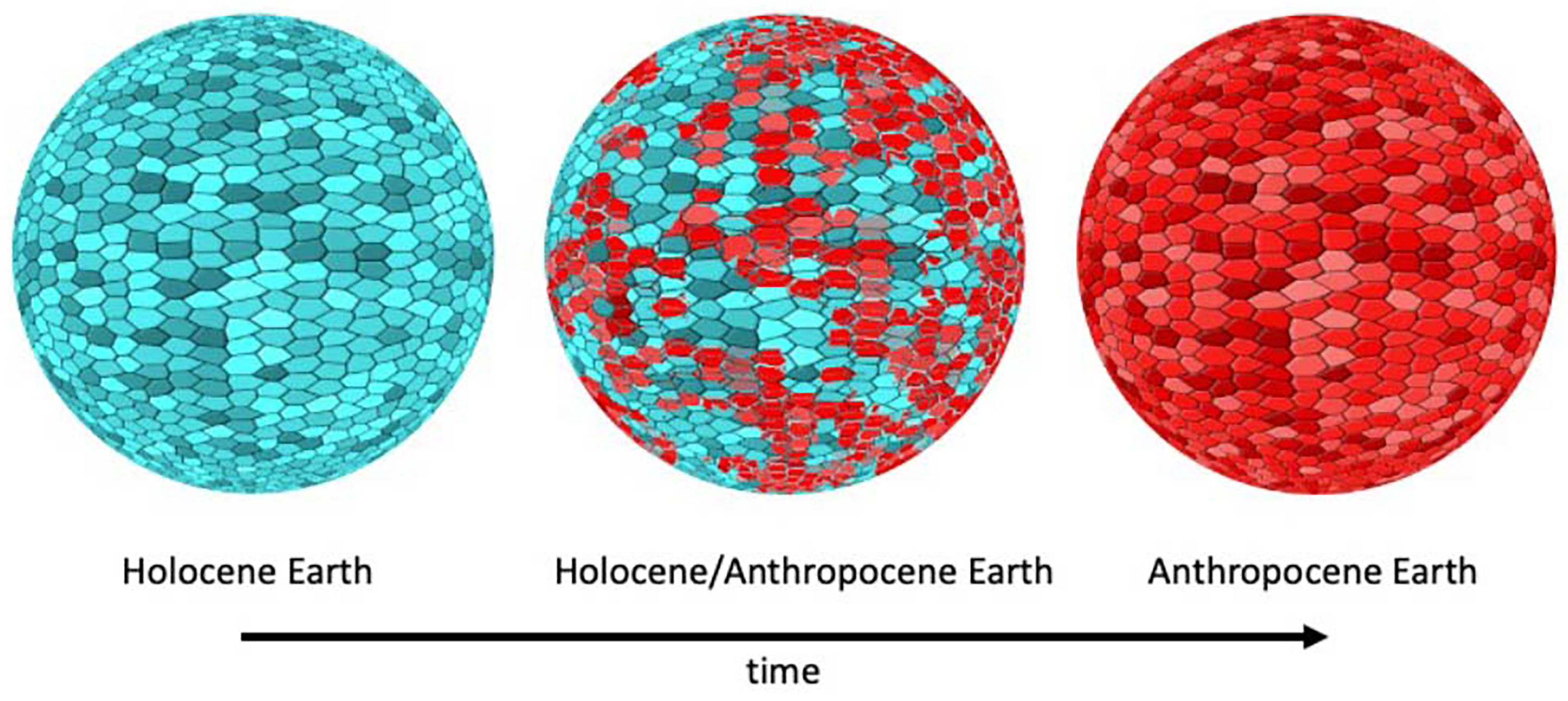
Graphic model of the Holocene/Anthropocene boundary event. Throughout the document, I use blue to signify Holocene ecologies and red for Anthropocene space.
Nevertheless, the Anthropocene conversation has been a gift to the humanities. In the last decades, scholars in my field, anthropology, have shifted away from discursive critiques of nature/culture binaries and the wilderness concept to develop more materially grounded studies of environmental violence. In the late 2000s, environmental decline was treated as an alarmist narrative to be countered. With the rise of the Anthropocene conversation, anthropologists have lost their allergy to declension narratives. Today's anthropologists are ramping up their commitments to field studies that interrogate the more-than-human dimensions of colonial ruination, industrial waste dumping, invasive species transfers––to name just a few Anthropocene-conjuring practices. Apart from a few who appear to celebrate the Anthropocene and the “emergent creativity” of its ecologies, the Anthropocene discourse has awakened us to the scale and intensity of colonial-capitalist disturbances and the cascading conditions of unlivability they proliferate.
And yet, a realignment is needed. In the rush to study the Anthropocene, we have neglected the more-than-human Holocene, its uneven patterns of erasure and persistence, and the life/deathworlds of its remnants. Most research associated with the “geological turn” has ignored questions of the Holocene or, at best, treated the epoch as the passive backdrop to the Anthropocene's emergence. The concept of the Holocene/Anthropocene boundary event recenters our empirical and political attention to the Holocene and its contemporary fragments. Holocene fragments are all around us. They exist as individual species like the wood stork that have learned to live in heavily modified environments, as ancient woodlands hemmed in by roads and urban developments, and as marine ecosystems confronting a growing drift of plastic.
Prior to its present fracturing, the Holocene constituted the most biodiverse version of Gaia 4 and, through the orchestrations of its incalculable biotic and abiotic actants, it furnished a warm and stable climate, flourishing oceans, and many other critical functions that render the planet habitable. In its current fragmented condition, the Holocene continues to issue forth livability but at a much-reduced scale and, of course, with considerable geographic unevenness. In addition to being the most biodiverse epoch in earth history (Wilson, 2016), the historical Holocene supported the diversification of human cultures, with people dispersing across the globe, developing niches in all the planet's major biomes. Whereas many anthropologists adopt a strong version of the social construction of nature in which ecological landscapes are never without a human architect, the Holocene, in my view, is overwhelmingly a nonhuman assemblage in which humans may or may not be present. Consider the flatwoods ecoregion that once extended across Bone Valley, including the area that is now Lake Somerset. Flatwoods are an open, fire-adapted pine forest that form the ecological “matrix that ties together and merges with other Florida vegetation types” (Abrahamson and Hartnett, 1990, 110). Before the diseases and slave-raiding of Spanish explorers that lead to the demise of Timucua, Tocobaga, and other Indigenous peoples of Central Florida, this bioregion was used as a hunting and foraging ground. With settled life concentrated around the coasts and, secondarily, inland waters, these ecosystems were economically marginal and consequently underwent little landscape modification, except, perhaps, for the occasional prescribed fire. On the coasts, by contrast, Florida's native peoples engaged in more intensive terraformations, building monumental shell mounds and complex weir systems for capturing fish (Thompson et al., 2020). Though these activities altered ecological trajectories, their impacts did not rise to the levels of irreversible violence that, I argue, characterize Anthropocene peoples and the ecologies they proliferate. 5
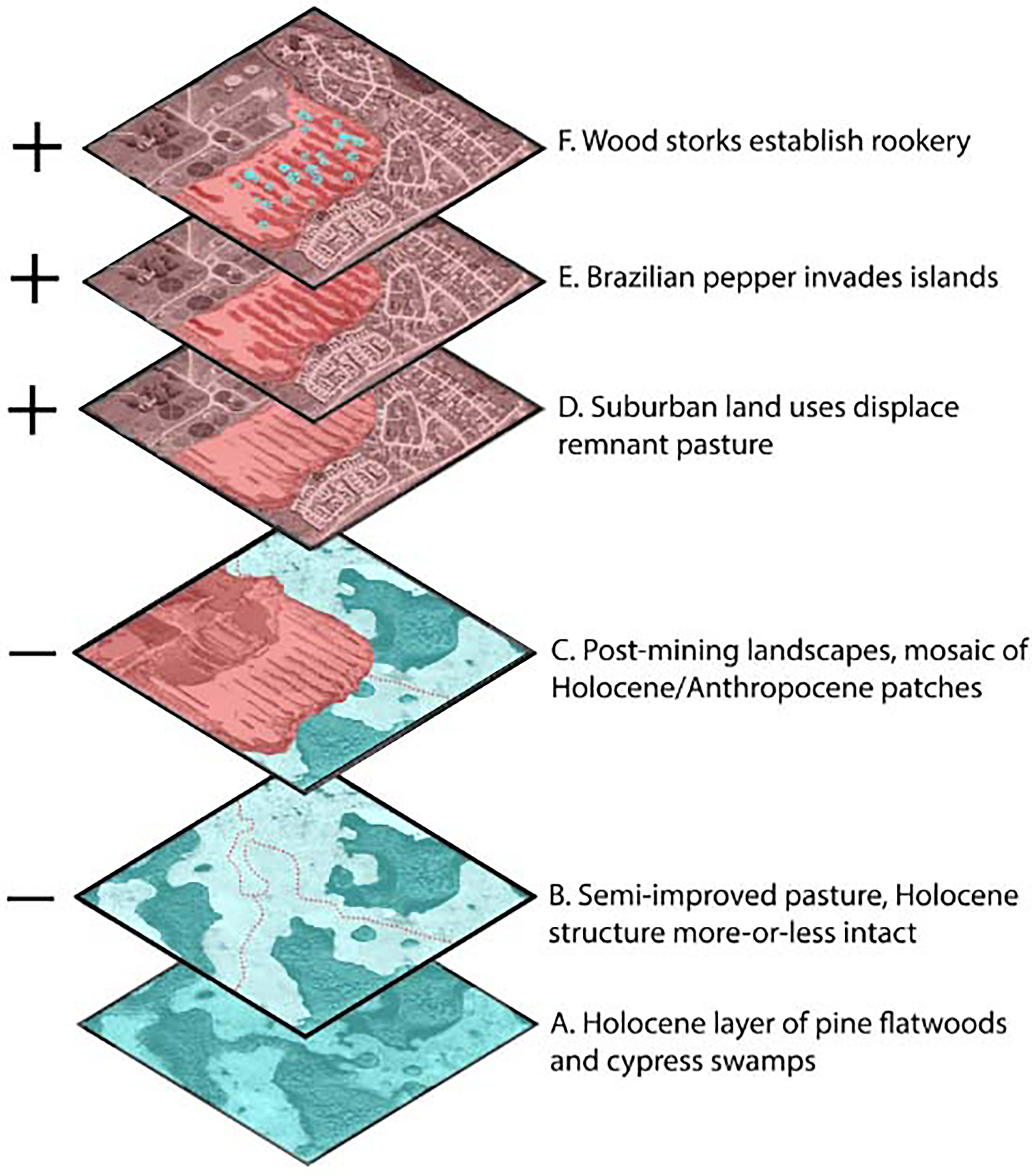
A palimpsest model of Holocene/Anthropocene transition at Lake Somerset corresponding with stories A-F. In layer A, the landscape starts out in a Holocene state of flatwoods (blue) and cypress swamps (darker blue). In layer B, cattle ranchers slowly erode botanical diversity from the landscape (lighter blue areas) and etch Anthropocene pathways into the land (red). Layer C depicts how phosphate mining creates a large disturbance patch, forming a mosaic of remnant pastures and an Anthropocene void (red). In histories B and C, the transition is triggered by processes of subtraction (–). In D and E, the Anthropocene state of the landscape is intensified by the additive (+) niche construction activities of real estate developers and Brazilian pepper. In layer F, Holocene storks join the assemblage, flecking the all-Anthropocene landscape with bits of blue.
In our appraisal of the boundary event, we must also confront the ways the Holocene sowed the seeds of its own undoing, functioning as an incubator for ecologically destructive humans, especially those weedy European varieties who spread the machinery of conquest and industrialism around the globe. While I resist encapsulating the Holocene/Anthropocene transition in a single storyline, there is no way to ignore the explosive impacts of European colonialism and the successive waves of capitalist development it set in motion. A comprehensive overview of colonial-capitalism is beyond the scope of this paper; however, it is important to highlight a few features of the system that render it so disruptive.
At the heart of the colonial-capitalist project is a teleology of invasion and extractive growth. Thinking with the more-than-human forces of ecological imperialism described by Alfred Crosby (1986) can help us here. While the Anthropocene is made through all-too-human processes of conquest and capitalist development, introduced species––diseases, domesticated plants and animals, and hitchhiking weeds––are crucial to displacing Holocene worlds. Some of these alien species spread with little assistance from humans. Often, however, the invasive properties of exotic species are enhanced through interactions with industrial systems. The digital publication Feral Atlas describes a number of such “supercharging” relations (Tsing et al., 2021). What concerns me in this paper is the way industrial humans and their supercharged companion species––like Brazilian pepper––collaborate in creative niche destruction. Creative niche destruction (CND) is my term for describing how the more-than-human disturbances of colonial-capitalist invasions irreversibly alter ecological space. The term is a portmanteau that splices the Marxist concept of creative destruction (Schumpeter, 1942) and biologists’ theories of niche construction (Jones et al., 1997; Oldling-Smee et al., 2013). Let me briefly introduce the composite concepts before describing how they fit together. Creative destruction generally refers to the process by which avant-garde forces of capital tear down, reconfigure, or revolutionize pre-existing social orders that pose a barrier to accumulation. Understood as a force of landscape history, creative destruction develops as a succession of frontiers that renders previous ways of life obsolete as it conjures the new. Niche construction theory explores how organisms make environmental niches for themselves and others. Beaver dam-building is the most iconic example of niche construction but all organisms engage in engineering activities of one sort or another. Furthermore, niche construction activity takes place at all scales, manifesting in landscapes and the multiscalar concrescence that is Gaia (Latour, 2021). A core tenet of this theory relevant to this analysis is that niche construction activities of the past structure ecological and evolutionary futures. The environments built by our more-than-human ancestors become the milieus that we rework and bequeath to our successors.
CND brings these phenomenal processes together, helping us notice the ways colonial-capitalist projects destroy historical landscapes while creating new niches for insurgent Anthropocene species and peoples. As colonial-capitalist frontiers expand, Holocene natures constantly get in the way, requiring land clearing, draining, earth moving, etc. In contrast to prescribed fires that regenerate long-standing ecosystems, colonial-capitalist disturbances are typically of a scale and intensity that they irreversibly alter environments such that the organisms that lived there before can no longer live (or struggle to live) in the environments that come after. Paying attention to the before-worlds and after-worlds of CND helps us distinguish Holocene and Anthropocene patterns in a landscape. In Florida, the contrast between before and after is sharp. But in other parts of the world, where people have been transforming landscapes and moving species for thousands of years, the picture is more muddled. Although such transformations may be more gradual and muddled, to the extent that they are irreversible and linked to something like empire, they can be traced onto a Holocene/Anthropocene storyline.
The Holocene/Anthropocene transition can also be mapped at the level of lifeforms. Wood storks are coded “Holocene” because they are an established part of the historical ecology. Although this colony hails from the Florida Everglades, which once hosted the largest colonies of storks, the species’ distribution extends as far north as South Carolina. It is highly conceivable that the displaced wood storks may have merged with the local population. Brazilian pepper is coded “Anthropocene” not simply because humans introduced them from another part of the world, but because their demographic success is part of a more-than-human forcefield revolutionizing Florida. Although the taxonomy between long-established “before” species and invasive “after” species is coarse, we cannot ignore this distinction any more than we can the historical break between dinosaurs and mammals.
Of course, the creativity of CND does not just lie with the production of no-analogue ecosystems: capitalist disturbances exist to generate capital. Fertilizer companies destroy vast areas of Florida countryside not because they want to create water-filled holes but because the phosphate they extract is essential to capitalist growth and the expansion of agribusiness frontiers. Studies of CND, therefore, must attend to historical shifts in landscape structure as outcomes of wider accumulation processes.
System invasions do not come all once but in waves (Steffen et al., 2015). As Anthropocene forces crash into Holocene worlds, preexisting life-fabrics break down, creating new livability challenges for surviving species and novel niches in which additional Anthropocene species can take hold and proliferate. The metaphor of waves is apt as it draws attention to processes of scouring that produce erasure (e.g., mining) alongside processes that sediment new structures (e.g., subdivision construction). Charting how waves of CND layer into landscapes, creating palimpsests of positive and negative traces, is key for interpreting the Holocene/Anthropocene transition at various points on the planet. As Paige West has argued, palimpsest landscapes are like “surfaces that have been written over and over and over and which, when refracted through certain kinds of methodologies, yield cracks that give us insight into the networks that brought them into being. They also hold within them the possibility of futures. (2020: 120).”
Situating Holocene/Anthropocene transitions in space and time
The Holocene/Anthropocene boundary event presents new occasions to tell big stories about humanity's relation to the planet. But we need big stories in service of small ones (and vice versa) in order to characterize how this transition materializes in situated land-, air-, and waterscapes. In my own fieldwork, I adopt an approach that integrates place-specific histories of environmental change and ethnographic investigations of the more-than-human present. In my research in Bone Valley, this has meant tracking how phosphate mining companies and their companion species have invaded specific landscape patches like Lake Somerset. It also means characterizing contemporary assemblage dynamics, always with an eye to the scoured and sedimented histories gathered in the here-and-now. In some instances, it is possible to read histories of change directly from the land itself, for example, in the parallel arrangement of spoil-pile islands. But most details of landscape history––at least on the human side of things––reside in archives and the memories of local observers. To interpret the landscape's natural history, I have found it indispensable to work with naturalists, land managers, and professional ecologists who are tied to or in some way knowledgeable of the landscape in question. To better understand stork and more-than-stork relations at Lake Somerset, I interviewed Reinier and canoed with him on multiple occasions. In our forays, Reinier trained me to observe the social lives of Lake Somerset's birds while sharing details of the lake's natural-cultural history, including its ongoing political entanglements with humans. For example, Reinier described his efforts to establish a no-wake zone on the lake to prevent rowdy boaters from disturbing storks during the nesting season; he also recounted how he coordinated with the Florida Fish and Wildlife Commission to prevent one particularly belligerent condominium resident from flying his drone over the islands. Both disturbances threaten to flush birds from their nest, leaving eggs vulnerable to predators like crows. Activist engagement of this sort is common among natural history guides.
These forays present opportunities for natural history observation as well as ethnography. Landscapes, after all, are not just accretions of more-than-human history, they are the everyday terrain in which human social life is lived and experienced. Early on in my tour with Reinier, I became alert to his distress around the injured osprey in the Lowe's parking lot. Reinier clearly shares in the plight of local birds: when the birds suffer, he suffers; when they demonstrate novel adaptations and resilience, he delights. These affective ties animate his activism. But they are not enough. As much energy as Reinier and the volunteers can commit to local bird emergencies, the situation threatens to get worse. As a pro-development, Sunbelt state and a haven of Trumpism, Florida is poised to continue along a path of self-devouring growth (Livingston, 2019). So long as that is the case, Anthropocene conditions will continue to pile up, squeezing what's left of Holocene livability from the land.
Engaging with landscapes as an ethnographer, naturalist, and historian can be a daunting task. But we need multispecies histories of the present if we are to track the patchy processes of Holocene/Anthropocene transition and their lived particulars. And we need such work at every point on the earth surface, multiplying narrative accounts that can converge on shared structural causes without denying the confluence of contingent histories that make every place unique (Chakrabarty, 2014). To do this work, we need to be able to distinguish between Holocene and Anthropocene historicities as they layer in mosaic landscapes (Forman, 1995).
In what remains, I chart a history of CND at Lake Somerset, reconstructing its Holocene/Anthropocene transition layer by layer. Each stratum of the palimpsest is a natural-cultural assemblage forged by a multiplicity of historical actors. To guide the reader through the layers of this palimpsest, I carry over the blue-red color scheme to Figure 4. The blue Holocene base layer consists of a landscape of pine flatwoods and cypress swamps following the eradication of the Timucua and Tocobaga. In successive waves of Euroamerican settlement, these Holocene ecologies are slowly and, then with phosphate mining, rapidly scoured away as the land obtains a new Anthropocene (red) identity. Despite the layers of landscape violence that shape this place, Lake Somerset became habitat for a colony of Holocene storks. To appreciate this surprising development, we turn to the fracturing of a neighboring Holocene ecosystem, the Florida Everglades, and the storks’ diaspora into Bone Valley. We conclude by returning to our canoe tour of Lake Somerset and resuming our observations of the Holocene/Anthropocene transition in the messy, bioactive timescape of the here-and-now.
A. Holocene without humans
If you were to visit Lake Somerset in 1800, you would have encountered a very different scene than you would today. Where today there is a pit-lake and condominiums there was once a mosaic of pine flatwoods and cypress swamps. Flatwoods, as their name suggests, are found in flat, sandy plains. 6 They have a relatively open canopy of slash and/or longleaf pine and a flammable understory of saw palmetto, grasses, and forbs. Embedded in the flatwoods matrix are cypress swamps. These swamps have a closed, bromeliad-festooned canopy; the understory is composed of water-loving herbaceous plants that grow among cypress knees. With Florida's high water table, just a foot or two of elevation change can mark a sharp transition between the two ecotypes (Abrahamson and Hartnett, 1990).
Before this ecological association was fractured by urban-industrial development, organisms moved freely across the region. As these organisms traveled, they carried the niche construction traditions of their ancestors with them, regenerating the association across space and time. The historicity of such processes matter: the pine flatwoods association is not an immutable feature of timeless Nature but a long-evolved, sympoetic formation whose spatial boundaries waxed and waned as climates shifted, water levels rose and fell, and human and nonhuman fires reset successional clocks. Despite its temporal durability, the assemblage lacked the fortitude to withstand the CND of Euroamerican settlers.
B. (Un)settling flatwoods
We begin this story of Holocene/Anthropocene transition with cowboys. Although Florida is not typically thought of as a cowboy state, the so-called “Florida cracker” represents a southern prong of the Euroamerican-cattle complex that invaded the American West. As foot soldiers of empire, these ranchers aided the U.S. Army in its campaigns against the Seminole and Miccosukee—Indigenous groups from Georgia and North Florida that the army displaced into Central and South Florida. 7 Lured to Florida with land grants of 160 acres from the Armed Occupation Act of 1842, these cracker communities helped secure conquered territories and established the basic infrastructures––roads, farms, commercial networks––that paved the way for later waves of industrial and suburban settlement. Although crackers brought a violent political culture to Central Florida, they were relatively benign ecological actors. Like the native peoples that came before, ranchers used fire to manage a landscape pre-adapted for burning and grazing. The southeast's open pine forests co-evolved with lightning-strike fires that produced a rich herb layer utilized by wild grazers. The cowboys' cattle and fire fit into existing eco-niches in more-or-less non-violent ways (Mealor and Prunty, 1976). But this cowboy complex was not without influence. At low stocking levels, fire and grazing can enhance floristic diversity. But higher levels of grazing pressure––often associated with fencing, forage improvement, and timber cutting—can lead to significant plant diversity declines. As late as the mid-twentieth century, however, most Florida ranches were only semi-improved and possessed the ecological structure of a floristically depleted prairie. Aerial photos from the 1940s, reveal semi-improved pastures in the area that would become Lake Somerset. I have coded these pastures with a lighter shade of blue, reflecting botanical losses tied to increased grazing. I have coded the cattle trails red to signify the colonial pathways that ranchers and their cattle literally and figuratively etched across the land. Although the landscape became more Anthropocenic, it remained––from a biological perspective––a predominately Holocene configuration.
C. Mining an Anthropocene void
The landscape's transition to a more solidly Anthropocene state was sparked by the irreversible disturbances of fertilizer companies. This section of Lakeland was first excavated for phosphate in the 1920s as part of a mining complex called Pauway. Pauway Mine was opened shortly after the incorporation of the Southern Phosphate Company in 1919. Headquartered in New York City, the company was formed with an initial investment of $30 million dollars that consolidated four existing phosphate companies. In 1946, the firm was purchased by its largest shareholder, the Davison Chemical Company of Baltimore. Eight years later, Davison was absorbed into W.R. Grace, a large phosphate magnate with roots in the nineteenth-century Peruvian guano trade (Cushman, 2013). In the 1950s, W.R. Grace excavated the pit that would become Lake Somerset. It was one of the last units mined before the Pauway complex closed in 1960.
In the decades after the Civil War, capital flowed into Florida, intensifying its status as an internal resource colony of the United States and deepening inequalities among the Northern investor class and poor Southerners, Blacks in particular (Hollander, 2008). In 1938, Paul Diggs of the Federal Writer's Project visited the segregated labor camp at Pauway Mine. There he met William Jackson, a Black miner. On the day he arrived, Jackson had spent the night in a mining pit mending a 12-inch water line. The pit had filled with water which had discolored his skin. William explained that he worked as part of a team composed of “a foreman, a nozzle-man, and four flunkies” who set up high-pressure water guns used to dislodge phosphate from the pit walls. “At present I am a nozzle-man. My salary is 30 per hour for eight hours work, making [$2.40?] a day. We only work four days a week which give me $9.60.” At this, Jackson's wife chimed in: “You see, we sure have to scrape and it's the bills that face us” (Diggs, 1939).
In addition to its poor pay, work in the mines was dangerous. At the Pauway mine alone there were multiple deaths and injuries, all of Black laborers. In 1946, one man was electrocuted, and three others badly burned when their drill pipe fell across a 2300-volt electric line. In 1927, a cable broke on a dragline causing the boom to drop, killing one man and injuring two others.
Let’s consider how the mining and ranching stories develop our understanding of CND. With phosphate mining, fertilizer companies irreversibly altered the landscape, creating (a) a literal hole in the earth, (b) a tear in the life-fabric of the flatwoods-cypress-swamp association, and (c) a mosaic of Holocene and Anthropocene spatial elements. 8 Both mining and ranching represent subtractive frontier processes: ranchers sucked up the land’s primary productivity and exported it as cattle sales; mining companies sucked up the land’s phosphate and exported it as fertilizer. But in contrast to the grazing disturbances which “lightened” Holocene diversity, mining instantiated a new set of Anthropocene patches––pits and piles––with novel affordances and niche potentials. This new geomorphological arrangement permanently excluded the possibility of flatwoods-cypress swamp regeneration while opening up the landscape to a new constellation of species, including Brazilian pepper.9,10
Ecological changes aside, these historical developments reflect a classic Schumpeterian story of creative destruction. The ranching invasion paves the way for the mining invasion, catalyzing its own undoing. It reflects other well-documented features of capitalism, too. For example, the Pauway mine comes into being through long-distance investments and the racial inequalities of the world-system: wealthy white businessmen in the metropole make profit on the backs of Black laborers in the periphery. CND does not require a new theory of capitalism, it only asks that we observe how capital infiltrates and transforms the multispecies landscapes it extracts value from.
Before reflecting on the next two layers (D and E), it is important to locate Twentieth-century Florida in an updated story of ecological imperialism. Although Florida was one of the first sites of Spanish exploration, the peninsula’s climate, sandy soils, and treacherous coasts made it difficult for Euroamericans to establish settlements. With a sparse population, Holocene conditions prevailed throughout the colonial period and well into the Twentieth century. Indeed, Florida’s Anthropocene transformation began relatively late, largely coinciding with the post-WWII surge in growth known as the Great Acceleration. In the 1950s, Americans streamed into Florida with the aid of air conditioners, automobiles, and low-interest home loans. Tract housing and stripmalls sprang up everywhere. To reproduce the suburban idyll in subtropical Florida, settlers imported turf grasses and ornamental plants from Australia, Asia, South America, and Africa. Many of these species would become troubling invasives. It is this invasive package, the Florida suburb and its tropical garden plants, that we turn to next.
D. Real estate conflicts over Anthropocene ground
If you were to take a stork's-eye-view of Lakeland today, you would see a number of subdivisions snaking around the shores of former phosphate pits. In the early-twentieth century, there was plenty of open space to go around: phosphate mining was over here, suburban development over there. But by mid-century, as Lakeland grew, Bone Valley's “monstrous landscapes of mutilated soil” became a barrier to urban expansion. Real estate developers complained to the city's Chamber of Commerce who, in turn, sponsored a bill in the Florida legislature mandating phosphate companies to “cover their pits” in development-friendly ways. Mining companies were eager to perform their responsibility to the local community, but with earth-moving costs around $500 per acre, phosphate companies complained that repairing the land cost more than they originally paid for it. Nonetheless, the Davison Chemical Company, with its mining operations close to the growing city, began to experiment with reclamation strategies at Pauway. Putting the landscape back together was a challenge. “Draglines proved ineffective because of the treacherous condition of the freshly cut pits.” In one of Davison's early attempts, a bulldozer slipped into a pit. Workers improvised a dam around the $10,000 machine and managed to pull it out (Wilder, 1948).
Eventually, the efforts of the real estate lobby paid off. In 1975, the Florida legislators passed a bill mandating the reclamation of all new mines. Included in the legislation was a severance tax on phosphate that created a $7-million trust for the reclamation of old mines and the founding of the Florida Institute for Phosphate Research, a state agency that sponsored research into development-oriented reclamation activities. Reclamation activities were quickly incorporated into mining plans. In peripheral areas of Bone Valley, mining areas were converted to pastures and citrus groves; along the edges of sprawling Lakeland, mines transformed into golf courses, strip malls, and tract housing. State officials successfully mediated a détente between the two industries, allowing suburban modes of capitalist development to expand without interruption. In the late 1980s, developers began building Somerset Condominiums––the condo complex that looks out on Lake Somerset. An industrial black eye had become lakefront property.
In contrast to the early stages of New World colonialism in which settlers’ access to land was seemingly inexhaustible, by the mid-Twentieth century, American frontiers were rapidly closing, forcing urban-industrial sectors to compete for space. We see this dynamic play out in the stand off between phosphate companies and real estate developers in Lakeland. When frontier landscapes become exhausted, capital turns to the residual value of its ruins. The Great Acceleration thus marks a period when Anthropocene forces begin to self-colonize, sedimenting additional layers of CND in the land. In the next section, we turn to another additive wave of Anthropocene formation: the out-of-control proliferation of Brazilian pepper.
E. A superweed is born
Brazilian pepper (Schinus terebinthifolia) is native to Brazil, Argentina, and Paraguay. It has shiny, compound leaves with white flowers that ripen into attractive sprays of red berries. A few meters in height, pepper trees form dense, impenetrable stands that block the growth of other plants through shading and the release of allelopathic chemicals. Pepper is a prolific seeder and is dispersed by passerine birds like robins and waxwings. In 1898, Walter T. Swingle, a U.S. Department of Agriculture horticulturalist, obtained a shipment of seeds from Algeria, derived from an unknown locale, that were propagated at the Plant Introduction Station in Miami. A second introduction occurred in 1926 when Dr George Stone received pepper seeds from “somewhere in Brazil” and planted them in his garden in Punta Gorda on Florida's southwest coast. “[Stone] distributed these seedlings freely among his friends and plant lovers, and many were planted out along the city streets” (Williams et al., 2005). Later genetic analysis would reveal that Swindle and Stone's pepper seeds came from two different parts of Brazil, the north and southeast respectively. These two pepper stocks represent two distinct genetic types or haplotypes that were separated by an 800-km distance in their native range. For several decades, birds and human gardeners slowly spread the Miami haplotype west and the Punta Gorda type east. In the 1960s, the haplotypes met for the first time in Central Florida. The plants hybridized and pepper underwent rapid evolution. The Florida hybrid exploded across the peninsula, exhibiting higher survival and growth rates and greater biomass than its parents (Mukherjee et al., 2012). Brazilian pepper is now one of the most invasive plants in Florida, covering more than 700,000 acres. Millions of dollars have been spent on its eradication.
While it is tempting to distinguish between human and nonhuman invasions, it is more accurate to describe such colonizations as more-than-human. The historical trajectories that brought Brazilian pepper to Lake Somerset entangle with the adventures of colonial botanists and the flight ways of seed-dispersing passerine birds.
Studying the Holocene/Anthropocene boundary event requires that scholars attune to the processes by which more-than-human actors come together in the here-and-now, while remaining sensitive to the multiplicity of elsewheres and elsewhens entangled in their trajectories (Haraway, 2016). Landscapes are made and re-made in the movement of things, people, and organisms. When tracing these thread-like movements, it can be difficult to keep track of what's a Holocene thread and what's an Anthropocene thread. Does Brazilian pepper become a red thread when it is plucked from its native range or when it hybridizes with its haplotype? How do we interpret a situation in which an invasive actor, like a cracker cowboy, sometimes behaves blue and other times behaves red? Nothing's simple. But tracking Holocene/Anthropocene world-making is not overly complex either. The stark contrast between before-worlds and after-worlds––often tiled together in the same landscape––is a clue that processes of CND are at work.
Thus far, I have narrated the Holocene/Anthropocene transition from a single landscape patch, but one patch story is never enough. To understand why a colony of Holocene storks would colonize an Anthropocene landscape so thoroughly degraded, I offer one last story of CND. This time in the Florida Everglades. I develop this story in part to point out that it is not just Anthropocene invaders on the move: Holocene species, always dynamic actors, are navigating a world of new hazards that force difficult life choices. When long-established lifeworlds shift into deathworlds, there is often no other option but to flee.
F. Storks on the move
In the pre-settlement Holocene, the mangroves fringe of the coastal Everglades supported the largest wood stork rookery in Florida. In the late-nineteenth century, hunters stalked storks to the brink of extinction to supply feathers to milliners in northern cities. As political pressure against the plume trade mounted and fashions changed, the rookeries recovered. But it wasn’t too long before humans struck again, this time through a series of drainage schemes intended to “improve” the Everglades for flood control and agricultural development. The Everglades is a complex wetland environment that, in its pre-European condition, overflowed Lake Okeechobee to form the slow-moving “River of Grass.” Though wood storks roosted in the mangroves, they foraged across many parts of the Everglades, including special sloughs they depended on during the breeding season. In the winter dry season, water levels in the sloughs dropped and created isolated pools with high concentrations of fish. Storks feasted in these pools, building up the caloric and nutrient stores for laying eggs and feeding hatchlings (Ogden, 1994).
Like many Everglades critters, wood storks are attuned to the wetland's rhythm of winter drought and summer flood. Agricultural drainage, beginning in the late-nineteenth century, disrupted this rhythm. But it wasn’t until the implementation of the high-modernist Central & Southern Florida Flood Control Project, or C&SF, that the Everglades was placed on an irreversible Anthropocene trajectory. In 1948, a hurricane swept through South Florida, causing considerable damage to property. Rather than expose the folly of Everglades drainage, the storm prompted the federal government to double down on flood control and launch the C&SF. Backed by the engineering and financial muscle of the Army Corps of Engineers, the dike around Lake Okeechobee was strengthened, the large canals that diverted floodwater to the Gulf of Mexico and Atlantic Ocean were deepened, and the lake's floodplain was converted to a massive sugarcane production zone––a zone, incidentally, that required Bone Valley phosphates to flourish. These changes fundamentally altered the hydrology of the Everglades, spurring widespread drought and raging fires. As Everglades floodwater was flushed to the sea, fish populations plummeted, and wood storks starved (Ogden, 1994). Wood storks fled South Florida. The storks dispersed across Florida and into Georgia and South Carolina, adapting their Everglades lifeways to new landscapes.
Attracted to its pit-lake islands, storks established several colonies in Bone Valley. Spoil-pile islands share several of the architectural features of their native mangroves that make useful breeding habitat: alligators guard against egg-hungry raccoons, and the flexible branches of Brazilian pepper hold nests together in the tumult of summer storms. Despite these advantages, the pit affords little in the way of food. Unlike ordinary lakes that support rich marshes on their fringe, mining pits have a steep drop off that occludes wetland development. Surrounded by subdivisions and strip malls, the birds must fly several miles across a busy toll road to forage in a recently restored marsh.
As breeding habitat, Lake Somerset simulates the Holocene conditions that these birds need to reproduce their future. But in other vital respects, the landscape fails to provide. For some Holocene species, anthropogenic landscapes have positive affordances that outweigh their negatives, providing “good enough” habitat. Lake Somerset's wood storks are getting by. But as the planned and unplanned forces of Anthropocene invasion tighten their grip on Central Florida, this improvised lifeworld is not guaranteed to hold. Wood storks have proven adept at navigating the growth of Anthropocene deathworlds thus far. But their embodied ways of inhabiting landscapes are not infinitely plastic. One day, these storks may be forced to flee Lake Somerset. But where will they go? Given the breakneck pace of development in Florida and adjoining Sunbelt states, the chances that future landscapes will meet the complex habitat requirements of storks grows lower and lower.
Bird dramas of the here-and-now
We dock the canoe in the shade of one of the islands and take in the vibrant activity of the rookery. Reinier draws me into his observations of the storks' behavior. He points to a bonded pair. “Do you hear that clacking noise? He's signaling to her that he’d like to mate.” Wood storks mate 2–3 times a day even when they have eggs, he explains. The male stork clacks his beak and arches his wings, signaling his interest. But the female is busy preening and ignores his advances.
He tells me wood storks are not particularly good nest builders. He instructs me to compare the stork's shoddy constructions with the cormorant nests. The cormorant nests, full of loudly chirping hatchlings, are intricately designed and carefully wedged into the branches of an oak. Wood storks’ nests are “gappier” and seem to merge with the haphazard growth of the peppertree.
In addition to the storks, we follow the dramatic action of other birds. We watch as two ospreys tussle over a fish and a little blue heron dives into the water after its prey. Reinier is astonished by this diving behavior: he has never seen this in a little blue before and conjectures that the steep slope of the islands prevents the heron from stalking its prey as it ordinarily would. Reinier offers a play-by-play of the action but also joins the choir, making his own clacks, screeches, and chirps. Then, his phone rings. It is the animal rescue volunteer on the line. She located the injured osprey in the parking lot. After he hangs up, I ask how a car could hit an osprey, an unusual form of roadkill. He speculates that fishing birds in the area are bioaccumulating mercury and toxins from urban-industrial sources, including the blue-green algae that thrive in phosphate pits. Perhaps such Anthropocene materials had built up in the osprey's nervous system, causing it to become disoriented in flight.
In the shade of the island, Reinier calls my attention to 15–20 wood storks and a bald eagle circling high in the sky. He tells me they are “riding the thermals,” rising pockets of warm air that birds use to ascend great heights and soar long distances to search for food. Reinier, who is also a pilot, tells me: “I’ve seen these guys at 4,000–5,000 feet. It would be great if someone had the money to tag them with transmitters to find out how far they go to forage.” “So, there are a lot of unknowns,” I ask. “Geez, yes,” he replies.
Conclusion
The Holocene is a deep-time, multispecies concrescence of the total earth system. It is not a superorganism so much as a variegated tapestry of landscape ecosystems that hold together through historically attuned relations of its sympoetic partners. As the only currently available Gaia configuration with a track record of providing a “safe operating space” for the planet, it is paramount that we protect what remains of the Holocene Earth and repair what has been lost (Rockström et al., 2009). But given the scale of existing damage and how entrenched the forces of Anthropocene expansion appear to be, I fear that the struggle for Holocene revitalization may be a lost cause.
In today’s political moment, mainstream environmentalism––narrowly focused on climate change––has made it easy to prioritize decarbonization, especially when re-engineering the carbon cycle aligns with the interests of green capitalism (Caple and Swanson, 2025). It is harder to care about wood storks. It is harder because the disappearance of wood storks is more than the loss of a single species: it is symptomatic of a landscape death process that is spreading fractally across the globe. To care about wood storks is to fight for hydrologic restoration in the Everglades and fight against the destruction of wetland habitat in and around Lakeland, to note only two uphill battles. These are complex fights that require full-bodied commitments that most Floridians––often apathetic or even hostile to environmental concerns––will not take up. Nor can we look to capitalist approaches to nature conservation, as important as they may be to preservation in the short term.
How might we become better political actors in the fight to restore Holocene livability to the earth's surface? The answer, in no small part, lies with how we ally ourselves with other species and ecological places. Haraway, writing about her concept of the Chthulucene—though equally applicable to the Holocene/Anthropocene boundary event—states: “[T]he Chthulucene is made up of ongoing multispecies stories and practices of becoming-with in times that remain at stake, in precarious times, in which the world is not finished and the sky has not fallen — yet. We are at stake to each other” (2016: 55). I find a model for “being at stake” in Reinier (Figure 5). As someone who lives, like the majority of Westerners, through industrial relations, Reinier contributes to the proliferation of the Anthropocene, yet he has cast his lot with Lake Somerset's wood storks and other Central Florida birds. He has allied his Anthropocene self to a particular strand of the Holocene's rehabilitation. Like Lake Somerset, he is red flecked with blue. Bird by bird, rookery-protection measure by rookery-protection measure, he is doing what he can, which, in Great Acceleration Florida, is never enough. With this alliance comes joys and frustrations, curiosity and rage in unequal measure. As entrenched as the present and future Anthropocene is, we need a politics of Holocene revitalization. The forces of manmade mass death are powerful, but they must be resisted if we are to have some chance at shifting the earth surface, as well as our modes of becoming human, from emergency red to the Holocene's regenerative cool blue.
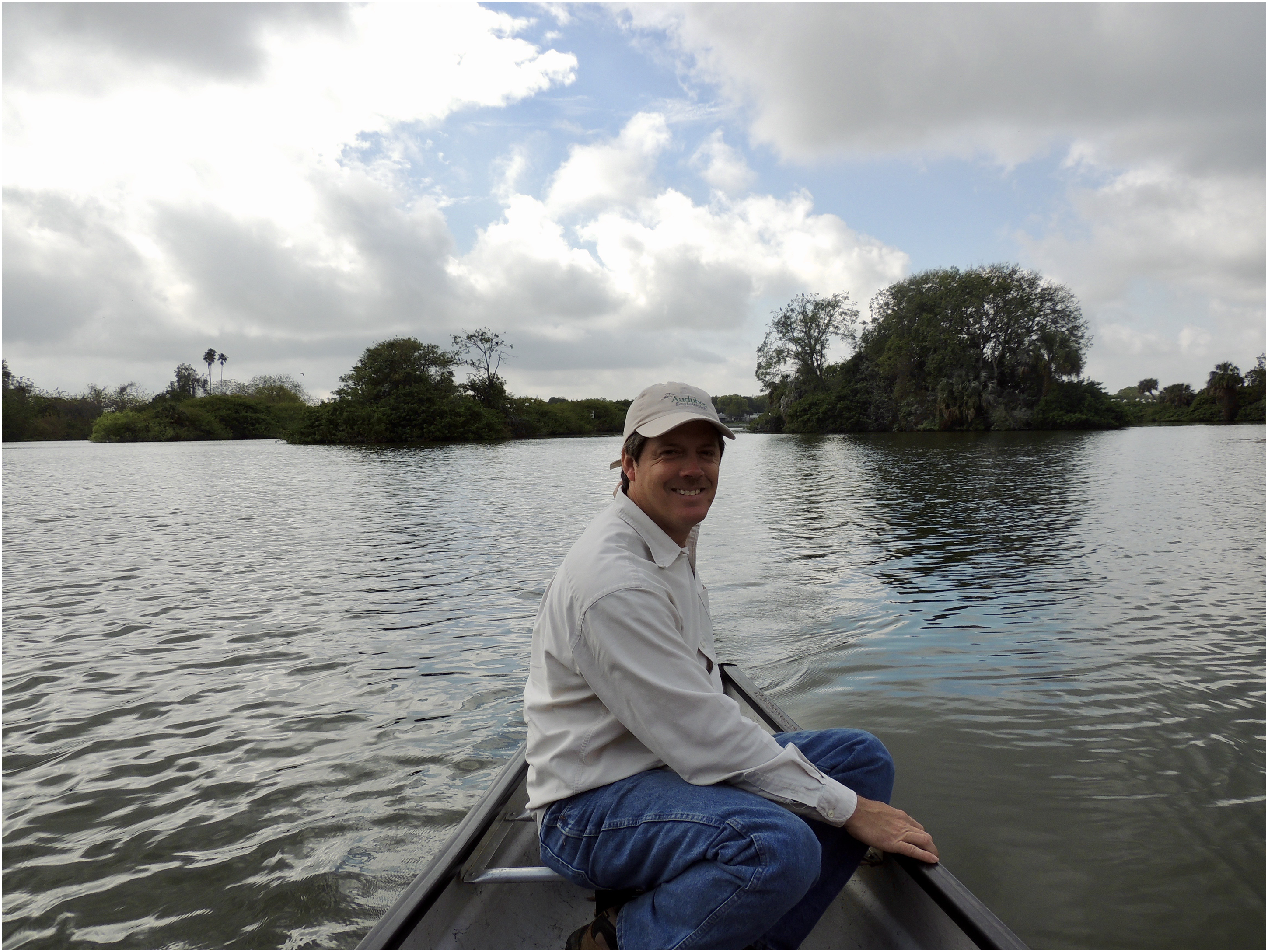
Reinier guiding our canoe tour of Lake Somerset. Photo by the author.
Highlights
The Holocene/Anthropocene boundary event, rather than the Anthropocene Epoch, is the most accurate characterization of the current planetary situation. The transition is enacted through colonial-capitalist invasions of Holocene ecologies. These invasions fundamentally alter the biophysical structure of nichespace and inscribe themselves in landscape form. The wood stork rookery at Lake Somerset in Central Florida provides a vivid case of a place-specific Holocene/Anthropocene transition. Holocene/Anthropocene transitions can be understood ethnographically and historically by examining landscapes as palimpsests.
Footnotes
Acknowledgements
I thank the generosity of colleagues from the University of South Florida, Yale Agrarian Studies, Centre for Environmental Humanities at Aarhus University, and the 4A Lab (Kunsthistorisches Institut in Florenz) for feedback on talk versions of the article. Micha Rahder helped me organize this complex story. A special thanks to Reinier Munguia for his time and instruction. The article is written as part of the ANTHEA project (Anthropogenic Heathlands: The Social Organization of Super- Resilient Past Human Ecosystems), which has received funding from the European Research Council (ERC) under the European Union's Horizon 2020 research and innovation program (grant agreement 853356).
Funding
The author disclosed receipt of the following financial support for the research, authorship, and/or publication of this article: This work was supported by the Horizon 2020 Framework Programme, (grant number 853356).
