




Abstract
The wind has profound cultural and economic value and plays an increasingly important role in today's economic system. Despite this, wind remains under-conceptualised as a resource in accounts of energy transition. This paper traces the resourcification of wind in the context of energy transition in the Republic of Ireland, analysing how the material properties of wind resources interact with the social property relations governing their integration into the economy. It does so by tracing the economic practices which ascribe value to the wind and integrate it into the system of commodity production, namely assetization by landowners in the form of rent payments. This is a key, and often overlooked, first step which precedes the conversion of wind resources into an electricity commodity by project developers. This assetization is composed of two moments: Firstly, the wind is treated as de facto private property through ‘proxy wind rights’ for landowners. Secondly, struggles over surplus value appropriation and distribution occur between landowners, developers and local communities. The outcomes of these two moments of wind assetization are unpacked. The paper concludes by discussing the implications for the relationship between agency and forms of rent, as well as the ‘world-making’ potential of concepts like ‘wind rights’ for prefigurative politics in energy transitions.
Introduction
The replacement of fossil fuels with alternative, cleaner energy sources is at the core of global climate change mitigation efforts. Renewable resource flows such as wind or solar irradiation are expected to play a key role in powering decarbonized societies. This means shifting the material basis of Western civilization from one class of finite energy sources (fossil fuels including coal, oil and gas) to ephemeral and inexhaustible resources. It is estimated that annual global wind resource potential stands at 560 PWh onshore and 315 PWh offshore (Eurek et al., 2017). This is compared with world total final energy consumption which reached approximately 115 PWh in 2019 (IEA, 2021). Social science has mostly dealt with the materiality of renewable resources such as wind or solar cursorily or indirectly, for example through the lens of land use (Frantál et al., 2023; Obane et al., 2020). This is surprising since, as historical studies have shown, the stock-like materiality of fossil fuels profoundly influenced the development of fundamental social institutions such as capitalism and democracy (Malm, 2016; Mitchell, 2023). The presumed implication of this is that the flow-like materiality of renewables will set important conditions for social and political action in a decarbonized society (Mitchell, 2023).
This clearly overlaps with plentiful research on energy system decarbonization, including work on energy democracy, energy justice and community energy (Baxter et al., 2020; Creamer et al., 2018; Ramasar et al., 2022; Szulecki, 2018), all of which address questions of power and the uptake of renewable energy. However, there is a tendency among all of these literatures to foreground the generating technology or electricity produced in their material framing, rather than the materiality of the underlying resources. For example, while community energy initiatives might represent more democratic or equitable organizational forms for renewable energy development than commercial developers, the question of how the resource itself is valued, measured and incorporated into the production process remains underexamined. This misses a key step in the process of how resources are integrated into the economy and society. By making an ontological shift towards resource materiality, this opens up new angles and also strategies for action. For example, by targeting ownership and access to renewable energy resources through legislation or litigation. As important loci of power, these resources could be harnessed to assist in wider struggles around energy, land or other systems of provision. Indeed, the ownership and property rights relating to fossil energy resources have been the focus of many social and political conflicts (Bina, 2006a; Slevin, 2016).
However, and perhaps due to their ephemeral materiality, wind resources have generally not been subject to the same debates and contestations around ownership. Indeed, it is generally assumed that wind resources cannot be owned, and therefore remain open access or public property. However, recent scholarship has begun to draw attention to the fact that wind resources are in fact subject to property relations, specifically by landowners in the case of onshore wind (Hughes, 2021; Sonnberger et al., 2024b; Traldi, 2021; Wade and Ellis, 2022), and the state in the case of offshore (Groupp, 2024). This paper traces how wind resources and their material properties interact with these social regimes of property in the Republic of Ireland. It argues that a property-based analysis does not go far enough in itself, and instead needs to show how these property relations fit and function in the system of wind energy production. To do this, the economic categories of rent and assetization are useful conceptual tools which strengthen the analysis in two ways: Firstly, by pointing to some of the structural effects of exclusive wind ownership in terms of the production process. Secondly, by opening up wind ownership to a moral critique rather than a mere distributional one (Sayer, 2023).
The question guiding this research is: “How do the material properties of wind interact with property rights in wind, and what implications does this have for the system of wind energy production in Ireland?”. Section 2 reviews relevant literature and theoretical perspectives for conceptualizing the wind as a resource. It proposes Marxist rent theory as a suitable lens through which to understand how natural resources such as wind come to be used by society. Section 3 describes the methods used to investigate this question. Section 4 presents the analysis, showing that wind is made into a private asset through these interactions. Section 5 discusses these findings in light of the theoretical literature, drawing out implications of the findings.
Literature review and theory
Materiality of wind
How can we conceive of the wind as a resource? Institutional economics classifications of excludability and subtractability (Buchanan, 1965; Ostrom, 2015; Samuelson, 1954) have been criticised for mistaking “institutionally contingent’’ conditions for intrinsic material properties (Helfrich, 2012; Rayamajhee and Paniagua, 2021: 3). A more multidimensional and nuanced understanding of resource materiality is needed, one that actively grapples with the interactions between material properties and social conditions, without affording dominance to one or the other (Balmaceda, 2018; Balmaceda et al., 2019; Gailing and Moss, 2016; Svensson, 2021): “energy resources have certain inherent properties that enable and condition, although does not determine, what kind of societies are possible’’ (Svensson, 2021: 8).
Wind has three relevant material properties 1 : low power density, temporal variability, and flow-like state: Firstly, wind energy has extensive spatial requirements relative to other energy sources - or a low power density (Scheidel and Sorman, 2012; van Zalk and Behrens, 2018). This implies that energy transitions generate new spatial relations, particularly around the role of land and landownership, or potentially opening possibilities for more localised and democratic forms of ownership (Bridge and Gailing, 2020). Another important material property of wind is its natural temporal variability occurring at numerous timescales (Ciupăgeanu et al., 2019; Jung et al., 2019; Ward et al., 2023; Watson, 2014). This means that balancing or demand management are required to ensure supply matches demand. Finally, at a more local level, the flow-like nature of wind resources can lead to wake effects 2 between turbines which can create coordination problems for turbine siting within and between windfarms (Howland et al., 2022; Kaffine and Worley, 2010; Lundquist et al., 2018; Stieren and Stevens, 2022). It therefore becomes possible for ‘wind theft’ to occur, whereby an upwind project can steal the wind of a downwind neighbour (Diamond and Crivella, 2011; Van Der Horst and Vermeylen, 2010). We will see how each of these material properties, low power density, temporal variability, and flow-like state, interacts with social practices and property relations in the following sections.
Resourcification of wind
Resourcification literature draws on the insight that resources do not just exist but must be socially constructed (Hultman et al., 2021). This requires “infrastructures, logics, temporalities, and valuation systems” (Valdivia et al., 2022a: 1), often mediated through the state, for an object to be successfully turned into a useable resource. In turn, resourcification itself affects society and political economy (Valdivia et al., 2022b). For example, resourcification is central to territorialization and state-making (Bridge, 2014; Lund, 2016; Sikor and Lund, 2009) or as symbol formation for nation-building (Huber, 2019). From this perspective, wind can be seen as a new resource frontier requiring both resource-making, but indeed also implicated in ‘world-making’ (Rasmussen and Lund, 2018; Valdivia et al., 2022a). Crucial to all of these processes is the role of property (Blomley, 2019; Huber, 2019; Lund, 2016; Sikor and Lund, 2009). Furthermore, the process of resourcification is at least partially conditioned by the physical materiality of resources (Valdivia et al., 2022a).
In her study of UK North Sea wind energy, Groupp (2024) shows how wind is being transformed into a resource through cartographic representations (including by private companies) and new laws (e.g., Energy Act, 2004): “to effectively extend volumetric sovereignty over the entire offshore space, above and below the water, in ways that have not been imaginable before” (Groupp, 2024: 16). What Groupp calls ventographic mapping practices “work to ground what are inherently transboundary atmospheric phenomena to specific locations, thereby naturalizing them as a part of evolving visions of territory” (Groupp, 2024: 2). Based on its pre-existing property rights to the seabed and subsoil, the Crown Estate claims offshore wind resources as property which it can lease to corporate developers (Groupp, 2024). Similarly, when it comes to onshore wind, actors with pre-existing legal claims or rights to adjacent resources are effectively able to grab control of wind resources. In this case, however, in most instances it is landowners (in their various forms) who assume control over access to wind, rather than the state (or Crown Estate) (Hughes, 2021; Traldi, 2021; Wade and Ellis, 2022). This, combined with the low power density of wind, leads to a landrush for wind resources (Kirkegaard et al., 2023; Pfeiffer and Sonnberger, 2025). Again, the construction of territorial sovereignty can be deeply implicated here, for example with respect to indigenous claims to land (Chandrashekeran, 2021; O’Neill et al., 2021). Wind resources can become sites for indigenous claims (such as veto rights and free, prior and informed consent) to territorial and volumetric sovereignty in similar ways to how states make territorial claims through offshore wind resourcification.
From both offshore and onshore, we can see that property is critical to the resourcification of wind (Groupp, 2024; Sonnberger et al., 2024b). Legally speaking, wind resource ownership is often obscure or undetermined–a “quasi-fictitious commons” (Sonnberger et al., 2024b: 11). Noting that landowners act as if they do own the wind, legal scholars in the US argue that rights to severable wind estates are created when landowners sign wind leases (Alexander, 2011; Chavarria, 2008; Hartman, 2009; Marshall, 2018; Montgomery, 2019), some arguing that these should be formalized in de jure legislation (Alexander, 2011; Boyd, 2015; Montgomery, 2019). These are property-based solutions to issues of international wind theft (e.g., in the North Sea) (Groupp, 2024; Van Der Horst and Vermeylen, 2010) or wind theft between landowners (Rule, 2012, 2014), both deriving from the flow-like materiality of the resource. In most cases, however, wind ownership remains obscure or undetermined from a strictly legal perspective. In such situations, frequently those with pre-existing rights will grab the resources (Chen and Cui, 2013; Lai, 2023), with states controlling offshore wind resources (Groupp, 2024) and landowners onshore (Hughes, 2021; Traldi, 2021)–a situation Wade and Ellis (2022) refer to as ‘proxy wind rights’. It should also be noted that the opposite also holds true: “While there may be formal laws defining property rights, they may not become relevant in the performance of particular practices because they are deliberately ignored or have even been forgotten” (Sonnberger et al., 2024b: 4).
What we can conclude from the above is that the de jure legal situation does not tell the entire story and it is necessary to understand the actual social practices and material relations, including the wider constellation of properties and actors needed to valorise wind resources (Sonnberger et al., 2024b). Because it emphasises the social relations of production over the legal regimes, Marxist materialist analysis is well suited to this task. The Marxian concept of assetization enables use to trace resourcification leading to valorization in the form of rent (Birch and Muniesa, 2020; Birch and Ward, 2022; Huber, 2022). Furthermore, Marxian rent theory embeds this processual apparatus in a more structural account of the economy, helping us to understand the position of landowners/wind owners regardless of their legal entitlement.
Assetization of wind
Marxist materialist analysis distinguishes between nature's ‘free gifts’, labour power, and the means of production (technologies) in its theory of value. This ontological foundation informs the rest of the Marxian class-based analytical framework: “Capital–profit (profit of enterprise plus interest), land–ground-rent, labour–wages, this is the trinity formula which comprises all the secrets of the social production process” (Marx, 1991: 953). Each of these revenue streams correspond to a specific social position vis-à-vis the production of value within capitalism. Therefore, at its core, Marx's theory conceptualizes natural resources as ontologically distinct. It theorises how nature is viewed, valued, worked upon and integrated into the economy through the social relations of production and is therefore ripe for a resource-centric approach. It indicates how nature interacts with the production process most fundamentally by mixing with labour, which is coordinated by capital, which in turn is mediated by landed property. It can therefore also assist in diagnosing the fundamental causes for the current destruction of nature (Saito, 2017).
Particularly useful here is the concept of rent. For Marx, all rent is ultimately derived from monopoly control: “Wherever natural forces can be monopolised and guarantee a surplus-profit to the industrial capitalist using them, be it waterfalls, rich mines, waters teeming with fish, or a favourably located building site, there the person who by virtue of title to a portion of the globe has become the proprietor of these natural objects will wrest this surplus-profit from functioning capital in the form of rent” (Marx, 1991: 908). Rent that is based on monopoly control can be termed absolute rent (AR) or monopoly rent (MR). 3 In addition, landowners located in advantageous locations (e.g., due to soil fertility, closer to urban centres, more productive wind resources) can collect higher rents than those in worse locations. These rents based on locational advantage are called differential rents (DR). Marxist scholars have applied rent theory to a variety of natural resources in the past including fisheries, oil, coal, mining and minerals (Bina, 1992, 2006b; Campling and Havice, 2014; Capps, 2012, 2016; Fine, 1990, 1994).
Landed property and rent perform a useful coordinating function within capitalism by allocating land and natural resources to capitalists (Harvey, 2018). By charging higher differential rents for more valuable locations/resources, landed property appropriates any excess value that would otherwise accrue to fortuitous capitalists, thus keeping inter-capitalist competition in check. However, whether this positive coordinating function operates properly depends on various conditions, not least the balance of power between landed property and capital. Rent also played a coordinating role in the British coal industry, generating problems ultimately contributing to nationalization (Fine, 1990). The division of landed property parcels and underlying coal seams led to coordination issues for the British coal industry which hampered its development in the 19th and early 20th centuries. This, Fine (1990) argues, was due to the incongruence of surface landownership rights and the natural dimensions of subsurface coal seams to which those landowners held rights. As coalmines covered many land parcels, every landowner could then stake a claim for increased rent from each attempt at mechanisation on any single parcel, which would enable deepening of the mines. This cumulative pressure ultimately inhibited the development of the industry as mechanisation was disincentivised (Fine, 1985). Marxist categories of landed property and rent are therefore well suited for an analysis which integrates the materiality of natural resources into accounts of the production process. Recent literature on rentiership and assetization tries to explicitly connect a Marxian perspective with more social constructivist theories from STS (Birch and Ward, 2022; Purcell, 2024). These studies emphasize the agency and processes required in the construction of assets, which are understood as playing an increasingly important role in capitalism today (Christophers, 2020). Rent-bearing assets range from natural resources and land to intellectual property and digital platforms.
These concepts can be usefully applied to wind resources. Landowners whose land is suitable for production from these energy sources can, in most places, block renewable energy development on their land. This veto power allows them to extract a tribute in the form of rent from developers. Chandrashekeran argues that rents claimed by indigenous groups in Australia “can create value for historically marginalised and formerly dispossessed Indigenous communities” (2021: 379). Alonso Serna uses the concept of value grabbing to examine struggles over property and rent in the Isthmus of Tehuantepec in Oaxaca, Mexico, between landowners, indigenous populations and developers (Alonso Serna, 2020, 2022). In their study of French renewables projects, Nadaï and Cointe claim that “the resource (sun, wind) remained res communis” (Nadaï and Cointe, 2020: 162). However, they apply an STS perspective to explore how “sunlit rooftops and windy sites are turned into energy assets” (Nadaï and Cointe, 2020: 149). In particular, this paper draws on the work of Andreucci et al. (2017) on ‘value grabbing’, in which they provide a political ecological understanding of rent. This can be used interchangeably with the more recently popular term ‘assetization’, which is used here. They identify two analytically distinct moments in the creation of assets: “(a) the creation of property rights that establish rent relations and (b) the struggle over the appropriation and distribution of surplus value generated by the rent relation itself’’ (Andreucci et al., 2017: 28). In the Case Analysis to follow, these two analytical moments of assetization (creation of property rights and struggles over the appropriation and distribution of value) will be deployed and conceptually interwoven with the three material properties of wind resources outlined above in order to answer the research question (see Figure 1 below).
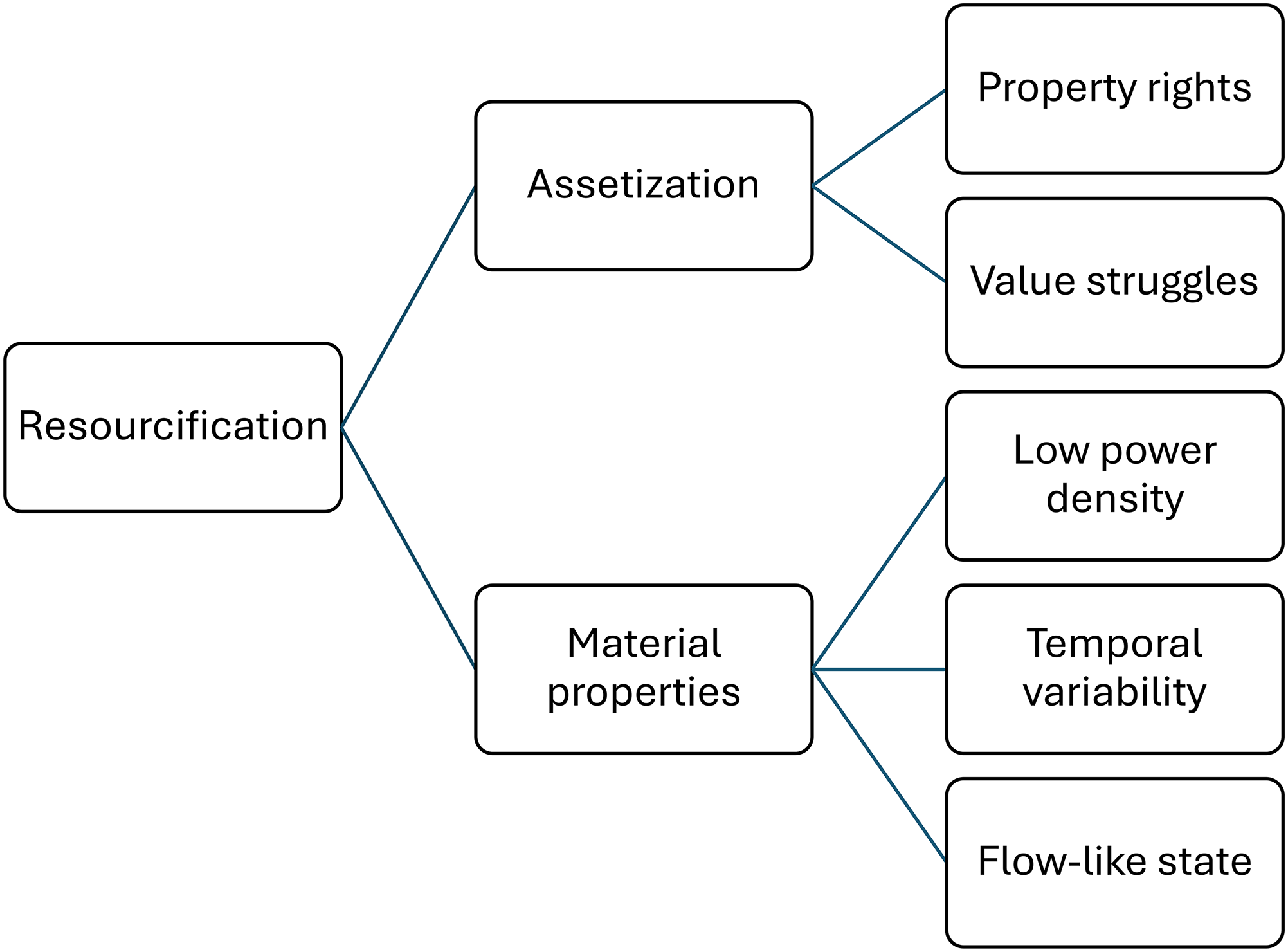
Conceptual structure.
Method
The question guiding this research is: How do the material properties of wind interact with property rights in wind, and what implications does this have for the system of wind energy production in Ireland?
The primary method adopted was semi-structured interviews. Overall, 26 interviews were conducted through the period September 2020 to April 2022. The participants included wind energy developers (7), policymakers/civil servants (3), spatial planners (2), grid operators and experts (2), community energy developers and lobbyists (3), semi-state landowners (2), farmers and farmer lobby organisations (3), land agents (1), environmental NGOs (1), community engagement consultants (1) and academics (1). Interviewees were identified through a mixture of personal and academic networks, as well as internet searches for relevant stakeholders, reaching out to them via phone or email. The author also engaged with the Socialist Lawyers’ Association of Ireland on the legal status of wind ownership in Ireland.
In-depth, semi-structured interviews provide a space where the researcher can interrogate the positions, motives and actions of interviewees, digging beneath the surface appearance to understand causal mechanisms (Brönnimann, 2021; Porpora, 2016). They are particularly useful for providing a level of structure to the dialogue while also allowing new themes and topics to emerge (Wilson, 2014). While the research question guiding this paper enquires about the material properties of wind resources, the way these resources interact with social property regimes was largely interpreted from the answers, rather than asked directly. In some instances, interviewees were asked about who they think should own or benefit from wind resources. Others were also asked about wake effects and their implications. Overall though, questions were less about seeking introspective reflections and feelings of events, and more about trying to uncover the underlying motivations for actors’ positions and actions (Brönnimann, 2021). Supplementary questions helped to guide more detailed inquiry and the questions posed to each participant varied depending on their specific circumstances and knowledge. Interviews were recorded using various softwares including Microsoft Teams and Zoom, as well as with a dictaphone for in-person interviews. Most interviews were conducted online due to the COVID-19 pandemic. Transcripts were produced both manually and using Otter.ai. Transcripts were then cleaned and anonymised before analysis. The qualitative data was coded and analysed using NVIVO coding software.
A selection of relevant concepts and themes was derived deductively from the literature review and theory. These concepts provided the basis for the coding categories. However, this was not used in a rigid manner, and the research was open to new data and codes which did not fit. The relations between the categories were open to change, and therefore retroduction, or inference to best explanation, best describes this logic (Danermark et al., 2002). Following initial coding, causal relations were then drawn (as per Figure 2 below) between the different code categories of conditions, interactions and outcomes (often termed axial coding in grounded theory methodologies) (Vollstedt and Rezat, 2019). While the interview data were used to inform the conceptual model more generally, specific quotes from interviews are also used for illustrative purposes in the presentation of the case studies in the next section.
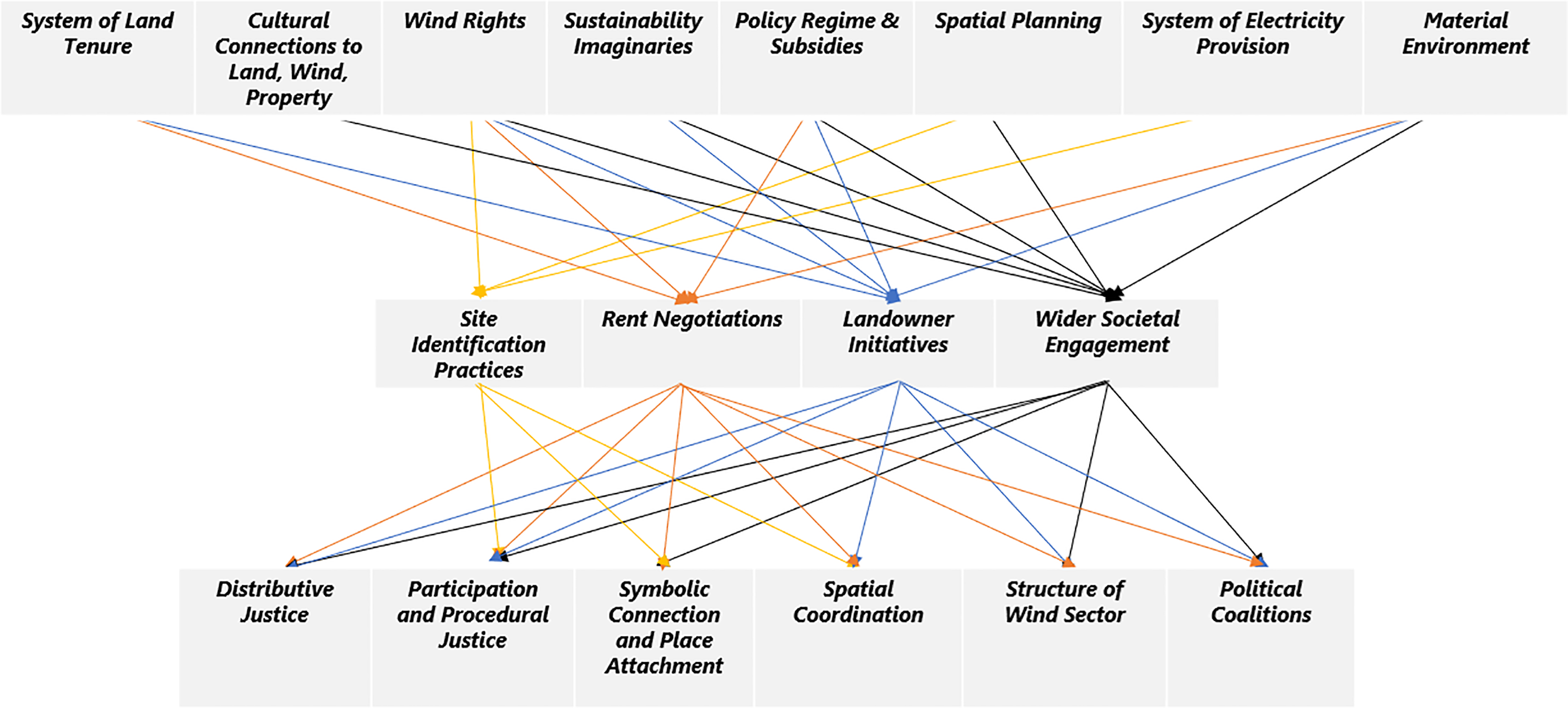
Schematic map tracing causal processes between conditions, interactions and outcomes. Categories in this model were used for coding.
Case analysis: wind resource assetization in the republic of Ireland
This analysis section traces how the abovementioned material properties of wind resources interact with the assetization processes of wind energy in the Republic of Ireland. It begins by providing some short background context on the agrarian structure and political economy of landownership in Ireland.
The largest landowner on the island of Ireland is the semi-state forestry body, Coillte (1,102,000 acres; 6.3% of total land), followed by the Catholic Church (148,000–296,000 acres; 1% - 2%) and the semi-state peat board, Bord na Móna (200,000 acres; 1.4%) (Cahill, 2021: 425). Ireland is characterised by a relatively equally distributed system of medium to large-sized, owner-occupied family farms (Cahill, 2001, 2021; Eurostat, 2017; Piet, 2020). Regionally speaking, the northern and western regions are dominated by small and less profitable holdings; predominantly beef and sheep farming (CSO, 2022). The southern and eastern regions are characterised by generally better soil quality and larger, higher-income holdings, with more dairy and tillage (CSO, 2022; DAFM, 2021; Guiomar et al., 2018). Ireland has an abnormally low level of rented agricultural land compared with the rest of Europe, standing at around 19% (Altes and de Wolff, 2020), linked to historical process of land reform in Ireland both leading up to and after independence (1890s-1930s) (Cahill, 2001). Another interesting landownership structure in Ireland are commonages (land held in common by multiple owners). These commonages tend to be marginal uplands where multiple farmers graze sheep as a supplementary income source to their primary farming activities, and are more heavily concentrated in the west (Van Rensburg et al., 2009). The Irish Farmers’ Assocation (IFA) is the dominant farming lobby group in the country but several smaller groups represent specific interests such as the Irish Cattle and Sheep Farmers’ Association (ICSA) and the Irish Natura and Hill Farmers’ Association (INHFA).
Access to wind resources is first and foremost controlled by landowners by virtue of their land rights. Harnessing this control, landowners can demand payment for access to wind resources. This relationship between landowners and developers usually materializes in the form of land lease contracts and options agreements. It is through these contracts that wind resources are ascribed a value and exchanged in return for rent. 4
In most cases, the identification and selection of suitable sites for wind energy is developer-led: “We tend to use GIS maps and Eircode postal locators to scan parts of the country and we see an area that's just a bit elevated and potentially suitable. First of all, you check the county development plan to see if it's in an open consideration or green area. And then you have a look at it in terms of its suitability, land use, no NATURA sites - really high level stuff that would be an instant ‘no’. And then after that we have a land agent, we look on the PRAI, the property registration authority's website, and we pick out the folio details and buy those. That shows you what the landowners names are, and their addresses. And generally we cold call if we don't know anybody in the area.” (Interviewee #19 - project developer)
Once a suitable area is found, developers generally identify private landowners through the Property Registry Authority of Ireland (PRAI) records and cold-call them, initiating the rental negotiation process. The important position of landowners based on their property rights enables them to enter into a rental negotiation: “Landowners are absolutely key to any project. The project begins and ends with the landowner. So we put them up on a pedestal. They’re absolutely pivotal to our business.” (Interviewee #18 – project developer)
The creation of exclusive property rights in wind
A key prerequisite to enable wind rent relations to form is the establishment of property rights in the resource (Andreucci et al., 2017). How can ownership of wind be considered in the Irish context?
The ownership of airspace or air is legally unclear in Ireland. The Irish legal system is based on British common law (Newman and Thornley, 1996). UK common law dismisses the ad coelum doctrine and instead emphasises that although landowners do not have “ownership rights over all the airspace above their property, their rights did extend to such height as was necessary for the ordinary use and enjoyment of the land and the structures on it” (O'Sullivan, 2016: 2). Irish law reflects this common law precedent. Section 55 of the 1936 Air Navigation and Transport Act states that “No action shall lie in respect of trespass or in respect of nuisance, by reason only of the flight of aircraft over any property at a height above the ground, which, having regard to wind, weather and all the circumstances of the case is reasonable, or the ordinary incidents of the flight” (Government of Ireland, 1936). More recent cases seem to acknowledge the “interest of landowners in the lower altitude airspace above their property”, however little legal clarification has been given on this (O'Sullivan, 2016: 2). Most recently, “recognition of landowner's interests in some share of the airspace over private property was implicitly acknowledged in the Land and Conveyancing Law Reform Act 2009. ‘Land’ is defined in the 2009 Act as including: ‘the airspace above the surface of land or above any building or structure on land which is capable of being or was previously occupied by a building or structure and any part of such airspace, whether the division is made horizontally, vertically or in any other way’” (O'Sullivan, 2016: 2). This above definition in the 2009 Act would therefore seem to acknowledge wind rights for landowners for wind turbines (as structures).
However, there is also a legal basis for natural resources like wind or air as belonging to the state, absent a proprietor. Article 10 of the Constitution of Ireland (1937) states that “All natural resources, including the air and all forms of potential energy, within the jurisdiction of the Parliament and Government established by this Constitution and all royalties and franchises within that jurisdiction belong to the State subject to all estates and interests therein for the time being lawfully vested in any person or body” and that “Provision may be made by law for the management of the property which belongs to the State by virtue of this Article and for the control of the alienation, whether temporary or permanent, of that property”. The scope of Article 10 was described as “striking” by Chief Justice O’Donnell: “[T]he subject matter of the Article is itself far-reaching. “Natural resources” necessarily include the air, and forms of potential energy and therefore extended to matters which were conceivably not understood in 1937 as natural resources, or capable of exploitation’’ (Barlow v. Minister for Agriculture, 2016: 63). Furthermore, “the capacity for example to exploit the power of waves or the wind would I think be readily understood to be included within Article 10, notwithstanding the fact that no one can claim ownership in the water or the air, and that the waves which wash the shore and the wind which blows over land and sea cannot be said to be territorially limited in any way. The capacity to extract from the waters or the air energy for commercial purposes falls easily within the concept of both Constitutions and would also readily be understood as within the broader terms of the Irish text – ábhar maoine nádúrtha – a source of natural wealth’’ (Barlow v. Minister for Agriculture, 2016: 65). This quote illustrates the links between the construction of natural resources and state or nation-making in the Republic of Ireland. It also seems to suggest that the state is the legal owner of air/wind resources.
In de jure terms, it is therefore legally unclear whether wind (as air or airspace) should be considered the property of the state or the landowner. As landowners step into this legal void and engage in de facto wind ownership practices by virtue of their land rights, this situation can be best characterised as ‘proxy wind rights’ for landowners (Wade and Ellis, 2022). The establishment of exclusive proxy wind rights are the first moment in the assetization of wind resources. This moment, when mixed with the material properties of wind resources described above, has various implications for how the wind is interpreted, conceived, and managed. These implications relate to procedural conflicts, local siting issues, and grid integration issues.
Procedural conflicts due to exclusive property rights
Landowners occupy an exclusive position due to their veto power and wind rights, whereas wider communities are generally relegated in the participation ladder. The interactions of other actors such as communities or civil society tend to be reactive, with landowners and developers in negotiation long before other actors can participate in the process. This means that ‘lower-order’ siting decisions (such as contextual social and environmental values) are resultantly left largely in the hands of landowners and developers, with very little meaningful procedural participation of wider impacted communities (González et al., 2016):
“In terms of the five steps in the [site identification and rent negotiation] process you outlined at the start, at what stages does the project become known to the wider community?
Never, or not in that process. And that's certainly the intention. We would often find ourselves reverting to, well, this is a confidential agreement. This is private. And if you’re here in a group meeting, we’ve invited you. There's not a community meeting until much later in the process. No, it's still early in the overall process. And it's as early as possible. But it's also as early as is appropriate. I guess, typically, if developers called a community meeting about a windfarm the first question will be: how many turbines, where, what size? And you just don’t have all those questions. You don’t have the answers to them.” (Interviewee #5 – land agent) “One of the facets of renewable energy is that because you’re harvesting over a much wider area than is typical for a fossil fuel resource, it's actually more democratic. You do have to engage with and arrive at a compromise with a lot more people to implement projects than would be typical for fossil fuel projects.” (Interviewee #1 – civil servant) “Well, at the end of the day, whoever owns the land which the windmill is on and the infrastructure associated goes through, I think, should have a fairly major role to play in it. Because they’re the custodians of the landscape. They’re there, and they’re gonna be there for generations.” (Interviewee #12 – farmer lobby organisation) “And the poor landowner stuck in between. Because the landowner is potentially community, but very quickly is part of the developer's team. Especially the way it's done in Ireland where they are asked not to say anything, and they’re essentially bought out. Bought out and told to shut up.” (Interviewee #11 – community engagement consultant) “Nine out of ten would would be interested in hearing us out. You know, obviously, there's a commercial element to it and they want to know what it is.” (Interviewee #5 – land agent)
Local siting issues due to wind resource fragmentation
The combination of private, exclusive wind rights mixed with the material flow-like state of wind resources means that access to the wind resource is locally fragmented. The need to negotiate separate lease agreements with multiple landowners can add both time and costs to projects. Furthermore, uncooperativeness of certain landowners can lead to suboptimal siting arrangements at the local level in terms of wind resource use, for example due to wake effect interactions caused by its flow-like materiality. Based on interviews with developers in Ireland, these challenges are acknowledged but are not perceived to be a major impediment to the industry: “The land fragmentation and landownership fragmentation is a big issue. So if we see a site that has four or five different landowners that need to be acquired, it's one turbine or two turbines. And we’ll put a bit of effort in, but if we’re hitting roadblocks, we just move on.” (Interviewee #6 – project developer) “I would say when it goes above 10 landowners, and unless you speak to commonage landowners collectively, it doesn’t really work because it only takes one commonage landlord to say I don’t like it and then everyone walks away.” (Interviewee #19 – project developer) “It's a big advantage, because I think it gives you the ability to look at multiple sites and to screen what you have and to pick out sites that are best suited to wind development. As opposed to just picking sites because you’ve got the land.” (Interviewee #7 – semi-state landowner)
Struggles over surplus value
The second moment in assetization refers to struggles over surplus value appropriation and distribution. For wind resources, this largely takes legal form in land rental contracts. The rental negotiation process generally comes in two phases: the options agreement and the land lease contract. Developers first attempt to sign options agreements with landowners in a potential project area. These agreements essentially bind landowners to a given developer in the event that a project will be given a green light. In return, landowners are usually paid an annual option fee. During this option period, a number of pre-feasibility studies are conducted. Wind measurement masts are erected, environmental studies are conducted and, if site conditions are found suitable for a business case, planning permission is sought from the local authority: “Typically, you get paid 2000–3000 for signing the option agreement, and then it might be 1000 Euro annually to keep it valid.” (Interviewee #9 – project developer)
Land lease agreements reflect the balance of power in the class conflict between landowners and developers. While individual landowners are generally not collectively organised with regard to wind energy, in 2013 the Irish Farmers’ Association (IFA) negotiated changes to wind energy contracts on behalf of farmers: “These changes set a new bar for the wind industry. 5% of energy price each year is now achievable, payments of over €6000/MW are also achievable” (IFA, 2013). While the IFA negotiated these terms in 2013, at the time of this research (2019–2022), the rent level was still reported in interviews to be around this rate of €6000–8000/MW; 3–5% of gross revenues; €2 per MW/h. With standard turbine sizes of 3–3.5 MW today, interviewees reported current average rental values of around €20,000-€30,000 per turbine per year. Pricing structures vary, with some based on a flat rate per turbine or capacity (MW) while others are based on production (usually a % of gross revenues), depending on the situation. These figures are broadly corroborated by Companies Registration Office (CRO) report data obtained by the author.
Generally, interviewees stated that landowner rents were inflating. However, many felt that this was in tandem with growth in turbine size. There was therefore a perception among some that rent per MW was broadly consistent over time. Some interviewees felt that scarcity of and competition for land was a driving factor behind increasing rent values: “But it's everything: it's signing on fees, it's annual option fees, and then the returns you can expect to get if the windfarm goes ahead, all of that is inflating because of the strength of demand for lands.” (Interviewee #19 – project developer) “I can see there being a correction. I mean, I’m certainly giving that message to my team that this is a competitive process. And if we want to be competitive, we can’t be paying 4.5% rent.” (Interviewee #6 – project developer) “We have had conversations with large energy companies who are looking at who may be in the business. But generally the Irish Wind Energy Association, we have asked to meet them but unfortunately, they do seem to be of the opinion that they would like the market to drive the terms.” (Interviewee #21 – farmer lobby organisation)
Struggles over the share of this surplus value centres on two main axes of class conflict: struggles between landowners/developers and local residents; and struggles between landowners and developers.
Local community tensions over surplus value extraction
Wind rents are a source of intra-class conflict and sense of distributive injustice. Firstly, between landowners: “Issues arise within communities between landowners. We would have seen that whereby people are pissed off that you got two on your land, and I got none.” (Interviewee #4 – project developer) “I suppose that can be divisive in that the landowner is getting the benefit of the turbine, yet the population in the area is being impacted upon… So I suppose there could be almost a community rift may be some way of describing it in terms of who owns or who's actually benefiting from it.” (Interviewee #24 – local authority planner)
Distributive struggles leading to monopolistic conditions
Since developers require permission from landowners to site their turbines, they generally enter into land lease agreement with them, as described above. It is through this mechanism that scarcity is created as increasingly more sites are tied up under such agreements (Kirkegaard et al., 2023). In Ireland, there is indeed a sense among many of land scarcity and competition for land among developers: “I think our land will be signed up within the next two years. For the traditional developer, excluding Coillte or Bord na Móna or anyone who's dealing with Coillte or Bord na Móna on joint ventures. I think that's the reality of it. I have some sites that I will be on with two, three other developers. We all use the same parameters. It's not rocket science.” (Interviewee #20 - project developer/landowner)
As discussed above, landowners are generally quite passive when it comes to the site identification and assetization process. This means that those developers who are quicker or more aggressive at identifying sites and signing options agreements with landowners can monopolise suitable sites. Since there is only a finite (and increasingly scarce) number of such sites, these developers can then benefit from superior (or simply available) wind resources even if they do not outperform their competitors. These inefficiencies ultimately pass on to consumers. This spatial coordination is a fine balance which depends on the power relations and processes of class conflict between landowners and developers.
Grid integration issues due to incomplete assetization
The development of large-scale, decentralised wind energy is predicated upon the ability of projects to connect to an electricity grid. This requires long-term, joint-up strategic development of grids in harmony with wind energy (and other renewables). Irish transmission system operator, Eirgrid, describes the current grid development system in Ireland as ‘developer-led’, with grid developments essentially reacting to the private agreements between wind energy developers and landowners (Eirgrid, 2021). The widespread unbundling of generation from distribution, transmission and retail, combined with processes of marketization and privatization in the energy sector in recent decades, has led to a system in which developers are incentivized to seek optimal wind resources in order to improve their competitiveness (Christophers, 2024). This has the effect of making viable wind resources scarce in the eyes of potential developers who are therefore incentivized to seek locations with the best wind resources. The systemically functional role of landowners in capitalism is to appropriate some of the surplus value from capitalists, to keep competitive forces in balance, as discussed above. This should mean that those windy areas are not exceedingly profitable for developers. Despite this, developers continue to locate in such areas despite policy attempts to internalize the price of distance from the grid, including the need for developers to cover ‘shallow’ grid connection costs.
Nonetheless, this system is still open to lock-in or snowball effects once a connection is offered in one location, initiating a clustering of projects around there. Or, developers of large projects may take the initiative and develop in a windy area with poor grid connection, willing to take the time and financial cost, gambling that Eirgrid will bolster deep connections down the line (e.g., for windfarm extensions or repowering). Especially looking forward to 2030, given the increasing scarcity of viable wind resources, the business case for siting projects in areas far away from existing grid capacity may be improving, and clustering/snowball effects could occur once a developer first settles there. Fundamentally, coordination happens in a reactive and isolated way, without long-term, strategic guidance of grid development. The developer-led system therefore produces sub-optimal outcomes in terms of spatial coordination between renewable energy infrastructure and the grid. For this reason, Eirgrid's recent ‘Shaping Our Electricity Future’ consultation indicated that the existing, reactive, developer-led approach might be insufficient to meet 2030 renewables generation targets: “EirGrid must connect new sources of renewable electricity, regardless of the local strength of the grid. If this approach continues, we forecast that developers can build enough generation to meet the demands of the 2030 target. However, our studies show that it will not be possible to expand the grid in time for Ireland to use all of this power” (Eirgrid, 2021: 15): “We know all the windy areas in Ireland and Northern Ireland are the north and the west and the coastal areas. And that's where the transmission network in both countries is the weakest. It's traditionally stronger in the big cities, Belfast and Dublin, and that's over towards the east. Whereas in those remote areas in the west and northwest, there's not a lot of capacity. And yet, that's where all the renewable generation wants to go. So in this developer-led approach, you saw a huge amount of potential reinforcements required compared to some of the other approaches.” (Interviewee #26 – grid operator)
Concluding discussion
The processes described in the above analysis shed light on numerous ongoing debates in literature on, renewables, rent and assetization.
Bringing class into renewable energy infrastructure conflicts
Much critical social science and political ecology literature on renewables has drawn attention to the importance of land politics for renewable energy development (Knuth et al., 2022). This paper follows Alonso Serna (2020, 2022) in analysing communities along class lines, between landed property and non-landowning community members. This research corroborates previous findings that landowner rents can create conflicts and exacerbate existing inequalities along these class divisions (Baxter et al., 2013; Brannstrom et al., 2015; Walker et al., 2014). This is made worse by secretive practices of ‘private participation’ (Groth and Vogt, 2014; Jacquet, 2015; Kirkegaard et al., 2023). The primarily owner-occupier farmers studied here treated the land according to a financial logic (Harvey, 2018). This should not simply be described as greed or selfishness, however. A crucial factor here is the financial positions of landowners/farmers and indebtedness (Thorne et al., 2015). This economic relationship speaks to the importance of understanding the interrelations between financialisation and rent (Harvey, 2018; Swyngedouw and Ward, 2022).
This research has also pointed to the often neglected issue of the relationships between landowners and project developers as one being mediated by tension and class conflict. Some work in the field of social acceptance tries to understand landowner motivations for opposition/acceptance of wind energy projects (Chewinski et al., 2023; Jacquet, 2012; Mills et al., 2019; Parkins et al., 2022). However, supposedly ‘voluntary’ land deals can take on a coercive character. Even when landowners have relatively stable land rights, they may be pressured via other practices or circumstances, ranging from direct threats to debt burdens, to give up their land (Dunlap, 2021; Simón et al., 2019). Traldi (2021) specifically links these ideas to the concept of rent in her study of Brazilian land leases. She argues that the low levels of rent, right to renew leases and the exclusion of landowners from the leased lands amounts to a case of ‘accumulation by dispossession’. In contrast, Alonso Serna finds that Mexican “landholders organised to exert pressure on wind companies” and negotiated for rent increases through easement payments, for example (Alonso Serna, 2020: 208). She recognises that this “does not obliterate the structural inequality with energy developers, but it does show landlords’ agency” (Alonso Serna, 2020: 208). Landowners in the Irish case are somewhere in between. They are not completely powerless and they can and do still reject project proposals at times. Some landowners also develop smaller projects on their own lands themselves. While Irish landowners and farmers are relatively well organised in terms of agricultural policy (e.g., the IFA), they are rather atomistic and unorganised with respect to wind resources, thereby reducing their bargaining power. This not only has distributive effects but also implications for the spatial-economic coordination of production (e.g., fragmentation, monopolization of sites by developers, and grid integration issues). Therefore, the class politics of land differ between wind resources and other sectoral resources such as agriculture.
Varieties of wind rent and the role of agency
The relative passivity and disorganization of landowners in this case raises the question of how, if at all, they can still capture value. It is possible to dig further into the distributive value dimensions of the class conflict between landed property and capital using the tools provided by Marx's rent theory. Despite their lack of agency, landowners in this case do still have a veto right to prevent access to the resource, and do still bargain with developers over lease agreements. The rent they earn is well above mere compensation for lost value. There is therefore seemingly at least some monopoly or ‘absolute rent’ (AR), in Marxian terminology, being extracted by landowners (Marx, 1991). For Marx, rent is defined by “palpable and complete passiveness of the owner, whose sole activity consists (especially in mines) in exploiting the progress of social development, toward which he contributes nothing and for which he risks nothing, unlike the industrial capitalist’’ (Marx, 1991: 908). This research depicts a similarly inactive rentier class who nonetheless still extract rent. Only in the case of a complete loss of agency where landowners no longer have the position of being able to veto access and extract rent would we say they no longer play a material role in the system of production, and therefore cannot be considered rentiers.
We have seen how developers are forced to seek the best wind resources due to inter-capitalist competition. However, the scarcity of sites held by landed property can lead to a reduction in competition once the sites are transferred to capitalists in land lease agreements. This is because certain capitalists can then monopolise windy sites if they sign contracts first, thus protecting them from competition with other developers who might use that resource more efficiently. Furthermore, landowners do not seem to capture differential rents (DR) from those capitalists who locate in the most advantageous of these windy locations, with many accepting lease terms on a basic installed capacity basis set out by the IFA negotiations. This could also explain the stubbornness in project developers locating in remote but windy locations. In this sense, there might be some evidence for a “vertical displacement of the rent relation” from landowners to developers in the form of DR and potentially some AR/MR (Fine, 1994). This could be related to the lack of agency or active valuation practices by landowners. All of these practices are led by developers, as elsewhere in Europe (Kirkegaard et al., 2023). This likely means that landowners simply do not know or fully realise the value of their resource and are willing to accept the base lease terms which only allow for capturing of absolute rent, while developers appropriate some of the differential and monopoly rents. These considerations open up new lines of enquiry for interesting future research questions such as: What resourcification/assetization practices (including mapping, valuation, wind rights) are connected to what varieties of rent, and in what ways? Answering this could help clarify the sometimes blurred distinction between valuation and value (Purcell, 2024).
Wind or site assetization?
Assetization litetature has been applied to wind energy development by other authors including Alonso Serna (2020, 2022) and Nadaï and Cointe (2020). These authors remain terrestrial in focus, arguing that essentially sites (or projects/ generation technologies) are being assetized, rather than the wind itself. However, the present study argues that what is in fact being assetized is not just the site, but indeed the wind. In doing so, this paper follows Hughes (2021), Traldi (2021) and Wade and Ellis (2022). From the perspective of Marxist rent theory, it does not necessarily matter whether the wind or the site is being assetized once we describe and analyse the same social processes of assetization and rent extraction. Nonetheless, there are two reasons why it might be preferrable to refer to the wind. Firstly, even if wind as a resource is not ascribed clear legal ownership, there is still the possibility that it could be in the future. This opens up a new horizon of strategies for legislative or litigative action to socialise ownership and control of wind resources (Hughes, 2020). For example, this could assist energy cooperatives in gaining access to these resources or support local control and use of resources through smart grids and energy sharing (Wade and Rudolph, 2024; Wolsink, 2024). In other words, the ‘world-making’ potential of wind is greater than of sites (Valdivia et al., 2022a). Since wind resources are oftentimes legally open access and their governance is not yet solidified in practice, this strategic option is arguably easier than pursuing land reform more broadly (Hughes, 2021).
Secondly, if we just focus on sites, then does this limit our ability to analyse the materiality of wind and its implications? The issues of power density, temporal variability and wake effects have interesting social implications which need to be drawn out. When all we discuss (as is common in practice) are ‘sites’, then the resource itself gets forgotten. Indeed, wind's relative invisibility is already a problem in our ‘non-knowledge’ of wake effects (Sonnberger et al., 2024a). For these reasons, it is fruitful to think about wind assetization. Academic discourse therefore has a performative role to play in the resourcification of wind. Focussing on sites contributes to its ‘de-resourcification’ (Hultman et al., 2021), precluding possibilities for both resource-making and world-making which are opened up by ‘wind rights’ discourses (Boyd, 2015; Chavarria, 2008; Diamond, 2016; Kaffine and Worley, 2010; Rule, 2012; Van Der Horst and Vermeylen, 2010; Vermeylen, 2010).
Highlights
Traces the resourcification of wind and the role of ‘wind rights’ in this process Onshore wind resources are assetized through connection to land and landownership Private and fragmented ownership of wind resources leads to distributional conflicts as well as structural implications for the spatial coordination of production Assetization processes influence the formation of rent relations Conceptualising the wind as a resource subject to property rights opens up interesting strategic opportunities for prefigurative politics
Footnotes
Acknowledgements
The author would like to thank the Socialist Lawyers Association of Ireland for legal advice on ownership of wind resources in Ireland. The author would also like to thank Monika Bucha for feedback and discussions on the ideas in this paper.
Consent to participate
Interview participants signed informed consent forms. One of the interviewees did not sign the consent form. After several emails requesting a signature without response, a final email was sent stating that consent would be assumed if an answer was not received by a certain date. No answer was received so consent was assumed. The author is confident that the participant was fully aware of the reasons for the research and the potential use of their data. Furthermore, the author is confident that the interviewee is not a vulnerable participant.
Data availability
Qualitative interview data cannot be made available to protect participants’ anonymity, but they can be made available upon request in anonymised form by the corresponding author.
Ethical considerations
This research received ethical approval from the Queen's University Belfast's Faculty of Engineering and Physical Sciences Ethics Committee before any data collection proceeded. This entailed detailing precisely what data gathering, processing and storage procedures were intended. Amendments to the ethical approval were then made for subsequent changes to the data gathering plan.
Funding
The author disclosed receipt of the following financial support for the research, authorship, and/or publication of this article: This work was supported by the Horizon 2020 Framework Programme (grant number 813837) and European Research Council (grant number 101044076).
